
1 HOW TO WRITE A CASE COMMENT The



![23 “The whole area of law is a mess, and [suggest an alternative approach].](https://slidetodoc.com/presentation_image_h/75d551e0fb42f04b3093e9f2e70a29b1/image-23.jpg "23 “The whole area of law is a mess, and [suggest an alternative approach].")







- Slides: 48
1 HOW TO WRITE A CASE COMMENT The Tax Lawyer American Criminal Law Review Georgetown Journal of International Law
2 Introductions • The Tax Lawyer • Peter Diaz, ped 35@georgetown. edu • American Criminal Law Review • Ryan Shymansky, rss 68@georgetown. edu • Georgetown Journal of International Law • Suhaib Khan, sjk 130@georgetown. edu
3 What we will cover today: • What is Write On? • Reading the Packet & Packet Procedures • Crafting a Case Comment • Formal Requirements • Timeline & Resources • Q&A
4 What Is Write On? • Write On is the only way to get on a journal • It will run from May 18 th to May 31 st • In order to participate, you must purchase a Write On packet online • You can purchase a packet on the Write On website beginning on or about May 11 th • The packet contains: 1. Case comment 2. Bluebook test 3. Optional personal statement or resume • These requirements vary depending on the journal
5 Transfer Students • There is a separate, but very similar write on competition for transfer students • The competition will include a case comment, Bluebook test, and optional personal statements/resume • It is still mandatory for transfer students to complete the competition • The 2018 Write On Transfer Competition is mandatory for all incoming students seeking membership on law journal • The Transfer Student Write On Competition is schedule to take place May 25 th – July 12 th
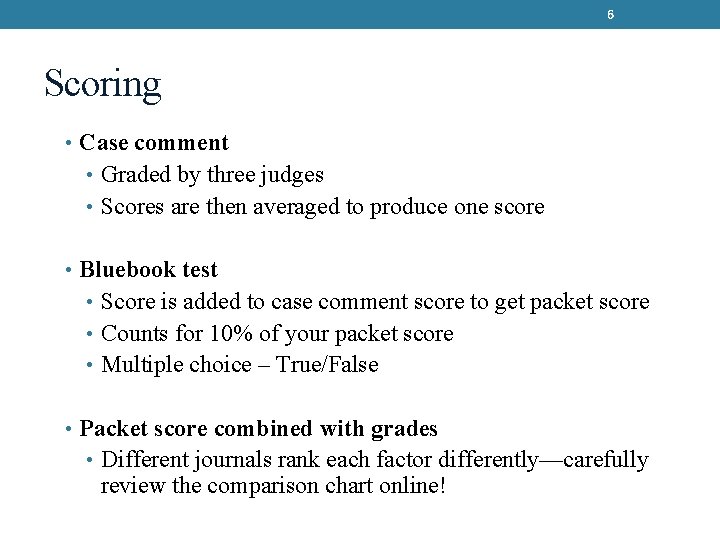
6 Scoring • Case comment • Graded by three judges • Scores are then averaged to produce one score • Bluebook test • Score is added to case comment score to get packet score • Counts for 10% of your packet score • Multiple choice – True/False • Packet score combined with grades • Different journals rank each factor differently—carefully review the comparison chart online!
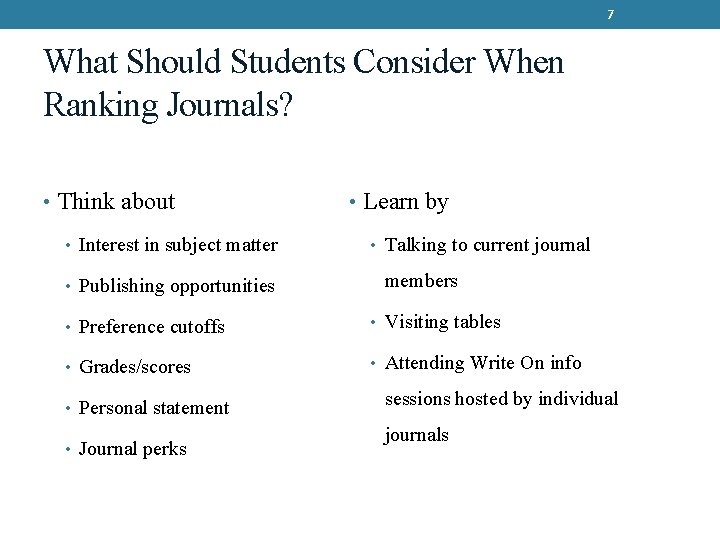
7 What Should Students Consider When Ranking Journals? • Think about • Interest in subject matter • Publishing opportunities • Learn by • Talking to current journal members • Preference cutoffs • Visiting tables • Grades/scores • Attending Write On info • Personal statement • Journal perks sessions hosted by individual journals
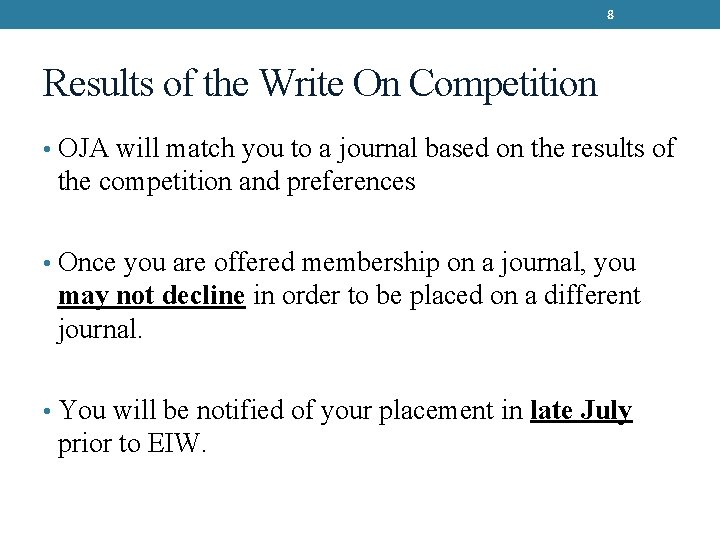
8 Results of the Write On Competition • OJA will match you to a journal based on the results of the competition and preferences • Once you are offered membership on a journal, you may not decline in order to be placed on a different journal. • You will be notified of your placement in late July prior to EIW.
9 READING THE PACKET & PACKET PROCEDURES
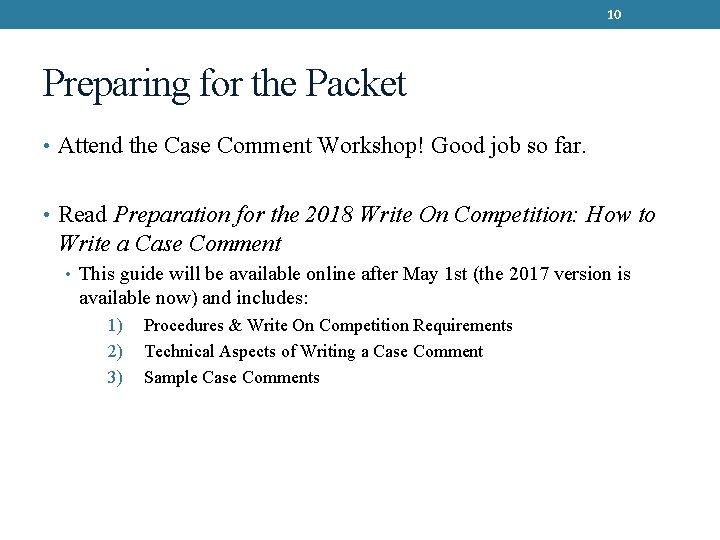
10 Preparing for the Packet • Attend the Case Comment Workshop! Good job so far. • Read Preparation for the 2018 Write On Competition: How to Write a Case Comment • This guide will be available online after May 1 st (the 2017 version is available now) and includes: 1) 2) 3) Procedures & Write On Competition Requirements Technical Aspects of Writing a Case Comment Sample Case Comments
11 Procedures • Packet Purchase & Availability • Purchase on or around May 11 th (online) (typically $40) • Competition: May 18 th – May 31 st • Preferencing open until mid-July • Turning in Submissions • Carefully read the Write On packet instructions • Upload the completed materials & supplemental materials to the competition website early • Write On Packet Contents • Main case that you will analyze • Other cases, secondary sources, etc. • You may use only the materials provided in the packet • Remember to complete and submit the Bluebook test!
12 Restrictions • You may use only the materials provided in the packet, a dictionary, legal dictionary, thesaurus, and your Bluebook. • You may not consult any additional materials during the competition. • You are NOT allowed to do any outside research. • You may not discuss and/or receive any assistance from anyone during the competition. • Do not contact current journal members or editors for help. Contact OJA directly.
13 CRAFTING YOUR CASE COMMENT
14 What is a Case Comment? • A case comment is a short paper analyzing the decision in a particular case • For the purposes of Write On, the comment is generally limited to a maximum of seven pages of double-spaced text and three pages of singlespaced endnotes (but make sure you check the packet for specifics). • Should provide your own original analysis of the case, such as: • The case was decided incorrectly. • The court is correct, but for the wrong reasons. • The court missed the point. • The whole area of law is a mess, and you have a better approach. • The court is correct. • Some creative, dynamic idea of your own.
15 Packet Materials • Packet contains: • The principal case on which you are to comment • Maybe a lower court decision in the principal case • Cases that bear on the principal case • Maybe statutes and legislative history • Maybe law review articles • Maybe newspaper, magazine, or other periodical articles
16 Reading the Packet • Things to keep in mind as you read: • Do not confuse a lower court case with the case that you are supposed to be analyzing. The other cases are included only to give you a basis for your comment on the principal case. • You do not need to cite to every source in the packet. Your thesis will determine what you cite; some of the sources might be superfluous. • Nevertheless, remember that the sources are there for a reason. A dearth of sources in your comment will be noted, so do your best to provide a detailed analysis.
17 Reading the Packet • Read the packet as early as possible. • You can probably read everything in a day, but do what works best for you. • Take notes to stay organized. • Read the principal case first, then decide how you want to read the packet: • Chronologically • Makes the most intuitive sense, so you can get an idea of the development of the law. • In order of importance • Also makes sense, but you will not have a very good idea of the order of importance until you read a few cases. • Order in which the cases are given to you • Takes less thought.
18 Choose Your Approach • After reading, decide what your case comment will argue. • The following slides provide examples.
19 “The case was decided incorrectly because…” • Most common approach • Demonstrate why the court’s analysis is wrong • Must be careful not to mimic the dissent
20 “The court is correct, but for the wrong reasons. ” • Demonstrate that the court applied the wrong reasoning and explain why this was the wrong approach • Must be careful to distinguish your reasoning from the court’s reasoning
21 “The court missed the point. ” • Analyze a different issue in the case that you think the court missed • Make sure to incorporate the principal case and the other materials in the packet
22 “The court is correct. ” • Demonstrate that the court was 100% correct • Address the relevant counterarguments • Make sure not to simply repeat the court’s opinion • This can be tricky. It’s often easier to criticize than to agree.
23 “The whole area of law is a mess, and [suggest an alternative approach]. ” • Very ambitious approach • Use the principal case to suggest your own approach to the area of law • Make sure your approach is logical, yields consistent results, and has public policy support
24 Some creative, dynamic idea of your own • Also an ambitious approach • Use the case as a springboard for an original legal idea of your own • Make sure the materials in the packet support your idea
25 How To Craft a Thesis Statement • Choose your approach • Review the materials carefully • Get to the POINT! • A few examples • Remember the big picture
26 How to decide your thesis • As you read through the packet, did one view jump out at you? • What feels most natural to you? What has the most support in the packet? • Carefully noting and keeping track of your sources will help you with this. It may help to note which sources support each approach.
27 Get to the POINT • Your thesis statement should be clear and concise statement of your argument. • It is perfectly appropriate to use direct language, for example: • “This Comment argues that…” • Clarity and brevity pay practical dividends. A concise thesis: • Helps you focus on your argument • Organizes the document for the reader • Conserves space
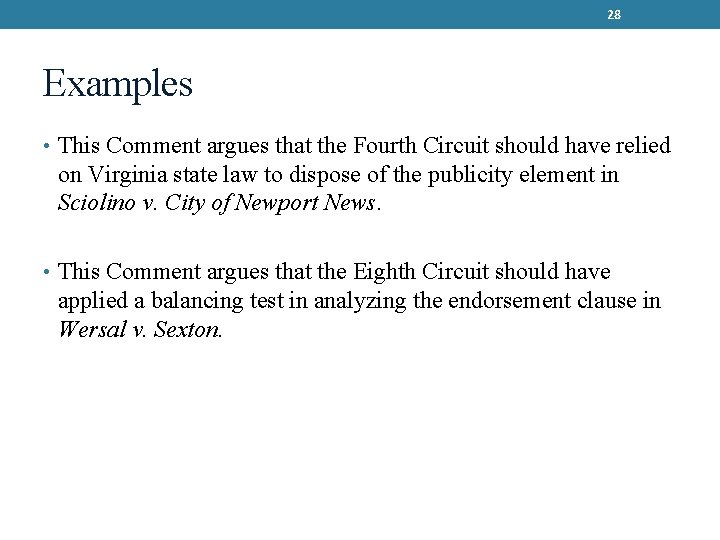
28 Examples • This Comment argues that the Fourth Circuit should have relied on Virginia state law to dispose of the publicity element in Sciolino v. City of Newport News. • This Comment argues that the Eighth Circuit should have applied a balancing test in analyzing the endorsement clause in Wersal v. Sexton.
29 Remember the BIG Picture • Make sure your thesis is streamlined and hones in on the key point of your argument. • Make sure your roadmap and the rest of your case comment provide the information supporting your thesis.
30 FORMAL REQUIREMENTS
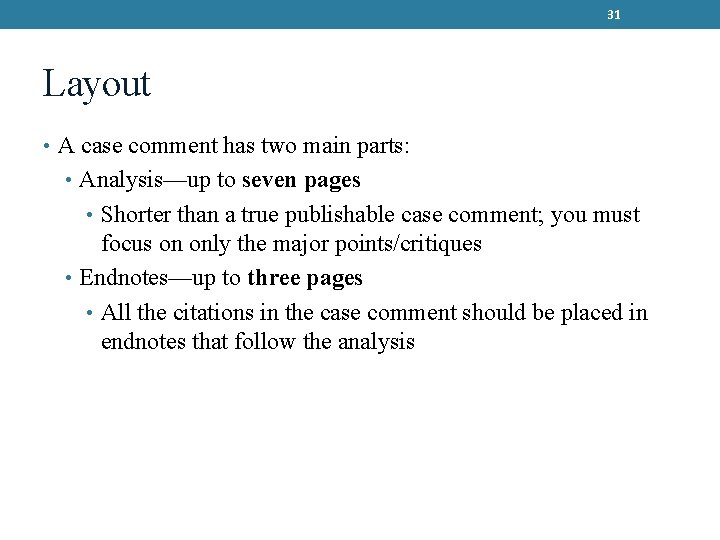
31 Layout • A case comment has two main parts: • Analysis—up to seven pages • Shorter than a true publishable case comment; you must focus on only the major points/critiques • Endnotes—up to three pages • All the citations in the case comment should be placed in endnotes that follow the analysis
32 Layout • Read the instructions in the packet carefully for specific formatting details (different for the two parts) • Times New Roman, 12 -point • 1 -inch margins • Double spaced comment • Single spaced endnotes, with one blank line in between each endnote • Title page that lists your case comment title, packet number, and exam number—does not count toward page limit • Submit in PDF if possible to retain formatting
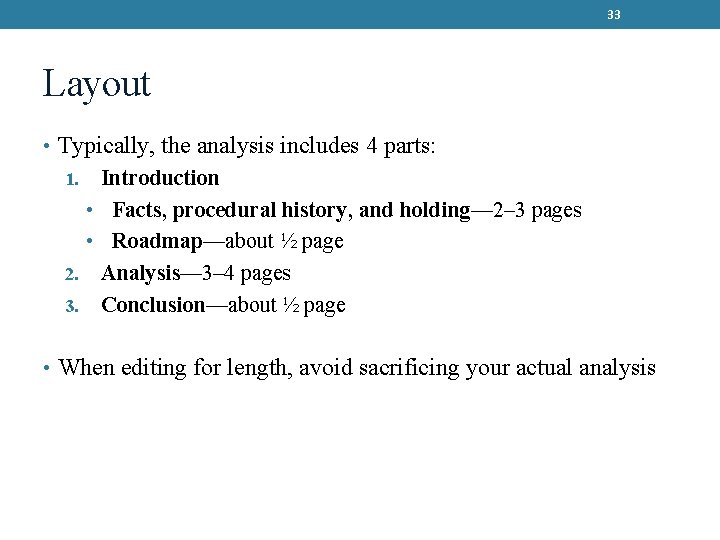
33 Layout • Typically, the analysis includes 4 parts: 1. • • 2. 3. Introduction Facts, procedural history, and holding— 2– 3 pages Roadmap—about ½ page Analysis— 3– 4 pages Conclusion—about ½ page • When editing for length, avoid sacrificing your actual analysis
34 Layout • All citations should be placed in endnotes • Read the instructions to make sure you format endnotes correctly • The three primary endnote functions: • Direct citation: when expressly referencing information found in the materials • Supportive citation: when stating a legal contention that is supported by information in the materials • Ancillary points: to provide the reader with analysis that is useful but tangential to your main points • Endnotes must be used when citing authority or when necessary to back up a proposition.
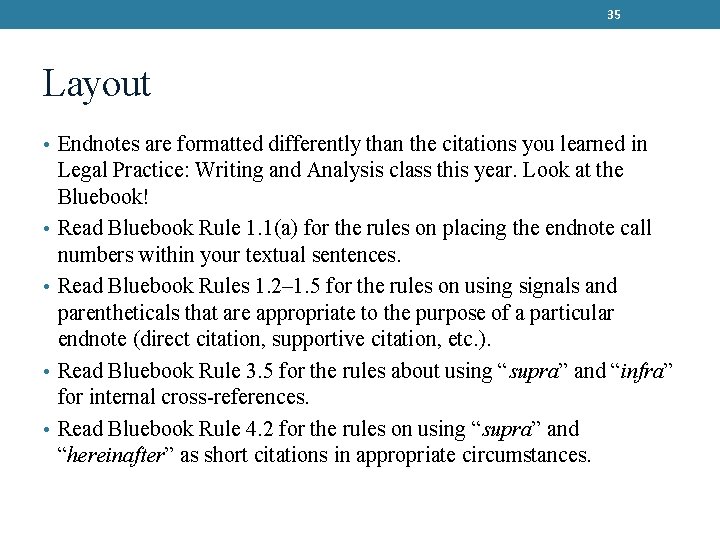
35 Layout • Endnotes are formatted differently than the citations you learned in • • Legal Practice: Writing and Analysis class this year. Look at the Bluebook! Read Bluebook Rule 1. 1(a) for the rules on placing the endnote call numbers within your textual sentences. Read Bluebook Rules 1. 2– 1. 5 for the rules on using signals and parentheticals that are appropriate to the purpose of a particular endnote (direct citation, supportive citation, etc. ). Read Bluebook Rule 3. 5 for the rules about using “supra” and “infra” for internal cross-references. Read Bluebook Rule 4. 2 for the rules on using “supra” and “hereinafter” as short citations in appropriate circumstances.
36 Structure • Introduction A. Statement of Facts, including Procedural History B. Holding C. Roadmap Ø The Statement of Facts and Holding can be switched, depending on whether the facts are more or less interesting/persuasive. • • Analysis Conclusion
37 Statement of Facts • 1 -2 pages • Relay any facts that are interesting and are essential to your argument, just like Legal Practice: Writing & Analysis. • Objective, academic tone
38 Holding • ½ - 1 page • Analogous to the “Statement of the Case” in a brief • Explain the court’s reasoning behind the outcome
39 Roadmap • ½ page • Provide the reader with your thesis statement • Lay out the different aspects of your argument, corresponding with your headings • Convince the reader why this issue is important and how your argument demonstrates the optimal outcome • Should be introduced with language like “This Comment will argue…”
40 Analysis • Constitutes the majority of your comment • Should be organized around headings and subheadings • Remember, you only have 7 pages, so keep it relevant and concise • Outlining is important!
41 What Makes an Effective Roadmap and Analysis? • Components of an Effective Roadmap • Explains why the issue is important, describes the discussion and states thesis. • Purpose is to inform the reader about what is coming so that the organization and relevance of subsequent material is understood. • Components of an Effective Analysis • Organization corresponds to roadmap • Analysis ties to thesis and argument using cases and secondary sources • Stays on topic and discusses only what is relevant to the analysis
42 Conclusion • ½ Page • Sum up the different prongs of your argument. • Mirror your roadmap! • Briefly restate the underlying reasoning for your argument and the outcome for which you are advocating.
43 TIMELINES & RESOURCES
44 Timeline: Non-working Students • Write On competition dates: May 18 th – May 31 st • That is 14 days, including two weekends! There is plenty of time to complete the competition on your own schedule. This is merely a guide. • Remember to budget time for the Bluebook Exam.
45 Timeline: Non-working Students • Many students find it helpful to do the Bluebook exam first. • If you want to jump right into the case comment, do it, but don’t forget to complete the exam! • Read as early as possible. • Some students like to brief each source as they proceed. • Others like to plow through with minimal notes to get the reading done. • Do what works best for your learning style, but make sure you’re reading with a goal in mind: to analyze the principal case. • Get a draft done as soon as possible. • Starting with an outline is helpful, as it keeps you focused and organized. • Once you get something substantive on paper, you’ll be able to locate the paper’s strengths and weaknesses. • Leave time to edit—you’ll need it! • Ideally, you’ll be able to step away from your comment for a day and come back to it with fresh eyes. Whatever you do, though, you’ll need substantial time to edit. • You don’t want to be working until the last minute to get under the page limit.
46 Timeline: Working Students • Try to get a few days of rest before Write On. • Finish reading the packet as early as possible, so you can develop your thesis and keep organized. • Set a schedule that works for you. Work methodically every night, setting aside a few hours for reading and writing. • According to OJA, Write On is designed to be completed in about six days. If you work diligently, you can space it out and get it done on time. • Ideally, reserve a couple of days at the end to review, edit, and proofread.
47 Other Resources • EUGENE VOLOKH, ACADEMIC LEGAL WRITING (3 d ed. 2007). • ELIZABETH FAJANS & MARY R. FALK, SCHOLARLY WRITING FOR LAW STUDENTS (3 d ed. 2005). • Remember, you cannot consult these resources or any other source after the Write On competition begins.
48 Questions? • Ask us anything! Remember you can’t talk to any current Journal members once Write On begins.