
1 How did the cotton gin change the



- Slides: 58
1. How did the cotton gin change the South? • • A) Cotton prices increased. B) Cost of growing cotton increased. C) It encouraged the South to grow more cotton. D) The South relied less on slaves.
Correct !! Next Question
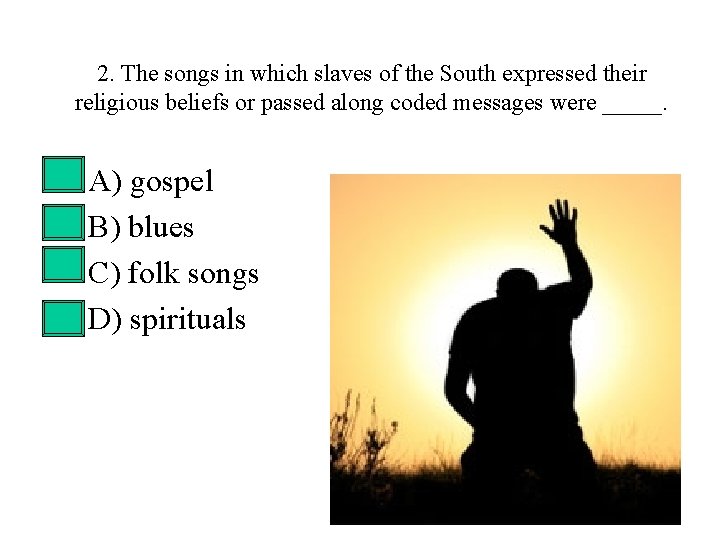
2. The songs in which slaves of the South expressed their religious beliefs or passed along coded messages were _____. • • A) gospel B) blues C) folk songs D) spirituals
Correct !! Next Question
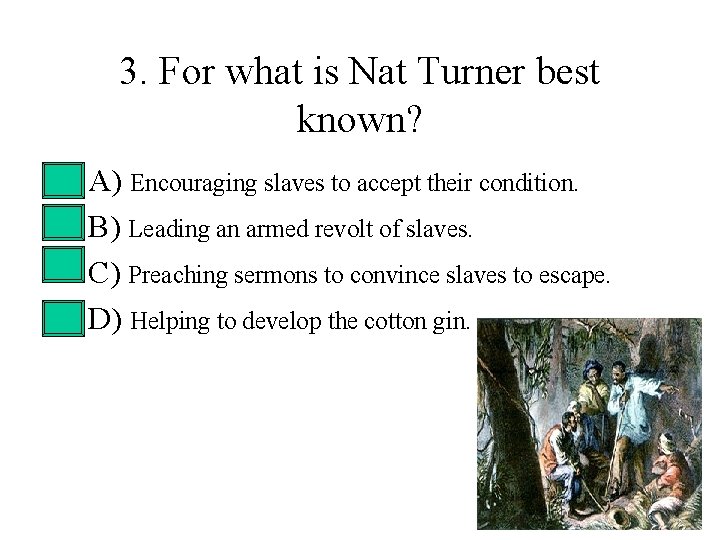
3. For what is Nat Turner best known? • • A) Encouraging slaves to accept their condition. B) Leading an armed revolt of slaves. C) Preaching sermons to convince slaves to escape. D) Helping to develop the cotton gin.
Correct !! Next Question
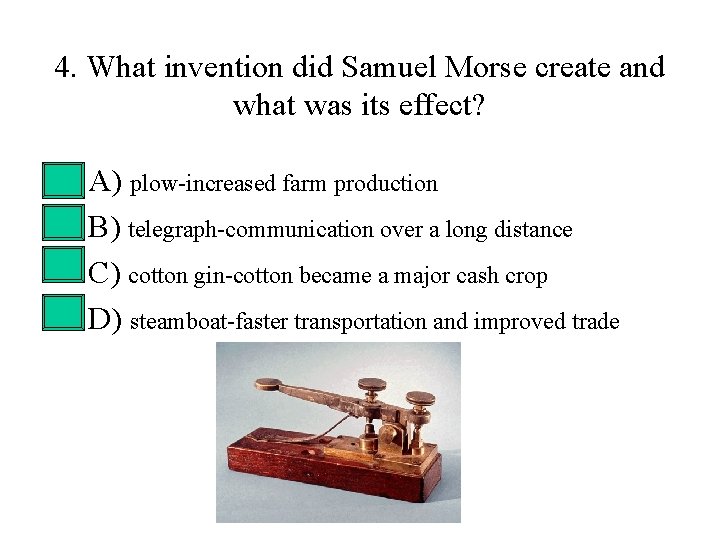
4. What invention did Samuel Morse create and what was its effect? • • A) plow-increased farm production B) telegraph-communication over a long distance C) cotton gin-cotton became a major cash crop D) steamboat-faster transportation and improved trade
Correct !! Next Question
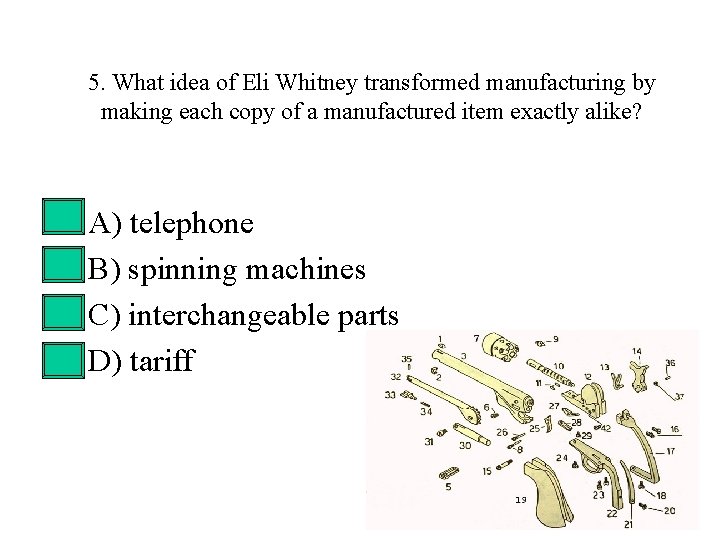
5. What idea of Eli Whitney transformed manufacturing by making each copy of a manufactured item exactly alike? • • A) telephone B) spinning machines C) interchangeable parts D) tariff
Correct !! Next Question
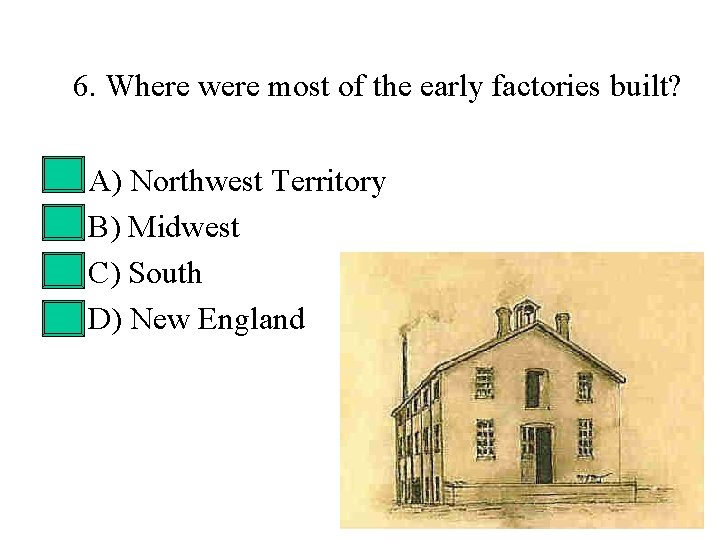
6. Where were most of the early factories built? • • A) Northwest Territory B) Midwest C) South D) New England
Correct !! Next Question
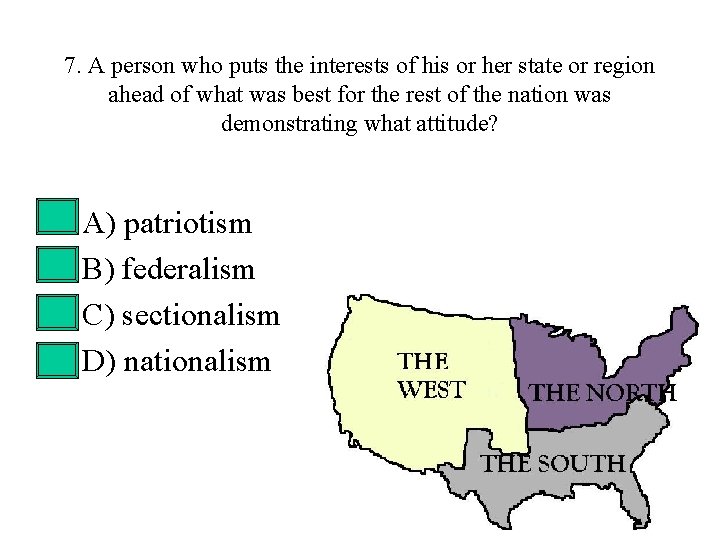
7. A person who puts the interests of his or her state or region ahead of what was best for the rest of the nation was demonstrating what attitude? • • A) patriotism B) federalism C) sectionalism D) nationalism
Correct !! Next Question
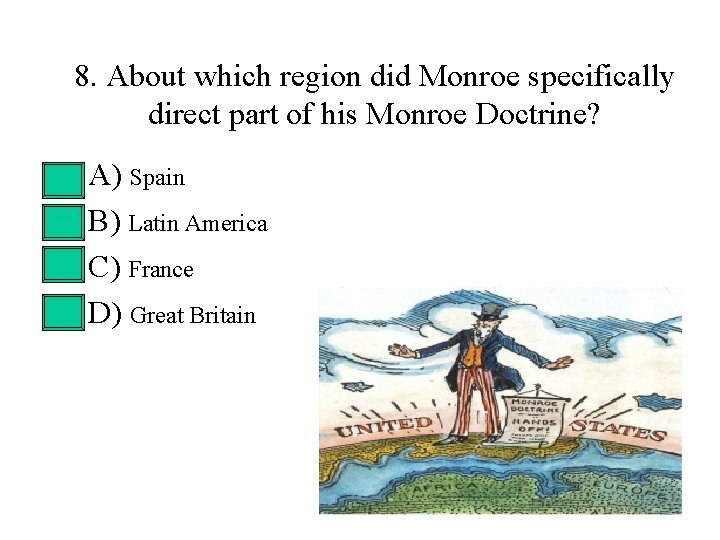
8. About which region did Monroe specifically direct part of his Monroe Doctrine? • • A) Spain B) Latin America C) France D) Great Britain
Correct !! Next Question
9. How did the improvements in transportation change life in the 1800’s? • • A) They encouraged national unity by linking distant places. B) They opened up larger markets for products. C) They made the movement of people & products cheaper. D) all are true
Correct !! Next Question
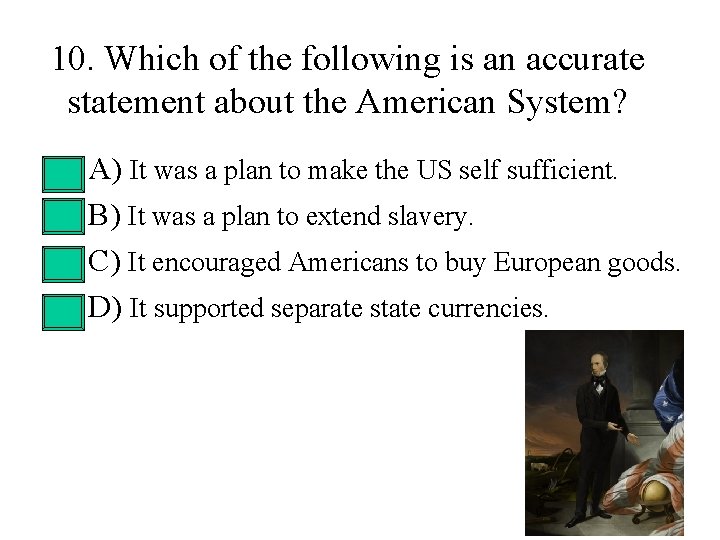
10. Which of the following is an accurate statement about the American System? • • A) It was a plan to make the US self sufficient. B) It was a plan to extend slavery. C) It encouraged Americans to buy European goods. D) It supported separate state currencies.
Correct !! Next Question
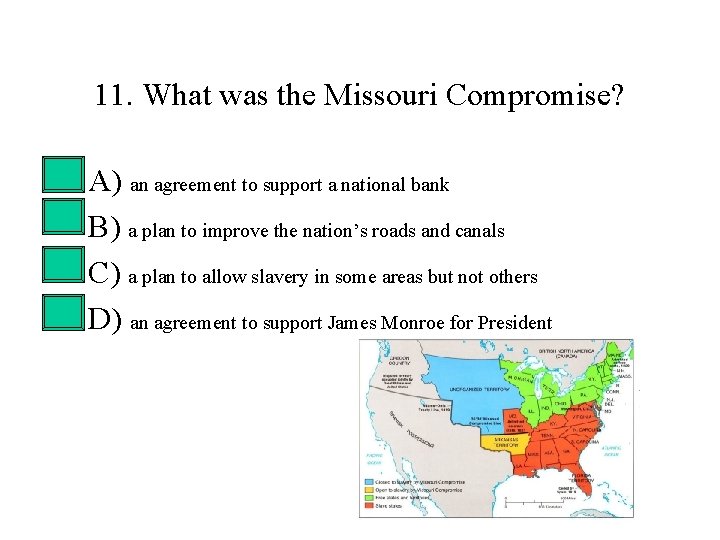
11. What was the Missouri Compromise? • • A) an agreement to support a national bank B) a plan to improve the nation’s roads and canals C) a plan to allow slavery in some areas but not others D) an agreement to support James Monroe for President
Correct !! Next Question
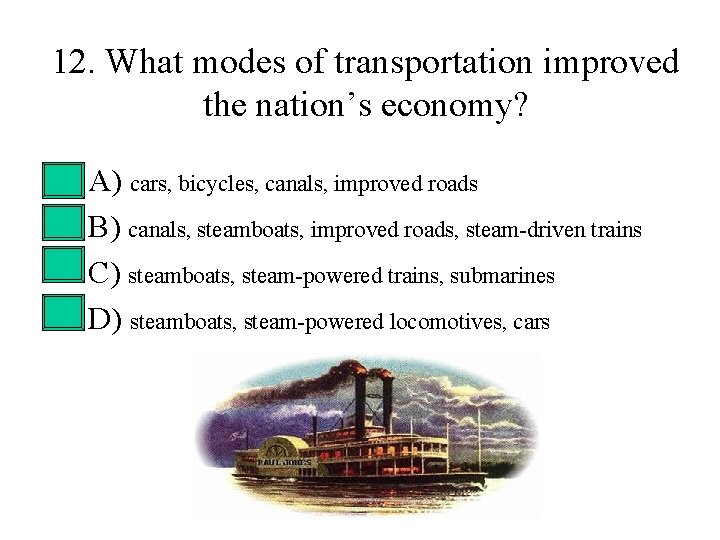
12. What modes of transportation improved the nation’s economy? • • A) cars, bicycles, canals, improved roads B) canals, steamboats, improved roads, steam-driven trains C) steamboats, steam-powered trains, submarines D) steamboats, steam-powered locomotives, cars
Correct !! Next Question
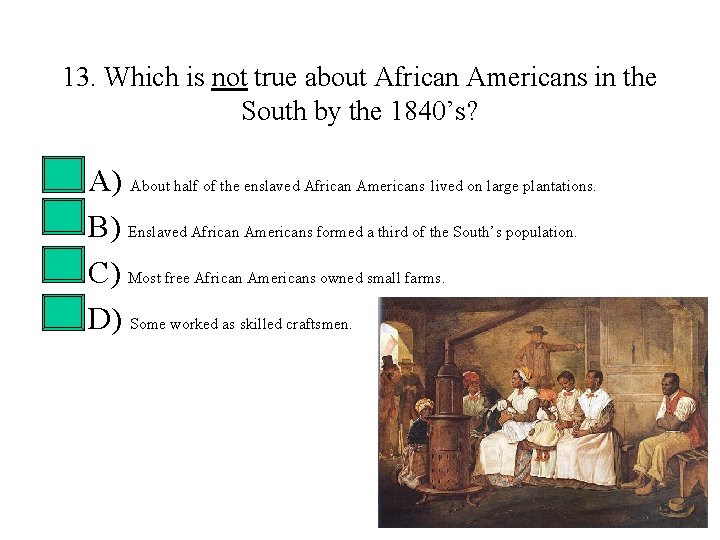
13. Which is not true about African Americans in the South by the 1840’s? • • A) About half of the enslaved African Americans lived on large plantations. B) Enslaved African Americans formed a third of the South’s population. C) Most free African Americans owned small farms. D) Some worked as skilled craftsmen.
Correct !! Next Question
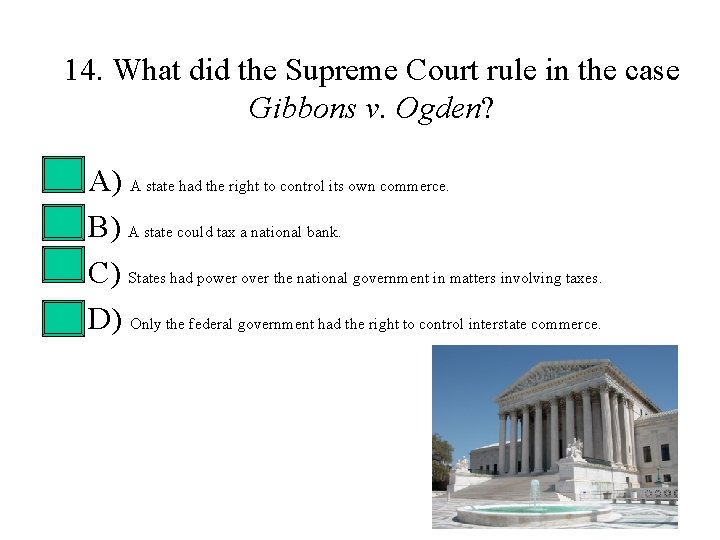
14. What did the Supreme Court rule in the case Gibbons v. Ogden? • • A) A state had the right to control its own commerce. B) A state could tax a national bank. C) States had power over the national government in matters involving taxes. D) Only the federal government had the right to control interstate commerce.
Correct !! Next Question
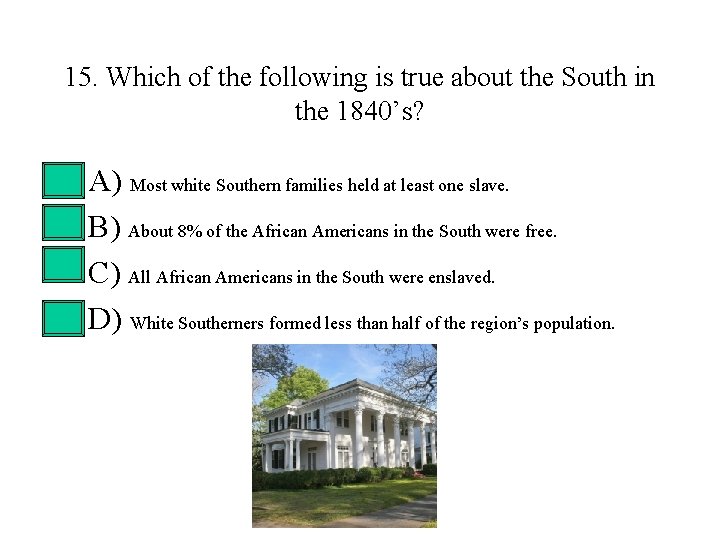
15. Which of the following is true about the South in the 1840’s? • • A) Most white Southern families held at least one slave. B) About 8% of the African Americans in the South were free. C) All African Americans in the South were enslaved. D) White Southerners formed less than half of the region’s population.
Correct !! Next Question
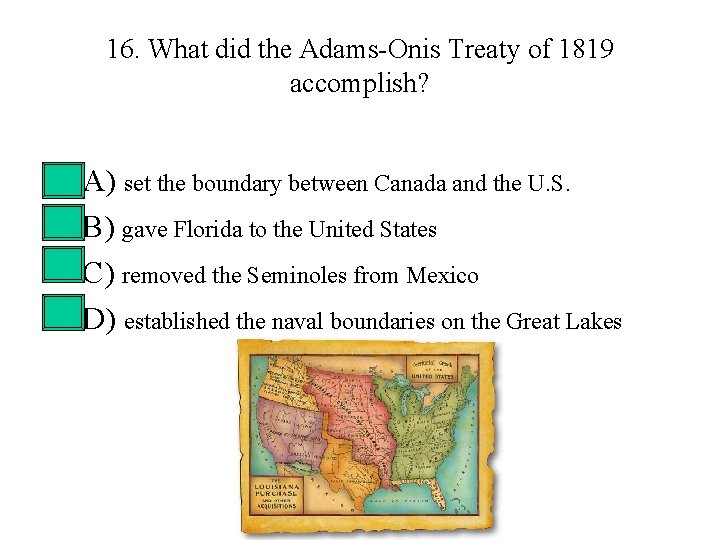
16. What did the Adams-Onis Treaty of 1819 accomplish? • • A) set the boundary between Canada and the U. S. B) gave Florida to the United States C) removed the Seminoles from Mexico D) established the naval boundaries on the Great Lakes
Correct !! Next Question
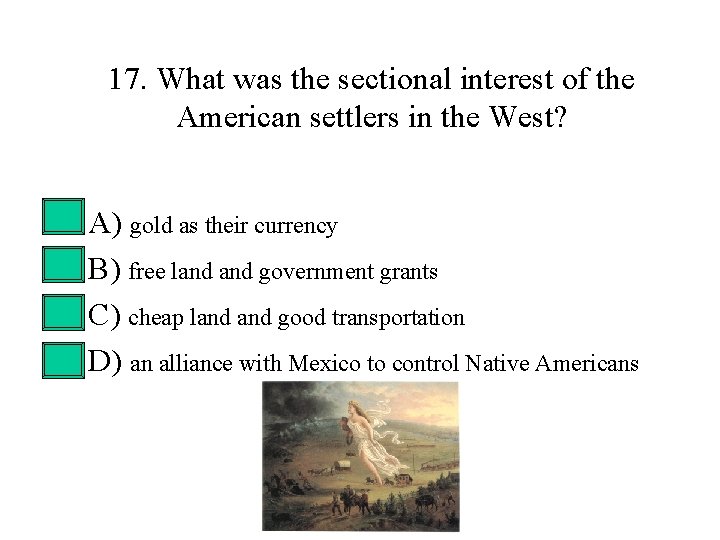
17. What was the sectional interest of the American settlers in the West? • • A) gold as their currency B) free land government grants C) cheap land good transportation D) an alliance with Mexico to control Native Americans
Correct !! Next Question
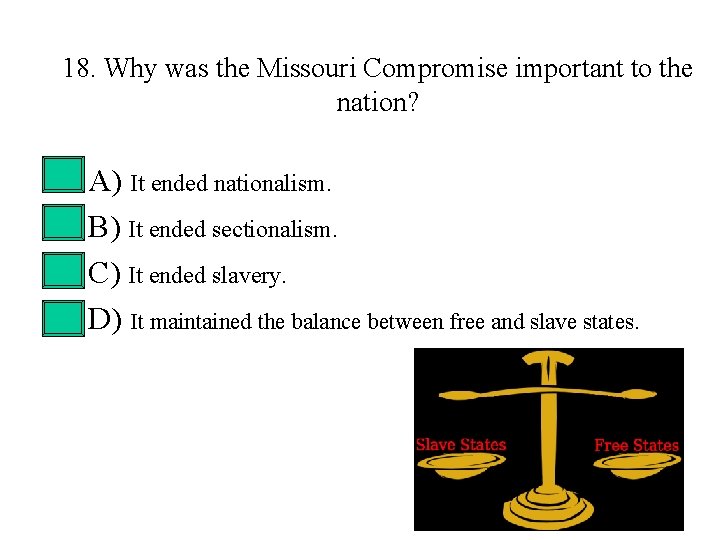
18. Why was the Missouri Compromise important to the nation? • • A) It ended nationalism. B) It ended sectionalism. C) It ended slavery. D) It maintained the balance between free and slave states.
Correct !! Next Question
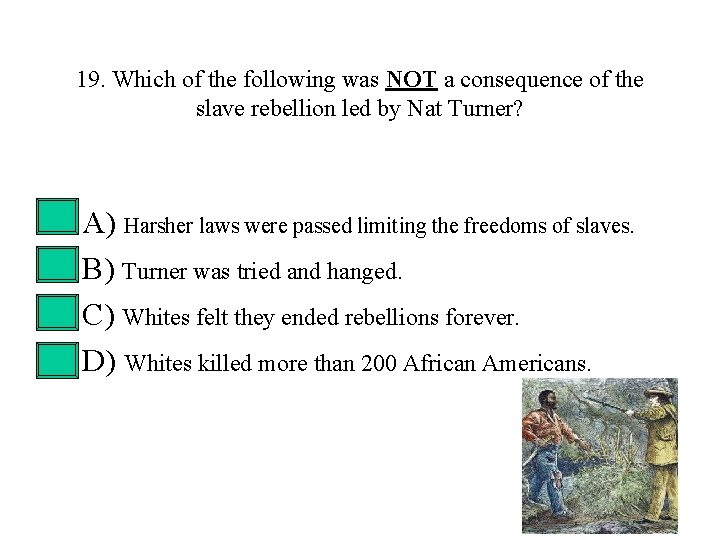
19. Which of the following was NOT a consequence of the slave rebellion led by Nat Turner? • • A) Harsher laws were passed limiting the freedoms of slaves. B) Turner was tried and hanged. C) Whites felt they ended rebellions forever. D) Whites killed more than 200 African Americans.
Correct !! Next Question
20. Which was NOT part of Henry Clay’s American System? • • A) A tariff to protect American business from foreign competition. B) A toll on roads and canals to fund future construction. C) A national bank to promote a national currency. D) An improved transportation system.
Correct !! Next Question
21. The secrets of the British textile industry were brought to America by _____. • • A) Rush Bagot B) Eli Whitney C) Robert Fulton D) Samuel Slater
Correct !! Next Question
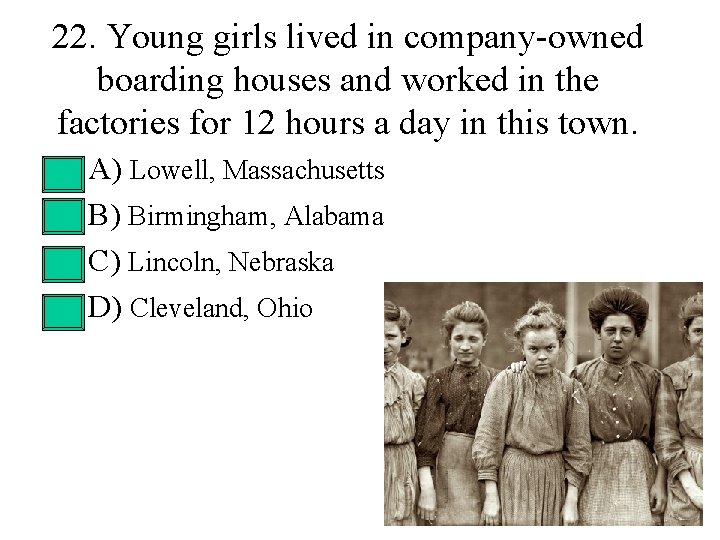
22. Young girls lived in company-owned boarding houses and worked in the factories for 12 hours a day in this town. • • A) Lowell, Massachusetts B) Birmingham, Alabama C) Lincoln, Nebraska D) Cleveland, Ohio
Correct !! Next Question
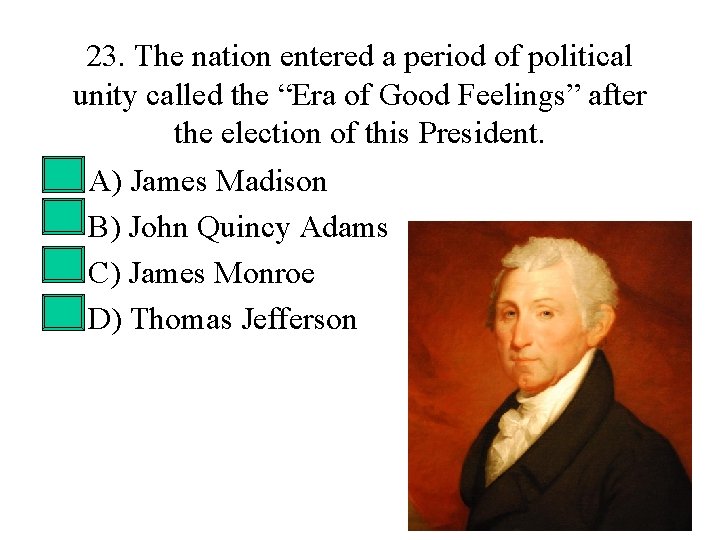
23. The nation entered a period of political unity called the “Era of Good Feelings” after the election of this President. • A) James Madison • B) John Quincy Adams • C) James Monroe • D) Thomas Jefferson
Correct !! Next Question
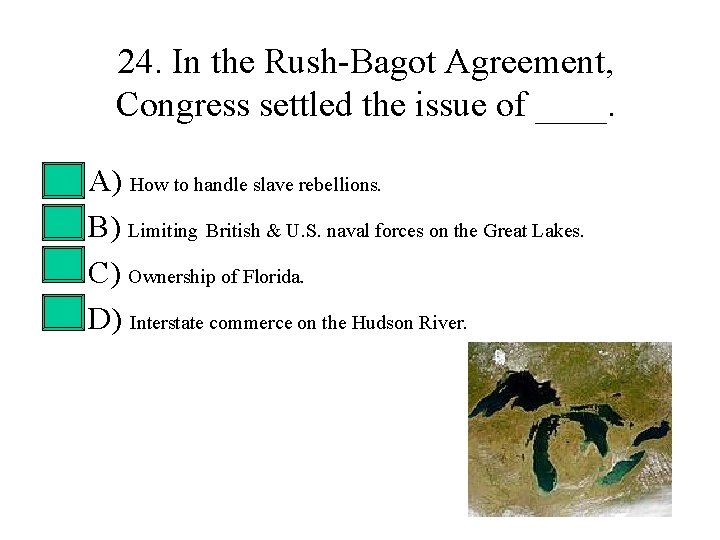
24. In the Rush-Bagot Agreement, Congress settled the issue of ____. • • A) How to handle slave rebellions. B) Limiting British & U. S. naval forces on the Great Lakes. C) Ownership of Florida. D) Interstate commerce on the Hudson River.
Correct !! Next Question
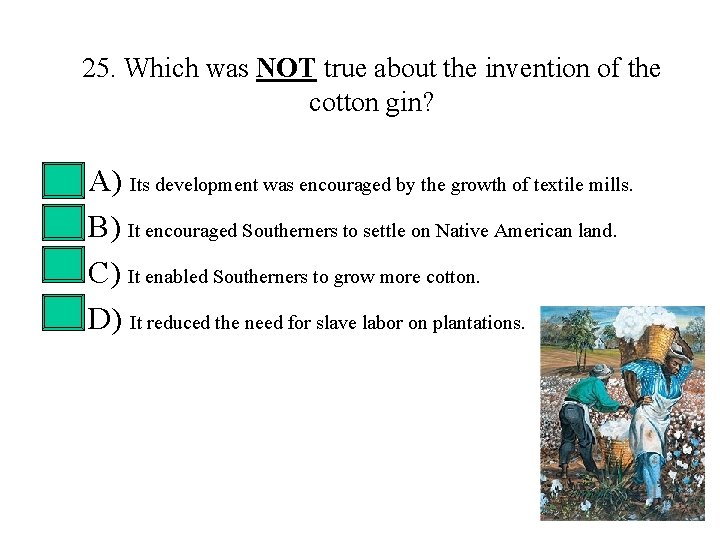
25. Which was NOT true about the invention of the cotton gin? • • A) Its development was encouraged by the growth of textile mills. B) It encouraged Southerners to settle on Native American land. C) It enabled Southerners to grow more cotton. D) It reduced the need for slave labor on plantations.
Correct !! Next Question
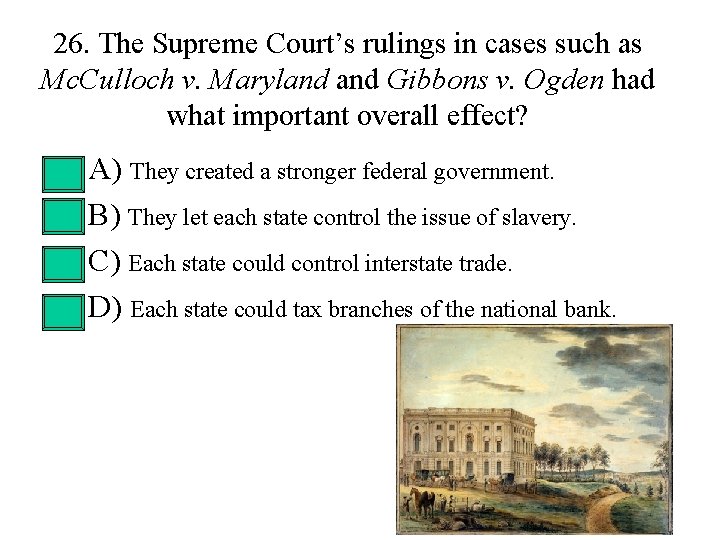
26. The Supreme Court’s rulings in cases such as Mc. Culloch v. Maryland Gibbons v. Ogden had what important overall effect? • • A) They created a stronger federal government. B) They let each state control the issue of slavery. C) Each state could control interstate trade. D) Each state could tax branches of the national bank.
Correct !! Next Question
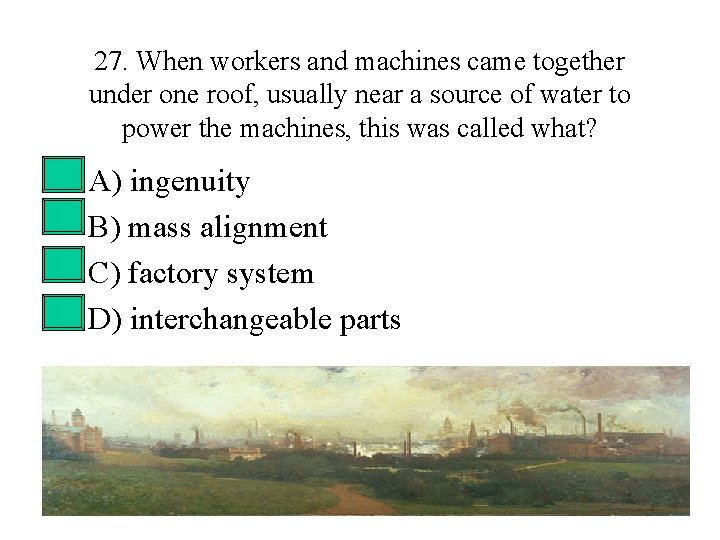
27. When workers and machines came together under one roof, usually near a source of water to power the machines, this was called what? • • A) ingenuity B) mass alignment C) factory system D) interchangeable parts
Correct !! Next Question
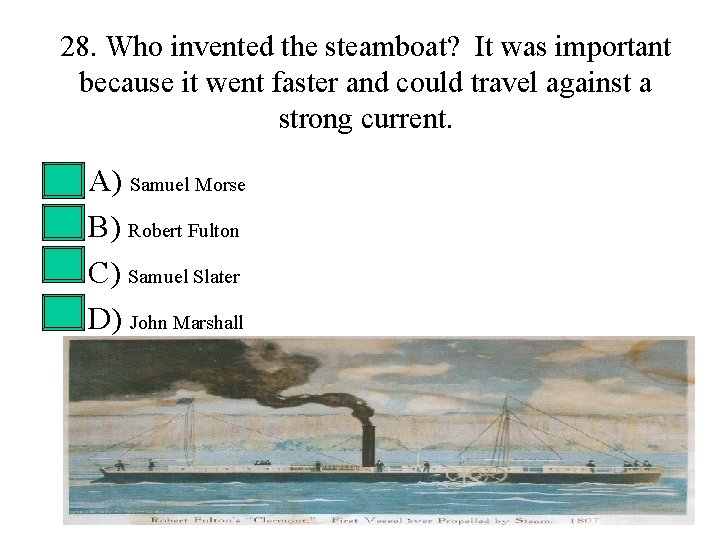
28. Who invented the steamboat? It was important because it went faster and could travel against a strong current. • • A) Samuel Morse B) Robert Fulton C) Samuel Slater D) John Marshall
Correct !! Next Question
Congratulations, you are done! Click here to reset quiz
Sorry, try again. Return to Question