
1 Highlevel requirement 2 R V table Prof

1. High-level requirement 2. R & V table Prof. Jing Jiang, Sohpie Liu
Problem statement & High-level requirements
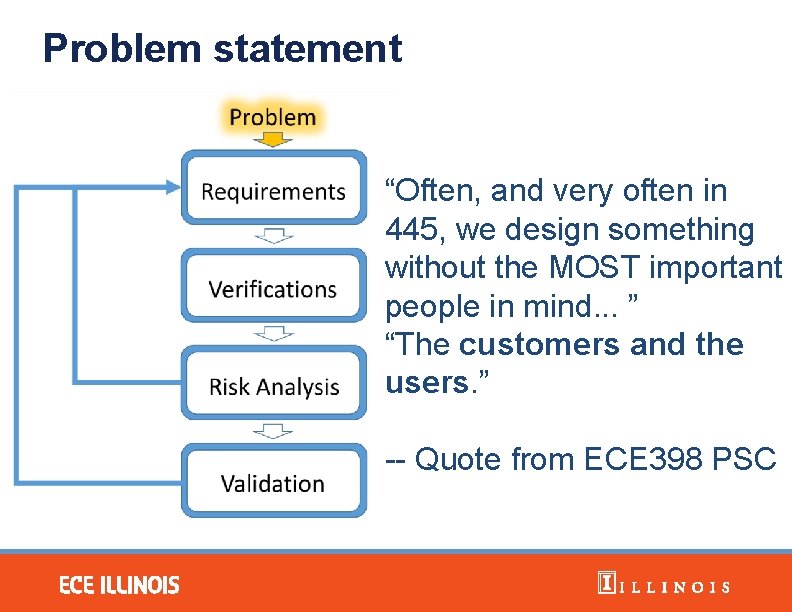
Problem statement “Often, and very often in 445, we design something without the MOST important people in mind. . . ” “The customers and the users. ” -- Quote from ECE 398 PSC
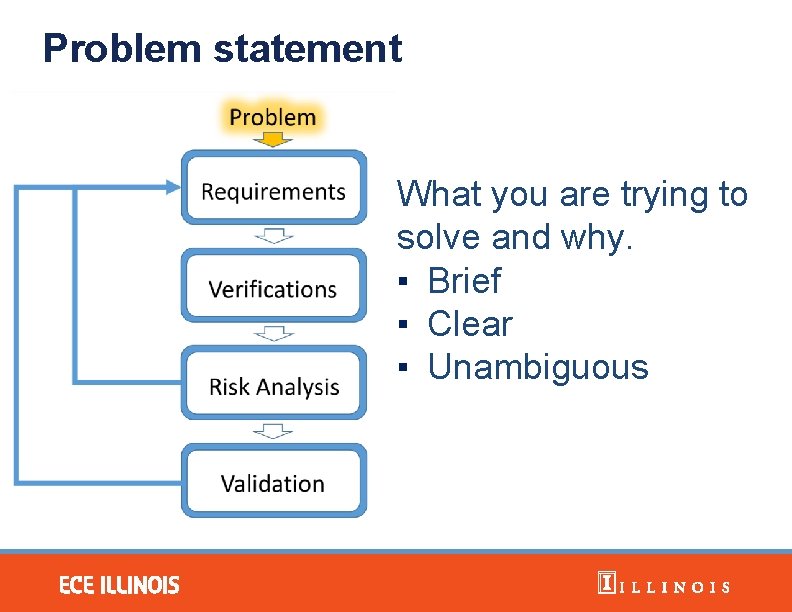
Problem statement What you are trying to solve and why. ▪ Brief ▪ Clear ▪ Unambiguous
Problem proposition • • Keep customer in mind in your design! 30 -sec pitch: follow this template, pitch in DDC, design review, demo, presentation, and all the time! I build ___A___ (my core product) for ___B___ customer who pays money to my company). (my core My customer has a problem, and it is ___C___ (describe the customer’s pain point) My product solves my customer’s problem by ___D___ (how do you solve the problem? )
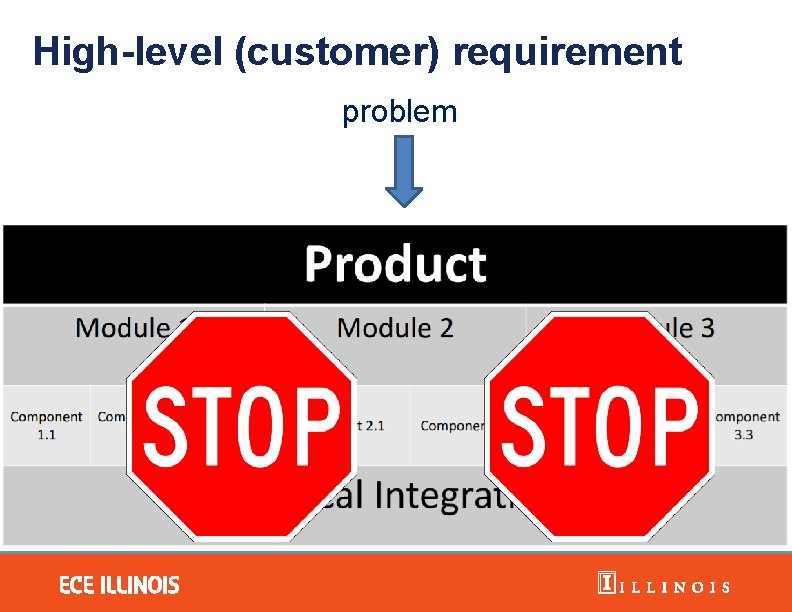
High-level (customer) requirement problem
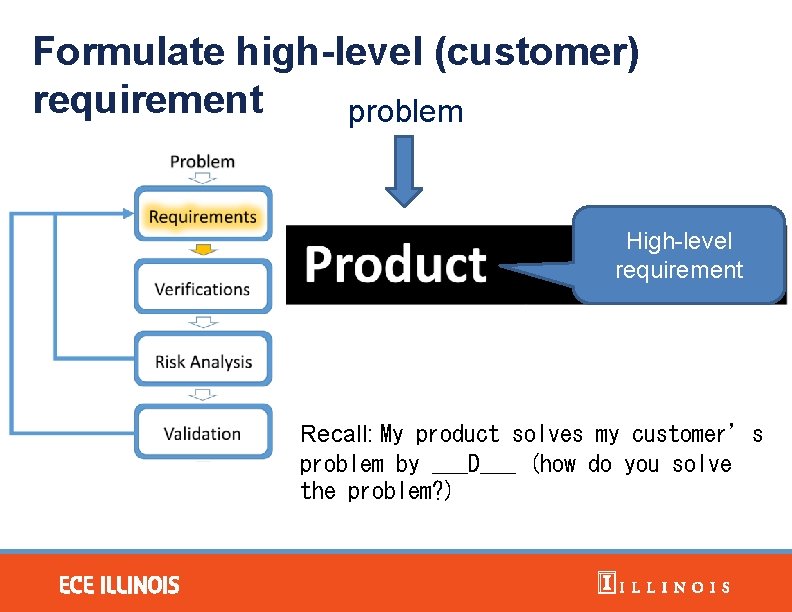
Formulate high-level (customer) requirement problem High-level requirement Recall: My product solves my customer’s problem by ___D___ (how do you solve the problem? )
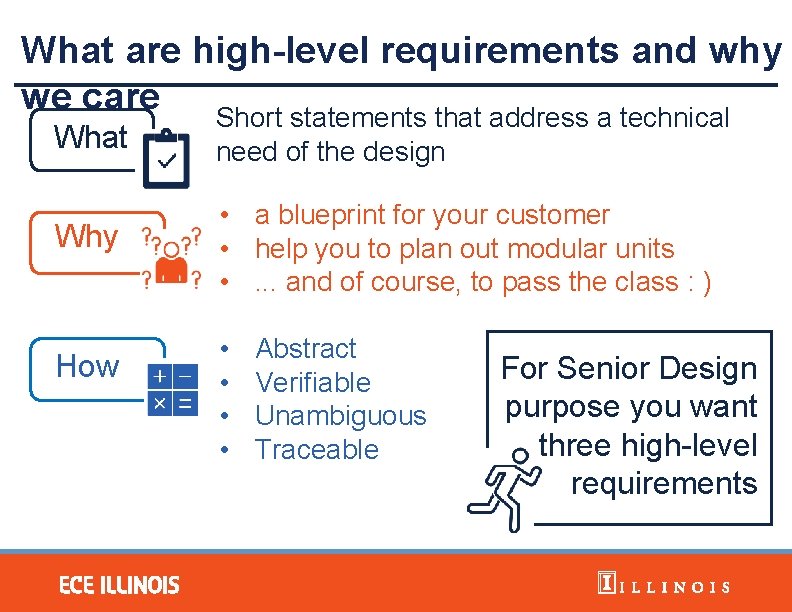
What are high-level requirements and why we care Short statements that address a technical What Why How need of the design • a blueprint for your customer • help you to plan out modular units • . . . and of course, to pass the class : ) • • Abstract Verifiable Unambiguous Traceable For Senior Design purpose you want three high-level requirements
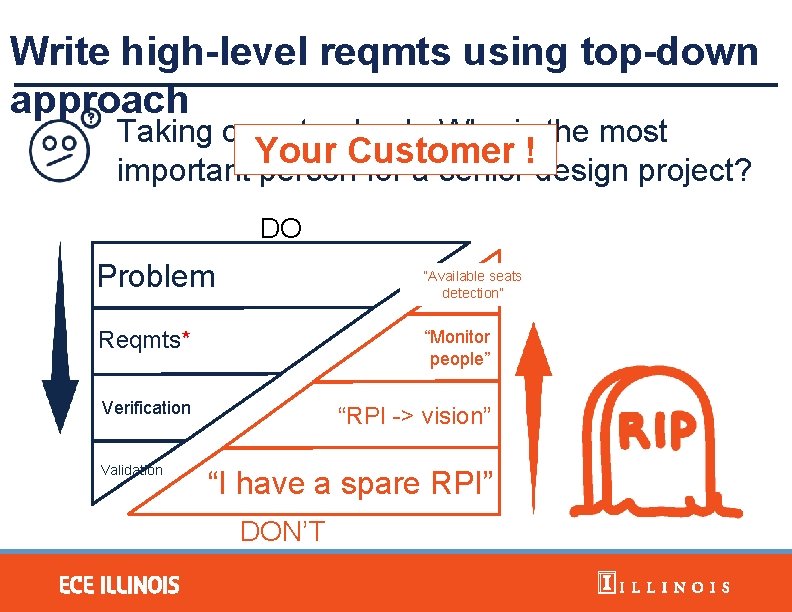
Write high-level reqmts using top-down approach Taking one step back: Who is the most Your Customer ! important person for a senior design project? DO Problem “Available seats detection” Reqmts* “Monitor people” Verification “RPI -> vision” Validation “I have a spare RPI” DON’T
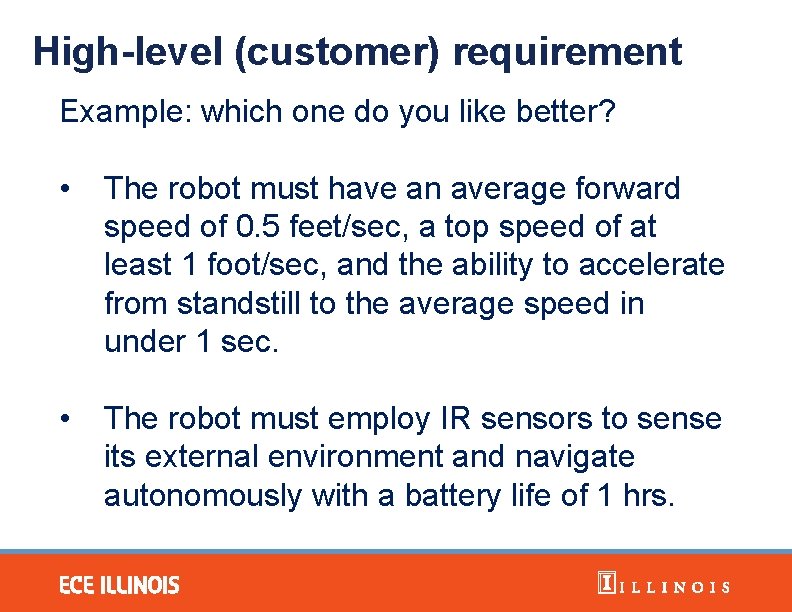
High-level (customer) requirement Example: which one do you like better? • The robot must have an average forward speed of 0. 5 feet/sec, a top speed of at least 1 foot/sec, and the ability to accelerate from standstill to the average speed in under 1 sec. • The robot must employ IR sensors to sense its external environment and navigate autonomously with a battery life of 1 hrs.
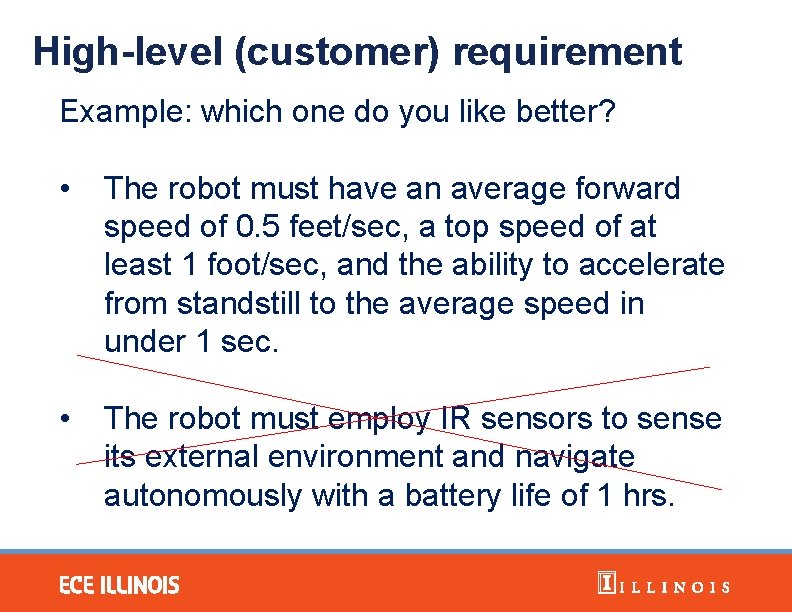
High-level (customer) requirement Example: which one do you like better? • The robot must have an average forward speed of 0. 5 feet/sec, a top speed of at least 1 foot/sec, and the ability to accelerate from standstill to the average speed in under 1 sec. • The robot must employ IR sensors to sense its external environment and navigate autonomously with a battery life of 1 hrs.
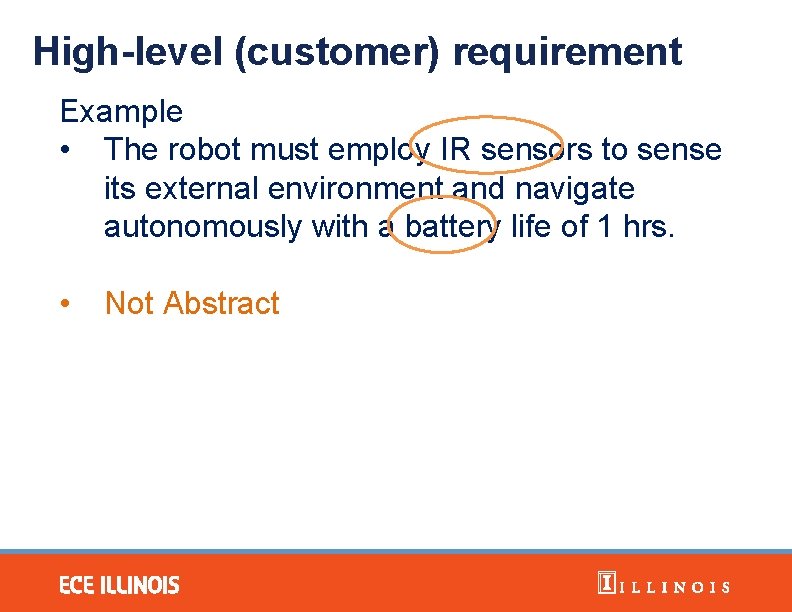
High-level (customer) requirement Example • The robot must employ IR sensors to sense its external environment and navigate autonomously with a battery life of 1 hrs. • Not Abstract
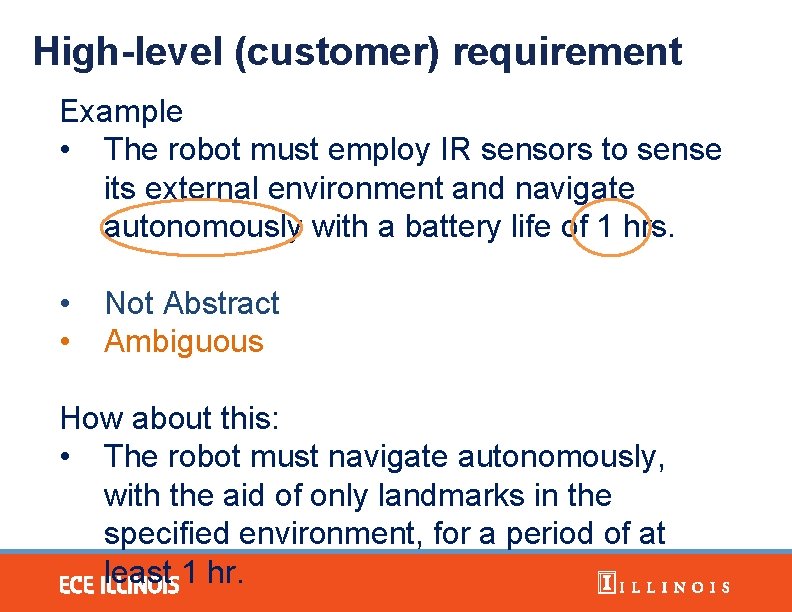
High-level (customer) requirement Example • The robot must employ IR sensors to sense its external environment and navigate autonomously with a battery life of 1 hrs. • • Not Abstract Ambiguous How about this: • The robot must navigate autonomously, with the aid of only landmarks in the specified environment, for a period of at least 1 hr.
High-level (customer) requirement If you don’t satisfy your all your high-level requirements (in the demo): • As a company, you’ll lose money. • As a product manager, you’ll lose job. • As an ECE 445 student, you’ll …
How to design good high-level Interview customer requirement? • Customers pay for the product • Users use or break products • Users should be involved in the design process Role-playing game • Customer: I have pain in XXX. I want to solve my problem and pay reasonable price for it. I don’t understand technical details. • Manager: I want to get the max gain from this project, which is the potential income (sales price * quantity) minus expense (labor, BOM, R&D cost). • Engineer: …
How to design good high-level Context Free Process Questions requirement? • Who is the client for the XXX project? • What is a highly successful solution really worth to this client? • What is the real reason for wanting to solve this problem? • How much time do we have? • Where else can the solution to this problem be obtained? Can we copy an existing solution? Context Free Product Questions • What problems does this system solve? • What problems could this system create? • What environment is this system likely to encounter? • What kind of precision is required?
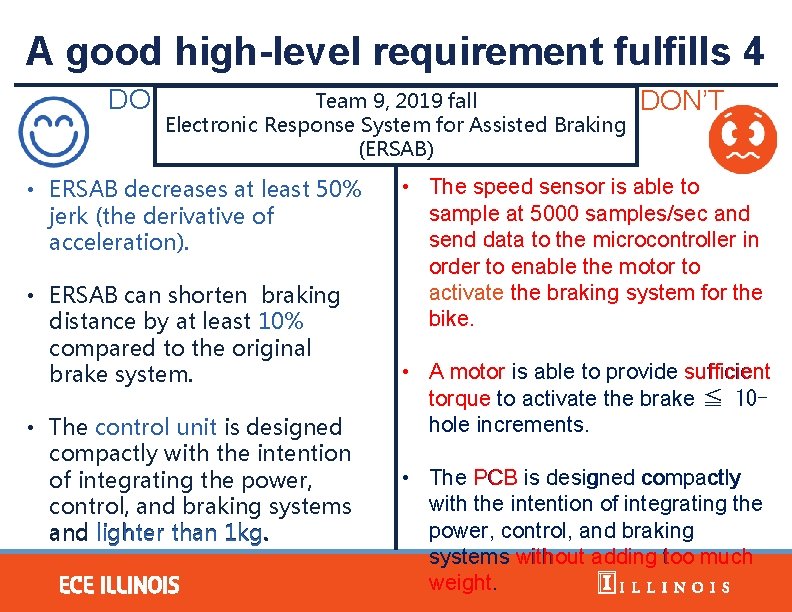
A good high-level requirement fulfills 4 Team 9, 2019 fall DO DON’T criteria Electronic Response System for Assisted Braking (ERSAB) • ERSAB decreases at least 50% jerk (the derivative of acceleration). has shorter equal • ERSAB can shortenorbraking distance compared to distance by at least 10% the originaltobrake system (50 compared the original 100%). system. brake • The control unit is designed compactly with the intention of integrating the power, control, and braking systems and lighter than 1 kg. • The speed sensor is able to sample at 5000 samples/sec and send data to the microcontroller in order to enable the motor to activate the braking system for the bike. • A motor is able to provide sufficient torque to activate the brake ≦ 10 hole increments. • The PCB is designed compactly with the intention of integrating the power, control, and braking systems without adding too much weight.
R & V table (Requirements and Verification)
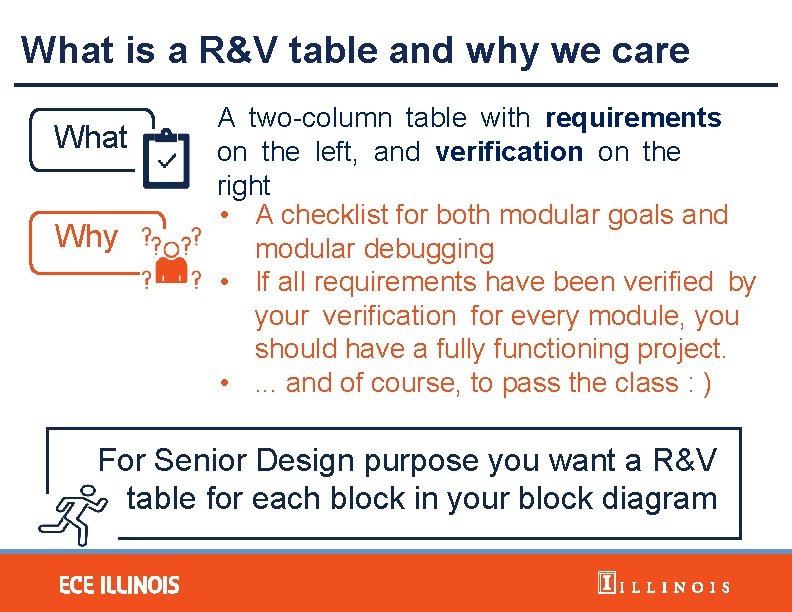
What is a R&V table and why we care What Why A two-column table with requirements on the left, and verification on the right • A checklist for both modular goals and modular debugging • If all requirements have been verified by your verification for every module, you should have a fully functioning project. • . . . and of course, to pass the class : ) For Senior Design purpose you want a R&V table for each block in your block diagram
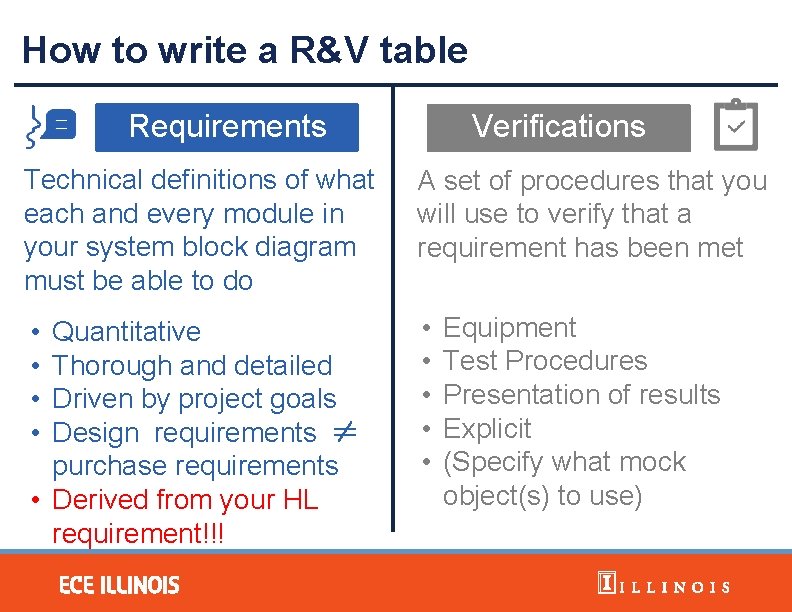
How to write a R&V table Requirements Verifications Technical definitions of what each and every module in your system block diagram must be able to do A set of procedures that you will use to verify that a requirement has been met • • • Quantitative Thorough and detailed Driven by project goals Design requirements ≠ purchase requirements • Derived from your HL requirement!!! Equipment Test Procedures Presentation of results Explicit (Specify what mock object(s) to use)
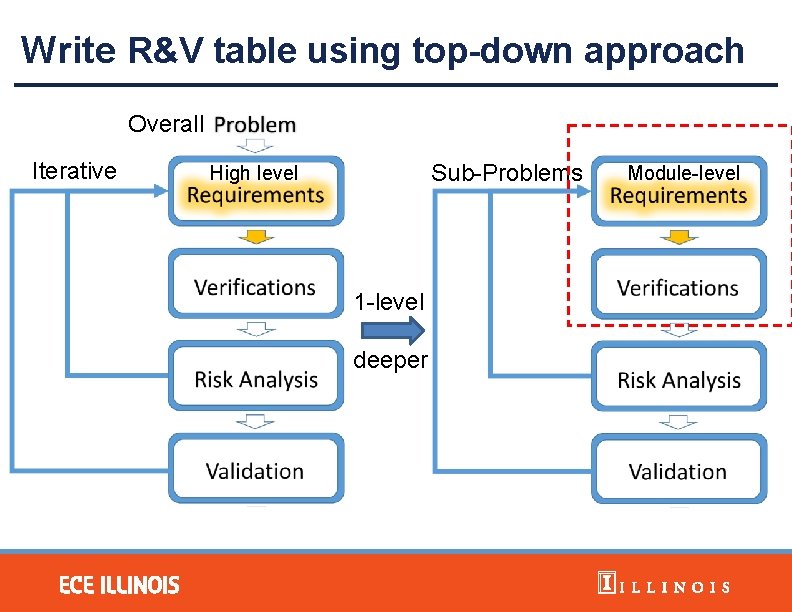
Write R&V table using top-down approach Overall Iterative Sub-Problems High level 1 -level deeper Module-level
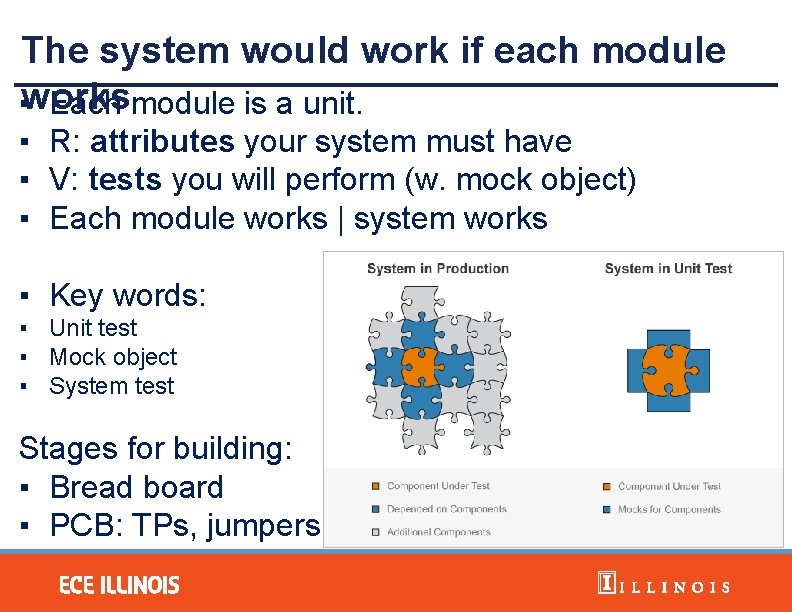
The system would work if each module ▪works Each module is a unit. ▪ R: attributes your system must have ▪ V: tests you will perform (w. mock object) ▪ Each module works | system works ▪ Key words: ▪ Unit test ▪ Mock object ▪ System test Stages for building: ▪ Bread board ▪ PCB: TPs, jumpers
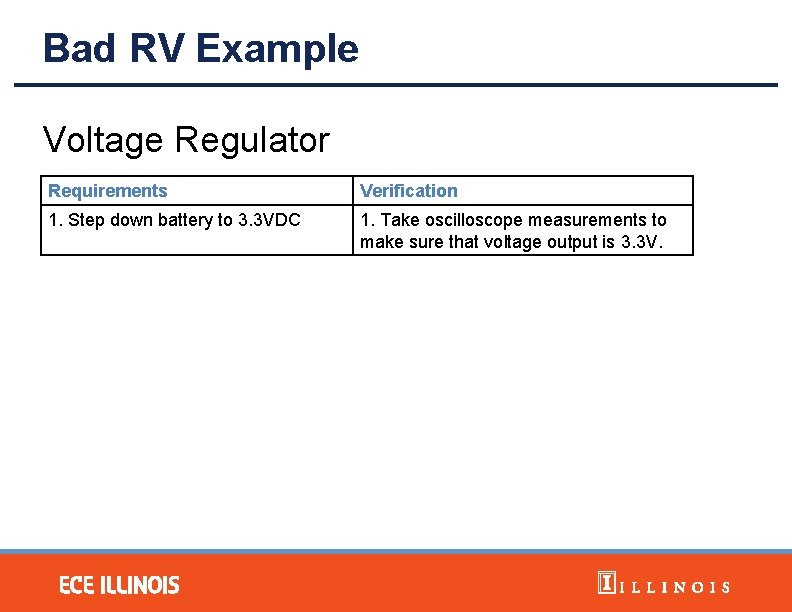
Bad RV Example Voltage Regulator Requirements Verification 1. Step down battery to 3. 3 VDC 1. Take oscilloscope measurements to make sure that voltage output is 3. 3 V.
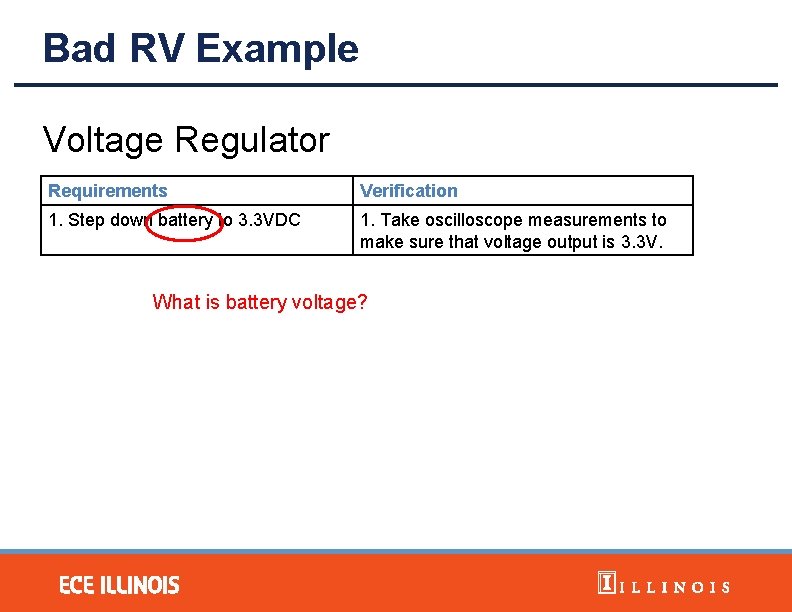
Bad RV Example Voltage Regulator Requirements Verification 1. Step down battery to 3. 3 VDC 1. Take oscilloscope measurements to make sure that voltage output is 3. 3 V. What is battery voltage?
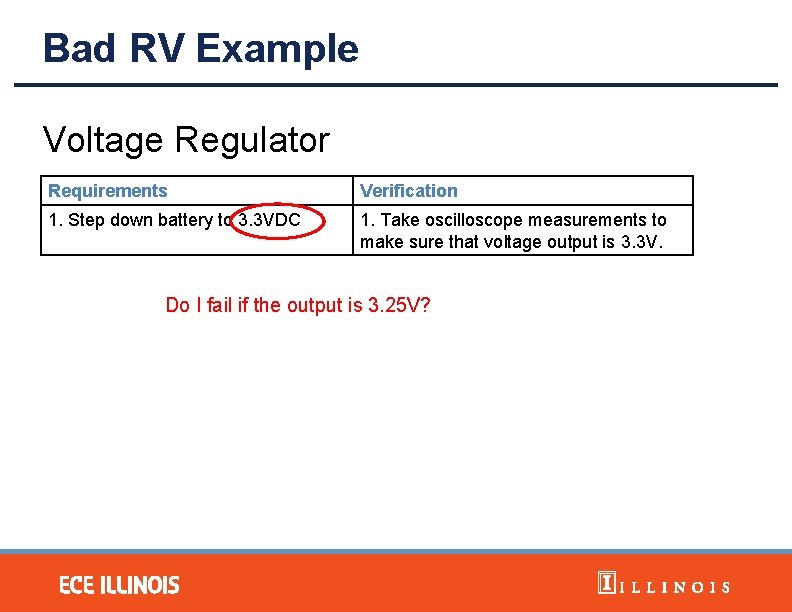
Bad RV Example Voltage Regulator Requirements Verification 1. Step down battery to 3. 3 VDC 1. Take oscilloscope measurements to make sure that voltage output is 3. 3 V. Do I fail if the output is 3. 25 V?
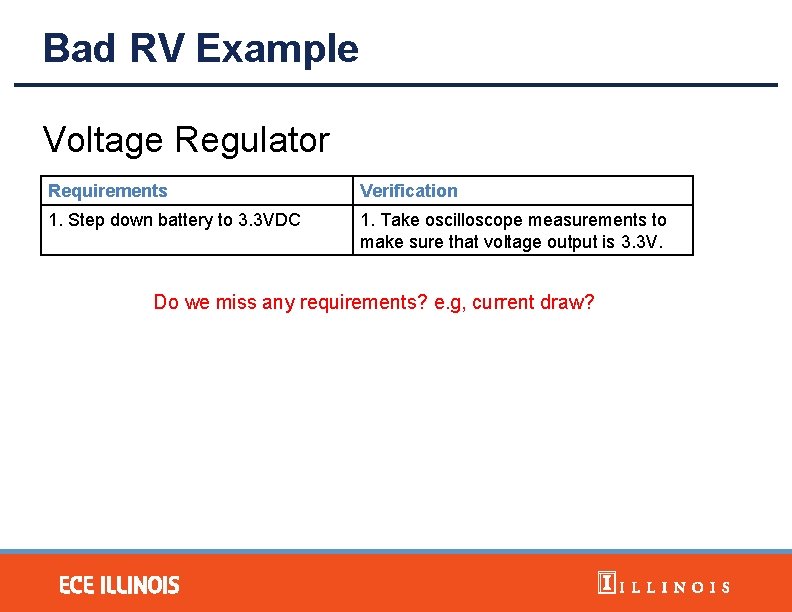
Bad RV Example Voltage Regulator Requirements Verification 1. Step down battery to 3. 3 VDC 1. Take oscilloscope measurements to make sure that voltage output is 3. 3 V. Do we miss any requirements? e. g, current draw?
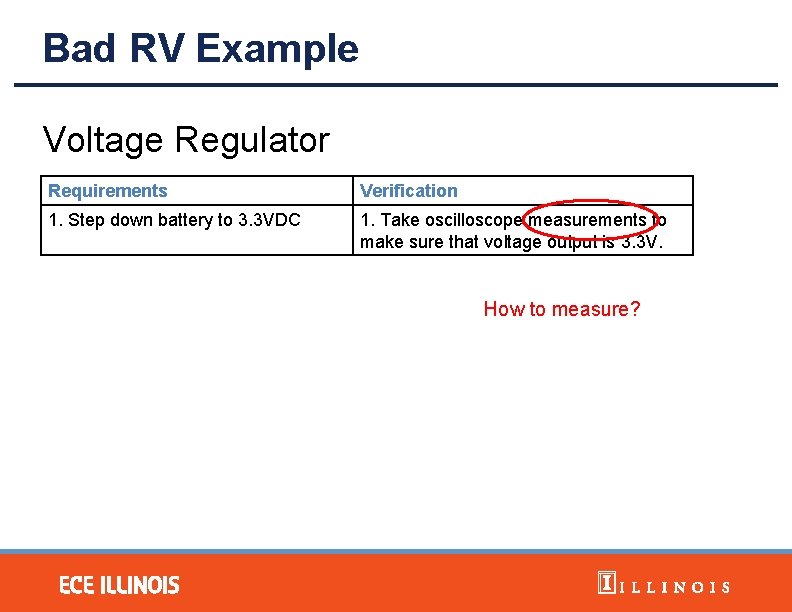
Bad RV Example Voltage Regulator Requirements Verification 1. Step down battery to 3. 3 VDC 1. Take oscilloscope measurements to make sure that voltage output is 3. 3 V. How to measure?
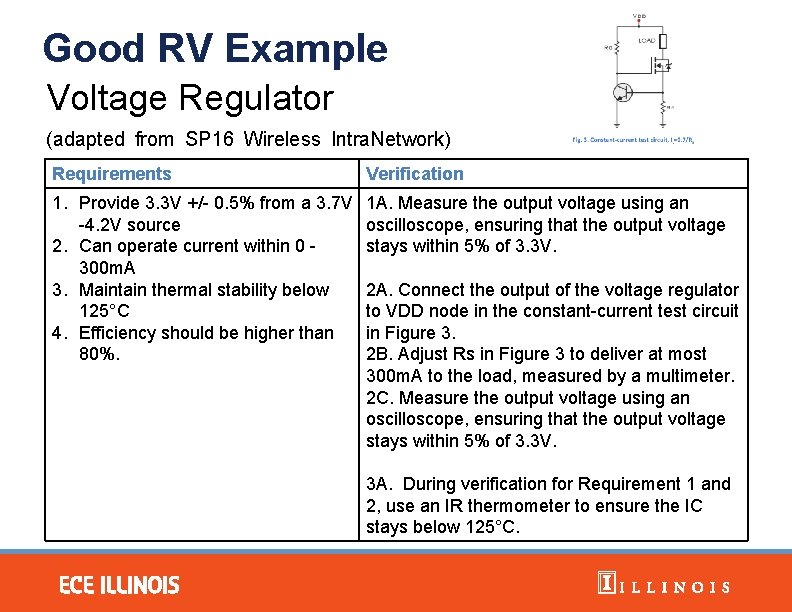
Good RV Example Voltage Regulator (adapted from SP 16 Wireless Intra. Network) Requirements Verification 1. Provide 3. 3 V +/- 0. 5% from a 3. 7 V -4. 2 V source 2. Can operate current within 0 300 m. A 3. Maintain thermal stability below 125°C 4. Efficiency should be higher than 80%. 1 A. Measure the output voltage using an oscilloscope, ensuring that the output voltage stays within 5% of 3. 3 V. 2 A. Connect the output of the voltage regulator to VDD node in the constant-current test circuit in Figure 3. 2 B. Adjust Rs in Figure 3 to deliver at most 300 m. A to the load, measured by a multimeter. 2 C. Measure the output voltage using an oscilloscope, ensuring that the output voltage stays within 5% of 3. 3 V. 3 A. During verification for Requirement 1 and 2, use an IR thermometer to ensure the IC stays below 125°C.
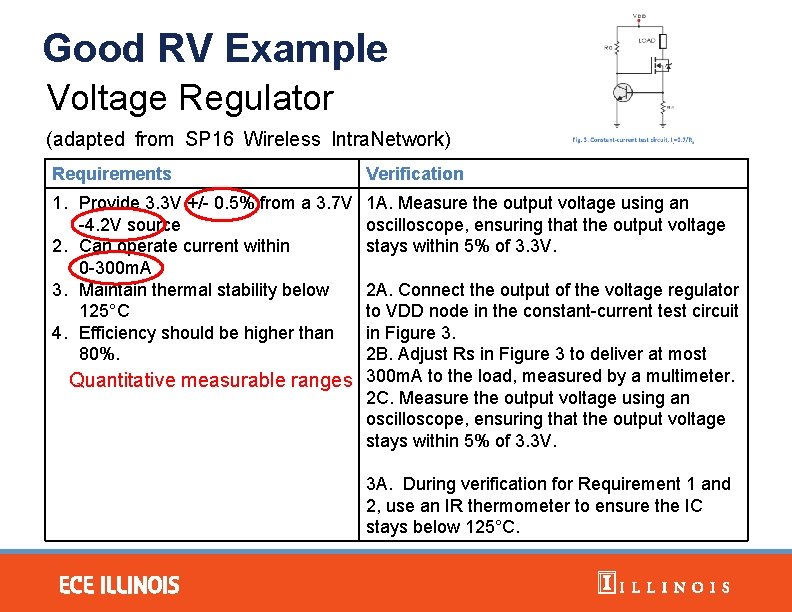
Good RV Example Voltage Regulator (adapted from SP 16 Wireless Intra. Network) Requirements Verification 1. Provide 3. 3 V +/- 0. 5% from a 3. 7 V -4. 2 V source 2. Can operate current within 0 -300 m. A 3. Maintain thermal stability below 125°C 4. Efficiency should be higher than 80%. 1 A. Measure the output voltage using an oscilloscope, ensuring that the output voltage stays within 5% of 3. 3 V. 2 A. Connect the output of the voltage regulator to VDD node in the constant-current test circuit in Figure 3. 2 B. Adjust Rs in Figure 3 to deliver at most Quantitative measurable ranges 300 m. A to the load, measured by a multimeter. 2 C. Measure the output voltage using an oscilloscope, ensuring that the output voltage stays within 5% of 3. 3 V. 3 A. During verification for Requirement 1 and 2, use an IR thermometer to ensure the IC stays below 125°C.
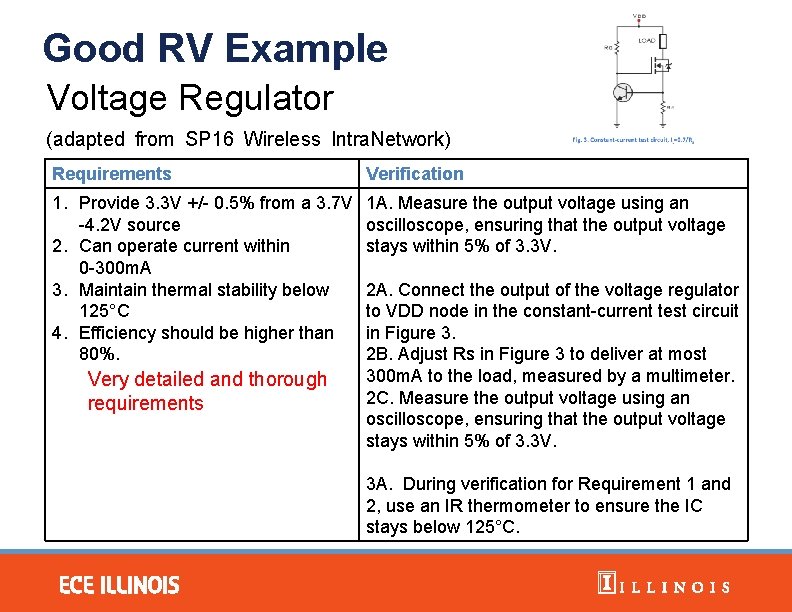
Good RV Example Voltage Regulator (adapted from SP 16 Wireless Intra. Network) Requirements Verification 1. Provide 3. 3 V +/- 0. 5% from a 3. 7 V -4. 2 V source 2. Can operate current within 0 -300 m. A 3. Maintain thermal stability below 125°C 4. Efficiency should be higher than 80%. 1 A. Measure the output voltage using an oscilloscope, ensuring that the output voltage stays within 5% of 3. 3 V. Very detailed and thorough requirements 2 A. Connect the output of the voltage regulator to VDD node in the constant-current test circuit in Figure 3. 2 B. Adjust Rs in Figure 3 to deliver at most 300 m. A to the load, measured by a multimeter. 2 C. Measure the output voltage using an oscilloscope, ensuring that the output voltage stays within 5% of 3. 3 V. 3 A. During verification for Requirement 1 and 2, use an IR thermometer to ensure the IC stays below 125°C.
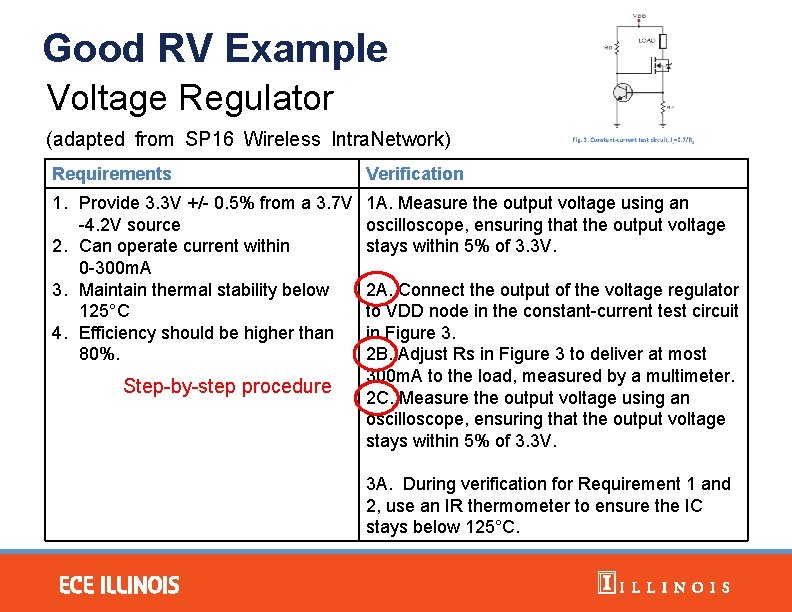
Good RV Example Voltage Regulator (adapted from SP 16 Wireless Intra. Network) Requirements Verification 1. Provide 3. 3 V +/- 0. 5% from a 3. 7 V -4. 2 V source 2. Can operate current within 0 -300 m. A 3. Maintain thermal stability below 125°C 4. Efficiency should be higher than 80%. 1 A. Measure the output voltage using an oscilloscope, ensuring that the output voltage stays within 5% of 3. 3 V. Step-by-step procedure 2 A. Connect the output of the voltage regulator to VDD node in the constant-current test circuit in Figure 3. 2 B. Adjust Rs in Figure 3 to deliver at most 300 m. A to the load, measured by a multimeter. 2 C. Measure the output voltage using an oscilloscope, ensuring that the output voltage stays within 5% of 3. 3 V. 3 A. During verification for Requirement 1 and 2, use an IR thermometer to ensure the IC stays below 125°C.
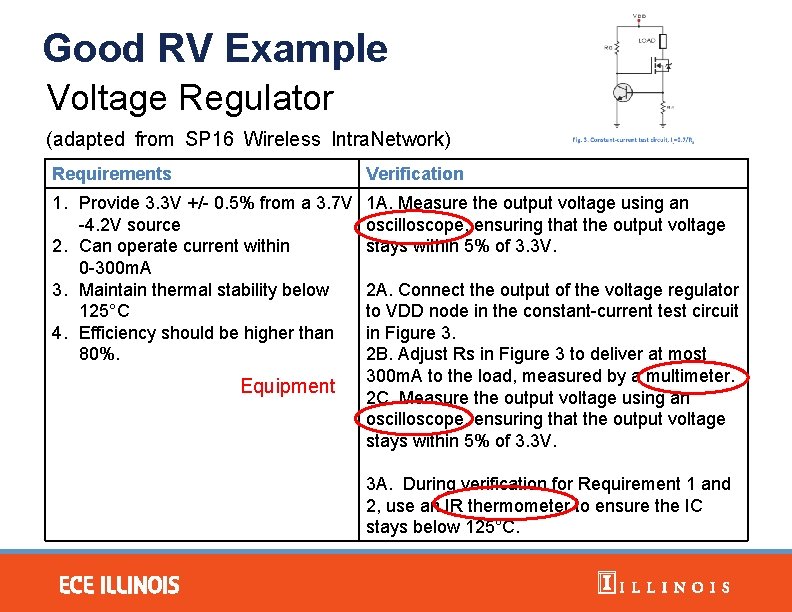
Good RV Example Voltage Regulator (adapted from SP 16 Wireless Intra. Network) Requirements Verification 1. Provide 3. 3 V +/- 0. 5% from a 3. 7 V -4. 2 V source 2. Can operate current within 0 -300 m. A 3. Maintain thermal stability below 125°C 4. Efficiency should be higher than 80%. 1 A. Measure the output voltage using an oscilloscope, ensuring that the output voltage stays within 5% of 3. 3 V. Equipment 2 A. Connect the output of the voltage regulator to VDD node in the constant-current test circuit in Figure 3. 2 B. Adjust Rs in Figure 3 to deliver at most 300 m. A to the load, measured by a multimeter. 2 C. Measure the output voltage using an oscilloscope, ensuring that the output voltage stays within 5% of 3. 3 V. 3 A. During verification for Requirement 1 and 2, use an IR thermometer to ensure the IC stays below 125°C.
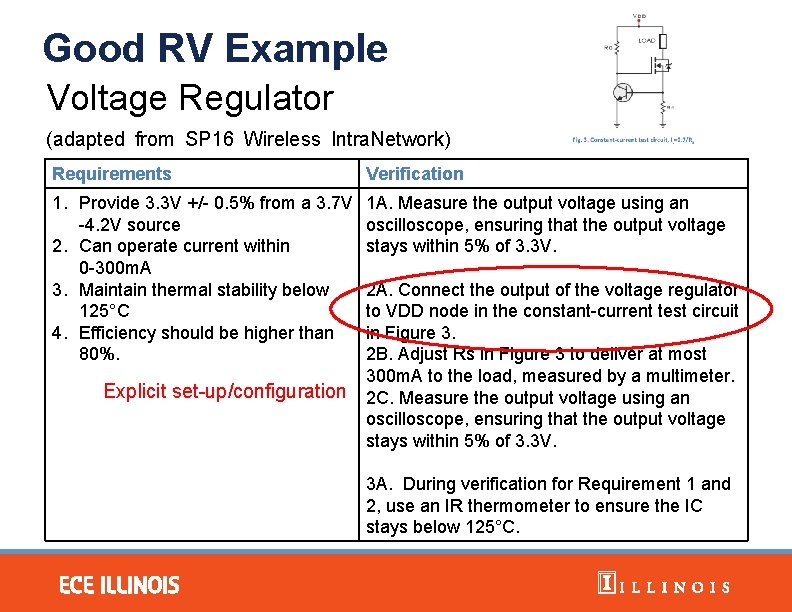
Good RV Example Voltage Regulator (adapted from SP 16 Wireless Intra. Network) Requirements Verification 1. Provide 3. 3 V +/- 0. 5% from a 3. 7 V -4. 2 V source 2. Can operate current within 0 -300 m. A 3. Maintain thermal stability below 125°C 4. Efficiency should be higher than 80%. 1 A. Measure the output voltage using an oscilloscope, ensuring that the output voltage stays within 5% of 3. 3 V. Explicit set-up/configuration 2 A. Connect the output of the voltage regulator to VDD node in the constant-current test circuit in Figure 3. 2 B. Adjust Rs in Figure 3 to deliver at most 300 m. A to the load, measured by a multimeter. 2 C. Measure the output voltage using an oscilloscope, ensuring that the output voltage stays within 5% of 3. 3 V. 3 A. During verification for Requirement 1 and 2, use an IR thermometer to ensure the IC stays below 125°C.
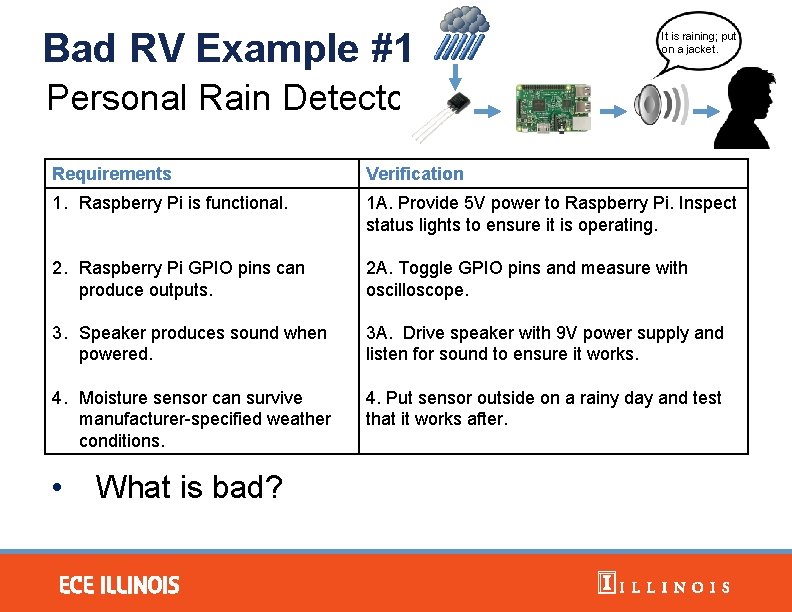
Bad RV Example #1 It is raining; put on a jacket. Personal Rain Detector Requirements Verification 1. Raspberry Pi is functional. 1 A. Provide 5 V power to Raspberry Pi. Inspect status lights to ensure it is operating. 2. Raspberry Pi GPIO pins can produce outputs. 2 A. Toggle GPIO pins and measure with oscilloscope. 3. Speaker produces sound when powered. 3 A. Drive speaker with 9 V power supply and listen for sound to ensure it works. 4. Moisture sensor can survive manufacturer-specified weather conditions. 4. Put sensor outside on a rainy day and test that it works after. • What is bad?
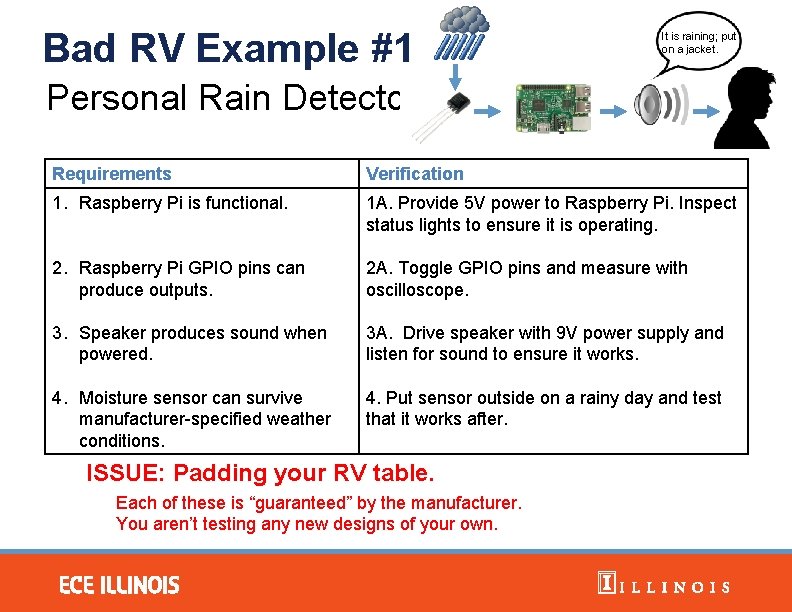
Bad RV Example #1 It is raining; put on a jacket. Personal Rain Detector Requirements Verification 1. Raspberry Pi is functional. 1 A. Provide 5 V power to Raspberry Pi. Inspect status lights to ensure it is operating. 2. Raspberry Pi GPIO pins can produce outputs. 2 A. Toggle GPIO pins and measure with oscilloscope. 3. Speaker produces sound when powered. 3 A. Drive speaker with 9 V power supply and listen for sound to ensure it works. 4. Moisture sensor can survive manufacturer-specified weather conditions. 4. Put sensor outside on a rainy day and test that it works after. ISSUE: Padding your RV table. Each of these is “guaranteed” by the manufacturer. You aren’t testing any new designs of your own.
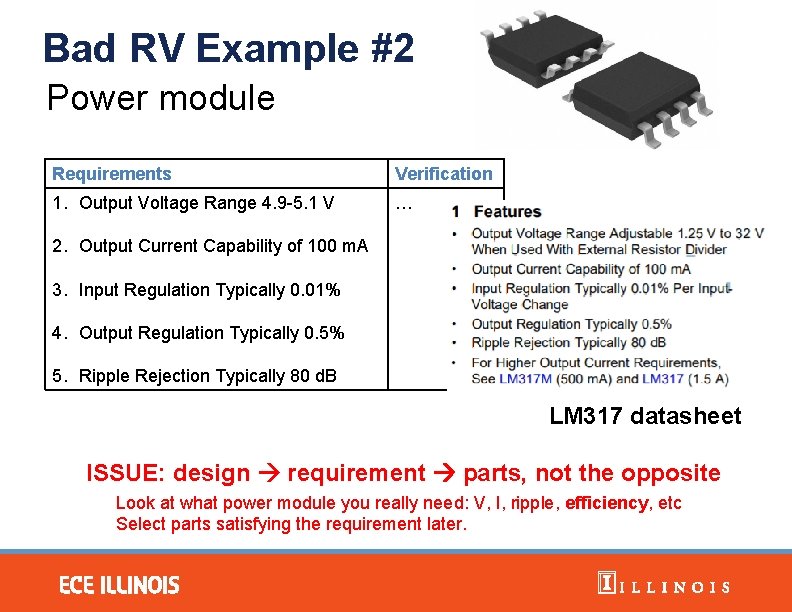
Bad RV Example #2 Power module Requirements Verification 1. Output Voltage Range 4. 9 -5. 1 V … 2. Output Current Capability of 100 m. A 3. Input Regulation Typically 0. 01% 4. Output Regulation Typically 0. 5% 5. Ripple Rejection Typically 80 d. B LM 317 datasheet ISSUE: design requirement parts, not the opposite Look at what power module you really need: V, I, ripple, efficiency, etc Select parts satisfying the requirement later.
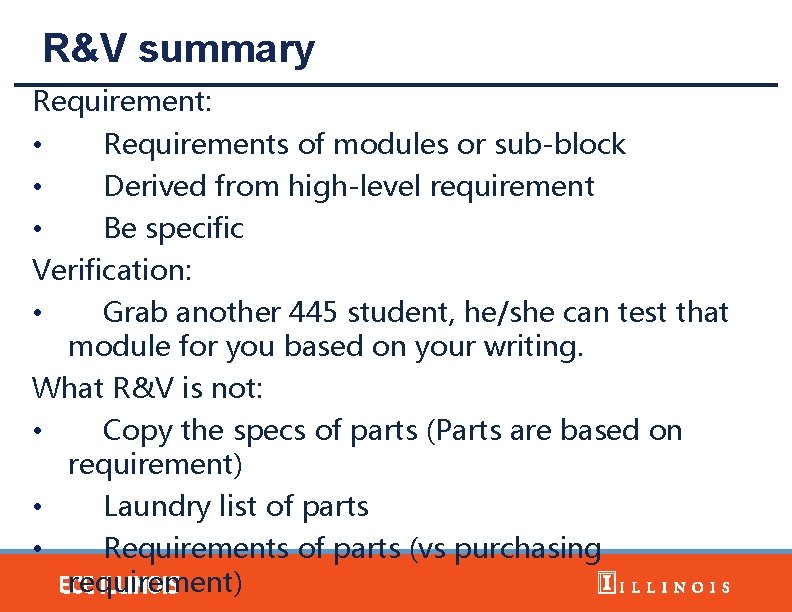
R&V summary Requirement: • Requirements of modules or sub-block • Derived from high-level requirement • Be specific Verification: • Grab another 445 student, he/she can test that module for you based on your writing. What R&V is not: • Copy the specs of parts (Parts are based on requirement) • Laundry list of parts • Requirements of parts (vs purchasing requirement)

Tips to succeed
Tips to succeed 1. Top-down approach 2. Check out good projects from previous semesters 3. Ask your TAs
- Slides: 39