
1 HEREDITY THE PASSING OF TRAITS FROM PARENTS
- Slides: 15
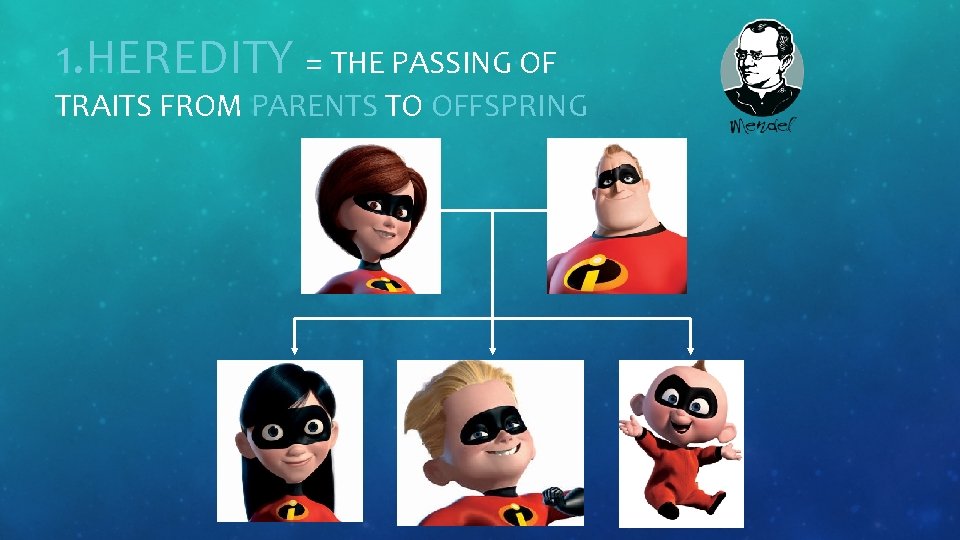
1. HEREDITY = THE PASSING OF TRAITS FROM PARENTS TO OFFSPRING
2. In some countries there is high population of individuals with straight hair versus curly hair. Explain how heredity contributes in high population of straight hair vs. curly • Straight hair is dominant to curly hair and more of the population has the dominant gene (either they are hybrid or have purebred dominant alleles). So more people are reproducing with other people with straight hair, passing down the genes that have instructions for straight hair.
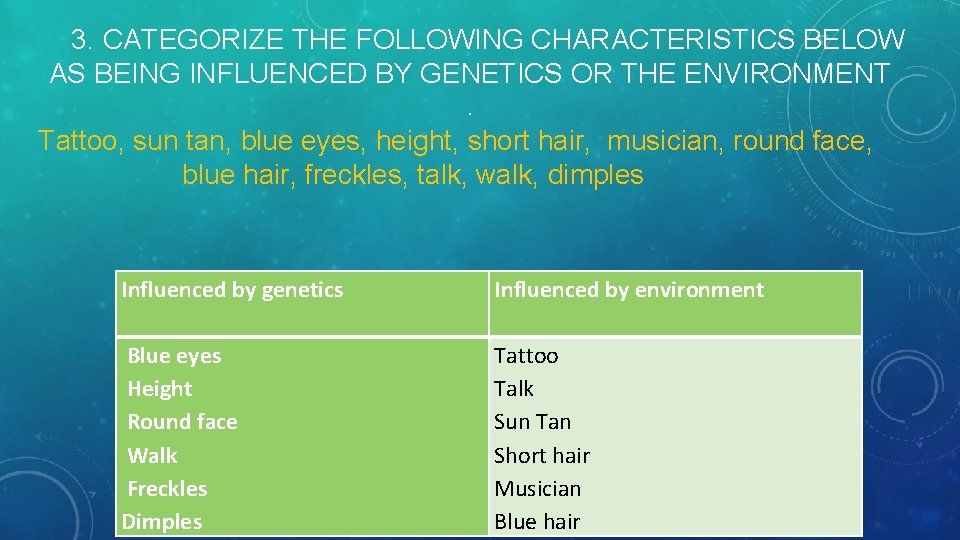
3. CATEGORIZE THE FOLLOWING CHARACTERISTICS BELOW AS BEING INFLUENCED BY GENETICS OR THE ENVIRONMENT. Tattoo, sun tan, blue eyes, height, short hair, musician, round face, blue hair, freckles, talk, walk, dimples • Categorize the following characteristics Influenced by environment below as being influenced by genetics or the environment. Influenced by genetics Tattoo sun tan blue eyes height short hair musician round face blue hair freckles talk walk dimples Influenced by genetics Influenced by environment Blue eyes Height Round face Walk Freckles Dimples Tattoo Talk Sun Tan Short hair Musician Blue hair
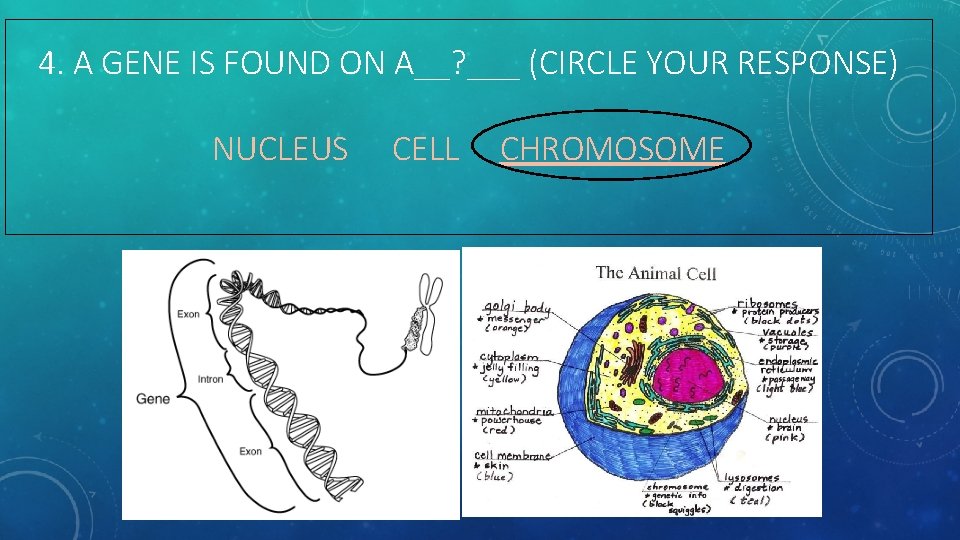
4. A GENE IS FOUND ON A__? ___ (CIRCLE YOUR RESPONSE) NUCLEUS CELL CHROMOSOME
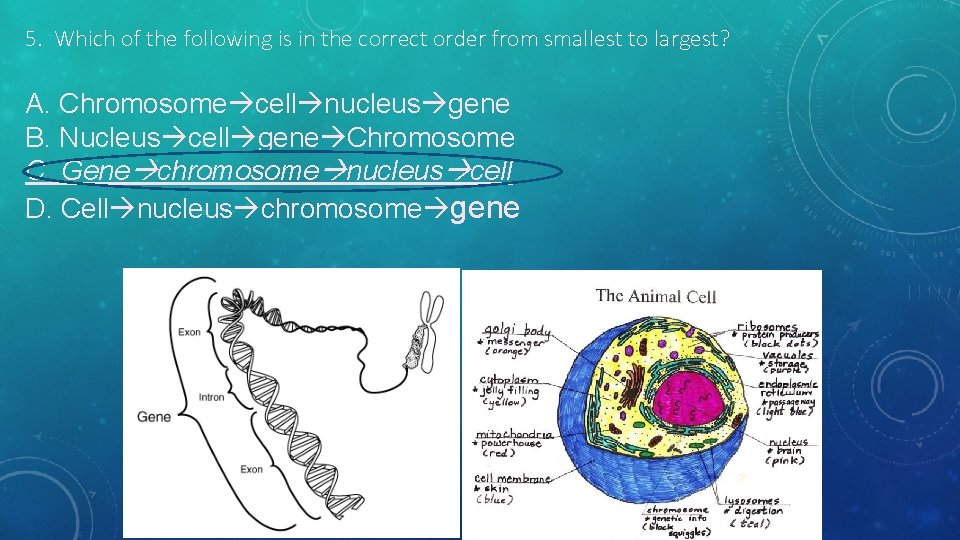
5. Which of the following is in the correct order from smallest to largest? A. Chromosome cell nucleus gene B. Nucleus cell gene Chromosome C. Gene chromosome nucleus cell D. Cell nucleus chromosome gene
6. In some parts of the world there are versions of a trait that are more apparent than others. For example, in a given country there is a higher number of brown eyed people verses green eyed. How does heredity cause this high frequency or trait? A. The climate will determine the frequency of the trait over time. B. People that have the dominant trait reproduce with others who have the same trait and pass it on to their offspring. C. The trait is part of the culture so everyone within the culture will have the trait. D. If one parent has the gene for the trait the offspring will have it regardless of the other parents trait.
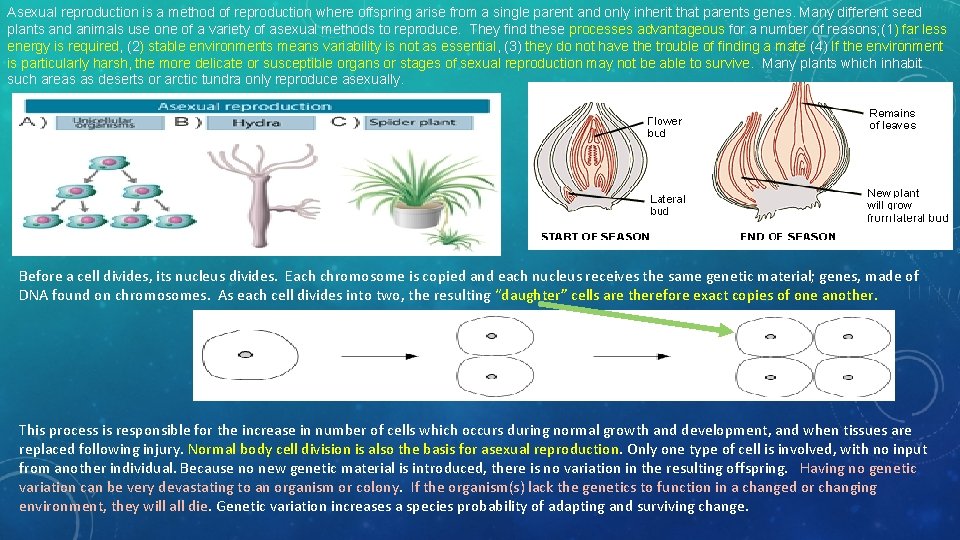
Asexual reproduction is a method of reproduction where offspring arise from a single parent and only inherit that parents genes. Many different seed plants and animals use one of a variety of asexual methods to reproduce. They find these processes advantageous for a number of reasons; (1) far less energy is required, (2) stable environments means variability is not as essential, (3) they do not have the trouble of finding a mate (4) If the environment is particularly harsh, the more delicate or susceptible organs or stages of sexual reproduction may not be able to survive. Many plants which inhabit such areas as deserts or arctic tundra only reproduce asexually. Before a cell divides, its nucleus divides. Each chromosome is copied and each nucleus receives the same genetic material; genes, made of DNA found on chromosomes. As each cell divides into two, the resulting “daughter” cells are therefore exact copies of one another. This process is responsible for the increase in number of cells which occurs during normal growth and development, and when tissues are replaced following injury. Normal body cell division is also the basis for asexual reproduction. Only one type of cell is involved, with no input from another individual. Because no new genetic material is introduced, there is no variation in the resulting offspring. Having no genetic variation can be very devastating to an organism or colony. If the organism(s) lack the genetics to function in a changed or changing environment, they will all die. Genetic variation increases a species probability of adapting and surviving change.
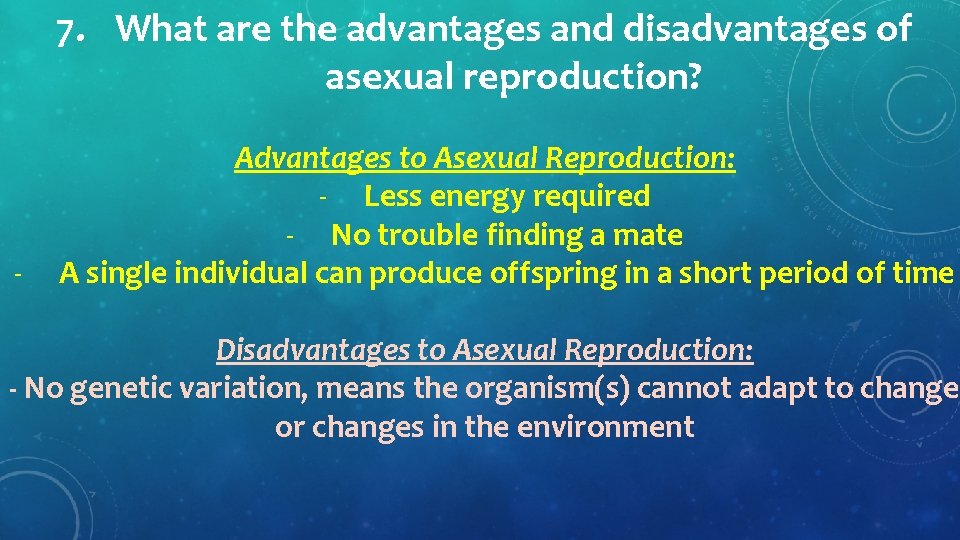
7. What are the advantages and disadvantages of asexual reproduction? Advantages to Asexual Reproduction: - Less energy required - No trouble finding a mate A single individual can produce offspring in a short period of time - Disadvantages to Asexual Reproduction: - No genetic variation, means the organism(s) cannot adapt to change or changes in the environment
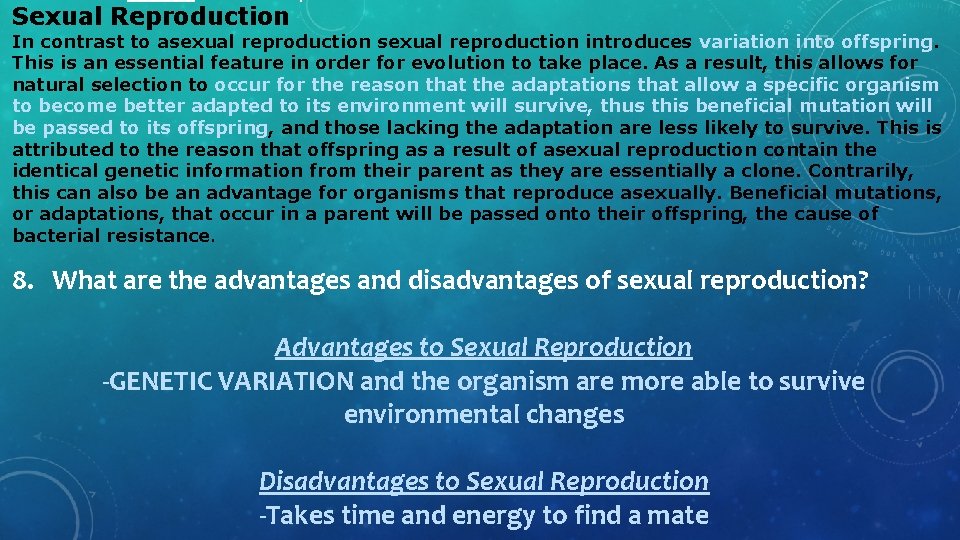
Sexual Reproduction In contrast to asexual reproduction introduces variation into offspring. This is an essential feature in order for evolution to take place. As a result, this allows for natural selection to occur for the reason that the adaptations that allow a specific organism to become better adapted to its environment will survive, thus this beneficial mutation will be passed to its offspring, and those lacking the adaptation are less likely to survive. This is attributed to the reason that offspring as a result of asexual reproduction contain the identical genetic information from their parent as they are essentially a clone. Contrarily, this can also be an advantage for organisms that reproduce asexually. Beneficial mutations, or adaptations, that occur in a parent will be passed onto their offspring, the cause of bacterial resistance. 8. What are the advantages and disadvantages of sexual reproduction? Advantages to Sexual Reproduction -GENETIC VARIATION and the organism are more able to survive environmental changes Disadvantages to Sexual Reproduction -Takes time and energy to find a mate
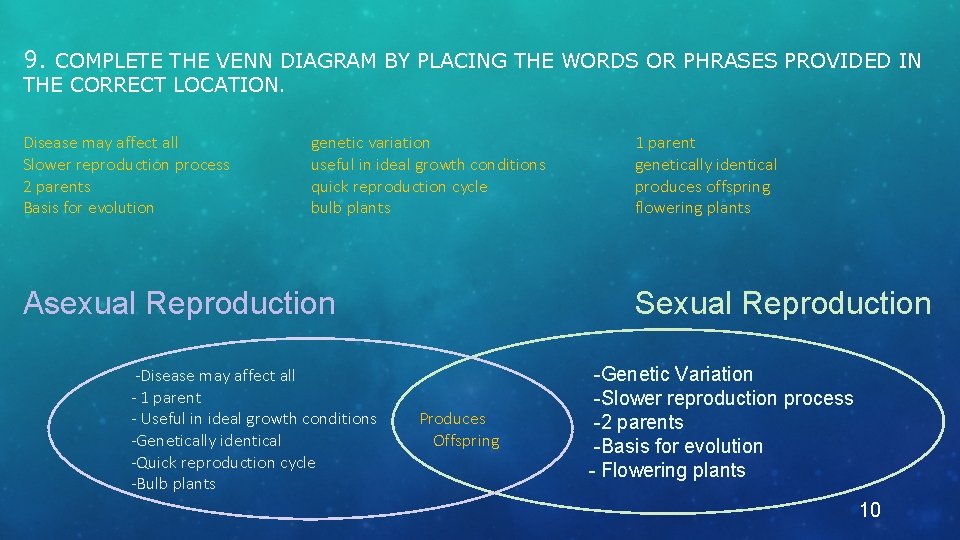
9. COMPLETE THE VENN DIAGRAM BY PLACING THE WORDS OR PHRASES PROVIDED IN THE CORRECT LOCATION. Disease may affect all Slower reproduction process 2 parents Basis for evolution genetic variation useful in ideal growth conditions quick reproduction cycle bulb plants Asexual Reproduction -Disease may affect all - 1 parent - Useful in ideal growth conditions Produces -Genetically identical Offspring -Quick reproduction cycle -Bulb plants 1 parent genetically identical produces offspring flowering plants Sexual Reproduction -Genetic Variation -Slower reproduction process -2 parents -Basis for evolution - Flowering plants 10
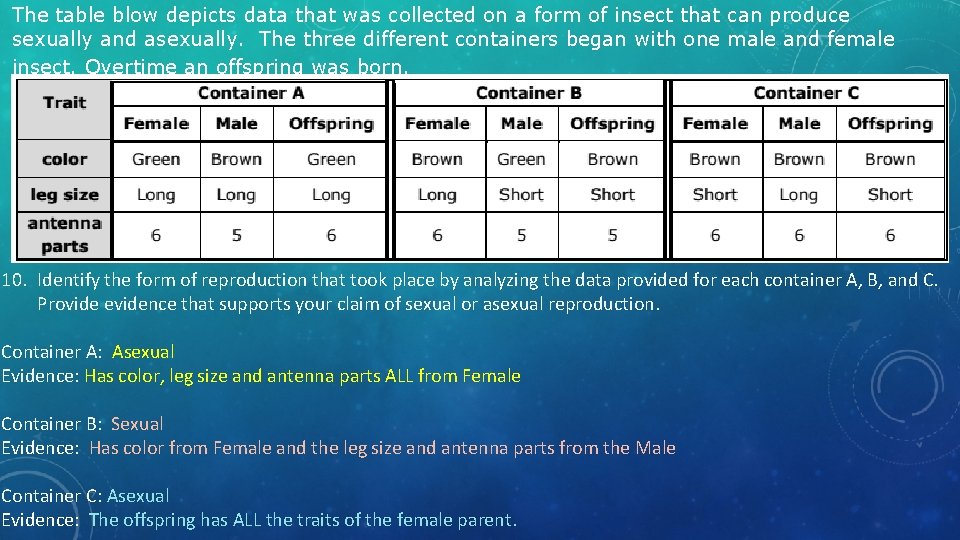
The table blow depicts data that was collected on a form of insect that can produce sexually and asexually. The three different containers began with one male and female insect. Overtime an offspring was born. 10. Identify the form of reproduction that took place by analyzing the data provided for each container A, B, and C. Provide evidence that supports your claim of sexual or asexual reproduction. Container A: Asexual Evidence: Has color, leg size and antenna parts ALL from Female Container B: Sexual Evidence: Has color from Female and the leg size and antenna parts from the Male Container C: Asexual Evidence: The offspring has ALL the traits of the female parent.
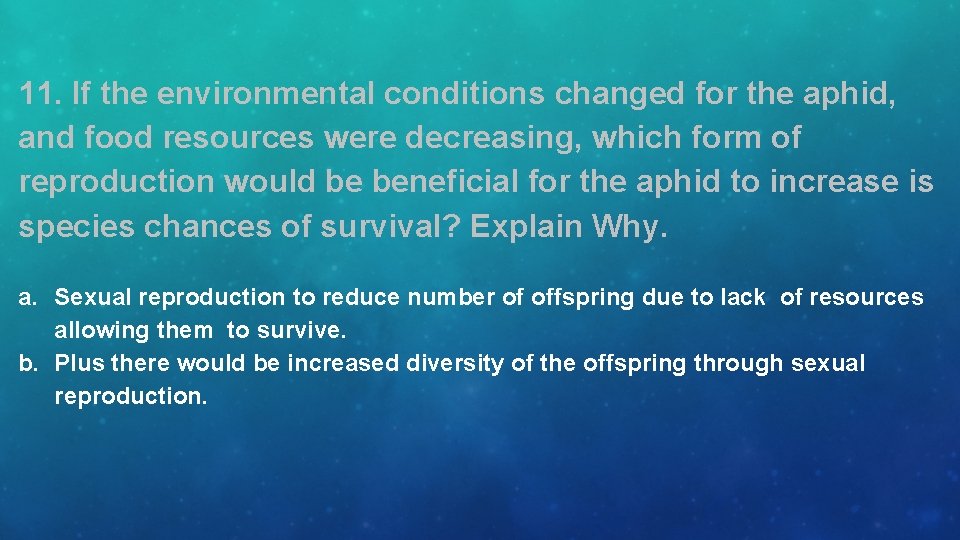
11. If the environmental conditions changed for the aphid, and food resources were decreasing, which form of reproduction would be beneficial for the aphid to increase is species chances of survival? Explain Why. a. Sexual reproduction to reduce number of offspring due to lack of resources allowing them to survive. b. Plus there would be increased diversity of the offspring through sexual reproduction.
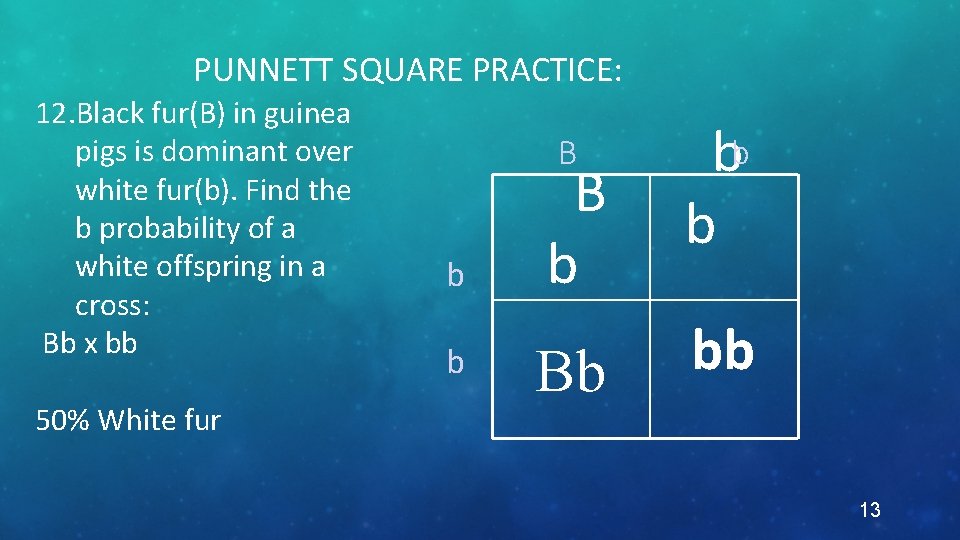
PUNNETT SQUARE PRACTICE: 12. Black fur(B) in guinea pigs is dominant over white fur(b). Find the b probability of a white offspring in a cross: Bb x bb 50% White fur B b b B b b bb Bb 13
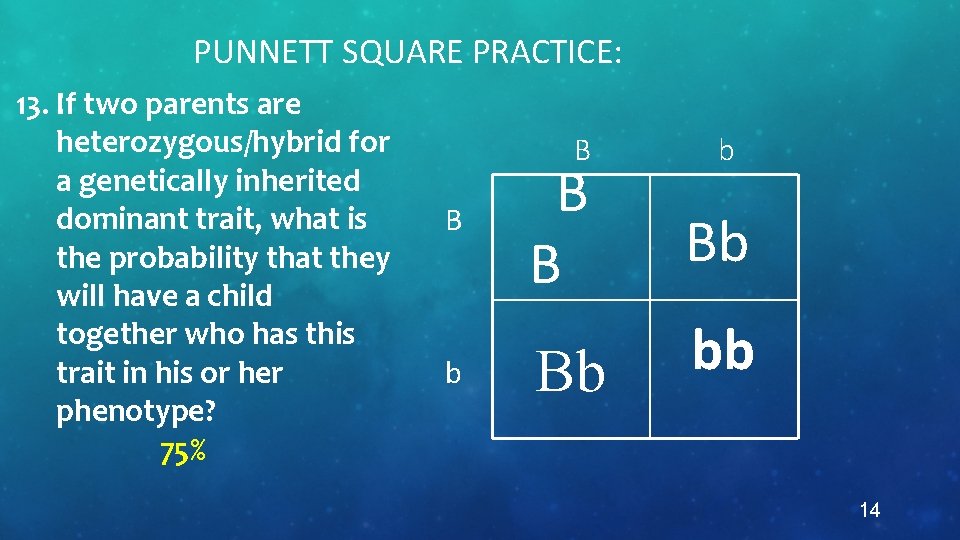
PUNNETT SQUARE PRACTICE: 13. If two parents are heterozygous/hybrid for a genetically inherited dominant trait, what is the probability that they will have a child together who has this trait in his or her phenotype? 75% B b B B B b bb Bb Bb 14
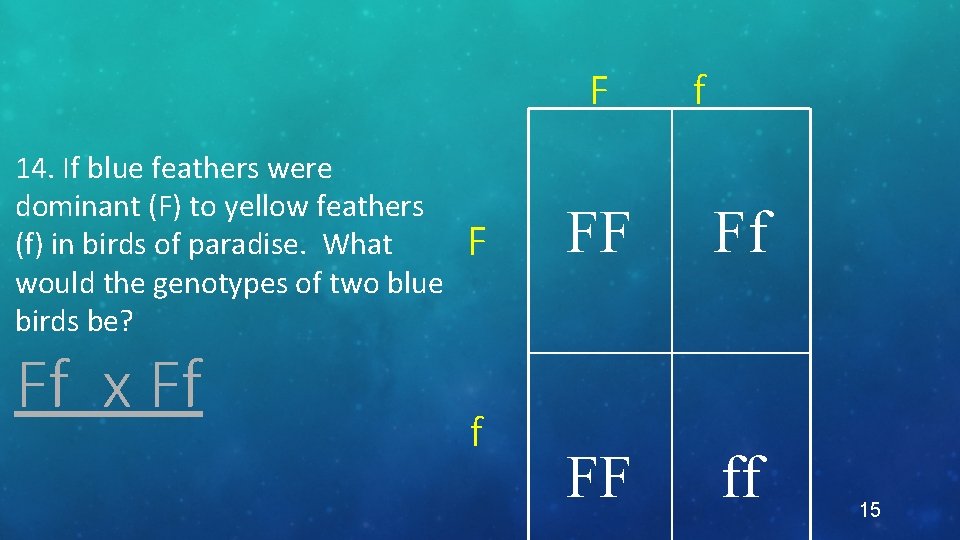
F 14. If blue feathers were dominant (F) to yellow feathers (f) in birds of paradise. What would the genotypes of two blue birds be? Ff x Ff F Ff f f FF ff 15