
1 HEART FAILURE By Dr Zahoor 2 HEART

1 HEART FAILURE By Dr. Zahoor
2 HEART FAILURE What is Heart Failure ? Ø It a condition when heart is not able to pump the blood to support physiological circulation Ø Cause may be structural or functional

3 HEART FAILURE Main causes • Ischemic Heart Disease – 35 -40% • Cardiomyopathy (dilated) 30 -34% • Hypertension 15 -20% Other causes • Valvular Heart Disease • Congenital Heart Disease Prognosis • 50% of patient with heart failure are dead in 5 years
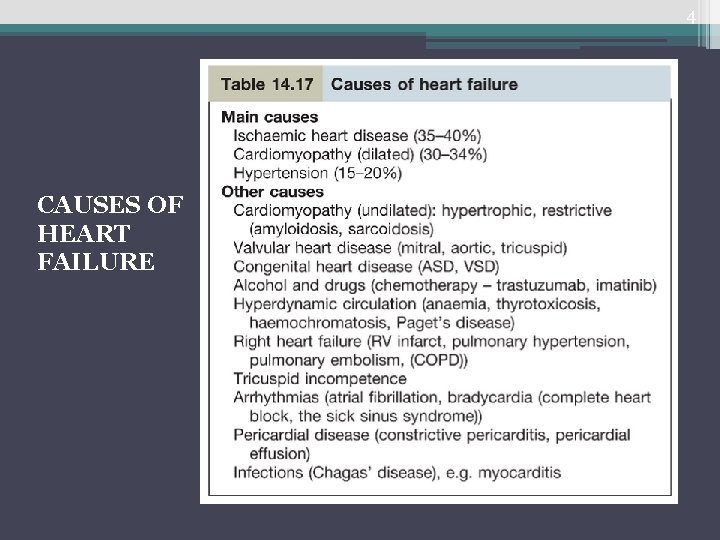
4 CAUSES OF HEART FAILURE

5 HEART FAILURE Pathophysiology • When heart fails, changes occur in heart and peripheral vascular system, they are - Ventricular dilatation - Increased ANP secretion - Salt and Water retention - Sympathetic stimulation - Peripheral Vasoconstriction • These changes are compensatory and maintain COP and peripheral perfusion
6 HEART FAILURE Pathophysiology (cont) • When there is heart failure, amount of blood ejected per beat decreases, there is more enddiastolic volume • Heart rate increases, therefore, any reduction of stroke volume is compensated by increased heart rate to maintain COP • COP = Stroke Volume × Heart Rate

7 HEART FAILURE Pathophysiology (cont) • When there is severe cardiac dysfunction, increased venous pressure on left side of the heart leads to back pressure in lungs and causes dyspnoea (due to accumulation of alveolar fluid) • There is hepatic enlargement, Ascites and dependent edema, due to right ventricle failure In severe heart failure, COP is reduced at rest

8 HEART FAILURE Pathophysiology (cont) Outflow Resistance (after load) • Normally ventricle contract against load or resistance which is formed by 1. Pulmonary and Systemic Resistance 2. Blood Vessel wall 3. Volume of blood that is ejected • Increase in after load – decreases cardiac output, it will increase end diastolic volume and causes dilatation of ventricle

9 HEART FAILURE Pathophysiology (cont) • Decrease cardiac output leads to diminished renal perfusion, activating Renin – Angiotensin – Aldosterone system and increases salt and water retention

10 HEART FAILURE Pathophysiology (cont) MYOCARDIAL REMODELING IN HEART FAILURE • There is alteration in ventricular size, shape, and function in clinical conditions e. g. hypertension, Cardiomyopathy, valvular heart disease and MI
11 HEART FAILURE Pathophysiology (cont) Natriuretic Peptides – ANP, BNP • ANP – Atrial Natriuretic Peptide is released from atrial myocyte in response to stretch • ANP is increased in CCF - causes diuresis, natriuresis, vasodilatation, and suppression of Renin – Angiotensin System • BNP – Brain Natriuretic Peptide It is called BNP because it was first discovered in brain, but it is predominantly secreted by ventricles and has similar action of ANP

12 HEART FAILURE Summary of pathophysiology changes
13 TYPES OF HEART FAILURE 1. Left sided heart failure 2. Right sided heart failure 3. Biventricular heart failure 1. Left sided heart failure • There is reduction in LV output and increase in left atrial pressure, pulmonary venous pressure which causes pulmonary edema and presents with dyspnoea
14 TYPES OF HEART FAILURE 2. Right sided heart failure • It occurs in chronic lung disease, pulmonary valve stenosis. There is reduction of RV output and back pressure on right atrium ( Increased JVP, Liver enlargement, peripheral edema ). 3. Biventricular failure • It affects both ventricle and occurs in dilated Cardiomyopathy, ischemic heart disease, or due to left ventricular failure which leads to increase LA pressure, pulmonary hypertension and RV failure.
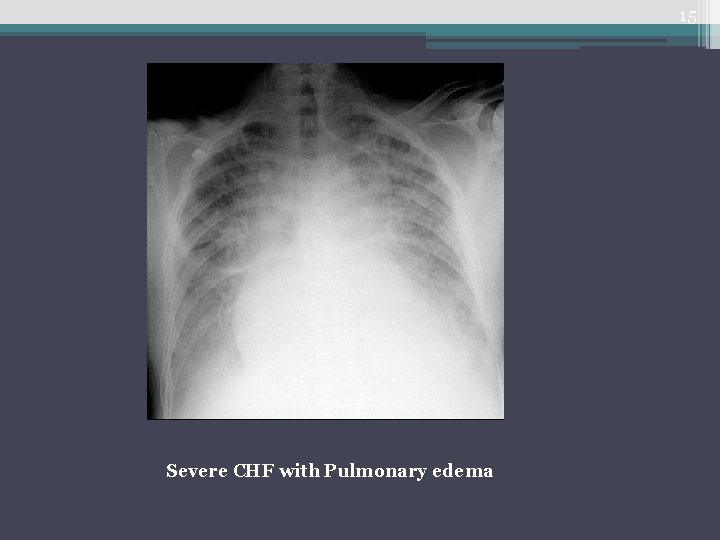
15 Severe CHF with Pulmonary edema

16 HEART FAILURE Clinical Syndrome of Heart Failure Heart failure can present as • Acute heart failure • Chronic heart failure We will discuss each one

17 HEART FAILURE Chronic Heart Failure • Left ventricular systolic dysfunction (LVSD) ▫ It is commonly caused by ischemic heart disease but also occurs with valvular heart disease and hypertension • Right ventricular systolic dysfunction (RVSD) ▫ It may be secondary to LVSD, Pulmonary Hypertension, Right Ventricular Infarction

18 HEART FAILURE Chronic Heart Failure • Diastolic Heart Failure It is a syndrome, where left ventricle relaxation is abnormal. There is stiffness in ventricular wall and decrease LV Compliance, leading to decrease diastolic ventricular filling with reduced cardiac output • Ejection fraction of left ventricle is about 45 -50% (Normal 60%) • Cause- Hypertension in elderly , Hypertrophic Cardiomyopathy (Restrictive)

19 HEART FAILURE Chronic Heart Failure • Symptoms and Signs of Chronic Heart Failure: • Symptoms: ▫ ▫ Exertional Dyspnoea Orthopnoea Proximal Nocturnal Dyspnoea Fatigue

20 HEART FAILURE Chronic Heart Failure Symptoms and Signs of Chronic Heart Failure: • Signs: ▫ ▫ Cardiomegaly 3 rd and 4 th Heart sound Elevated JVP Tachycardia ▫ ▫ ▫ Hypotension Bibasal crackles Pleural Effusion Ankle edema Ascitis Tender hepatomegaly

21 HEART FAILURE Classification of Heart Failure

22 HEART FAILURE Chronic Heart Failure • Diagnosis of Heart failure ▫ Symptoms and signs of Heart failure eg. Breathlessness, ↑JVP, Ankle Edema, Liver enlargement ▫ X-ray chest – look for cardiomegaly, pulmonary congestion and pulmonary edema ▫ ECG – for ischemia, hypertensive changes, arrhythmia ▫ Echocardiography – cardiac chambers, systolic and diastolic functions, valvular heart disease, cardiomyopathy
23 HEART FAILURE Chronic Heart Failure • Diagnosis of Heart failure Other Investigations • Blood test ▫ FBC, Liver Biochemistry, U&E, Cardiac enzymes • Nuclear cardiography ▫ Radionucleotide angiography (RNA) for ventricular ejection fraction • SPECT - Single Photon Emission Computed Tomography can demonstrate myocardial ischemia and dysfunction of myocardium • CMR (Cardiac MRI) for myocardial dysfunction

24 HEART FAILURE Chronic Heart Failure (cont) Investigations • Cardiac Catheterization � For IHD, revascularization � Pressures in heart chambers • Cardiac Biopsy � Cardiomyopathies e. g. Amyloid � Follow up in transplanted patients to assess rejections • Ambulatory 24 hour ECG monitoring (HOLTER) in patients with history of Arrhythmias
25 HEART FAILURE Chronic Heart Failure • Treatment of heart failure ( Drugs we will see ) • Prevention ▫ Avoid smoking ▫ Avoid alcohol ▫ Treat hypertension ▫ Treat Diabetes Mellitus ▫ Treat Hypercholesterolaemia

26 HEART FAILURE (cont) Chronic Heart Failure • Prevention (cont) General Lifestyle ▫ Control of obesity ▫ Dietary modifications –avoid large meal ▫ Restrict salt intake ▫ Low level exercise – walking 20 -30 minutes five times per week when tolerated

27 HEART FAILURE Chronic Heart Failure • PREVENTION General Lifestyle (cont) • Driving �Person can drive �Symptomatic heart failure if present, person should not drive large lorries and buses • Multidisciplinary team approach Many health care personal are required �Nurse (specialist in heart failure) �Dietician �Pharmacist �Occupational therapist �Physiotherapist
28 HEART FAILURE Chronic Heart Failure • Treatment of Chronic heart failure Drug Treatment • Diuretics – causes renal excretion of salt and water �Loop diuretics e. g. furosemide (lasix) �Thiazide diuretics e. g. Hydrochlorothiazide • ACE inhibitors – e. g. Captopril, Enalapril �they are useful, they slow down the development of heart failure and improve survival � Side effect – cough, hypotension, hyperkalemia, renal dysfunction �Contraindications – renal artery stenosis, pregnancy
29 HEART FAILURE Chronic Heart Failure • Treatment of Chronic heart failure Drug Treatment (cont) • Angiotensin II receptor antagonist (ARA) e. g. Valsartan �They are second line therapy, used if patient is not tolerant to ACE inhibitors �They do not affect bradykinin metabolism therefore do not cause cough • Beta Blockers – e. g. Tenormin, Concor �They reduce cardiovascular morbidity and mortality �They decrease oxygen demand �In heart failure start with low dose and gradually increase dose

30 HEART FAILURE Chronic Heart Failure • Treatment of Chronic heart failure Drug Treatment (cont) • Aldosterone antagonist – e. g. Spironolactone �Improves survival in heart failure • Cardiac glycoside – e. g. Digoxin �Indicated in AF with heart failure • Vasodilators & Nitrates – Hydralazine & Nitrates reduce after load and preload �They are used in patients who can not tolerate ACEI and ARA • Prophylactic anticoagulant- in HF , as there is four fold increased risk of stroke

31 HEART FAILURE Chronic Heart Failure (CHF) • Treatment of Chronic heart failure Non Pharmacological Treatment • Biventricular pacemaker & Implantable cardioverter defibrillator ▫ Indicated in patients with SA node and AV node conduction blocks
32 HEART FAILURE CHF - Non Pharmacological Treatment (cont) • Cardiac Transplantation - Indicated in younger patient with severe heart failure, whose life expectancy is less than 6 months - After heart transplant expected 1 year survival over 90% and 5 year survival 75% - Quality of life is improved

33

34
35 ACUTE HEART FAILURE (AHF)
36 ACUTE HEART FAILURE (AHF) • AHF occurs with rapid onset of symptoms and signs of heart failure • This causes severe dyspnoea, pulmonary edema and peripheral edema • AHF has poor prognosis with 60 days mortality of 10% Poor prognostic indicators • Pulmonary capillary wedge pressure (PCWP) more than 16 mm. Hg • Decreased serum Na+ • Increase left ventricle end-diastolic dimension on Echo • Decreased O 2 consumption
37 ACUTE HEART FAILURE (AHF) Aetiology of AHF • Ischaemic Heart Disease – acute coronary syndrome can cause papillary muscle rupture or VSD (Ventricular Septal Defect) • People with Valvular heart disease can present with AHF due to endocarditis or prosthetic valve thrombosis • People with Hypertension can present with pulmonary edema • Acute and Chronic Kidney Disease can cause fluid overload and pulmonary edema • Atrial fibrillation (AF) is associated with AHF and may require cardio version
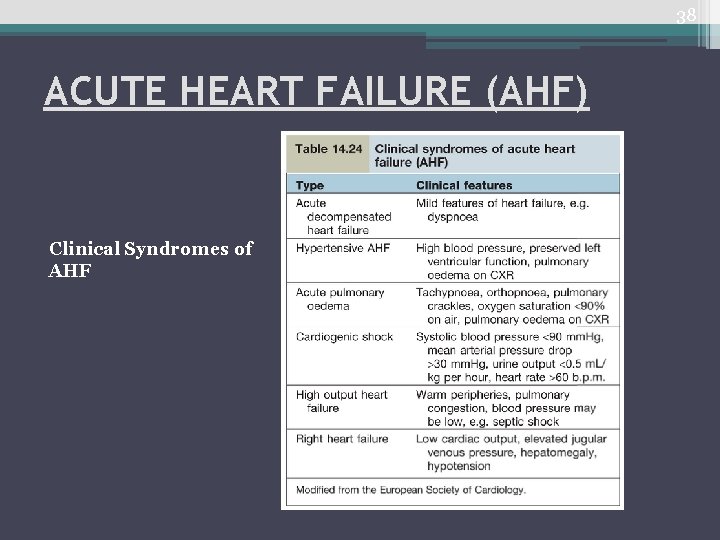
38 ACUTE HEART FAILURE (AHF) Clinical Syndromes of AHF
39 ACUTE HEART FAILURE (AHF) Diagnosis • 12 lead ECG – for acute coronary syndrome, left ventricular hypertrophy, AF • X-ray chest – for cardiomegly, pulmonary edema • Blood investigations – cardiac enzymes • Blood BNP – more than 100 PG/m indicates heart failure • Echocardiography – to confirm heart failure
40 ACUTE HEART FAILURE (AHF) Treatment of AHF Goals of Treatment in AHF • To relieve symptoms • Reduction in stay in hospitals • Reduction in mortality from AHF Monitor • Heart rate, BP, temperature and cardiac monitoring • All patient require low molecular weight heparin as prophylactic coagulation e. g. ENOXAPARIN 1 mg/kg S. C × 2 daily • Atrial blood gases Central venous canulation for 1/V medication
41 ACUTE HEART FAILURE (AHF) Treatment of AHF (cont) • Initial therapy O 2 Diuretic e. g. lasix Vasodilator – GTN infusion Inotropic support e. g. Dobutamine • If blood pressure is low, use nor-epinephrine
42 Case History – A fit woman with shortness of breath and flu like symptoms A 23 year old woman, who is long distance runner and extremely fit and well, has been brought to A & E department. Since yesterday she has been increasingly short of breath. She had been unwell with a flu like illness and fever over the last week, she also had mild chest discomfort. On examination she appears unwell and short of breath. Her respiratory rate is 34/min, BP 88/50 mm. Hg, and pulse 140/min. Her temperature 38. 5 o. C and Sp. O 2 89%. Her JVP is raised and on auscultation, there is 3 rd heart sound. There are wide spread fine inspiratory crackles.
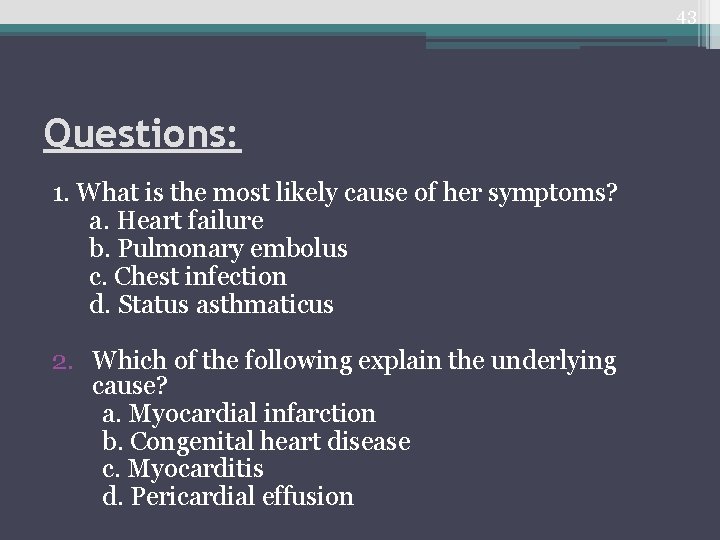
43 Questions: 1. What is the most likely cause of her symptoms? a. Heart failure b. Pulmonary embolus c. Chest infection d. Status asthmaticus 2. Which of the following explain the underlying cause? a. Myocardial infarction b. Congenital heart disease c. Myocarditis d. Pericardial effusion
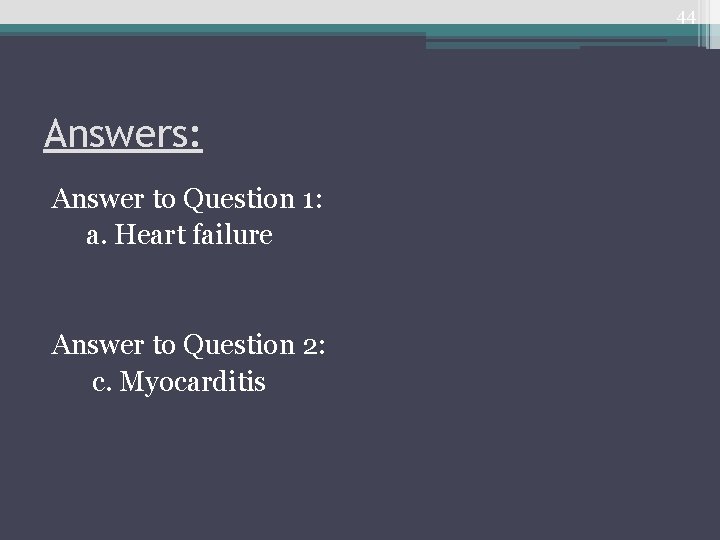
44 Answers: Answer to Question 1: a. Heart failure Answer to Question 2: c. Myocarditis

45 Thank you
- Slides: 45