
1 Hb structure function Department of Biochemistry V

1
Hb structure, function © Department of Biochemistry (V. P. ), Faculty of Medicine, MU Brno 2009 2
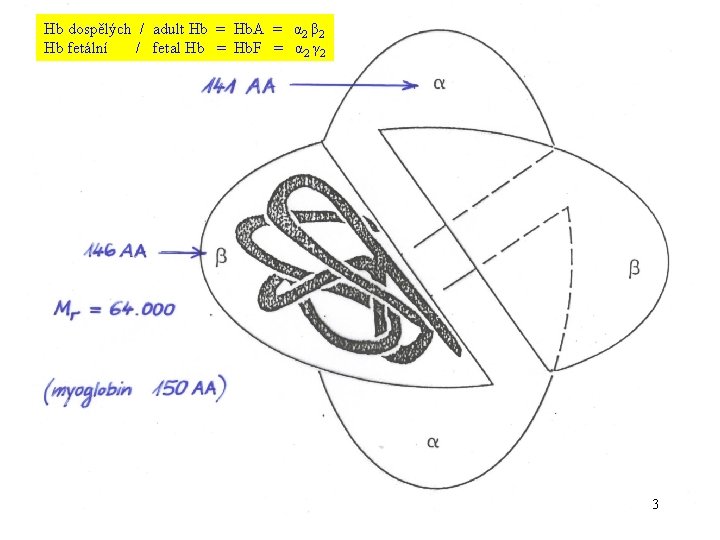
Hb dospělých / adult Hb = Hb. A = α 2 β 2 Hb fetální / fetal Hb = Hb. F = α 2 γ 2 3
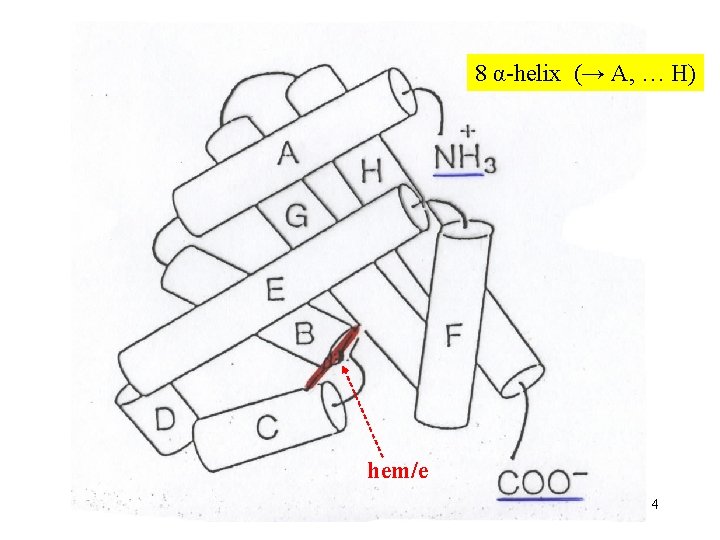
8 α-helix (→ A, … H) hem/e 4
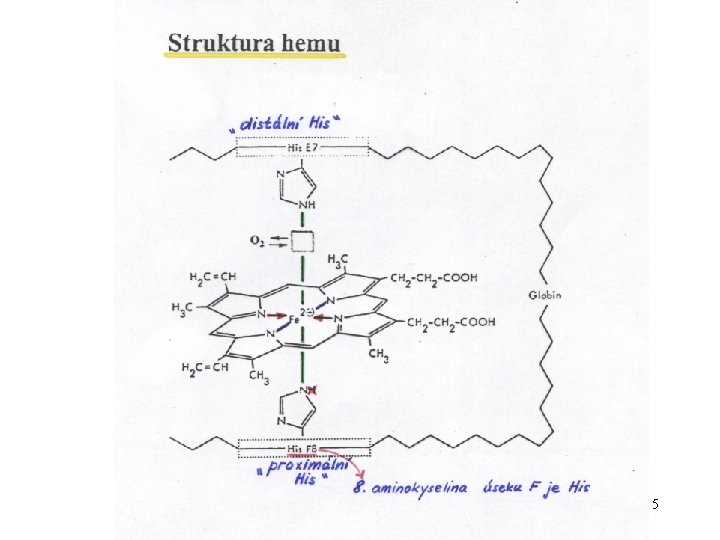
5
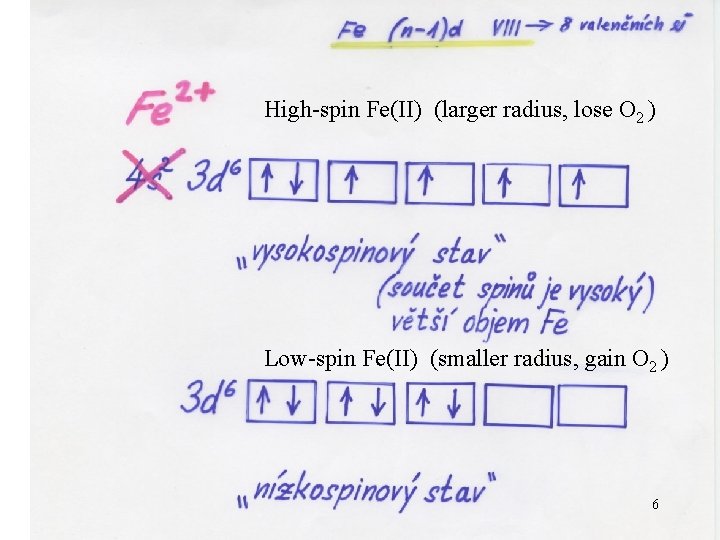
High-spin Fe(II) (larger radius, lose O 2 ) Low-spin Fe(II) (smaller radius, gain O 2 ) 6
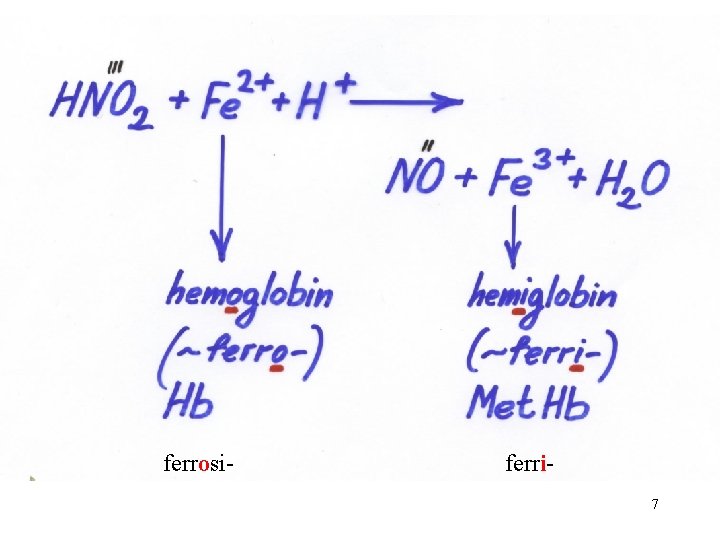
ferrosi- ferri 7
Iron in hem - remark Iron is bonded to the cyclic tetrapyrrole so, that formal two pyrrole nuclei lost H+ from their nitrogens. This way free electrone pair was formed on every from two nitrogens. The pair of electrons creates dative covalent bond with Fe 2+ (on every from two nuclei). Fe 2+ brings in the molecule of heme 2 positive charges, „lost“ as 2 H+. Heme in hemoglobin is now electric neutral and bonds also electric neutral moleculs (O 2 , CO) too. The oxidation of iron on Fe 3+ ( hemiglobin, methemoglobin) leads to gain of one positive charge in molecule of heme. Then heme is a cation and bonds anionts (e. g. CN-, however it is not able to bond electric neutral molecules – so it cannot transfer oxygen). The facts are important among others for toxicology. 8
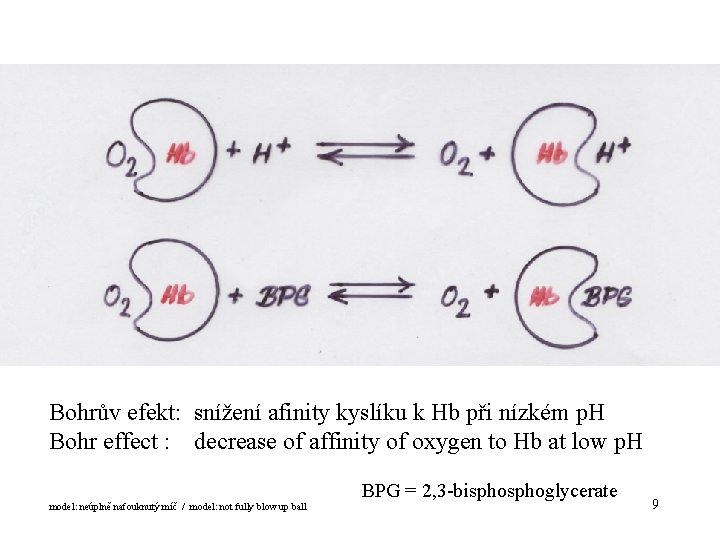
Bohrův efekt: snížení afinity kyslíku k Hb při nízkém p. H Bohr effect : decrease of affinity of oxygen to Hb at low p. H model: neúplně nafouknutý míč / model: not fully blow up ball BPG = 2, 3 -bisphoglycerate 9
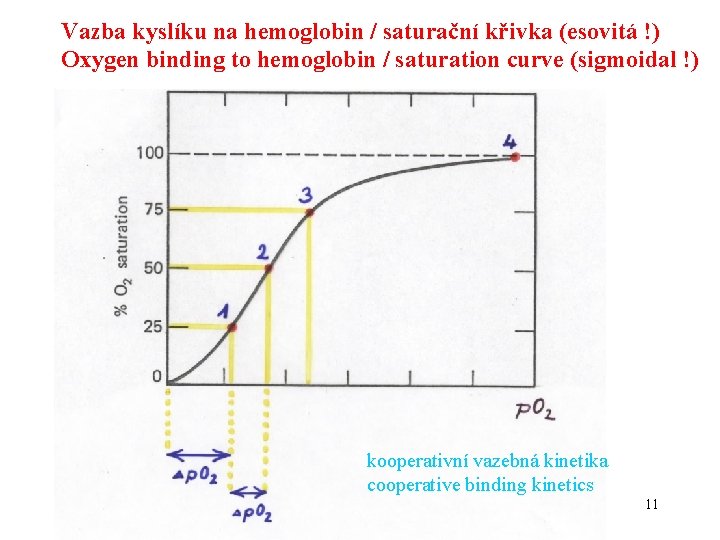
Vazba kyslíku na hemoglobin / saturační křivka (esovitá !) Oxygen binding to hemoglobin / saturation curve (sigmoidal !) kooperativní vazebná kinetika cooperative binding kinetics 11
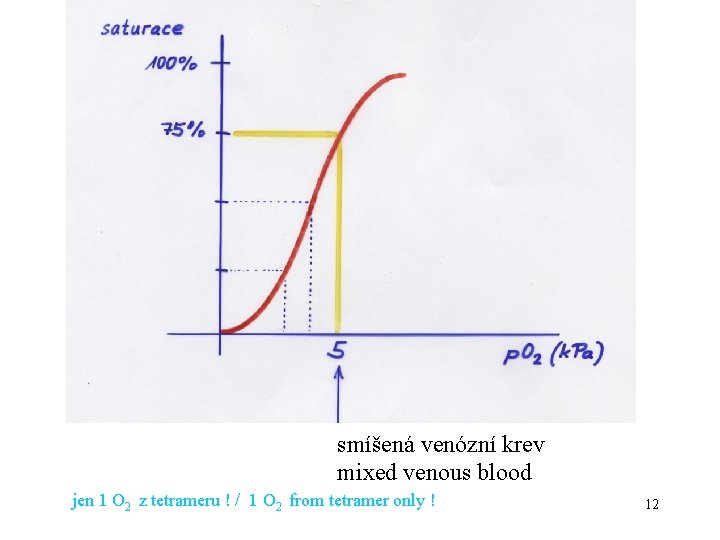
smíšená venózní krev mixed venous blood jen 1 O 2 z tetrameru ! / 1 O 2 from tetramer only ! 12
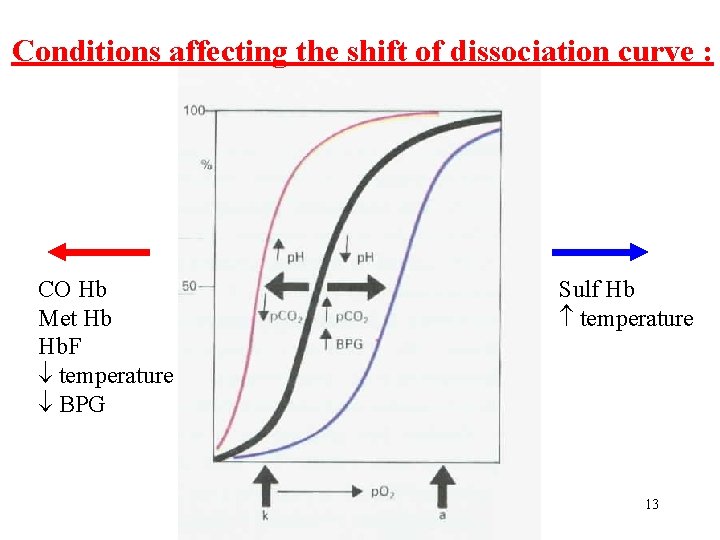
Conditions affecting the shift of dissociation curve : CO Hb Met Hb Hb. F temperature BPG Sulf Hb temperature 13
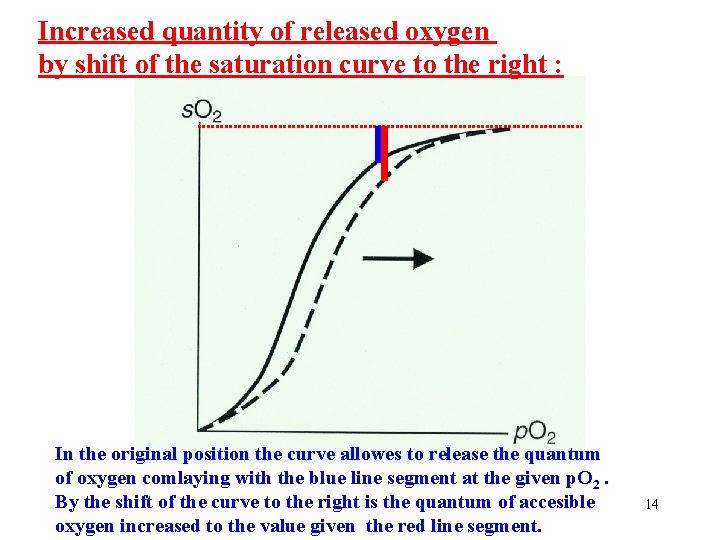
Increased quantity of released oxygen by shift of the saturation curve to the right : In the original position the curve allowes to release the quantum of oxygen comlaying with the blue line segment at the given p. O 2. By the shift of the curve to the right is the quantum of accesible oxygen increased to the value given the red line segment. 14
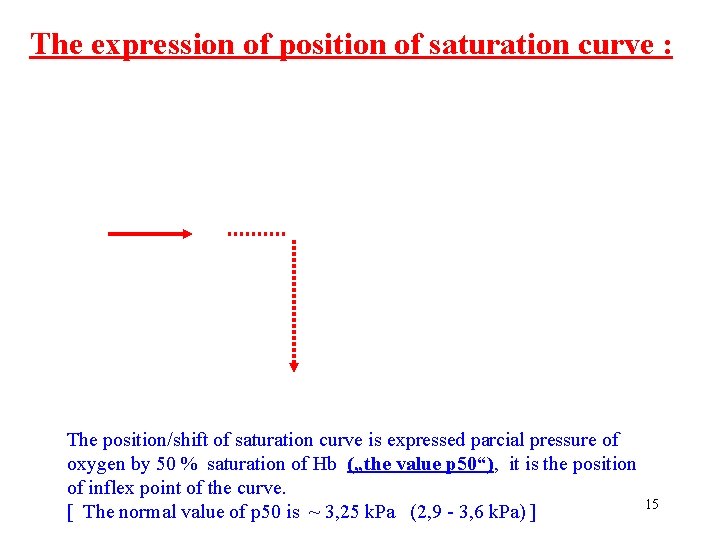
The expression of position of saturation curve : The position/shift of saturation curve is expressed parcial pressure of oxygen by 50 % saturation of Hb („the value p 50“), it is the position of inflex point of the curve. [ The normal value of p 50 is ~ 3, 25 k. Pa (2, 9 - 3, 6 k. Pa) ] 15

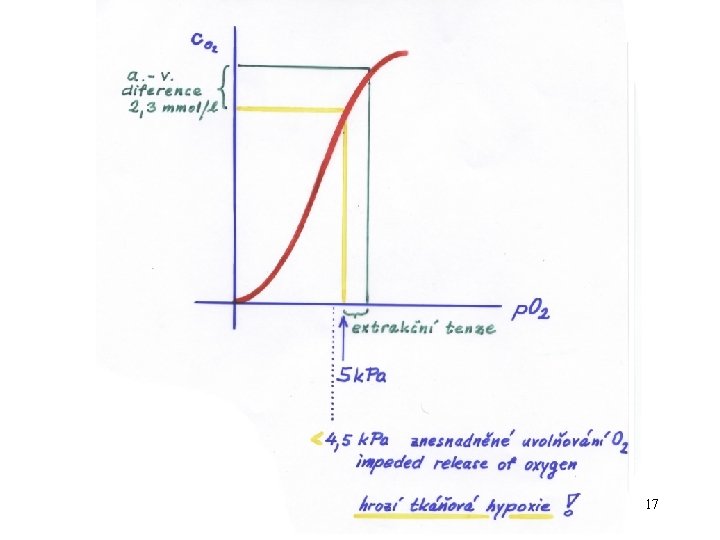
s. O 2 c. O 2 (mmol / l) p. O 2 saturační křivka saturation curve p. O 2 absorpční křivka absoption curve 16
17
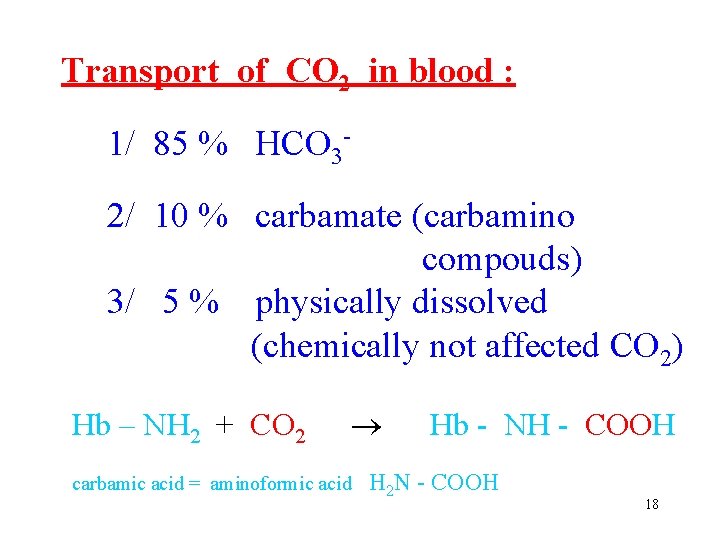
Transport of CO 2 in blood : 1/ 85 % HCO 32/ 10 % carbamate (carbamino compouds) 3/ 5 % physically dissolved (chemically not affected CO 2) Hb – NH 2 + CO 2 carbamic acid = aminoformic acid Hb - NH - COOH H 2 N - COOH 18
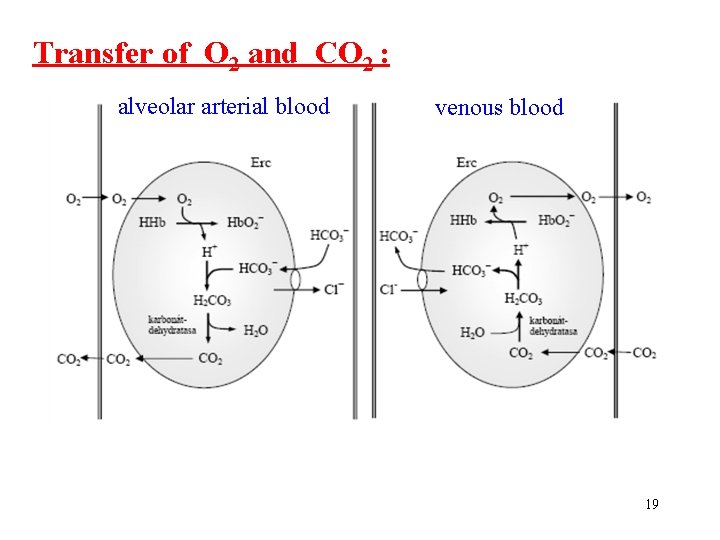
Transfer of O 2 and CO 2 : alveolar arterial blood venous blood 19
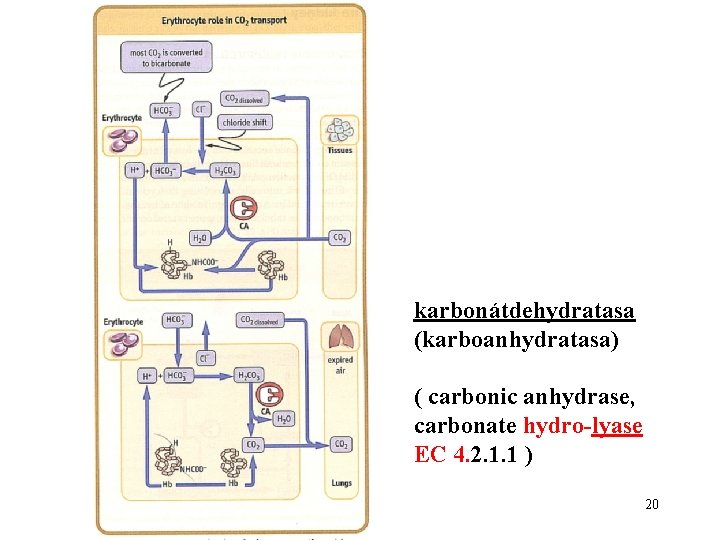
karbonátdehydratasa (karboanhydratasa) ( carbonic anhydrase, carbonate hydro-lyase EC 4. 2. 1. 1 ) 20
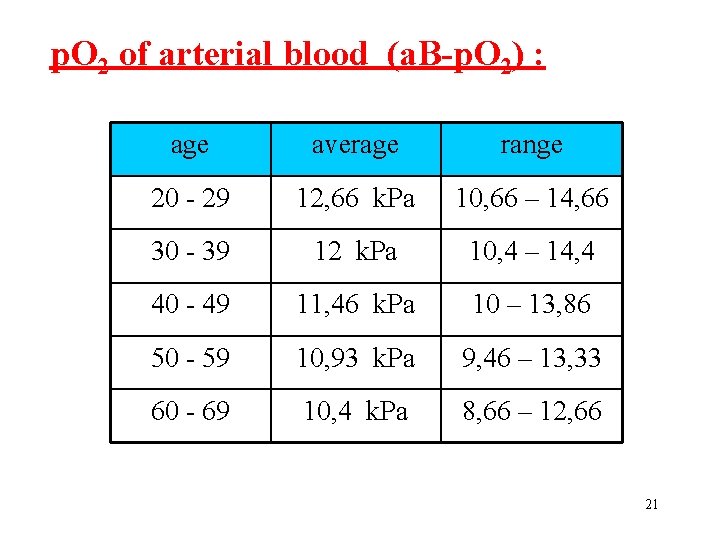
p. O 2 of arterial blood (a. B-p. O 2) : age average range 20 - 29 12, 66 k. Pa 10, 66 – 14, 66 30 - 39 12 k. Pa 10, 4 – 14, 4 40 - 49 11, 46 k. Pa 10 – 13, 86 50 - 59 10, 93 k. Pa 9, 46 – 13, 33 60 - 69 10, 4 k. Pa 8, 66 – 12, 66 21
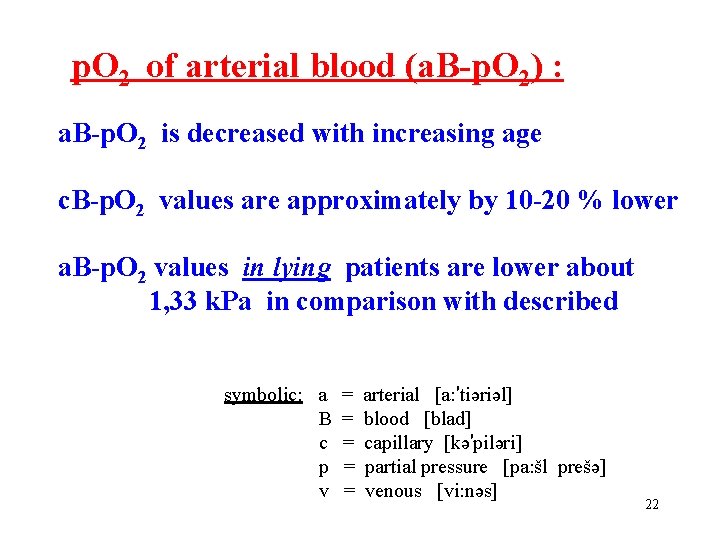
p. O 2 of arterial blood (a. B-p. O 2) : a. B-p. O 2 is decreased with increasing age c. B-p. O 2 values are approximately by 10 -20 % lower a. B-p. O 2 values in lying patients are lower about 1, 33 k. Pa in comparison with described symbolic: a B c p v = = = arterial [a: ′tiәriәl] blood [blad] capillary [kә′pilәri] partial pressure [pa: šl prešә] venous [vi: nәs] 22
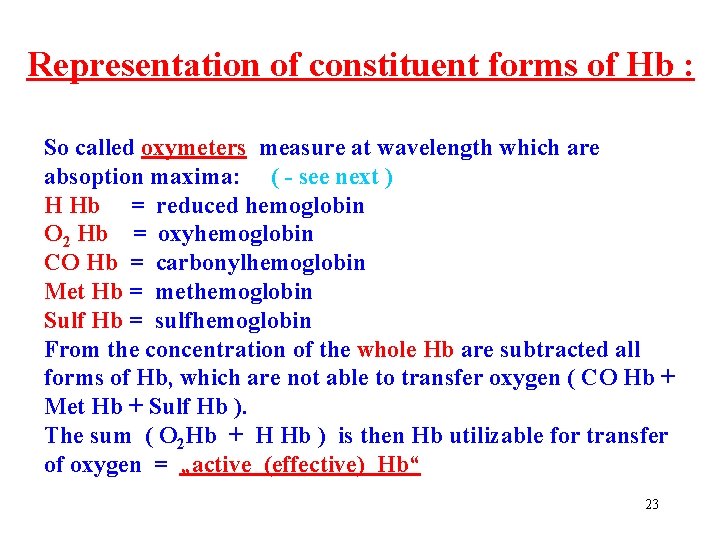
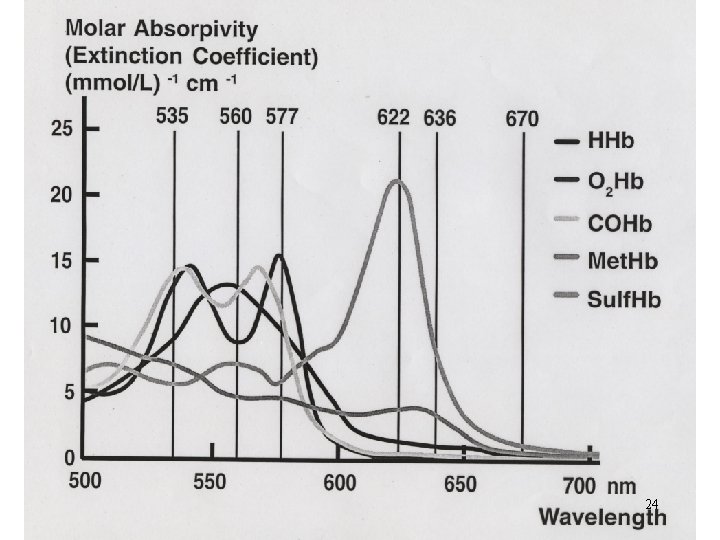
Representation of constituent forms of Hb : So called oxymeters measure at wavelength which are absoption maxima: ( - see next ) H Hb = reduced hemoglobin O 2 Hb = oxyhemoglobin CO Hb = carbonylhemoglobin Met Hb = methemoglobin Sulf Hb = sulfhemoglobin From the concentration of the whole Hb are subtracted all forms of Hb, which are not able to transfer oxygen ( CO Hb + Met Hb + Sulf Hb ). The sum ( O 2 Hb + H Hb ) is then Hb utilizable for transfer of oxygen = „active (effective) Hb“ 23
24
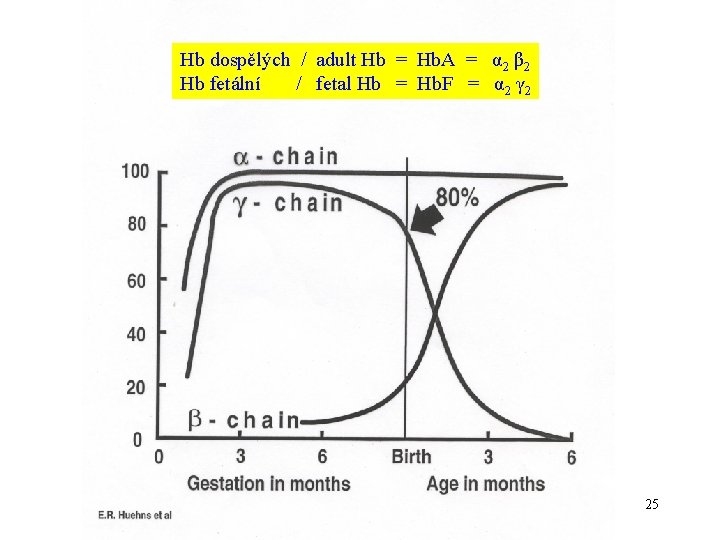
Hb dospělých / adult Hb = Hb. A = α 2 β 2 Hb fetální / fetal Hb = Hb. F = α 2 γ 2 25
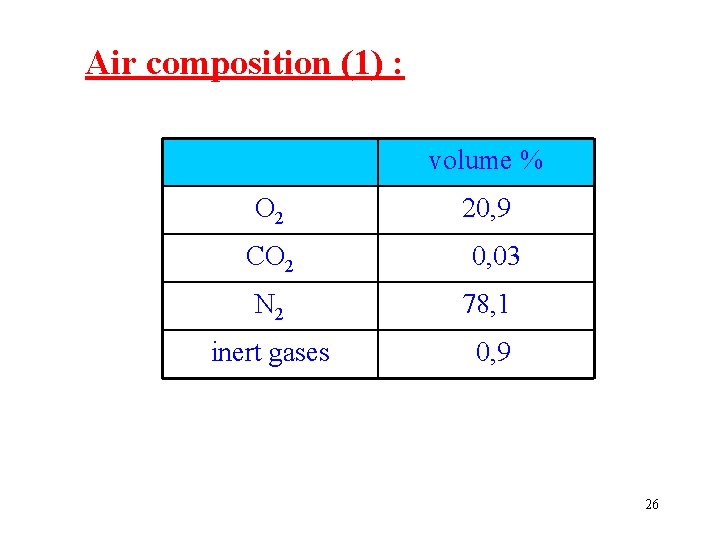
Air composition (1) : volume % O 2 CO 2 20, 9 0, 03 N 2 78, 1 inert gases 0, 9 26
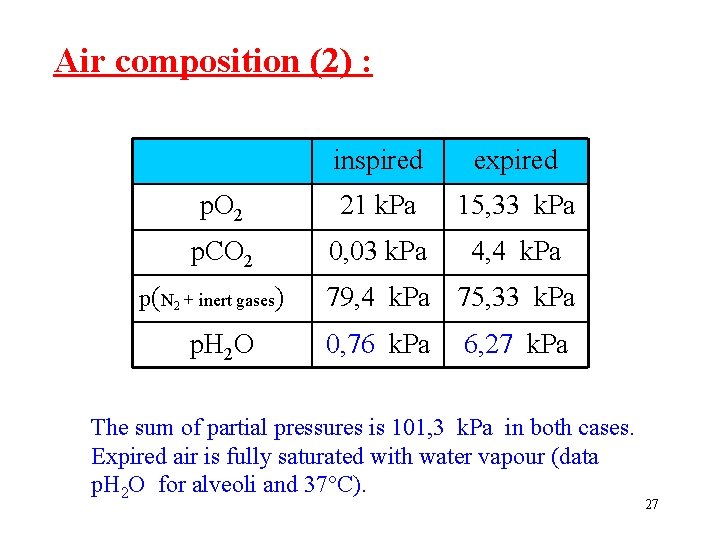
Air composition (2) : inspired expired p. O 2 21 k. Pa 15, 33 k. Pa p. CO 2 0, 03 k. Pa 4, 4 k. Pa p(N 2 + inert gases) p. H 2 O 79, 4 k. Pa 75, 33 k. Pa 0, 76 k. Pa 6, 27 k. Pa The sum of partial pressures is 101, 3 k. Pa in both cases. Expired air is fully saturated with water vapour (data p. H 2 O for alveoli and 37°C). 27

28
- Slides: 27