
1 Hazardous Waste Management Program Policy and Program
- Slides: 22
1 Hazardous Waste Management Program Policy and Program Support Branch Workload Analysis for Fiscal Year 2018 - 2019 October 26, 2020 Prepared by:
2 Slide Intentionally Left Blank SLIDE INTENTIONALLY LEFT BLANK
3 Purpose This workload analysis provides information on how the Policy and Program Support Branch: § Uses its current resources to meet legislative mandates and achieve its mission; § Tracks and manages projects to promote efficiency and effectiveness; § Produces outcomes to meet their mission; and § Identifies risks to program performance and effectiveness.
Mission Statements “DTSC’s mission is to protect California’s people, communities, and environment from toxic substances, to enhance economic vitality by restoring contaminated land, and to compel manufacturers to make safer consumer products. ” California Department of Toxic Substances Control Mission Statement “The mission of PPSB is to ensure that hazardous waste handlers and DTSC’s regulatory staff have the tools and information they need to safely manage hazardous waste and ensure compliance. ” Hazardous Waste Management Program Policy and Program Support Branch Mission Statement 4
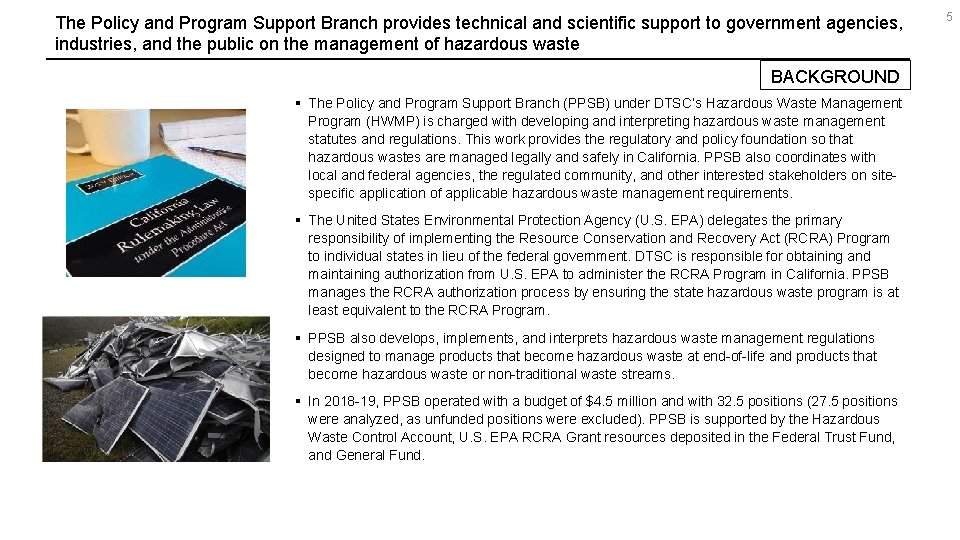
The Policy and Program Support Branch provides technical and scientific support to government agencies, industries, and the public on the management of hazardous waste BACKGROUND § The Policy and Program Support Branch (PPSB) under DTSC’s Hazardous Waste Management Program (HWMP) is charged with developing and interpreting hazardous waste management statutes and regulations. This work provides the regulatory and policy foundation so that hazardous wastes are managed legally and safely in California. PPSB also coordinates with local and federal agencies, the regulated community, and other interested stakeholders on sitespecific application of applicable hazardous waste management requirements. § The United States Environmental Protection Agency (U. S. EPA) delegates the primary responsibility of implementing the Resource Conservation and Recovery Act (RCRA) Program to individual states in lieu of the federal government. DTSC is responsible for obtaining and maintaining authorization from U. S. EPA to administer the RCRA Program in California. PPSB manages the RCRA authorization process by ensuring the state hazardous waste program is at least equivalent to the RCRA Program. § PPSB also develops, implements, and interprets hazardous waste management regulations designed to manage products that become hazardous waste at end-of-life and products that become hazardous waste or non-traditional waste streams. § In 2018 -19, PPSB operated with a budget of $4. 5 million and with 32. 5 positions (27. 5 positions were analyzed, as unfunded positions were excluded). PPSB is supported by the Hazardous Waste Control Account, U. S. EPA RCRA Grant resources deposited in the Federal Trust Fund, and General Fund. 5
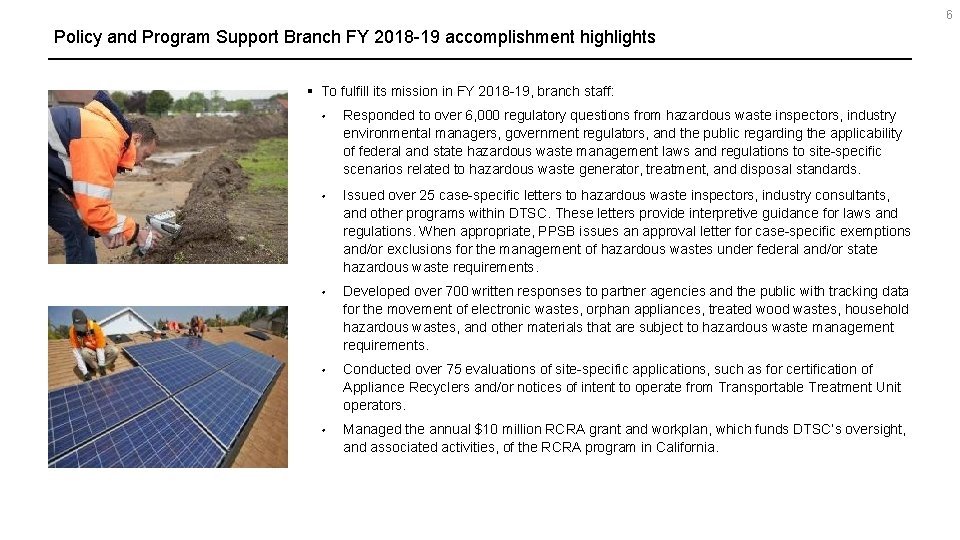
6 Policy and Program Support Branch FY 2018 -19 accomplishment highlights § To fulfill its mission in FY 2018 -19, branch staff: Responded to over 6, 000 regulatory questions from hazardous waste inspectors, industry environmental managers, government regulators, and the public regarding the applicability of federal and state hazardous waste management laws and regulations to site-specific scenarios related to hazardous waste generator, treatment, and disposal standards. Issued over 25 case-specific letters to hazardous waste inspectors, industry consultants, and other programs within DTSC. These letters provide interpretive guidance for laws and regulations. When appropriate, PPSB issues an approval letter for case-specific exemptions and/or exclusions for the management of hazardous wastes under federal and/or state hazardous waste requirements. Developed over 700 written responses to partner agencies and the public with tracking data for the movement of electronic wastes, orphan appliances, treated wood wastes, household hazardous wastes, and other materials that are subject to hazardous waste management requirements. Conducted over 75 evaluations of site-specific applications, such as for certification of Appliance Recyclers and/or notices of intent to operate from Transportable Treatment Unit operators. Managed the annual $10 million RCRA grant and workplan, which funds DTSC’s oversight, and associated activities, of the RCRA program in California.
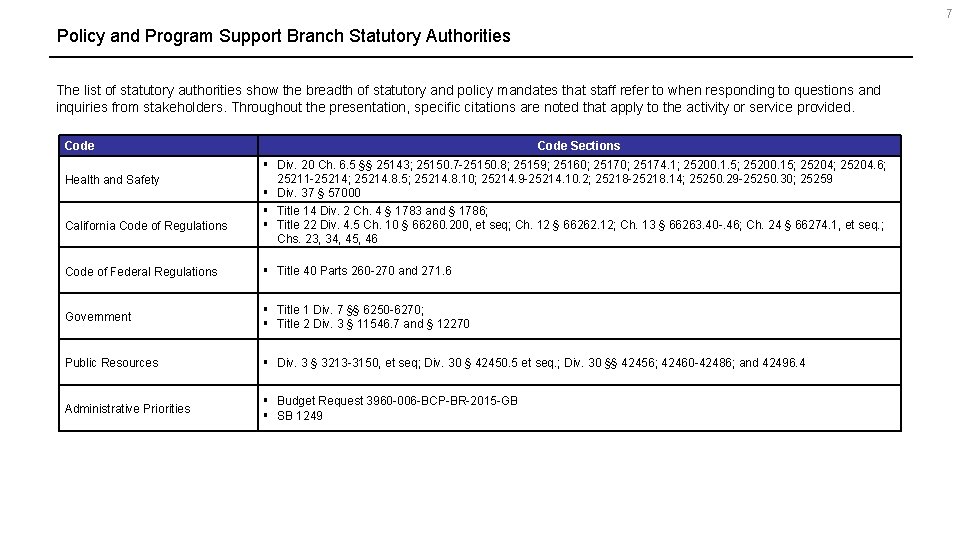
7 Policy and Program Support Branch Statutory Authorities The list of statutory authorities show the breadth of statutory and policy mandates that staff refer to when responding to questions and inquiries from stakeholders. Throughout the presentation, specific citations are noted that apply to the activity or service provided. Code Health and Safety California Code of Regulations Code Sections § Div. 20 Ch. 6. 5 §§ 25143; 25150. 7 -25150. 8; 25159; 25160; 25174. 1; 25200. 1. 5; 25200. 15; 25204. 6; 25211 -25214; 25214. 8. 5; 25214. 8. 10; 25214. 9 -25214. 10. 2; 25218 -25218. 14; 25250. 29 -25250. 30; 25259 § Div. 37 § 57000 § Title 14 Div. 2 Ch. 4 § 1783 and § 1786; § Title 22 Div. 4. 5 Ch. 10 § 66260. 200, et seq; Ch. 12 § 66262. 12; Ch. 13 § 66263. 40 -. 46; Ch. 24 § 66274. 1, et seq. ; Chs. 23, 34, 45, 46 Code of Federal Regulations § Title 40 Parts 260 -270 and 271. 6 Government § Title 1 Div. 7 §§ 6250 -6270; § Title 2 Div. 3 § 11546. 7 and § 12270 Public Resources § Div. 3 § 3213 -3150, et seq; Div. 30 § 42450. 5 et seq. ; Div. 30 §§ 42456; 42460 -42486; and 42496. 4 Administrative Priorities § Budget Request 3960 -006 -BCP-BR-2015 -GB § SB 1249
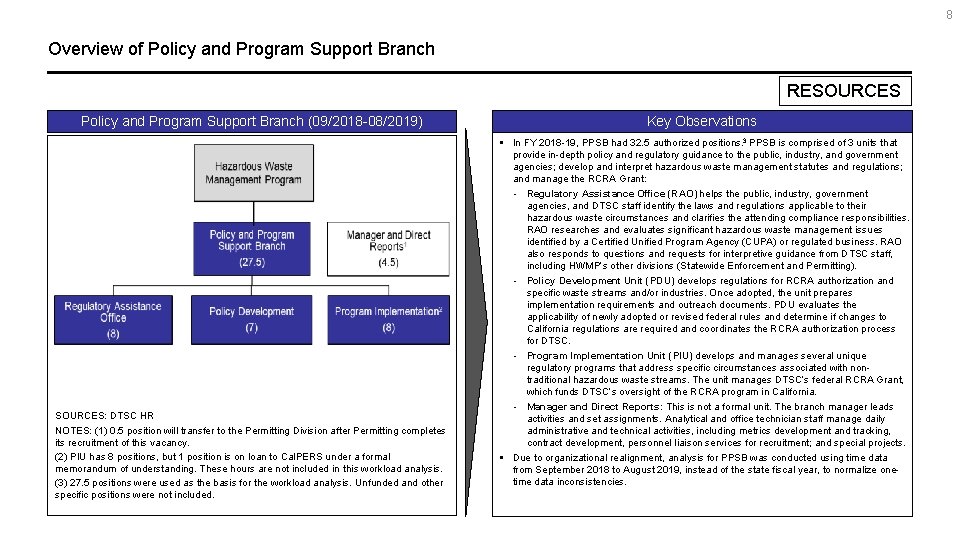
8 Overview of Policy and Program Support Branch RESOURCES Policy and Program Support Branch (09/2018 -08/2019) SOURCES: DTSC HR NOTES: (1) 0. 5 position will transfer to the Permitting Division after Permitting completes its recruitment of this vacancy. (2) PIU has 8 positions, but 1 position is on loan to Cal. PERS under a formal memorandum of understanding. These hours are not included in this workload analysis. (3) 27. 5 positions were used as the basis for the workload analysis. Unfunded and other specific positions were not included. Key Observations § In FY 2018 -19, PPSB had 32. 5 authorized positions. 3 PPSB is comprised of 3 units that provide in-depth policy and regulatory guidance to the public, industry, and government agencies; develop and interpret hazardous waste management statutes and regulations; and manage the RCRA Grant: Regulatory Assistance Office (RAO) helps the public, industry, government agencies, and DTSC staff identify the laws and regulations applicable to their hazardous waste circumstances and clarifies the attending compliance responsibilities. RAO researches and evaluates significant hazardous waste management issues identified by a Certified Unified Program Agency (CUPA) or regulated business. RAO also responds to questions and requests for interpretive guidance from DTSC staff, including HWMP’s other divisions (Statewide Enforcement and Permitting). Policy Development Unit (PDU) develops regulations for RCRA authorization and specific waste streams and/or industries. Once adopted, the unit prepares implementation requirements and outreach documents. PDU evaluates the applicability of newly adopted or revised federal rules and determine if changes to California regulations are required and coordinates the RCRA authorization process for DTSC. Program Implementation Unit (PIU) develops and manages several unique regulatory programs that address specific circumstances associated with nontraditional hazardous waste streams. The unit manages DTSC’s federal RCRA Grant, which funds DTSC’s oversight of the RCRA program in California. Manager and Direct Reports: This is not a formal unit. The branch manager leads activities and set assignments. Analytical and office technician staff manage daily administrative and technical activities, including metrics development and tracking, contract development, personnel liaison services for recruitment; and special projects. § Due to organizational realignment, analysis for PPSB was conducted using time data from September 2018 to August 2019, instead of the state fiscal year, to normalize onetime data inconsistencies.
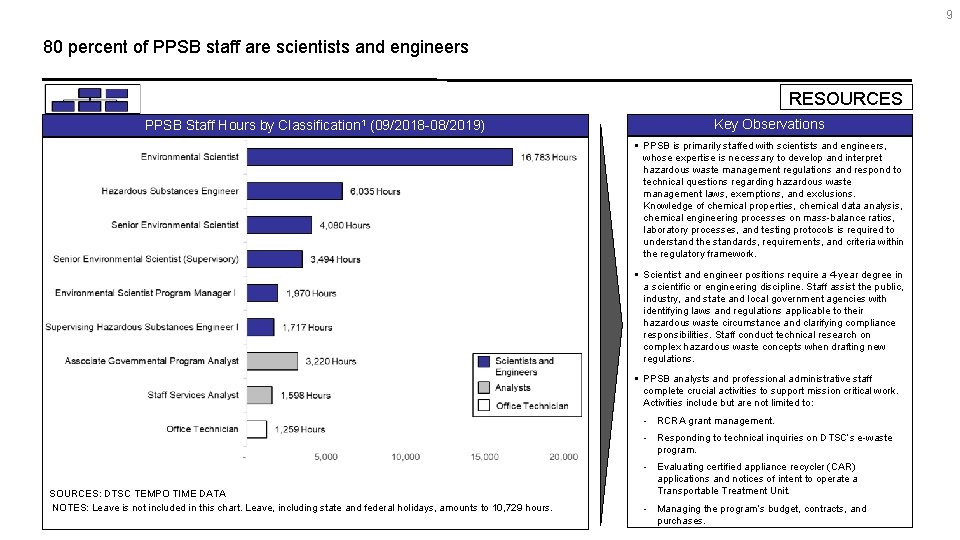
9 80 percent of PPSB staff are scientists and engineers RESOURCES Key Observations PPSB Staff Hours by Classification 1 (09/2018 -08/2019) § PPSB is primarily staffed with scientists and engineers, whose expertise is necessary to develop and interpret hazardous waste management regulations and respond to technical questions regarding hazardous waste management laws, exemptions, and exclusions. Knowledge of chemical properties, chemical data analysis, chemical engineering processes on mass-balance ratios, laboratory processes, and testing protocols is required to understand the standards, requirements, and criteria within the regulatory framework. § Scientist and engineer positions require a 4 -year degree in a scientific or engineering discipline. Staff assist the public, industry, and state and local government agencies with identifying laws and regulations applicable to their hazardous waste circumstance and clarifying compliance responsibilities. Staff conduct technical research on complex hazardous waste concepts when drafting new regulations. § PPSB analysts and professional administrative staff complete crucial activities to support mission critical work. Activities include but are not limited to: SOURCES: DTSC TEMPO TIME DATA NOTES: Leave is not included in this chart. Leave, including state and federal holidays, amounts to 10, 729 hours. RCRA grant management. Responding to technical inquiries on DTSC’s e-waste program. Evaluating certified appliance recycler (CAR) applications and notices of intent to operate a Transportable Treatment Unit. Managing the program’s budget, contracts, and purchases.
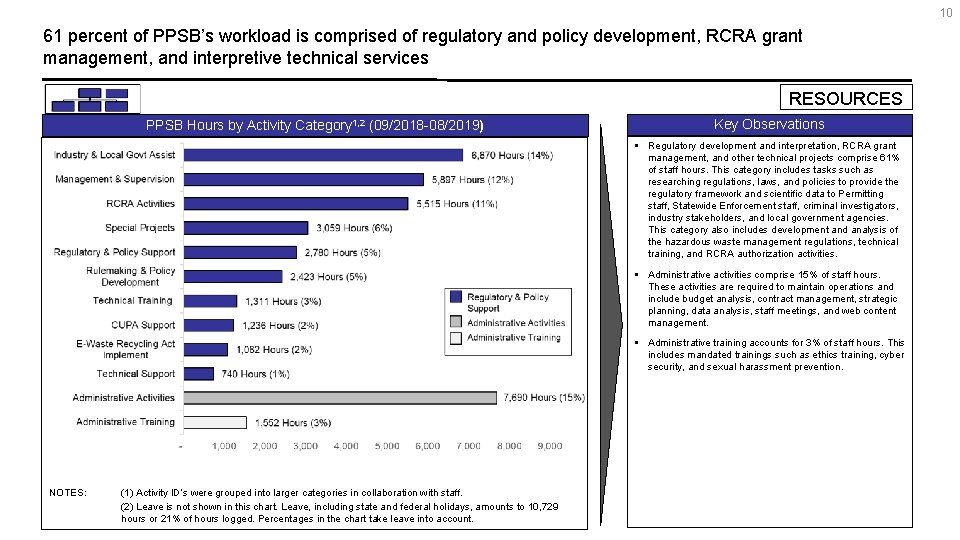
10 61 percent of PPSB’s workload is comprised of regulatory and policy development, RCRA grant management, and interpretive technical services RESOURCES PPSB Hours by Activity Category 1, 2 (09/2018 -08/2019) Key Observations § Regulatory development and interpretation, RCRA grant management, and other technical projects comprise 61% of staff hours. This category includes tasks such as researching regulations, laws, and policies to provide the regulatory framework and scientific data to Permitting staff, Statewide Enforcement staff, criminal investigators, industry stakeholders, and local government agencies. This category also includes development and analysis of the hazardous waste management regulations, technical training, and RCRA authorization activities. § Administrative activities comprise 15% of staff hours. These activities are required to maintain operations and include budget analysis, contract management, strategic planning, data analysis, staff meetings, and web content management. § Administrative training accounts for 3% of staff hours. This includes mandated trainings such as ethics training, cyber security, and sexual harassment prevention. NOTES: (1) Activity ID’s were grouped into larger categories in collaboration with staff. (2) Leave is not shown in this chart. Leave, including state and federal holidays, amounts to 10, 729 hours or 21% of hours logged. Percentages in the chart take leave into account.
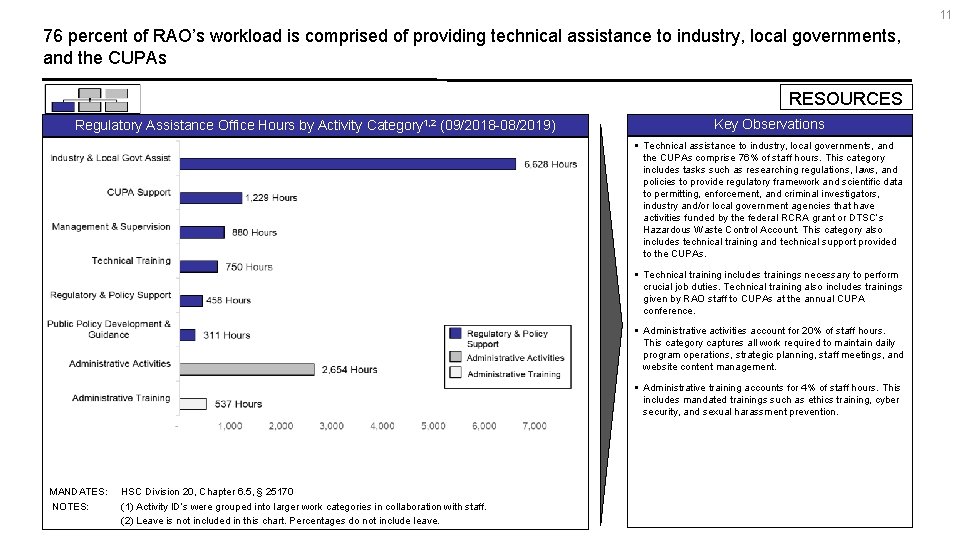
11 76 percent of RAO’s workload is comprised of providing technical assistance to industry, local governments, and the CUPAs RESOURCES Regulatory Assistance Office Hours by Activity Category 1, 2 (09/2018 -08/2019) Key Observations § Technical assistance to industry, local governments, and the CUPAs comprise 76% of staff hours. This category includes tasks such as researching regulations, laws, and policies to provide regulatory framework and scientific data to permitting, enforcement, and criminal investigators, industry and/or local government agencies that have activities funded by the federal RCRA grant or DTSC’s Hazardous Waste Control Account. This category also includes technical training and technical support provided to the CUPAs. § Technical training includes trainings necessary to perform crucial job duties. Technical training also includes trainings given by RAO staff to CUPAs at the annual CUPA conference. § Administrative activities account for 20% of staff hours. This category captures all work required to maintain daily program operations, strategic planning, staff meetings, and website content management. § Administrative training accounts for 4% of staff hours. This includes mandated trainings such as ethics training, cyber security, and sexual harassment prevention. MANDATES: NOTES: HSC Division 20, Chapter 6. 5, § 25170 (1) Activity ID’s were grouped into larger work categories in collaboration with staff. (2) Leave is not included in this chart. Percentages do not include leave.
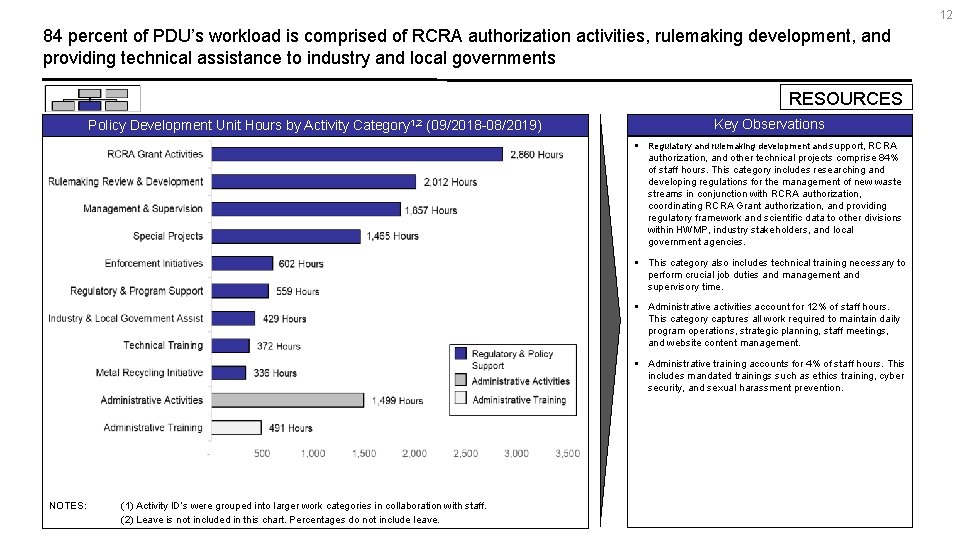
12 84 percent of PDU’s workload is comprised of RCRA authorization activities, rulemaking development, and providing technical assistance to industry and local governments RESOURCES Policy Development Unit Hours by Activity Category 1, 2 (09/2018 -08/2019) Key Observations § Regulatory and rulemaking development and support, RCRA authorization, and other technical projects comprise 84% of staff hours. This category includes researching and developing regulations for the management of new waste streams in conjunction with RCRA authorization, coordinating RCRA Grant authorization, and providing regulatory framework and scientific data to other divisions within HWMP, industry stakeholders, and local government agencies. § This category also includes technical training necessary to perform crucial job duties and management and supervisory time. § Administrative activities account for 12% of staff hours. This category captures all work required to maintain daily program operations, strategic planning, staff meetings, and website content management. § Administrative training accounts for 4% of staff hours. This includes mandated trainings such as ethics training, cyber security, and sexual harassment prevention. NOTES: (1) Activity ID’s were grouped into larger work categories in collaboration with staff. (2) Leave is not included in this chart. Percentages do not include leave.
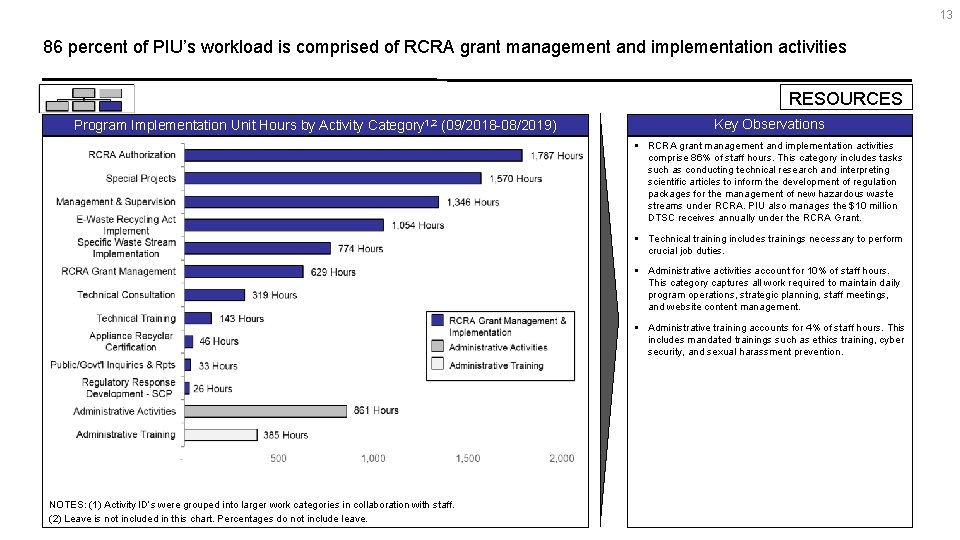
13 86 percent of PIU’s workload is comprised of RCRA grant management and implementation activities RESOURCES Program Implementation Unit Hours by Activity Category 1, 2 (09/2018 -08/2019) Key Observations § RCRA grant management and implementation activities comprise 86% of staff hours. This category includes tasks such as conducting technical research and interpreting scientific articles to inform the development of regulation packages for the management of new hazardous waste streams under RCRA. PIU also manages the $10 million DTSC receives annually under the RCRA Grant. § Technical training includes trainings necessary to perform crucial job duties. § Administrative activities account for 10% of staff hours. This category captures all work required to maintain daily program operations, strategic planning, staff meetings, and website content management. § Administrative training accounts for 4% of staff hours. This includes mandated trainings such as ethics training, cyber security, and sexual harassment prevention. NOTES: (1) Activity ID’s were grouped into larger work categories in collaboration with staff. (2) Leave is not included in this chart. Percentages do not include leave.
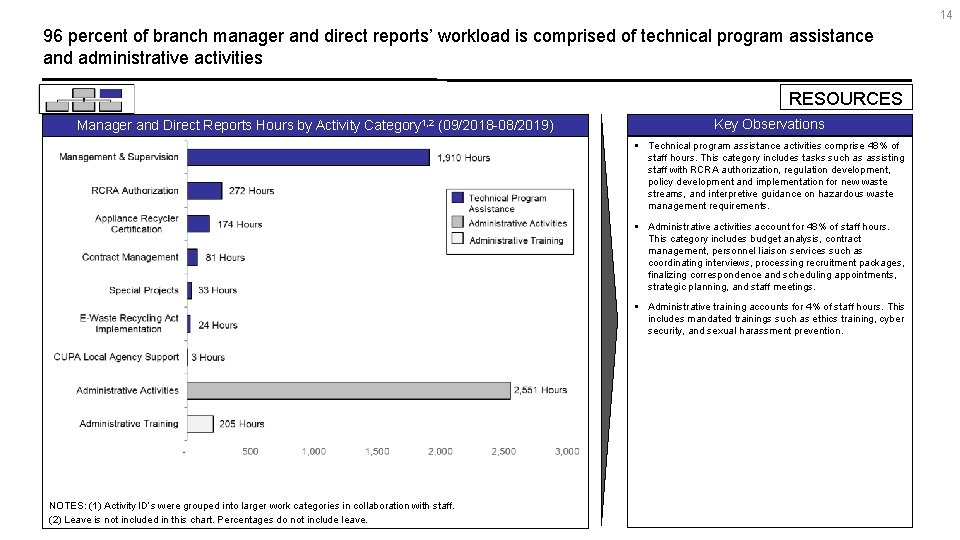
14 96 percent of branch manager and direct reports’ workload is comprised of technical program assistance and administrative activities RESOURCES Manager and Direct Reports Hours by Activity Category 1, 2 (09/2018 -08/2019) Key Observations § Technical program assistance activities comprise 48% of staff hours. This category includes tasks such as assisting staff with RCRA authorization, regulation development, policy development and implementation for new waste streams, and interpretive guidance on hazardous waste management requirements. § Administrative activities account for 48% of staff hours. This category includes budget analysis, contract management, personnel liaison services such as coordinating interviews, processing recruitment packages, finalizing correspondence and scheduling appointments, strategic planning, and staff meetings. § Administrative training accounts for 4% of staff hours. This includes mandated trainings such as ethics training, cyber security, and sexual harassment prevention. NOTES: (1) Activity ID’s were grouped into larger work categories in collaboration with staff. (2) Leave is not included in this chart. Percentages do not include leave.
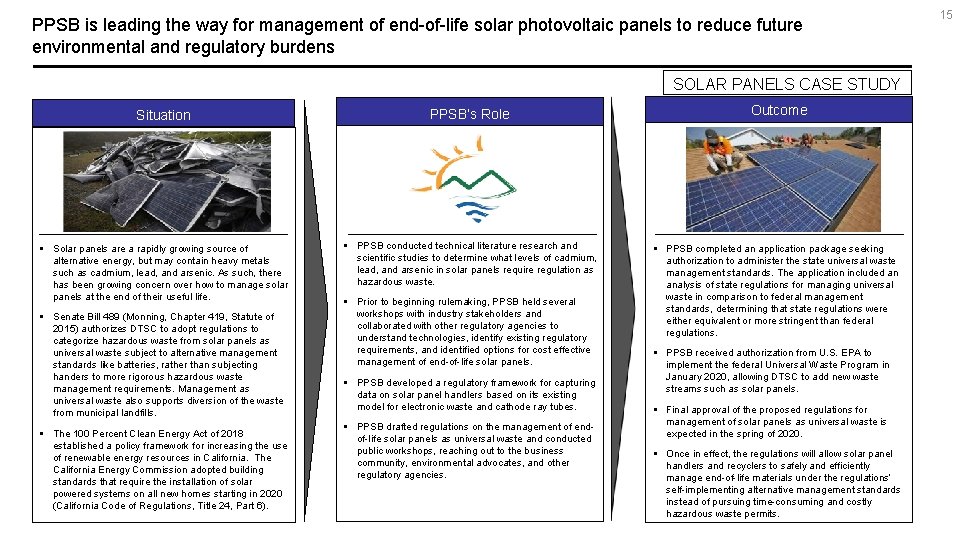
PPSB is leading the way for management of end-of-life solar photovoltaic panels to reduce future environmental and regulatory burdens SOLAR PANELS CASE STUDY Situation PPSB’s Role § Solar panels are a rapidly growing source of alternative energy, but may contain heavy metals such as cadmium, lead, and arsenic. As such, there has been growing concern over how to manage solar panels at the end of their useful life. § PPSB conducted technical literature research and scientific studies to determine what levels of cadmium, lead, and arsenic in solar panels require regulation as hazardous waste. § Senate Bill 489 (Monning, Chapter 419, Statute of 2015) authorizes DTSC to adopt regulations to categorize hazardous waste from solar panels as universal waste subject to alternative management standards like batteries, rather than subjecting handers to more rigorous hazardous waste management requirements. Management as universal waste also supports diversion of the waste from municipal landfills. § The 100 Percent Clean Energy Act of 2018 established a policy framework for increasing the use of renewable energy resources in California. The California Energy Commission adopted building standards that require the installation of solar powered systems on all new homes starting in 2020 (California Code of Regulations, Title 24, Part 6). § Prior to beginning rulemaking, PPSB held several workshops with industry stakeholders and collaborated with other regulatory agencies to understand technologies, identify existing regulatory requirements, and identified options for cost effective management of end-of-life solar panels. § PPSB developed a regulatory framework for capturing data on solar panel handlers based on its existing model for electronic waste and cathode ray tubes. § PPSB drafted regulations on the management of endof-life solar panels as universal waste and conducted public workshops, reaching out to the business community, environmental advocates, and other regulatory agencies. Outcome § PPSB completed an application package seeking authorization to administer the state universal waste management standards. The application included an analysis of state regulations for managing universal waste in comparison to federal management standards, determining that state regulations were either equivalent or more stringent than federal regulations. § PPSB received authorization from U. S. EPA to implement the federal Universal Waste Program in January 2020, allowing DTSC to add new waste streams such as solar panels. § Final approval of the proposed regulations for management of solar panels as universal waste is expected in the spring of 2020. § Once in effect, the regulations will allow solar panel handlers and recyclers to safely and efficiently manage end-of-life materials under the regulations’ self-implementing alternative management standards instead of pursuing time-consuming and costly hazardous waste permits. 15
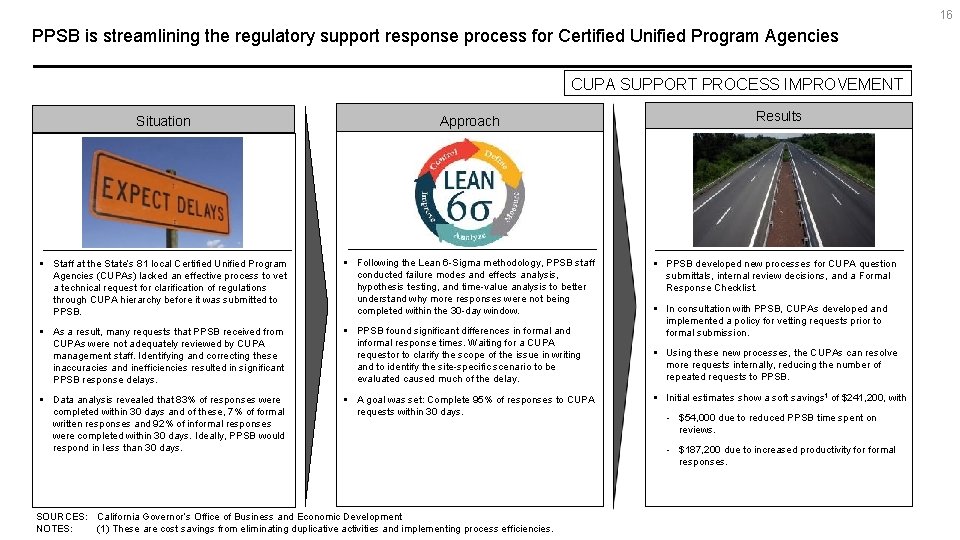
16 PPSB is streamlining the regulatory support response process for Certified Unified Program Agencies CUPA SUPPORT PROCESS IMPROVEMENT Situation Approach § Staff at the State’s 81 local Certified Unified Program Agencies (CUPAs) lacked an effective process to vet a technical request for clarification of regulations through CUPA hierarchy before it was submitted to PPSB. § Following the Lean 6 -Sigma methodology, PPSB staff conducted failure modes and effects analysis, hypothesis testing, and time-value analysis to better understand why more responses were not being completed within the 30 -day window. § As a result, many requests that PPSB received from CUPAs were not adequately reviewed by CUPA management staff. Identifying and correcting these inaccuracies and inefficiencies resulted in significant PPSB response delays. § PPSB found significant differences in formal and informal response times. Waiting for a CUPA requestor to clarify the scope of the issue in writing and to identify the site-specific scenario to be evaluated caused much of the delay. § Data analysis revealed that 83% of responses were completed within 30 days and of these, 7% of formal written responses and 92% of informal responses were completed within 30 days. Ideally, PPSB would respond in less than 30 days. § A goal was set: Complete 95% of responses to CUPA requests within 30 days. SOURCES: California Governor’s Office of Business and Economic Development NOTES: (1) These are cost savings from eliminating duplicative activities and implementing process efficiencies. Results § PPSB developed new processes for CUPA question submittals, internal review decisions, and a Formal Response Checklist. § In consultation with PPSB, CUPAs developed and implemented a policy for vetting requests prior to formal submission. § Using these new processes, the CUPAs can resolve more requests internally, reducing the number of repeated requests to PPSB. § Initial estimates show a soft savings 1 of $241, 200, with $54, 000 due to reduced PPSB time spent on reviews. $187, 200 due to increased productivity formal responses.
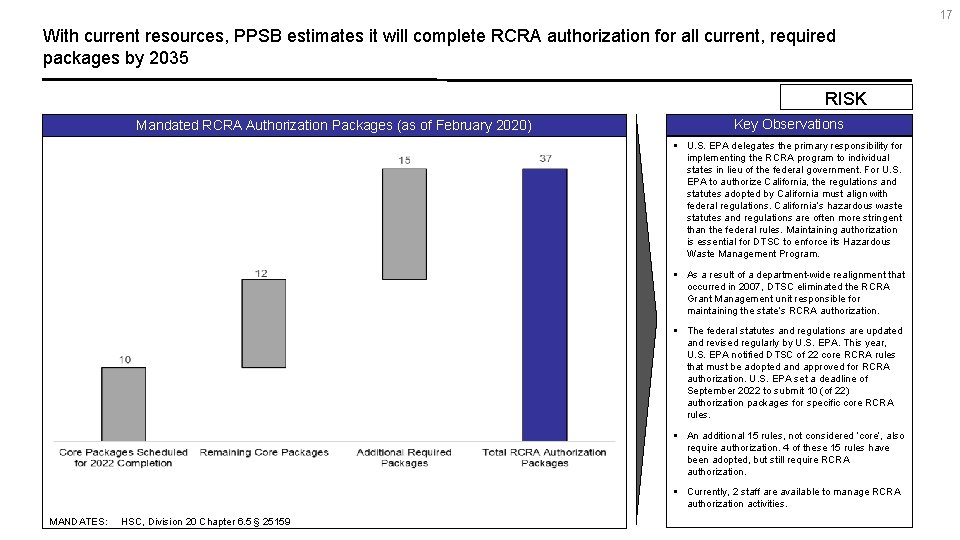
17 With current resources, PPSB estimates it will complete RCRA authorization for all current, required packages by 2035 RISK Mandated RCRA Authorization Packages (as of February 2020) Key Observations § U. S. EPA delegates the primary responsibility for implementing the RCRA program to individual states in lieu of the federal government. For U. S. EPA to authorize California, the regulations and statutes adopted by California must align with federal regulations. California’s hazardous waste statutes and regulations are often more stringent than the federal rules. Maintaining authorization is essential for DTSC to enforce its Hazardous Waste Management Program. § As a result of a department-wide realignment that occurred in 2007, DTSC eliminated the RCRA Grant Management unit responsible for maintaining the state’s RCRA authorization. § The federal statutes and regulations are updated and revised regularly by U. S. EPA. This year, U. S. EPA notified DTSC of 22 core RCRA rules that must be adopted and approved for RCRA authorization. U. S. EPA set a deadline of September 2022 to submit 10 (of 22) authorization packages for specific core RCRA rules. § An additional 15 rules, not considered ‘core’, also require authorization. 4 of these 15 rules have been adopted, but still require RCRA authorization. § Currently, 2 staff are available to manage RCRA authorization activities. MANDATES: HSC, Division 20 Chapter 6. 5 § 25159
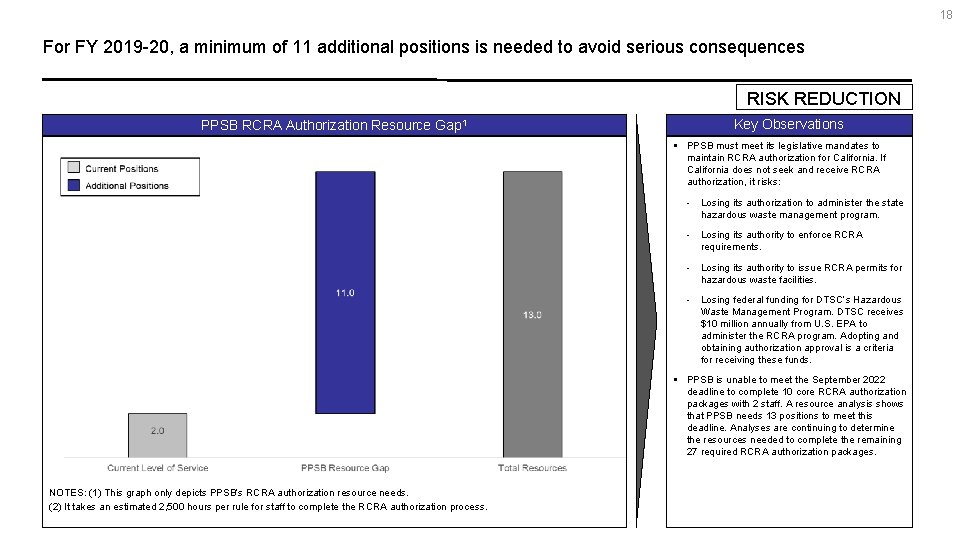
18 For FY 2019 -20, a minimum of 11 additional positions is needed to avoid serious consequences RISK REDUCTION Key Observations PPSB RCRA Authorization Resource Gap 1 § PPSB must meet its legislative mandates to maintain RCRA authorization for California. If California does not seek and receive RCRA authorization, it risks: Losing its authorization to administer the state hazardous waste management program. Losing its authority to enforce RCRA requirements. Losing its authority to issue RCRA permits for hazardous waste facilities. Losing federal funding for DTSC’s Hazardous Waste Management Program. DTSC receives $10 million annually from U. S. EPA to administer the RCRA program. Adopting and obtaining authorization approval is a criteria for receiving these funds. § PPSB is unable to meet the September 2022 deadline to complete 10 core RCRA authorization packages with 2 staff. A resource analysis shows that PPSB needs 13 positions to meet this deadline. Analyses are continuing to determine the resources needed to complete the remaining 27 required RCRA authorization packages. NOTES: (1) This graph only depicts PPSB’s RCRA authorization resource needs. (2) It takes an estimated 2, 500 hours per rule for staff to complete the RCRA authorization process.
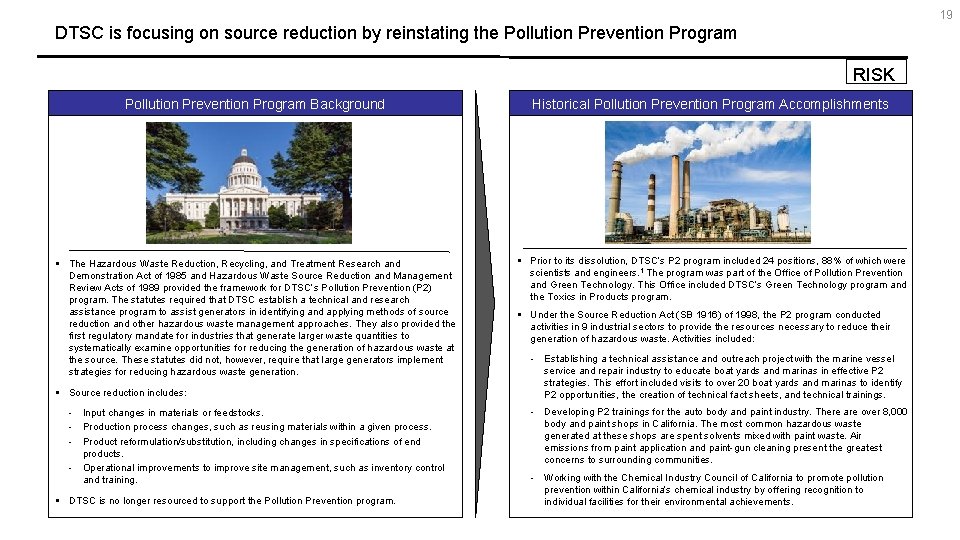
19 DTSC is focusing on source reduction by reinstating the Pollution Prevention Program RISK Pollution Prevention Program Background Historical Pollution Prevention Program Accomplishments § The Hazardous Waste Reduction, Recycling, and Treatment Research and Demonstration Act of 1985 and Hazardous Waste Source Reduction and Management Review Acts of 1989 provided the framework for DTSC’s Pollution Prevention (P 2) program. The statutes required that DTSC establish a technical and research assistance program to assist generators in identifying and applying methods of source reduction and other hazardous waste management approaches. They also provided the first regulatory mandate for industries that generate larger waste quantities to systematically examine opportunities for reducing the generation of hazardous waste at the source. These statutes did not, however, require that large generators implement strategies for reducing hazardous waste generation. § Prior to its dissolution, DTSC’s P 2 program included 24 positions, 88% of which were scientists and engineers. 1 The program was part of the Office of Pollution Prevention and Green Technology. This Office included DTSC’s Green Technology program and the Toxics in Products program. § Under the Source Reduction Act (SB 1916) of 1998, the P 2 program conducted activities in 9 industrial sectors to provide the resources necessary to reduce their generation of hazardous waste. Activities included: Establishing a technical assistance and outreach project with the marine vessel service and repair industry to educate boat yards and marinas in effective P 2 strategies. This effort included visits to over 20 boat yards and marinas to identify P 2 opportunities, the creation of technical fact sheets, and technical trainings. Developing P 2 trainings for the auto body and paint industry. There are over 8, 000 body and paint shops in California. The most common hazardous waste generated at these shops are spent solvents mixed with paint waste. Air emissions from paint application and paint-gun cleaning present the greatest concerns to surrounding communities. Working with the Chemical Industry Council of California to promote pollution prevention within California’s chemical industry by offering recognition to individual facilities for their environmental achievements. § Source reduction includes: Input changes in materials or feedstocks. Production process changes, such as reusing materials within a given process. Product reformulation/substitution, including changes in specifications of end products. Operational improvements to improve site management, such as inventory control and training. § DTSC is no longer resourced to support the Pollution Prevention program.
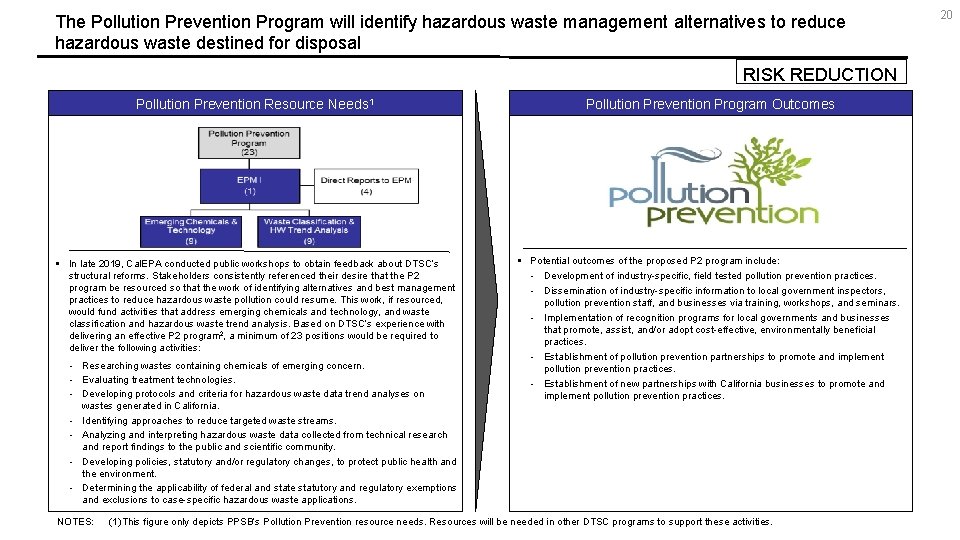
The Pollution Prevention Program will identify hazardous waste management alternatives to reduce hazardous waste destined for disposal RISK REDUCTION Pollution Prevention Resource Needs 1 Pollution Prevention Program Outcomes § In late 2019, Cal. EPA conducted public workshops to obtain feedback about DTSC’s structural reforms. Stakeholders consistently referenced their desire that the P 2 program be resourced so that the work of identifying alternatives and best management practices to reduce hazardous waste pollution could resume. This work, if resourced, would fund activities that address emerging chemicals and technology, and waste classification and hazardous waste trend analysis. Based on DTSC’s experience with delivering an effective P 2 program 2, a minimum of 23 positions would be required to deliver the following activities: § Potential outcomes of the proposed P 2 program include: Development of industry-specific, field tested pollution prevention practices. Dissemination of industry-specific information to local government inspectors, pollution prevention staff, and businesses via training, workshops, and seminars. Implementation of recognition programs for local governments and businesses that promote, assist, and/or adopt cost-effective, environmentally beneficial practices. Establishment of pollution prevention partnerships to promote and implement pollution prevention practices. Establishment of new partnerships with California businesses to promote and implement pollution prevention practices. Researching wastes containing chemicals of emerging concern. Evaluating treatment technologies. Developing protocols and criteria for hazardous waste data trend analyses on wastes generated in California. Identifying approaches to reduce targeted waste streams. Analyzing and interpreting hazardous waste data collected from technical research and report findings to the public and scientific community. Developing policies, statutory and/or regulatory changes, to protect public health and the environment. Determining the applicability of federal and state statutory and regulatory exemptions and exclusions to case-specific hazardous waste applications. NOTES: (1)This figure only depicts PPSB’s Pollution Prevention resource needs. Resources will be needed in other DTSC programs to support these activities. 20
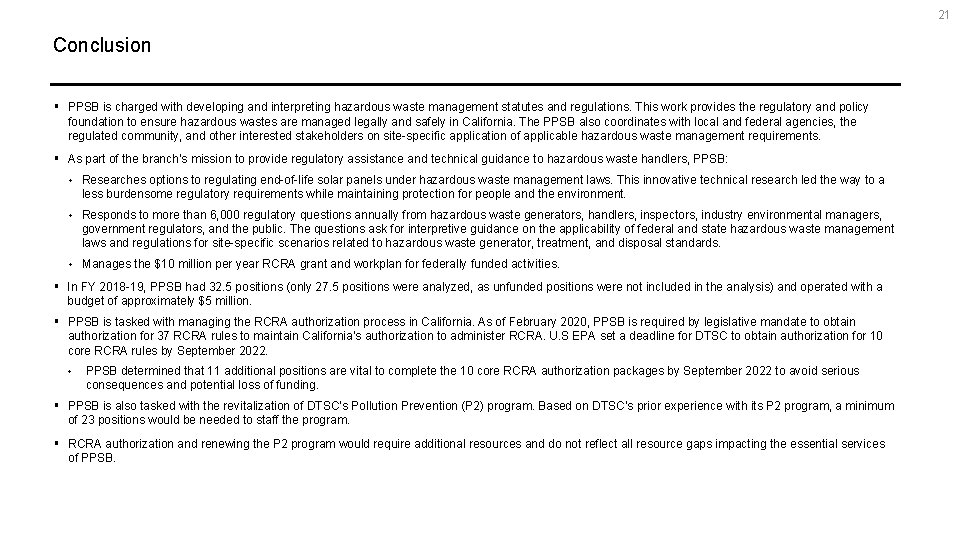
21 Conclusion § PPSB is charged with developing and interpreting hazardous waste management statutes and regulations. This work provides the regulatory and policy foundation to ensure hazardous wastes are managed legally and safely in California. The PPSB also coordinates with local and federal agencies, the regulated community, and other interested stakeholders on site-specific application of applicable hazardous waste management requirements. § As part of the branch’s mission to provide regulatory assistance and technical guidance to hazardous waste handlers, PPSB: Researches options to regulating end-of-life solar panels under hazardous waste management laws. This innovative technical research led the way to a less burdensome regulatory requirements while maintaining protection for people and the environment. Responds to more than 6, 000 regulatory questions annually from hazardous waste generators, handlers, inspectors, industry environmental managers, government regulators, and the public. The questions ask for interpretive guidance on the applicability of federal and state hazardous waste management laws and regulations for site-specific scenarios related to hazardous waste generator, treatment, and disposal standards. Manages the $10 million per year RCRA grant and workplan for federally funded activities. § In FY 2018 -19, PPSB had 32. 5 positions (only 27. 5 positions were analyzed, as unfunded positions were not included in the analysis) and operated with a budget of approximately $5 million. § PPSB is tasked with managing the RCRA authorization process in California. As of February 2020, PPSB is required by legislative mandate to obtain authorization for 37 RCRA rules to maintain California’s authorization to administer RCRA. U. S EPA set a deadline for DTSC to obtain authorization for 10 core RCRA rules by September 2022. PPSB determined that 11 additional positions are vital to complete the 10 core RCRA authorization packages by September 2022 to avoid serious consequences and potential loss of funding. § PPSB is also tasked with the revitalization of DTSC’s Pollution Prevention (P 2) program. Based on DTSC’s prior experience with its P 2 program, a minimum of 23 positions would be needed to staff the program. § RCRA authorization and renewing the P 2 program would require additional resources and do not reflect all resource gaps impacting the essential services of PPSB.
22 Contact Information Rizgar Ghazi, P. E. Deputy Director Hazardous Waste Management Program Department of Toxic Substances Control 1001 I Street Sacramento, CA 95814 Email: Rizgar. Ghazi@dtsc. ca. gov Jane R. Numazu Hazardous Substances Engineer Office of Performance Management and Program Review Department of Toxic Substances Control 1001 I Street Sacramento, CA 95814 Email: Jane. Numazu@dtsc. ca. gov