
1 Hazardous Waste Management Program Office of Criminal

- Slides: 18
1 Hazardous Waste Management Program Office of Criminal Investigations Workload Analysis for FY 2018 -19 October 26, 2020 Prepared by:
2 Slide Intentionally Left Blank SLIDE INTENTIONALLY LEFT BLANK
3 Purpose This workload analysis provides information on how the Department of Toxic Substances Control’s Office of Criminal Investigations: Uses its current resources to meet legislative mandates and achieve its mission. Tracks and manages projects to promote efficiency and effectiveness. Produces outcomes to meet its mission. Identifies risks to program performance and effectiveness.
Mission Statements “DTSC’s mission is to protect California’s people, communities, and environment from toxic substances, to enhance economic vitality by restoring contaminated land, and to compel manufacturers to make safer consumer products. ” California Department of Toxic Substances Control Mission Statement “The mission of the Office of Criminal Investigations is to prevent and investigate violations of California’s Hazardous Waste Control Laws for the safety of the public and protection of the environment. ” Hazardous Waste Management Program Office of Criminal Investigations Mission Statement 4
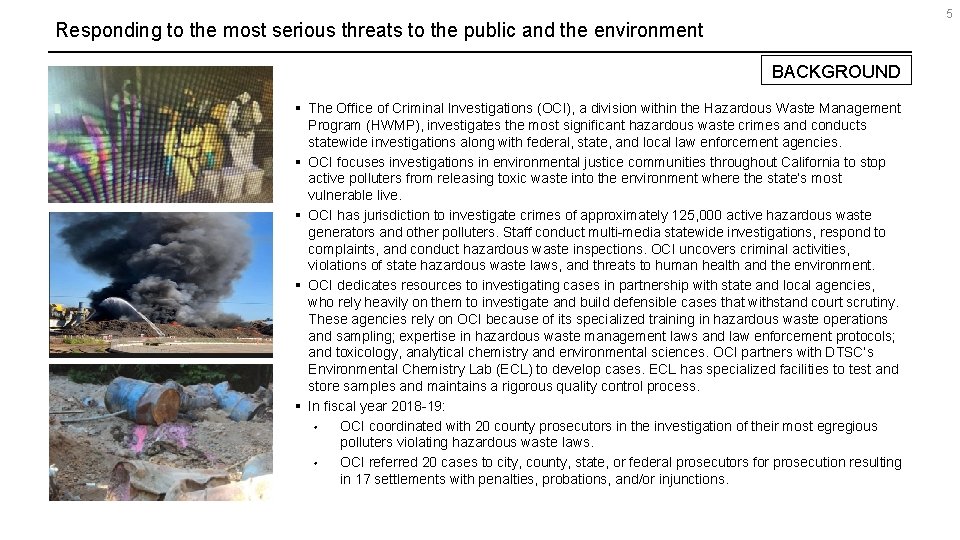
Responding to the most serious threats to the public and the environment (Page 1 of 2) BACKGROUND The Office of Criminal Investigations (OCI), a division within the Hazardous Waste Management Program (HWMP), investigates the most significant hazardous waste crimes and conducts statewide investigations along with federal, state, and local law enforcement agencies. OCI focuses investigations in environmental justice communities throughout California to stop active polluters from releasing toxic waste into the environment where the state’s most vulnerable live. OCI has jurisdiction to investigate crimes of approximately 125, 000 active hazardous waste generators and other polluters. Staff conduct multi-media statewide investigations, respond to complaints, and conduct hazardous waste inspections. OCI uncovers criminal activities, violations of state hazardous waste laws, and threats to human health and the environment. OCI dedicates resources to investigating cases in partnership with state and local agencies, who rely heavily on them to investigate and build defensible cases that withstand court scrutiny. These agencies rely on OCI because of its specialized training in hazardous waste operations and sampling; expertise in hazardous waste management laws and law enforcement protocols; and toxicology, analytical chemistry and environmental sciences. OCI partners with DTSC’s Environmental Chemistry Lab (ECL) to develop cases. ECL has specialized facilities to test and store samples and maintains a rigorous quality control process. In fiscal year 2018 -19: OCI coordinated with 20 county prosecutors in the investigation of their most egregious polluters violating hazardous waste laws. OCI referred 20 cases to city, county, state, or federal prosecutors for prosecution resulting in 17 settlements with penalties, probations, and/or injunctions. 5
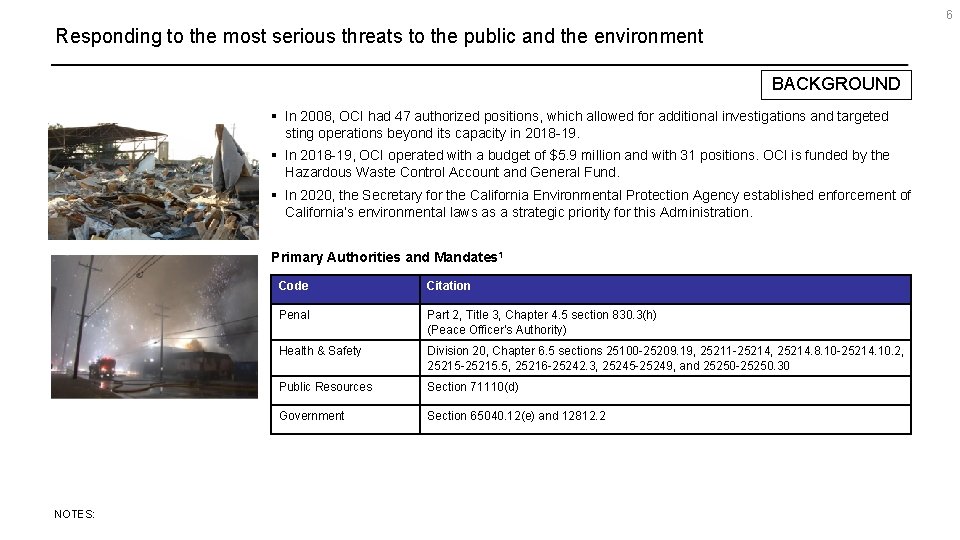
6 Responding to the most serious threats to the public and the environment (Page 2 of 2) BACKGROUND In 2008, OCI had 47 authorized positions, which allowed for additional investigations and targeted sting operations beyond its capacity in 2018 -19. In 2018 -19, OCI operated with a budget of $5. 9 million and with 31 positions. OCI is funded by the Hazardous Waste Control Account and General Fund. In 2020, the Secretary for the California Environmental Protection Agency established enforcement of California’s environmental laws as a strategic priority for this Administration. Primary Authorities and Mandates 1 NOTES: Code Citation Penal Part 2, Title 3, Chapter 4. 5 section 830. 3(h) (Peace Officer’s Authority) Health & Safety Division 20, Chapter 6. 5 sections 25100 -25209. 19, 25211 -25214, 25214. 8. 10 -25214. 10. 2, 25215 -25215. 5, 25216 -25242. 3, 25245 -25249, and 25250 -25250. 30 Public Resources Section 71110(d) Government Section 65040. 12(e) and 12812. 2
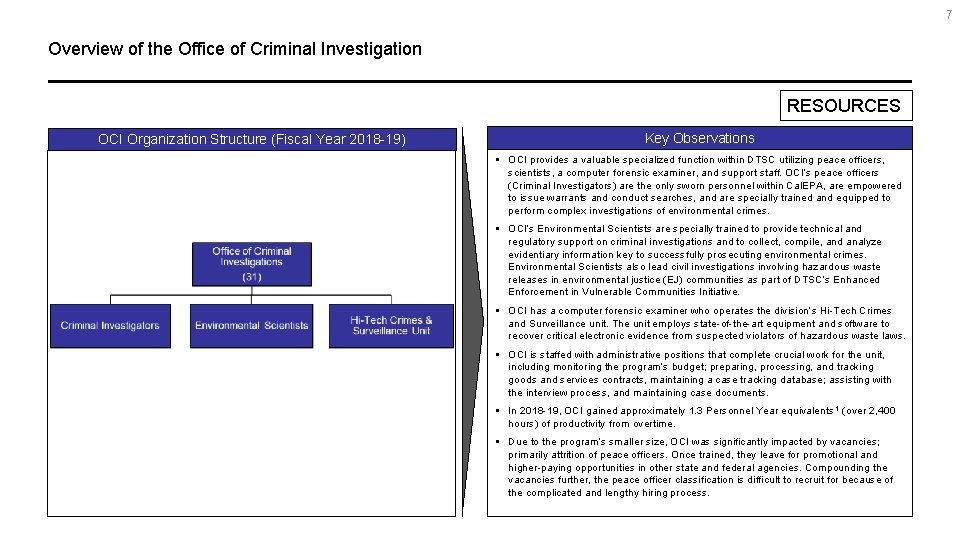
7 Overview of the Office of Criminal Investigation RESOURCES OCI Organization Structure (Fiscal Year 2018 -19) Key Observations OCI provides a valuable specialized function within DTSC utilizing peace officers, scientists, a computer forensic examiner, and support staff. OCI’s peace officers (Criminal Investigators) are the only sworn personnel within Cal. EPA, are empowered to issue warrants and conduct searches, and are specially trained and equipped to perform complex investigations of environmental crimes. OCI’s Environmental Scientists are specially trained to provide technical and regulatory support on criminal investigations and to collect, compile, and analyze evidentiary information key to successfully prosecuting environmental crimes. Environmental Scientists also lead civil investigations involving hazardous waste releases in environmental justice (EJ) communities as part of DTSC’s Enhanced Enforcement in Vulnerable Communities Initiative. OCI has a computer forensic examiner who operates the division’s Hi-Tech Crimes and Surveillance unit. The unit employs state-of-the-art equipment and software to recover critical electronic evidence from suspected violators of hazardous waste laws. OCI is staffed with administrative positions that complete crucial work for the unit, including monitoring the program’s budget; preparing, processing, and tracking goods and services contracts, maintaining a case tracking database; assisting with the interview process, and maintaining case documents. In 2018 -19, OCI gained approximately 1. 3 Personnel Year equivalents 1 (over 2, 400 hours) of productivity from overtime. Due to the program’s smaller size, OCI was significantly impacted by vacancies; primarily attrition of peace officers. Once trained, they leave for promotional and higher-paying opportunities in other state and federal agencies. Compounding the vacancies further, the peace officer classification is difficult to recruit for because of the complicated and lengthy hiring process.
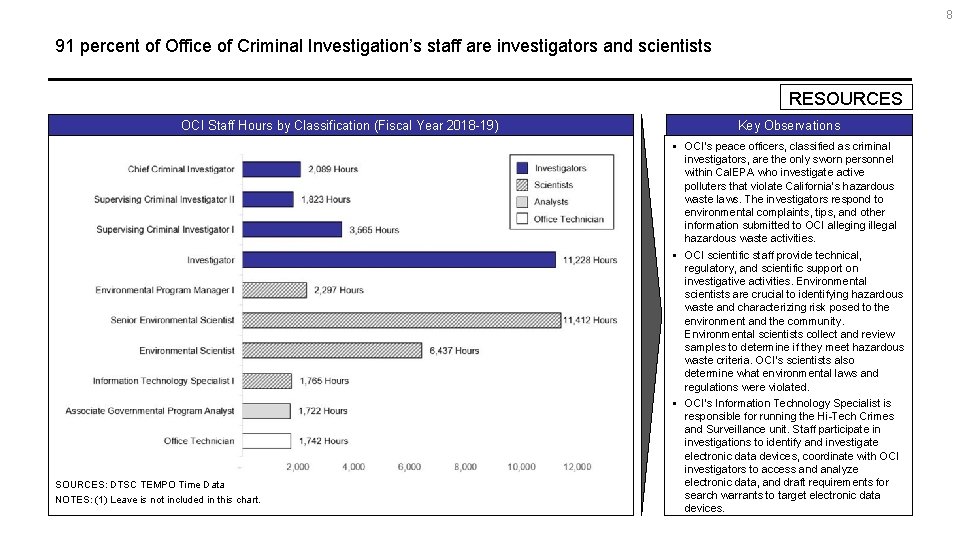
8 91 percent of Office of Criminal Investigation’s staff are investigators and scientists RESOURCES OCI Staff Hours by Classification (Fiscal Year 2018 -19) SOURCES: DTSC TEMPO Time Data NOTES: (1) Leave is not included in this chart. Key Observations OCI’s peace officers, classified as criminal investigators, are the only sworn personnel within Cal. EPA who investigate active polluters that violate California’s hazardous waste laws. The investigators respond to environmental complaints, tips, and other information submitted to OCI alleging illegal hazardous waste activities. OCI scientific staff provide technical, regulatory, and scientific support on investigative activities. Environmental scientists are crucial to identifying hazardous waste and characterizing risk posed to the environment and the community. Environmental scientists collect and review samples to determine if they meet hazardous waste criteria. OCI’s scientists also determine what environmental laws and regulations were violated. OCI’s Information Technology Specialist is responsible for running the Hi-Tech Crimes and Surveillance unit. Staff participate in investigations to identify and investigate electronic data devices, coordinate with OCI investigators to access and analyze electronic data, and draft requirements for search warrants to target electronic data devices.
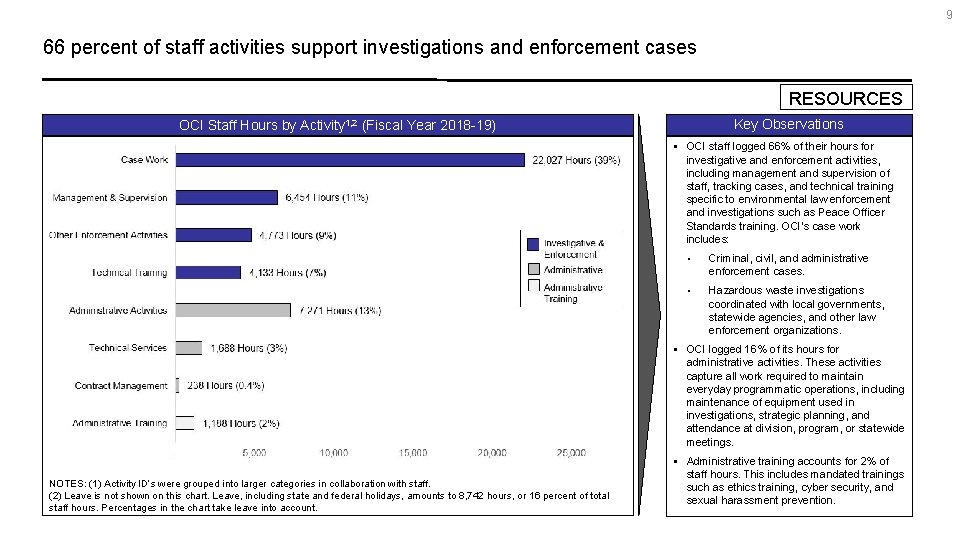
9 66 percent of staff activities support investigations and enforcement cases RESOURCES Key Observations OCI Staff Hours by Activity 1, 2 (Fiscal Year 2018 -19) OCI staff logged 66% of their hours for investigative and enforcement activities, including management and supervision of staff, tracking cases, and technical training specific to environmental law enforcement and investigations such as Peace Officer Standards training. OCI’s case work includes: Criminal, civil, and administrative enforcement cases. Hazardous waste investigations coordinated with local governments, statewide agencies, and other law enforcement organizations. OCI logged 16% of its hours for administrative activities. These activities capture all work required to maintain everyday programmatic operations, including maintenance of equipment used in investigations, strategic planning, and attendance at division, program, or statewide meetings. NOTES: (1) Activity ID’s were grouped into larger categories in collaboration with staff. (2) Leave is not shown on this chart. Leave, including state and federal holidays, amounts to 8, 742 hours, or 16 percent of total staff hours. Percentages in the chart take leave into account. Administrative training accounts for 2% of staff hours. This includes mandated trainings such as ethics training, cyber security, and sexual harassment prevention.
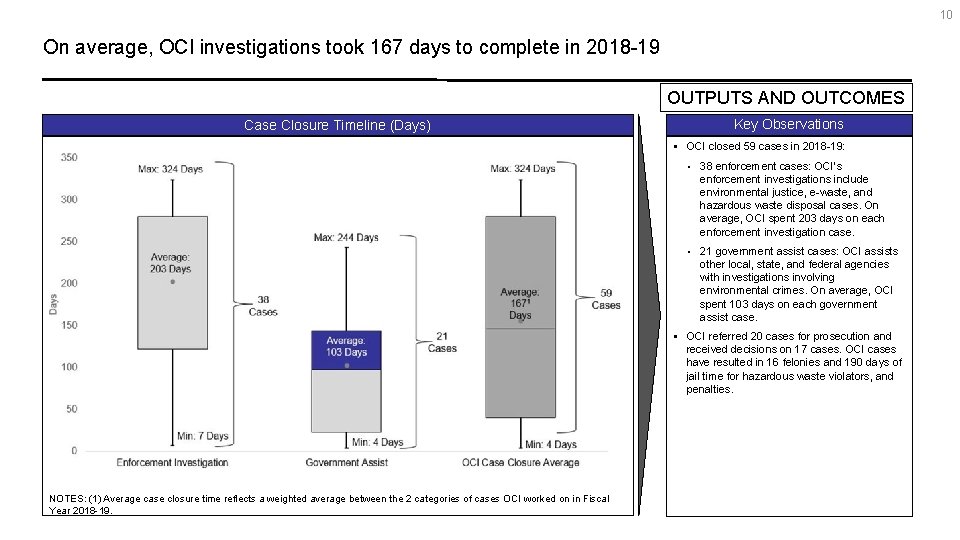
10 On average, OCI investigations took 167 days to complete in 2018 -19 OUTPUTS AND OUTCOMES Key Observations Case Closure Timeline (Days) OCI closed 59 cases in 2018 -19: 38 enforcement cases: OCI’s enforcement investigations include environmental justice, e-waste, and hazardous waste disposal cases. On average, OCI spent 203 days on each enforcement investigation case. 21 government assist cases: OCI assists other local, state, and federal agencies with investigations involving environmental crimes. On average, OCI spent 103 days on each government assist case. OCI referred 20 cases for prosecution and received decisions on 17 cases. OCI cases have resulted in 16 felonies and 190 days of jail time for hazardous waste violators, and penalties. NOTES: (1) Average case closure time reflects a weighted average between the 2 categories of cases OCI worked on in Fiscal Year 2018 -19.
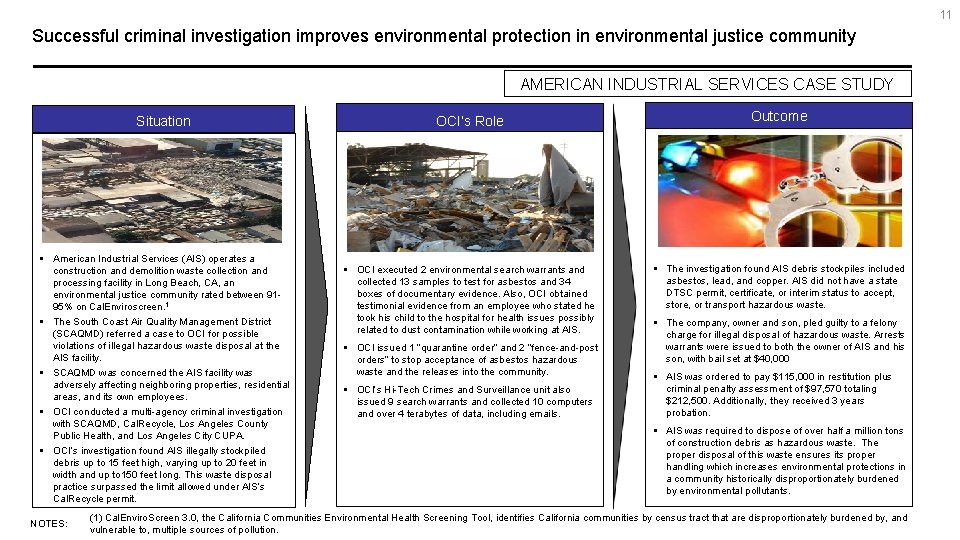
11 Successful criminal investigation improves environmental protection in environmental justice community AMERICAN INDUSTRIAL SERVICES CASE STUDY Situation American Industrial Services (AIS) operates a construction and demolition waste collection and processing facility in Long Beach, CA, an environmental justice community rated between 9195% on Cal. Enviroscreen. 1 The South Coast Air Quality Management District (SCAQMD) referred a case to OCI for possible violations of illegal hazardous waste disposal at the AIS facility. SCAQMD was concerned the AIS facility was adversely affecting neighboring properties, residential areas, and its own employees. OCI conducted a multi-agency criminal investigation with SCAQMD, Cal. Recycle, Los Angeles County Public Health, and Los Angeles City CUPA. OCI’s investigation found AIS illegally stockpiled debris up to 15 feet high, varying up to 20 feet in width and up to 150 feet long. This waste disposal practice surpassed the limit allowed under AIS’s Cal. Recycle permit. NOTES: OCI’s Role Outcome OCI executed 2 environmental search warrants and collected 13 samples to test for asbestos and 34 boxes of documentary evidence. Also, OCI obtained testimonial evidence from an employee who stated he took his child to the hospital for health issues possibly related to dust contamination while working at AIS. The investigation found AIS debris stockpiles included asbestos, lead, and copper. AIS did not have a state DTSC permit, certificate, or interim status to accept, store, or transport hazardous waste. OCI issued 1 “quarantine order” and 2 “fence-and-post orders” to stop acceptance of asbestos hazardous waste and the releases into the community. OCI’s Hi-Tech Crimes and Surveillance unit also issued 9 search warrants and collected 10 computers and over 4 terabytes of data, including emails. The company, owner and son, pled guilty to a felony charge for illegal disposal of hazardous waste. Arrests warrants were issued to both the owner of AIS and his son, with bail set at $40, 000 AIS was ordered to pay $115, 000 in restitution plus criminal penalty assessment of $97, 570 totaling $212, 500. Additionally, they received 3 years probation. AIS was required to dispose of over half a million tons of construction debris as hazardous waste. The proper disposal of this waste ensures its proper handling which increases environmental protections in a community historically disproportionately burdened by environmental pollutants. (1) Cal. Enviro. Screen 3. 0, the California Communities Environmental Health Screening Tool, identifies California communities by census tract that are disproportionately burdened by, and vulnerable to, multiple sources of pollution.
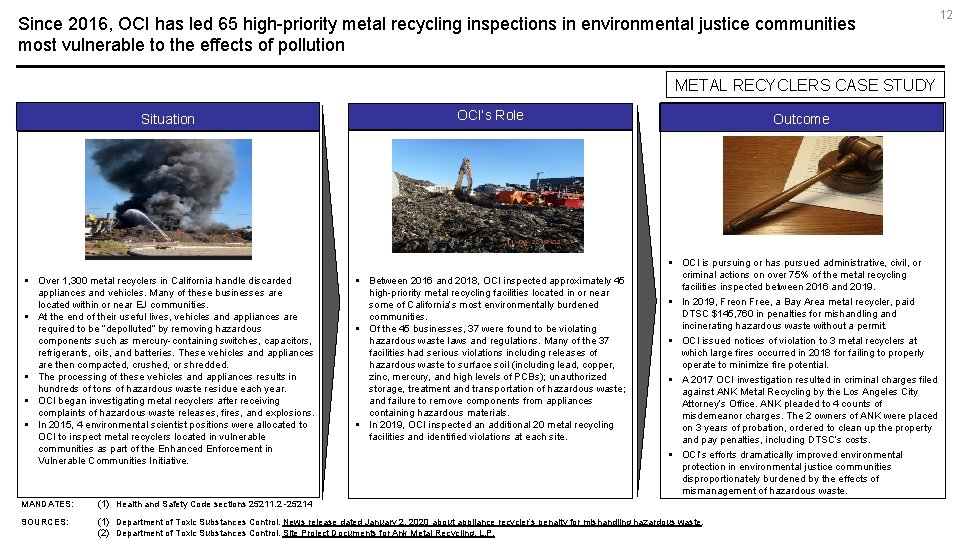
Since 2016, OCI has led 65 high-priority metal recycling inspections in environmental justice communities most vulnerable to the effects of pollution METAL RECYCLERS CASE STUDY Situation Over 1, 300 metal recyclers in California handle discarded appliances and vehicles. Many of these businesses are located within or near EJ communities. At the end of their useful lives, vehicles and appliances are required to be “depolluted” by removing hazardous components such as mercury-containing switches, capacitors, refrigerants, oils, and batteries. These vehicles and appliances are then compacted, crushed, or shredded. The processing of these vehicles and appliances results in hundreds of tons of hazardous waste residue each year. OCI began investigating metal recyclers after receiving complaints of hazardous waste releases, fires, and explosions. In 2015, 4 environmental scientist positions were allocated to OCI to inspect metal recyclers located in vulnerable communities as part of the Enhanced Enforcement in Vulnerable Communities Initiative. OCI’s Role Between 2016 and 2018, OCI inspected approximately 45 high-priority metal recycling facilities located in or near some of California’s most environmentally burdened communities. Of the 45 businesses, 37 were found to be violating hazardous waste laws and regulations. Many of the 37 facilities had serious violations including releases of hazardous waste to surface soil (including lead, copper, zinc, mercury, and high levels of PCBs); unauthorized storage, treatment and transportation of hazardous waste; and failure to remove components from appliances containing hazardous materials. In 2019, OCI inspected an additional 20 metal recycling facilities and identified violations at each site. Outcome OCI is pursuing or has pursued administrative, civil, or criminal actions on over 75% of the metal recycling facilities inspected between 2016 and 2019. In 2019, Freon Free, a Bay Area metal recycler, paid DTSC $145, 760 in penalties for mishandling and incinerating hazardous waste without a permit. OCI issued notices of violation to 3 metal recyclers at which large fires occurred in 2018 for failing to properly operate to minimize fire potential. A 2017 OCI investigation resulted in criminal charges filed against ANK Metal Recycling by the Los Angeles City Attorney’s Office. ANK pleaded to 4 counts of misdemeanor charges. The 2 owners of ANK were placed on 3 years of probation, ordered to clean up the property and pay penalties, including DTSC’s costs. OCI’s efforts dramatically improved environmental protection in environmental justice communities disproportionately burdened by the effects of mismanagement of hazardous waste. MANDATES: (1) Health and Safety Code sections 25211. 2 -25214 . SOURCES: (1) Department of Toxic Substances Control. News release dated January 2, 2020 about appliance recycler’s penalty for mishandling hazardous waste. (2) Department of Toxic Substances Control. Site Project Documents for Ank Metal Recycling, L. P. 12
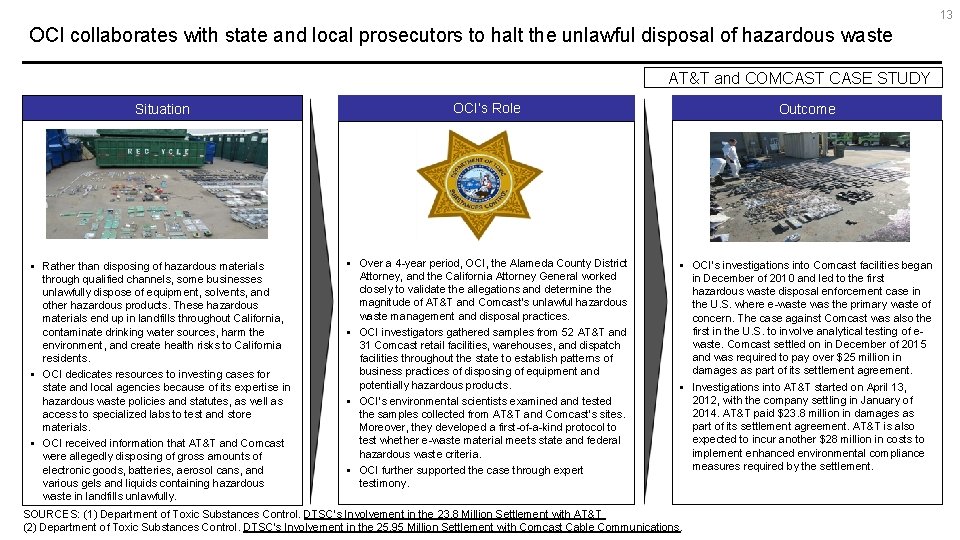
13 OCI collaborates with state and local prosecutors to halt the unlawful disposal of hazardous waste AT&T and COMCAST CASE STUDY Situation OCI’s Role Outcome Rather than disposing of hazardous materials through qualified channels, some businesses unlawfully dispose of equipment, solvents, and other hazardous products. These hazardous materials end up in landfills throughout California, contaminate drinking water sources, harm the environment, and create health risks to California residents. OCI dedicates resources to investing cases for state and local agencies because of its expertise in hazardous waste policies and statutes, as well as access to specialized labs to test and store materials. OCI received information that AT&T and Comcast were allegedly disposing of gross amounts of electronic goods, batteries, aerosol cans, and various gels and liquids containing hazardous waste in landfills unlawfully. Over a 4 -year period, OCI, the Alameda County District Attorney, and the California Attorney General worked closely to validate the allegations and determine the magnitude of AT&T and Comcast’s unlawful hazardous waste management and disposal practices. OCI investigators gathered samples from 52 AT&T and 31 Comcast retail facilities, warehouses, and dispatch facilities throughout the state to establish patterns of business practices of disposing of equipment and potentially hazardous products. OCI’s environmental scientists examined and tested the samples collected from AT&T and Comcast’s sites. Moreover, they developed a first-of-a-kind protocol to test whether e-waste material meets state and federal hazardous waste criteria. OCI further supported the case through expert testimony. OCI’s investigations into Comcast facilities began in December of 2010 and led to the first hazardous waste disposal enforcement case in the U. S. where e-waste was the primary waste of concern. The case against Comcast was also the first in the U. S. to involve analytical testing of ewaste. Comcast settled on in December of 2015 and was required to pay over $25 million in damages as part of its settlement agreement. Investigations into AT&T started on April 13, 2012, with the company settling in January of 2014. AT&T paid $23. 8 million in damages as part of its settlement agreement. AT&T is also expected to incur another $28 million in costs to implement enhanced environmental compliance measures required by the settlement. SOURCES: (1) Department of Toxic Substances Control. DTSC’s Involvement in the 23. 8 Million Settlement with AT&T (2) Department of Toxic Substances Control. DTSC’s Involvement in the 25. 95 Million Settlement with Comcast Cable Communications.
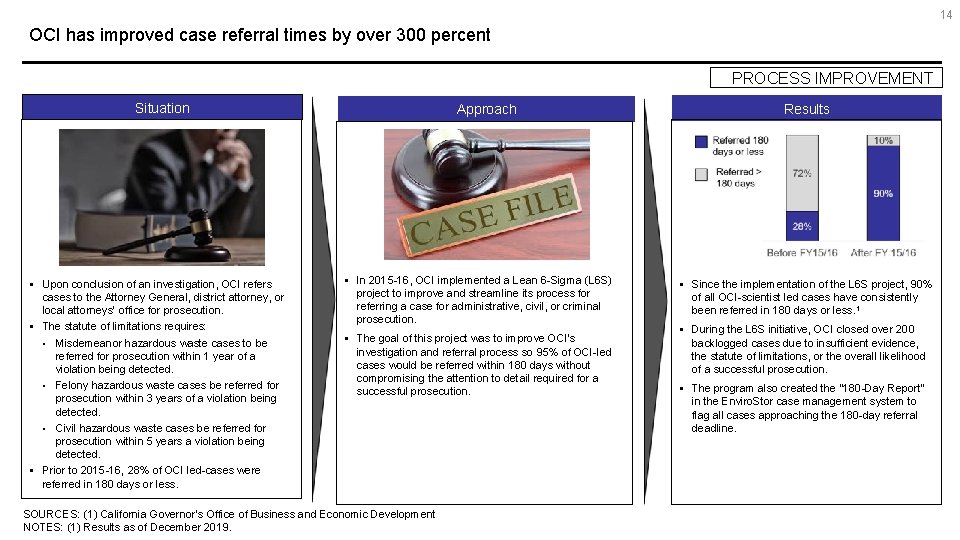
14 OCI has improved case referral times by over 300 percent PROCESS IMPROVEMENT Situation Upon conclusion of an investigation, OCI refers cases to the Attorney General, district attorney, or local attorneys’ office for prosecution. The statute of limitations requires: Misdemeanor hazardous waste cases to be referred for prosecution within 1 year of a violation being detected. Felony hazardous waste cases be referred for prosecution within 3 years of a violation being detected. Civil hazardous waste cases be referred for prosecution within 5 years a violation being detected. Prior to 2015 -16, 28% of OCI led-cases were referred in 180 days or less. Approach In 2015 -16, OCI implemented a Lean 6 -Sigma (L 6 S) project to improve and streamline its process for referring a case for administrative, civil, or criminal prosecution. The goal of this project was to improve OCI’s investigation and referral process so 95% of OCI-led cases would be referred within 180 days without compromising the attention to detail required for a successful prosecution. SOURCES: (1) California Governor’s Office of Business and Economic Development NOTES: (1) Results as of December 2019. Results Since the implementation of the L 6 S project, 90% of all OCI-scientist led cases have consistently been referred in 180 days or less. 1 During the L 6 S initiative, OCI closed over 200 backlogged cases due to insufficient evidence, the statute of limitations, or the overall likelihood of a successful prosecution. The program also created the “ 180 -Day Report” in the Enviro. Stor case management system to flag all cases approaching the 180 -day referral deadline.
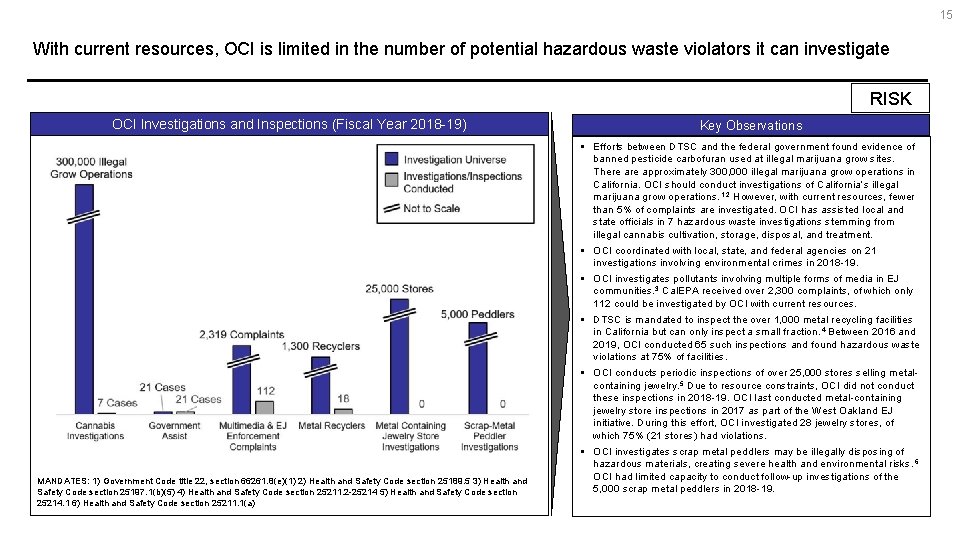
15 With current resources, OCI is limited in the number of potential hazardous waste violators it can investigate RISK OCI Investigations and Inspections (Fiscal Year 2018 -19) MANDATES: 1) Government Code title 22, section 66261. 8(e)(1) 2) Health and Safety Code section 25189. 5 3) Health and Safety Code section 25197. 1(b)(5) 4) Health and Safety Code section 25211. 2 -25214 5) Health and Safety Code section 25214. 1 6) Health and Safety Code section 25211. 1(a) Key Observations Efforts between DTSC and the federal government found evidence of banned pesticide carbofuran used at illegal marijuana grow sites. There approximately 300, 000 illegal marijuana grow operations in California. OCI should conduct investigations of California’s illegal marijuana grow operations. 1, 2 However, with current resources, fewer than 5% of complaints are investigated. OCI has assisted local and state officials in 7 hazardous waste investigations stemming from illegal cannabis cultivation, storage, disposal, and treatment. OCI coordinated with local, state, and federal agencies on 21 investigations involving environmental crimes in 2018 -19. OCI investigates pollutants involving multiple forms of media in EJ communities. 3 Cal. EPA received over 2, 300 complaints, of which only 112 could be investigated by OCI with current resources. DTSC is mandated to inspect the over 1, 000 metal recycling facilities in California but can only inspect a small fraction. 4 Between 2016 and 2019, OCI conducted 65 such inspections and found hazardous waste violations at 75% of facilities. OCI conducts periodic inspections of over 25, 000 stores selling metalcontaining jewelry. 5 Due to resource constraints, OCI did not conduct these inspections in 2018 -19. OCI last conducted metal-containing jewelry store inspections in 2017 as part of the West Oakland EJ initiative. During this effort, OCI investigated 28 jewelry stores, of which 75% (21 stores) had violations. OCI investigates scrap metal peddlers may be illegally disposing of hazardous materials, creating severe health and environmental risks. 6 OCI had limited capacity to conduct follow-up investigations of the 5, 000 scrap metal peddlers in 2018 -19.
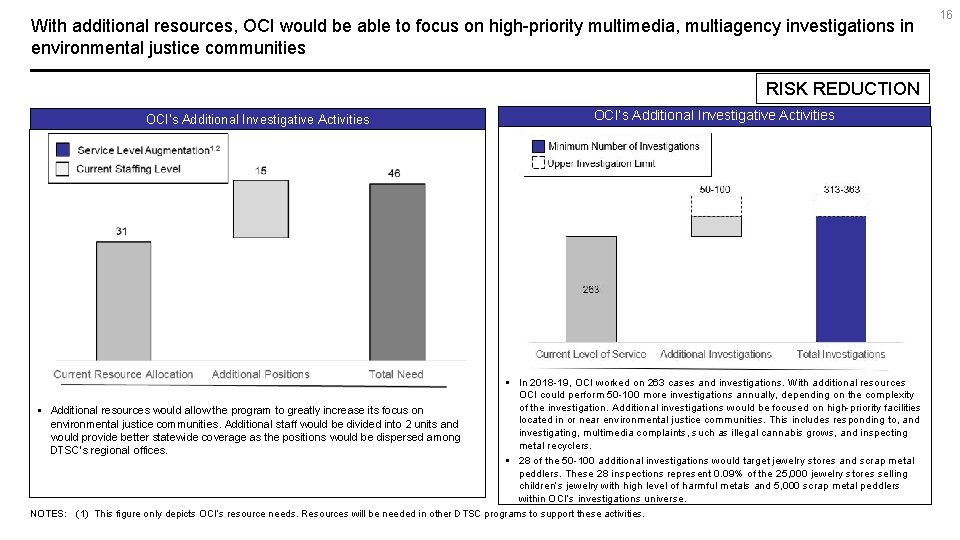
With additional resources, OCI would be able to focus on high-priority multimedia, multiagency investigations in environmental justice communities RISK REDUCTION OCI’s Additional Investigative Activities Additional resources would allow the program to greatly increase its focus on environmental justice communities. Additional staff would be divided into 2 units and would provide better statewide coverage as the positions would be dispersed among DTSC’s regional offices. OCI’s Additional Investigative Activities In 2018 -19, OCI worked on 263 cases and investigations. With additional resources OCI could perform 50 -100 more investigations annually, depending on the complexity of the investigation. Additional investigations would be focused on high-priority facilities located in or near environmental justice communities. This includes responding to, and investigating, multimedia complaints, such as illegal cannabis grows, and inspecting metal recyclers. 28 of the 50 -100 additional investigations would target jewelry stores and scrap metal peddlers. These 28 inspections represent 0. 09% of the 25, 000 jewelry stores selling children’s jewelry with high level of harmful metals and 5, 000 scrap metal peddlers within OCI’s investigations universe. NOTES: (1) This figure only depicts OCI’s resource needs. Resources will be needed in other DTSC programs to support these activities. 16
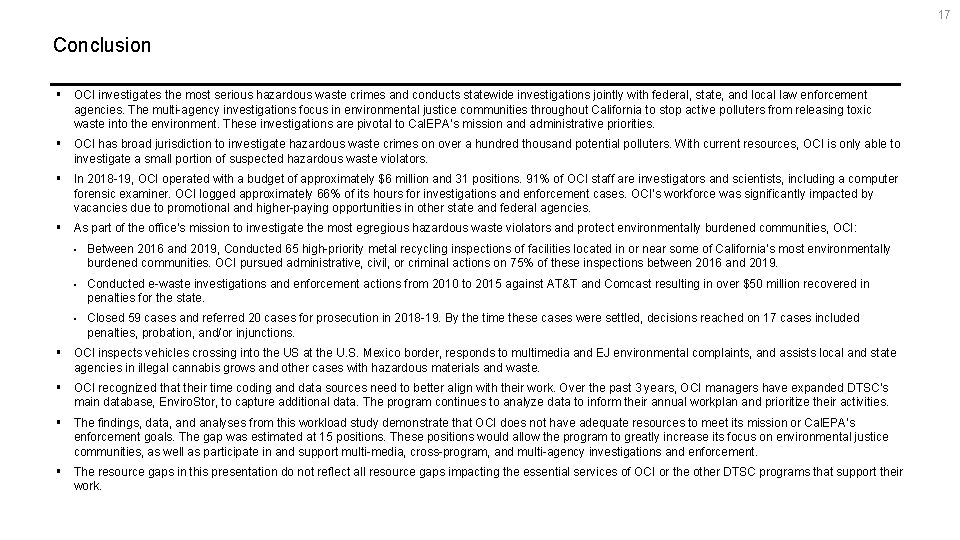
17 Conclusion OCI investigates the most serious hazardous waste crimes and conducts statewide investigations jointly with federal, state, and local law enforcement agencies. The multi-agency investigations focus in environmental justice communities throughout California to stop active polluters from releasing toxic waste into the environment. These investigations are pivotal to Cal. EPA’s mission and administrative priorities. OCI has broad jurisdiction to investigate hazardous waste crimes on over a hundred thousand potential polluters. With current resources, OCI is only able to investigate a small portion of suspected hazardous waste violators. In 2018 -19, OCI operated with a budget of approximately $6 million and 31 positions. 91% of OCI staff are investigators and scientists, including a computer forensic examiner. OCI logged approximately 66% of its hours for investigations and enforcement cases. OCI’s workforce was significantly impacted by vacancies due to promotional and higher-paying opportunities in other state and federal agencies. As part of the office’s mission to investigate the most egregious hazardous waste violators and protect environmentally burdened communities, OCI: Between 2016 and 2019, Conducted 65 high-priority metal recycling inspections of facilities located in or near some of California’s most environmentally burdened communities. OCI pursued administrative, civil, or criminal actions on 75% of these inspections between 2016 and 2019. Conducted e-waste investigations and enforcement actions from 2010 to 2015 against AT&T and Comcast resulting in over $50 million recovered in penalties for the state. Closed 59 cases and referred 20 cases for prosecution in 2018 -19. By the time these cases were settled, decisions reached on 17 cases included penalties, probation, and/or injunctions. OCI inspects vehicles crossing into the US at the U. S. Mexico border, responds to multimedia and EJ environmental complaints, and assists local and state agencies in illegal cannabis grows and other cases with hazardous materials and waste. OCI recognized that their time coding and data sources need to better align with their work. Over the past 3 years, OCI managers have expanded DTSC’s main database, Enviro. Stor, to capture additional data. The program continues to analyze data to inform their annual workplan and prioritize their activities. The findings, data, and analyses from this workload study demonstrate that OCI does not have adequate resources to meet its mission or Cal. EPA’s enforcement goals. The gap was estimated at 15 positions. These positions would allow the program to greatly increase its focus on environmental justice communities, as well as participate in and support multi-media, cross-program, and multi-agency investigations and enforcement. The resource gaps in this presentation do not reflect all resource gaps impacting the essential services of OCI or the other DTSC programs that support their work.
18 Contact Information Rizgar Ghazi, P. E. Deputy Director Hazardous Waste Management Program Department of Toxic Substances Control 1001 I Street Sacramento, CA 95814 Email: Rizgar. Ghazi@dtsc. ca. gov Jane R. Numazu Hazardous Substances Engineer Office of Performance Management and Program Review Department of Toxic Substances Control 1001 I Street Sacramento, CA 95814 Email: Jane. Numazu@dtsc. ca. gov