
1 GroundBased Observations of Mars and Venus Jeremy
1. Ground-Based Observations of Mars and Venus Jeremy Bailey, Sarah Chamberlain, Andrew Simpson (Australian Centre for Astrobiology, Macquarie University, Sydney) David Crisp, Vikki Meadows (Jet Propulsion Laboratory/Caltech) 2. Polarimetric Detection and Characterization of Extrasolar Planets Jeremy Bailey (ACA) Jim Hough, Phil Lucas (University of Hertfordshire)
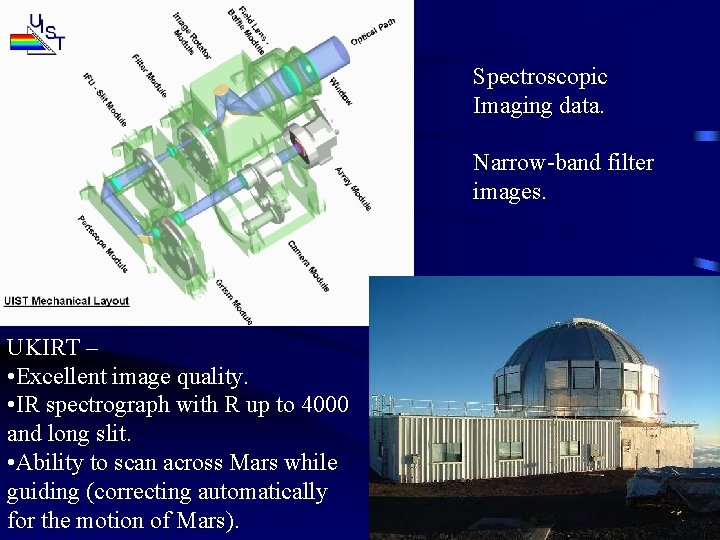
Spectroscopic Imaging data. Narrow-band filter images. UKIRT – • Excellent image quality. • IR spectrograph with R up to 4000 and long slit. • Ability to scan across Mars while guiding (correcting automatically for the motion of Mars).
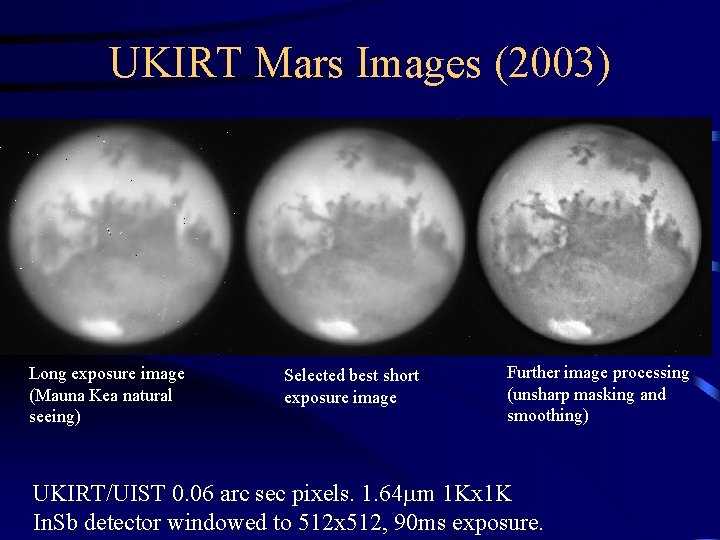
UKIRT Mars Images (2003) Long exposure image (Mauna Kea natural seeing) Selected best short exposure image Further image processing (unsharp masking and smoothing) UKIRT/UIST 0. 06 arc sec pixels. 1. 64 mm 1 Kx 1 K In. Sb detector windowed to 512 x 512, 90 ms exposure.
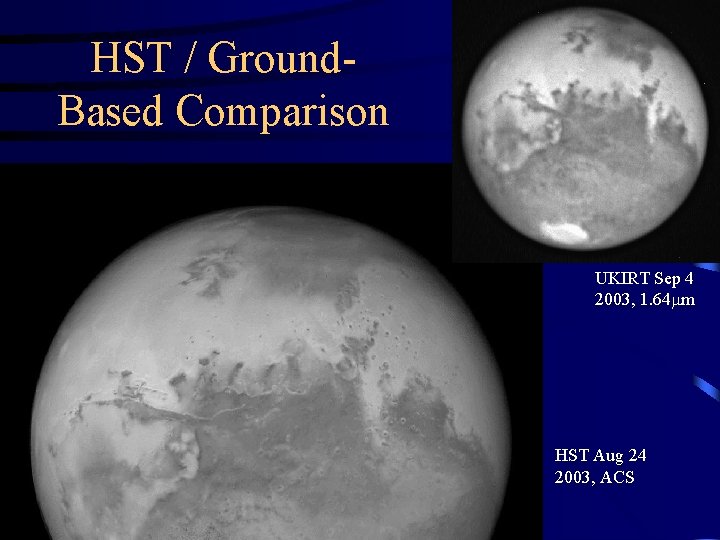
HST / Ground. Based Comparison UKIRT Sep 4 2003, 1. 64 mm HST Aug 24 2003, ACS
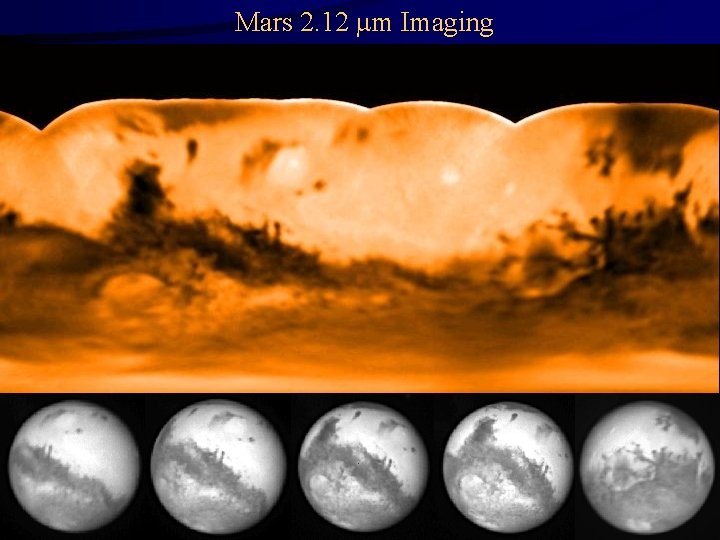
Mars 2. 12 mm Imaging
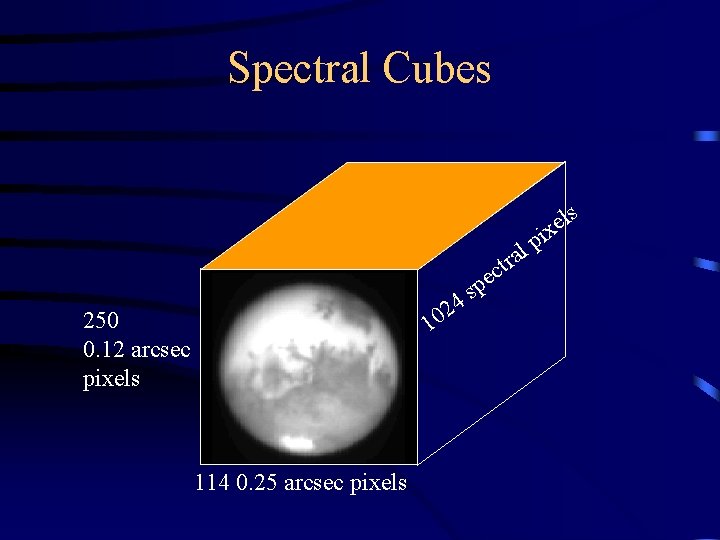
Spectral Cubes ls e ix c e p 10 250 0. 12 arcsec pixels 114 0. 25 arcsec pixels s 4 2 t p l ra
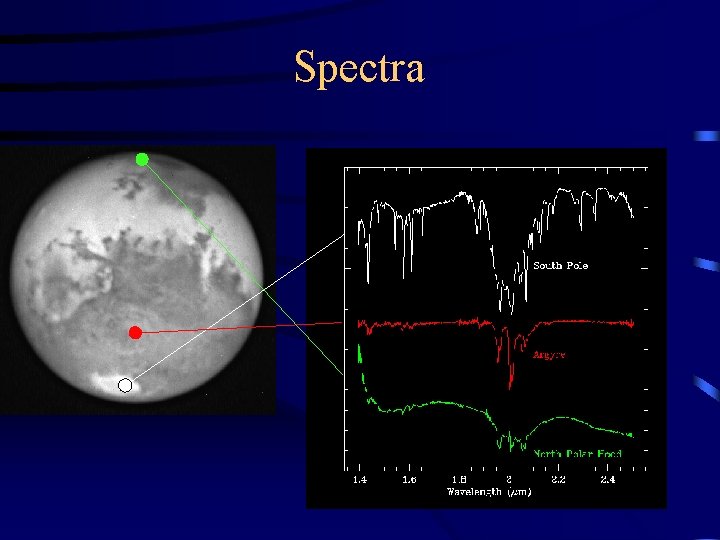
Spectra
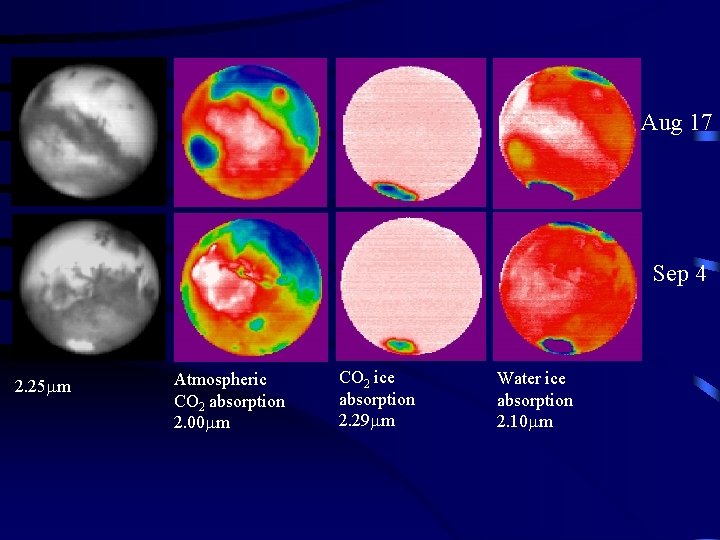
Aug 17 Sep 4 2. 25 mm Atmospheric CO 2 absorption 2. 00 mm CO 2 ice absorption 2. 29 mm Water ice absorption 2. 10 mm
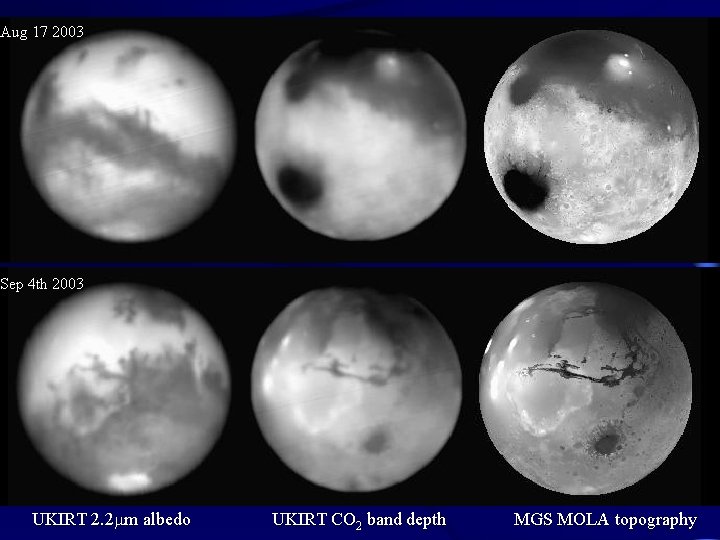
Aug 17 2003 Sep 4 th 2003 UKIRT 2. 2 mm albedo UKIRT CO 2 band depth MGS MOLA topography
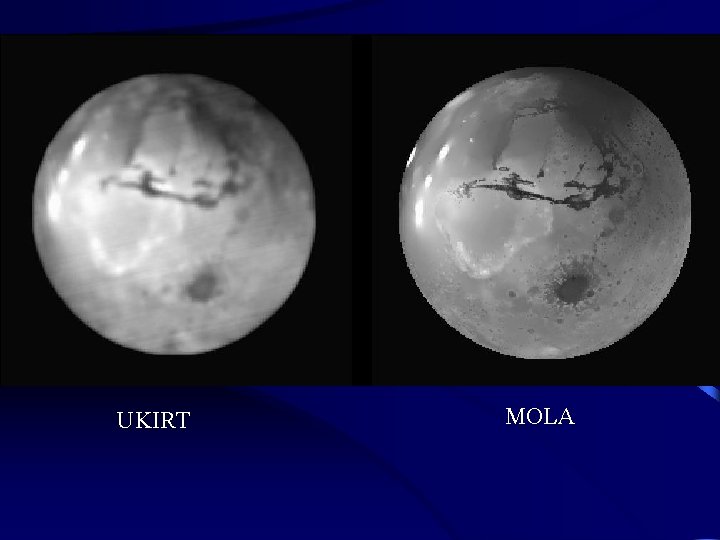
UKIRT MOLA
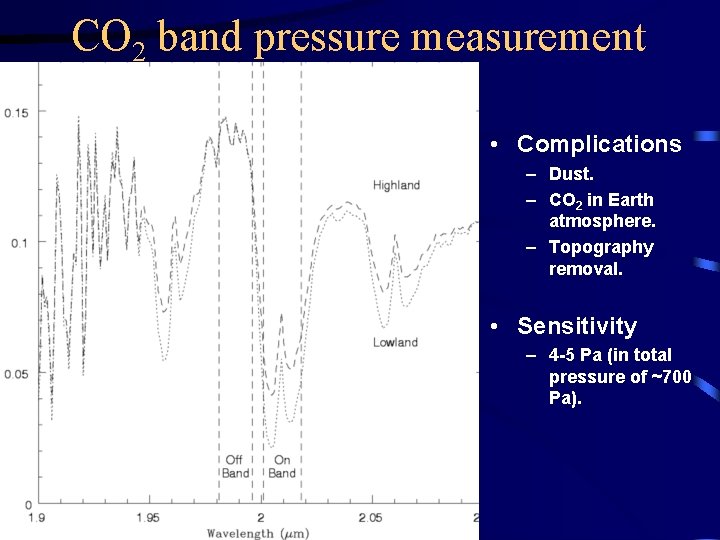
CO 2 band pressure measurement • Complications – Dust. – CO 2 in Earth atmosphere. – Topography removal. • Sensitivity – 4 -5 Pa (in total pressure of ~700 Pa).
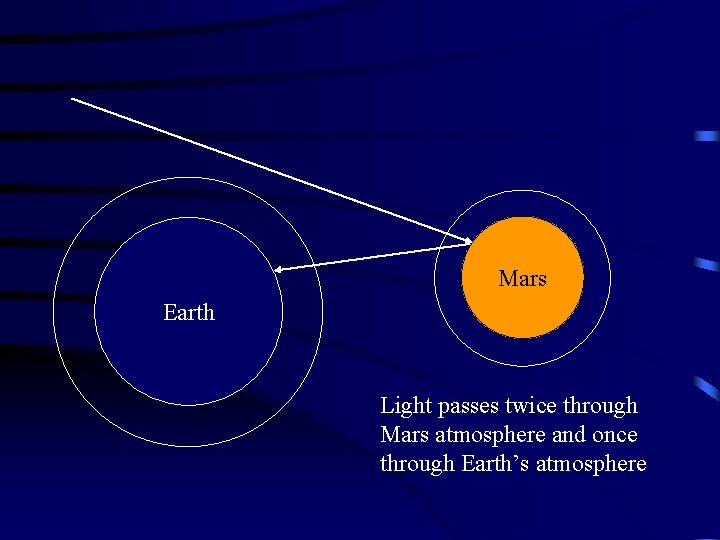
Mars Earth Light passes twice through Mars atmosphere and once through Earth’s atmosphere
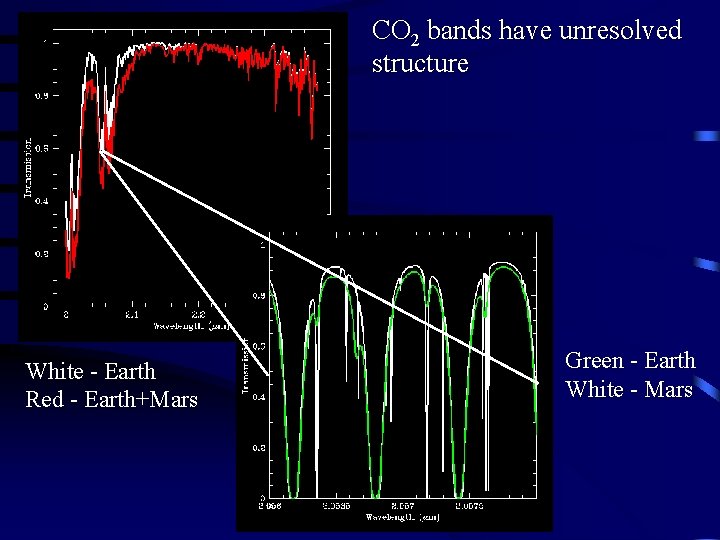
CO 2 bands have unresolved structure White - Earth Red - Earth+Mars Green - Earth White - Mars
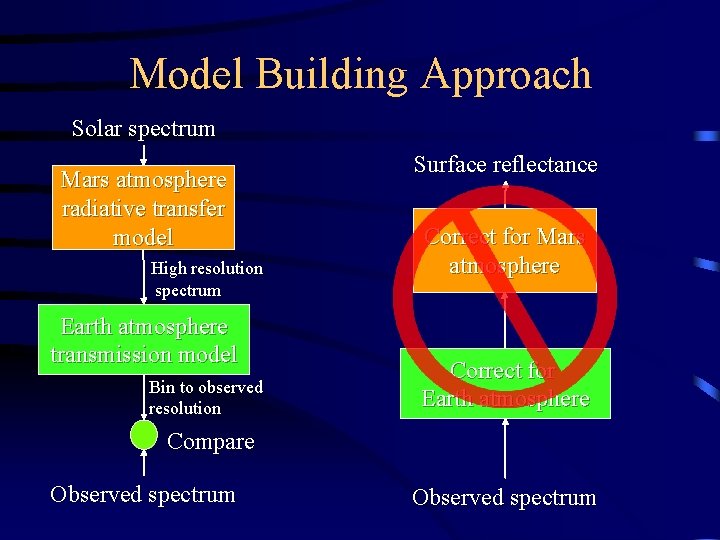
Model Building Approach Solar spectrum Mars atmosphere radiative transfer model High resolution spectrum Earth atmosphere transmission model Bin to observed resolution Surface reflectance Correct for Mars atmosphere Correct for Earth atmosphere Compare Observed spectrum
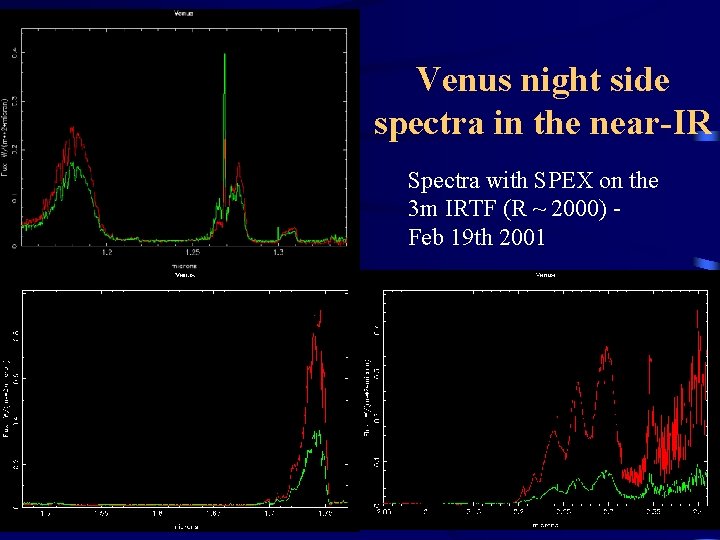
Venus night side spectra in the near-IR Spectra with SPEX on the 3 m IRTF (R ~ 2000) Feb 19 th 2001
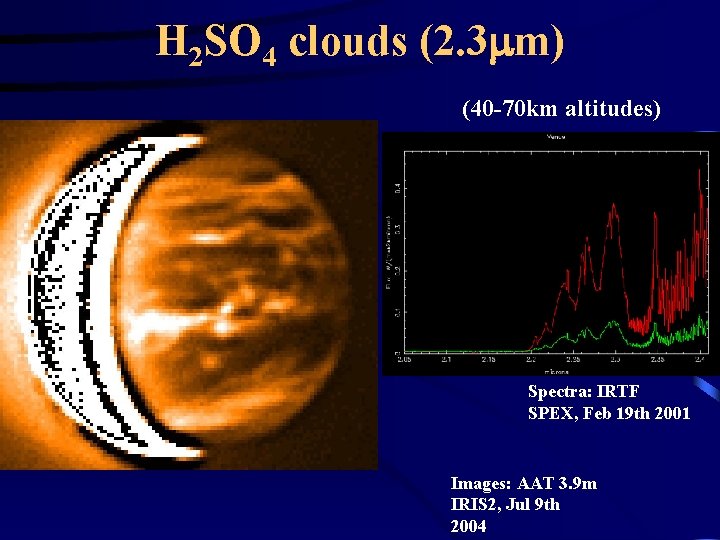
H 2 SO 4 clouds (2. 3 mm) (40 -70 km altitudes) Spectra: IRTF SPEX, Feb 19 th 2001 Images: AAT 3. 9 m IRIS 2, Jul 9 th 2004
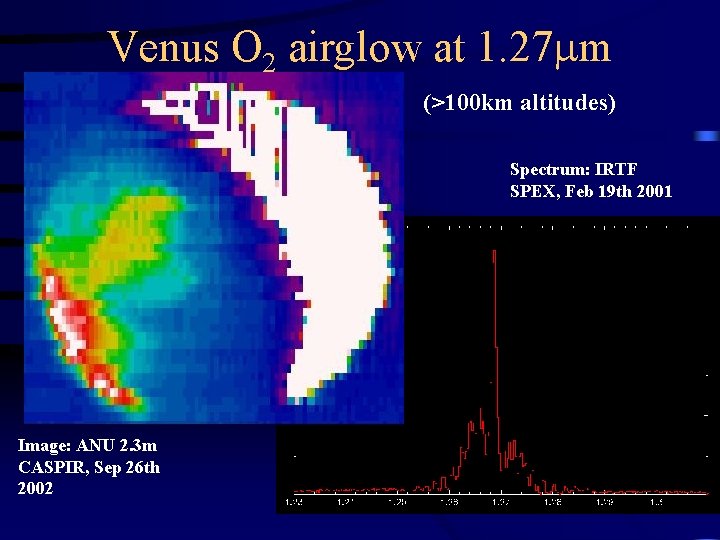
Venus O 2 airglow at 1. 27 mm (>100 km altitudes) Spectrum: IRTF SPEX, Feb 19 th 2001 Image: ANU 2. 3 m CASPIR, Sep 26 th 2002
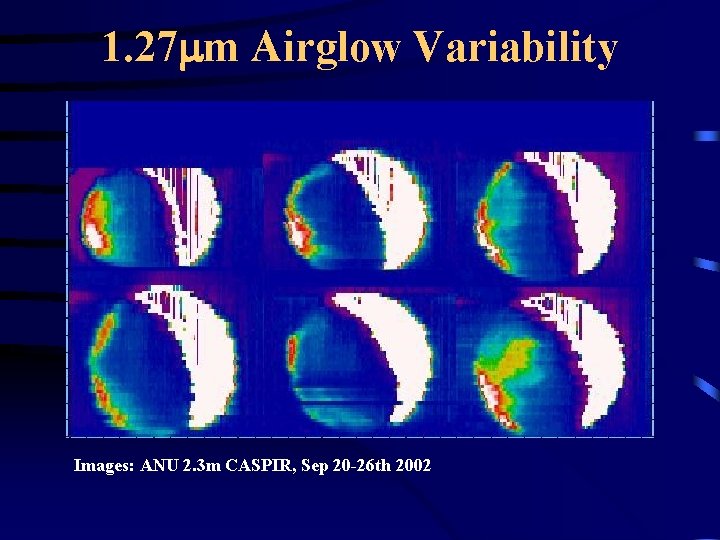
1. 27 mm Airglow Variability Images: ANU 2. 3 m CASPIR, Sep 20 -26 th 2002
Our Future Plans • Instrument Development – Demonstrate HST resolution or better from ground-based telescopes. – IR Spectroscopy R ~ 2000 and R > 100, 000. • Continued observing program of Mars and Venus. – Long sequences of CO 2 observations of Mars to look for weather systems. – High spectral resolution observations to measure winds and trace gases. • Development of modeling and analysis software – Techniques for Earth Atmosphere correction. – Retrieval algorithms for pressure, temperature, dust etc.
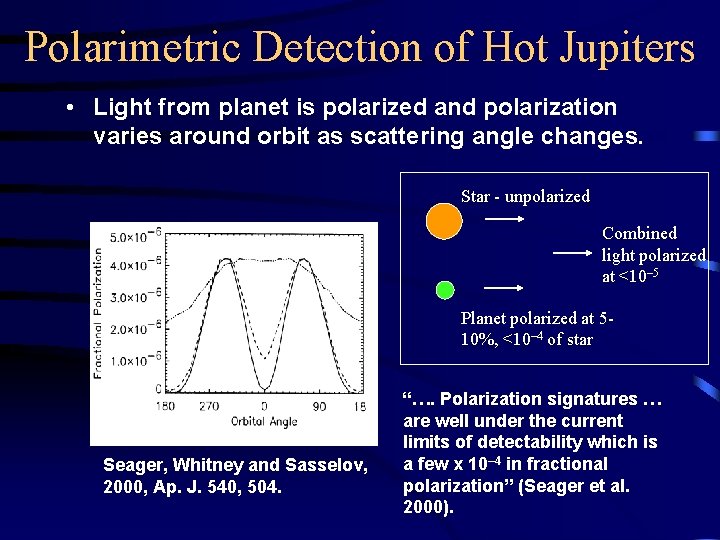
Polarimetric Detection of Hot Jupiters • Light from planet is polarized and polarization varies around orbit as scattering angle changes. Star - unpolarized Combined light polarized at <10– 5 Planet polarized at 510%, <10– 4 of star Seager, Whitney and Sasselov, 2000, Ap. J. 540, 504. “…. Polarization signatures … are well under the current limits of detectability which is a few x 10– 4 in fractional polarization” (Seager et al. 2000).
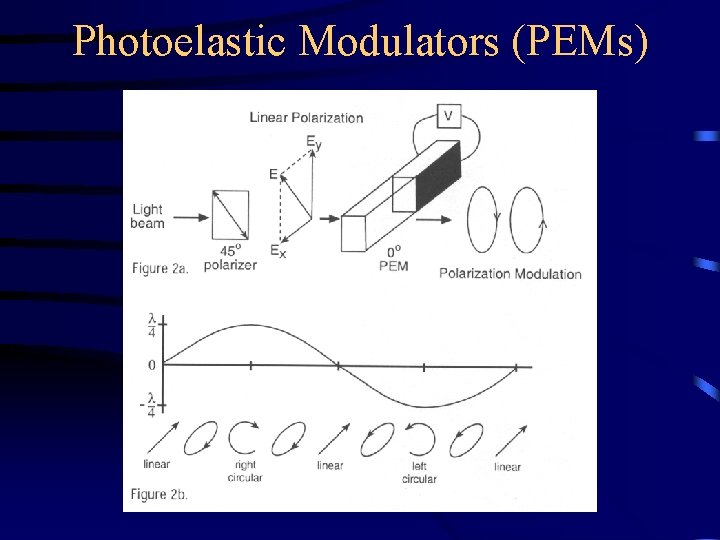
Photoelastic Modulators (PEMs)
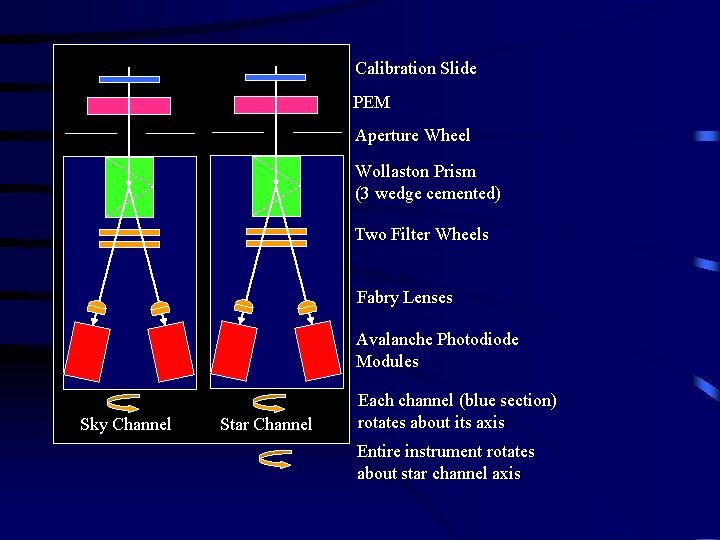
Calibration Slide PEM Aperture Wheel Wollaston Prism (3 wedge cemented) Two Filter Wheels Fabry Lenses Avalanche Photodiode Modules Sky Channel Star Channel Each channel (blue section) rotates about its axis Entire instrument rotates about star channel axis
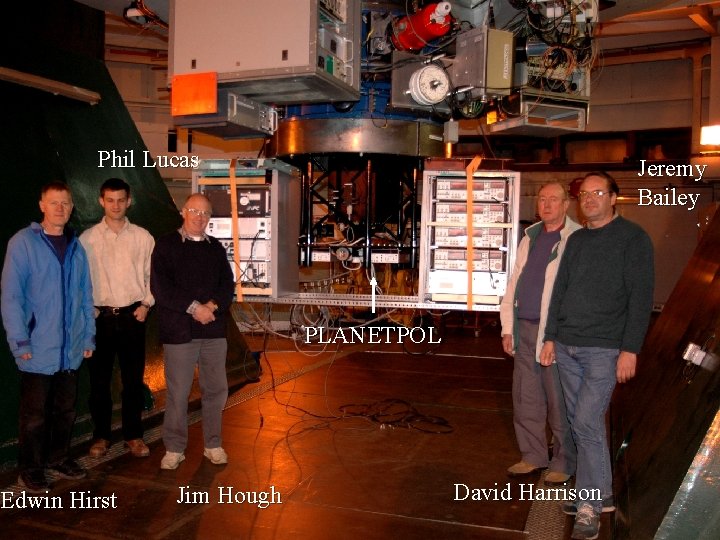
Phil Lucas Edwin Hirst Jeremy Bailey PLANETPOL Jim Hough David Harrison
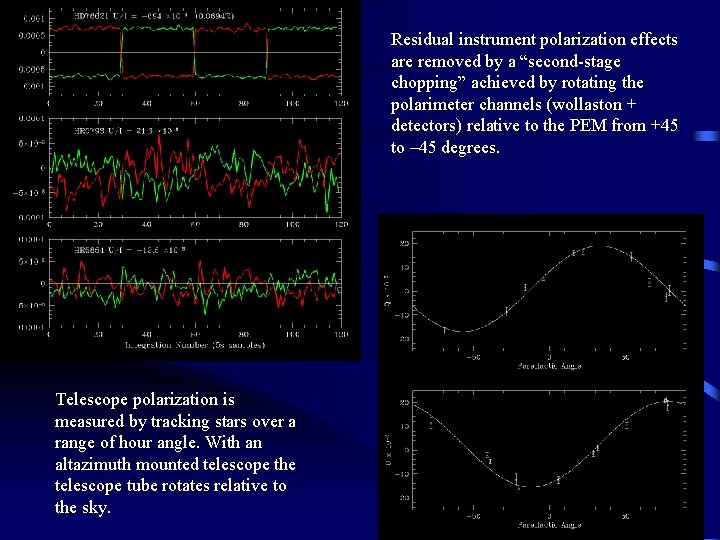
Residual instrument polarization effects are removed by a “second-stage chopping” achieved by rotating the polarimeter channels (wollaston + detectors) relative to the PEM from +45 to – 45 degrees. Telescope polarization is measured by tracking stars over a range of hour angle. With an altazimuth mounted telescope the telescope tube rotates relative to the sky.
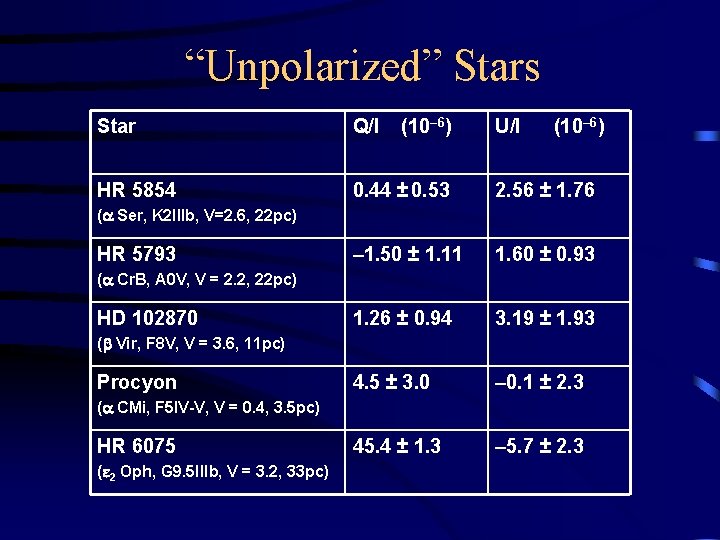
“Unpolarized” Stars Star Q/I (10– 6) U/I (10– 6) HR 5854 0. 44 ± 0. 53 2. 56 ± 1. 76 – 1. 50 ± 1. 11 1. 60 ± 0. 93 1. 26 ± 0. 94 3. 19 ± 1. 93 4. 5 ± 3. 0 – 0. 1 ± 2. 3 45. 4 ± 1. 3 – 5. 7 ± 2. 3 (a Ser, K 2 IIIb, V=2. 6, 22 pc) HR 5793 (a Cr. B, A 0 V, V = 2. 2, 22 pc) HD 102870 (b Vir, F 8 V, V = 3. 6, 11 pc) Procyon (a CMi, F 5 IV-V, V = 0. 4, 3. 5 pc) HR 6075 (e 2 Oph, G 9. 5 IIIb, V = 3. 2, 33 pc)
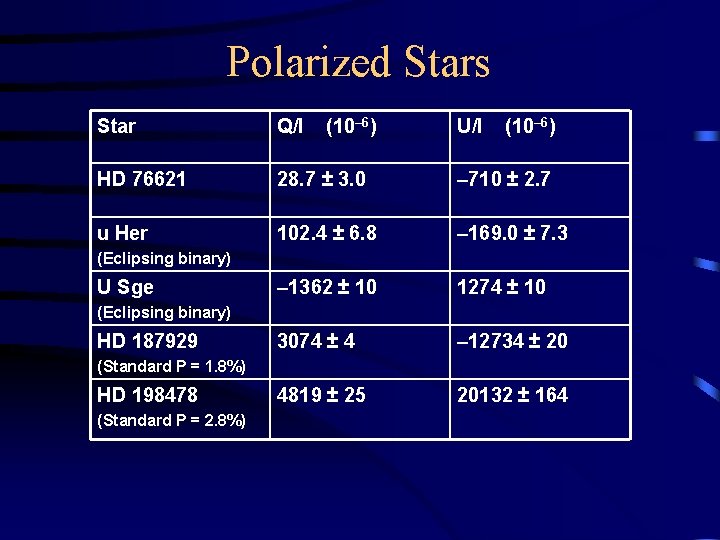
Polarized Stars Star Q/I (10– 6) U/I (10– 6) HD 76621 28. 7 ± 3. 0 – 710 ± 2. 7 u Her 102. 4 ± 6. 8 – 169. 0 ± 7. 3 – 1362 ± 10 1274 ± 10 3074 ± 4 – 12734 ± 20 4819 ± 25 20132 ± 164 (Eclipsing binary) U Sge (Eclipsing binary) HD 187929 (Standard P = 1. 8%) HD 198478 (Standard P = 2. 8%)
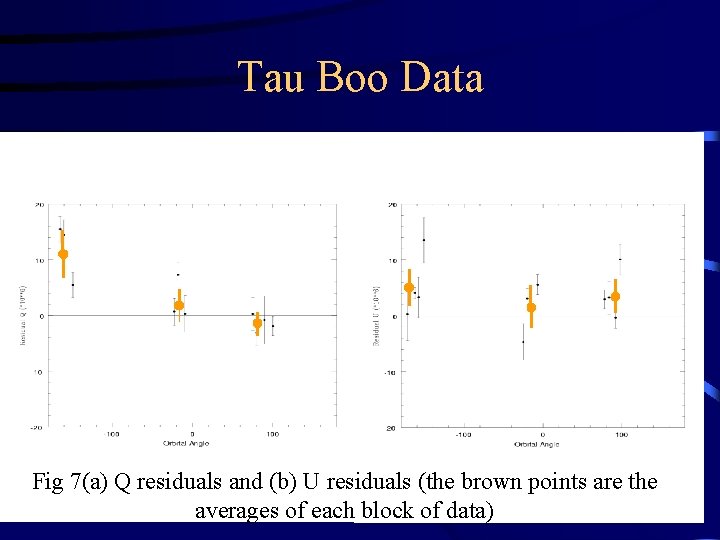
Tau Boo Data Fig 7(a) Q residuals and (b) U residuals (the brown points are the averages of each block of data)
What the Polarization Can Tell Us • Position angle variation through orbit gives us the inclination. – and hence the mass of the planet removing the sin I uncertainty. • The presence or absence of Rayleigh scattering polarization provides information on the pressure at the cloud tops. • The orbital variation of polarization tells us about particle size and composition. • We will have some idea of the albedo and this will assist other direct detection techniques (e. g. photometry and spectrscopy).
Summary of Results • PLANETPOL works and delivers repeatable polarization measurements at the 10– 6 level. • The telescope polarization of the WHT is low and seems stable (over a few days at least). – Good news for us — It could be much more difficult to get reliable results in the presence of a telescope polarization at the 10– 3 to 10– 4 level. • Normal nearby stars have very low polarization (~3 x 10– 6 or less). – Also good for us — We shouldn’t have too many problems from star polarization in interpreting the data from our extrasolar planet systems. • We are measuring t Boo to an accuracy of about 2 -3 x 10– 6 for a 24 minute integration. – More extended observations should be sufficient for a detection or a significant upper limit. – We have a 13 night run on the WHT in April/May 2005.
Imaging Polarimetry • Similar polarization techniques using an imaging system can be used for detection and characterization of resolved planetary images. – e. g. From Adaptive Optics systems on large ground-based telescopes. – Space instruments such as TPF-C. • Polarimetry can be used as a differential technique to pick the planet out of the speckle noise halo around the star. • Polarimetry can be used to help characterize any detected planet.
- Slides: 31