
1 Ground Calibration Procedures for the PREFIRE Cube
1. Ground Calibration Procedures for the PREFIRE Cube. Sat Spectrometer 2. Phased Antenna Array Design for a Scalable Kaband Digital Beamforming Array Receiver 2020 Postdoc Research Day Presentation Conference Lavanya Periasamy Organization: 329 H Advisor: Brian Drouin (329 H), Sidharth Misra (386 G) Postdoc Program: JPL
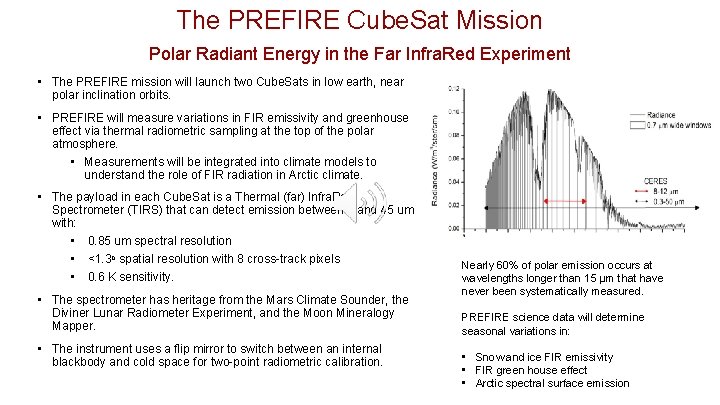
The PREFIRE Cube. Sat Mission Polar Radiant Energy in the Far Infra. Red Experiment • The PREFIRE mission will launch two Cube. Sats in low earth, near polar inclination orbits. • PREFIRE will measure variations in FIR emissivity and greenhouse effect via thermal radiometric sampling at the top of the polar atmosphere. • Measurements will be integrated into climate models to understand the role of FIR radiation in Arctic climate. • The payload in each Cube. Sat is a Thermal (far) Infra. Red Spectrometer (TIRS) that can detect emission between 5 and 45 um with: • 0. 85 um spectral resolution • <1. 3 o spatial resolution with 8 cross-track pixels • 0. 6 K sensitivity. • The spectrometer has heritage from the Mars Climate Sounder, the Diviner Lunar Radiometer Experiment, and the Moon Mineralogy Mapper. • The instrument uses a flip mirror to switch between an internal blackbody and cold space for two-point radiometric calibration. Nearly 60% of polar emission occurs at wavelengths longer than 15 µm that have never been systematically measured. PREFIRE science data will determine seasonal variations in: • Snow and ice FIR emissivity • FIR green house effect • Arctic spectral surface emission

Laboratory Calibration of a Spectrometer • Prelaunch characterization of the FIR spectrometer includes three calibration procedures: • Spectral calibration • Determines spectral response of the instrument across all channels • Uses a FIR source with a monochromator • Radiometric calibration • Determines instrument gain and offset corrections due to thermal drift or fluctuations • Uses two external hot and cold temperature controlled blackbody targets • Spatial calibration • Determines field of view of each detector, relative alignment between detectors • Uses a tunable laser source in conjunction with a monochromator • Calibration procedures have similarity with those of the MCS and DLRE spectrometers’. • This work focuses on developing the laboratory setup for spatial calibration and includes • determining optical requirements and procurement of the new PREFIRE monochromator including the collimated FIR ceramic emitter source, condensing optics, gratings, and filter wheel. • developing a mathematical model for determining monochromator throughput based on the optics • understanding the MCS legacy monochromator and associated calibration procedures • development of a chopper stabilized instrumentation amplifier for integrating with the monochromator reference detector and for laser alignment
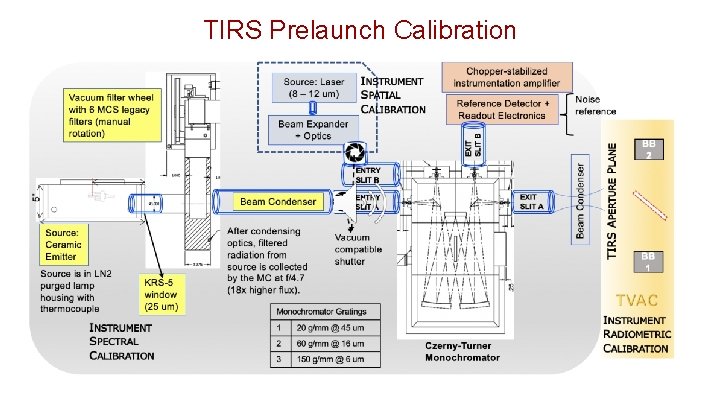
TIRS Prelaunch Calibration
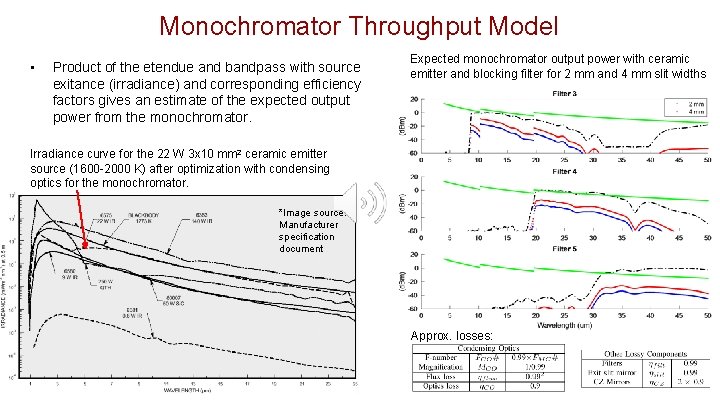
Monochromator Throughput Model • Product of the etendue and bandpass with source exitance (irradiance) and corresponding efficiency factors gives an estimate of the expected output power from the monochromator. Expected monochromator output power with ceramic emitter and blocking filter for 2 mm and 4 mm slit widths Irradiance curve for the 22 W 3 x 10 mm 2 ceramic emitter source (1600 -2000 K) after optimization with condensing optics for the monochromator. *Image source: Manufacturer specification document Approx. losses:
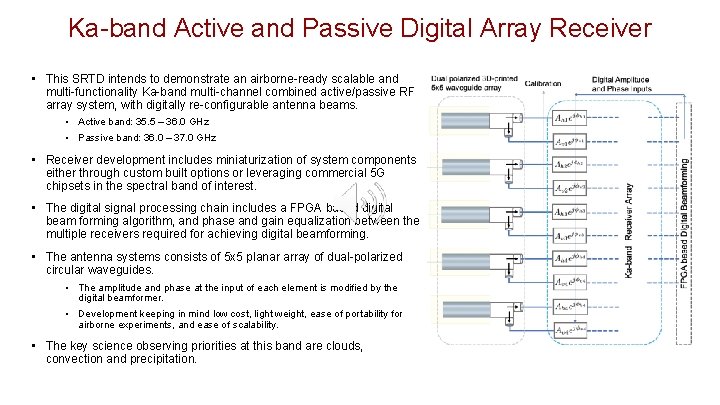
Ka-band Active and Passive Digital Array Receiver • This SRTD intends to demonstrate an airborne-ready scalable and multi-functionality Ka-band multi-channel combined active/passive RF array system, with digitally re-configurable antenna beams. • Active band: 35. 5 – 36. 0 GHz • Passive band: 36. 0 – 37. 0 GHz • Receiver development includes miniaturization of system components either through custom built options or leveraging commercial 5 G chipsets in the spectral band of interest. • The digital signal processing chain includes a FPGA based digital beam forming algorithm, and phase and gain equalization between the multiple receivers required for achieving digital beamforming. • The antenna systems consists of 5 x 5 planar array of dual-polarized circular waveguides. • The amplitude and phase at the input of each element is modified by the digital beamformer. • Development keeping in mind low cost, light weight, ease of portability for airborne experiments, and ease of scalability. • The key science observing priorities at this band are clouds, convection and precipitation.
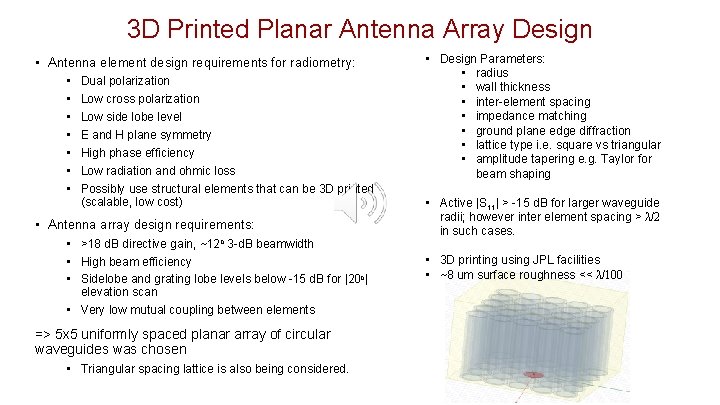
3 D Printed Planar Antenna Array Design • Antenna element design requirements for radiometry: • • Dual polarization Low cross polarization Low side lobe level E and H plane symmetry High phase efficiency Low radiation and ohmic loss Possibly use structural elements that can be 3 D printed (scalable, low cost) • Antenna array design requirements: • >18 d. B directive gain, ~12 o 3 -d. B beamwidth • High beam efficiency • Sidelobe and grating lobe levels below -15 d. B for |20 o| elevation scan • Very low mutual coupling between elements => 5 x 5 uniformly spaced planar array of circular waveguides was chosen • Triangular spacing lattice is also being considered. • Design Parameters: • radius • wall thickness • inter-element spacing • impedance matching • ground plane edge diffraction • lattice type i. e. square vs triangular • amplitude tapering e. g. Taylor for beam shaping • Active |S 11| > -15 d. B for larger waveguide radii; however inter element spacing > λ/2 in such cases. • 3 D printing using JPL facilities • ~8 um surface roughness << λ/100
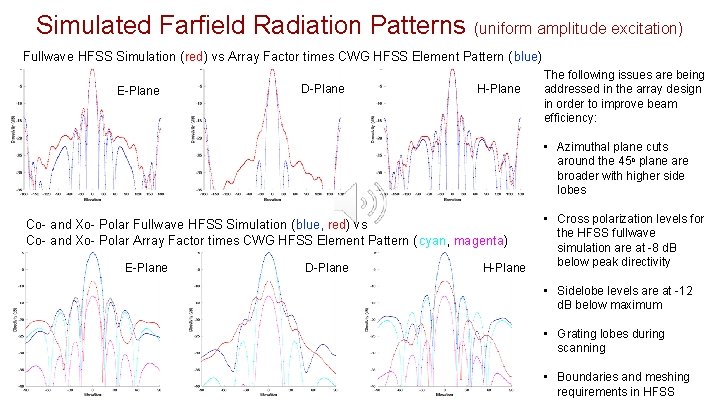
Simulated Farfield Radiation Patterns (uniform amplitude excitation) Fullwave HFSS Simulation (red) vs Array Factor times CWG HFSS Element Pattern (blue) E-Plane D-Plane H-Plane The following issues are being addressed in the array design in order to improve beam efficiency: • Azimuthal plane cuts around the 45 o plane are broader with higher side lobes Co- and Xo- Polar Fullwave HFSS Simulation (blue, red) vs Co- and Xo- Polar Array Factor times CWG HFSS Element Pattern (cyan, magenta) E-Plane D-Plane H-Plane • Cross polarization levels for the HFSS fullwave simulation are at -8 d. B below peak directivity • Sidelobe levels are at -12 d. B below maximum • Grating lobes during scanning • Boundaries and meshing requirements in HFSS
Acknowledgements PREFIRE TIRS CALIBRATION SETUP Ka BAND ANTENNA ARRAY • Brian Drouin • Sidharth Misra • Sharmila Padmanabhan • Richard Hodges • Mary White • Xavier Bosch • Mehmet Ogut
- Slides: 9