
1 Governance Models in the Public Sector Niketan
1 Governance Models in the Public Sector - Niketan, Pragati, Sanchit, Uma
Risk Management • What is Risk? As defined in ISO 31000 risk is the effect of uncertainty on objectives, whether positive or negative. • What is Risk Management? It is the identification, assessment, and prioritization of risks followed by the application of resources to minimize, monitor, and control the probability of occurrence of any unfortunate events.
3 Fundamentals of Risk Management: • Risk Management Process must be enterprise wide involving all the people at all different levels of an enterprise. • Risk Categories: E. g. External, Internal, Technical & Unforeseeable Categorized by Cause: E. g. Schedule, Cost, Quality, Scope, Resources, Customer Satisfaction • Effective Risk Management increases the probability of positive risks and decreases the probability of threats.
4 Risk Management Phases: v. Risk Identification v. Quantitative or Qualitative Assessment of Risk v. Risk Prioritization v. Risk Monitoring
5 Risk Identification • “Risk identification process requires a studied, deliberate approach to looking at potential risks in each area of operations and then identifying the more significant risk areas that may impact each operation in a reasonable time period. “ • This risk identification process should occur at multiple levels in an enterprise. A risk that impacts an individual business unit or project may not have that great of an impact on the entire enterprise or beyond. Conversely, is also true.
6 Risk Identification - Brainstorming • Rapid response group exercise • Knowledgeable individuals from different backgrounds are asked to focus on the same subject • Risks affecting different areas are listed • This list is reduced by voting conducted by a mediator • The results must be shared with other groups who were unable to participate in the process
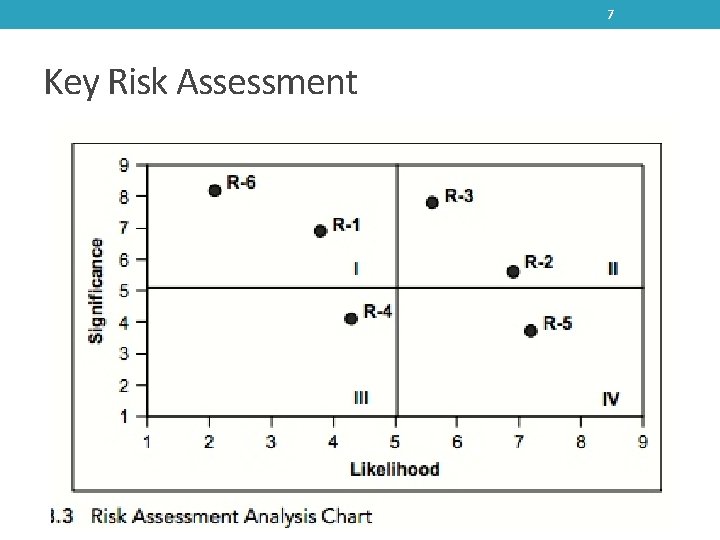
7 Key Risk Assessment
8 • Probability & Uncertainty v Important when a large set of risks are identified v Ranges between 0. 00 to 0. 99 v Joint Probability of 2 separate events occurring is given by: Pr(Event #1) * Pr(Event #2) = Pr(Both Events) • Period of Analysis When estimating occurrences and likelihoods, the ERM team should take care to assure that all estimates are made over the same period of time. (Usually 1 year)
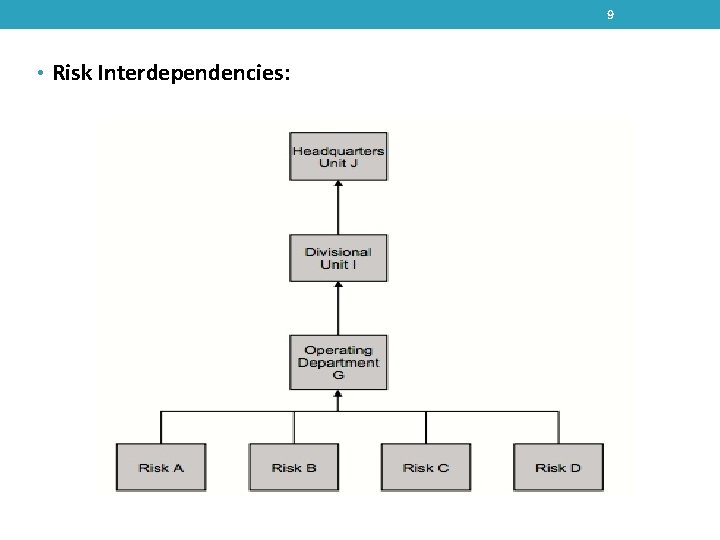
9 • Risk Interdependencies:
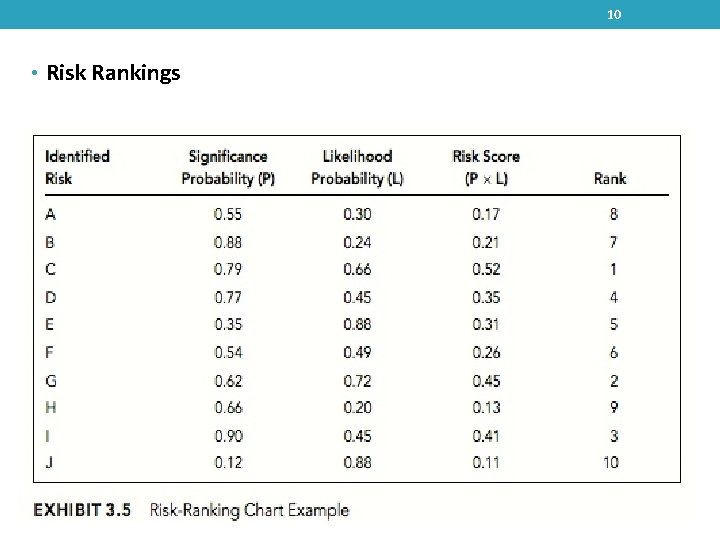
10 • Risk Rankings
11 The Delphi Method • Interactive forecasting method that relies upon experts • Experts answer questionnaires in 2 or more rounds • After every round, facilitator provides an anonymous summary of every round • The experts are encouraged to revise their answers • Thereby, helping the group to arrive at a correct answer
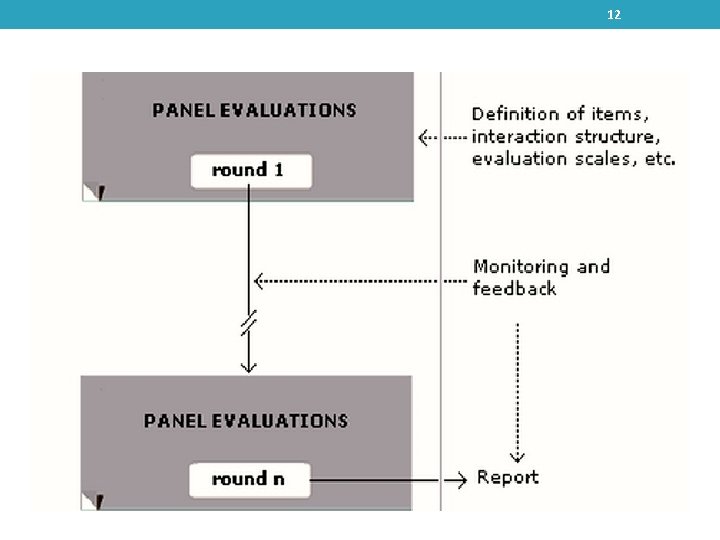
12
13 Monte Carlo Simulation • Computerized Mathematical Technique which lets you see all possible outcomes of your decision • Asses impact of risk thereby Improving decision making during uncertainty • Primarily used when: v. Input data has uncertainties that can be quantified v. Output data needs to accurately represent input data v. The calculated uncertainty needs to be accurate • Used in NASA, Nuclear Weapon Design
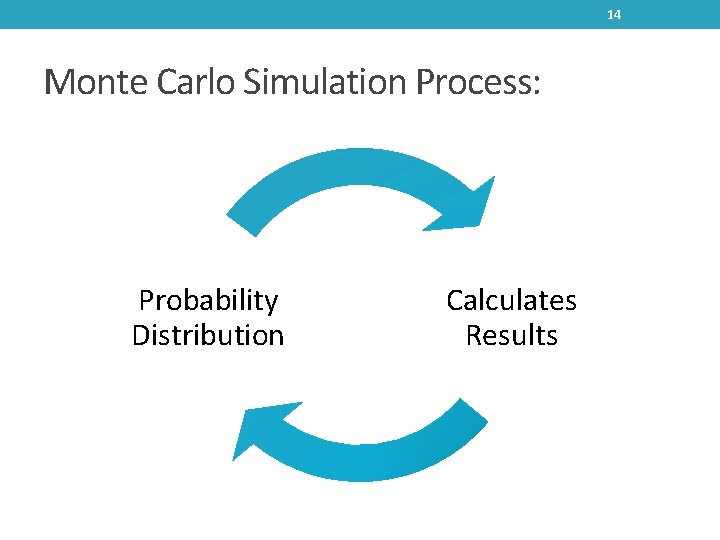
14 Monte Carlo Simulation Process: Probability Distribution Calculates Results
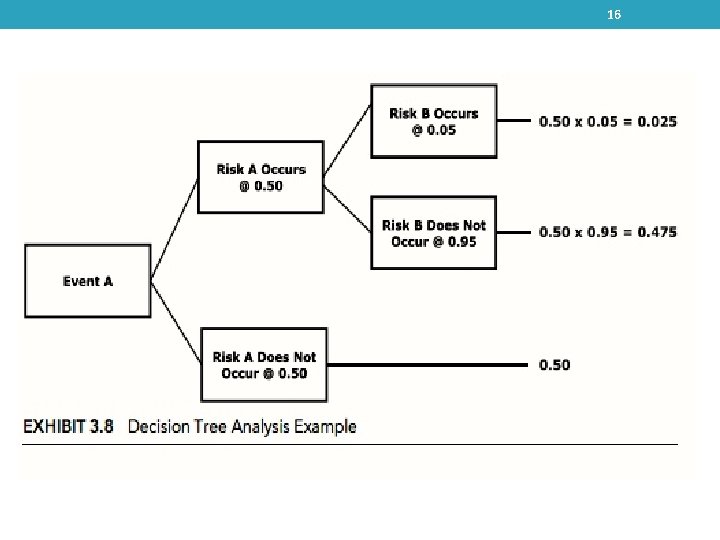
15 Decision Tree Analysis • A graphical technique to look at multiple risk combinations to come up with some estimates of the outcomes. • Best used for probabilities covering a limited set of risks. • It takes future events into consideration. • Calculates EMV (Effective Monetary Value) in a complex way. EMV= Probability * Impact
16
17 COSO ERM FRAMEWORK • What is it? • ERM framework starts by defining enterprise risk management as follows: “Enterprise risk management is a process, effected by an entity’s board of directors, management and other personnel, applied in a strategy setting and across the enterprise, designed to identify potential events that may affect the entity, and manage risk to be within its risk appetite, to provide reasonable assurance regarding the achievement of entity objectives. ”
18 Key COSO ERM Points • ERM is a Process • ERM Processes Are Implemented by People in the Enterprise. • ERM Is Applied by Setting Strategies Across the Overall Enterprise. • Concepts of Risk Appetite Must Be Considered. • ERM Provides Only Reasonable, Not Positive Assurance on Objective Achievements
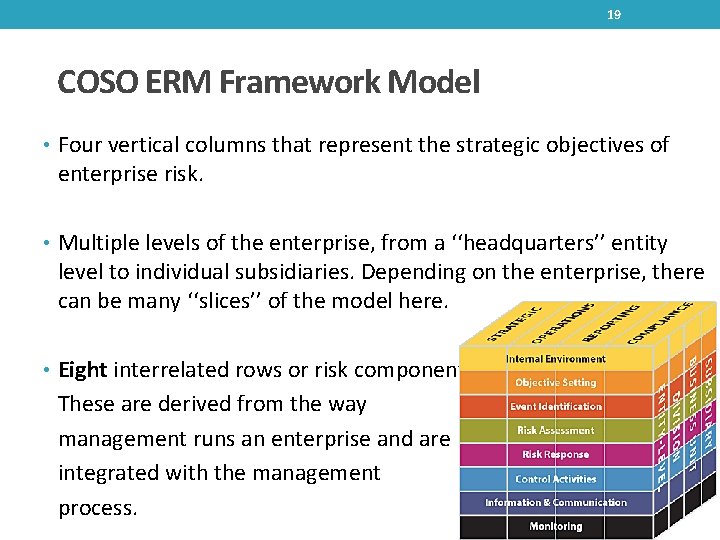
19 COSO ERM Framework Model • Four vertical columns that represent the strategic objectives of enterprise risk. • Multiple levels of the enterprise, from a ‘‘headquarters’’ entity level to individual subsidiaries. Depending on the enterprise, there can be many ‘‘slices’’ of the model here. • Eight interrelated rows or risk components. These are derived from the way management runs an enterprise and are integrated with the management process.
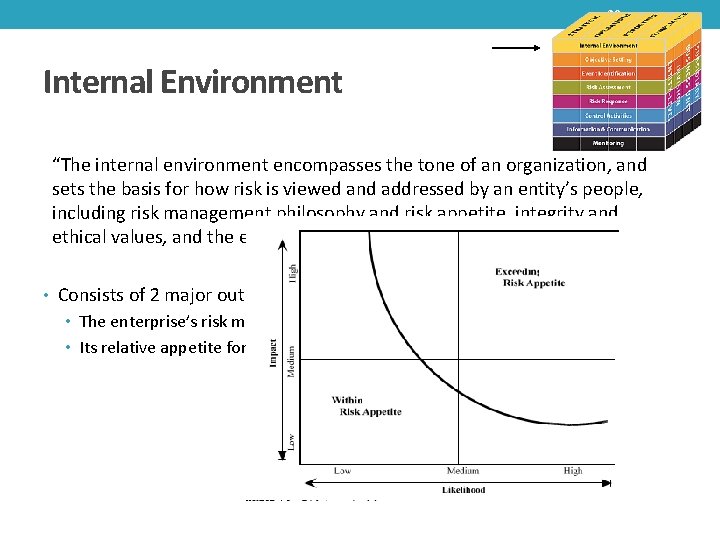
20 Internal Environment “The internal environment encompasses the tone of an organization, and sets the basis for how risk is viewed and addressed by an entity’s people, including risk management philosophy and risk appetite, integrity and ethical values, and the environment in which they operate. ”” • Consists of 2 major outputs that feeds other components: • The enterprise’s risk management philosophy • Its relative appetite for risk
21 COSO ERM Internal Foundation: Key Elements • Risk Management Philosophy • Risk Appetite • Board of Directors’ Attitudes • Integrity and Ethical Values • Organizational Structure
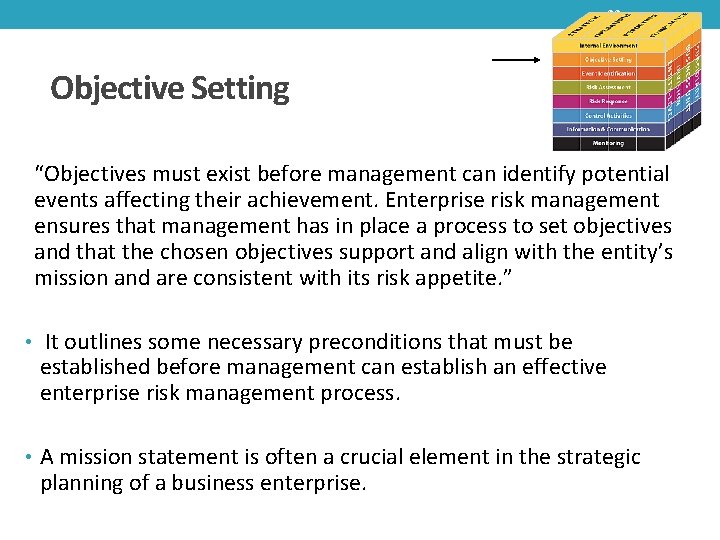
22 Objective Setting “Objectives must exist before management can identify potential events affecting their achievement. Enterprise risk management ensures that management has in place a process to set objectives and that the chosen objectives support and align with the entity’s mission and are consistent with its risk appetite. ” • It outlines some necessary preconditions that must be established before management can establish an effective enterprise risk management process. • A mission statement is often a crucial element in the strategic planning of a business enterprise.
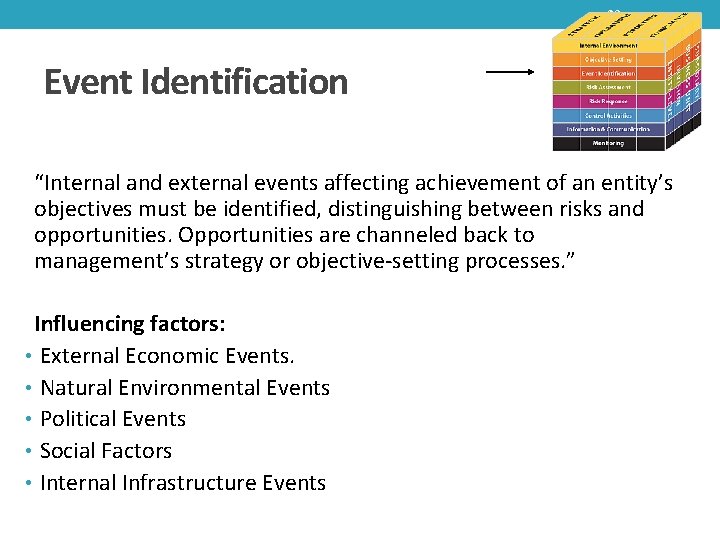
23 Event Identification “Internal and external events affecting achievement of an entity’s objectives must be identified, distinguishing between risks and opportunities. Opportunities are channeled back to management’s strategy or objective-setting processes. ” Influencing factors: • External Economic Events. • Natural Environmental Events • Political Events • Social Factors • Internal Infrastructure Events
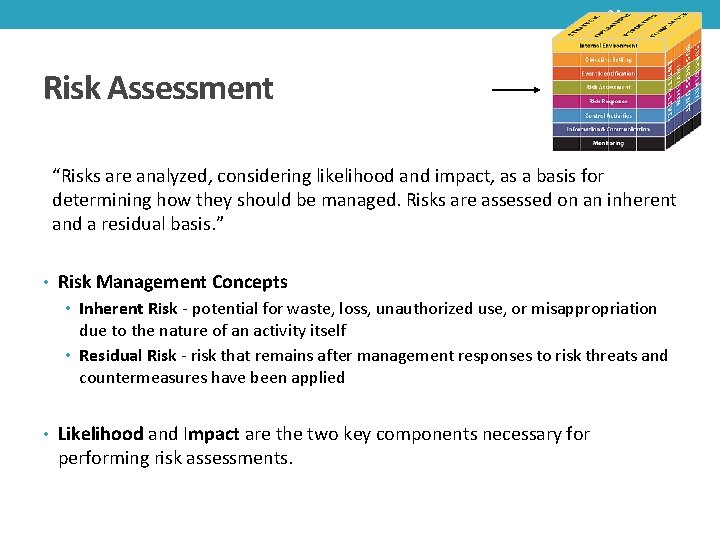
24 Risk Assessment “Risks are analyzed, considering likelihood and impact, as a basis for determining how they should be managed. Risks are assessed on an inherent and a residual basis. ” • Risk Management Concepts • Inherent Risk - potential for waste, loss, unauthorized use, or misappropriation due to the nature of an activity itself • Residual Risk - risk that remains after management responses to risk threats and countermeasures have been applied • Likelihood and Impact are the two key components necessary for performing risk assessments.
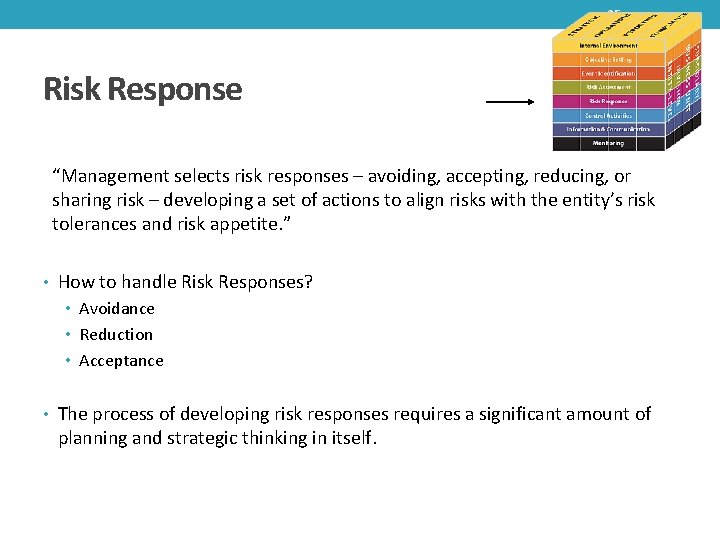
25 Risk Response “Management selects risk responses – avoiding, accepting, reducing, or sharing risk – developing a set of actions to align risks with the entity’s risk tolerances and risk appetite. ” • How to handle Risk Responses? • Avoidance • Reduction • Acceptance • The process of developing risk responses requires a significant amount of planning and strategic thinking in itself.
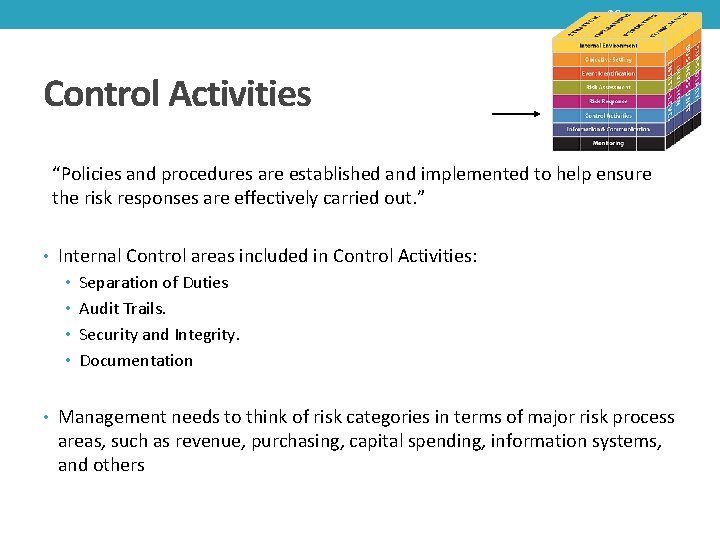
26 Control Activities “Policies and procedures are established and implemented to help ensure the risk responses are effectively carried out. ” • Internal Control areas included in Control Activities: • Separation of Duties • Audit Trails. • Security and Integrity. • Documentation • Management needs to think of risk categories in terms of major risk process areas, such as revenue, purchasing, capital spending, information systems, and others
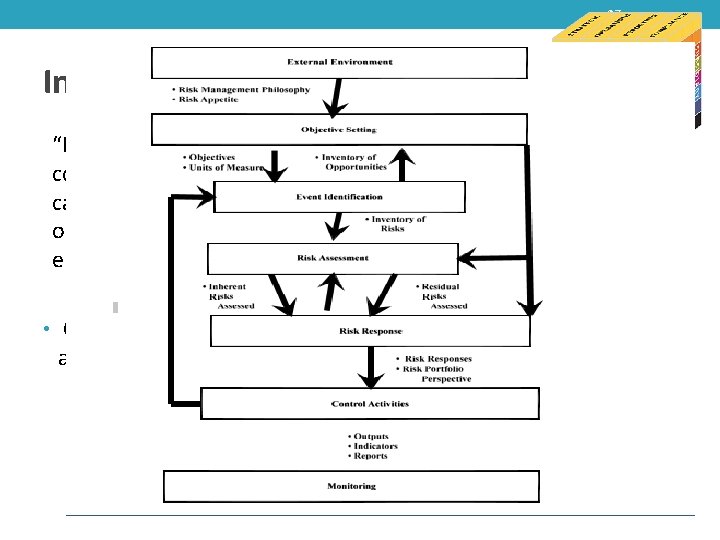
27 Information and Communication “Relevant information is identified, captured, and communicated in a form and timeframe that enable people to carry out their responsibilities. Effective communication also occurs in a broader sense, flowing down, across, and up the entity. ” • COSO ERM also talks about communication beyond just IT applications.
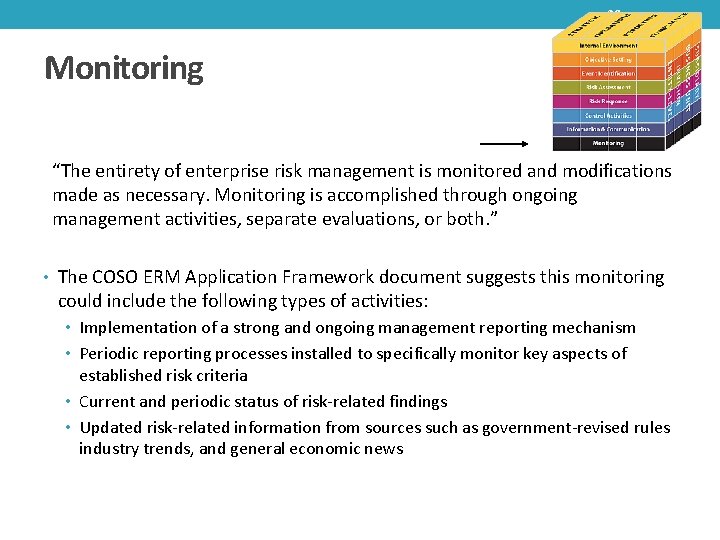
28 Monitoring “The entirety of enterprise risk management is monitored and modifications made as necessary. Monitoring is accomplished through ongoing management activities, separate evaluations, or both. ” • The COSO ERM Application Framework document suggests this monitoring could include the following types of activities: • Implementation of a strong and ongoing management reporting mechanism • Periodic reporting processes installed to specifically monitor key aspects of established risk criteria • Current and periodic status of risk-related findings • Updated risk-related information from sources such as government-revised rules industry trends, and general economic news
29 U. S. Department of Homeland security • DHS was created following the 9/11 attacks as announced by former President George W. Bush • Established November 25, 2002 by the Homeland Security Act of 2002 • Department states 5 core missions: • Prevent terrorism and enhance security • Secure and manage our borders • Enforce and administer our immigration laws • Safeguard and secure cyberspace • Ensure resilience to disasters
30 U. S. Department of Homeland security • Today there are more than 200, 000 employees within the DHS comprised over 22 agencies • These 22 agencies were selected to integrate DHS: • U. S. Customs Service • Immigration & Naturalization Service • The Federal Protective Service • The Transportation Security Administration • Federal Law Enforcement Training Center • Animal & Plant Health Inspection Service • Office for Domestic Preparedness • Federal Emergency Management Agency • U. S. Coast Guard • U. S. Secret Service
31 U. S. Department of Homeland security • Strategic National Stockpile and the National Disaster Medical System • Nuclear Incident Response Team • Domestic Emergency Support Teams • National Domestic Preparedness Office • CBRN Countermeasures Programs • Environmental Measurements Laboratory • National BW Defense Analysis Center • Plum Island Animal Disease Center • Federal Computer Incident Response Center • National Communications System • National Infrastructure Protection Center • Energy Security and Assurance Program
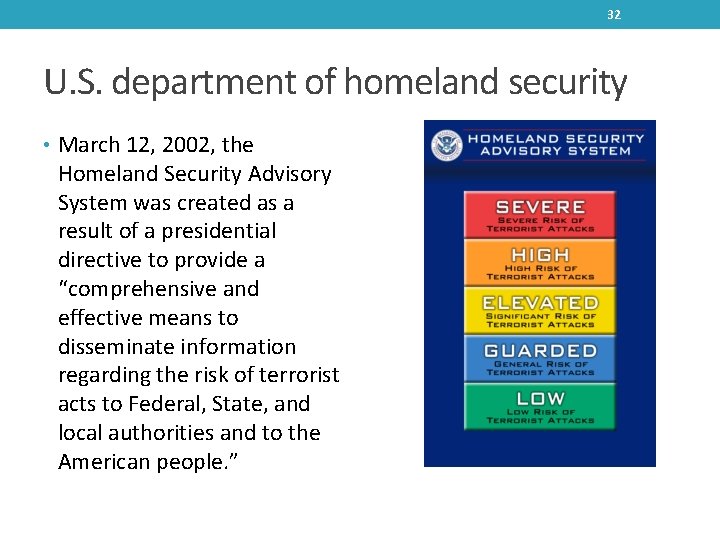
32 U. S. department of homeland security • March 12, 2002, the Homeland Security Advisory System was created as a result of a presidential directive to provide a “comprehensive and effective means to disseminate information regarding the risk of terrorist acts to Federal, State, and local authorities and to the American people. ”
33 U. S. department of treasury • Established by an Act of Congress in 1789 • Headed by the Secretary of Treasury (cabinet member) • Organized into two major components: • Departmental Offices – Responsible formulation of policy and management of the Department as a whole • Operating Bureaus – Carry out the specific operations assigned to the department • 2003 reorganization several agencies were transferred out following the 9/11 attacks • ATF fell into the newly created DHS
34 U. S. Department of treasury • Basic Functions: • Managing Federal finances • Collecting taxes and paying all bills of the U. S. • Currency and coinage • Managing government accounts and the public debt • Supervising national banks • Advising on domestic & intl. financial, economic, trade and tax policy • Enforcing Federal finance and tax laws • Investigating and prosecuting tax evaders, counterfeiters and forgers
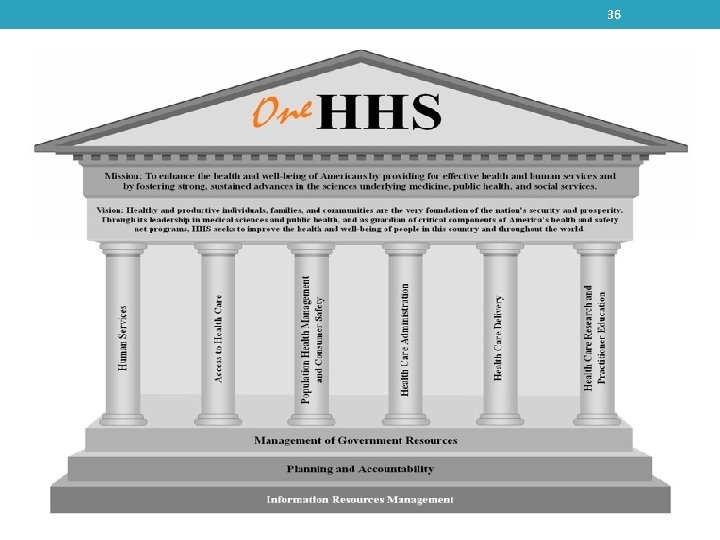
35 U. S. department of health & human services • Federal government dept, headed by a U. S. Secretary (cabinet level) • Goal is to protect the health of all Americans and provide essential human services • Services Include: • Public Health & Medical Services Support • International Preparedness & Response • Public Health Emergency Response
36
37 U. S. Department of Homeland Security President Bush talking about The Department of Homeland Security. https: //www. youtube. com/watch? v=JDLvm. Mlqq. QY Key Functions: • Intelligence Agency Communication Coordination of the efforts of the major intelligence agencies of the USA • Enhanced National Security Focus on increased security and law enforcement personnel in targeted areas across the country. • Natural Disasters 1. Better coordination of emergency preparedness and post-emergency services 2. Infrastructure designed to protect against natural disasters and increased personnel to aid people.
38 Concerns: • Potential for abuse by federal officials. • Perceived loss of individual freedoms and privacy under the Homeland Security Act. • The heavy financial burden the nation is required to carry.
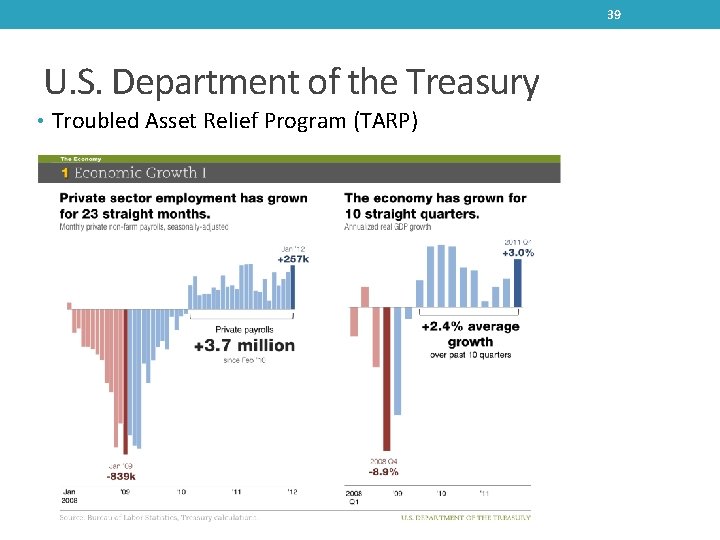
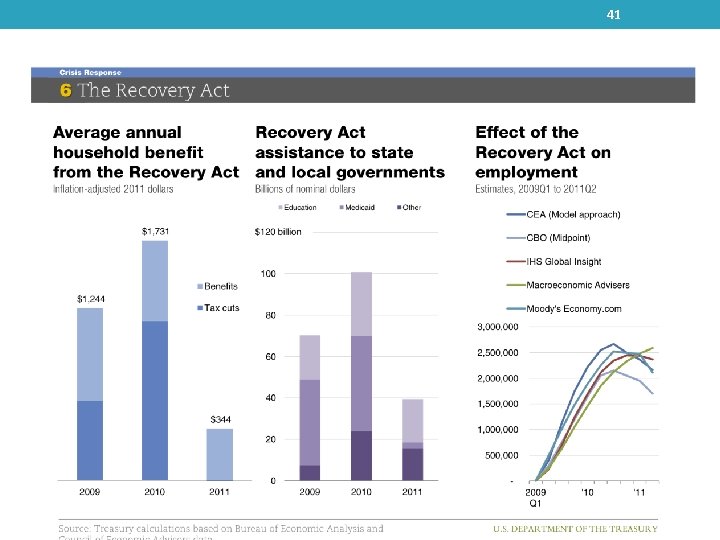
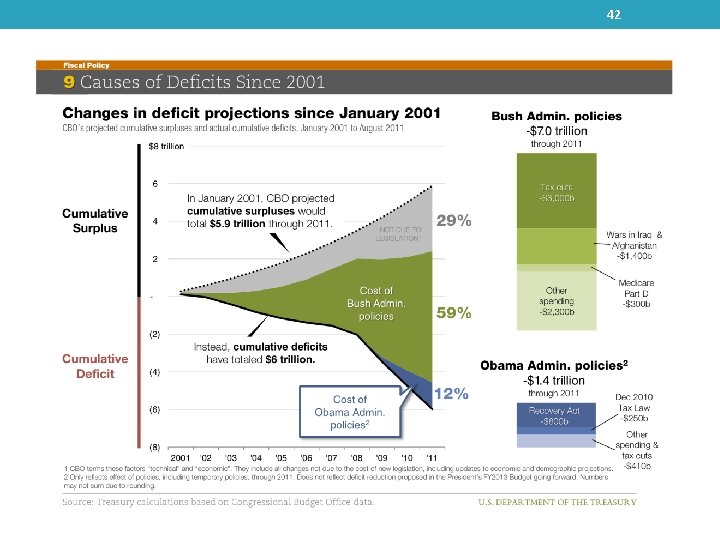
39 U. S. Department of the Treasury • Troubled Asset Relief Program (TARP)
40
41
42
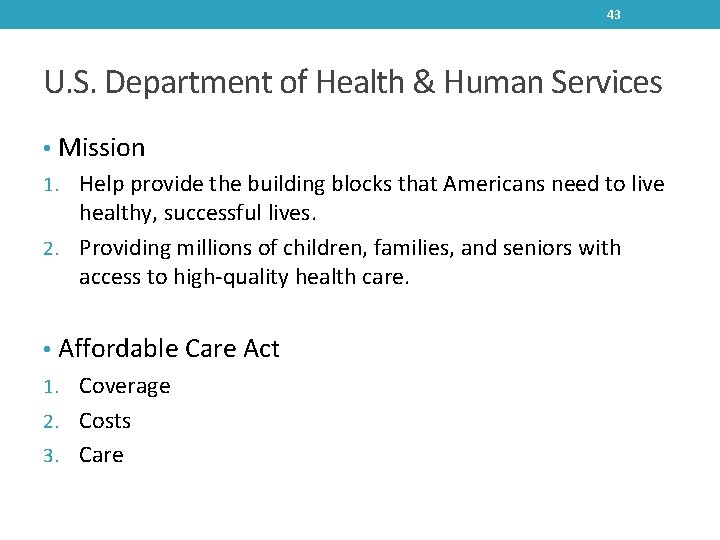
43 U. S. Department of Health & Human Services • Mission 1. Help provide the building blocks that Americans need to live healthy, successful lives. 2. Providing millions of children, families, and seniors with access to high-quality health care. • Affordable Care Act 1. Coverage 2. Costs 3. Care

44 THANK YOU!
- Slides: 44