
1 Glaucoma Clinical Trials Classic clinical trials The
- Slides: 127
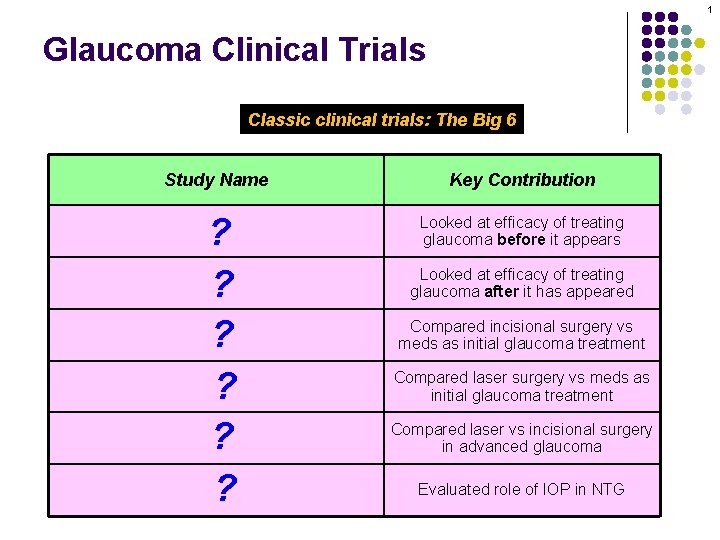
1 Glaucoma Clinical Trials Classic clinical trials: The Big 6 Study Name Key Contribution ? Early Manifest Glaucoma ? Trial (EMGT) Collaborative Initial Glaucoma ? (CIGTS) Treatment Study Glaucoma Laser ? Trial (GLT) Advanced Glaucoma Intervention Study ? (AGIS) Collaborative Normal -Tension ? Study Glaucoma Looked at efficacy of treating glaucoma before it appears Ocular Hypertension Treatment Trial (OHTS) Looked at efficacy of treating glaucoma after it has appeared Compared incisional surgery vs meds as initial glaucoma treatment Compared laser vs incisional surgery in advanced glaucoma Evaluated role of IOP in NTG
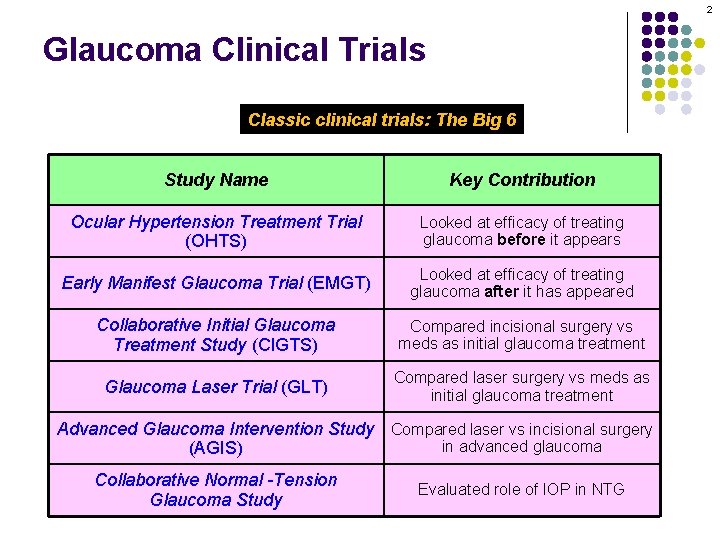
2 Glaucoma Clinical Trials Classic clinical trials: The Big 6 Study Name Key Contribution Ocular Hypertension Treatment Trial (OHTS) Looked at efficacy of treating glaucoma before it appears Early Manifest Glaucoma Trial (EMGT) Looked at efficacy of treating glaucoma after it has appeared Collaborative Initial Glaucoma Treatment Study (CIGTS) Compared incisional surgery vs meds as initial glaucoma treatment Glaucoma Laser Trial (GLT) Compared laser surgery vs meds as initial glaucoma treatment Advanced Glaucoma Intervention Study Compared laser vs incisional surgery in advanced glaucoma (AGIS) Collaborative Normal -Tension Glaucoma Study Evaluated role of IOP in NTG
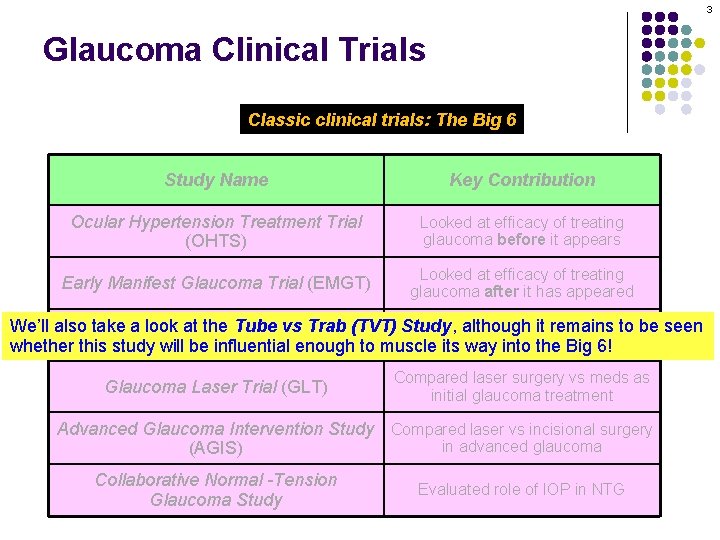
3 Glaucoma Clinical Trials Classic clinical trials: The Big 6 Study Name Key Contribution Ocular Hypertension Treatment Trial (OHTS) Looked at efficacy of treating glaucoma before it appears Early Manifest Glaucoma Trial (EMGT) Looked at efficacy of treating glaucoma after it has appeared Collaborative Initial Glaucoma Compared incisional surgery vs We’ll also take a look at the Tube vs Trab (TVT) Study, although it remains to be seen meds as glaucoma treatment Treatment Study (CIGTS) whether this study will be influential enough to muscle its initial way into the Big 6! Glaucoma Laser Trial (GLT) Compared laser surgery vs meds as initial glaucoma treatment Advanced Glaucoma Intervention Study Compared laser vs incisional surgery in advanced glaucoma (AGIS) Collaborative Normal -Tension Glaucoma Study Evaluated role of IOP in NTG
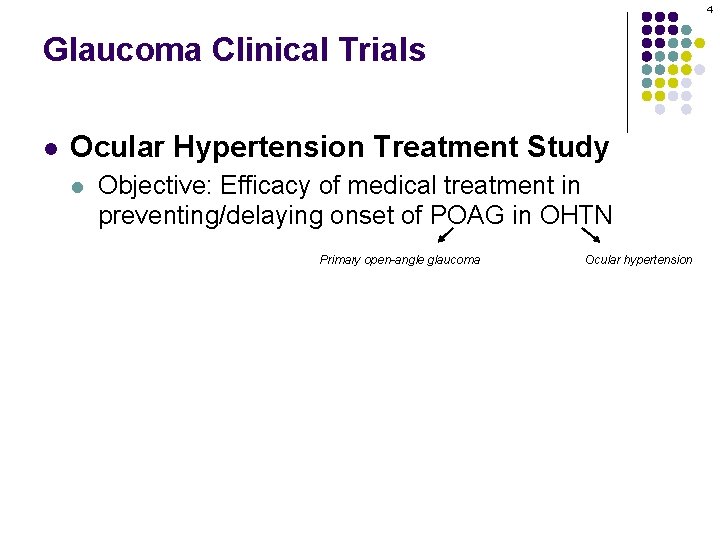
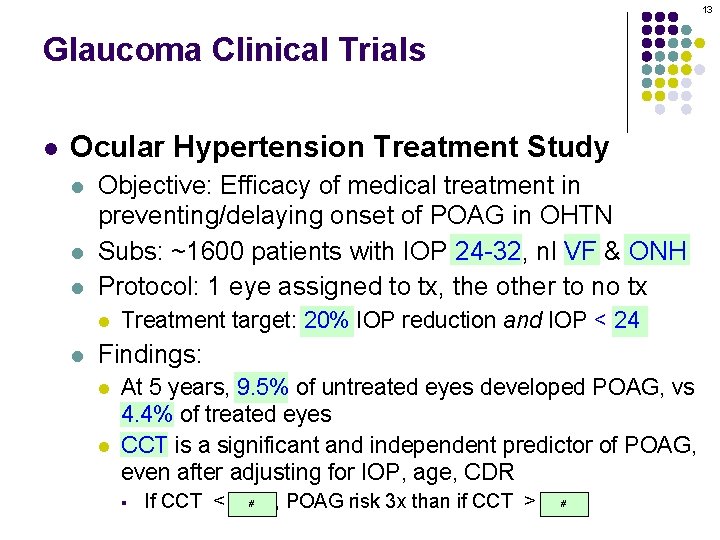
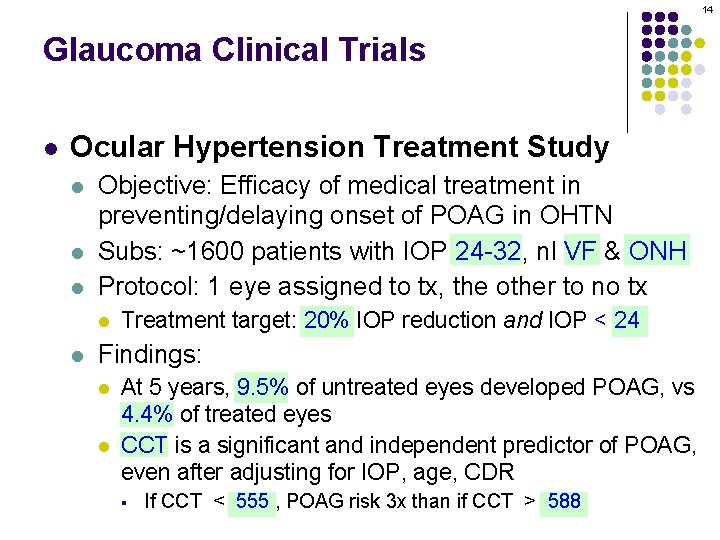
4 Glaucoma Clinical Trials l Ocular Hypertension Treatment Study l l l Objective: Efficacy of medical treatment in preventing/delaying onset of POAG in OHTN Subs: ~1600 patients with IOP 24 -32, nl VFOcular & hypertension ONH Primary open-angle glaucoma Protocol: 1 eye assigned to tx , the other to no tx l l Treatment target: 20% IOP reduction and IOP < 24 Findings: l l At 5 years, 9. 5% of untreated eyes developed POAG, vs 4. 4% of treated eyes CCT is powerful predictor for POAG, even after adjusting for IOP, age, CDR § If CCT < 555 , POAG risk 3 x than if CCT > 588
5 Glaucoma Clinical Trials l Ocular Hypertension Treatment Study Objective: Efficacy of medical treatment in preventing/delaying onset of POAG in OHTN l Subs: ~1600 patients with IOP 24 -32, nl VF & ONH tocol: 1 l # to # abb. diff abb.
6 Glaucoma Clinical Trials l Ocular Hypertension Treatment Study l l Objective: Efficacy of medical treatment in preventing/delaying onset of POAG in OHTN Subs: ~1600 patients with IOP 24 -32, nl VF & ONH ‘Normal visual fields and optic nerve head’
7 Glaucoma Clinical Trials l Ocular Hypertension Treatment Study l l l Objective: Efficacy of medical treatment in preventing/delaying onset of POAG in OHTN Subs: ~1600 patients with IOP 24 -32, nl VF & ONH Protocol: 1 eye assigned to tx, the other to no tx l % # Treatment target: 20% IOP reduction and IOP < 24
8 Glaucoma Clinical Trials l Ocular Hypertension Treatment Study l l l Objective: Efficacy of medical treatment in preventing/delaying onset of POAG in OHTN Subs: ~1600 patients with IOP 24 -32, nl VF & ONH Protocol: 1 eye assigned to tx, the other to no tx l Treatment target: 20% IOP reduction and IOP < 24
9 Glaucoma Clinical Trials l Ocular Hypertension Treatment Study l l l Objective: Efficacy of medical treatment in preventing/delaying onset of POAG in OHTN Subs: ~1600 patients with IOP 24 -32, nl VF & ONH Protocol: 1 eye assigned to tx, the other to no tx l l Treatment target: 20% IOP reduction and IOP < 24 Findings: l % At 5 years, 9. 5% of untreated eyes developed POAG, vs % 4. 4% of treated eyes
10 Glaucoma Clinical Trials l Ocular Hypertension Treatment Study l l l Objective: Efficacy of medical treatment in preventing/delaying onset of POAG in OHTN Subs: ~1600 patients with IOP 24 -32, nl VF & ONH Protocol: 1 eye assigned to tx, the other to no tx l l Treatment target: 20% IOP reduction and IOP < 24 Findings: l At 5 years, 9. 5% of untreated eyes developed POAG, vs 4. 4% of treated eyes
11 Glaucoma Clinical Trials l Ocular Hypertension Treatment Study l l l Objective: Efficacy of medical treatment in preventing/delaying onset of POAG in OHTN Subs: ~1600 patients with IOP 24 -32, nl VF & ONH Protocol: 1 eye assigned to tx, the other to no tx l l Treatment target: 20% IOP reduction and IOP < 24 Findings: l l At 5 years, 9. 5% of untreated eyes developed POAG, vs 4. 4% of treated eyes CCT is a significant and independent predictor of POAG, even after adjusting for IOP, age, CDR new risk factor (abb. ) cup-disc ratio
12 Glaucoma Clinical Trials l Ocular Hypertension Treatment Study l l l Objective: Efficacy of medical treatment in preventing/delaying onset of POAG in OHTN Subs: ~1600 patients with IOP 24 -32, nl VF & ONH Protocol: 1 eye assigned to tx, the other to no tx l l Treatment target: 20% IOP reduction and IOP < 24 Findings: l l Central Corneal Thickness At 5 years, 9. 5% of untreated eyes developed POAG, vs 4. 4% of treated eyes CCT is a significant and independent predictor of POAG, even after adjusting for IOP, age, CDR § If CCT < 555 , POAG risk 3 x than if CCT > 588
13 Glaucoma Clinical Trials l Ocular Hypertension Treatment Study l l l Objective: Efficacy of medical treatment in preventing/delaying onset of POAG in OHTN Subs: ~1600 patients with IOP 24 -32, nl VF & ONH Protocol: 1 eye assigned to tx, the other to no tx l l Treatment target: 20% IOP reduction and IOP < 24 Findings: l l At 5 years, 9. 5% of untreated eyes developed POAG, vs 4. 4% of treated eyes CCT is a significant and independent predictor of POAG, even after adjusting for IOP, age, CDR § # # If CCT < 555 , POAG risk 3 x than if CCT > 588
14 Glaucoma Clinical Trials l Ocular Hypertension Treatment Study l l l Objective: Efficacy of medical treatment in preventing/delaying onset of POAG in OHTN Subs: ~1600 patients with IOP 24 -32, nl VF & ONH Protocol: 1 eye assigned to tx, the other to no tx l l Treatment target: 20% IOP reduction and IOP < 24 Findings: l l At 5 years, 9. 5% of untreated eyes developed POAG, vs 4. 4% of treated eyes CCT is a significant and independent predictor of POAG, even after adjusting for IOP, age, CDR § If CCT < 555 , POAG risk 3 x than if CCT > 588
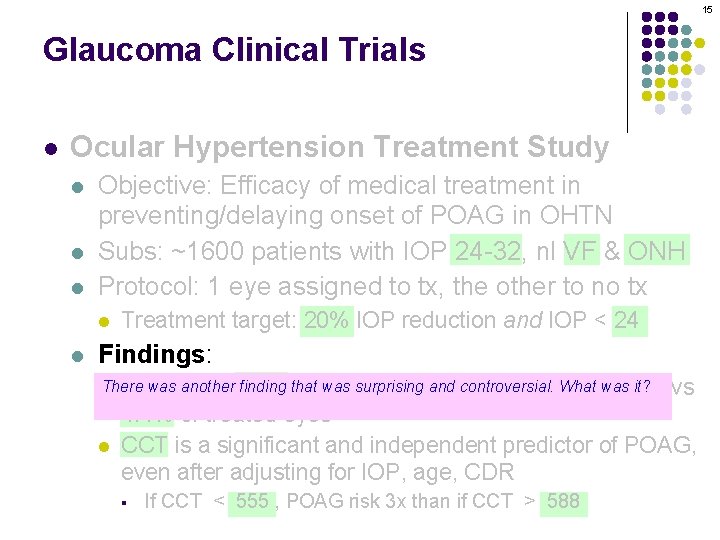
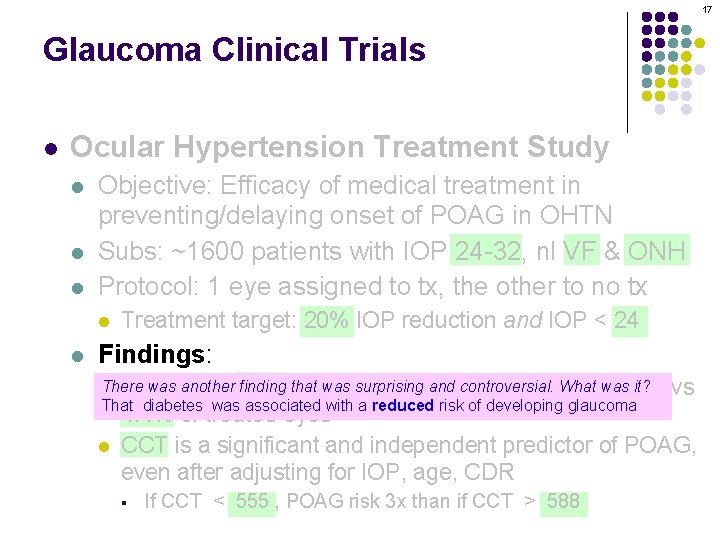
15 Glaucoma Clinical Trials l Ocular Hypertension Treatment Study l l l Objective: Efficacy of medical treatment in preventing/delaying onset of POAG in OHTN Subs: ~1600 patients with IOP 24 -32, nl VF & ONH Protocol: 1 eye assigned to tx, the other to no tx l l Treatment target: 20% IOP reduction and IOP < 24 Findings: There another 9. 5% finding that was surprising eyes and controversial. What. POAG, was it? l At was 5 years, of untreated developed That diabetes was associated with a reduced risk of developing glaucoma l vs 4. 4% of treated eyes CCT is a significant and independent predictor of POAG, even after adjusting for IOP, age, CDR § If CCT < 555 , POAG risk 3 x than if CCT > 588
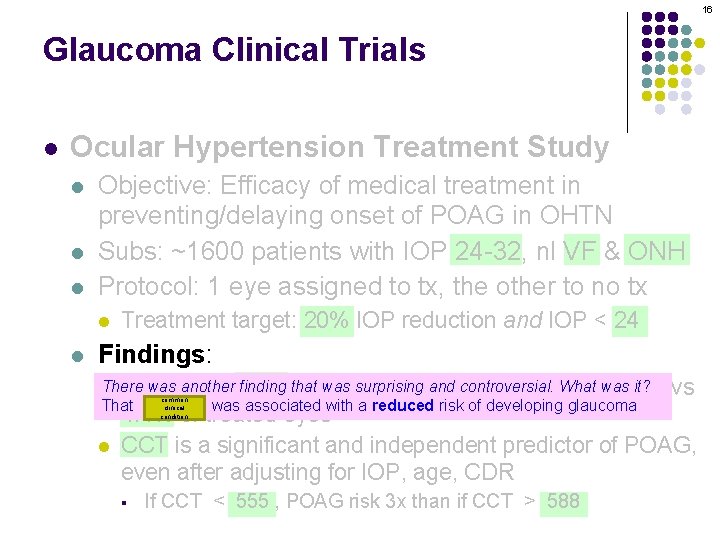
16 Glaucoma Clinical Trials l Ocular Hypertension Treatment Study l l l Objective: Efficacy of medical treatment in preventing/delaying onset of POAG in OHTN Subs: ~1600 patients with IOP 24 -32, nl VF & ONH Protocol: 1 eye assigned to tx, the other to no tx l l Treatment target: 20% IOP reduction and IOP < 24 Findings: There another 9. 5% finding that was surprising eyes and controversial. What. POAG, was it? l At was 5 common years, of untreated developed clinical That diabetes was associated with a reduced risk of developing glaucoma condition l vs 4. 4% of treated eyes CCT is a significant and independent predictor of POAG, even after adjusting for IOP, age, CDR § If CCT < 555 , POAG risk 3 x than if CCT > 588
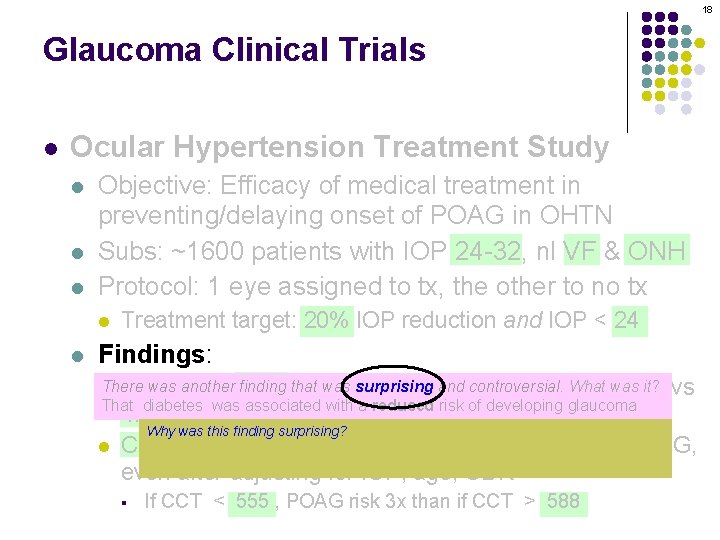
17 Glaucoma Clinical Trials l Ocular Hypertension Treatment Study l l l Objective: Efficacy of medical treatment in preventing/delaying onset of POAG in OHTN Subs: ~1600 patients with IOP 24 -32, nl VF & ONH Protocol: 1 eye assigned to tx, the other to no tx l l Treatment target: 20% IOP reduction and IOP < 24 Findings: There another 9. 5% finding that was surprising eyes and controversial. What. POAG, was it? l At was 5 years, of untreated developed That diabetes was associated with a reduced risk of developing glaucoma l vs 4. 4% of treated eyes CCT is a significant and independent predictor of POAG, even after adjusting for IOP, age, CDR § If CCT < 555 , POAG risk 3 x than if CCT > 588
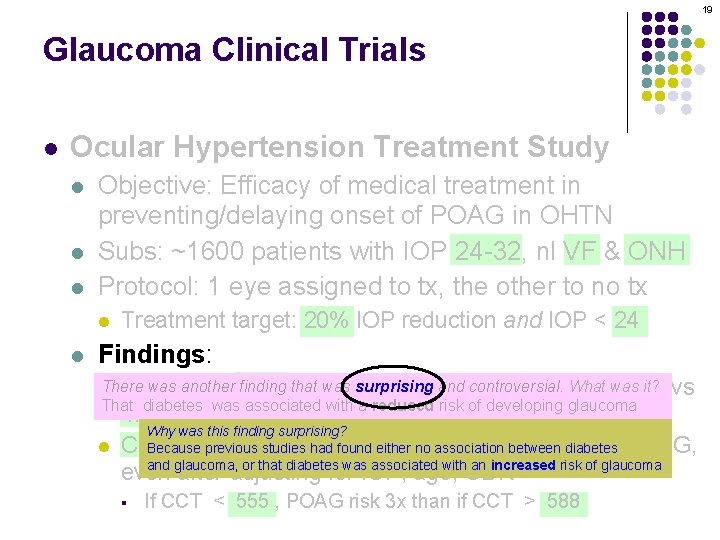
18 Glaucoma Clinical Trials l Ocular Hypertension Treatment Study l l l Objective: Efficacy of medical treatment in preventing/delaying onset of POAG in OHTN Subs: ~1600 patients with IOP 24 -32, nl VF & ONH Protocol: 1 eye assigned to tx, the other to no tx l l Treatment target: 20% IOP reduction and IOP < 24 Findings: There another 9. 5% finding that was surprising and controversial. What was it? l At was 5 years, of untreated eyes developed POAG, That diabetes was associated with a reduced risk of developing glaucoma l vs 4. 4% of treated eyes Why was this finding surprising? Because studies had foundindependent either no associationpredictor between diabetes CCT is aprevious significant and of POAG, and glaucoma, or that diabetes was associated with an increased risk of glaucoma even after adjusting for IOP, age, CDR § If CCT < 555 , POAG risk 3 x than if CCT > 588
19 Glaucoma Clinical Trials l Ocular Hypertension Treatment Study l l l Objective: Efficacy of medical treatment in preventing/delaying onset of POAG in OHTN Subs: ~1600 patients with IOP 24 -32, nl VF & ONH Protocol: 1 eye assigned to tx, the other to no tx l l Treatment target: 20% IOP reduction and IOP < 24 Findings: There another 9. 5% finding that was surprising and controversial. What was it? l At was 5 years, of untreated eyes developed POAG, That diabetes was associated with a reduced risk of developing glaucoma l vs 4. 4% of treated eyes Why was this finding surprising? Because studies had foundindependent either no associationpredictor between diabetes CCT is aprevious significant and of POAG, and glaucoma, or that diabetes was associated with an increased risk of glaucoma even after adjusting for IOP, age, CDR § If CCT < 555 , POAG risk 3 x than if CCT > 588
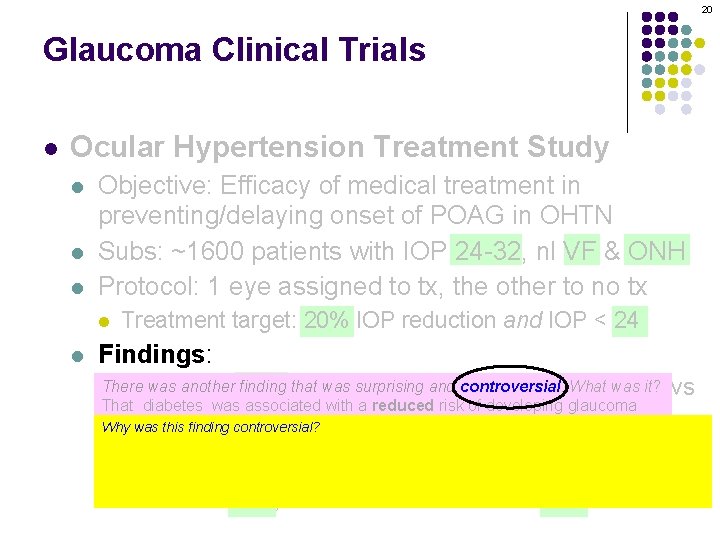
20 Glaucoma Clinical Trials l Ocular Hypertension Treatment Study l l l Objective: Efficacy of medical treatment in preventing/delaying onset of POAG in OHTN Subs: ~1600 patients with IOP 24 -32, nl VF & ONH Protocol: 1 eye assigned to tx, the other to no tx l l Treatment target: 20% IOP reduction and IOP < 24 Findings: There another 9. 5% finding that was surprising eyes and controversial. What was it? l At was 5 years, of untreated developed POAG, That diabetes was associated with a reduced risk of developing glaucoma vs 4. 4% of treated eyes CCT is a significant and independent predictor of POAG, even after adjusting for IOP, age, CDR Why was this finding controversial? The OHTS exclusion criteria included the presence of retinopathy, including diabetic retinopathy. l Because of this, the diabetic cohort that participated in the OHTS is not representative of the diabetic population as a whole. Thus, any conclusions derived from the OHTS regarding the relationship between diabetes and glaucoma are tentative at best. § If CCT < 555 , POAG risk 3 x than if CCT > 588
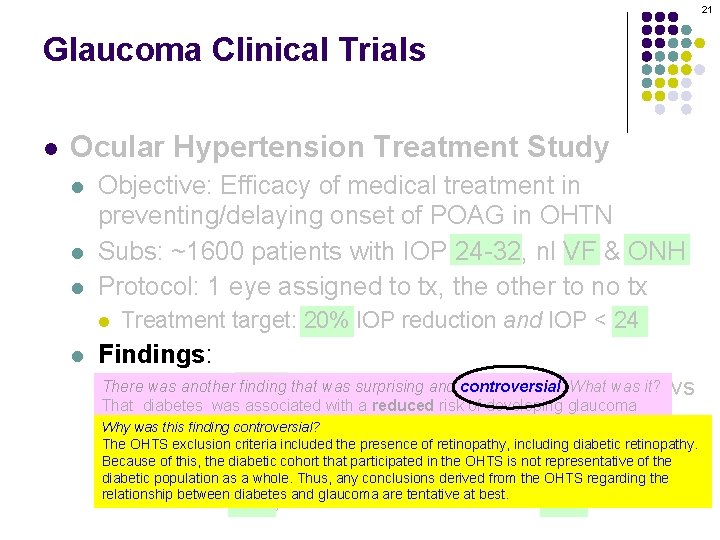
21 Glaucoma Clinical Trials l Ocular Hypertension Treatment Study l l l Objective: Efficacy of medical treatment in preventing/delaying onset of POAG in OHTN Subs: ~1600 patients with IOP 24 -32, nl VF & ONH Protocol: 1 eye assigned to tx, the other to no tx l l Treatment target: 20% IOP reduction and IOP < 24 Findings: There another 9. 5% finding that was surprising eyes and controversial. What was it? l At was 5 years, of untreated developed POAG, That diabetes was associated with a reduced risk of developing glaucoma vs 4. 4% of treated eyes CCT is a significant and independent predictor of POAG, even after adjusting for IOP, age, CDR Why was this finding controversial? The OHTS exclusion criteria included the presence of retinopathy, including diabetic retinopathy. l Because of this, the diabetic cohort that participated in the OHTS is not representative of the diabetic population as a whole. Thus, any conclusions derived from the OHTS regarding the relationship between diabetes and glaucoma are tentative at best. § If CCT < 555 , POAG risk 3 x than if CCT > 588
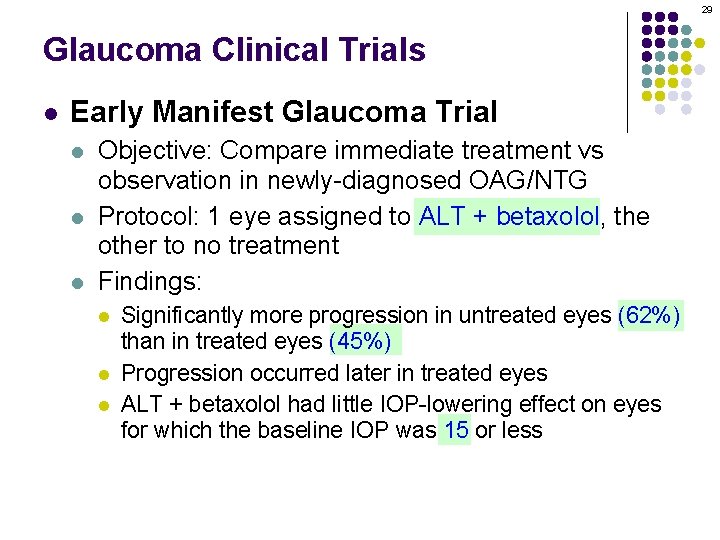
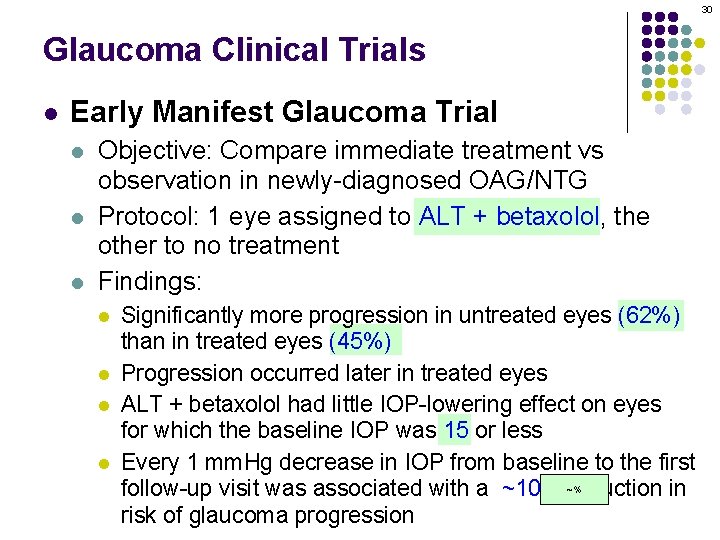
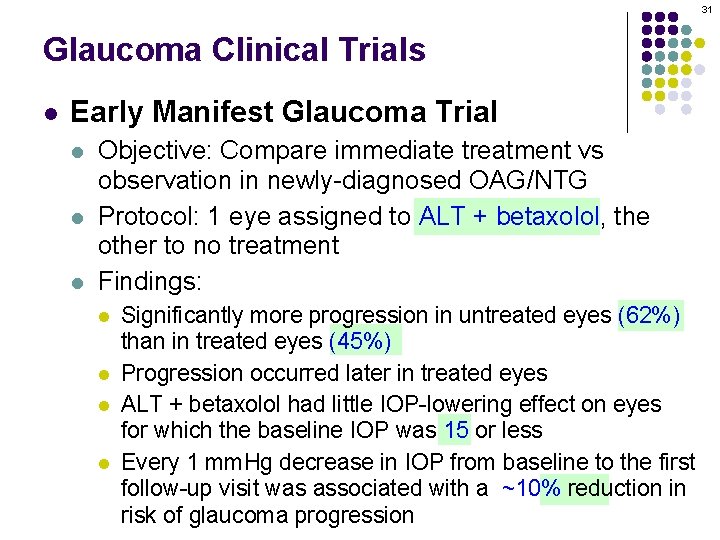
22 Glaucoma Clinical Trials l Early Manifest Glaucoma Trial l Objective: Compare immediate treatment vs observation in newly-diagnosed OAG/NTG normal-tension glaucoma
23 Glaucoma Clinical Trials l Early Manifest Glaucoma Trial l l Objective: Compare immediate treatment vs observation in newly-diagnosed OAG/NTG Protocol: 1 eye assigned to ALT + betaxolol, the other to no treatment + treatment
24 Glaucoma Clinical Trials l Early Manifest Glaucoma Trial l l Objective: Compare immediate treatment vs observation in newly-diagnosed OAG/NTG Protocol: 1 eye assigned to ALT + betaxolol, the other to no treatment
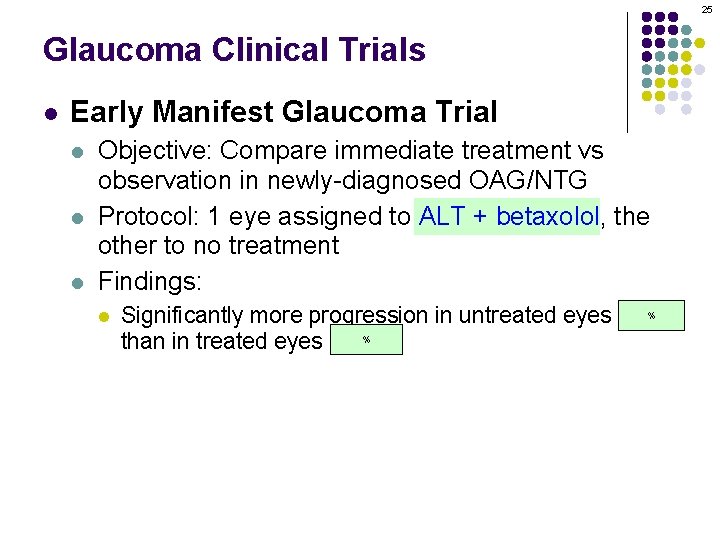
25 Glaucoma Clinical Trials l Early Manifest Glaucoma Trial l Objective: Compare immediate treatment vs observation in newly-diagnosed OAG/NTG Protocol: 1 eye assigned to ALT + betaxolol, the other to no treatment Findings: l % Significantly more progression in untreated eyes (62%) % than in treated eyes (45%)
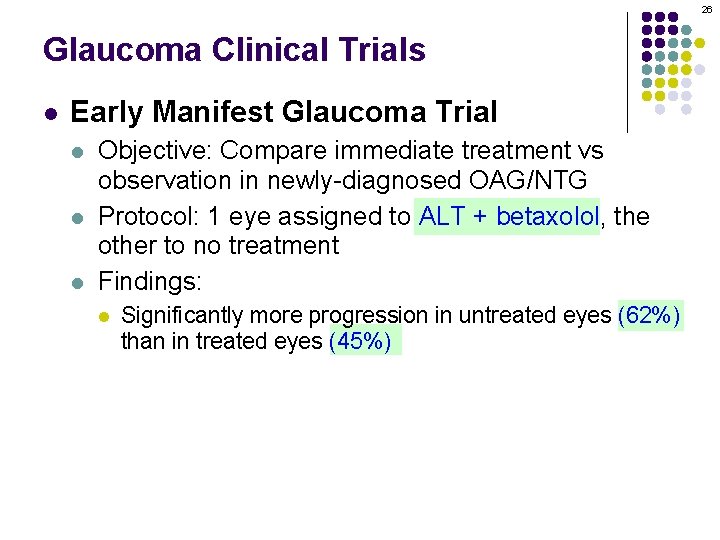
26 Glaucoma Clinical Trials l Early Manifest Glaucoma Trial l Objective: Compare immediate treatment vs observation in newly-diagnosed OAG/NTG Protocol: 1 eye assigned to ALT + betaxolol, the other to no treatment Findings: l Significantly more progression in untreated eyes (62%) than in treated eyes (45%)
27 Glaucoma Clinical Trials l Early Manifest Glaucoma Trial l Objective: Compare immediate treatment vs observation in newly-diagnosed OAG/NTG Protocol: 1 eye assigned to ALT + betaxolol, the other to no treatment Findings: l l Significantly more progression in untreated eyes (62%) than in treated eyes (45%) Progression occurred later in treated eyes
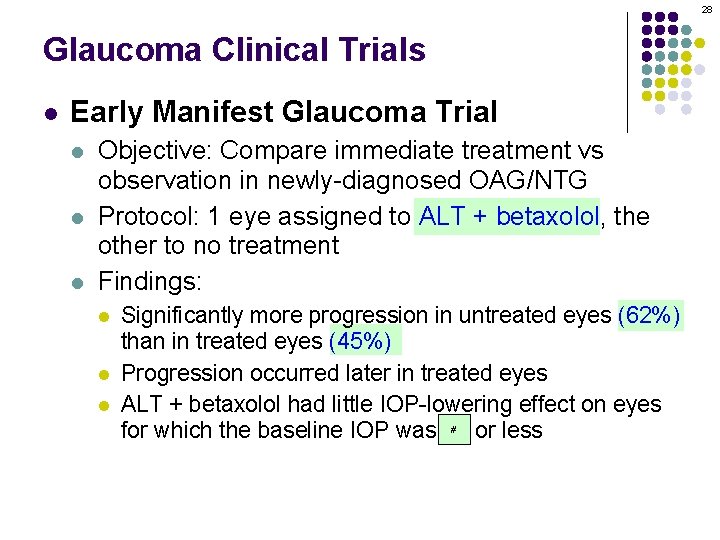
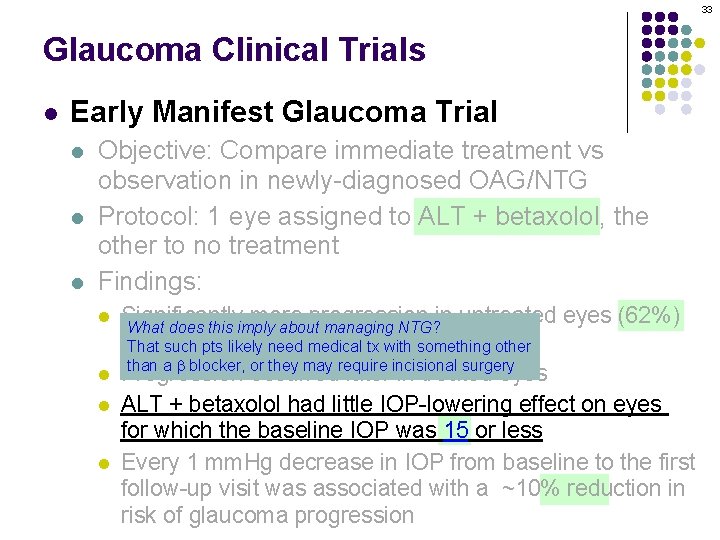
28 Glaucoma Clinical Trials l Early Manifest Glaucoma Trial l Objective: Compare immediate treatment vs observation in newly-diagnosed OAG/NTG Protocol: 1 eye assigned to ALT + betaxolol, the other to no treatment Findings: l l l Significantly more progression in untreated eyes (62%) than in treated eyes (45%) Progression occurred later in treated eyes ALT + betaxolol had little IOP-lowering effect on eyes # for which the baseline IOP was 15 or less
29 Glaucoma Clinical Trials l Early Manifest Glaucoma Trial l Objective: Compare immediate treatment vs observation in newly-diagnosed OAG/NTG Protocol: 1 eye assigned to ALT + betaxolol, the other to no treatment Findings: l l l Significantly more progression in untreated eyes (62%) than in treated eyes (45%) Progression occurred later in treated eyes ALT + betaxolol had little IOP-lowering effect on eyes for which the baseline IOP was 15 or less
30 Glaucoma Clinical Trials l Early Manifest Glaucoma Trial l Objective: Compare immediate treatment vs observation in newly-diagnosed OAG/NTG Protocol: 1 eye assigned to ALT + betaxolol, the other to no treatment Findings: l l Significantly more progression in untreated eyes (62%) than in treated eyes (45%) Progression occurred later in treated eyes ALT + betaxolol had little IOP-lowering effect on eyes for which the baseline IOP was 15 or less Every 1 mm. Hg decrease in IOP from baseline to the first follow-up visit was associated with a ~10% ~% reduction in risk of glaucoma progression
31 Glaucoma Clinical Trials l Early Manifest Glaucoma Trial l Objective: Compare immediate treatment vs observation in newly-diagnosed OAG/NTG Protocol: 1 eye assigned to ALT + betaxolol, the other to no treatment Findings: l l Significantly more progression in untreated eyes (62%) than in treated eyes (45%) Progression occurred later in treated eyes ALT + betaxolol had little IOP-lowering effect on eyes for which the baseline IOP was 15 or less Every 1 mm. Hg decrease in IOP from baseline to the first follow-up visit was associated with a ~10% reduction in risk of glaucoma progression
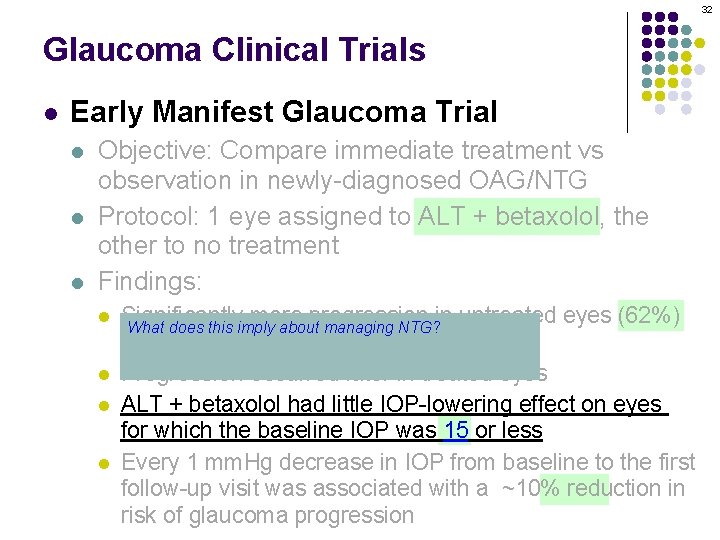
32 Glaucoma Clinical Trials l Early Manifest Glaucoma Trial l Objective: Compare immediate treatment vs observation in newly-diagnosed OAG/NTG Protocol: 1 eye assigned to ALT + betaxolol, the other to no treatment Findings: l l Significantly more progression in untreated eyes (62%) What does this imply about managing NTG? than in treated eyes (45%) That such pts likely need medical tx with something other than a b blocker, or they may require incisional surgery Progression occurred later in treated eyes ALT + betaxolol had little IOP-lowering effect on eyes for which the baseline IOP was 15 or less Every 1 mm. Hg decrease in IOP from baseline to the first follow-up visit was associated with a ~10% reduction in risk of glaucoma progression
33 Glaucoma Clinical Trials l Early Manifest Glaucoma Trial l Objective: Compare immediate treatment vs observation in newly-diagnosed OAG/NTG Protocol: 1 eye assigned to ALT + betaxolol, the other to no treatment Findings: l l Significantly more progression in untreated eyes (62%) What does this imply about managing NTG? than in treated eyes (45%) That such pts likely need medical tx with something other than a b blocker, or they may require incisional surgery Progression occurred later in treated eyes ALT + betaxolol had little IOP-lowering effect on eyes for which the baseline IOP was 15 or less Every 1 mm. Hg decrease in IOP from baseline to the first follow-up visit was associated with a ~10% reduction in risk of glaucoma progression
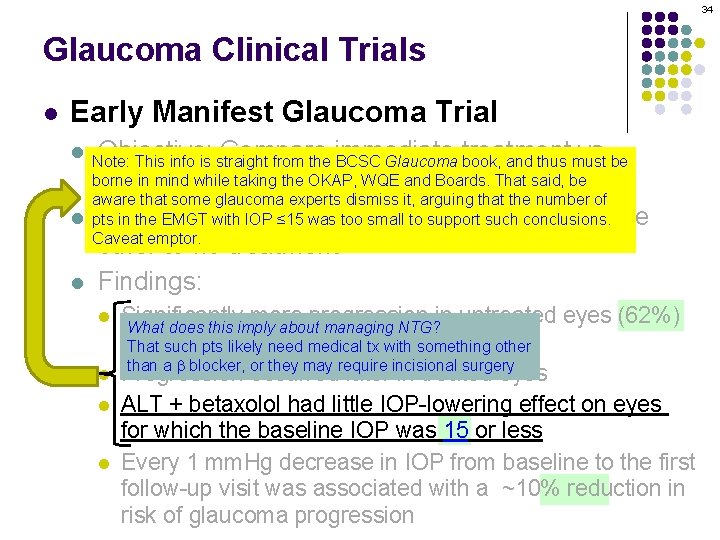
34 Glaucoma Clinical Trials l Early Manifest Glaucoma Trial l Note: Objective: Compare vs be This info is straight from the immediate BCSC Glaucoma treatment book, and thus must observation in newly-diagnosed OAG/NTG Protocol: 1 eye assigned to ALT + betaxolol, the other to no treatment Findings: borne in mind while taking the OKAP, WQE and Boards. That said, be aware that some glaucoma experts dismiss it, arguing that the number of l pts in the EMGT with IOP ≤ 15 was too small to support such conclusions. Caveat emptor. l l l Significantly more progression in untreated eyes (62%) What does this imply about managing NTG? than in treated eyes (45%) That such pts likely need medical tx with something other than a b blocker, or they may require incisional surgery Progression occurred later in treated eyes ALT + betaxolol had little IOP-lowering effect on eyes for which the baseline IOP was 15 or less Every 1 mm. Hg decrease in IOP from baseline to the first follow-up visit was associated with a ~10% reduction in risk of glaucoma progression
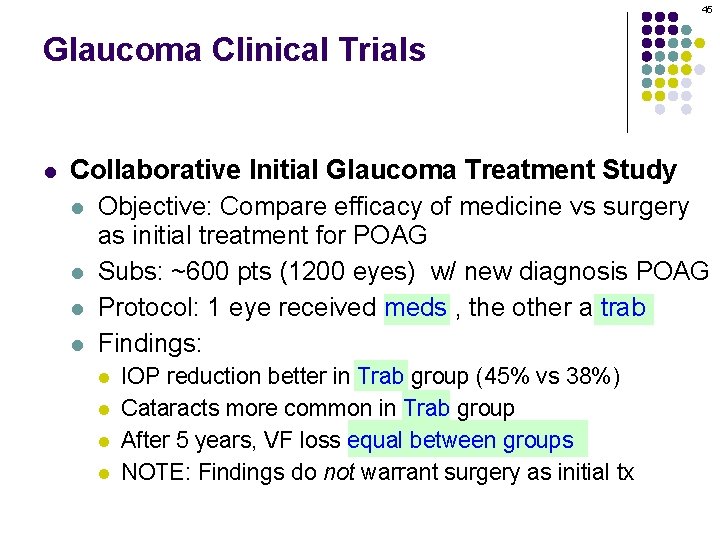
35 Glaucoma Clinical Trials l Collaborative Initial Glaucoma Treatment Study l Objective: Compare efficacy of medicine vs surgery as initial treatment for POAGinitial tx
36 Glaucoma Clinical Trials l Collaborative Initial Glaucoma Treatment Study l Objective: Compare efficacy of medicine vs surgery as initial treatment for POAG l Subs: ~600 pts (1200 eyes) w/ new diagnosis POAG
37 Glaucoma Clinical Trials l Collaborative Initial Glaucoma Treatment Study l Objective: Compare efficacy of medicine vs surgery as initial treatment for POAG l Subs: ~600 pts (1200 eyes) w/ new diagnosis POAG l Protocol: 1 eye received meds , the other a trab tx 1 tx 2
38 Glaucoma Clinical Trials l Collaborative Initial Glaucoma Treatment Study l Objective: Compare efficacy of medicine vs surgery as initial treatment for POAG l Subs: ~600 pts (1200 eyes) w/ new diagnosis POAG l Protocol: 1 eye received meds , the other a trab
39 Glaucoma Clinical Trials l Collaborative Initial Glaucoma Treatment Study l Objective: Compare efficacy of medicine vs surgery as initial treatment for POAG l Subs: ~600 pts (1200 eyes) w/ new diagnosis POAG l Protocol: 1 eye received meds , the other a trab l Findings: l tx IOP reduction better in Trab group (45% vs 38%)
40 Glaucoma Clinical Trials l Collaborative Initial Glaucoma Treatment Study l Objective: Compare efficacy of medicine vs surgery as initial treatment for POAG l Subs: ~600 pts (1200 eyes) w/ new diagnosis POAG l Protocol: 1 eye received meds , the other a trab l Findings: l IOP reduction better in Trab group (45% vs 38%)
41 Glaucoma Clinical Trials l Collaborative Initial Glaucoma Treatment Study l Objective: Compare efficacy of medicine vs surgery as initial treatment for POAG l Subs: ~600 pts (1200 eyes) w/ new diagnosis POAG l Protocol: 1 eye received meds , the other a trab l Findings: l l IOP reduction better in Trab group (45% vs 38%) tx Cataracts more common in Trab group
42 Glaucoma Clinical Trials l Collaborative Initial Glaucoma Treatment Study l Objective: Compare efficacy of medicine vs surgery as initial treatment for POAG l Subs: ~600 pts (1200 eyes) w/ new diagnosis POAG l Protocol: 1 eye received meds , the other a trab l Findings: l l IOP reduction better in Trab group (45% vs 38%) Cataracts more common in Trab group
43 Glaucoma Clinical Trials l Collaborative Initial Glaucoma Treatment Study l Objective: Compare efficacy of medicine vs surgery as initial treatment for POAG l Subs: ~600 pts (1200 eyes) w/ new diagnosis POAG l Protocol: 1 eye received meds , the other a trab l Findings: l l l IOP reduction better in Trab group (45% vs 38%) Cataracts more common in Trab group worse in which group? After 5 years, VF loss equal between groups
44 Glaucoma Clinical Trials l Collaborative Initial Glaucoma Treatment Study l Objective: Compare efficacy of medicine vs surgery as initial treatment for POAG l Subs: ~600 pts (1200 eyes) w/ new diagnosis POAG l Protocol: 1 eye received meds , the other a trab l Findings: l l l IOP reduction better in Trab group (45% vs 38%) Cataracts more common in Trab group After 5 years, VF loss equal between groups
45 Glaucoma Clinical Trials l Collaborative Initial Glaucoma Treatment Study l Objective: Compare efficacy of medicine vs surgery as initial treatment for POAG l Subs: ~600 pts (1200 eyes) w/ new diagnosis POAG l Protocol: 1 eye received meds , the other a trab l Findings: l l IOP reduction better in Trab group (45% vs 38%) Cataracts more common in Trab group After 5 years, VF loss equal between groups NOTE: Findings do not warrant surgery as initial tx
46 Glaucoma Clinical Trials l Glaucoma Laser Trial Objective: Compare efficacy/safety of ALT vs T. 5 for (Timolol 0. 5%) initial treatment of POAG Findings: l
47 Glaucoma Clinical Trials l Glaucoma Laser Trial Objective: Compare efficacy/safety of ALT vs T. 5 for initial treatment of POAG l Subs: ~270 pts (540 eyes) w/ new diagnosis POAG , a 2 agonists l
48 Glaucoma Clinical Trials l Glaucoma Laser Trial l Objective: Compare efficacy/safety of ALT vs T. 5 for initial treatment of POAG Subs: ~270 pts (540 eyes) w/ new diagnosis POAG Protocol: 1 eye assigned to ALT, other to T. 5 l Other meds added to either eye as needed
49 Glaucoma Clinical Trials l Glaucoma Laser Trial l Objective: Compare efficacy/safety of ALT vs T. 5 for initial treatment of POAG Subs: ~270 pts (540 eyes) w/ new diagnosis POAG Protocol: 1 eye assigned to ALT, other to T. 5 l l Other meds added to either eye as needed Findings: l ALT IOP 1 -2 better, needed fewer additional meds ALT v T. 5
50 Glaucoma Clinical Trials l Glaucoma Laser Trial l Objective: Compare efficacy/safety of ALT vs T. 5 for initial treatment of POAG Subs: ~270 pts (540 eyes) w/ new diagnosis POAG Protocol: 1 eye assigned to ALT, other to T. 5 l l Other meds added to either eye as needed Findings: l ALT IOP 1 -2 better, needed fewer additional meds
51 Glaucoma Clinical Trials l Glaucoma Laser Trial l Objective: Compare efficacy/safety of ALT vs T. 5 for initial treatment of POAG Subs: ~270 pts (540 eyes) w/ new diagnosis POAG Protocol: 1 eye assigned to ALT, other to T. 5 l l Other meds added to either eye as needed Findings: l l l ALT IOP 1 -2 better, needed fewer additional meds No difference in VF/VA at 2 years, but… ALT v T. had better VF at 7 and 9 years ALT 5
52 Glaucoma Clinical Trials l Glaucoma Laser Trial l Objective: Compare efficacy/safety of ALT vs T. 5 for initial treatment of POAG Subs: ~270 pts (540 eyes) w/ new diagnosis POAG Protocol: 1 eye assigned to ALT, other to T. 5 l l Other meds added to either eye as needed Findings: l l l ALT IOP 1 -2 better, needed fewer additional meds No difference in VF/VA at 2 years, but… ALT had better VF at 7 and 9 years
53 Glaucoma Clinical Trials l Glaucoma Laser Trial l Objective: Compare efficacy/safety of ALT vs T. 5 for initial treatment of POAG Subs: ~270 pts (540 eyes) w/ new diagnosis POAG Protocol: 1 eye assigned to ALT, other to T. 5 l l Findings: l l Other meds added to either eye as needed ALT IOP 1 -2 better, needed fewer additional meds No difference in VF/VA at 2 years, but… ALT had better VF at 7 and 9 years Note: Study preceded Xalatan, CAI, a 2 agonists, as well as SLT , so implications are somewhat dated drug not ALT drug
54 Glaucoma Clinical Trials l Glaucoma Laser Trial l Objective: Compare efficacy/safety of ALT vs T. 5 for initial treatment of POAG Subs: ~270 pts (540 eyes) w/ new diagnosis POAG Protocol: 1 eye assigned to ALT, other to T. 5 l l Findings: l l Other meds added to either eye as needed ALT IOP 1 -2 better, needed fewer additional meds No difference in VF/VA at 2 years, but… Carbonic anhydrase inhibitors ALT had better VF at 7 and 9 years Note: Study preceded Xalatan, CAI, a 2 agonists, as well as SLT , so implications are somewhat dated (Selective laser trabeculoplasty)
55 Glaucoma Clinical Trials l Advanced Glaucoma Intervention Study l Two objectives: 1) Compare ALT (A) vs trab (T) as first surgery in advanced POAG (You come uprelation with the second objective) 2) Determine between IOP and VF loss
56 Glaucoma Clinical Trials l Advanced Glaucoma Intervention Study l Two objectives: 1) Compare ALT (A) vs trab (T) as first surgery in advanced POAG 2) Determine relation between IOP and VF loss
57 Glaucoma Clinical Trials l Advanced Glaucoma Intervention Study l l Two objectives: 1) Compare ALT (A) vs trab (T) as first surgery in advanced POAG 2) Determine relation between IOP and VF loss Subs: 789 eyes w/ advanced OAG refractory to MTMT (maximum tolerated medical management)
58 Glaucoma Clinical Trials l Advanced Glaucoma Intervention Study l l l Two objectives: 1) Compare ALT (A) vs trab (T) as first surgery in advanced POAG 2) Determine relation between IOP and VF loss Subs: 789 eyes w/ advanced OAG refractory to MTMT 3 txs Protocol: half assigned to tx order ATT, other half to TAT
59 Glaucoma Clinical Trials l Advanced Glaucoma Intervention Study l l l Two objectives: 1) Compare ALT (A) vs trab (T) as first surgery in advanced POAG 2) Determine relation between IOP and VF loss Subs: 789 eyes w/ advanced OAG refractory to MTMT Protocol: half assigned to tx order ATT, other half to TAT
60 Glaucoma Clinical Trials l Advanced Glaucoma Intervention Study l l Two objectives: 1) Compare ALT (A) vs trab (T) as first surgery in advanced POAG 2) Determine relation between IOP and VF loss Subs: 789 eyes w/ advanced OAG refractory to MTMT Protocol: half assigned to tx order ATT, other half to TAT Findings: treatment l IOP control better in treatment order ATT order
61 Glaucoma Clinical Trials l Advanced Glaucoma Intervention Study l l Two objectives: 1) Compare ALT (A) vs trab (T) as first surgery in advanced POAG 2) Determine relation between IOP and VF loss Subs: 789 eyes w/ advanced OAG refractory to MTMT Protocol: half assigned to tx order ATT, other half to TAT Findings: l IOP control better in treatment order TAT
62 Glaucoma Clinical Trials l Advanced Glaucoma Intervention Study l l Two objectives: 1) Compare ALT (A) vs trab (T) as first surgery in advanced POAG 2) Determine relation between IOP and VF loss Subs: 789 eyes w/ advanced OAG refractory to MTMT Protocol: half assigned to tx order ATT, other half to TAT Findings: l IOP control better in treatment order TAT treatment order l VF/VA loss: Whites better w/ TAT ; blacks better w/ ATT
63 Glaucoma Clinical Trials l Advanced Glaucoma Intervention Study l l Two objectives: 1) Compare ALT (A) vs trab (T) as first surgery in advanced POAG 2) Determine relation between IOP and VF loss Subs: 789 eyes w/ advanced OAG refractory to MTMT Protocol: half assigned to tx order ATT, other half to TAT Findings: l IOP control better in treatment order TAT l VF/VA loss: Whites better w/ TAT ; blacks better w/ ATT
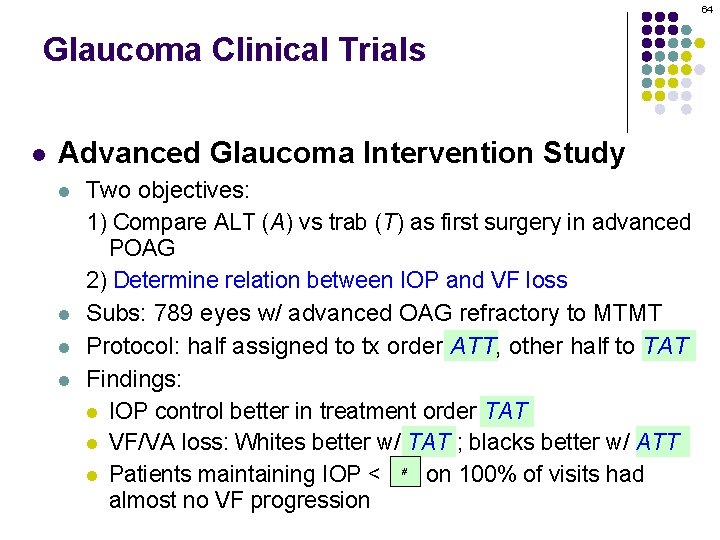
64 Glaucoma Clinical Trials l Advanced Glaucoma Intervention Study l l Two objectives: 1) Compare ALT (A) vs trab (T) as first surgery in advanced POAG 2) Determine relation between IOP and VF loss Subs: 789 eyes w/ advanced OAG refractory to MTMT Protocol: half assigned to tx order ATT, other half to TAT Findings: l IOP control better in treatment order TAT l VF/VA loss: Whites better w/ TAT ; blacks better w/ ATT # l Patients maintaining IOP < 18 on 100% of visits had almost no VF progression
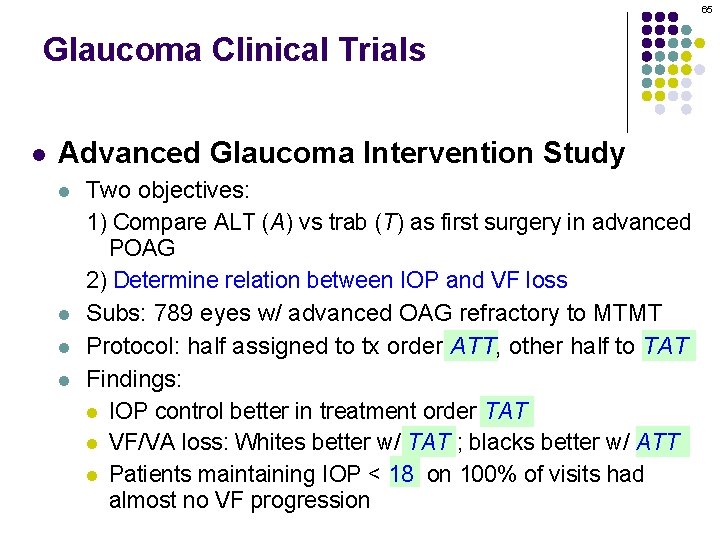
65 Glaucoma Clinical Trials l Advanced Glaucoma Intervention Study l l Two objectives: 1) Compare ALT (A) vs trab (T) as first surgery in advanced POAG 2) Determine relation between IOP and VF loss Subs: 789 eyes w/ advanced OAG refractory to MTMT Protocol: half assigned to tx order ATT, other half to TAT Findings: l IOP control better in treatment order TAT l VF/VA loss: Whites better w/ TAT ; blacks better w/ ATT l Patients maintaining IOP < 18 on 100% of visits had almost no VF progression
66 Glaucoma Clinical Trials l Collaborative Normal-Tension Glaucoma Study l Objective: Determine whether IOP is involved in the pathogenesis of NTG
67 Glaucoma Clinical Trials l Collaborative Normal-Tension Glaucoma Study l Objective: Determine whether IOP is involved in the pathogenesis of NTG l Subjects: 70 patients (140 eyes) with normal IOP and VF loss
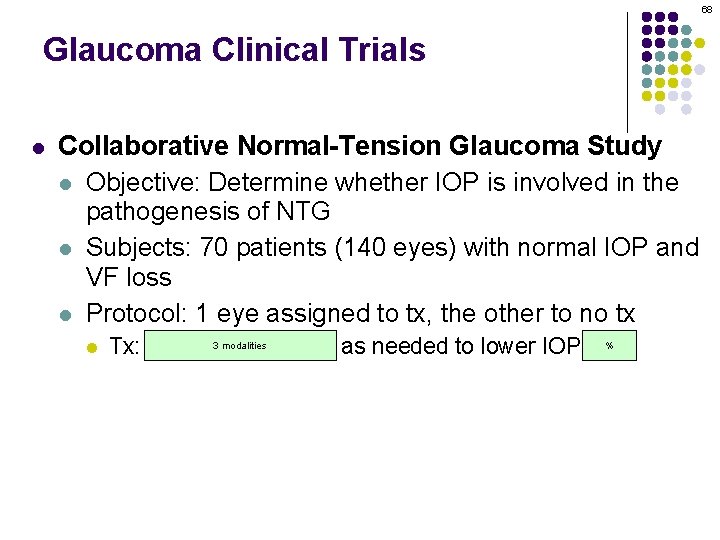
68 Glaucoma Clinical Trials l Collaborative Normal-Tension Glaucoma Study l Objective: Determine whether IOP is involved in the pathogenesis of NTG l Subjects: 70 patients (140 eyes) with normal IOP and VF loss l Protocol: 1 eye assigned to tx, the other to no tx l 3 modalities % Tx: Meds/ALT/surgery as needed to lower IOP 30%
69 Glaucoma Clinical Trials l Collaborative Normal-Tension Glaucoma Study l Objective: Determine whether IOP is involved in the pathogenesis of NTG l Subjects: 70 patients (140 eyes) with normal IOP and VF loss l Protocol: 1 eye assigned to tx, the other to no tx l Tx: Meds/ALT/surgery as needed to lower IOP 30%
70 Glaucoma Clinical Trials l Collaborative Normal-Tension Glaucoma Study l Objective: Determine whether IOP is involved in the pathogenesis of NTG l Subjects: 70 patients (140 eyes) with normal IOP and VF loss l Protocol: 1 eye assigned to tx, the other to no tx l Tx: Meds/ALT/surgery as needed to lower IOP 30% Findings: l one topical hypotensive was used? What Pilo
71 Glaucoma Clinical Trials l Collaborative Normal-Tension Glaucoma Study l Objective: Determine whether IOP is involved in the pathogenesis of NTG l Subjects: 70 patients (140 eyes) with normal IOP and VF loss l Protocol: 1 eye assigned to tx, the other to no tx l Tx: Meds/ALT/surgery as needed to lower IOP 30% Findings: l one topical hypotensive was used? What Pilo
72 Glaucoma Clinical Trials l Collaborative Normal-Tension Glaucoma Study l Objective: Determine whether IOP is involved in the pathogenesis of NTG l Subjects: 70 patients (140 eyes) with normal IOP and VF loss l Protocol: 1 eye assigned to tx, the other to no tx l l Tx: Meds/ALT/surgery as needed to lower IOP 30% Findings: l Lowering IOP 30% reduced rate of ONH/VF loss, but…
73 Glaucoma Clinical Trials l Collaborative Normal-Tension Glaucoma Study l Objective: Determine whether IOP is involved in the pathogenesis of NTG l Subjects: 70 patients (140 eyes) with normal IOP and VF loss l Protocol: 1 eye assigned to tx, the other to no tx l l Tx: Meds/ALT/surgery as needed to lower IOP 30% Findings: l Lowering IOP 30% reduced rate of ONH/VF loss, but… § 65% of untreated eyes had no progression
74 Glaucoma Clinical Trials l Collaborative Normal-Tension Glaucoma Study l Objective: Determine whether IOP is involved in the pathogenesis of NTG l Subjects: 70 patients (140 eyes) with normal IOP and VF loss l Protocol: 1 eye assigned to tx, the other to no tx l l Tx: Meds/ALT/surgery as needed to lower IOP 30% Findings: l Lowering IOP 30% reduced rate of ONH/VF loss, but… § 65% of untreated eyes had no progression
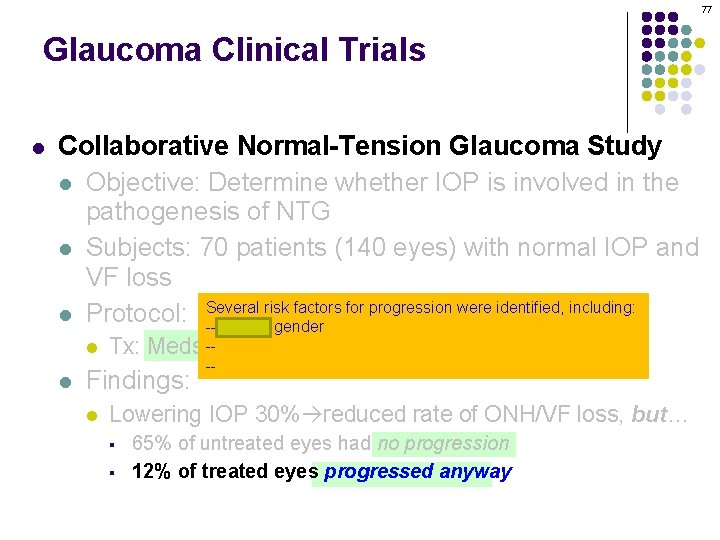
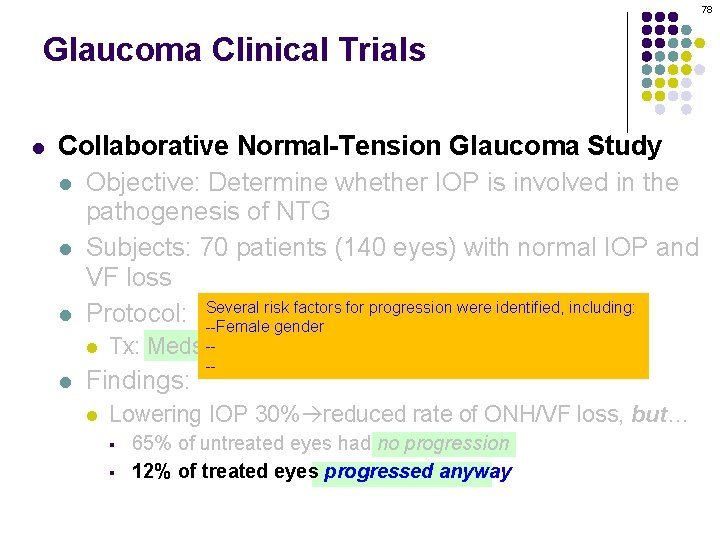
75 Glaucoma Clinical Trials l Collaborative Normal-Tension Glaucoma Study l Objective: Determine whether IOP is involved in the pathogenesis of NTG l Subjects: 70 patients (140 eyes) with normal IOP and VF loss l Protocol: 1 eye assigned to tx, the other to no tx l l Tx: Meds/ALT/surgery as needed to lower IOP 30% Findings: l Lowering IOP 30% reduced rate of ONH/VF loss, but… § § 65% of untreated eyes had no progression 12% of treated eyes progressed anyway
76 Glaucoma Clinical Trials l Collaborative Normal-Tension Glaucoma Study l Objective: Determine whether IOP is involved in the pathogenesis of NTG l Subjects: 70 patients (140 eyes) with normal IOP and VF loss l Protocol: 1 eye assigned to tx, the other to no tx l l Tx: Meds/ALT/surgery as needed to lower IOP 30% Findings: l Lowering IOP 30% reduced rate of ONH/VF loss, but… § § 65% of untreated eyes had no progression 12% of treated eyes progressed anyway
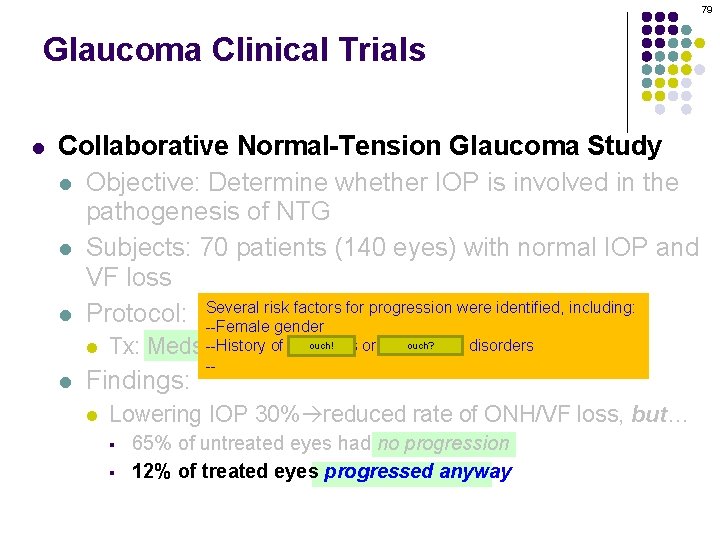
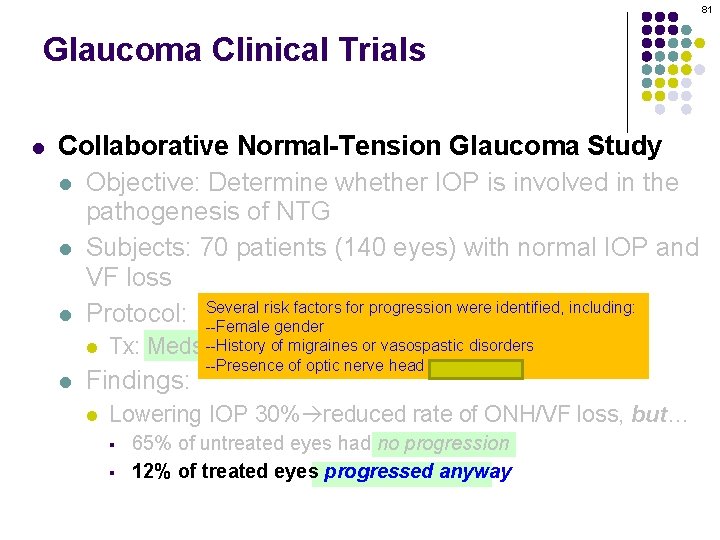
77 Glaucoma Clinical Trials l Collaborative Normal-Tension Glaucoma Study l Objective: Determine whether IOP is involved in the pathogenesis of NTG l Subjects: 70 patients (140 eyes) with normal IOP and VF loss risk factors for progression were identified, including: l Protocol: 1 Several eye assigned to tx, the other to no tx --Female gender l l -Tx: Meds/ALT/surgery as needed to lower IOP 30% Findings: l -- Lowering IOP 30% reduced rate of ONH/VF loss, but… § § 65% of untreated eyes had no progression 12% of treated eyes progressed anyway
78 Glaucoma Clinical Trials l Collaborative Normal-Tension Glaucoma Study l Objective: Determine whether IOP is involved in the pathogenesis of NTG l Subjects: 70 patients (140 eyes) with normal IOP and VF loss risk factors for progression were identified, including: l Protocol: 1 Several eye assigned to tx, the other to no tx --Female gender l l -Tx: Meds/ALT/surgery as needed to lower IOP 30% Findings: l -- Lowering IOP 30% reduced rate of ONH/VF loss, but… § § 65% of untreated eyes had no progression 12% of treated eyes progressed anyway
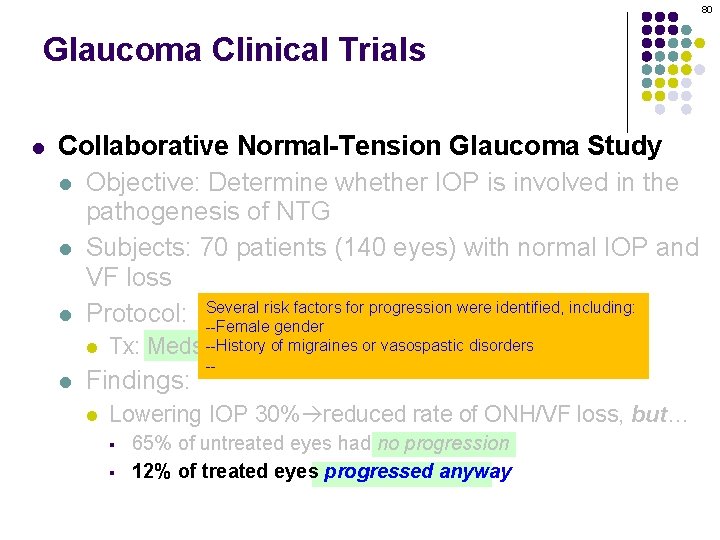
79 Glaucoma Clinical Trials l Collaborative Normal-Tension Glaucoma Study l Objective: Determine whether IOP is involved in the pathogenesis of NTG l Subjects: 70 patients (140 eyes) with normal IOP and VF loss risk factors for progression were identified, including: l Protocol: 1 Several eye assigned to tx, the other to no tx --Female gender l l ouch? ouch! asorneeded --History of migraines vasospastic Tx: Meds/ALT/surgery todisorders lower IOP 30% Findings: l -- Lowering IOP 30% reduced rate of ONH/VF loss, but… § § 65% of untreated eyes had no progression 12% of treated eyes progressed anyway
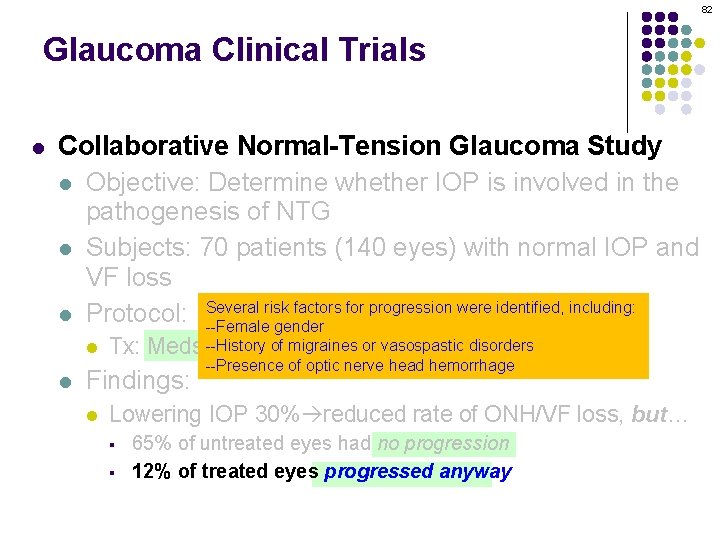
80 Glaucoma Clinical Trials l Collaborative Normal-Tension Glaucoma Study l Objective: Determine whether IOP is involved in the pathogenesis of NTG l Subjects: 70 patients (140 eyes) with normal IOP and VF loss risk factors for progression were identified, including: l Protocol: 1 Several eye assigned to tx, the other to no tx --Female gender l l --History of migraines vasospastic Tx: Meds/ALT/surgery asorneeded todisorders lower IOP 30% Findings: l -- Lowering IOP 30% reduced rate of ONH/VF loss, but… § § 65% of untreated eyes had no progression 12% of treated eyes progressed anyway
81 Glaucoma Clinical Trials l Collaborative Normal-Tension Glaucoma Study l Objective: Determine whether IOP is involved in the pathogenesis of NTG l Subjects: 70 patients (140 eyes) with normal IOP and VF loss risk factors for progression were identified, including: l Protocol: 1 Several eye assigned to tx, the other to no tx --Female gender l l --History of migraines vasospastic Tx: Meds/ALT/surgery asorneeded todisorders lower IOP 30% Findings: l --Presence of optic nerve head hemorrhage Lowering IOP 30% reduced rate of ONH/VF loss, but… § § 65% of untreated eyes had no progression 12% of treated eyes progressed anyway
82 Glaucoma Clinical Trials l Collaborative Normal-Tension Glaucoma Study l Objective: Determine whether IOP is involved in the pathogenesis of NTG l Subjects: 70 patients (140 eyes) with normal IOP and VF loss risk factors for progression were identified, including: l Protocol: 1 Several eye assigned to tx, the other to no tx --Female gender l l --History of migraines vasospastic Tx: Meds/ALT/surgery asorneeded todisorders lower IOP 30% Findings: l --Presence of optic nerve head hemorrhage Lowering IOP 30% reduced rate of ONH/VF loss, but… § § 65% of untreated eyes had no progression 12% of treated eyes progressed anyway
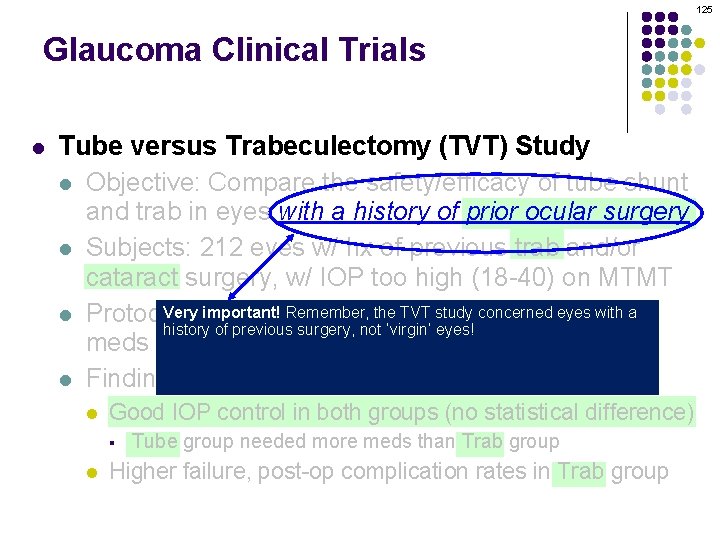
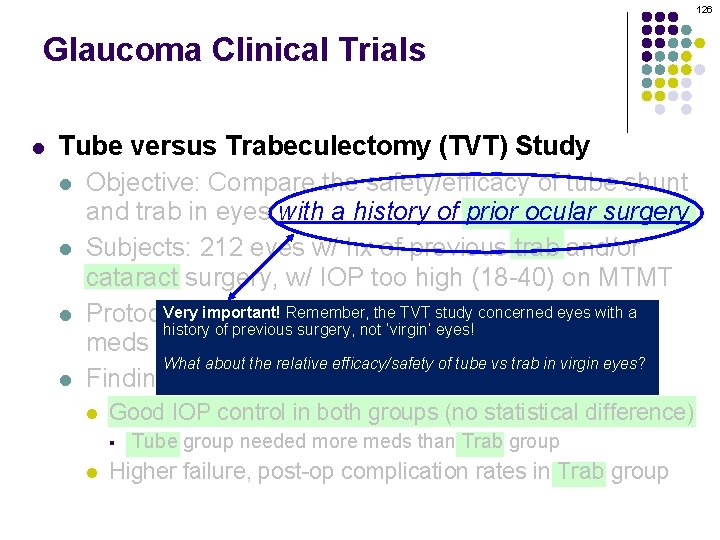
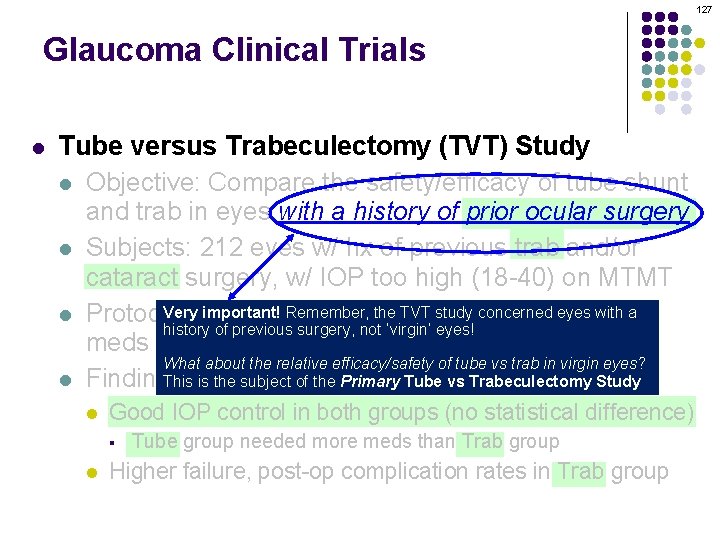
83 Glaucoma Clinical Trials l Tube versus Trabeculectomy (TVT) Study l Objective: Compare the safety/efficacy of tube shunt and trab in eyes with a history of prior ocular surgery three words
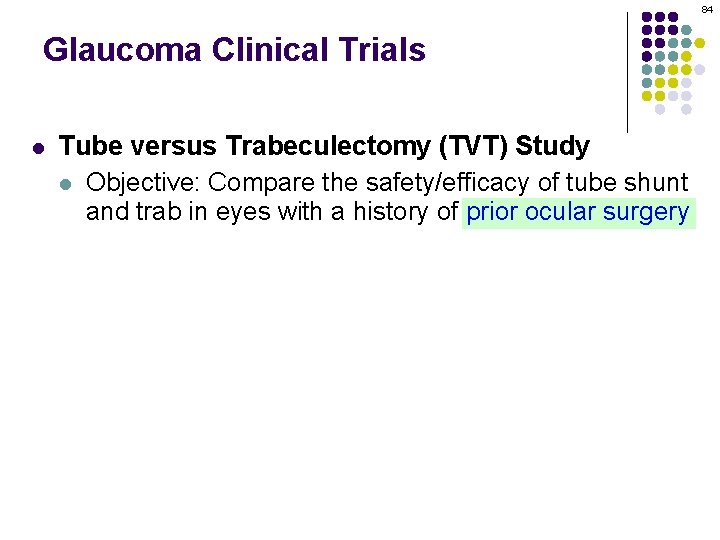
84 Glaucoma Clinical Trials l Tube versus Trabeculectomy (TVT) Study l Objective: Compare the safety/efficacy of tube shunt and trab in eyes with a history of prior ocular surgery
85 Glaucoma Clinical Trials l Tube versus Trabeculectomy (TVT) Study l Objective: Compare the safety/efficacy of tube shunt and trab in eyes with a history of prior ocular surgery l Subjects: 212 eyes w/ hx of previous trab and/or cataract surgery, w/ IOP too high (18 -40) on MTMT surgery
86 Glaucoma Clinical Trials l Tube versus Trabeculectomy (TVT) Study l Objective: Compare the safety/efficacy of tube shunt and trab in eyes with a history of prior ocular surgery l Subjects: 212 eyes w/ hx of previous trab and/or cataract surgery, w/ IOP too high (18 -40) on MTMT
87 Glaucoma Clinical Trials l Tube versus Trabeculectomy (TVT) Study l Objective: Compare the safety/efficacy of tube shunt and trab in eyes with a history of prior ocular surgery l Subjects: 212 eyes w/ hx of previous trab and/or cataract surgery, w/ IOP too high (18 -40) on MTMT l Protocol: Eyes randomly assigned to tube or trab; meds added as needed for IOP control
88 Glaucoma Clinical Trials l Tube versus Trabeculectomy (TVT) Study l Objective: Compare the safety/efficacy of tube shunt and trab in eyes with a history of prior ocular surgery l Subjects: 212 eyes w/ hx of previous trab and/or cataract surgery, w/ IOP too high (18 -40) on MTMT l Protocol: Eyes randomly assigned to tube or trab; meds added as needed for IOP control l Findings: l outcome: Good in vs poor control; which treatment (if either) yielded better IOP control? Good IOPIOPcontrol both groups (no statistical difference)
89 Glaucoma Clinical Trials l Tube versus Trabeculectomy (TVT) Study l Objective: Compare the safety/efficacy of tube shunt and trab in eyes with a history of prior ocular surgery l Subjects: 212 eyes w/ hx of previous trab and/or cataract surgery, w/ IOP too high (18 -40) on MTMT l Protocol: Eyes randomly assigned to tube or trab; meds added as needed for IOP control l Findings: l Good IOP control in both groups (no statistical difference)
90 Glaucoma Clinical Trials l Tube versus Trabeculectomy (TVT) Study l Objective: Compare the safety/efficacy of tube shunt and trab in eyes with a history of prior ocular surgery l Subjects: 212 eyes w/ hx of previous trab and/or cataract surgery, w/ IOP too high (18 -40) on MTMT l Protocol: Eyes randomly assigned to tube or trab; meds added as needed for IOP control l Findings: l Good IOP control in both groups (no statistical difference) § v trab group Tube group needed more meds than tube Trab tube v trab
91 Glaucoma Clinical Trials l Tube versus Trabeculectomy (TVT) Study l Objective: Compare the safety/efficacy of tube shunt and trab in eyes with a history of prior ocular surgery l Subjects: 212 eyes w/ hx of previous trab and/or cataract surgery, w/ IOP too high (18 -40) on MTMT l Protocol: Eyes randomly assigned to tube or trab; meds added as needed for IOP control l Findings: l Good IOP control in both groups (no statistical difference) § Tube group needed more meds than Trab group
92 Glaucoma Clinical Trials l Tube versus Trabeculectomy (TVT) Study l Objective: Compare the safety/efficacy of tube shunt and trab in eyes with a history of prior ocular surgery l Subjects: 212 eyes w/ hx of previous trab and/or cataract surgery, w/ IOP too high (18 -40) on MTMT l Protocol: Eyes randomly assigned to tube or trab; meds added as needed for IOP control l Findings: l Good IOP control in both groups (no statistical difference) § l Tube group needed more meds than Trab group Higher failure, post-op complication rates in Trab group tube v trab
93 Glaucoma Clinical Trials l Tube versus Trabeculectomy (TVT) Study l Objective: Compare the safety/efficacy of tube shunt and trab in eyes with a history of prior ocular surgery l Subjects: 212 eyes w/ hx of previous trab and/or cataract surgery, w/ IOP too high (18 -40) on MTMT l Protocol: Eyes randomly assigned to tube or trab; meds added as needed for IOP control l Findings: l Good IOP control in both groups (no statistical difference) § l Tube group needed more meds than Trab group Higher failure, post-op complication rates in Trab group
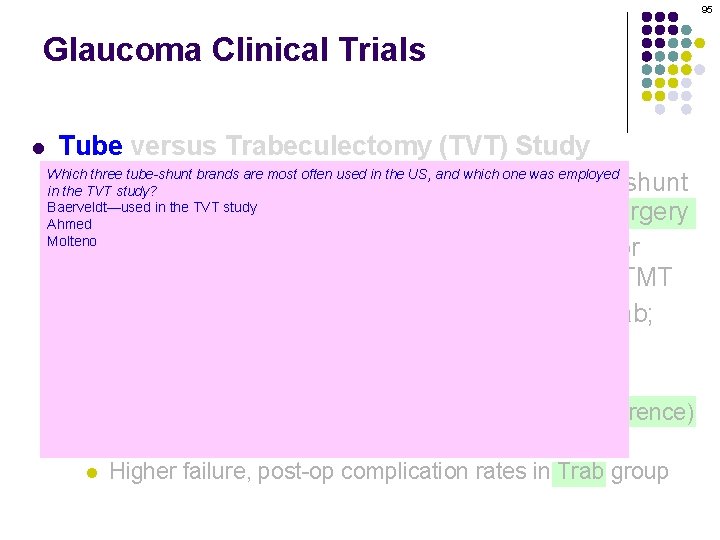
94 Glaucoma Clinical Trials l Tube versus Trabeculectomy (TVT) Study Which three tube-shunt brands are most often used in the US, and which one was employed Objective: Compare the safety/efficacy of tube shunt inl the TVT study? Baerveldt—used in the TVT study and trab in eyes with a history of prior ocular surgery Ahmed Molteno l Subjects: 212 eyes w/ hx of previous trab and/or Is the Baerveldt a valved or nonvalved w/ device? cataract surgery, IOP too high (18 -40) on MTMT Nonvalved l Protocol: Eyes randomly assigned to tube or trab; What intra-op maneuver is commonly performed—and was required by the TVT protocol— to reduce the risk added of overfiltration? meds as needed for IOP control The drainage tube was tied off with a suture, to be cut later. l Findings: After what biological event would the drainage-tube suture be lysed? Good IOP control in both groups (no statistical difference) After the l Tenon’s capsule and conj overlying the drainage device had scarred sufficiently to offer some (but not too much!) resistance to aqueous filtration; this scarring process is called encapsulation § Tube group needed more meds than Trab group l Higher failure, post-op complication rates in Trab group
95 Glaucoma Clinical Trials l Tube versus Trabeculectomy (TVT) Study Which three tube-shunt brands are most often used in the US, and which one was employed Objective: Compare the safety/efficacy of tube shunt inl the TVT study? Baerveldt—used in the TVT study and trab in eyes with a history of prior ocular surgery Ahmed Molteno l Subjects: 212 eyes w/ hx of previous trab and/or Is the Baerveldt a valved or nonvalved w/ device? cataract surgery, IOP too high (18 -40) on MTMT Nonvalved l Protocol: Eyes randomly assigned to tube or trab; What intra-op maneuver is commonly performed—and was required by the TVT protocol— to reduce the risk added of overfiltration? meds as needed for IOP control The drainage tube was tied off with a suture, to be cut later. l Findings: After what biological event would the drainage-tube suture be lysed? Good IOP control in both groups (no statistical difference) After the l Tenon’s capsule and conj overlying the drainage device had scarred sufficiently to offer some (but not too much!) resistance to aqueous filtration; this scarring process is called encapsulation § Tube group needed more meds than Trab group l Higher failure, post-op complication rates in Trab group
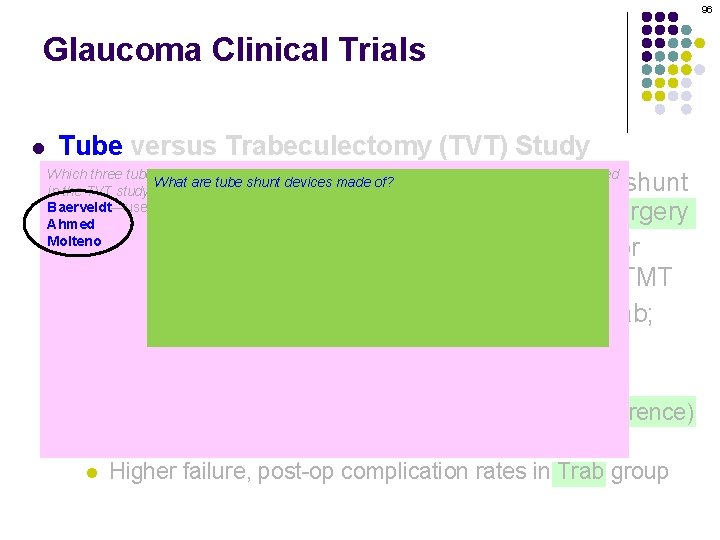
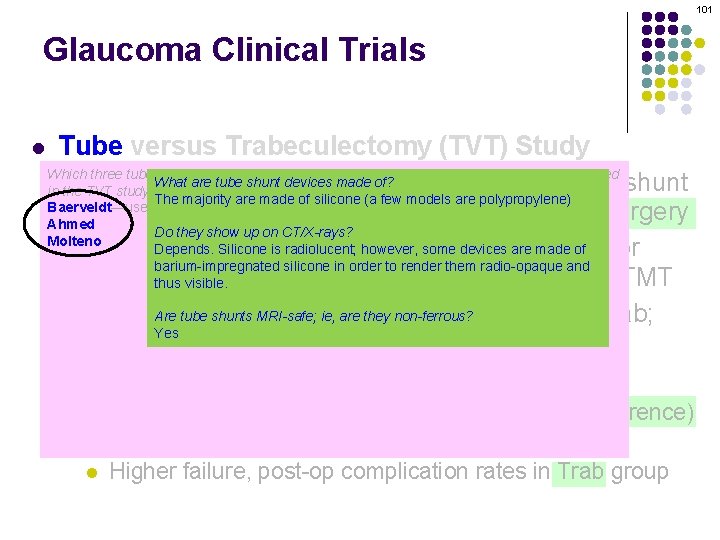
96 Glaucoma Clinical Trials l Tube versus Trabeculectomy (TVT) Study Which three tube-shunt brands are most often used in the US, and which one was employed What are. Compare tube shunt devices madesafety/efficacy of? Objective: the of tube shunt inl the TVT study? The majority are made of silicone (a few models are polypropylene) Baerveldt—used in the TVT study and trab in eyes with a history of prior ocular surgery Ahmed Do they show up on CT/X-rays? Molteno Depends. Silicone is radiolucent; some devices are madeand/or of l Subjects: 212 eyes w/ hxhowever, of previous trab barium-impregnated silicone in order to render them radio-opaque and Is the Baerveldt a valved or nonvalved w/ device? cataract surgery, IOP too high (18 -40) on MTMT thus visible. Nonvalved Are tube shunts MRI-safe; ie, are they non-ferrous? to tube or trab; l Protocol: Eyes randomly assigned What intra-op maneuver is commonly performed—and was required by the TVT protocol— Yes to reduce the risk added of overfiltration? meds as needed for IOP control The drainage tube was tied off with a suture, to be cut later. l Findings: After what biological event would the drainage-tube suture be lysed? Good IOP control in both groups (no statistical difference) After the l Tenon’s capsule and conj overlying the drainage device had scarred sufficiently to offer some (but not too much!) resistance to aqueous filtration; this scarring process is called encapsulation § Tube group needed more meds than Trab group l Higher failure, post-op complication rates in Trab group
97 Glaucoma Clinical Trials l Tube versus Trabeculectomy (TVT) Study Which three tube-shunt brands are most often used in the US, and which one was employed What are. Compare tube shunt devices madesafety/efficacy of? Objective: the of tube shunt inl the TVT study? The majority are made of silicone (a few models are polypropylene) Baerveldt—used in the TVT study and trab in eyes with a history of prior ocular surgery Ahmed Do they show up on CT/X-rays? Molteno Depends. Silicone is radiolucent; some devices are madeand/or of l Subjects: 212 eyes w/ hxhowever, of previous trab barium-impregnated silicone in order to render them radio-opaque and Is the Baerveldt a valved or nonvalved w/ device? cataract surgery, IOP too high (18 -40) on MTMT thus visible. Nonvalved Are tube shunts MRI-safe; ie, are they non-ferrous? to tube or trab; l Protocol: Eyes randomly assigned What intra-op maneuver is commonly performed—and was required by the TVT protocol— Yes to reduce the risk added of overfiltration? meds as needed for IOP control The drainage tube was tied off with a suture, to be cut later. l Findings: After what biological event would the drainage-tube suture be lysed? Good IOP control in both groups (no statistical difference) After the l Tenon’s capsule and conj overlying the drainage device had scarred sufficiently to offer some (but not too much!) resistance to aqueous filtration; this scarring process is called encapsulation § Tube group needed more meds than Trab group l Higher failure, post-op complication rates in Trab group
98 Glaucoma Clinical Trials l Tube versus Trabeculectomy (TVT) Study Which three tube-shunt brands are most often used in the US, and which one was employed What are. Compare tube shunt devices madesafety/efficacy of? Objective: the of tube shunt inl the TVT study? The majority are made of silicone (a few models are polypropylene) Baerveldt—used in the TVT study and trab in eyes with a history of prior ocular surgery Ahmed Do they show up on CT/X-rays? Molteno Depends. Silicone is radiolucent; some devices are madeand/or of l Subjects: 212 eyes w/ hxhowever, of previous trab barium-impregnated silicone in order to render them radio-opaque and Is the Baerveldt a valved or nonvalved w/ device? cataract surgery, IOP too high (18 -40) on MTMT thus visible. Nonvalved Are tube shunts MRI-safe; ie, are they non-ferrous? to tube or trab; l Protocol: Eyes randomly assigned What intra-op maneuver is commonly performed—and was required by the TVT protocol— Yes to reduce the risk added of overfiltration? meds as needed for IOP control The drainage tube was tied off with a suture, to be cut later. l Findings: After what biological event would the drainage-tube suture be lysed? Good IOP control in both groups (no statistical difference) After the l Tenon’s capsule and conj overlying the drainage device had scarred sufficiently to offer some (but not too much!) resistance to aqueous filtration; this scarring process is called encapsulation § Tube group needed more meds than Trab group l Higher failure, post-op complication rates in Trab group
99 Glaucoma Clinical Trials l Tube versus Trabeculectomy (TVT) Study Which three tube-shunt brands are most often used in the US, and which one was employed What are. Compare tube shunt devices madesafety/efficacy of? Objective: the of tube shunt inl the TVT study? The majority are made of silicone (a few models are polypropylene) Baerveldt—used in the TVT study and trab in eyes with a history of prior ocular surgery Ahmed Do they show up on CT/X-rays? Molteno Depends. Silicone is radiolucent; some devices are madeand/or of l Subjects: 212 eyes w/ hxhowever, of previous trab barium-impregnated silicone in order to render them radio-opaque and Is the Baerveldt a valved or nonvalved w/ device? cataract surgery, IOP too high (18 -40) on MTMT thus visible. Nonvalved Are tube shunts MRI-safe; ie, are they non-ferrous? to tube or trab; l Protocol: Eyes randomly assigned What intra-op maneuver is commonly performed—and was required by the TVT protocol— Yes to reduce the risk added of overfiltration? meds as needed for IOP control The drainage tube was tied off with a suture, to be cut later. l Findings: After what biological event would the drainage-tube suture be lysed? Good IOP control in both groups (no statistical difference) After the l Tenon’s capsule and conj overlying the drainage device had scarred sufficiently to offer some (but not too much!) resistance to aqueous filtration; this scarring process is called encapsulation § Tube group needed more meds than Trab group l Higher failure, post-op complication rates in Trab group
100 Glaucoma Clinical Trials l Tube versus Trabeculectomy (TVT) Study Which three tube-shunt brands are most often used in the US, and which one was employed What are. Compare tube shunt devices madesafety/efficacy of? Objective: the of tube shunt inl the TVT study? The majority are made of silicone (a few models are polypropylene) Baerveldt—used in the TVT study and trab in eyes with a history of prior ocular surgery Ahmed Do they show up on CT/X-rays? Molteno Depends. Silicone is radiolucent; some devices are madeand/or of l Subjects: 212 eyes w/ hxhowever, of previous trab barium-impregnated silicone in order to render them radio-opaque and Is the Baerveldt a valved or nonvalved w/ device? cataract surgery, IOP too high (18 -40) on MTMT thus visible. Nonvalved Are tube shunts MRI-safe; ie, are they non-ferrous? to tube or trab; l Protocol: Eyes randomly assigned What intra-op maneuver is commonly performed—and was required by the TVT protocol— Yes to reduce the risk added of overfiltration? meds as needed for IOP control The drainage tube was tied off with a suture, to be cut later. l Findings: After what biological event would the drainage-tube suture be lysed? Good IOP control in both groups (no statistical difference) After the l Tenon’s capsule and conj overlying the drainage device had scarred sufficiently to offer some (but not too much!) resistance to aqueous filtration; this scarring process is called encapsulation § Tube group needed more meds than Trab group l Higher failure, post-op complication rates in Trab group
101 Glaucoma Clinical Trials l Tube versus Trabeculectomy (TVT) Study Which three tube-shunt brands are most often used in the US, and which one was employed What are. Compare tube shunt devices madesafety/efficacy of? Objective: the of tube shunt inl the TVT study? The majority are made of silicone (a few models are polypropylene) Baerveldt—used in the TVT study and trab in eyes with a history of prior ocular surgery Ahmed Do they show up on CT/X-rays? Molteno Depends. Silicone is radiolucent; some devices are madeand/or of l Subjects: 212 eyes w/ hxhowever, of previous trab barium-impregnated silicone in order to render them radio-opaque and Is the Baerveldt a valved or nonvalved w/ device? cataract surgery, IOP too high (18 -40) on MTMT thus visible. Nonvalved Are tube shunts MRI-safe; ie, are they non-ferrous? to tube or trab; l Protocol: Eyes randomly assigned What intra-op maneuver is commonly performed—and was required by the TVT protocol— Yes to reduce the risk added of overfiltration? meds as needed for IOP control The drainage tube was tied off with a suture, to be cut later. l Findings: After what biological event would the drainage-tube suture be lysed? Good IOP control in both groups (no statistical difference) After the l Tenon’s capsule and conj overlying the drainage device had scarred sufficiently to offer some (but not too much!) resistance to aqueous filtration; this scarring process is called encapsulation § Tube group needed more meds than Trab group l Higher failure, post-op complication rates in Trab group
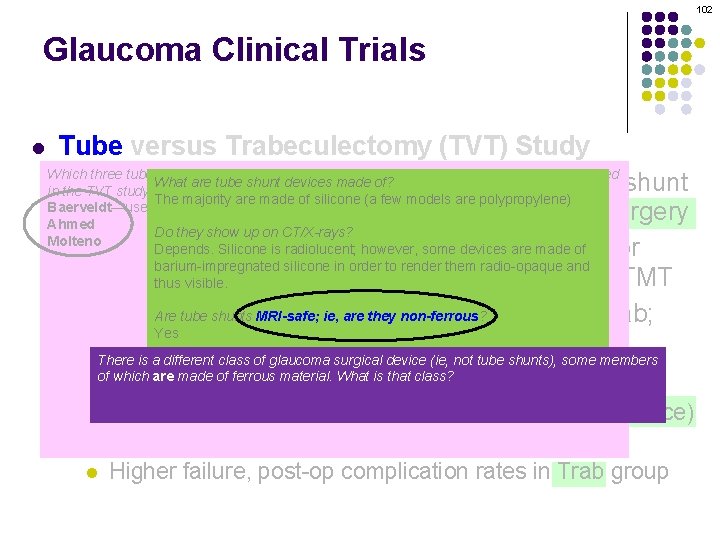
102 Glaucoma Clinical Trials l Tube versus Trabeculectomy (TVT) Study Which three tube-shunt brands are most often used in the US, and which one was employed What are. Compare tube shunt devices madesafety/efficacy of? Objective: the of tube shunt inl the TVT study? The majority are made of silicone (a few models are polypropylene) Baerveldt—used in the TVT study and trab in eyes with a history of prior ocular surgery Ahmed Do they show up on CT/X-rays? Molteno Depends. Silicone is radiolucent; some devices are madeand/or of l Subjects: 212 eyes w/ hxhowever, of previous trab barium-impregnated silicone in order to render them radio-opaque and Is the Baerveldt a valved or nonvalved w/ device? cataract surgery, IOP too high (18 -40) on MTMT thus visible. Nonvalved Are tube shunts MRI-safe; ie, are they non-ferrous? to tube or trab; l Protocol: Eyes randomly assigned What intra-op maneuver is commonly performed—and was required by the TVT protocol— Yes to reduce the risk added of overfiltration? meds as needed forlater. IOP control The drainage tube was tied off with a suture, to be cut There is a different class of glaucoma surgical device (ie, not tube shunts), some members of which are made of ferrous material. What is that class? l Findings: After what wouldimplanted the drainage-tube suture be lysed? It isbiological the classevent of devices during some forms of ‘minimally invasive glaucoma Good IOP control in both groups (no statistical difference) After the Tenon’s(MIGS); capsuleeg, andthe conj overlying glaucoma the drainage device had scarred EX-PRESS filtration is madesufficiently of stainless steel lsurgery’ to offer some (but not too much!) resistance to aqueous filtration; this scarring process is called encapsulation § Tube group needed more meds than Trab group l Higher failure, post-op complication rates in Trab group
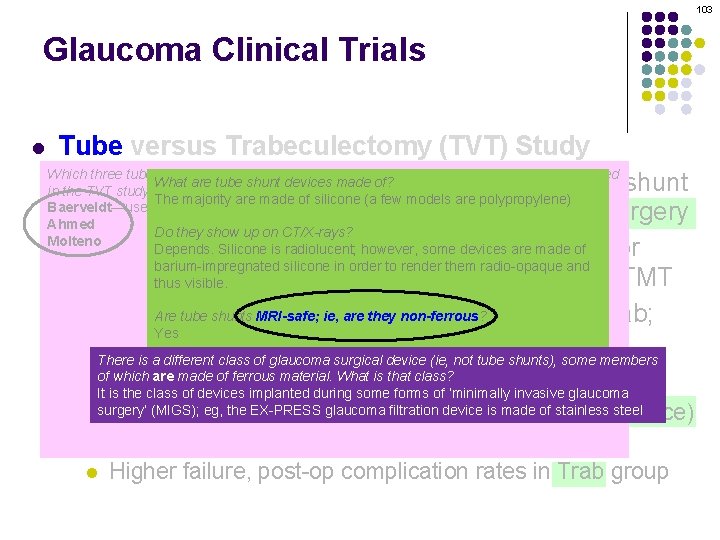
103 Glaucoma Clinical Trials l Tube versus Trabeculectomy (TVT) Study Which three tube-shunt brands are most often used in the US, and which one was employed What are. Compare tube shunt devices madesafety/efficacy of? Objective: the of tube shunt inl the TVT study? The majority are made of silicone (a few models are polypropylene) Baerveldt—used in the TVT study and trab in eyes with a history of prior ocular surgery Ahmed Do they show up on CT/X-rays? Molteno Depends. Silicone is radiolucent; some devices are madeand/or of l Subjects: 212 eyes w/ hxhowever, of previous trab barium-impregnated silicone in order to render them radio-opaque and Is the Baerveldt a valved or nonvalved w/ device? cataract surgery, IOP too high (18 -40) on MTMT thus visible. Nonvalved Are tube shunts MRI-safe; ie, are they non-ferrous? to tube or trab; l Protocol: Eyes randomly assigned What intra-op maneuver is commonly performed—and was required by the TVT protocol— Yes to reduce the risk added of overfiltration? meds as needed forlater. IOP control The drainage tube was tied off with a suture, to be cut There is a different class of glaucoma surgical device (ie, not tube shunts), some members of which are made of ferrous material. What is that class? l Findings: After what wouldimplanted the drainage-tube suture be lysed? It isbiological the classevent of devices during some forms of ‘minimally invasive glaucoma Good IOP control in both groups (no statistical difference) After the Tenon’s(MIGS); capsuleeg, andthe conj overlying glaucoma the drainage device had scarred EX-PRESS filtration is madesufficiently of stainless steel lsurgery’ to offer some (but not too much!) resistance to aqueous filtration; this scarring process is called encapsulation § Tube group needed more meds than Trab group l Higher failure, post-op complication rates in Trab group
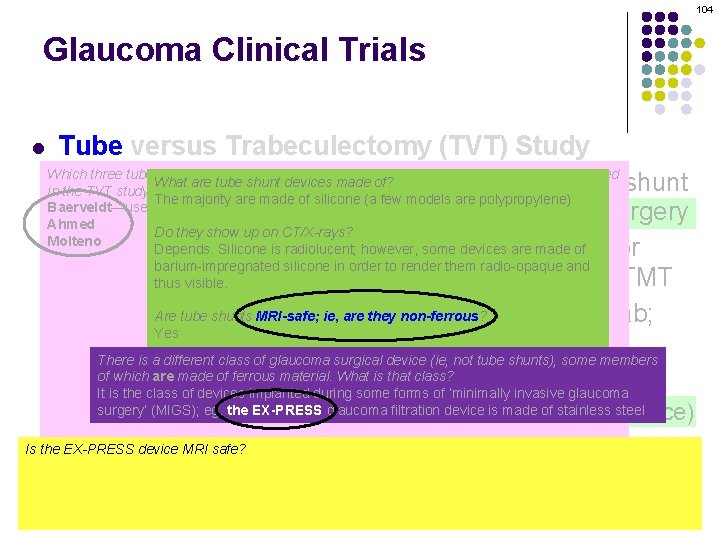
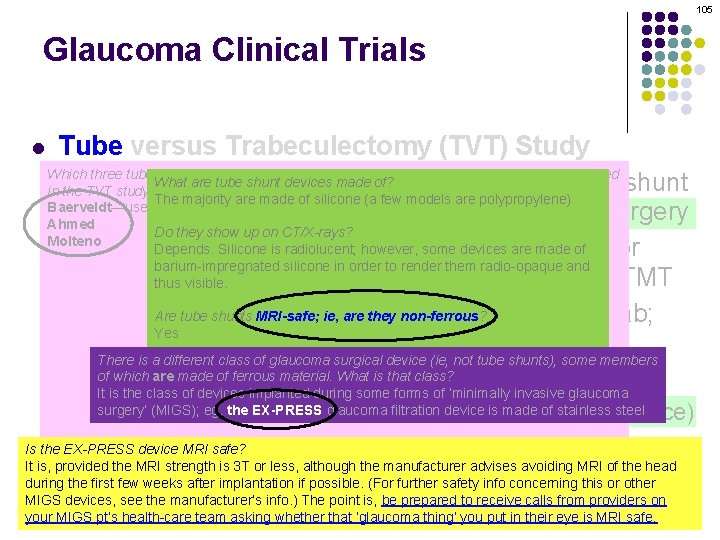
104 Glaucoma Clinical Trials l Tube versus Trabeculectomy (TVT) Study Which three tube-shunt brands are most often used in the US, and which one was employed What are. Compare tube shunt devices madesafety/efficacy of? Objective: the of tube shunt inl the TVT study? The majority are made of silicone (a few models are polypropylene) Baerveldt—used in the TVT study and trab in eyes with a history of prior ocular surgery Ahmed Do they show up on CT/X-rays? Molteno Depends. Silicone is radiolucent; some devices are madeand/or of l Subjects: 212 eyes w/ hxhowever, of previous trab barium-impregnated silicone in order to render them radio-opaque and Is the Baerveldt a valved or nonvalved w/ device? cataract surgery, IOP too high (18 -40) on MTMT thus visible. Nonvalved Are tube shunts MRI-safe; ie, are they non-ferrous? to tube or trab; l Protocol: Eyes randomly assigned What intra-op maneuver is commonly performed—and was required by the TVT protocol— Yes to reduce the risk added of overfiltration? meds as needed forlater. IOP control The drainage tube was tied off with a suture, to be cut There is a different class of glaucoma surgical device (ie, not tube shunts), some members of which are made of ferrous material. What is that class? l Findings: After what wouldimplanted the drainage-tube suture be lysed? It isbiological the classevent of devices during some forms of ‘minimally invasive glaucoma Good IOP control in both groups (no statistical difference) After the Tenon’s(MIGS); capsuleeg, andthe conj overlying the drainage device had scarred sufficiently EX-PRESS glaucoma filtration is made of stainless steel lsurgery’ to offer some (but not too much!) resistance to aqueous filtration; this scarring process is called encapsulation § Tube group Is the EX-PRESS device MRI safe? needed more meds than Trab group Higher failure, post-op complication rates in Trab group It is, provided the MRI strength is 3 T or less, although the manufacturer advises avoiding MRI of the head l during the first few weeks after implantation if possible. (For further safety info concerning this or other MIGS devices, see the manufacturer’s info. ) The point is, be prepared to receive calls from providers on your MIGS pt’s health-care team asking whether that ‘glaucoma thing’ you put in their eye is MRI safe.
105 Glaucoma Clinical Trials l Tube versus Trabeculectomy (TVT) Study Which three tube-shunt brands are most often used in the US, and which one was employed What are. Compare tube shunt devices madesafety/efficacy of? Objective: the of tube shunt inl the TVT study? The majority are made of silicone (a few models are polypropylene) Baerveldt—used in the TVT study and trab in eyes with a history of prior ocular surgery Ahmed Do they show up on CT/X-rays? Molteno Depends. Silicone is radiolucent; some devices are madeand/or of l Subjects: 212 eyes w/ hxhowever, of previous trab barium-impregnated silicone in order to render them radio-opaque and Is the Baerveldt a valved or nonvalved w/ device? cataract surgery, IOP too high (18 -40) on MTMT thus visible. Nonvalved Are tube shunts MRI-safe; ie, are they non-ferrous? to tube or trab; l Protocol: Eyes randomly assigned What intra-op maneuver is commonly performed—and was required by the TVT protocol— Yes to reduce the risk added of overfiltration? meds as needed forlater. IOP control The drainage tube was tied off with a suture, to be cut There is a different class of glaucoma surgical device (ie, not tube shunts), some members of which are made of ferrous material. What is that class? l Findings: After what wouldimplanted the drainage-tube suture be lysed? It isbiological the classevent of devices during some forms of ‘minimally invasive glaucoma Good IOP control in both groups (no statistical difference) After the Tenon’s(MIGS); capsuleeg, andthe conj overlying the drainage device had scarred sufficiently EX-PRESS glaucoma filtration is made of stainless steel lsurgery’ to offer some (but not too much!) resistance to aqueous filtration; this scarring process is called encapsulation § Tube group Is the EX-PRESS device MRI safe? needed more meds than Trab group Higher failure, post-op complication rates in Trab group It is, provided the MRI strength is 3 T or less, although the manufacturer advises avoiding MRI of the head l during the first few weeks after implantation if possible. (For further safety info concerning this or other MIGS devices, see the manufacturer’s info. ) The point is, be prepared to receive calls from providers on your MIGS pt’s health-care team asking whether that ‘glaucoma thing’ you put in their eye is MRI safe.
106 Glaucoma Clinical Trials l Tube versus Trabeculectomy (TVT) Study Which three tube-shunt brands are most often used in the US, and which one was employed Objective: Compare the safety/efficacy of tube shunt inl the TVT study? Baerveldt—used in the TVT study and trab in eyes with a history of prior ocular surgery Ahmed Molteno What does it mean to say aw/ tube hx shuntof is valved? l Subjects: 212 eyes previous trab and/or It means the device is intentionally constructed to provide some Is the Baerveldt a valved or nonvalved w/ device? cataract surgery, IOP too highinto(18 -40) resistance to filtration (ie, to the egress of aqueous the device) on MTMT Nonvalved devicesrandomly are at increased risk for what post-op l Protocol: Eyes assigned tocomplication? tube or trab; What intra-op maneuver is commonly performed—and was required by the TVT protocol— Overfiltration, with subsequent hypotony to reduce the risk added of overfiltration? meds as needed for IOP control The drainage tube was tied off with a suture, to be cut later. l Findings: After what biological event would the drainage-tube suture be lysed? Good IOP control in both groups (no statistical difference) After the l Tenon’s capsule and conj overlying the drainage device had scarred sufficiently to offer some (but not too much!) resistance to aqueous filtration; this scarring process is called encapsulation § Tube group needed more meds than Trab group l Higher failure, post-op complication rates in Trab group
107 Glaucoma Clinical Trials l Tube versus Trabeculectomy (TVT) Study Which three tube-shunt brands are most often used in the US, and which one was employed Objective: Compare the safety/efficacy of tube shunt inl the TVT study? Baerveldt—used in the TVT study and trab in eyes with a history of prior ocular surgery Ahmed Molteno What does it mean to say aw/ tube hx shuntof is valved? l Subjects: 212 eyes previous trab and/or It means the device is intentionally constructed to provide some Is the Baerveldt a valved or nonvalved w/ device? cataract surgery, IOP too highinto(18 -40) resistance to filtration (ie, to the egress of aqueous the device) on MTMT Nonvalved devicesrandomly are at increased risk for what post-op l Protocol: Eyes assigned tocomplication? tube or trab; What intra-op maneuver is commonly performed—and was required by the TVT protocol— Overfiltration, with subsequent hypotony to reduce the risk added of overfiltration? meds as needed for IOP control The drainage tube was tied off with a suture, to be cut later. l Findings: After what biological event would the drainage-tube suture be lysed? Good IOP control in both groups (no statistical difference) After the l Tenon’s capsule and conj overlying the drainage device had scarred sufficiently to offer some (but not too much!) resistance to aqueous filtration; this scarring process is called encapsulation § Tube group needed more meds than Trab group l Higher failure, post-op complication rates in Trab group
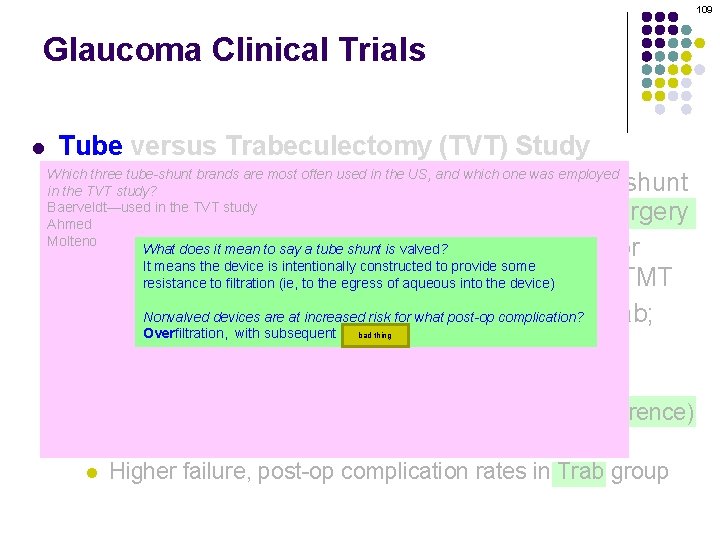
108 Glaucoma Clinical Trials l Tube versus Trabeculectomy (TVT) Study Which three tube-shunt brands are most often used in the US, and which one was employed Objective: Compare the safety/efficacy of tube shunt inl the TVT study? Baerveldt—used in the TVT study and trab in eyes with a history of prior ocular surgery Ahmed Molteno What does it mean to say aw/ tube hx shuntof is valved? l Subjects: 212 eyes previous trab and/or It means the device is intentionally constructed to provide some Is the Baerveldt a valved or nonvalved w/ device? cataract surgery, IOP too highinto(18 -40) resistance to filtration (ie, to the egress of aqueous the device) on MTMT Nonvalved devicesrandomly are at increased risk for what post-op l Protocol: Eyes assigned tocomplication? tube or trab; What intra-op maneuver is commonly performed—and was required by the TVT protocol— Overfiltration, with subsequent hypotony to reduce the risk added of overfiltration? meds as needed for IOP control The drainage tube was tied off with a suture, to be cut later. l Findings: After what biological event would the drainage-tube suture be lysed? Good IOP control in both groups (no statistical difference) After the l Tenon’s capsule and conj overlying the drainage device had scarred sufficiently to offer some (but not too much!) resistance to aqueous filtration; this scarring process is called encapsulation § Tube group needed more meds than Trab group l Higher failure, post-op complication rates in Trab group
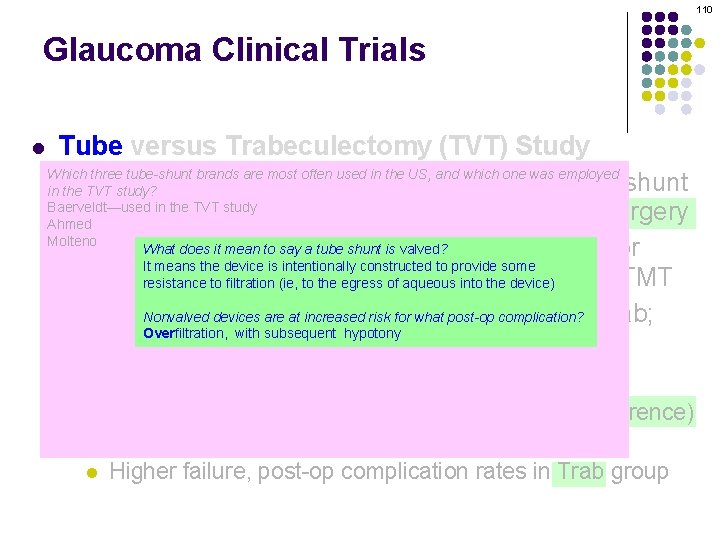
109 Glaucoma Clinical Trials l Tube versus Trabeculectomy (TVT) Study Which three tube-shunt brands are most often used in the US, and which one was employed Objective: Compare the safety/efficacy of tube shunt inl the TVT study? Baerveldt—used in the TVT study and trab in eyes with a history of prior ocular surgery Ahmed Molteno What does it mean to say aw/ tube hx shuntof is valved? l Subjects: 212 eyes previous trab and/or It means the device is intentionally constructed to provide some Is the Baerveldt a valved or nonvalved w/ device? cataract surgery, IOP too highinto(18 -40) resistance to filtration (ie, to the egress of aqueous the device) on MTMT Nonvalved devicesrandomly are at increased risk for what post-op l Protocol: Eyes assigned tocomplication? tube or trab; What intra-op maneuver is commonly performed—and was required by the TVT protocol— Overfiltration, with subsequent hypotony to reduce the risk added of overfiltration? meds as needed for IOP control The drainage tube was tied off with a suture, to be cut later. l Findings: After what biological event would the drainage-tube suture be lysed? bad thing Good IOP control in both groups (no statistical difference) After the l Tenon’s capsule and conj overlying the drainage device had scarred sufficiently to offer some (but not too much!) resistance to aqueous filtration; this scarring process is called encapsulation § Tube group needed more meds than Trab group l Higher failure, post-op complication rates in Trab group
110 Glaucoma Clinical Trials l Tube versus Trabeculectomy (TVT) Study Which three tube-shunt brands are most often used in the US, and which one was employed Objective: Compare the safety/efficacy of tube shunt inl the TVT study? Baerveldt—used in the TVT study and trab in eyes with a history of prior ocular surgery Ahmed Molteno What does it mean to say aw/ tube hx shuntof is valved? l Subjects: 212 eyes previous trab and/or It means the device is intentionally constructed to provide some Is the Baerveldt a valved or nonvalved w/ device? cataract surgery, IOP too highinto(18 -40) resistance to filtration (ie, to the egress of aqueous the device) on MTMT Nonvalved devicesrandomly are at increased risk for what post-op l Protocol: Eyes assigned tocomplication? tube or trab; What intra-op maneuver is commonly performed—and was required by the TVT protocol— Overfiltration, with subsequent hypotony to reduce the risk added of overfiltration? meds as needed for IOP control The drainage tube was tied off with a suture, to be cut later. l Findings: After what biological event would the drainage-tube suture be lysed? Good IOP control in both groups (no statistical difference) After the l Tenon’s capsule and conj overlying the drainage device had scarred sufficiently to offer some (but not too much!) resistance to aqueous filtration; this scarring process is called encapsulation § Tube group needed more meds than Trab group l Higher failure, post-op complication rates in Trab group
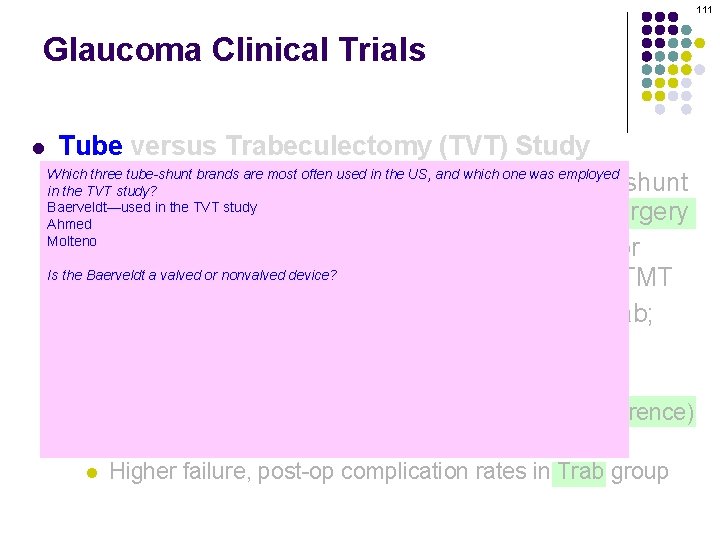
111 Glaucoma Clinical Trials l Tube versus Trabeculectomy (TVT) Study Which three tube-shunt brands are most often used in the US, and which one was employed Objective: Compare the safety/efficacy of tube shunt inl the TVT study? Baerveldt—used in the TVT study and trab in eyes with a history of prior ocular surgery Ahmed Molteno l Subjects: 212 eyes w/ hx of previous trab and/or Is the Baerveldt a valved or nonvalved w/ device? cataract surgery, IOP too high (18 -40) on MTMT Nonvalved l Protocol: Eyes randomly assigned to tube or trab; What intra-op maneuver is commonly performed—and was required by the TVT protocol— to reduce the risk added of overfiltration? meds as needed for IOP control The drainage tube was tied off with a suture, to be cut later. l Findings: After what biological event would the drainage-tube suture be lysed? Good IOP control in both groups (no statistical difference) After the l Tenon’s capsule and conj overlying the drainage device had scarred sufficiently to offer some (but not too much!) resistance to aqueous filtration; this scarring process is called encapsulation § Tube group needed more meds than Trab group l Higher failure, post-op complication rates in Trab group
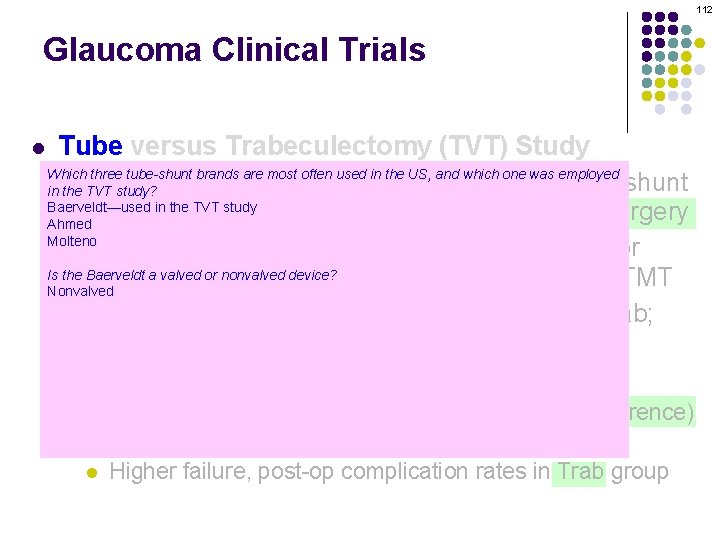
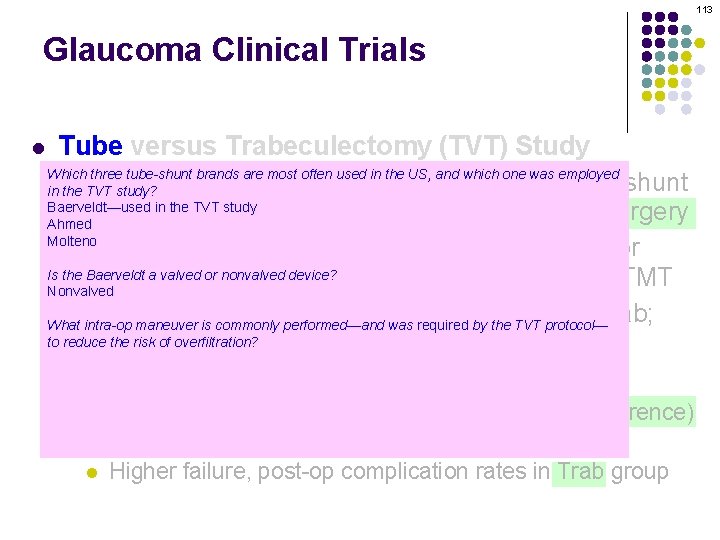
112 Glaucoma Clinical Trials l Tube versus Trabeculectomy (TVT) Study Which three tube-shunt brands are most often used in the US, and which one was employed Objective: Compare the safety/efficacy of tube shunt inl the TVT study? Baerveldt—used in the TVT study and trab in eyes with a history of prior ocular surgery Ahmed Molteno l Subjects: 212 eyes w/ hx of previous trab and/or Is the Baerveldt a valved or nonvalved w/ device? cataract surgery, IOP too high (18 -40) on MTMT Nonvalved l Protocol: Eyes randomly assigned to tube or trab; What intra-op maneuver is commonly performed—and was required by the TVT protocol— to reduce the risk added of overfiltration? meds as needed for IOP control The drainage tube was tied off with a suture, to be cut later. l Findings: After what biological event would the drainage-tube suture be lysed? Good IOP control in both groups (no statistical difference) After the l Tenon’s capsule and conj overlying the drainage device had scarred sufficiently to offer some (but not too much!) resistance to aqueous filtration; this scarring process is called encapsulation § Tube group needed more meds than Trab group l Higher failure, post-op complication rates in Trab group
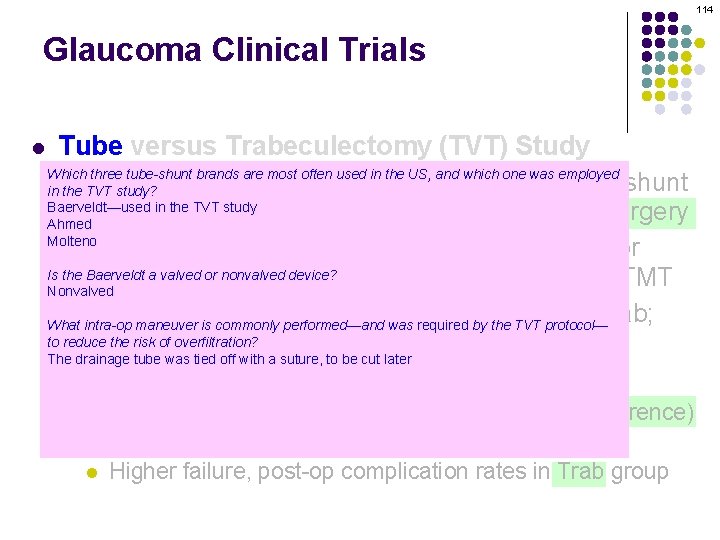
113 Glaucoma Clinical Trials l Tube versus Trabeculectomy (TVT) Study Which three tube-shunt brands are most often used in the US, and which one was employed Objective: Compare the safety/efficacy of tube shunt inl the TVT study? Baerveldt—used in the TVT study and trab in eyes with a history of prior ocular surgery Ahmed Molteno l Subjects: 212 eyes w/ hx of previous trab and/or Is the Baerveldt a valved or nonvalved w/ device? cataract surgery, IOP too high (18 -40) on MTMT Nonvalved l Protocol: Eyes randomly assigned to tube or trab; What intra-op maneuver is commonly performed—and was required by the TVT protocol— to reduce the risk added of overfiltration? meds as needed for IOP control The drainage tube was tied off with a suture, to be cut later. l Findings: After what biological event would the drainage-tube suture be lysed? Good IOP control in both groups (no statistical difference) After the l Tenon’s capsule and conj overlying the drainage device had scarred sufficiently to offer some (but not too much!) resistance to aqueous filtration; this scarring process is called encapsulation § Tube group needed more meds than Trab group l Higher failure, post-op complication rates in Trab group
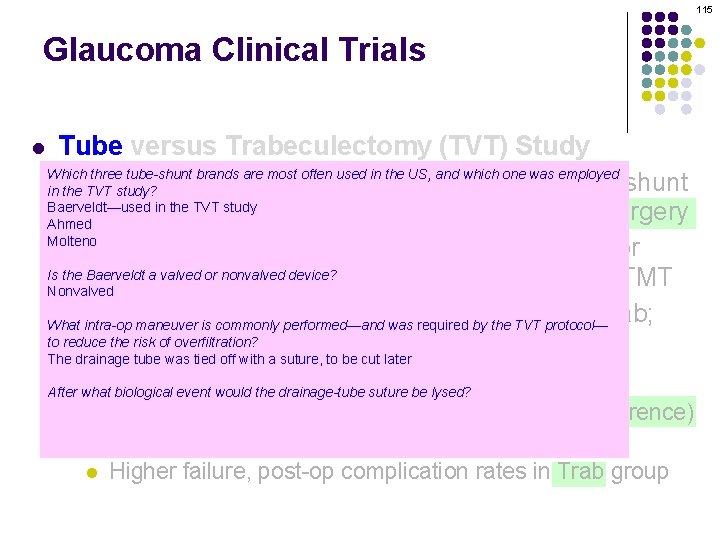
114 Glaucoma Clinical Trials l Tube versus Trabeculectomy (TVT) Study Which three tube-shunt brands are most often used in the US, and which one was employed Objective: Compare the safety/efficacy of tube shunt inl the TVT study? Baerveldt—used in the TVT study and trab in eyes with a history of prior ocular surgery Ahmed Molteno l Subjects: 212 eyes w/ hx of previous trab and/or Is the Baerveldt a valved or nonvalved w/ device? cataract surgery, IOP too high (18 -40) on MTMT Nonvalved l Protocol: Eyes randomly assigned to tube or trab; What intra-op maneuver is commonly performed—and was required by the TVT protocol— to reduce the risk added of overfiltration? meds as needed for IOP control The drainage tube was tied off with a suture, to be cut later l Findings: After what biological event would the drainage-tube suture be lysed? Good IOP control in both groups (no statistical difference) After the l Tenon’s capsule and conj overlying the drainage device had scarred sufficiently to offer some (but not too much!) resistance to aqueous filtration; this scarring process is called encapsulation § Tube group needed more meds than Trab group l Higher failure, post-op complication rates in Trab group
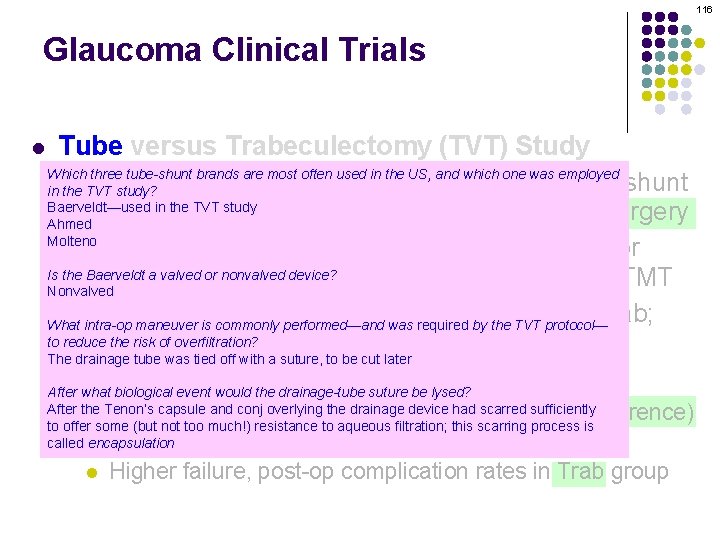
115 Glaucoma Clinical Trials l Tube versus Trabeculectomy (TVT) Study Which three tube-shunt brands are most often used in the US, and which one was employed Objective: Compare the safety/efficacy of tube shunt inl the TVT study? Baerveldt—used in the TVT study and trab in eyes with a history of prior ocular surgery Ahmed Molteno l Subjects: 212 eyes w/ hx of previous trab and/or Is the Baerveldt a valved or nonvalved w/ device? cataract surgery, IOP too high (18 -40) on MTMT Nonvalved l Protocol: Eyes randomly assigned to tube or trab; What intra-op maneuver is commonly performed—and was required by the TVT protocol— to reduce the risk added of overfiltration? meds as needed for IOP control The drainage tube was tied off with a suture, to be cut later l Findings: After what biological event would the drainage-tube suture be lysed? Good IOP control in both groups (no statistical difference) After the l Tenon’s capsule and conj overlying the drainage device had scarred sufficiently to offer some (but not too much!) resistance to aqueous filtration; this scarring process is called encapsulation § Tube group needed more meds than Trab group l Higher failure, post-op complication rates in Trab group
116 Glaucoma Clinical Trials l Tube versus Trabeculectomy (TVT) Study Which three tube-shunt brands are most often used in the US, and which one was employed Objective: Compare the safety/efficacy of tube shunt inl the TVT study? Baerveldt—used in the TVT study and trab in eyes with a history of prior ocular surgery Ahmed Molteno l Subjects: 212 eyes w/ hx of previous trab and/or Is the Baerveldt a valved or nonvalved w/ device? cataract surgery, IOP too high (18 -40) on MTMT Nonvalved l Protocol: Eyes randomly assigned to tube or trab; What intra-op maneuver is commonly performed—and was required by the TVT protocol— to reduce the risk added of overfiltration? meds as needed for IOP control The drainage tube was tied off with a suture, to be cut later l Findings: After what biological event would the drainage-tube suture be lysed? Good IOP control in both groups (no statistical difference) After the l Tenon’s capsule and conj overlying the drainage device had scarred sufficiently to offer some (but not too much!) resistance to aqueous filtration; this scarring process is called encapsulation § Tube group needed more meds than Trab group l Higher failure, post-op complication rates in Trab group
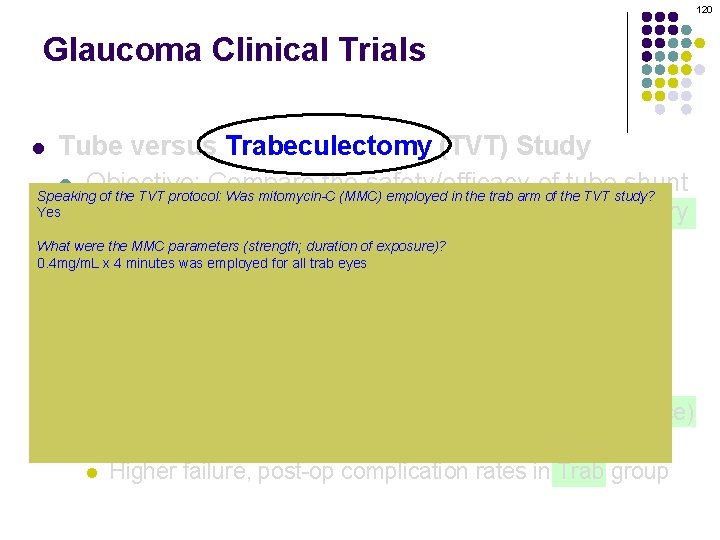
117 Glaucoma Clinical Trials Tube versus Trabeculectomy (TVT) Study l Objective: Compare the safety/efficacy of tube shunt Speaking of the TVT protocol: Was mitomycin-C (MMC) employed in the trab arm of the TVT study? Yes and trab in eyes with a history of prior ocular surgery What the MMC parameters (strength; duration of exposure)? l were Subjects: 212 eyes w/ hx of previous trab and/or 0. 4 mg/m. L x 4 minutes was employed for all trab eyes cataract surgery, w/ IOP too high (18 -40) on MTMT Why is this ‘one size fits all’ approach to MMC dosing a source of controversy? Most titrate MMC dosing on an individual-patient basis. For example, most feel a lsurgeons Protocol: Eyes randomly assigned to tube orthattrab; young African-American eye likely requires more intense MMC dosing than does the eye of an elderly meds added as needed for 32 IOP Caucasian. The TVT study population ranged in age from to 85, control and included white, African. American and Latino patients. Left to their own devices, it is highly unlikely that the TVT surgeons would elected MMC 0. 4 mg/m. L x 4 minutes for all patients. l have Findings: l Good IOP control in both groups (no statistical difference) Why is this l a problem for the study? Some experts have questioned whether suboptimal MMC dosing might have inflated the § Tube needed more complication/failure rategroup in the Trab arm of the study meds than Trab group l Higher failure, post-op complication rates in Trab group
118 Glaucoma Clinical Trials Tube versus Trabeculectomy (TVT) Study l Objective: Compare the safety/efficacy of tube shunt Speaking of the TVT protocol: Was mitomycin-C (MMC) employed in the trab arm of the TVT study? Yes and trab in eyes with a history of prior ocular surgery What the MMC parameters (strength; duration of exposure)? l were Subjects: 212 eyes w/ hx of previous trab and/or 0. 4 mg/m. L x 4 minutes was employed for all trab eyes cataract surgery, w/ IOP too high (18 -40) on MTMT Why is this ‘one size fits all’ approach to MMC dosing a source of controversy? Most titrate MMC dosing on an individual-patient basis. For example, most feel a lsurgeons Protocol: Eyes randomly assigned to tube orthattrab; young African-American eye likely requires more intense MMC dosing than does the eye of an elderly meds added as needed for 32 IOP Caucasian. The TVT study population ranged in age from to 85, control and included white, African. American and Latino patients. Left to their own devices, it is highly unlikely that the TVT surgeons would elected MMC 0. 4 mg/m. L x 4 minutes for all patients. l have Findings: l Good IOP control in both groups (no statistical difference) Why is this l a problem for the study? Some experts have questioned whether suboptimal MMC dosing might have inflated the § Tube needed more complication/failure rategroup in the Trab arm of the study meds than Trab group l Higher failure, post-op complication rates in Trab group
119 Glaucoma Clinical Trials Tube versus Trabeculectomy (TVT) Study l Objective: Compare the safety/efficacy of tube shunt Speaking of the TVT protocol: Was mitomycin-C (MMC) employed in the trab arm of the TVT study? Yes and trab in eyes with a history of prior ocular surgery What the MMC parameters (strength; duration of exposure)? l were Subjects: 212 eyes w/ hx of previous trab and/or 0. 4 mg/m. L x 4 minutes was employed for all trab eyes cataract surgery, w/ IOP too high (18 -40) on MTMT Why is this ‘one size fits all’ approach to MMC dosing a source of controversy? Most titrate MMC dosing on an individual-patient basis. For example, most feel a lsurgeons Protocol: Eyes randomly assigned to tube orthattrab; young African-American eye likely requires more intense MMC dosing than does the eye of an elderly meds added as needed for 32 IOP Caucasian. The TVT study population ranged in age from to 85, control and included white, African. American and Latino patients. Left to their own devices, it is highly unlikely that the TVT surgeons would elected MMC 0. 4 mg/m. L x 4 minutes for all patients. l have Findings: l Good IOP control in both groups (no statistical difference) Why is this l a problem for the study? Some experts have questioned whether suboptimal MMC dosing might have inflated the § Tube needed more complication/failure rategroup in the Trab arm of the study meds than Trab group l Higher failure, post-op complication rates in Trab group
120 Glaucoma Clinical Trials Tube versus Trabeculectomy (TVT) Study l Objective: Compare the safety/efficacy of tube shunt Speaking of the TVT protocol: Was mitomycin-C (MMC) employed in the trab arm of the TVT study? Yes and trab in eyes with a history of prior ocular surgery What the MMC parameters (strength; duration of exposure)? l were Subjects: 212 eyes w/ hx of previous trab and/or 0. 4 mg/m. L x 4 minutes was employed for all trab eyes cataract surgery, w/ IOP too high (18 -40) on MTMT Why is this ‘one size fits all’ approach to MMC dosing a source of controversy? Most titrate MMC dosing on an individual-patient basis. For example, most feel a lsurgeons Protocol: Eyes randomly assigned to tube orthattrab; young African-American eye likely requires more intense MMC dosing than does the eye of an elderly meds added as needed for 32 IOP Caucasian. The TVT study population ranged in age from to 85, control and included white, African. American and Latino patients. Left to their own devices, it is highly unlikely that the TVT surgeons would elected MMC 0. 4 mg/m. L x 4 minutes for all patients. l have Findings: l Good IOP control in both groups (no statistical difference) Why is this l a problem for the study? Some experts have questioned whether suboptimal MMC dosing might have inflated the § Tube needed more complication/failure rategroup in the Trab arm of the study meds than Trab group l Higher failure, post-op complication rates in Trab group
121 Glaucoma Clinical Trials Tube versus Trabeculectomy (TVT) Study l Objective: Compare the safety/efficacy of tube shunt Speaking of the TVT protocol: Was mitomycin-C (MMC) employed in the trab arm of the TVT study? Yes and trab in eyes with a history of prior ocular surgery What the MMC parameters (strength; duration of exposure)? l were Subjects: 212 eyes w/ hx of previous trab and/or 0. 4 mg/m. L x 4 minutes was employed for all trab eyes cataract surgery, w/ IOP too high (18 -40) on MTMT Why is this ‘one size fits all’ approach to MMC dosing a source of controversy? Most titrate MMC dosing on an individual-patient basis. For example, most feel a lsurgeons Protocol: Eyes randomly assigned to tube orthattrab; young African-American eye likely requires more intense MMC dosing than does the eye of an elderly meds added as needed for 32 IOP Caucasian. The TVT study population ranged in age from to 85, control and included white, African. American and Latino patients. Left to their own devices, it is highly unlikely that the TVT surgeons would elected MMC 0. 4 mg/m. L x 4 minutes for all patients. l have Findings: l Good IOP control in both groups (no statistical difference) Why is this l a problem for the study? Some experts have questioned whether suboptimal MMC dosing might have inflated the § Tube needed more complication/failure rategroup in the Trab arm of the study meds than Trab group l Higher failure, post-op complication rates in Trab group
122 Glaucoma Clinical Trials Tube versus Trabeculectomy (TVT) Study l Objective: Compare the safety/efficacy of tube shunt Speaking of the TVT protocol: Was mitomycin-C (MMC) employed in the trab arm of the TVT study? Yes and trab in eyes with a history of prior ocular surgery What the MMC parameters (strength; duration of exposure)? l were Subjects: 212 eyes w/ hx of previous trab and/or 0. 4 mg/m. L x 4 minutes was employed for all trab eyes cataract surgery, w/ IOP too high (18 -40) on MTMT Why is this ‘one size fits all’ approach to MMC dosing a source of controversy? Most titrate MMC dosing on an individual-patient basis. For example, most feel a lsurgeons Protocol: Eyes randomly assigned to tube orthattrab; young African-American eye likely requires more intense MMC dosing than does the eye of an elderly meds added as needed for 32 IOP Caucasian. The TVT study population ranged in age from to 85, control and included white, African. American and Latino patients. Left to their own devices, it is highly unlikely that the TVT surgeons would elected MMC 0. 4 mg/m. L x 4 minutes for all patients. l have Findings: l Good IOP control in both groups (no statistical difference) Why is this l a problem for the study? Some experts have questioned whether suboptimal MMC dosing might have inflated the § Tube needed more complication/failure rategroup in the Trab arm of the study meds than Trab group l Higher failure, post-op complication rates in Trab group
123 Glaucoma Clinical Trials Tube versus Trabeculectomy (TVT) Study l Objective: Compare the safety/efficacy of tube shunt Speaking of the TVT protocol: Was mitomycin-C (MMC) employed in the trab arm of the TVT study? Yes and trab in eyes with a history of prior ocular surgery What the MMC parameters (strength; duration of exposure)? l were Subjects: 212 eyes w/ hx of previous trab and/or 0. 4 mg/m. L x 4 minutes was employed for all trab eyes cataract surgery, w/ IOP too high (18 -40) on MTMT Why is this ‘one size fits all’ approach to MMC dosing a source of controversy? Most titrate MMC dosing on an individual-patient basis. For example, most feel a lsurgeons Protocol: Eyes randomly assigned to tube orthattrab; young African-American eye likely requires more intense MMC dosing than does the eye of an elderly meds added as needed for 32 IOP Caucasian. The TVT study population ranged in age from to 85, control and included white, African. American and Latino patients. Left to their own devices, it is highly unlikely that the TVT surgeons would elected MMC 0. 4 mg/m. L x 4 minutes for all patients. l have Findings: l Good IOP control in both groups (no statistical difference) Why is this l a problem for the study? Some experts have questioned whether suboptimal MMC dosing might have inflated the § Tube needed more complication/failure rategroup in the Trab arm of the study meds than Trab group l Higher failure, post-op complication rates in Trab group
124 Glaucoma Clinical Trials Tube versus Trabeculectomy (TVT) Study l Objective: Compare the safety/efficacy of tube shunt Speaking of the TVT protocol: Was mitomycin-C (MMC) employed in the trab arm of the TVT study? Yes and trab in eyes with a history of prior ocular surgery What the MMC parameters (strength; duration of exposure)? l were Subjects: 212 eyes w/ hx of previous trab and/or 0. 4 mg/m. L x 4 minutes was employed for all trab eyes cataract surgery, w/ IOP too high (18 -40) on MTMT Why is this ‘one size fits all’ approach to MMC dosing a source of controversy? Most titrate MMC dosing on an individual-patient basis. For example, most feel a lsurgeons Protocol: Eyes randomly assigned to tube orthattrab; young African-American eye likely requires more intense MMC dosing than does the eye of an elderly meds added as needed for 32 IOP Caucasian. The TVT study population ranged in age from to 85, control and included white, African. American and Latino patients. Left to their own devices, it is highly unlikely that the TVT surgeons would elected MMC 0. 4 mg/m. L x 4 minutes for all patients. l have Findings: l Good IOP control in both groups (no statistical difference) Why is this l a problem for the study? Some experts have questioned whether suboptimal MMC dosing might have inflated the § Tube needed more complication/failure rategroup in the Trab arm of the study meds than Trab group l Higher failure, post-op complication rates in Trab group
125 Glaucoma Clinical Trials l Tube versus Trabeculectomy (TVT) Study l Objective: Compare the safety/efficacy of tube shunt and trab in eyes with a history of prior ocular surgery l Subjects: 212 eyes w/ hx of previous trab and/or cataract surgery, w/ IOP too high (18 -40) on MTMT Very. Eyes important! Remember, the TVT study concerned a l Protocol: randomly assigned to tubeeyes orwith trab; history of previous surgery, not ‘virgin’ eyes! meds added as needed for IOP control What about the relative efficacy/safety of tube vs trab in virgin eyes? This is the subject of the Primary Tube vs Trabeculectomy Study l Findings: l Good IOP control in both groups (no statistical difference) § l Tube group needed more meds than Trab group Higher failure, post-op complication rates in Trab group
126 Glaucoma Clinical Trials l Tube versus Trabeculectomy (TVT) Study l Objective: Compare the safety/efficacy of tube shunt and trab in eyes with a history of prior ocular surgery l Subjects: 212 eyes w/ hx of previous trab and/or cataract surgery, w/ IOP too high (18 -40) on MTMT Very. Eyes important! Remember, the TVT study concerned a l Protocol: randomly assigned to tubeeyes orwith trab; history of previous surgery, not ‘virgin’ eyes! meds added as needed for IOP control What about the relative efficacy/safety of tube vs trab in virgin eyes? This is the subject of the Primary Tube vs Trabeculectomy Study l Findings: l Good IOP control in both groups (no statistical difference) § l Tube group needed more meds than Trab group Higher failure, post-op complication rates in Trab group
127 Glaucoma Clinical Trials l Tube versus Trabeculectomy (TVT) Study l Objective: Compare the safety/efficacy of tube shunt and trab in eyes with a history of prior ocular surgery l Subjects: 212 eyes w/ hx of previous trab and/or cataract surgery, w/ IOP too high (18 -40) on MTMT Very. Eyes important! Remember, the TVT study concerned a l Protocol: randomly assigned to tubeeyes orwith trab; history of previous surgery, not ‘virgin’ eyes! meds added as needed for IOP control What about the relative efficacy/safety of tube vs trab in virgin eyes? This is the subject of the Primary Tube vs Trabeculectomy Study l Findings: l Good IOP control in both groups (no statistical difference) § l Tube group needed more meds than Trab group Higher failure, post-op complication rates in Trab group