
1 Forensic Science Fundamentals Investigations 2 e Chapter
- Slides: 34
1 Forensic Science: Fundamentals & Investigations, 2 e Chapter 4 All rights Reserved Cengage/NGL/South-Western © 2016
Chapter 4 A Study of Fibers and Textiles By the end of this chapter you will be able to: 4. 1 Identify and describe common weave patterns of textile samples. 4. 2 Compare and contrast various types of fibers through physical and chemical analysis. 4. 3 Describe principal characteristics of common fibers used in their identification. 4. 4 Apply forensic science techniques to analyze fibers. 2 Forensic Science: Fundamentals & Investigations, 2 e Chapter 4 All rights Reserved Cengage/NGL/South-Western © 2016
Chapter 4 Vocabulary o o o o 3 amorphous crystalline direct transfer fiber mineral fiber monomer natural fiber o o o o polymer synthetic fiber secondary transfer textile warp weft yard (thread) Forensic Science: Fundamentals & Investigations, 2 e Chapter 4 All rights Reserved Cengage/NGL/South-Western © 2016
Introduction o o Fibers are the smallest unit of a textile (must be at least 100 times longer than wide) Fibers are used in forensic science to create a link between crime and suspect. Fibers are not specific to a single person. Fibers are a form of trace evidence. • • 4 Direct transfer – passing of evidence from suspect to victim, or vise versa Secondary transfer – passing of evidence from a source (carpet i. e. ), to victim then to suspect Forensic Science: Fundamentals & Investigations, 2 e Chapter 4 All rights Reserved Cengage/NGL/South-Western © 2016
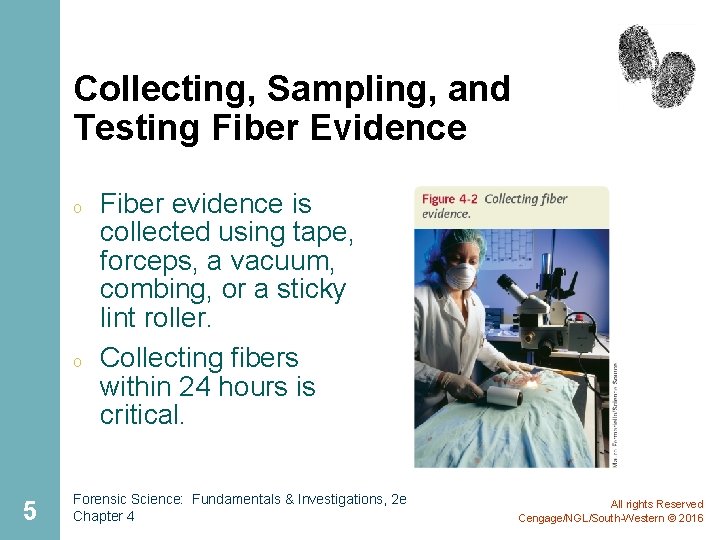
Collecting, Sampling, and Testing Fiber Evidence o o 5 Fiber evidence is collected using tape, forceps, a vacuum, combing, or a sticky lint roller. Collecting fibers within 24 hours is critical. Forensic Science: Fundamentals & Investigations, 2 e Chapter 4 All rights Reserved Cengage/NGL/South-Western © 2016
Evaluating Fiber Evidence o The value of fiber evidence in a crime investigation depends on its potential uniqueness. • • 6 Type of fiber Fiber color Number of fibers found Where the fiber was found Forensic Science: Fundamentals & Investigations, 2 e Chapter 4 All rights Reserved Cengage/NGL/South-Western © 2016
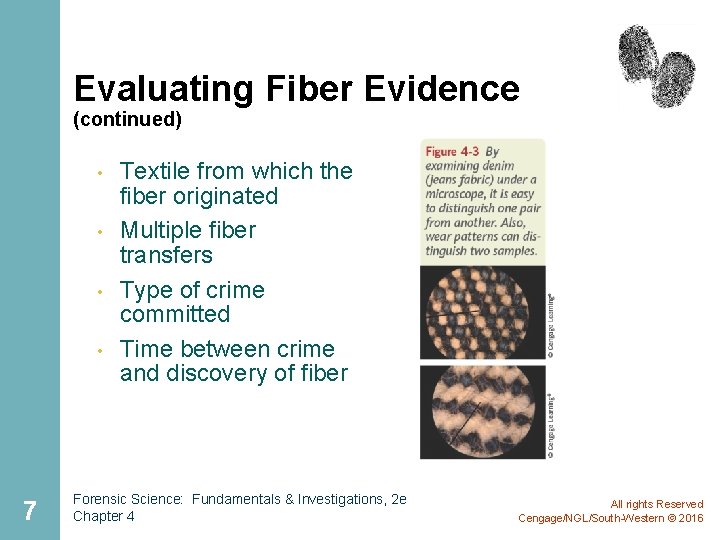
Evaluating Fiber Evidence (continued) • • 7 Textile from which the fiber originated Multiple fiber transfers Type of crime committed Time between crime and discovery of fiber Forensic Science: Fundamentals & Investigations, 2 e Chapter 4 All rights Reserved Cengage/NGL/South-Western © 2016
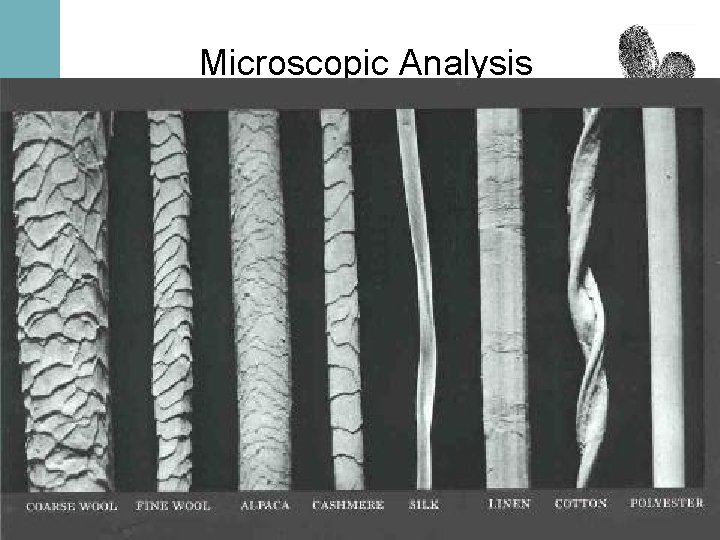
Fiber and Textile Evidence o Fiber Classification • • o 8 Natural Fibers – a fiber produced naturally and harvested from animal, plant, or mineral sources Synthetic Fibers – a fiber made from a manufactured substance such as plastic Tests to determine types of fibers – microscopic, chemical structure, burning, Becke Line (refractive index), florescence, infrared spectroscopy, solubility tests, thin layer chromatography (dyes) Forensic Science: Fundamentals & Investigations, 2 e Chapter 4 All rights Reserved Cengage/NGL/South-Western © 2016
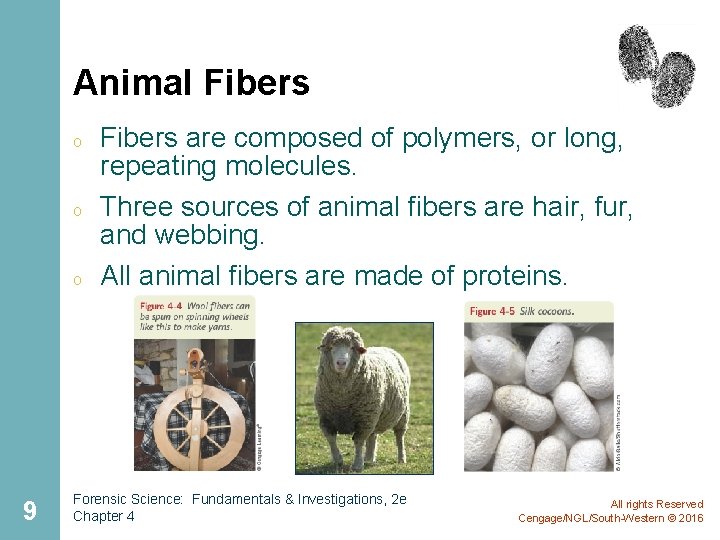
Animal Fibers o o o 9 Fibers are composed of polymers, or long, repeating molecules. Three sources of animal fibers are hair, fur, and webbing. All animal fibers are made of proteins. Forensic Science: Fundamentals & Investigations, 2 e Chapter 4 All rights Reserved Cengage/NGL/South-Western © 2016
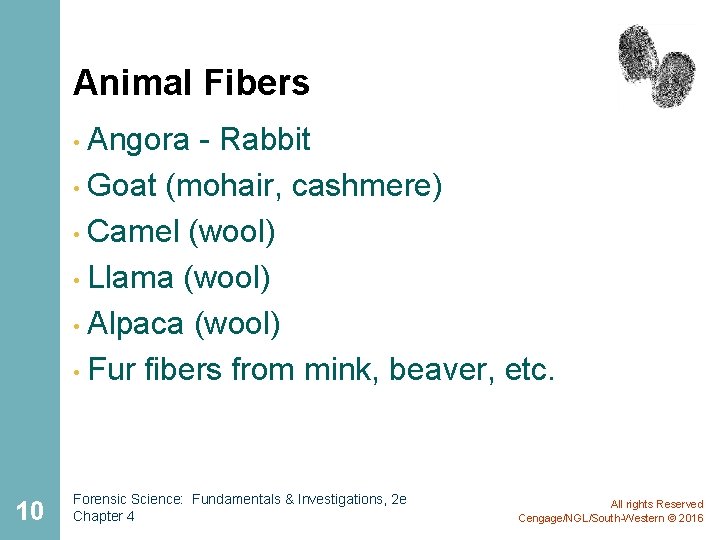
Animal Fibers Angora - Rabbit • Goat (mohair, cashmere) • Camel (wool) • Llama (wool) • Alpaca (wool) • Fur fibers from mink, beaver, etc. • 10 Forensic Science: Fundamentals & Investigations, 2 e Chapter 4 All rights Reserved Cengage/NGL/South-Western © 2016
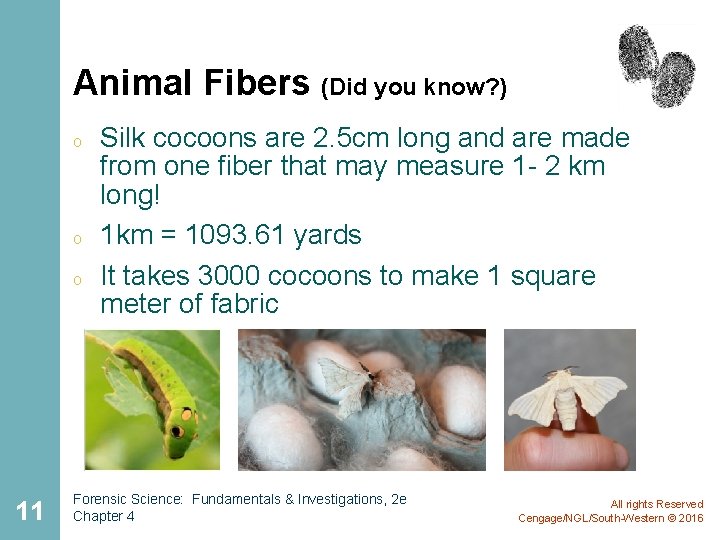
Animal Fibers (Did you know? ) o o o 11 Silk cocoons are 2. 5 cm long and are made from one fiber that may measure 1 - 2 km long! 1 km = 1093. 61 yards It takes 3000 cocoons to make 1 square meter of fabric Forensic Science: Fundamentals & Investigations, 2 e Chapter 4 All rights Reserved Cengage/NGL/South-Western © 2016
Plant Fibers o o 12 All plant fibers share the column polymer cellulose. Cellulose is made up of simple glucose units. Proteins and cellulose have very different chemical and physical properties that allow a forensic scientist to tell animal and plant fibers apart. Some plant fibers, such as cotton, are amorphous (loose arrangement of polymers that are soft, elastic, and absorbing) Forensic Science: Fundamentals & Investigations, 2 e Chapter 4 All rights Reserved Cengage/NGL/South-Western © 2016
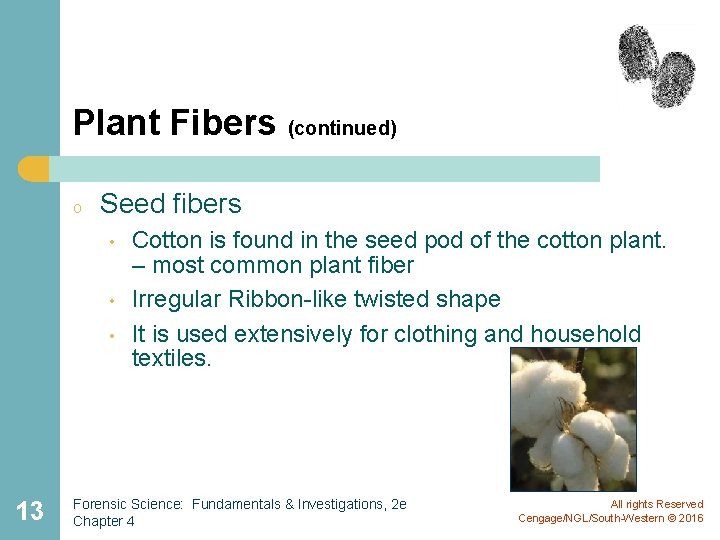
Plant Fibers (continued) o Seed fibers • • • 13 Cotton is found in the seed pod of the cotton plant. – most common plant fiber Irregular Ribbon-like twisted shape It is used extensively for clothing and household textiles. Forensic Science: Fundamentals & Investigations, 2 e Chapter 4 All rights Reserved Cengage/NGL/South-Western © 2016
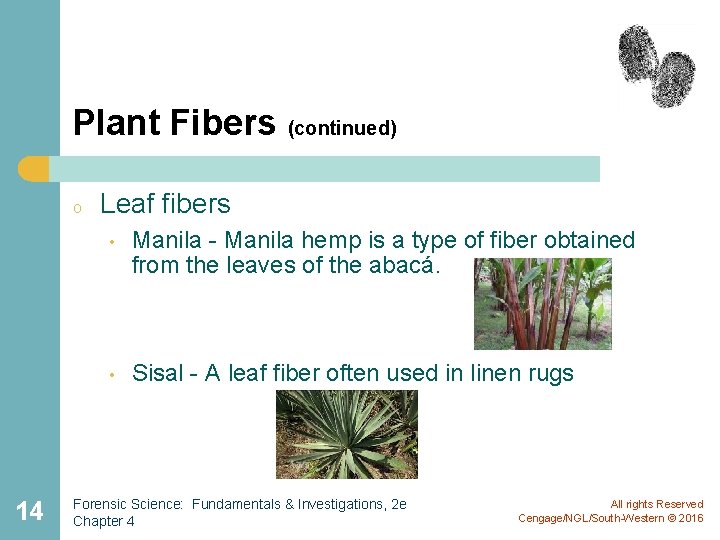
Plant Fibers (continued) o 14 Leaf fibers • Manila - Manila hemp is a type of fiber obtained from the leaves of the abacá. • Sisal - A leaf fiber often used in linen rugs Forensic Science: Fundamentals & Investigations, 2 e Chapter 4 All rights Reserved Cengage/NGL/South-Western © 2016
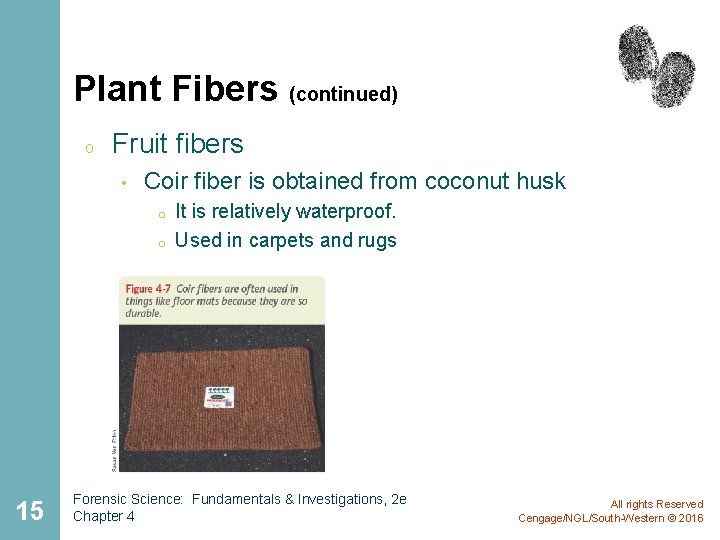
Plant Fibers (continued) o Fruit fibers • Coir fiber is obtained from coconut husk o o 15 It is relatively waterproof. Used in carpets and rugs Forensic Science: Fundamentals & Investigations, 2 e Chapter 4 All rights Reserved Cengage/NGL/South-Western © 2016
Plant Fibers (continued) o Stem fibers • • o 16 Flax – Most common stem fiber found in linen Ramie - used for items like rope. Too coarse for clothing Jute - used in ropes Hemp - the common name for cannabis for industrial or non-drug use; typically used for rope or sack are all produced from the thick region of plant stems. Forensic Science: Fundamentals & Investigations, 2 e Chapter 4 All rights Reserved Cengage/NGL/South-Western © 2016
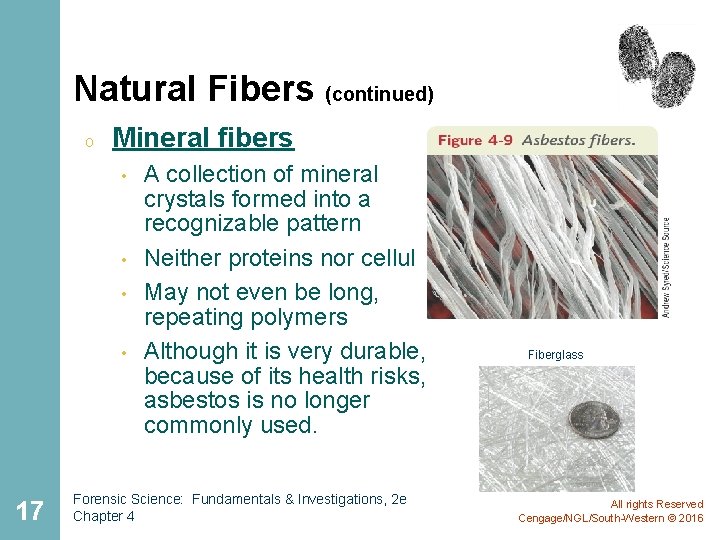
Natural Fibers (continued) o Mineral fibers • • 17 A collection of mineral crystals formed into a recognizable pattern Neither proteins nor cellulose May not even be long, repeating polymers Although it is very durable, because of its health risks, asbestos is no longer commonly used. Forensic Science: Fundamentals & Investigations, 2 e Chapter 4 Fiberglass All rights Reserved Cengage/NGL/South-Western © 2016
Synthetic (Manufactured) Fibers o Half of the fabrics produced today are synthetic fibers. • • 18 The fibers are produced by joining many monomers (small, repeating molecules) together to form polymers (long, repeating molecules) Rayon, acetate, nylon, acrylics, and polyesters Forensic Science: Fundamentals & Investigations, 2 e Chapter 4 All rights Reserved Cengage/NGL/South-Western © 2016
Synthetic (Manufactured) Fibers (continued) o Regenerated fibers (or modified natural fibers) These fibers are NOT found in nature(altered by man) – ex. Rayon (most common), acetate o Synthetic polymer fibers • Polyester – most common • Nylon – first truly synthetic fiber • Acrylic • Olefins o 19 Forensic Science: Fundamentals & Investigations, 2 e Chapter 4 All rights Reserved Cengage/NGL/South-Western © 2016
Comparison of Natural and Synthetic Fibers o o o 20 Synthetic fibers are stronger than the strongest natural fibers. Manufactured fibers are not damaged by microorganisms. Manufactured fibers can deteriorate in bright sunlight and melt at a lower temperature than natural fibers. Forensic Science: Fundamentals & Investigations, 2 e Chapter 4 All rights Reserved Cengage/NGL/South-Western © 2016
Microscopic Analysis 21 Forensic Science: Fundamentals & Investigations, 2 e Chapter 4 All rights Reserved Cengage/NGL/South-Western © 2016
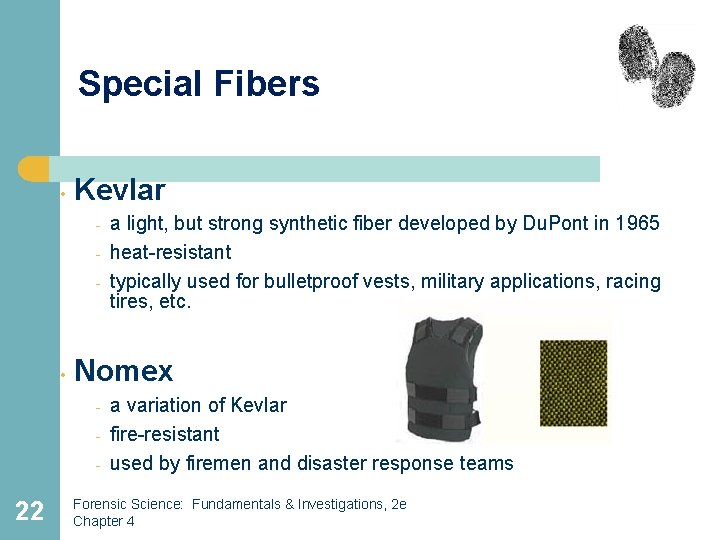
Special Fibers • Kevlar - • Nomex - 22 a light, but strong synthetic fiber developed by Du. Pont in 1965 heat-resistant typically used for bulletproof vests, military applications, racing tires, etc. a variation of Kevlar fire-resistant used by firemen and disaster response teams Forensic Science: Fundamentals & Investigations, 2 e Chapter 4
Yarns o o o 23 Fibers too short in their raw state to be used to make textiles may be spun together to make yarns. Very thin yarns are often called threads. For identification purposes, forensic scientists analyze twist direction of yarn. Forensic Science: Fundamentals & Investigations, 2 e Chapter 4 All rights Reserved Cengage/NGL/South-Western © 2016
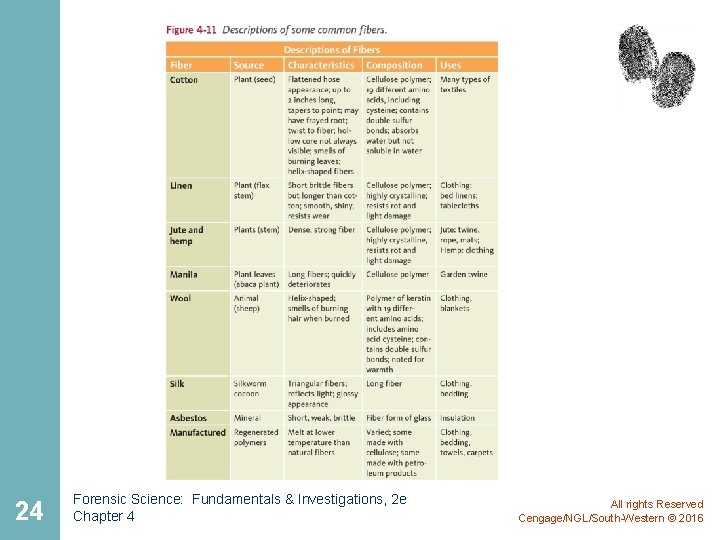
24 Forensic Science: Fundamentals & Investigations, 2 e Chapter 4 All rights Reserved Cengage/NGL/South-Western © 2016
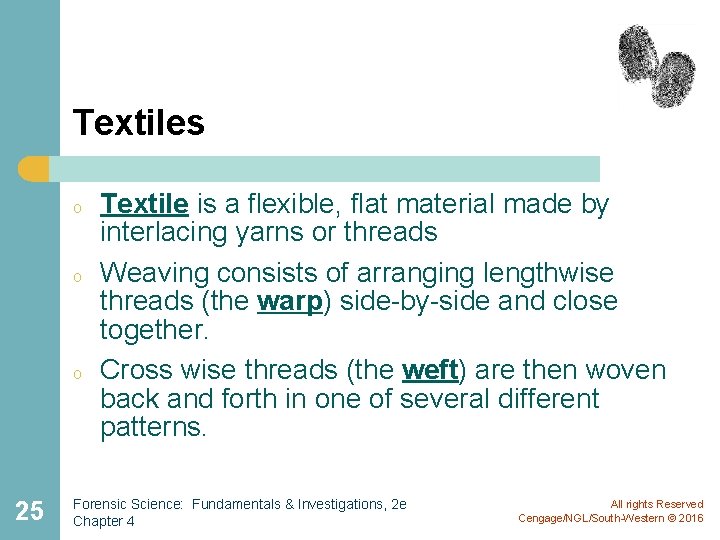
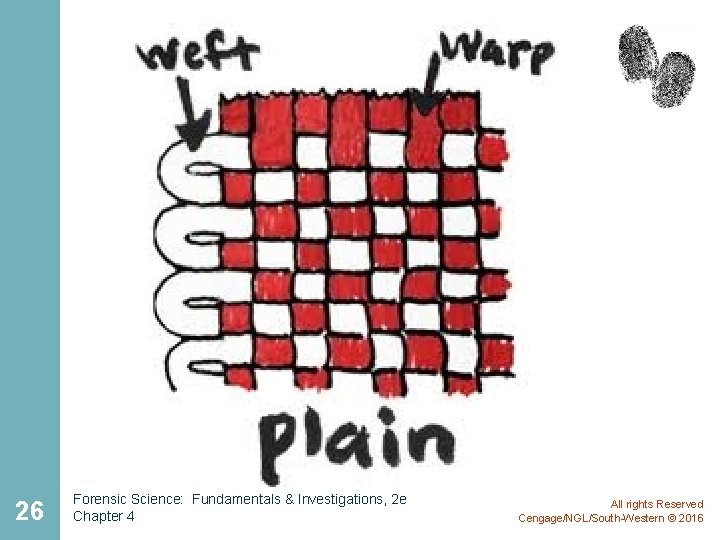
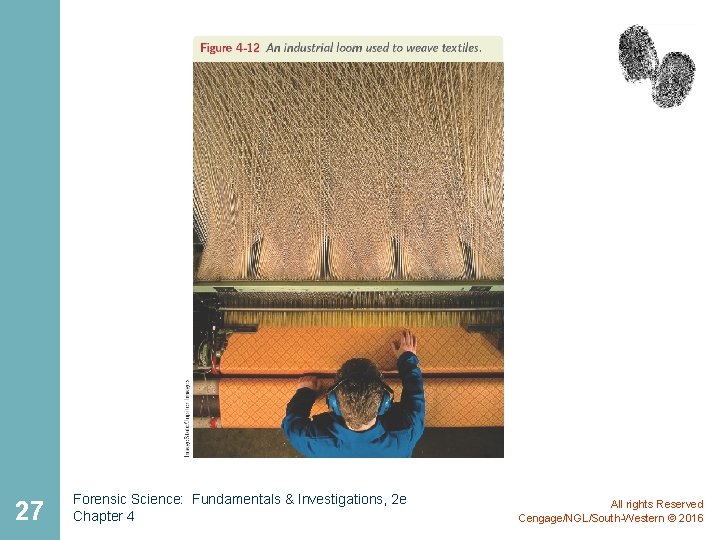
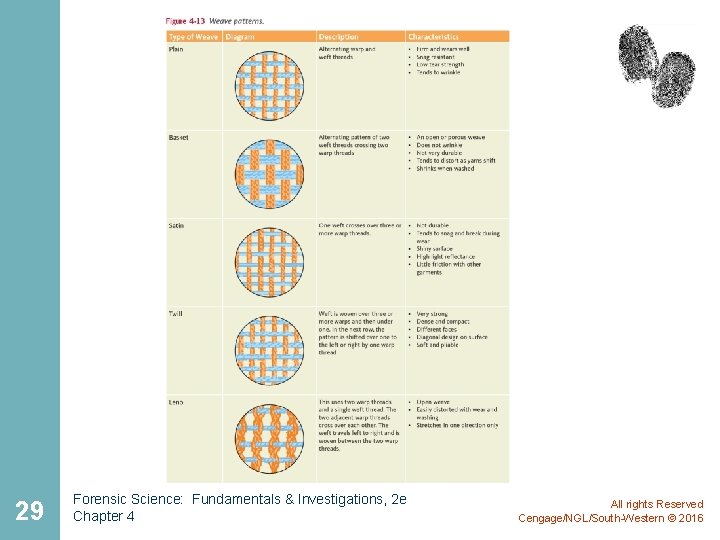
Textiles o o o 25 Textile is a flexible, flat material made by interlacing yarns or threads Weaving consists of arranging lengthwise threads (the warp) side-by-side and close together. Cross wise threads (the weft) are then woven back and forth in one of several different patterns. Forensic Science: Fundamentals & Investigations, 2 e Chapter 4 All rights Reserved Cengage/NGL/South-Western © 2016
26 Forensic Science: Fundamentals & Investigations, 2 e Chapter 4 All rights Reserved Cengage/NGL/South-Western © 2016
27 Forensic Science: Fundamentals & Investigations, 2 e Chapter 4 All rights Reserved Cengage/NGL/South-Western © 2016
Textiles (continued) o The ways that fabrics differ include: • • • o o 28 Weave pattern Thread count Two ply Fiber identification using various microscopes, gas chromatography, and mass spectrometers is possible. Fiber identification provides class evidence only and should not be used (alone) to convict someone. Forensic Science: Fundamentals & Investigations, 2 e Chapter 4 All rights Reserved Cengage/NGL/South-Western © 2016
29 Forensic Science: Fundamentals & Investigations, 2 e Chapter 4 All rights Reserved Cengage/NGL/South-Western © 2016
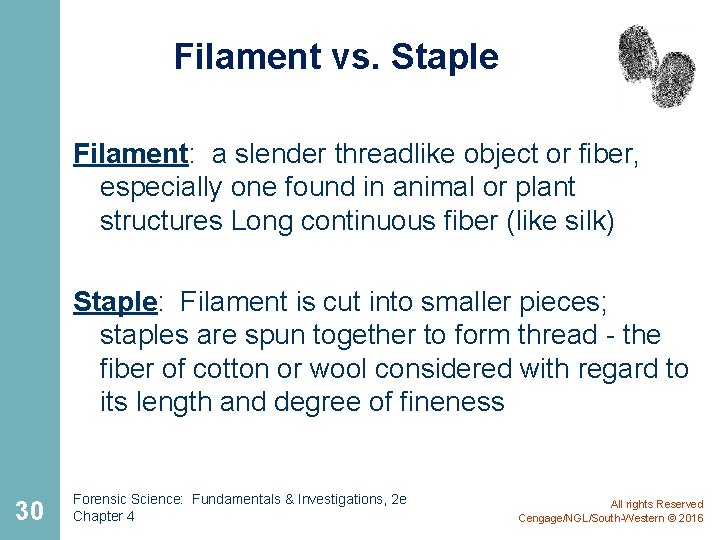
Filament vs. Staple Filament: a slender threadlike object or fiber, especially one found in animal or plant structures Long continuous fiber (like silk) Staple: Filament is cut into smaller pieces; staples are spun together to form thread - the fiber of cotton or wool considered with regard to its length and degree of fineness 30 Forensic Science: Fundamentals & Investigations, 2 e Chapter 4 All rights Reserved Cengage/NGL/South-Western © 2016
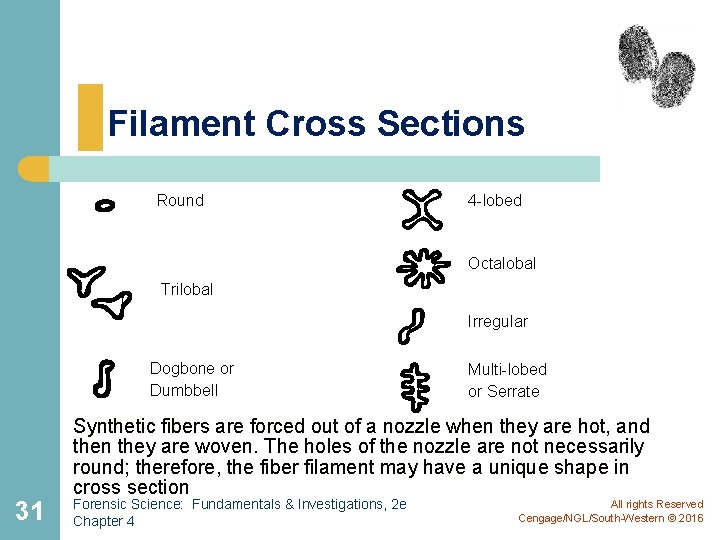
Filament Cross Sections Round 4 -lobed Octalobal Trilobal Irregular Dogbone or Dumbbell 31 Multi-lobed or Serrate Synthetic fibers are forced out of a nozzle when they are hot, and then they are woven. The holes of the nozzle are not necessarily round; therefore, the fiber filament may have a unique shape in cross section Forensic Science: Fundamentals & Investigations, 2 e Chapter 4 All rights Reserved Cengage/NGL/South-Western © 2016
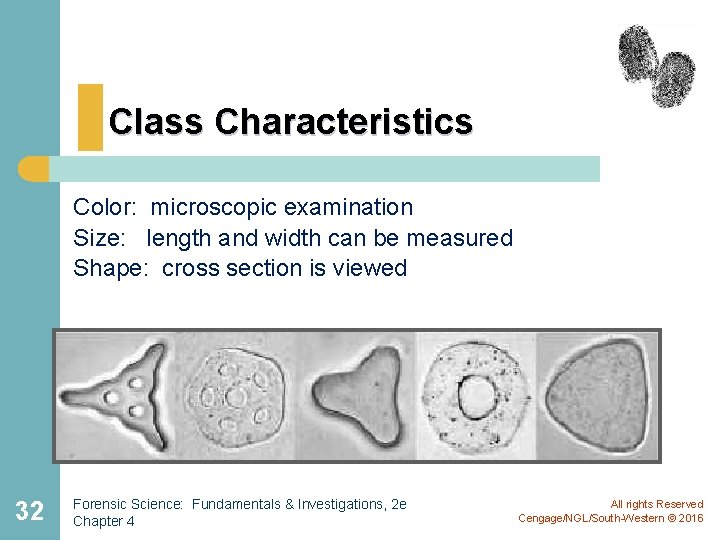
Class Characteristics Color: microscopic examination Size: length and width can be measured Shape: cross section is viewed 32 Forensic Science: Fundamentals & Investigations, 2 e Chapter 4 All rights Reserved Cengage/NGL/South-Western © 2016
Summary o o 33 Fibers are a form of class evidence used by crime-scene investigators; they are a form of trace evidence. Fiber evidence may be gathered using tape, forceps, a vacuum, or a sticky lint roller. Forensic scientists will try to determine the type of a fiber, its color, how many fibers of each kind were found, where they were found, what textile the fiber came from, and whethere were transfers of multiple types of fibers. Fibers may be analyzed using polarized light microscopy, infrared spectroscopy, burn tests, or tests for solubility in different liquids. Forensic Science: Fundamentals & Investigations, 2 e Chapter 4 All rights Reserved Cengage/NGL/South-Western © 2016
Summary (continued) o o o 34 Fibers may be classified as natural or synthetic. Natural fibers include animal hair; plant fibers from seeds, fruit, stems, or leaves; and mineral fibers. Synthetic fibers include regenerated or modified natural fibers as well as synthetic polymer fibers. Fibers are spun into yarns that have specific characteristics. Yarns are woven, with different weave patterns, into textiles. Forensic Science: Fundamentals & Investigations, 2 e Chapter 4 All rights Reserved Cengage/NGL/South-Western © 2016