
1 Forensic Science Fundamentals Investigations 2 e Chapter


- Slides: 21
1 Forensic Science: Fundamentals & Investigations, 2 e Chapter 6 All rights Reserved Cengage/NGL/South-Western © 2016
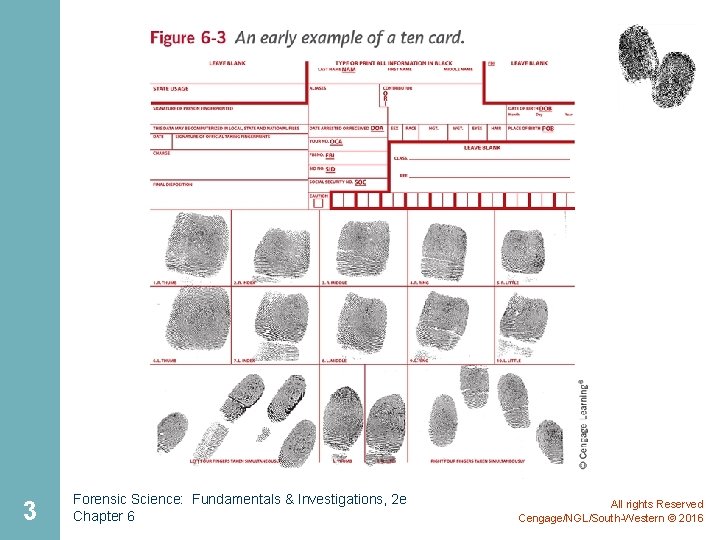
Chapter 6 Vocabulary o o o o 2 arch core delta fingerprint IAFIS (Integrated Automated Fingerprint Identification System) latent fingerprint loop o minutiae patent fingerprint plastic fingerprint ridge pattern ten card o whorl o o Forensic Science: Fundamentals & Investigations, 2 e Chapter 6 All rights Reserved Cengage/NGL/South-Western © 2016
3 Forensic Science: Fundamentals & Investigations, 2 e Chapter 6 All rights Reserved Cengage/NGL/South-Western © 2016
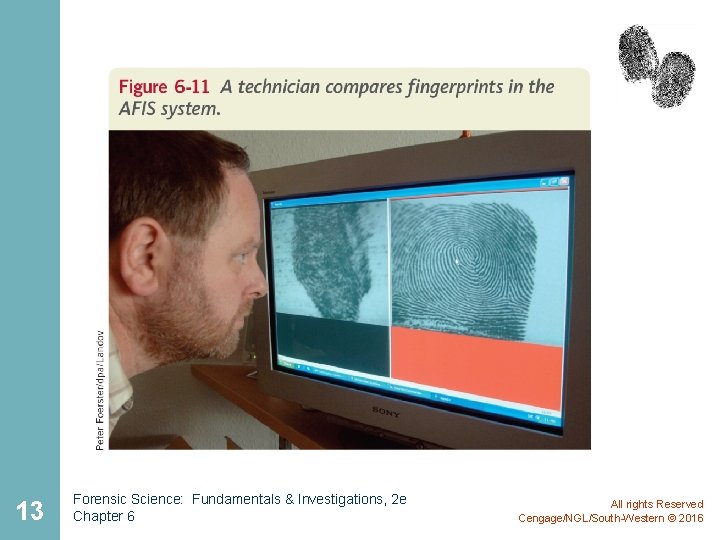
History (continued) o 2012 — The FBI-maintained IAFIS system had more than 76 million computerized fingerprints, mugshots, scars, tattoo photos, and other identification records. • o 2013 — The FBI was integrating the ability to compare crime-scene palm prints with prints collected at the time of arrest. • 4 The system will soon be enhanced by Advanced Fingerprint Identification Technology (AFIT). About 20 -30% of latent prints at a crime scene come from the palm or side of the hand from the little finger to the wrist. Forensic Science: Fundamentals & Investigations, 2 e Chapter 6 All rights Reserved Cengage/NGL/South-Western © 2016
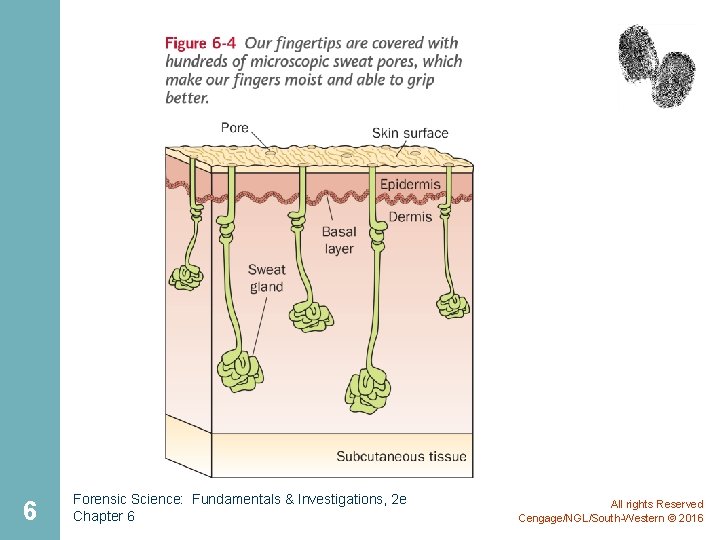
What Are Fingerprints? o Formation of Fingerprints • • • 5 Fingerprints are formed beginning at the 10 th week of gestation. The development of fingerprints happens in the basal layer of skin. Fingerprints are protected by the outer layer of epidermis. Forensic Science: Fundamentals & Investigations, 2 e Chapter 6 All rights Reserved Cengage/NGL/South-Western © 2016
6 Forensic Science: Fundamentals & Investigations, 2 e Chapter 6 All rights Reserved Cengage/NGL/South-Western © 2016
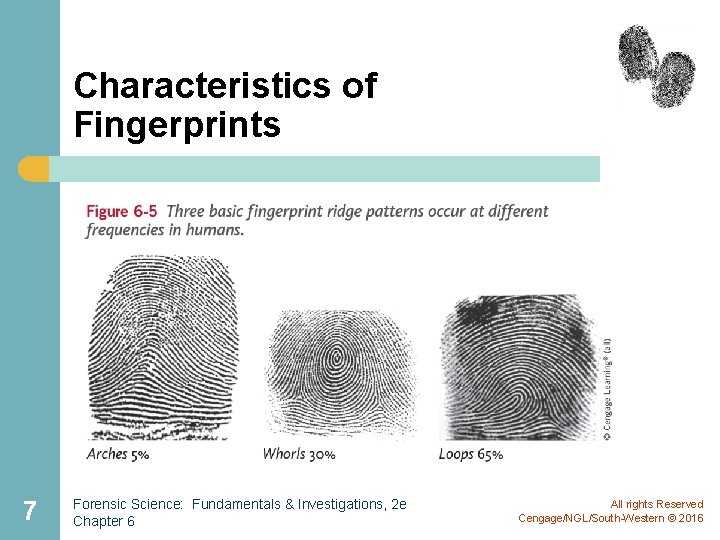
Characteristics of Fingerprints 7 Forensic Science: Fundamentals & Investigations, 2 e Chapter 6 All rights Reserved Cengage/NGL/South-Western © 2016
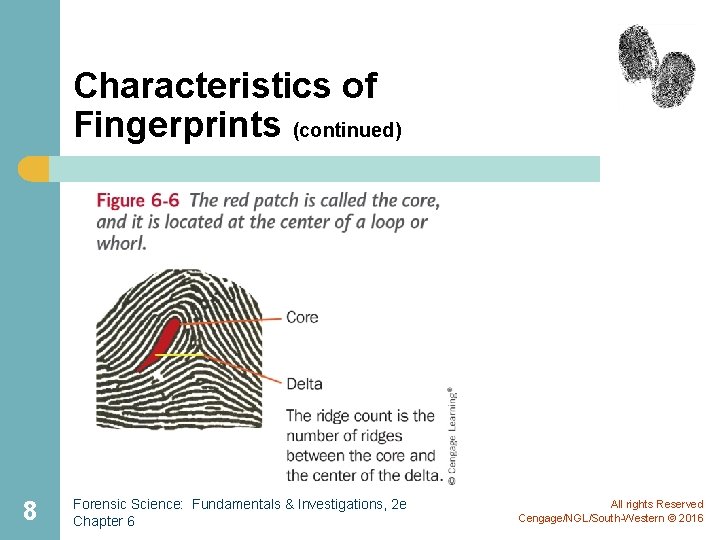
Characteristics of Fingerprints (continued) 8 Forensic Science: Fundamentals & Investigations, 2 e Chapter 6 All rights Reserved Cengage/NGL/South-Western © 2016
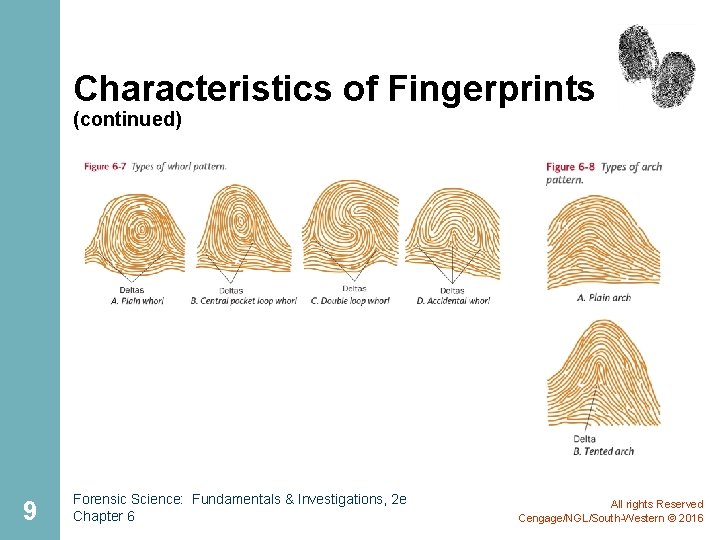
Characteristics of Fingerprints (continued) 9 Forensic Science: Fundamentals & Investigations, 2 e Chapter 6 All rights Reserved Cengage/NGL/South-Western © 2016
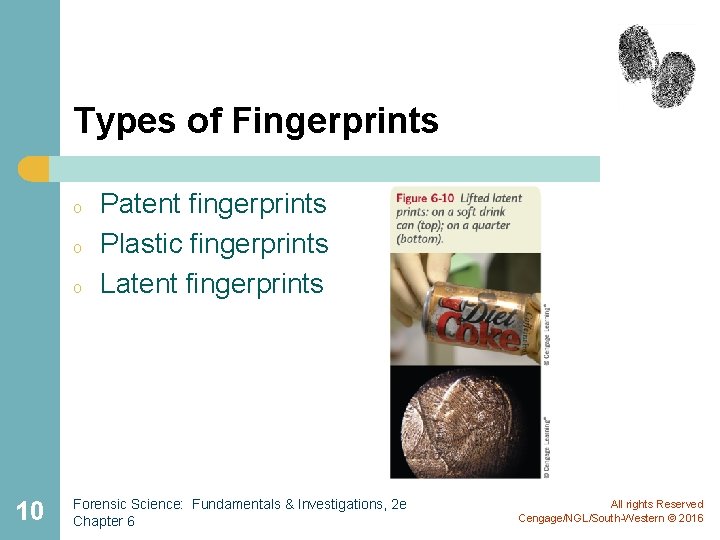
Types of Fingerprints o o o 10 Patent fingerprints Plastic fingerprints Latent fingerprints Forensic Science: Fundamentals & Investigations, 2 e Chapter 6 All rights Reserved Cengage/NGL/South-Western © 2016
11 Forensic Science: Fundamentals & Investigations, 2 e Chapter 6 All rights Reserved Cengage/NGL/South-Western © 2016
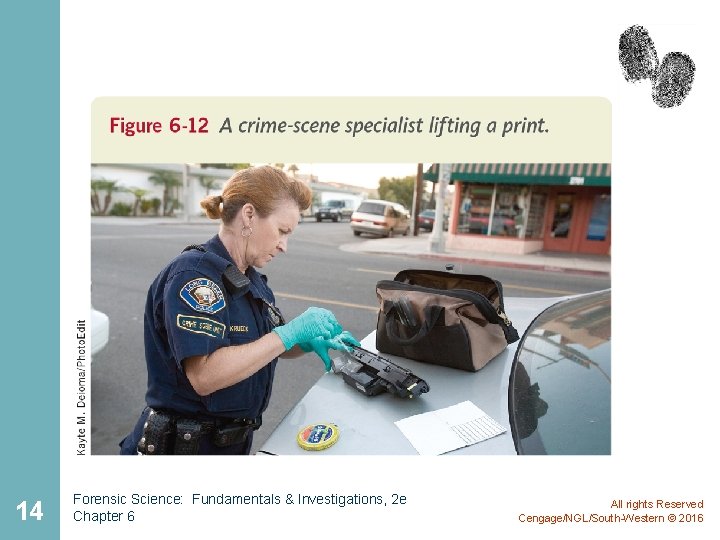
Fingerprint Forensic FAQs o o 12 Can fingerprints be altered or disguised? How reliable is fingerprinting as a means of identification? How are fingerprints analyzed? How are latent fingerprints collected? Forensic Science: Fundamentals & Investigations, 2 e Chapter 6 All rights Reserved Cengage/NGL/South-Western © 2016
13 Forensic Science: Fundamentals & Investigations, 2 e Chapter 6 All rights Reserved Cengage/NGL/South-Western © 2016
14 Forensic Science: Fundamentals & Investigations, 2 e Chapter 6 All rights Reserved Cengage/NGL/South-Western © 2016
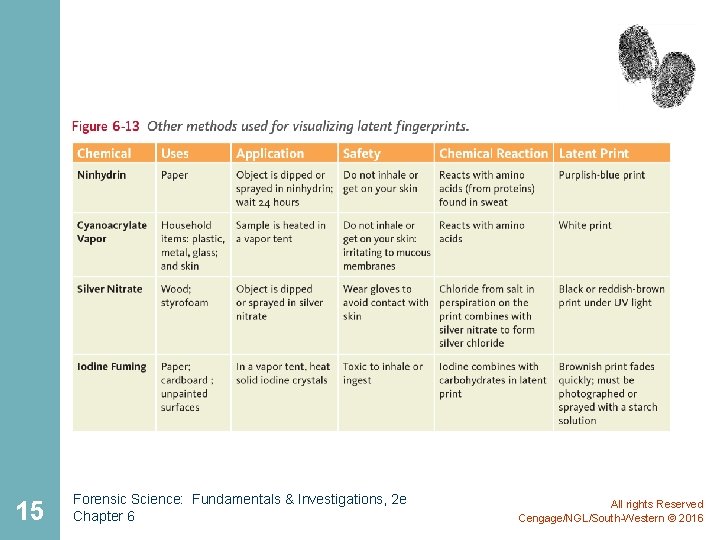
15 Forensic Science: Fundamentals & Investigations, 2 e Chapter 6 All rights Reserved Cengage/NGL/South-Western © 2016
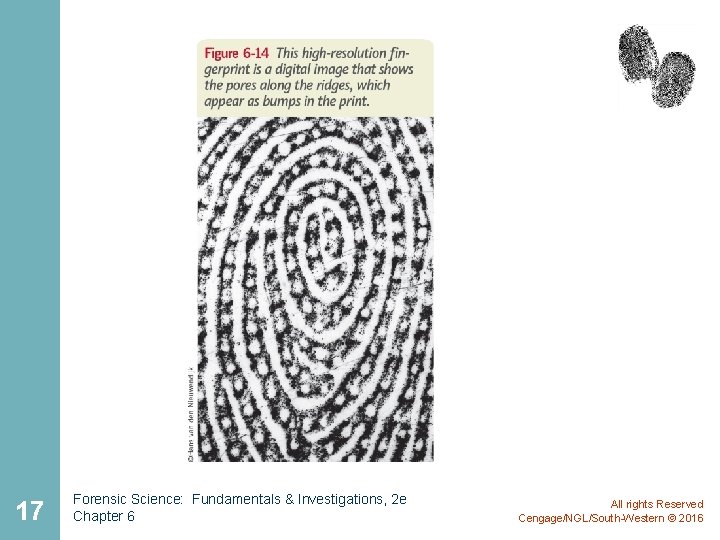
The Future of Fingerprinting o o o 16 Fingerprints can be scanned at a resolution of 500 to 1000 dots per inch. Nanoparticles have been added to fingerprint powders making poor patterns appear even sharper. The materials that we touch leaves trace evidence on our fingers and hands, which is in turn is left behind on the objects we touch. Forensic Science: Fundamentals & Investigations, 2 e Chapter 6 All rights Reserved Cengage/NGL/South-Western © 2016
17 Forensic Science: Fundamentals & Investigations, 2 e Chapter 6 All rights Reserved Cengage/NGL/South-Western © 2016
18 Forensic Science: Fundamentals & Investigations, 2 e Chapter 6 All rights Reserved Cengage/NGL/South-Western © 2016
Summary o o o 19 Humans have noticed the patterns on their hands for thousands of years, but it was not until 1684 that these patterns were described in detail. In the mid-1800 s, the idea of a fingerprint’s uniqueness was studied, and the application of fingerprints to an identification system began. By the late 1800 s, two effective systems were being used to identify criminals, and fingerprints were being collected as evidence in crimes. The elevated regions in a fingerprint are called friction ridges. Fingerprints consist of several main ridge patterns, including whorls, loops, and arches. They have a core, which is an area where ridges separate or unite after running in a parallel direction. The triangular region located near a loop pattern, or whorl, is called a delta. Fingerprints are formed in the womb at about week 10 of gestation. They are formed between two layers of skin, and their shape does not change during a person’s lifetime. They are unique to an individual. Not even identical twins have identical fingerprints. Forensic Science: Fundamentals & Investigations, 2 e Chapter 6 All rights Reserved Cengage/NGL/South-Western © 2016
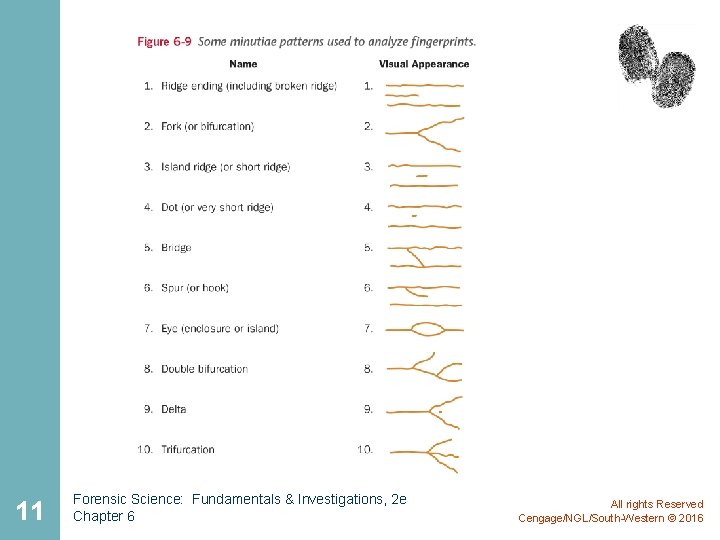
Summary (continued) o o o 20 Fingerprints left on an object are created by the naturally occurring ridges in the skin of fingertips and secretions from sweat glands that leave small amounts of oils and salts when the ridges are pressed against an object. The residues leave an impression of the ridges found on the finger of the donor. The basic types of fingerprints are patent (visible) fingerprints, plastic (indentation) fingerprints, and latent (not visible to the unaided eye) fingerprints. They are characterized as loops, whorls, or arches, and are compared on the basis of their minutiae. Criminals have sought to alter their fingerprints with chemicals, surgery, and superficial destruction. Some fingerprints can temporarily be altered by long-term contact with rough surfaces. Attempts at permanent fingerprint alteration have not been successful. Forensic Science: Fundamentals & Investigations, 2 e Chapter 6 All rights Reserved Cengage/NGL/South-Western © 2016
Summary (continued) o o o 21 Mistakes in fingerprint analysis have led to wrongful convictions, mostly because of human error. New forensic standards are being developed through the Scientific Working Groups and the Organization of Scientific Area Committees. The Integrated Automated Fingerprint Identification System (IAFIS) is a national database that holds more than 76 million fingerprint, identifying mark, and criminal history records. Fingerprints can be collected from surfaces by dusting them with certain powders and impressing them on tape, or putting them into contact with certain chemicals that help reveal the fingerprints. Forensic Science: Fundamentals & Investigations, 2 e Chapter 6 All rights Reserved Cengage/NGL/South-Western © 2016