
1 For development purposes only Modeling short module



![Practice Site #1 [Gas Station] 30 #1 Practice Site #1 [Gas Station] Template for](https://slidetodoc.com/presentation_image_h2/0fe74868f44135a0b7ee281966b0b58c/image-28.jpg "Practice Site #1 [Gas Station] 30 #1 Practice Site #1 [Gas Station] Template for")
![Practice Site #1 [Gas Station] 33 #1 Practice Site #1 [Gas Station] Template for](https://slidetodoc.com/presentation_image_h2/0fe74868f44135a0b7ee281966b0b58c/image-31.jpg "Practice Site #1 [Gas Station] 33 #1 Practice Site #1 [Gas Station] Template for")
![Practice Site #1 [Gas Station] 36 #1 Practice Site #1 [Gas Station] Template for](https://slidetodoc.com/presentation_image_h2/0fe74868f44135a0b7ee281966b0b58c/image-34.jpg "Practice Site #1 [Gas Station] 36 #1 Practice Site #1 [Gas Station] Template for")
![Practice Site #1 [Gas Station] 39 #1 Practice Site #1 [Gas Station] Template for](https://slidetodoc.com/presentation_image_h2/0fe74868f44135a0b7ee281966b0b58c/image-37.jpg "Practice Site #1 [Gas Station] 39 #1 Practice Site #1 [Gas Station] Template for")
![Practice Site #1 [Gas Station] 42 #1 Practice Site #1 [Gas Station] Template for](https://slidetodoc.com/presentation_image_h2/0fe74868f44135a0b7ee281966b0b58c/image-40.jpg "Practice Site #1 [Gas Station] 42 #1 Practice Site #1 [Gas Station] Template for")
![45 Modeling Deep Dive [Insert Content]](https://slidetodoc.com/presentation_image_h2/0fe74868f44135a0b7ee281966b0b58c/image-43.jpg "45 Modeling Deep Dive [Insert Content]")
![Practice Site #1 [Gas Station] 46 #1 Practice Site #1 [Gas Station] Template for](https://slidetodoc.com/presentation_image_h2/0fe74868f44135a0b7ee281966b0b58c/image-44.jpg "Practice Site #1 [Gas Station] 46 #1 Practice Site #1 [Gas Station] Template for")
- Slides: 45
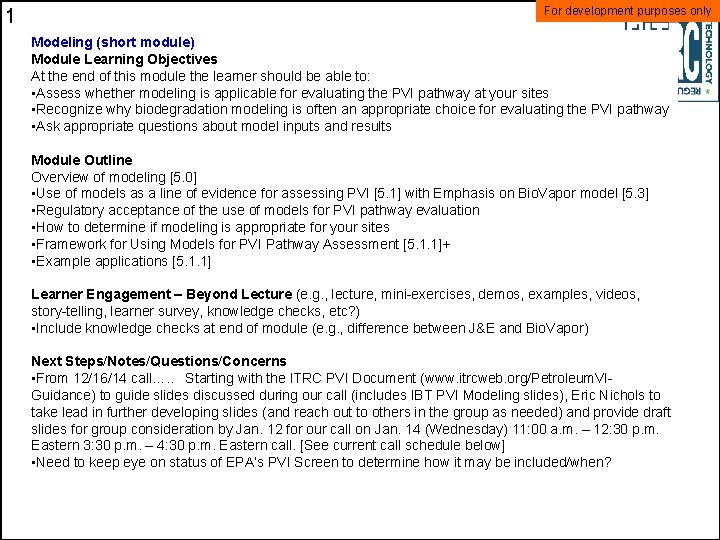
1 For development purposes only Modeling (short module) Module Learning Objectives At the end of this module the learner should be able to: • Assess whether modeling is applicable for evaluating the PVI pathway at your sites • Recognize why biodegradation modeling is often an appropriate choice for evaluating the PVI pathway • Ask appropriate questions about model inputs and results Module Outline Overview of modeling [5. 0] • Use of models as a line of evidence for assessing PVI [5. 1] with Emphasis on Bio. Vapor model [5. 3] • Regulatory acceptance of the use of models for PVI pathway evaluation • How to determine if modeling is appropriate for your sites • Framework for Using Models for PVI Pathway Assessment [5. 1. 1]+ • Example applications [5. 1. 1] Learner Engagement – Beyond Lecture (e. g. , lecture, mini-exercises, demos, examples, videos, story-telling, learner survey, knowledge checks, etc? ) • Include knowledge checks at end of module (e. g. , difference between J&E and Bio. Vapor) Next Steps/Notes/Questions/Concerns • From 12/16/14 call…. . Starting with the ITRC PVI Document (www. itrcweb. org/Petroleum. VIGuidance) to guide slides discussed during our call (includes IBT PVI Modeling slides), Eric Nichols to take lead in further developing slides (and reach out to others in the group as needed) and provide draft slides for group consideration by Jan. 12 for our call on Jan. 14 (Wednesday) 11: 00 a. m. – 12: 30 p. m. Eastern 3: 30 p. m. – 4: 30 p. m. Eastern call. [See current call schedule below] • Need to keep eye on status of EPA’s PVI Screen to determine how it may be included/when?
For development purposes only 2 Modeling - Optional Bonus – Modeling “Deep Dive” Session Module Learning Objectives Learning Objective (Modeling Optional Bonus Session): You have determined the appropriateness of using a model to evaluate the PVI Pathway. Guided by Trainer, Learners will work as group to follow steps in the modeling process to support decision making for Practice Site #1 (with demonstration of Bio. Vapor model) • Define problem and modeling objectives [5. 1. 1] • Review conceptual site model [5. 1. 2] • Select model (consistent with CSM) [5. 1. 3] • Determine model inputs [5. 1. 4] • Review modeling results to compare model predictions to available data [5. 1. 4] • Conduct modeling sensitivity analysis [5. 1. 5] Module Outline [5. 0, App H, App I] • See outline guided by learning objectives above Learner Engagement – Beyond Lecture (e. g. , lecture, mini-exercises, demos, examples, videos, story-telling, learner survey, knowledge checks, etc? ) Using Practice Site #1, Trainer leads learners through application of the modeling process to determine Bio. Vapor models results to support decision making for the PVI pathway Next Steps/Notes/Questions/Concerns • From 12/16/14 call…. . Starting with the ITRC PVI Document (www. itrcweb. org/Petroleum. VIGuidance) to guide slides discussed during our call (includes IBT PVI Modeling slides), Eric Nichols to take lead in further developing slides (and reach out to others in the group as needed) and provide draft slides for group consideration by Jan. 12 for our call on Jan. 14 (Wednesday) 11: 00 a. m. – 12: 30 p. m. Eastern 3: 30 p. m. – 4: 30 p. m. Eastern call. [See current call schedule below] • Need to keep eye on status of EPA’s PVI Screen to determine how it may be included/when?
Steps For development purposes only 3 Next From our 12/16/14 call…… Starting with the ITRC PVI Document (www. itrcweb. org/Petroleum. VI-Guidance) to guide slides discussed during our call (includes IBT PVI Modeling slides), Eric Nichols to take lead in further developing modeling slides (and reach out to others in the group as needed) and provide draft slides for group consideration by Jan. 12 for our call on Jan. 14 (Wednesday) 11: 00 a. m. – 12: 30 p. m. Eastern call. [See current call schedule below]. [After our January 14 call the next slide updates will be due to Mary by January 23, so drafts can be provided to the Training Group to review prior to the February Meeting. ] Where to Start? Before you further build the content please review the ITRC PVI Document (www. itrcweb. org/Petroleum. VI-Guidance) as the primary source of content for slide development, especially Chapter 5 Modeling, Appendix H Vapor Intrusion Models Using Aerobic Biodegradation, and Appendix I Biodegradation Model Processes, Inputs, and Case Examples. This document content along with the module learning objectives, content outline, and draft slides we discussed on our call should help guide your slide development. Certainly you may want to pull supporting information from elsewhere to reinforce key concepts, but start with the PVI document. Also, please read the section below on “Guiding Content Development”. Think about maximizing the learner’s ability to transfer their new PVI knowledge and skills gained in our training course, back to their job to improve their on-the-job performance. What does the learner need to practice in the classroom to confidently use the ITRC PVI document when they go back to work? Guiding Content Development: Be sure to focusing the content on the “must know” and “need to know” information for learners so they can apply the ITRC document. Think about how to integrate the Practice Site #1 Exercise to provide practice opportunities for the learners. Although there may be value in using slide content from presentations/trainings you have previously delivered, please be sure that the content is in direct support of the learners use of the ITRC PVI document and specifically designed to build their PVI knowledge and skills. Our focus should be helping learners practice the skills they will need to confidently apply the ITRC PVI document and strategy to their own sites.
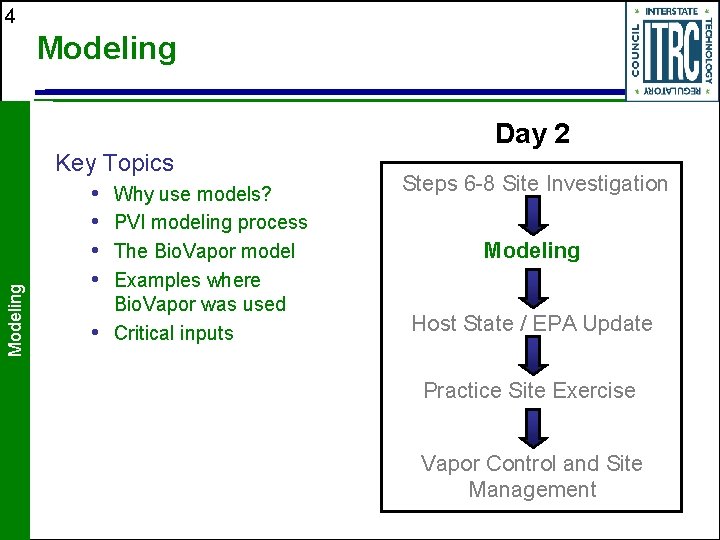
4 Modeling Day 2 Key Topics • Why use models? • PVI modeling process • The Bio. Vapor model • Examples where Bio. Vapor was used • Critical inputs Steps 6 -8 Site Investigation Modeling Host State / EPA Update Practice Site Exercise Vapor Control and Site Management
5 Learning Objectives – Modeling At the end of the module, the learner should be able to: u Determine whether modeling is useful for evaluating PVI at your site u Recognize why modeling bioattenuation is appropriate for evaluating PVI u Ask appropriate questions about model inputs and results Download Bio. Vapor at http: //www. api. org ITRC PVI-1, 2014: Chapter 5 and Appendix H and Appendix I
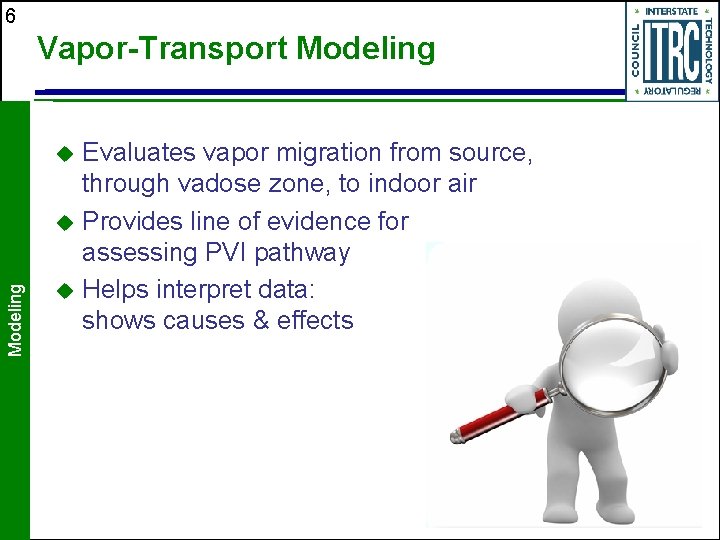
6 Vapor-Transport Modeling Evaluates vapor migration from source, through vadose zone, to indoor air u Provides line of evidence for assessing PVI pathway u Helps interpret data: shows causes & effects Modeling u
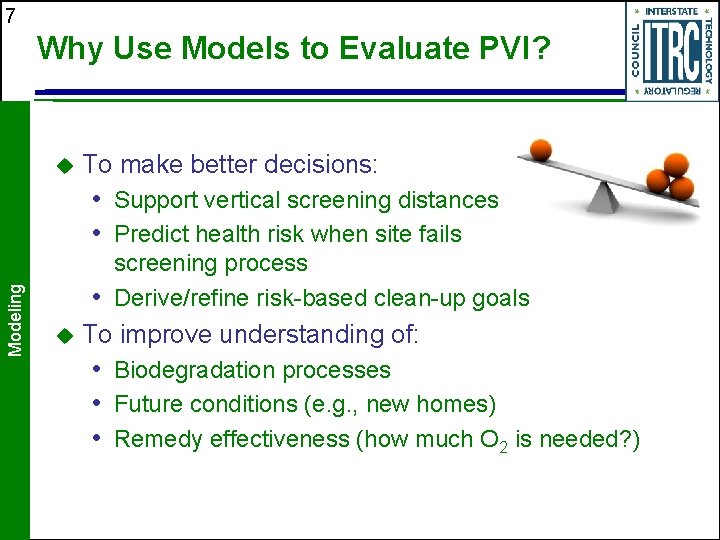
7 Why Use Models to Evaluate PVI? u To make better decisions: Modeling • Support vertical screening distances • Predict health risk when site fails screening process • Derive/refine risk-based clean-up goals u To improve understanding of: • Biodegradation processes • Future conditions (e. g. , new homes) • Remedy effectiveness (how much O 2 is needed? )
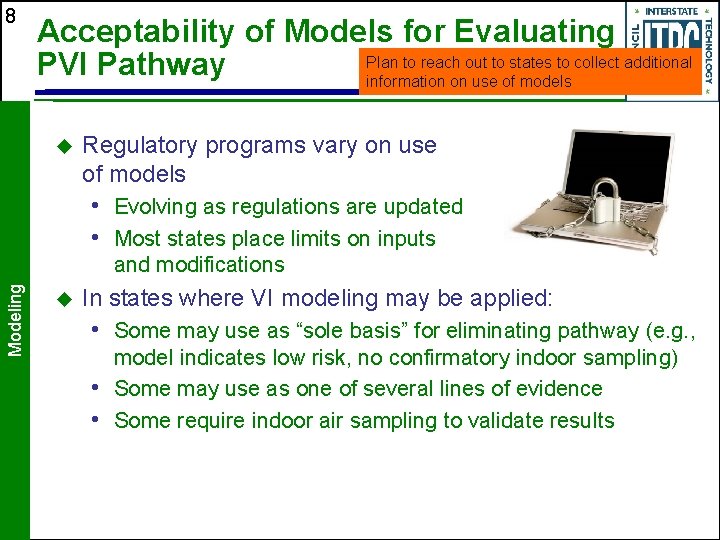
8 Acceptability of Models for Evaluating Plan to reach out to states to collect additional PVI Pathway information on use of models u Regulatory programs vary on use of models • Evolving as regulations are updated • Most states place limits on inputs Modeling and modifications u In states where VI modeling may be applied: • Some may use as “sole basis” for eliminating pathway (e. g. , model indicates low risk, no confirmatory indoor sampling) • Some may use as one of several lines of evidence • Some require indoor air sampling to validate results
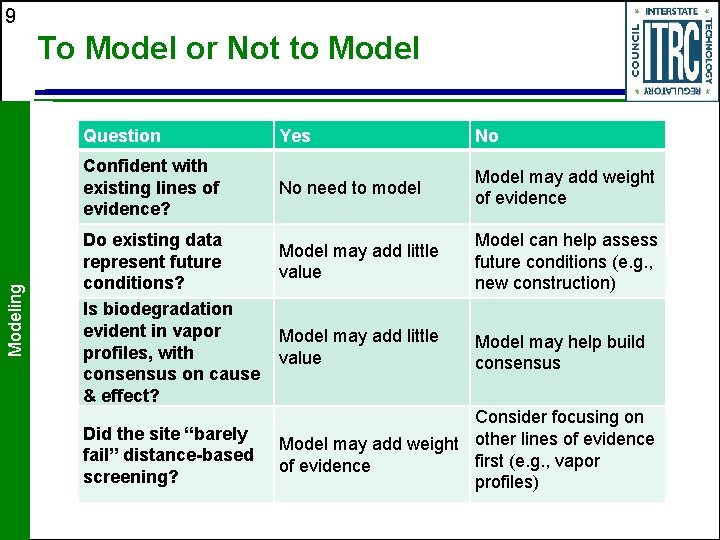
9 Modeling To Model or Not to Model Question Yes No Confident with existing lines of evidence? No need to model Model may add weight of evidence Model may add little value Model can help assess future conditions (e. g. , new construction) Model may add little value Model may help build consensus Do existing data represent future conditions? bioattenuation Is biodegradation evident in vapor profiles, with consensus on cause & effect? Did the site “barely fail” distance-based screening? Consider focusing on Model may add weight other lines of evidence first (e. g. , vapor of evidence profiles)
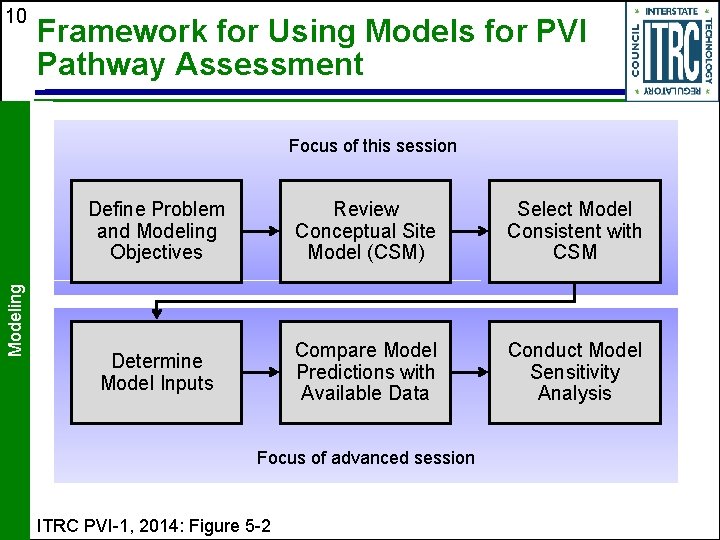
10 Framework for Using Models for PVI Pathway Assessment Modeling Focus of this session Define Problem and Modeling Objectives Review Conceptual Site Model (CSM) Select Model Consistent with CSM Determine Model Inputs Compare Model Predictions with Available Data Conduct Model Sensitivity Analysis Focus of advanced session ITRC PVI-1, 2014: Figure 5 -2
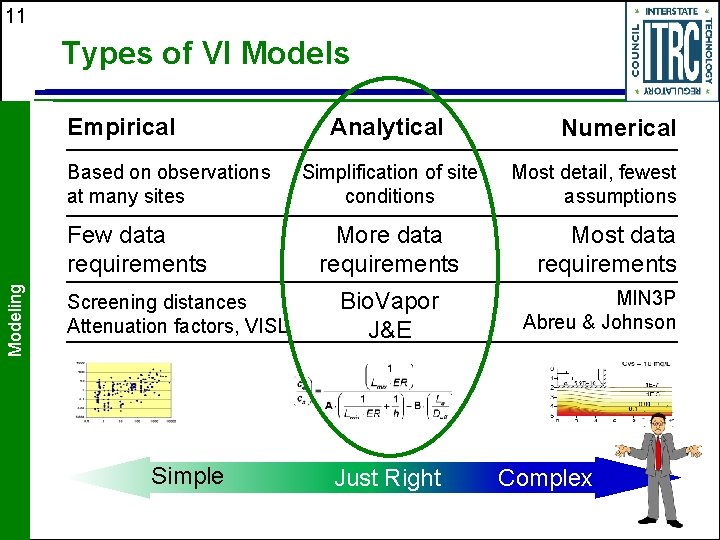
11 Types of VI Models Empirical Based on observations at many sites Modeling Few data requirements Screening distances Attenuation factors, VISL Simple Analytical Simplification of site conditions More data requirements Bio. Vapor J&E Just Right Numerical Most detail, fewest assumptions Most data requirements MIN 3 P Abreu & Johnson Complex
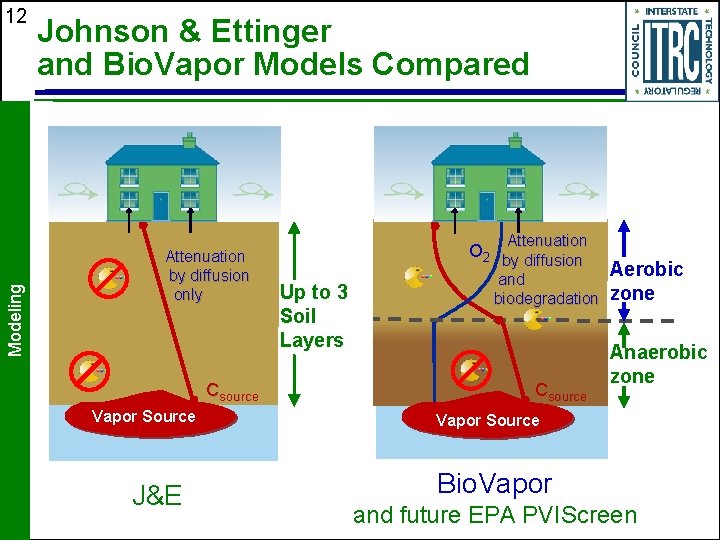
Modeling 12 Johnson & Ettinger and Bio. Vapor Models Compared Attenuation by diffusion only Csource Vapor Source J&E Attenuation O 2 by diffusion Up to 3 Soil Layers and biodegradation Csource Aerobic zone Anaerobic zone Vapor Source Bio. Vapor and future EPA PVIScreen
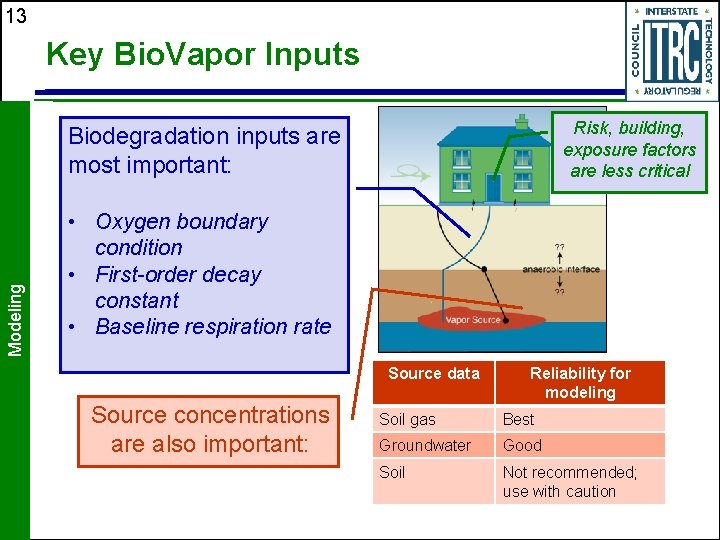
13 Key Bio. Vapor Inputs Risk, building, exposure factors are less critical Modeling Biodegradation inputs are most important: • Oxygen boundary condition • First-order decay constant • Baseline respiration rate Source data Source concentrations are also important: Reliability for modeling Soil gas Best Groundwater Good Soil Not recommended; use with caution
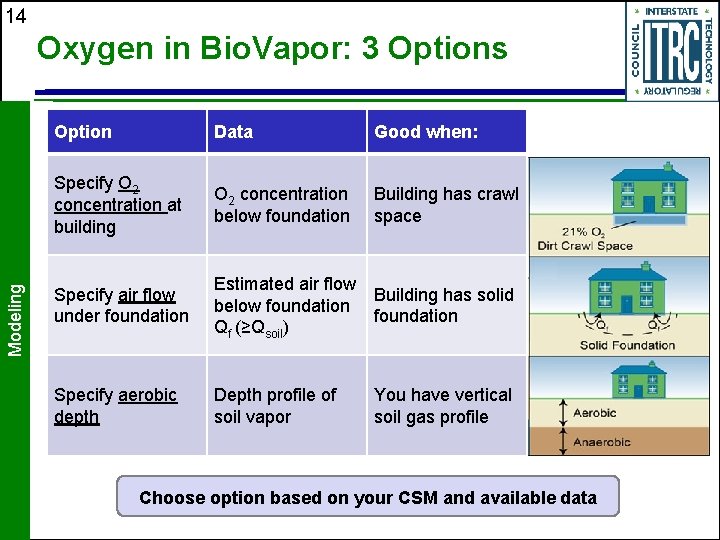
14 Modeling Oxygen in Bio. Vapor: 3 Options Option Data Good when: Specify O 2 concentration at building O 2 concentration below foundation Building has crawl space Specify air flow under foundation Estimated air flow below foundation Qf (≥Qsoil) Building has solid foundation Specify aerobic depth Depth profile of soil vapor You have vertical soil gas profile Choose option based on your CSM and available data
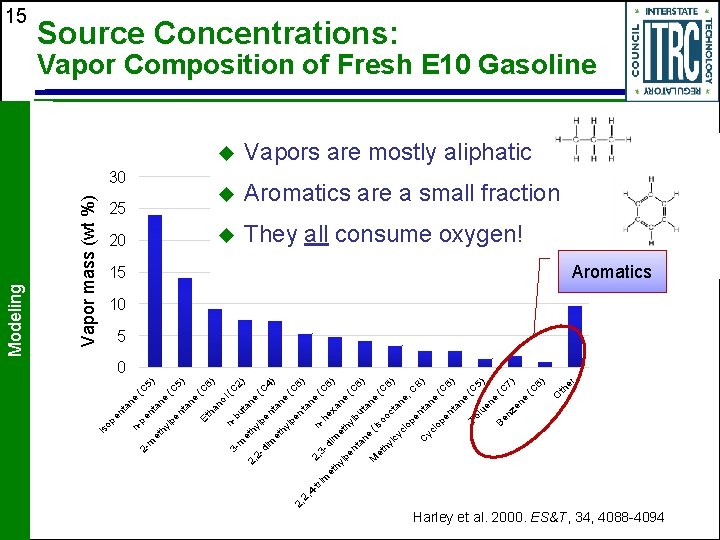
C yc l er th 6) (C 7) (C 5) (C 6) (C O e e en nz Be en ne ta e 8) 6) (C 4) (C 2) C , C ne e an lu To en op ct a nt pe oo (is an ut ne xa he hy lb yc lo lc hy et M ne ta en n- ne ne ta en lp hy ne ta ta en lp hy et m di 3 - 2, lp hy et m tri 4 - 2, et m di 2 - 2, et m l( 20 bu 6) (C 5) (C 25 n- no ha Et e ne ta en an nt ne ta Vapor mass (wt %) 30 3 - pe lp hy et m 2 - n- en op Is Modeling 15 Vapor Composition of Fresh E 10 Gasoline Source Concentrations: u Vapors are mostly aliphatic u Aromatics are a small fraction u They all consume oxygen! 15 Aromatics 10 5 0 Harley et al. 2000. ES&T, 34, 4088 -4094
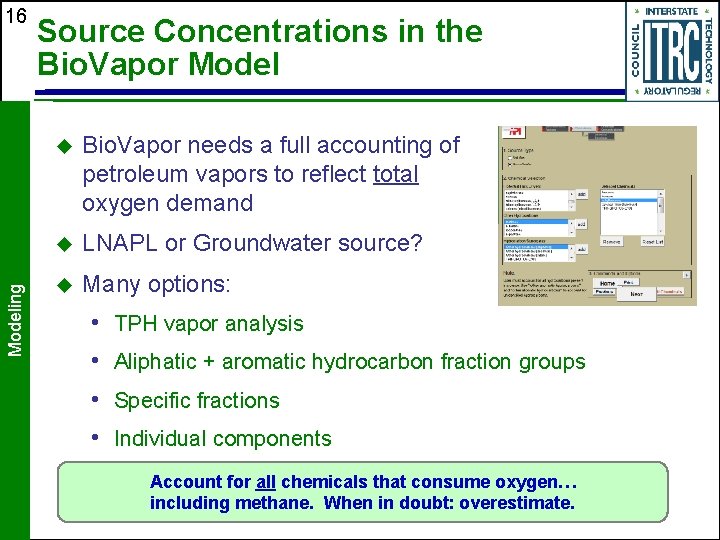
Modeling 16 Source Concentrations in the Bio. Vapor Model u Bio. Vapor needs a full accounting of petroleum vapors to reflect total oxygen demand u LNAPL or Groundwater source? u Many options: • • TPH vapor analysis Aliphatic + aromatic hydrocarbon fraction groups Specific fractions Individual components Account for all chemicals that consume oxygen… including methane. When in doubt: overestimate.
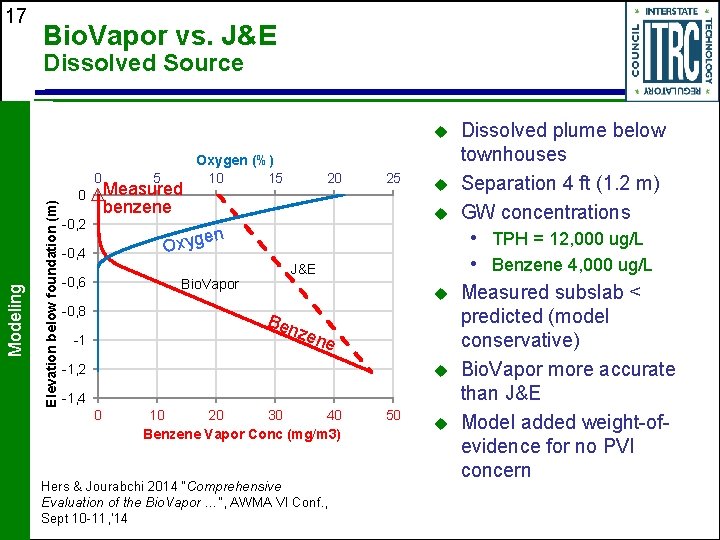
17 Bio. Vapor vs. J&E Dissolved Source u Elevation below foundation (m) Modeling 0 0 -0, 2 5 Measured benzene Oxygen (%) 10 15 20 25 u u en • TPH = 12, 000 ug/L • Benzene 4, 000 ug/L Oxyg -0, 4 -0, 6 Bio. Vapor -0, 8 J&E u Ben zen -1 e -1, 2 u -1, 4 0 Dissolved plume below townhouses Separation 4 ft (1. 2 m) GW concentrations 10 20 30 40 Benzene Vapor Conc (mg/m 3) Hers & Jourabchi 2014 “Comprehensive Evaluation of the Bio. Vapor …”, AWMA VI Conf. , Sept 10 -11, ’ 14 50 u Measured subslab < predicted (model conservative) Bio. Vapor more accurate than J&E Model added weight-ofevidence for no PVI concern
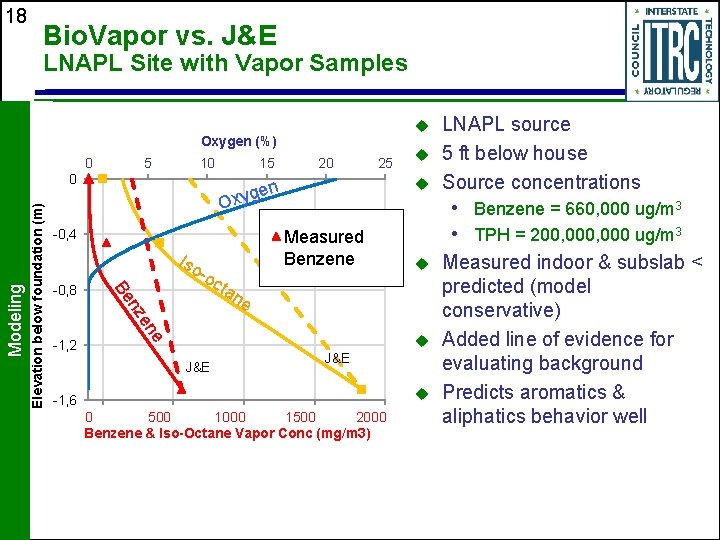
18 Bio. Vapor vs. J&E LNAPL Site with Vapor Samples u Oxygen (%) 0 5 10 Iso -o cta • Benzene = 660, 000 ug/m 3 • TPH = 200, 000 ug/m 3 u ne u e -1, 2 u u en Elevation below foundation (m) 25 Measured Benzene -0, 4 -0, 8 20 gen y x O nz Be Modeling 0 15 J&E u -1, 6 0 500 1000 1500 2000 Benzene & Iso-Octane Vapor Conc (mg/m 3) LNAPL source 5 ft below house Source concentrations Measured indoor & subslab < predicted (model conservative) Added line of evidence for evaluating background Predicts aromatics & aliphatics behavior well
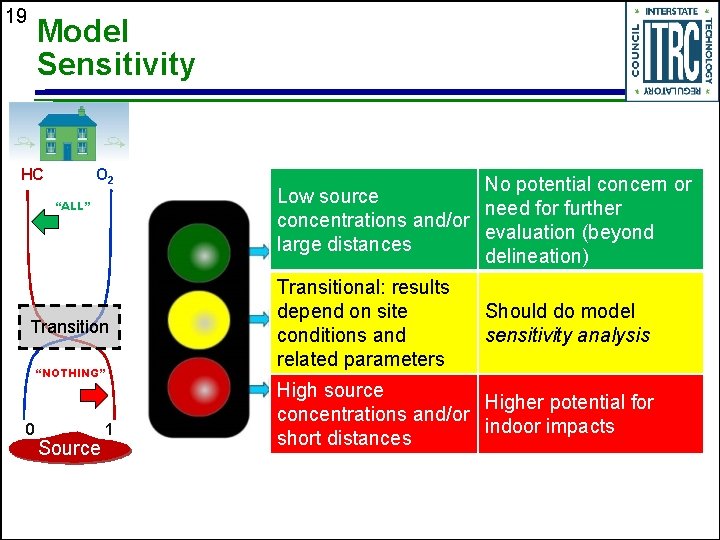
19 Model Sensitivity HC O 2 “ALL” Transition “NOTHING” 0 Source 1 No potential concern or Low source need for further concentrations and/or evaluation (beyond large distances delineation) Transitional: results depend on site conditions and related parameters Should do model sensitivity analysis High source Higher potential for concentrations and/or indoor impacts short distances
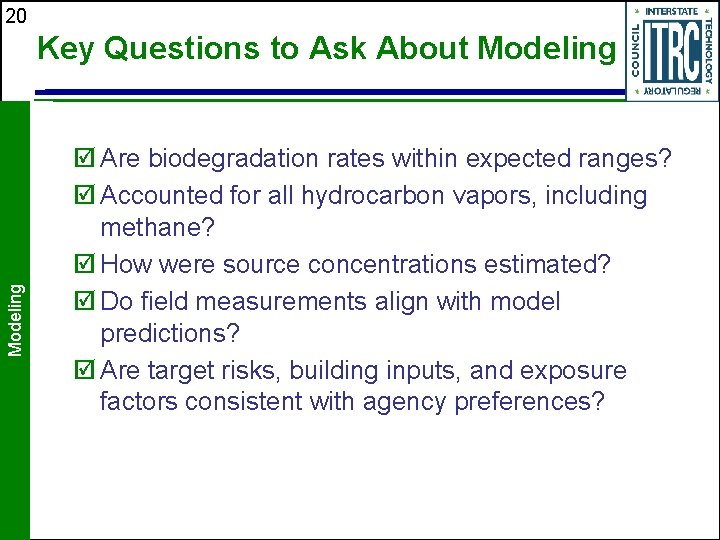
20 Modeling Key Questions to Ask About Modeling Are biodegradation rates within expected ranges? Accounted for all hydrocarbon vapors, including methane? How were source concentrations estimated? Do field measurements align with model predictions? Are target risks, building inputs, and exposure factors consistent with agency preferences?
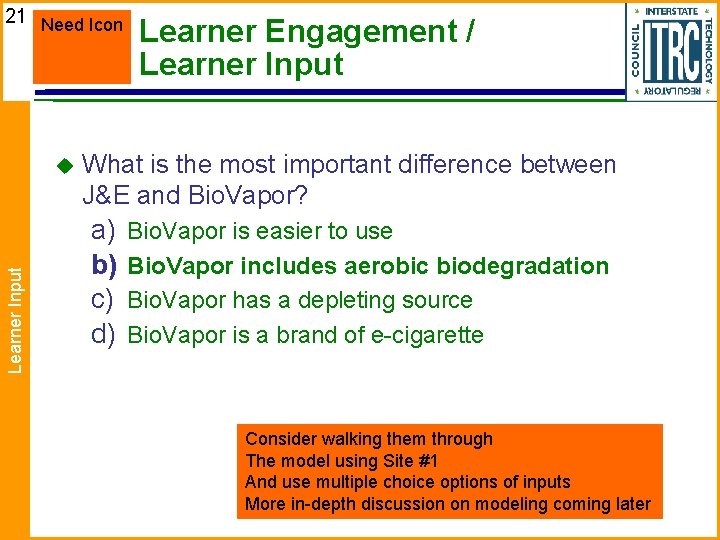
21 Need Icon Learner Input u Learner Engagement / Learner Input What is the most important difference between J&E and Bio. Vapor? a) b) c) d) Bio. Vapor is easier to use Bio. Vapor includes aerobic biodegradation Bio. Vapor has a depleting source Bio. Vapor is a brand of e-cigarette Consider walking them through The model using Site #1 And use multiple choice options of inputs More in-depth discussion on modeling coming later
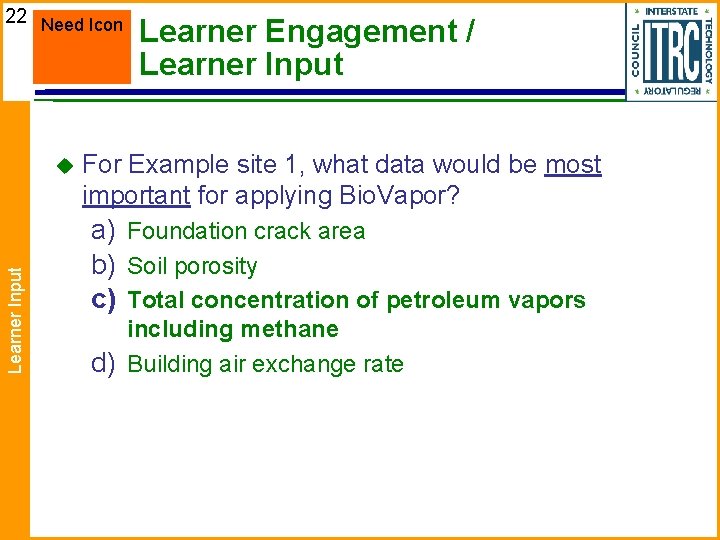
22 Need Icon Learner Input u Learner Engagement / Learner Input For Example site 1, what data would be most important for applying Bio. Vapor? a) Foundation crack area b) Soil porosity c) Total concentration of petroleum vapors including methane d) Building air exchange rate
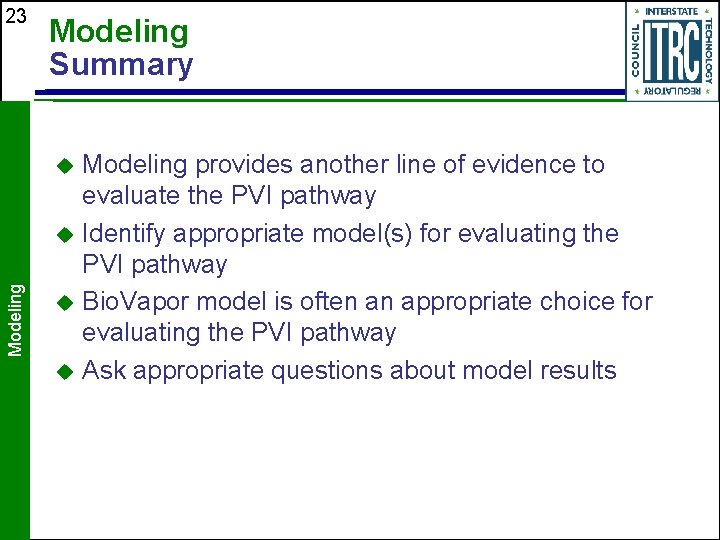
23 Modeling Summary Modeling provides another line of evidence to evaluate the PVI pathway u Identify appropriate model(s) for evaluating the PVI pathway u Bio. Vapor model is often an appropriate choice for evaluating the PVI pathway u Ask appropriate questions about model results Modeling u
“Advertisement” for Modeling Deep Dive – later on 24 Modeling Deep Dive Day 2 afternoon! u Optional session on using Bio. Vapor Modeling Deep Dive u • • More detail Advice on inputs Tips and tricks Modeling examples
25 Divider Slide u The remaining slides are for the advanced modeling session
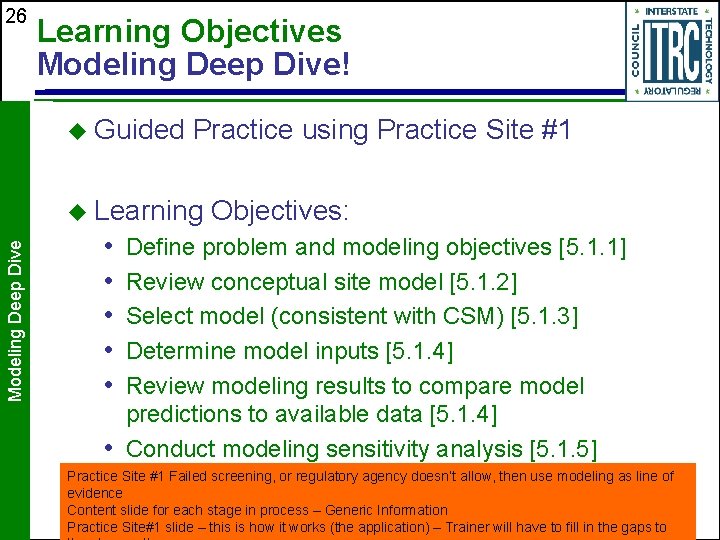
26 Learning Objectives Modeling Deep Dive! u Guided Practice using Practice Site #1 Modeling Deep Dive u Learning Objectives: • • • Define problem and modeling objectives [5. 1. 1] Review conceptual site model [5. 1. 2] Select model (consistent with CSM) [5. 1. 3] Determine model inputs [5. 1. 4] Review modeling results to compare model predictions to available data [5. 1. 4] • Conduct modeling sensitivity analysis [5. 1. 5] Practice Site #1 Failed screening, or regulatory agency doesn’t allow, then use modeling as line of evidence Content slide for each stage in process – Generic Information Practice Site#1 slide – this is how it works (the application) – Trainer will have to fill in the gaps to
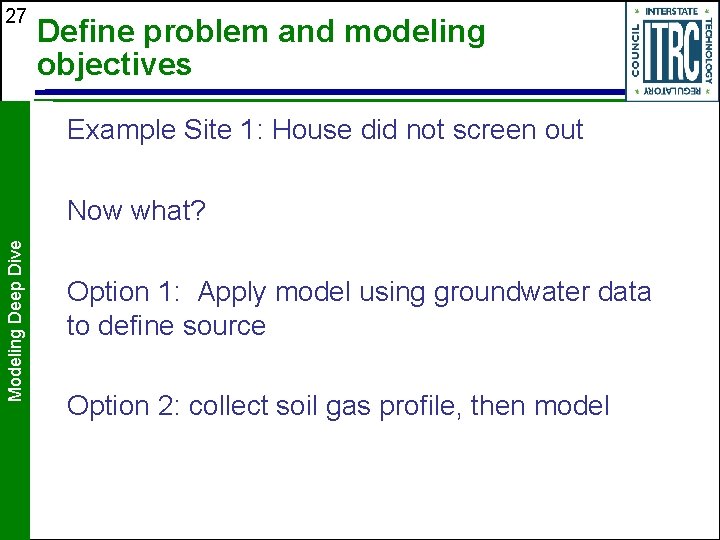
27 Define problem and modeling objectives Example Site 1: House did not screen out Modeling Deep Dive Now what? Option 1: Apply model using groundwater data to define source Option 2: collect soil gas profile, then model
Practice Site #1 [Gas Station] 30 #1 Practice Site #1 [Gas Station] Template for Practice Exercise Slides
31 Need Icon Learner Engagement / Learner Input Use this orange slide layout where ever you build in Learner Engagement / Learner Input activities u [Insert question and choices] Learner Input Learner Engagement Ideas from St. Paul Meeting Practice Site #1 [Gas Station] Exercise - Include knowledge checks at end of module (e. g. , difference between J&E and Bio. Vapor)
32 Define problem and modeling objectives Modeling Deep Dive u Content TBD
Practice Site #1 [Gas Station] 33 #1 Practice Site #1 [Gas Station] Template for Practice Exercise Slides
34 Need Icon Learner Engagement / Learner Input Use this orange slide layout where ever you build in Learner Engagement / Learner Input activities u [Insert question and choices] Learner Input Learner Engagement Ideas from St. Paul Meeting Practice Site #1 [Gas Station] Exercise - Include knowledge checks at end of module (e. g. , difference between J&E and Bio. Vapor)
35 Select model (consistent with CSM) Modeling Deep Dive u Content TBD
Practice Site #1 [Gas Station] 36 #1 Practice Site #1 [Gas Station] Template for Practice Exercise Slides
37 Need Icon Learner Engagement / Learner Input Use this orange slide layout where ever you build in Learner Engagement / Learner Input activities u [Insert question and choices] Learner Input Learner Engagement Ideas from St. Paul Meeting Practice Site #1 [Gas Station] Exercise - Include knowledge checks at end of module (e. g. , difference between J&E and Bio. Vapor)
38 Determine model inputs Modeling Deep Dive u Content TBD
Practice Site #1 [Gas Station] 39 #1 Practice Site #1 [Gas Station] Template for Practice Exercise Slides
40 Need Icon Learner Engagement / Learner Input Use this orange slide layout where ever you build in Learner Engagement / Learner Input activities u [Insert question and choices] Learner Input Learner Engagement Ideas from St. Paul Meeting Practice Site #1 [Gas Station] Exercise - Include knowledge checks at end of module (e. g. , difference between J&E and Bio. Vapor)
41 Review modeling results to compare model predictions to available data Modeling Deep Dive u Content TBD
Practice Site #1 [Gas Station] 42 #1 Practice Site #1 [Gas Station] Template for Practice Exercise Slides
43 Need Icon Learner Engagement / Learner Input Use this orange slide layout where ever you build in Learner Engagement / Learner Input activities u [Insert question and choices] Learner Input Learner Engagement Ideas from St. Paul Meeting Practice Site #1 [Gas Station] Exercise - Include knowledge checks at end of module (e. g. , difference between J&E and Bio. Vapor)
44 Conduct modeling sensitivity analysis Modeling Deep Dive u Content TBD
45 Modeling Deep Dive [Insert Content]
Practice Site #1 [Gas Station] 46 #1 Practice Site #1 [Gas Station] Template for Practice Exercise Slides
47 Need Icon Learner Engagement / Learner Input Use this orange slide layout where ever you build in Learner Engagement / Learner Input activities u [Insert question and choices] Learner Input Learner Engagement Ideas from St. Paul Meeting Practice Site #1 [Gas Station] Exercise - Include knowledge checks at end of module (e. g. , difference between J&E and Bio. Vapor)