
1 Fatty or oleaginous base Cocoa butter or
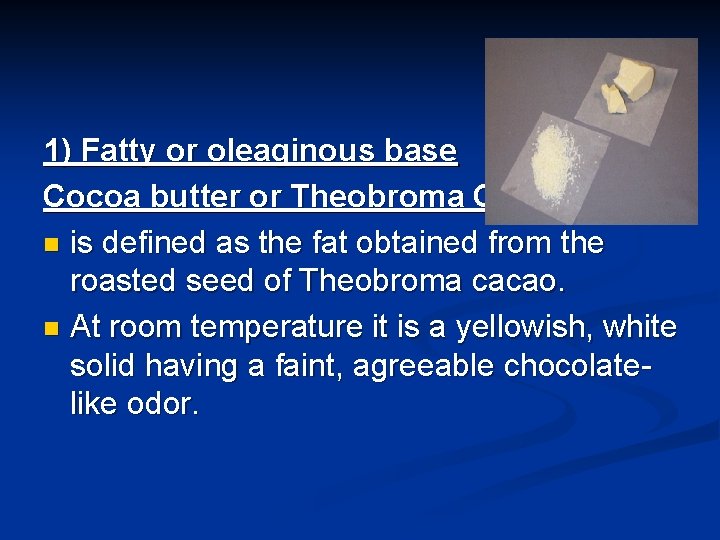
1) Fatty or oleaginous base Cocoa butter or Theobroma Oil n is defined as the fat obtained from the roasted seed of Theobroma cacao. n At room temperature it is a yellowish, white solid having a faint, agreeable chocolatelike odor.
- - Chemically, it is a triglyceride At ordinary room temperatures of 15 to 25 C, it is a hard, amorphous solid Cocoa butter melts between 30 C to 36 C, it is an ideal suppository base. Readily liquefiable on warming and rapid setting on cooling Cocoa butter exhibits marked polymorphism.
- - Two factors when preparing suppositories with cocoa butter base. First, this base must not be heated above 35 C because cocoa butter is a polymorphic compound and if overheated will convert to a metastable structure that melts in the 25 to 30 C range. Thus, the finished suppositories would melt at room temperature and not be usable. The second factor is the change in melting point caused by adding certain drugs to cocoa butter suppositories. For example, chloral hydrate and phenol tend to lower the melting point. It may be necessary to add spermaceti or beeswax to raise the melting point of finished suppositories back to the desired range.

Limitations: - Polymorphism – unstable gamma/beta forms - Adhere to mould due to contractility on solidification - Softening point too low for hot climates (beeswax may be added) - Batch to batch variation in composition - Becomes rancid on storage - Immiscible in body fluids and poor water absorption - Tendency to leak, immiscibility makes it not suitable for vaginal and urethral route - May melt at warmer climates
Synthetic lipophilic bases advantages & disadvantages: - readily available - do not become rancid - chemically more inert - do not exhibit polymorphism - good water absorption and emulsification properties - lubrication can be avoided - white, smooth & odorless - may become brittle & fracture if cooled rapidly - more expensive than cocoa butter
Hydrogenated fatty acids of vegetable oils (palm oil and cottonseed oil) n Fat-based compounds containing higher molecular weight fatty acids, such as palmitic and stearic acids with glycerin the (glyceryl monostearate and glyceryl monopalmitate, (Witepsol®) ) n

2) Water-soluble and water-miscible bases n Glycerinated gelatin - Glycerinated gelatin suppositories may be prepared by dissolving granular gelatin (20%) in glycerin (70%) and adding a solution or suspension of the medication (10%). - Glycerinated gelatin base (translucent) is most frequently used in the preparation of vaginal suppositories, it is tend to dissolve or disperse slowly in mucous secretions to provide

- - - Glycerinated gelatin-based suppositories have a tendency to absorb moisture due to the hygroscopic nature of glycerin. Should kept in well close container or seal The suppository may have a dehydrating effect and be irritating to the tissues upon insertion Urethral suppositories may be prepared from a glycerinated gelatin base (60% gelatin, 20% glycerin and 20%
Glycero-gelatin: - may cause irritation due to dehydration of mucosa - hygroscopic, careful storage - incompatible with many drugs - chance for microbial growth, addition of preservative. - base preparation is time consuming - sticky, can’t be used for hand rolling - they do not melt at body temperature, but dissolve to provide a more prolonged release than theobroma oil.

n - - Polyethylene glycols (PEG) PEGs are polymers of ethylene oxide and water, prepared to various chain lengths, molecular weights, and physical states. PEG suppositories do not melt at body temperature but rather dissolve slowly in the body’s fluids.
Suppositories are prepared by four methods: v HAND MOLDING METHOD v COMPRESSION MOLDING METHOD v POUR Molding METHOD v AUTOMATIC MOLDING METHOD. n
https: //www. youtube. com/watch? v=ppf. Wi ORDODc (introduction about suppository) n https: //www. youtube. com/watch? v=H 9 Om Hedm. K 50 (cocoa butter suppository) n
4. Preparation of suppositories 1)Preparation by molding The steps in molding include n Grind the needed ingredients n Wt the neceesary wt. of the ingredeint n melting the base, Do not over heat n incorporating any required medicaments, n pouring the melt (base + drug) into molds, n allowing the melt to cool and congeal
Suppository molds n Commercially available molds can produce individual or large numbers of suppositories of various shapes and sizes. n Molds in common use today are made from stainless steel, aluminum, brass, or plastic. n Individual molds may be obtained to form a single suppository.
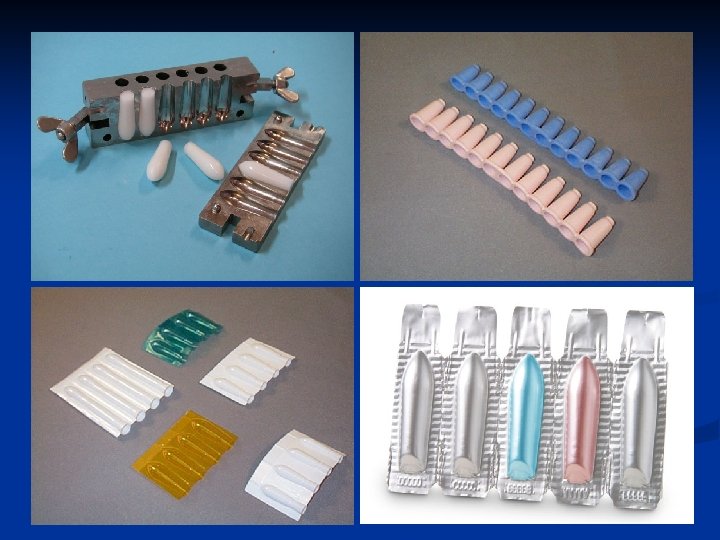

Lubrication of the mold n Depending on the formulation, suppository molds may require lubrication before the melt is poured to facilatate clean and easy removal of the molded suppositories. n Lubrication is seldom necessary when the suppository base is cocoa butter or polyethylene glycol. n Lubrication is usually necessary when glycerinated gelatin suppositories are prepared.
Calibration of the mold Each individual mold is capable of holding a specific volume of material in each of its openings. n The pharmacist should calibrate each suppository mold for the usual base so as to prepare medicated suppositories each having the proper quantity of medicaments. n
- - Prepare molded suppositories from base material alone After removal from the mold, the suppositories are weighted, and the total weight and the average weight of each suppository are recorded. To determine the volume of the mold, the suppositories are then carefully melted in a calibrated beaker, and the volume of the melt is determined for the total number as well as the average of one suppository.

Determination of the amount of base required n Volume of base= Total volume of the mold -the volume of the drug substances n If 12 ml of cocoa butter are required to fill a suppository mold and if the medicaments in the formula have a collective volume of 2. 8 ml, how many gram of cocoa butter required? (the density of cocoa butter is 0. 86 g/m. L) v/d=wt
a) b) c) d) e) Weigh the active ingredient for the preparation of a single suppository; Dissolve it or mix it with a portion of melted base insufficient to fill one cavity of the mold, and add the mixture to a cavity; Add additional melted base to the cavity to fill it completely Allow the suppository to congeal and harden Remove the suppository from the mold and weigh it
Preparing and pouring the melt n Using the least possible heat, the weighed suppository base material is melted, generally over a water bath, since no great deal of heat is usually required. n Medicinal substances are usually incorporated into a portion of the melted base by mixing on a glass or porcelain tile with a spatula.
After incorporation, this material is stirred into the remaining base, which has been allowed to cool almost to its congealing point. n The melt is poured carefully and continuously into each cavity of the mold, which has been previously equilibrated to room temperature. n
n When the suppositories are hard, the mold is removed from the refrigerator and allowed to come to room temperature. n Then the sections of the mold are separated, and the suppositories are dislodges.
n n n The solid materials remain suspended if the pouring is performed just above the conjealing point and not when the base is too fluid. In filling each suppository cavity, the pouring must be continuous to prevent layering, which may lead to a product easily broken on handling. To ensure a completely filled mold upon congealing, the melt is poured excessively (overload) over each opening, actually using above the level of the mold.

![Density calculations for suppositories Determination of the dosage replacement factor method f=[100(E-G)]/[GX+1] where E=the](http://slidetodoc.com/presentation_image_h/8a7094d6621683edad59a8ef196e304c/image-26.jpg "Density calculations for suppositories Determination of the dosage replacement factor method f=[100(E-G)]/[GX+1] where E=the")
Density calculations for suppositories Determination of the dosage replacement factor method f=[100(E-G)]/[GX+1] where E=the weight of the drug G=total weight of suppositories X% of the active ingredient n

Example 1 Prepare a suppository containing 100 mg of phenobarbital (f=0. 81) using cocoa butter as the base. The weight of the pure cocoa butter suppository is 2. 0 g. What will be the total weight of each suppository? If we about 5% phenobarbital. What will be the total wt of each suppository f=[100(E-G)]/[GX+1]

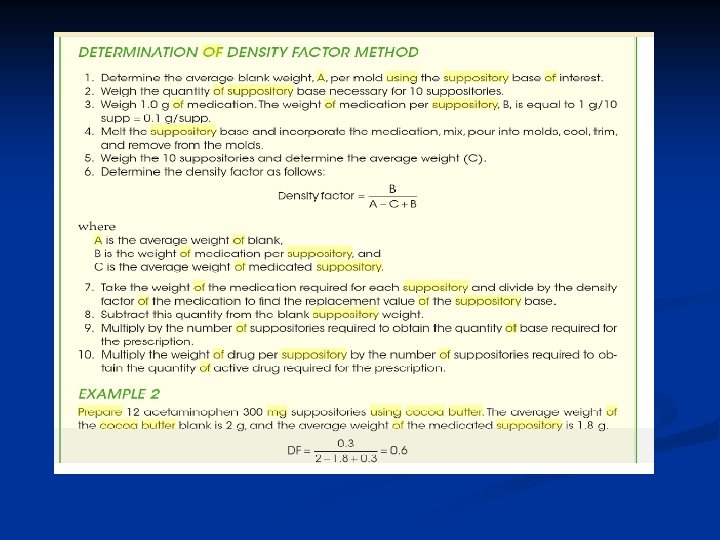
Determination of density factor method Density factor =df= B/(A-C+B) 1) 2) 3) 4) Determine the average blank weight, A, per mold using the suppository base of interest Weigh the quantity of suppository base necessary for 10 suppositories. Weigh 1. 0 g of medication Melt the suppository base and incorporate the medication, mix, pour into molds, cool, trim, and remove from the molds

6)determine the density factor as follows Density factor = B/(A-C+B) where A=average weight of blank B=weight of medication per suppository C=average weight of medicated suppository 7) Take the weight of the medication required for each suppository and divide by the density factor of the
8) Subtract this quantity from the blank suppository weight 9) Multiply by the number of suppositories required to obtain the quantity of suppository base required for the prescription. 10) Multiply the weight of drug per suppository by the number of suppositories required to obtain the quantity of active drug required for the prescription.

Example 2 Prepare 12 acetaminophen 300 mg suppositories using cocoa butter, where the average weight of the cocoa butter blank is 2 g and the average weight of the medicated suppository is 1. 8 g.
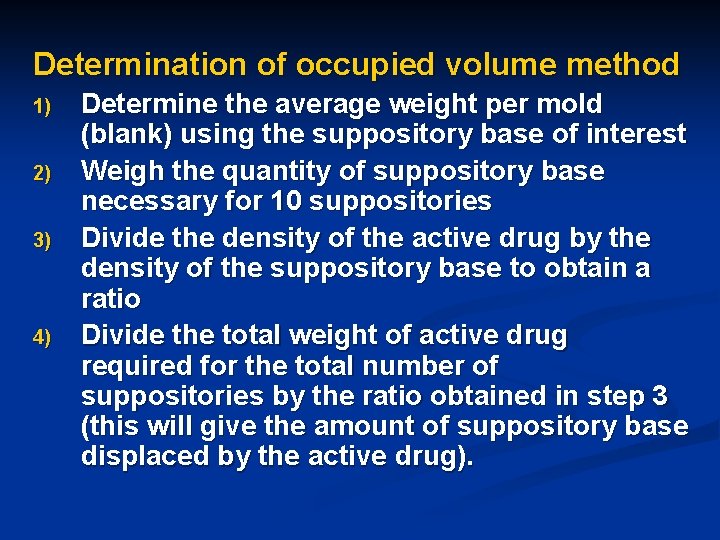
Determination of occupied volume method 1) 2) 3) 4) Determine the average weight per mold (blank) using the suppository base of interest Weigh the quantity of suppository base necessary for 10 suppositories Divide the density of the active drug by the density of the suppository base to obtain a ratio Divide the total weight of active drug required for the total number of suppositories by the ratio obtained in step 3 (this will give the amount of suppository base displaced by the active drug).
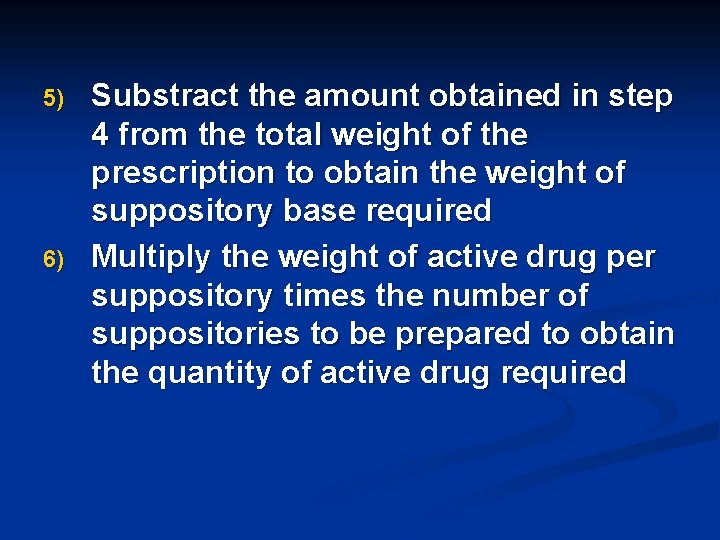
5) 6) Substract the amount obtained in step 4 from the total weight of the prescription to obtain the weight of suppository base required Multiply the weight of active drug per suppository times the number of suppositories to be prepared to obtain the quantity of active drug required
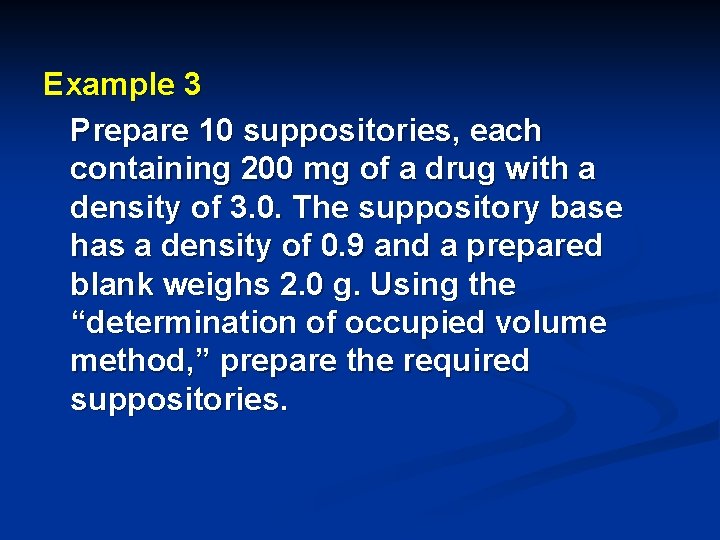
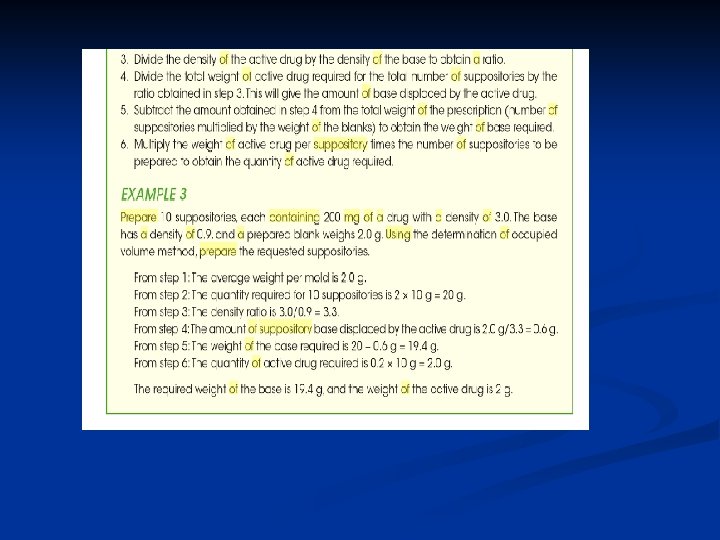
Example 3 Prepare 10 suppositories, each containing 200 mg of a drug with a density of 3. 0. The suppository base has a density of 0. 9 and a prepared blank weighs 2. 0 g. Using the “determination of occupied volume method, ” prepare the required suppositories.
2) Preparation by compression n Suppositories may be prepared by forcing the mixed mass of the base and the medicaments into special molds using suppository-making machines. n In preparation of compression into the molds, the base and the other formulative ingredients are combined by thorough mixing, the friction of the process softening the base into a pastelike consistency.
Compression is especially suited for making suppositories that contain heatlabile medicinal substances or a great deal of substances that are insoluble in the base. n In contrast to the molding method, compression permits no likelihood of insoluble matter settling during manufacture. n The disadvantage to compression is that the special suppository machine is required and there is some limitation as to shapes of suppositories that can be n

A formula of glycerin suppositories is as follows: n Glycerin 91 g n Sodium Stearate 9 g n Purified Water 5 g n Glycerin, a hygroscopic material, contributes to the laxative effect of the suppository by drawing water from the intestine and also from its irritant action on the mucous lining. n The sodium stearate, a soap, is the solidifying agent in the suppository and may also contribute to the laxative action.
Information for proper use of suppositories n If suppositories must be stored in the refrigerator, they should be allowed to warm to room temperature before insertion. n The patient should be advised to rub cocoa butter suppositories gently with the fingers to melt the surface to provide lubrication for insertion. n Glycerinated gelatin or polyethylene glycol suppositories should be moistened with water to enhance

Glycerol-gelatin bases Disadvantages: • Glycerol-gelatin bases cause rectal irritation. • As they dissolve in the mucous secretions of the rectum, osmosis occurs producing a laxative effect. • They are also hygroscopic and therefore require careful storage. • Because of the water content, microbial contamination is more likely than with the fatty bases. Preservatives may be added to the product, but can lead to problems of incompatibilities. • They are much more difficult to prepare and handle than other bases. This type of base is commonly used for pessaries rather than suppositories. 11/23/2020 BA-FP-JU-C

Macrogols (PEG) n n n These polyethylene glycols can be blended together to produce suppository bases with varying melting points, dissolution rates and physical characteristics. Drug release depends on the base dissolving rather than melting (the melting point is often around 50°C). Higher proportions of high molecular weight polymers produce preparations which release drug slowly and are also brittle. Advantages: 1. They have no physiological effect. 2. Are not prone to microbial contamination. 3. Have a high water-absorbing capacity. 4. As they dissolve, a viscous solution is produced which means there is less likelihood of leakage from the body. 11/23/2020 BA-FP-JU-C
Macrogols Disadvantages: n They are hygroscopic which means they must be carefully stored and this could lead to irritation of the rectal mucosa. n They become brittle if cooled too quickly and also may become brittle on storage. n Incompatibility with several drugs and packaging materials, e. g. benzocaine, penicillin and plastic, may limit their use. n In addition crystal growth occurs with some drugs causing irritation to the rectal mucosa and, if the crystals are large, prolonged dissolution times. 11/23/2020 BA-FP-JU-C
PEG Surfactants Preservative agent p. H 4. 5
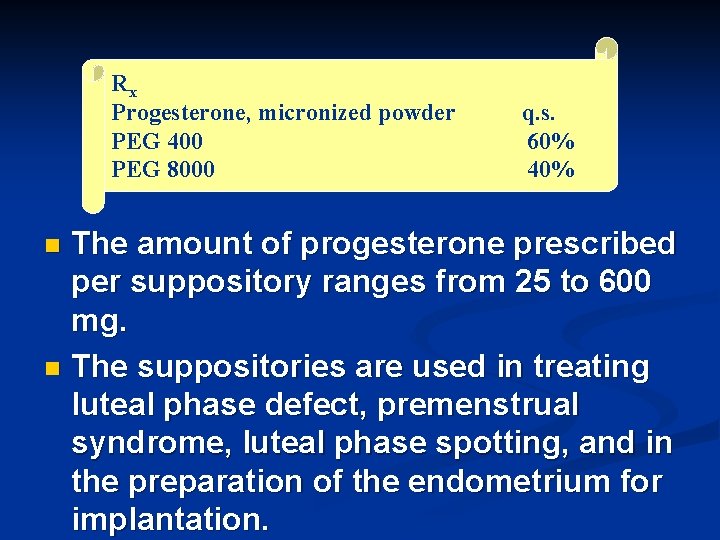
Rx Progesterone, micronized powder PEG 400 PEG 8000 q. s. 60% 40% The amount of progesterone prescribed per suppository ranges from 25 to 600 mg. n The suppositories are used in treating luteal phase defect, premenstrual syndrome, luteal phase spotting, and in the preparation of the endometrium for implantation. n
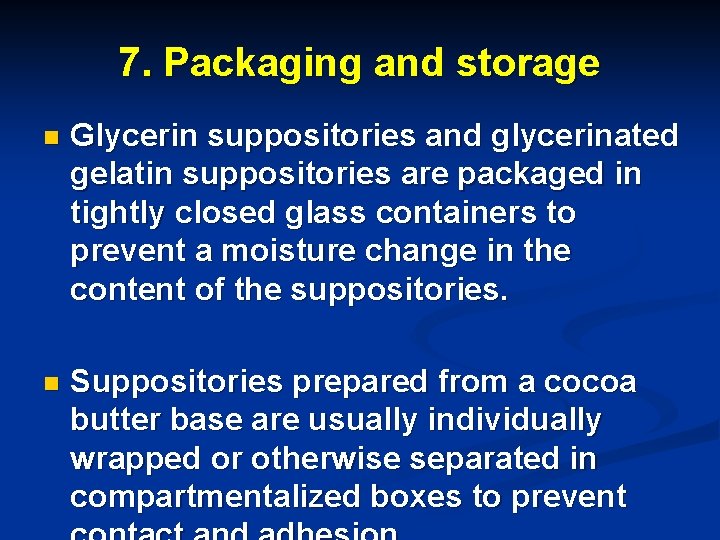
7. Packaging and storage n Glycerin suppositories and glycerinated gelatin suppositories are packaged in tightly closed glass containers to prevent a moisture change in the content of the suppositories. n Suppositories prepared from a cocoa butter base are usually individually wrapped or otherwise separated in compartmentalized boxes to prevent
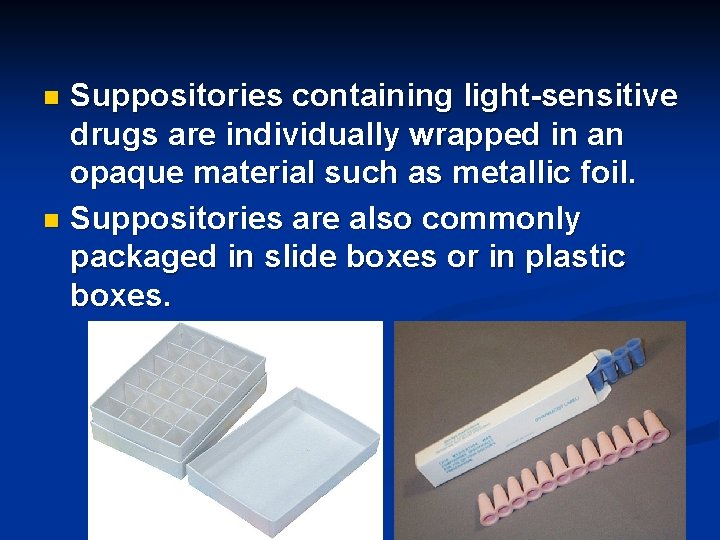
Suppositories containing light-sensitive drugs are individually wrapped in an opaque material such as metallic foil. n Suppositories are also commonly packaged in slide boxes or in plastic boxes. n

It is necessary to maintain suppositories in a cool place. n Suppositories having cocoa butter as the base must be stored below 30 C, and preferably in a refrigerator (2 8 C). n Glycerinated gelatin suppositories are best stored at temperatures below 8 C and can routinely be stored at controlled room temperature (20 25 C). n Suppositories made from a base of polyethylene glycol may be stored at usual room temperature. n
8. Vaginal inserts Vaginal tablets, frequently referred to as vaginal inserts, are usually ovoid in shape and are accompanied in their packaging with a plastic inserter. n Vaginal tablets contain the same types of antiinfective and hormonal substances as the vaginal suppositories. n
They are prepared by tablet compression, and are commonly formulated to contain n lactose as the base or filler n starch as the disintegrating agent n polyvinylpyrrolidone as a dispersing agent n magnesium stearate as a tablet lubricant.
Shelf life Provided they are well packaged and the storage temperature is low, suppositories and pessaries are relatively stable preparations. Unless other information is available, an expiry date of 1 month is appropriate. 11/23/2020 BA-FP-JU-C
Labelling for suppositories • • How to use the product. 'Store in a cool place' 'For rectal use only' or 'For vaginal use only', whichever is appropriate. 'Do not swallow' can be put on the label but do not use 'For external use only'. The preparation is being inserted into a body cavity and this instruction is therefore incorrect. 11/23/2020 BA-FP-JU-C
- Slides: 52