
1 FACILITY LOCATION GAMES ORIGIN TO RECENT DEVELOPMENT
- Slides: 47
1 FACILITY LOCATION GAMES ORIGIN TO RECENT DEVELOPMENT Minming Li City University of Hong Kong
2 Algorithmic Mechanism Design A mechanism M chooses a social outcome to maximize an objective regarding the information reported by agents; All agents share the same public information and know M; Each agent has his own private information si and is asked to report it to the mechanism, S = (s 1 , . . . , sn): agents’ private information; R = (r 1 , . . . , rn): information reported by agents to the mechanism; The mechanism chooses a social outcome O with regard to R; Each agent has a valuation vi on O. Problem: Each agent will manipulate his report (a. k. a strategy) in order to make the mechanism choose better outcome(s) for himself. 2
3 Algorithmic Mechanism Design A mechanism with payment is a function mapping a collection of information R to a social outcome O and a payment vector P = (p 1, . . . , pn). In this case, the utility of agent i is ui(O, P)=vi(O) – pi. A mechanism without payment is a function mapping a collection of information R to a social outcome O. In this case, the utility of agent i is ui(O)=vi(O). A mechanism is strategyproof or incentive compatible if for every agent, the utility from revealing his private information is not worse off regardless the reports from other agents. 3
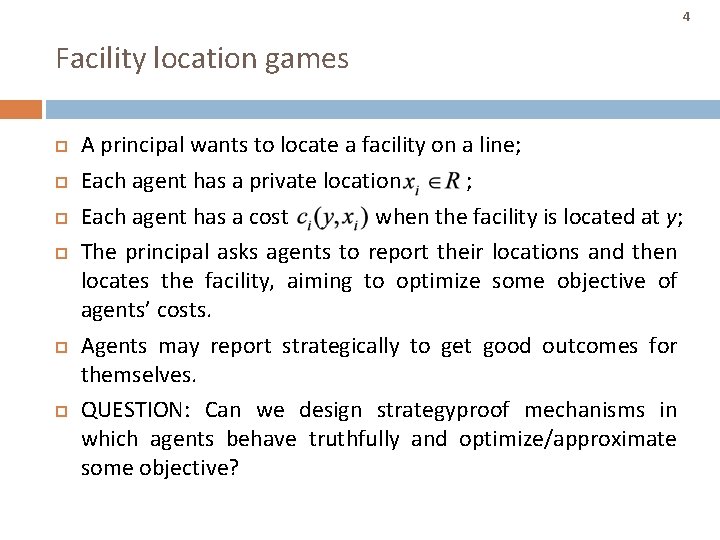
4 Facility location games A principal wants to locate a facility on a line; Each agent has a private location ; Each agent has a cost when the facility is located at y; The principal asks agents to report their locations and then locates the facility, aiming to optimize some objective of agents’ costs. Agents may report strategically to get good outcomes for themselves. QUESTION: Can we design strategyproof mechanisms in which agents behave truthfully and optimize/approximate some objective? 4
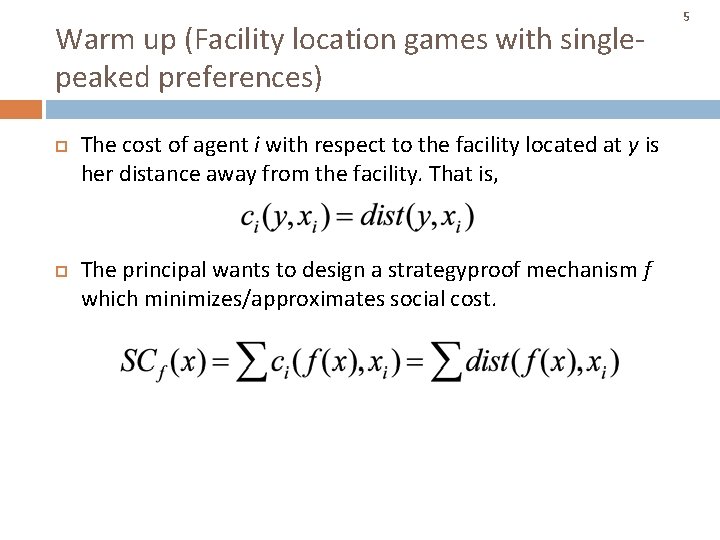
Warm up (Facility location games with singlepeaked preferences) The cost of agent i with respect to the facility located at y is her distance away from the facility. That is, The principal wants to design a strategyproof mechanism f which minimizes/approximates social cost. 5 5
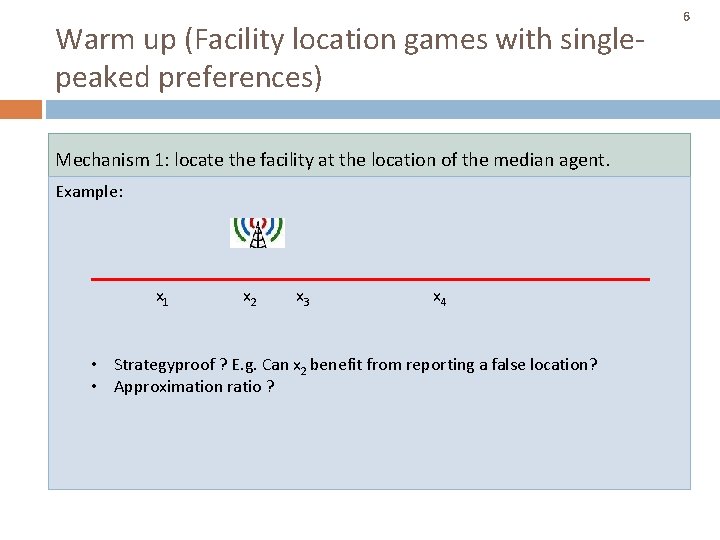
Warm up (Facility location games with singlepeaked preferences) Mechanism 1: locate the facility at the location of the median agent. Example: x 1 x 2 x 3 x 4 • Strategyproof ? E. g. Can x 2 benefit from reporting a false location? • Approximation ratio ? 6 6
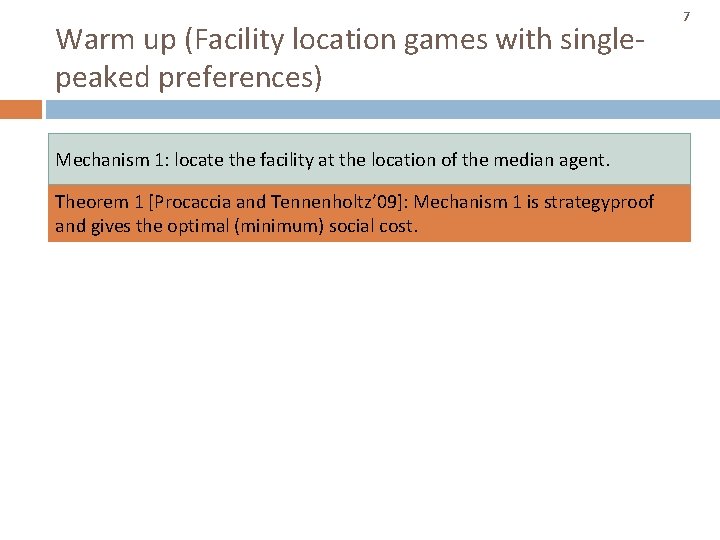
Warm up (Facility location games with singlepeaked preferences) Mechanism 1: locate the facility at the location of the median agent. Theorem 1 [Procaccia and Tennenholtz’ 09]: Mechanism 1 is strategyproof and gives the optimal (minimum) social cost. 7 7
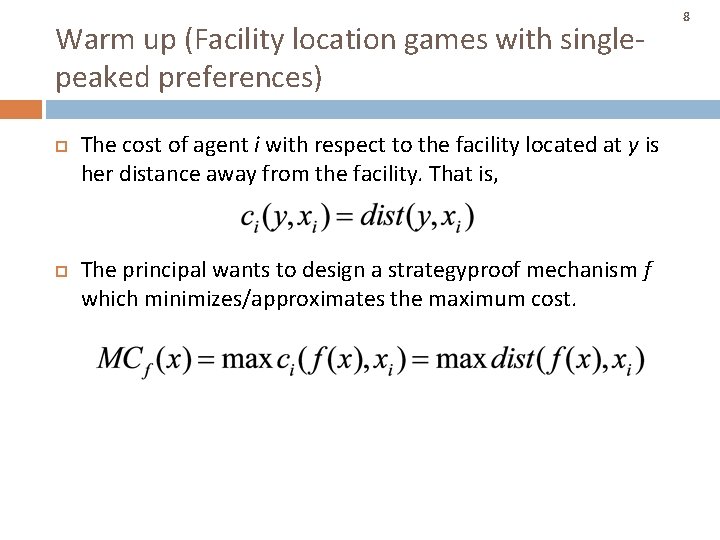
Warm up (Facility location games with singlepeaked preferences) The cost of agent i with respect to the facility located at y is her distance away from the facility. That is, The principal wants to design a strategyproof mechanism f which minimizes/approximates the maximum cost. 8 8
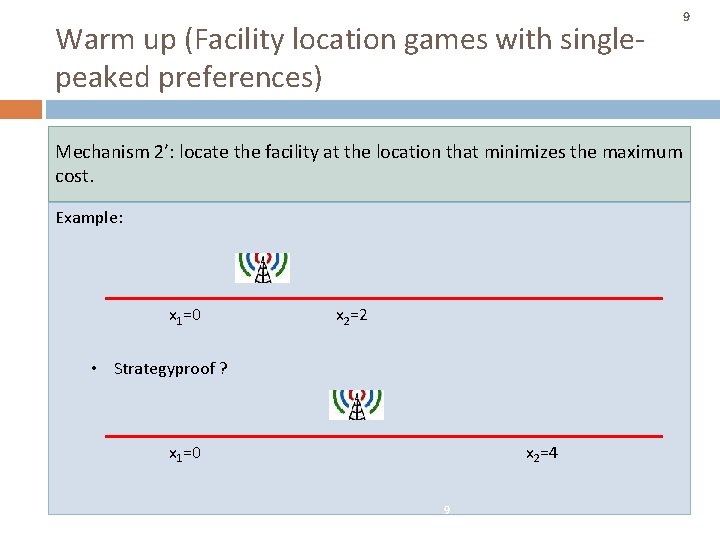
Warm up (Facility location games with singlepeaked preferences) 9 Mechanism 2’: locate the facility at the location that minimizes the maximum cost. Example: x 1=0 x 2=2 • Strategyproof ? x 1=0 x 2=4 9
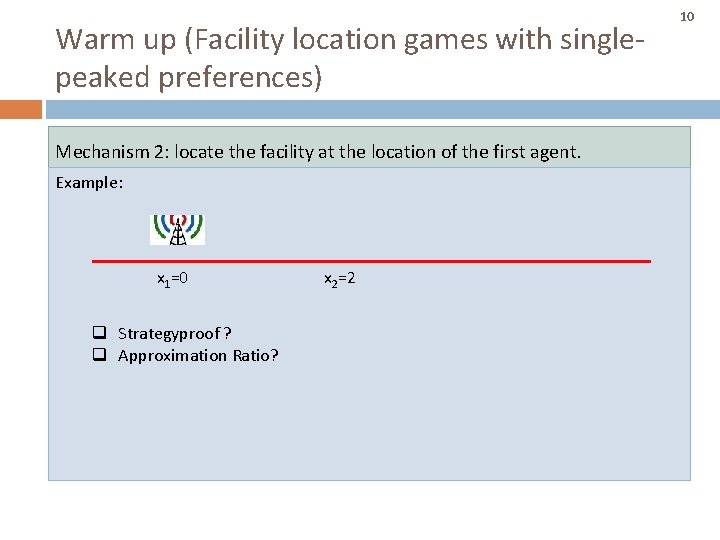
Warm up (Facility location games with singlepeaked preferences) Mechanism 2: locate the facility at the location of the first agent. Example: x 1=0 x 2=2 q Strategyproof ? q Approximation Ratio? 10 10
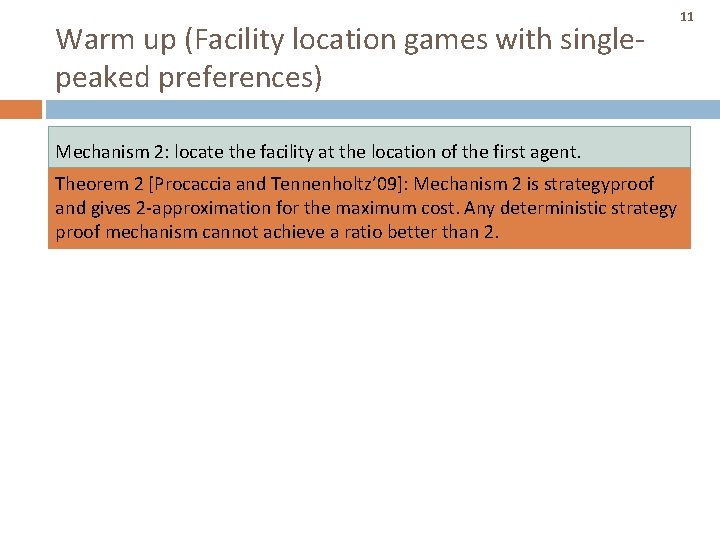
Warm up (Facility location games with singlepeaked preferences) 11 Mechanism 2: locate the facility at the location of the first agent. Theorem 2 [Procaccia and Tennenholtz’ 09]: Mechanism 2 is strategyproof and gives 2 -approximation for the maximum cost. Any deterministic strategy proof mechanism cannot achieve a ratio better than 2. 11
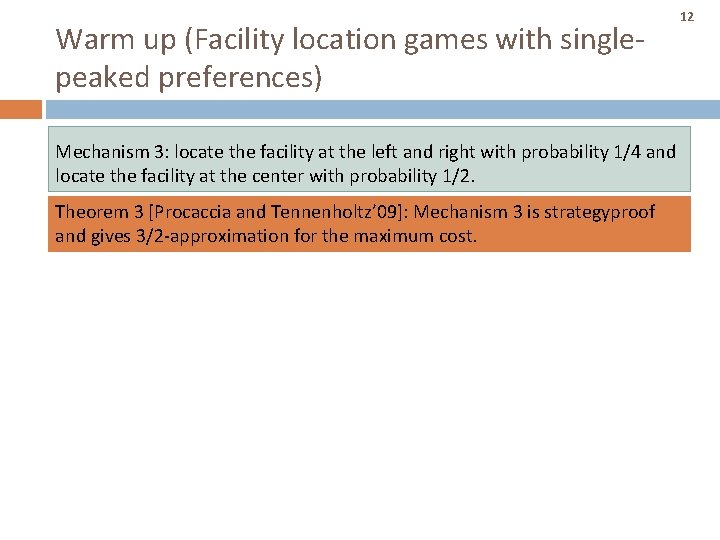
Warm up (Facility location games with singlepeaked preferences) 12 Mechanism 3: locate the facility at the left and right with probability 1/4 and locate the facility at the center with probability 1/2. Theorem 3 [Procaccia and Tennenholtz’ 09]: Mechanism 3 is strategyproof and gives 3/2 -approximation for the maximum cost. 12
Warm up (Facility location games with singlepeaked preferences) Other extensions Two facilities (same) One agent controlling multiple locations 13 13
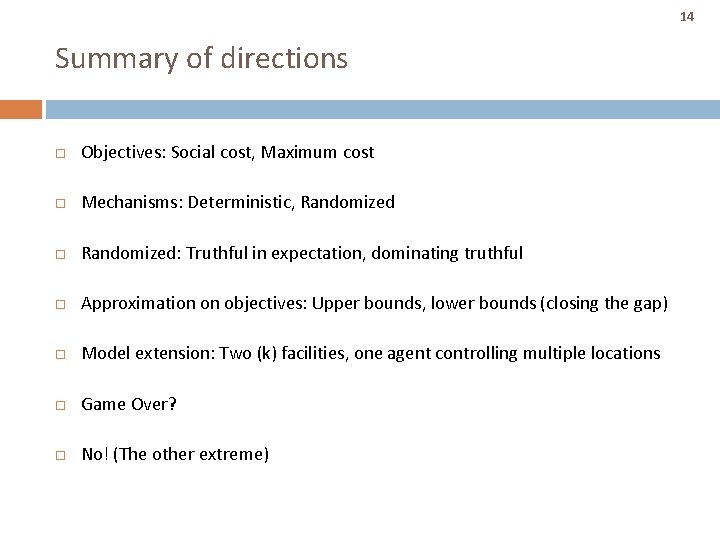
14 Summary of directions Objectives: Social cost, Maximum cost Mechanisms: Deterministic, Randomized: Truthful in expectation, dominating truthful Approximation on objectives: Upper bounds, lower bounds (closing the gap) Model extension: Two (k) facilities, one agent controlling multiple locations Game Over? No! (The other extreme) 14
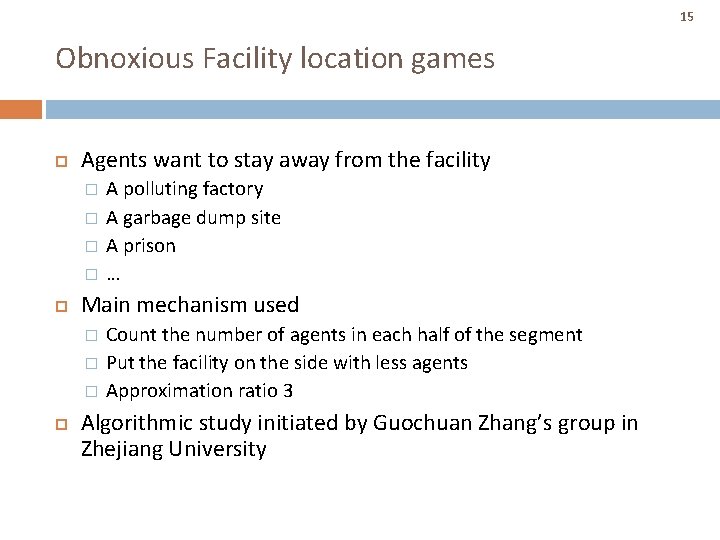
15 Obnoxious Facility location games Agents want to stay away from the facility � � Main mechanism used � � � A polluting factory A garbage dump site A prison … Count the number of agents in each half of the segment Put the facility on the side with less agents Approximation ratio 3 Algorithmic study initiated by Guochuan Zhang’s group in Zhejiang University 15
16 Obnoxious Facility location games Agents want to stay away from the facility � � � Main mechanism used � � A polluting factory A garbage dump site A prison Count the number of agents in each half of the segment Put the facility on the side with less agents Algorithmic study initiated by Guochuan Zhang’s group in Zhejiang University A complete picture? (No) 16
17 Facility location games with non-identical agents Motivation: To investigate possible strategyproof mechanisms when agents are not identical in facility location games. Two approaches: � Weighted agents � Threshold based agents 17
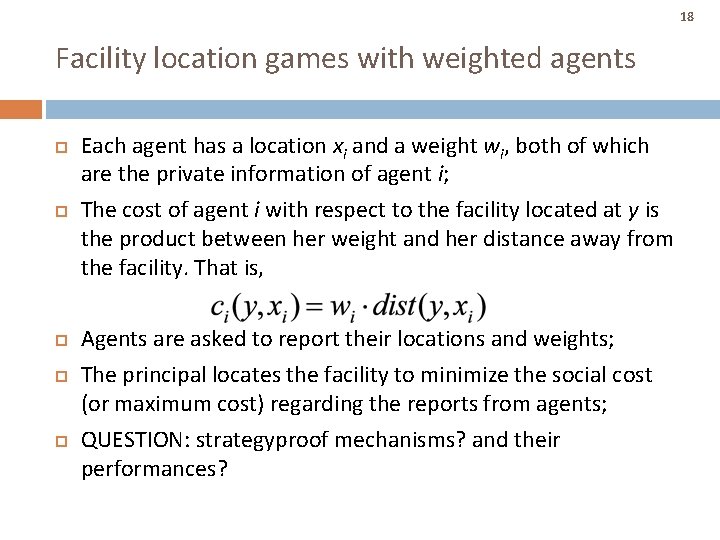
18 Facility location games with weighted agents Each agent has a location xi and a weight wi, both of which are the private information of agent i; The cost of agent i with respect to the facility located at y is the product between her weight and her distance away from the facility. That is, Agents are asked to report their locations and weights; The principal locates the facility to minimize the social cost (or maximum cost) regarding the reports from agents; QUESTION: strategyproof mechanisms? and their performances? 18
19 Facility location games with weighted agents Results: � For single-peaked preferences, most existing strategyproof mechanisms with identical agents are the best ones in facility location games with weighted agents. � In other words, the best strategyproof mechanisms are the ones which ignore the weights of agents. 19
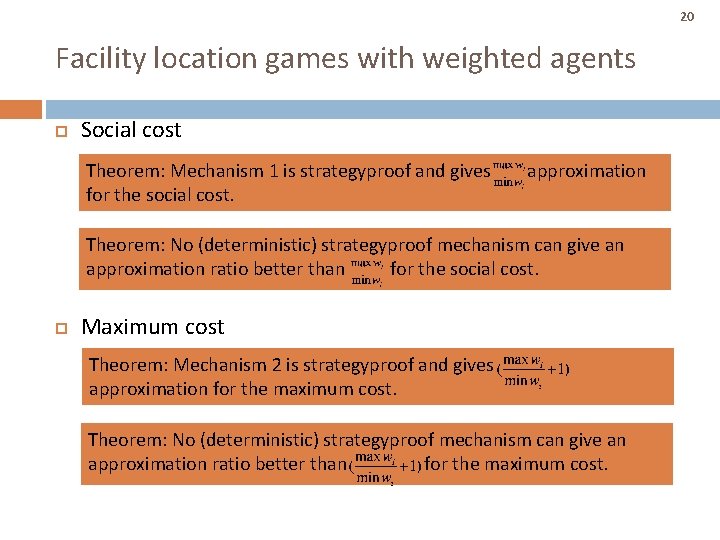
20 Facility location games with weighted agents Social cost Theorem: Mechanism 1 is strategyproof and gives approximation for the social cost. Theorem: No (deterministic) strategyproof mechanism can give an approximation ratio better than for the social cost. Maximum cost Theorem: Mechanism 2 is strategyproof and gives approximation for the maximum cost. Theorem: No (deterministic) strategyproof mechanism can give an approximation ratio better than for the maximum cost. 20
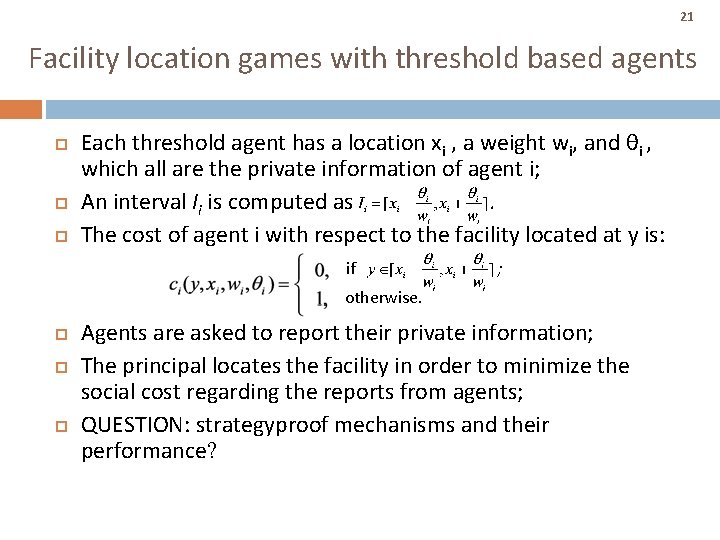
21 Facility location games with threshold based agents Each threshold agent has a location xi , a weight wi, and θi , which all are the private information of agent i; An interval Ii is computed as . The cost of agent i with respect to the facility located at y is: if ; otherwise. Agents are asked to report their private information; The principal locates the facility in order to minimize the social cost regarding the reports from agents; QUESTION: strategyproof mechanisms and their performance? 21
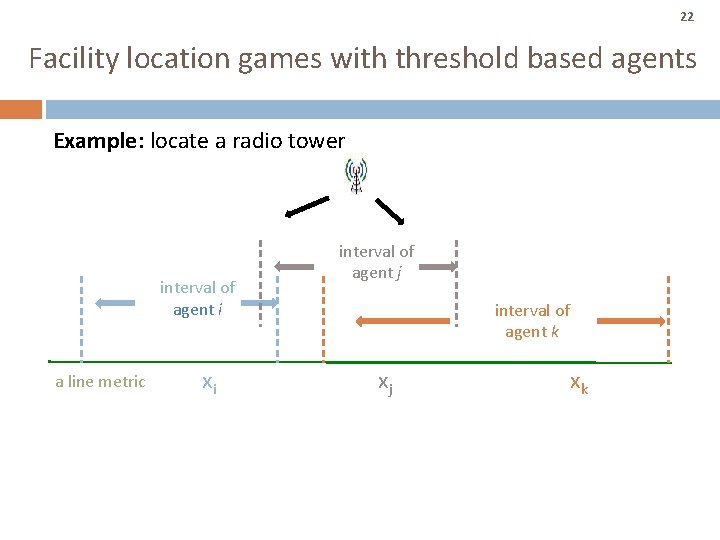
22 Facility location games with threshold based agents Example: locate a radio tower interval of agent i a line metric xi interval of agent j interval of agent k xj xk 22
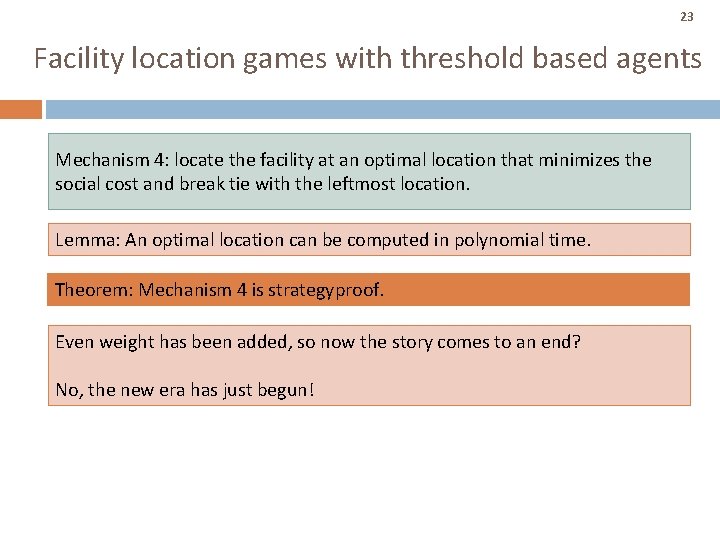
23 Facility location games with threshold based agents Mechanism 4: locate the facility at an optimal location that minimizes the social cost and break tie with the leftmost location. Lemma: An optimal location can be computed in polynomial time. Theorem: Mechanism 4 is strategyproof. Even weight has been added, so now the story comes to an end? No, the new era has just begun! 23
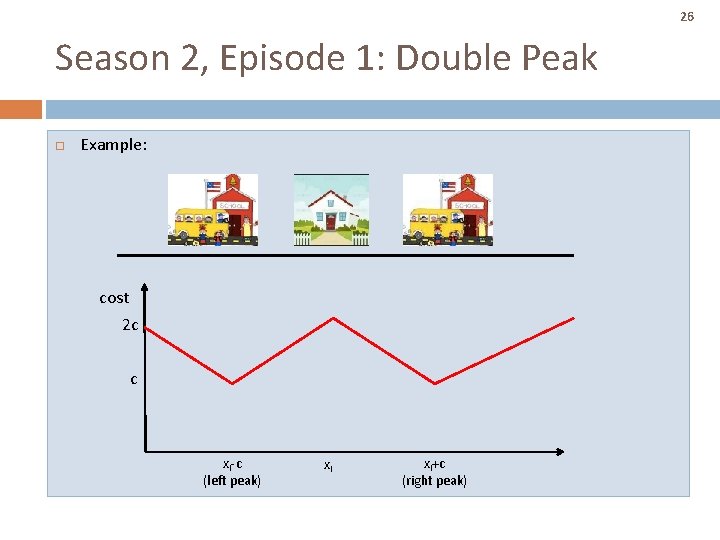
Season 2: Change Agents’ Preference functions Double peak (Filos-Ratsikas, Li, Zhang AAAI 2015) Dual Preference (Zou and Li AAMAS 2015) (Feigenbaum and Sethuraman AAAI 2015 workshop) 24 24
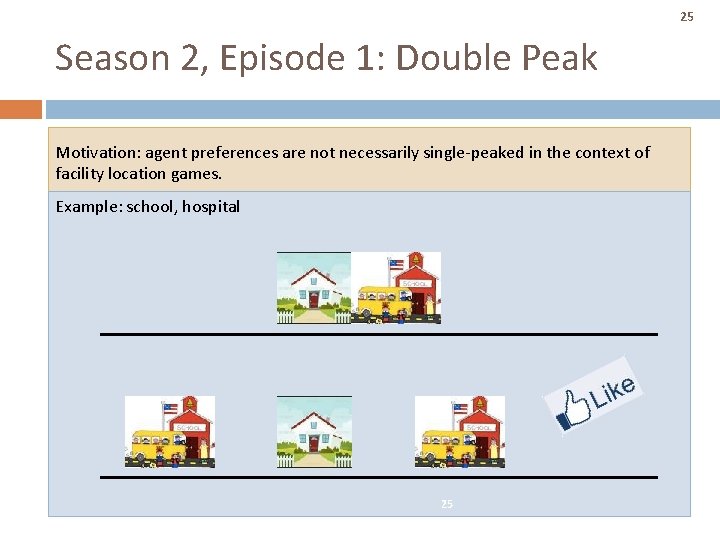
25 Season 2, Episode 1: Double Peak Motivation: agent preferences are not necessarily single-peaked in the context of facility location games. Example: school, hospital 25 25
26 Season 2, Episode 1: Double Peak Example: cost 2 c c xi-c (left peak) xi xi+c (right peak) 26
27 Group-strategyproofness Definition (Group-strategyproofness): A mechanism f is group strategyproof if any reports from any coalition of agents, there exits an agent in the coalition whose cost increases. Definition (Position invariance): A mechanism f satisfies position invariance if for all and , it holds +t Definition (Anonymity): A mechanism f is anonymous if for every location profile and every permutation of the agents, it holds Theorem: There is no deterministic group strategyproof mechanism that is anonymous and position invariant. 27
28 Strategyproof (Deterministic Mechanism) Mechanism 1: Given any instance , locate the facility always on the left peak of agent 1, i. e. , or always on the right peak of agent n, i. e. , . Theorem: Mechanism 1 is strategyproof. Theorem: When n=2, the only strategyproof mechanism that satisfies position invariance and anonymity is Mechanism 1. In fact, for single-peak preference, outputting the kth agent’s position is strategyproof, which is not true for double-peak preference 28
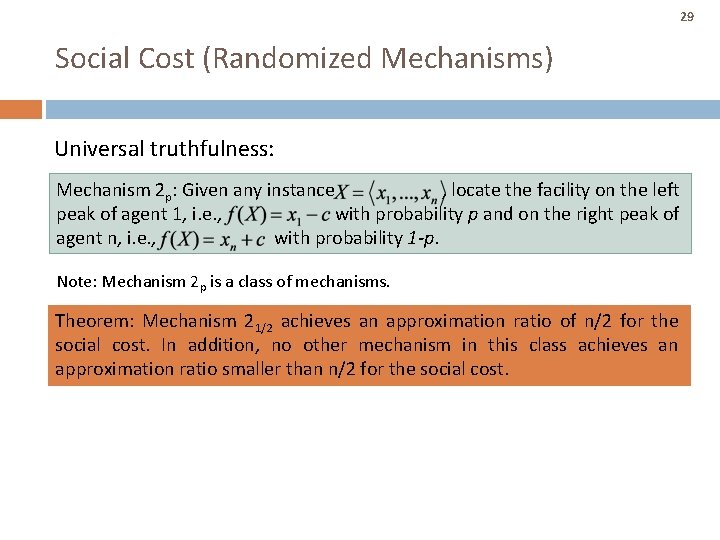
29 Social Cost (Randomized Mechanisms) Universal truthfulness: Mechanism 2 p: Given any instance , locate the facility on the left peak of agent 1, i. e. , with probability p and on the right peak of agent n, i. e. , with probability 1 -p. Note: Mechanism 2 p is a class of mechanisms. Theorem: Mechanism 21/2 achieves an approximation ratio of n/2 for the social cost. In addition, no other mechanism in this class achieves an approximation ratio smaller than n/2 for the social cost. 29
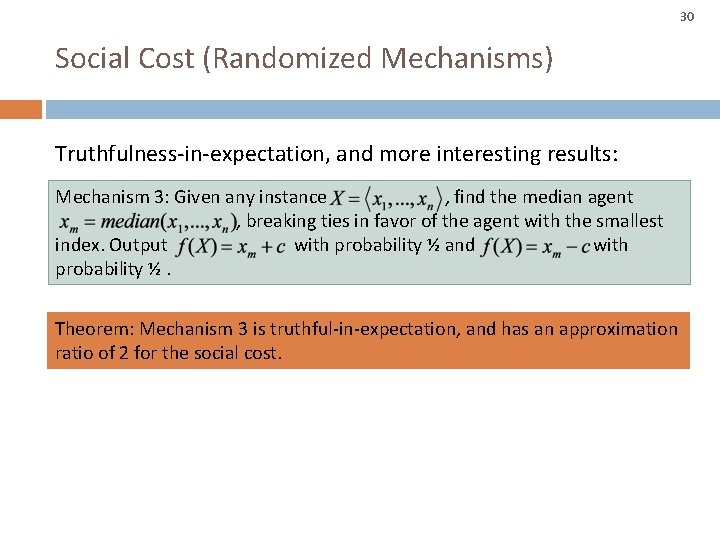
30 Social Cost (Randomized Mechanisms) Truthfulness-in-expectation, and more interesting results: Mechanism 3: Given any instance , find the median agent , breaking ties in favor of the agent with the smallest index. Output with probability ½ and with probability ½. Theorem: Mechanism 3 is truthful-in-expectation, and has an approximation ratio of 2 for the social cost. 30
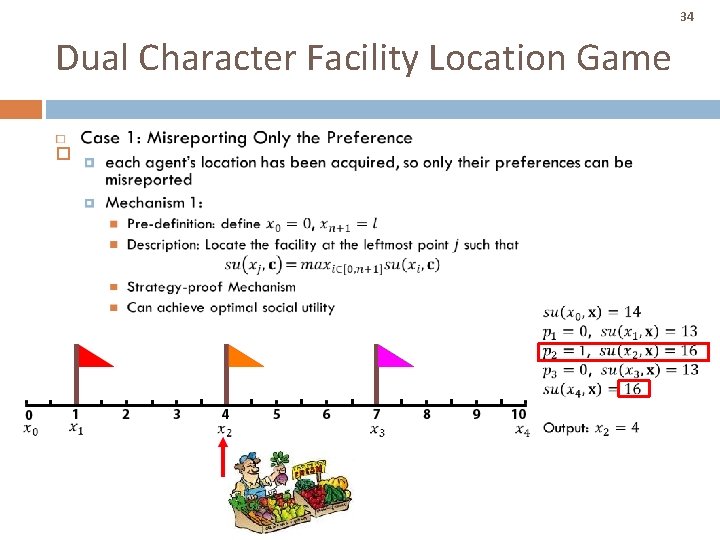
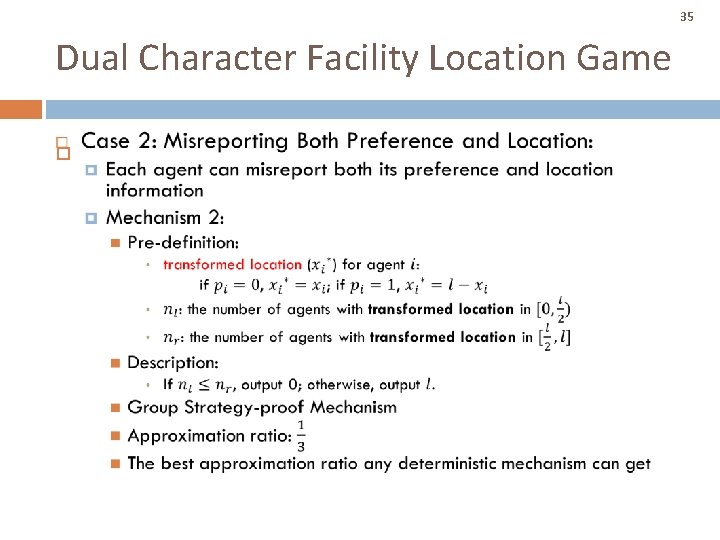
31 Season 2, Episode 2: Dual Preference Some agents like the facility but other agents hate the facility Agents may lie about � Only preference � Only location � Both preference and location The latter two cases have the same results 31
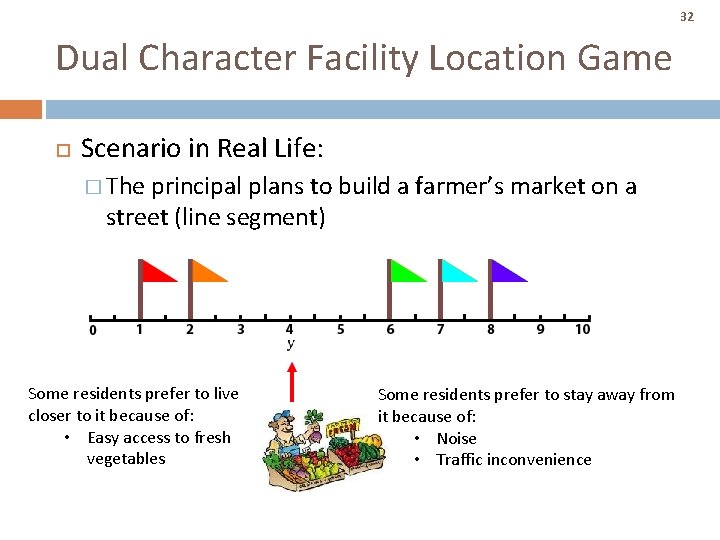
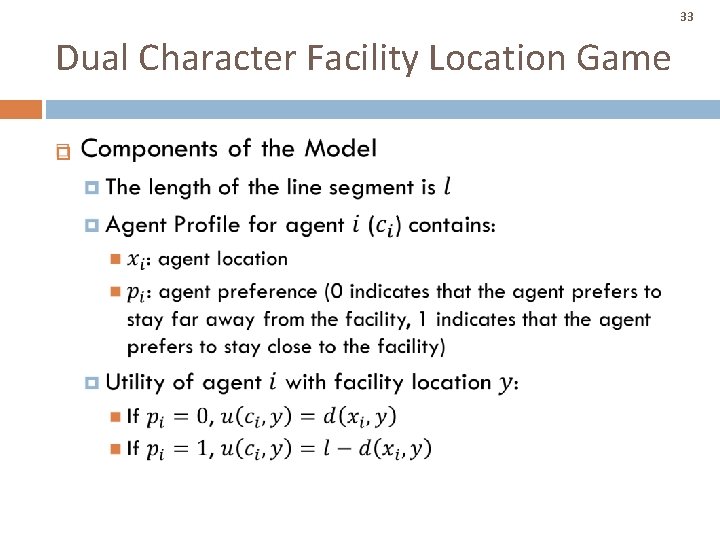
32 Dual Character Facility Location Game Scenario in Real Life: � The principal plans to build a farmer’s market on a street (line segment) Some residents prefer to live closer to it because of: • Easy access to fresh vegetables Some residents prefer to stay away from it because of: • Noise • Traffic inconvenience
33 Dual Character Facility Location Game
34 Dual Character Facility Location Game
35 Dual Character Facility Location Game
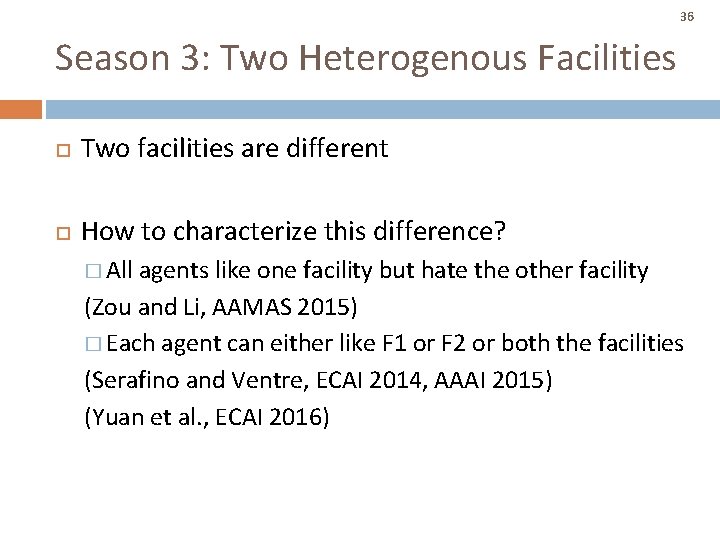
36 Season 3: Two Heterogenous Facilities Two facilities are different How to characterize this difference? � All agents like one facility but hate the other facility (Zou and Li, AAMAS 2015) � Each agent can either like F 1 or F 2 or both the facilities (Serafino and Ventre, ECAI 2014, AAAI 2015) (Yuan et al. , ECAI 2016) 36
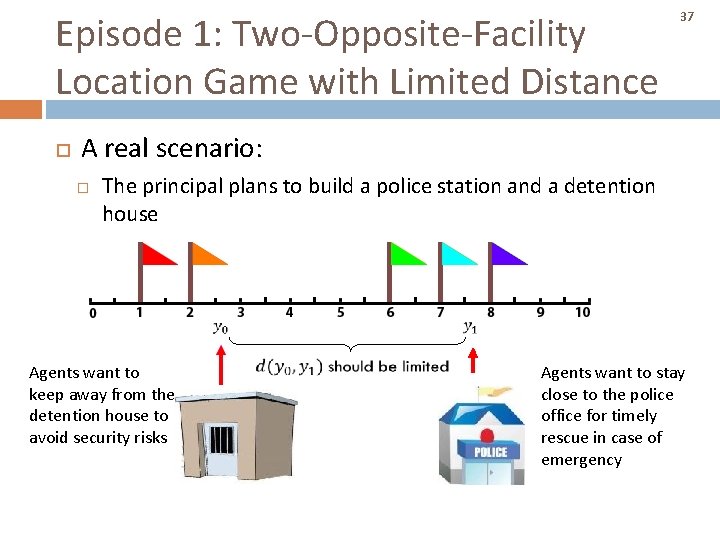
Episode 1: Two-Opposite-Facility Location Game with Limited Distance 37 A real scenario: The principal plans to build a police station and a detention house Agents want to keep away from the detention house to avoid security risks Agents want to stay close to the police office for timely rescue in case of emergency
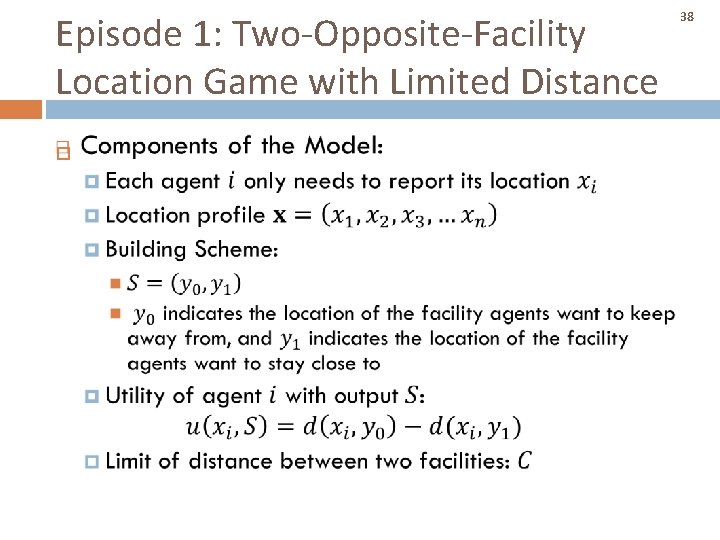
Episode 1: Two-Opposite-Facility Location Game with Limited Distance 38
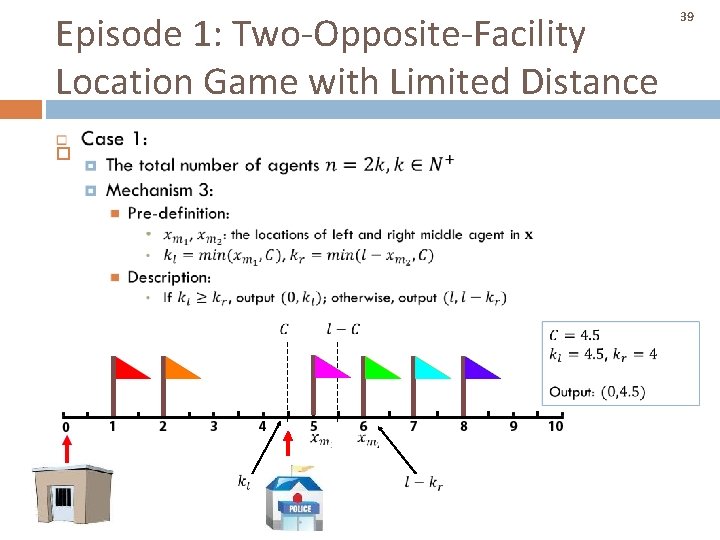
Episode 1: Two-Opposite-Facility Location Game with Limited Distance 39
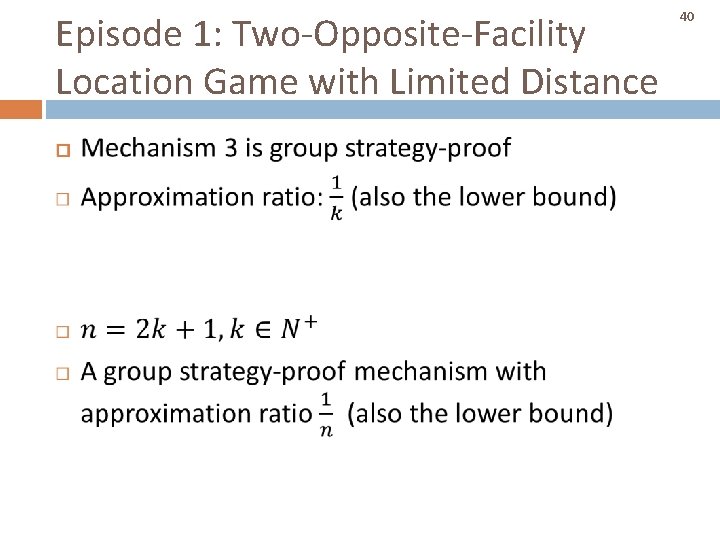
Episode 1: Two-Opposite-Facility Location Game with Limited Distance 40
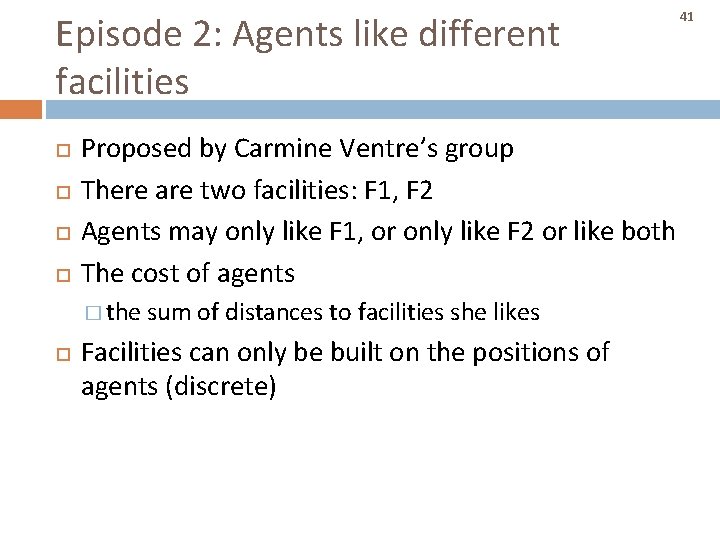
Episode 2: Agents like different facilities Proposed by Carmine Ventre’s group There are two facilities: F 1, F 2 Agents may only like F 1, or only like F 2 or like both The cost of agents � the sum of distances to facilities she likes Facilities can only be built on the positions of agents (discrete) 41
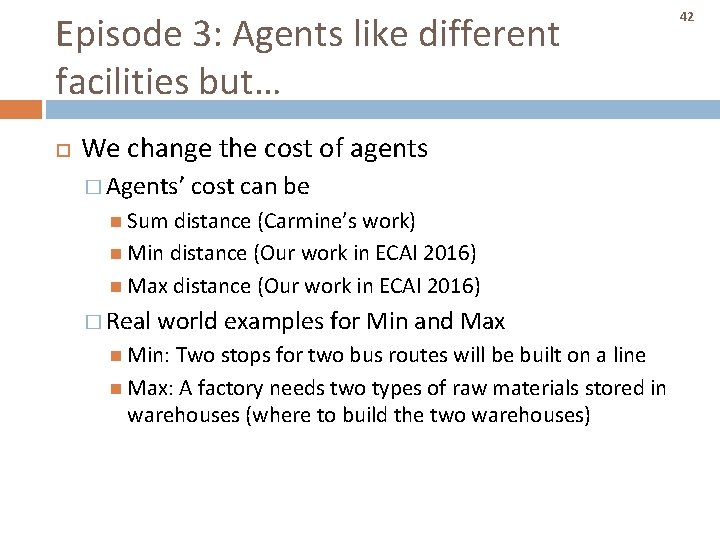
Episode 3: Agents like different facilities but… We change the cost of agents � Agents’ cost can be Sum distance (Carmine’s work) Min distance (Our work in ECAI 2016) Max distance (Our work in ECAI 2016) � Real world examples for Min and Max Min: Two stops for two bus routes will be built on a line Max: A factory needs two types of raw materials stored in warehouses (where to build the two warehouses) 42 42
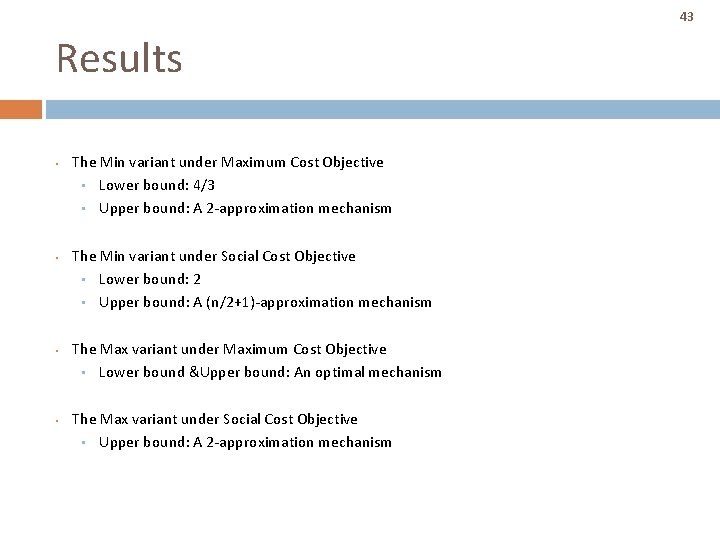
43 Results • • The Min variant under Maximum Cost Objective • Lower bound: 4/3 • Upper bound: A 2 -approximation mechanism The Min variant under Social Cost Objective • Lower bound: 2 • Upper bound: A (n/2+1)-approximation mechanism The Max variant under Maximum Cost Objective • Lower bound &Upper bound: An optimal mechanism The Max variant under Social Cost Objective • Upper bound: A 2 -approximation mechanism 43
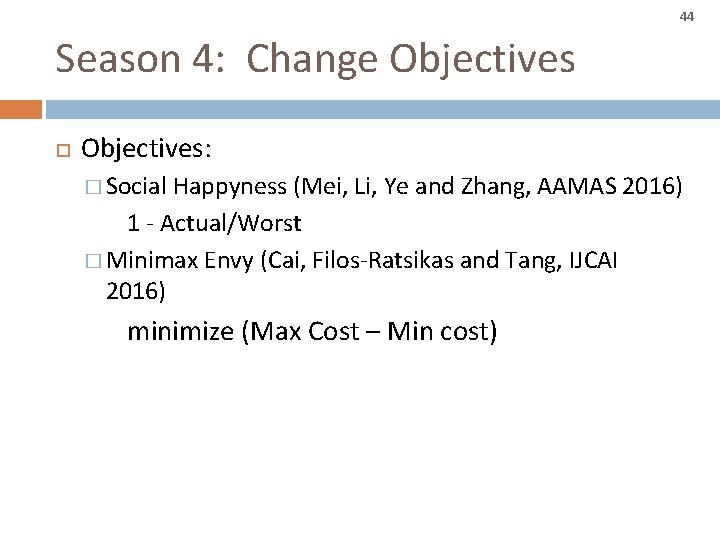
44 Season 4: Change Objectives: � Social Happyness (Mei, Li, Ye and Zhang, AAMAS 2016) 1 - Actual/Worst � Minimax Envy (Cai, Filos-Ratsikas and Tang, IJCAI 2016) minimize (Max Cost – Min cost) 44
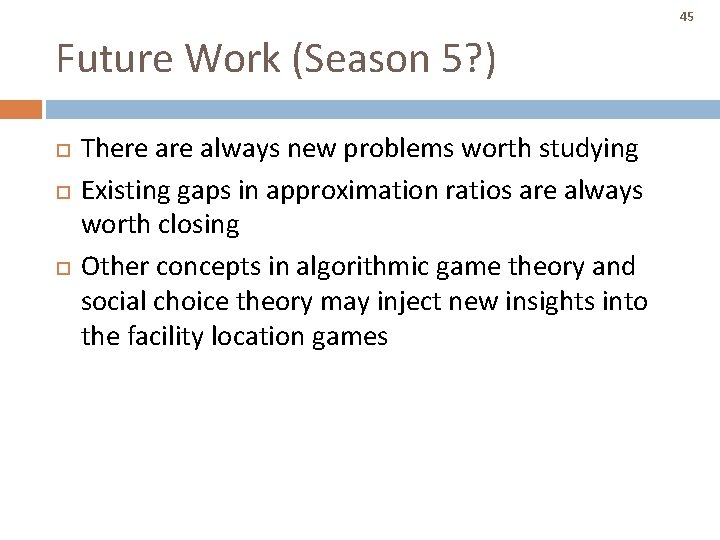
45 Future Work (Season 5? ) There always new problems worth studying Existing gaps in approximation ratios are always worth closing Other concepts in algorithmic game theory and social choice theory may inject new insights into the facility location games 45
46 Thanks! 46
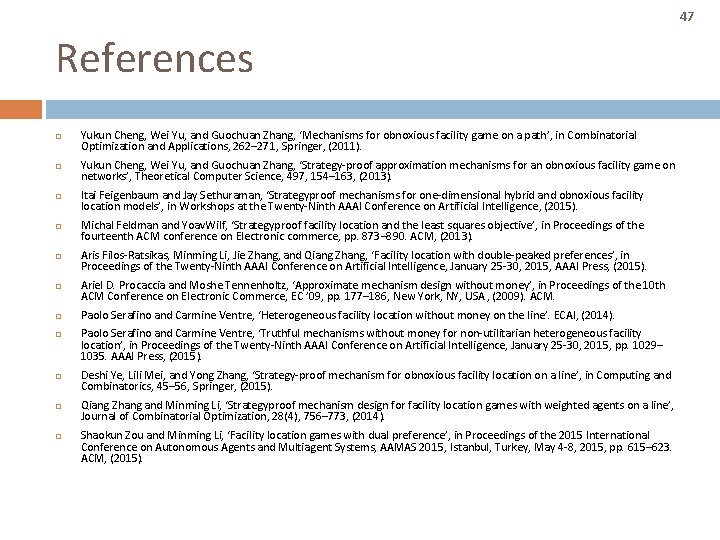
47 References Yukun Cheng, Wei Yu, and Guochuan Zhang, ‘Mechanisms for obnoxious facility game on a path’, in Combinatorial Optimization and Applications, 262– 271, Springer, (2011). Yukun Cheng, Wei Yu, and Guochuan Zhang, ‘Strategy-proof approximation mechanisms for an obnoxious facility game on networks’, Theoretical Computer Science, 497, 154– 163, (2013). Itai Feigenbaum and Jay Sethuraman, ‘Strategyproof mechanisms for one-dimensional hybrid and obnoxious facility location models’, in Workshops at the Twenty-Ninth AAAI Conference on Artificial Intelligence, (2015). Michal Feldman and Yoav. Wilf, ‘Strategyproof facility location and the least squares objective’, in Proceedings of the fourteenth ACM conference on Electronic commerce, pp. 873– 890. ACM, (2013). Aris Filos-Ratsikas, Minming Li, Jie Zhang, and Qiang Zhang, ‘Facility location with double-peaked preferences’, in Proceedings of the Twenty-Ninth AAAI Conference on Artificial Intelligence, January 25 -30, 2015, AAAI Press, (2015). Ariel D. Procaccia and Moshe Tennenholtz, ‘Approximate mechanism design without money’, in Proceedings of the 10 th ACM Conference on Electronic Commerce, EC ’ 09, pp. 177– 186, New York, NY, USA , (2009). ACM. Paolo Serafino and Carmine Ventre, ‘Heterogeneous facility location without money on the line’. ECAI, (2014). Paolo Serafino and Carmine Ventre, ‘Truthful mechanisms without money for non-utilitarian heterogeneous facility location’, in Proceedings of the Twenty-Ninth AAAI Conference on Artificial Intelligence, January 25 -30, 2015, pp. 1029– 1035. AAAI Press, (2015). Deshi Ye, Lili Mei, and Yong Zhang, ‘Strategy-proof mechanism for obnoxious facility location on a line’, in Computing and Combinatorics, 45– 56, Springer, (2015). Qiang Zhang and Minming Li, ‘Strategyproof mechanism design for facility location games with weighted agents on a line’, Journal of Combinatorial Optimization, 28(4), 756– 773, (2014). Shaokun Zou and Minming Li, ‘Facility location games with dual preference’, in Proceedings of the 2015 International Conference on Autonomous Agents and Multiagent Systems, AAMAS 2015, Istanbul, Turkey, May 4 -8, 2015, pp. 615– 623. ACM, (2015). 47