
1 Exponential Function y bx where base b
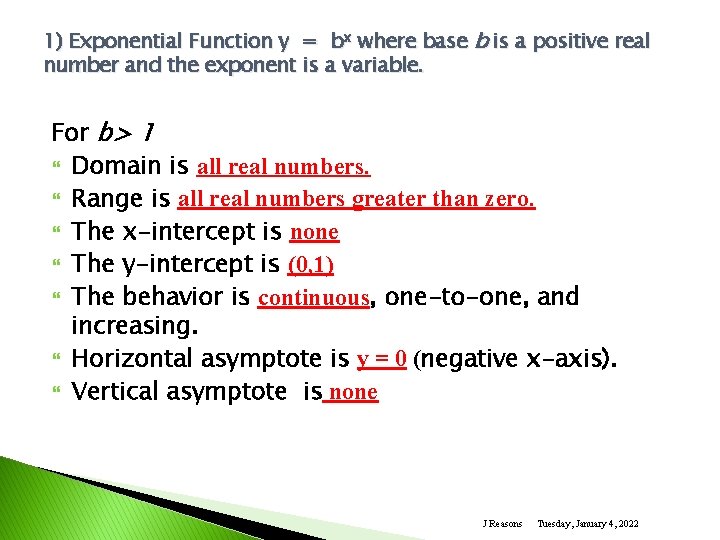
1) Exponential Function y = bx where base b is a positive real number and the exponent is a variable. For b> 1 Domain is all real numbers. Range is all real numbers greater than zero. The x-intercept is none The y-intercept is (0, 1) The behavior is continuous, one-to-one, and increasing. Horizontal asymptote is y = 0 (negative x-axis). Vertical asymptote is none J Reasons Tuesday, January 4, 2022
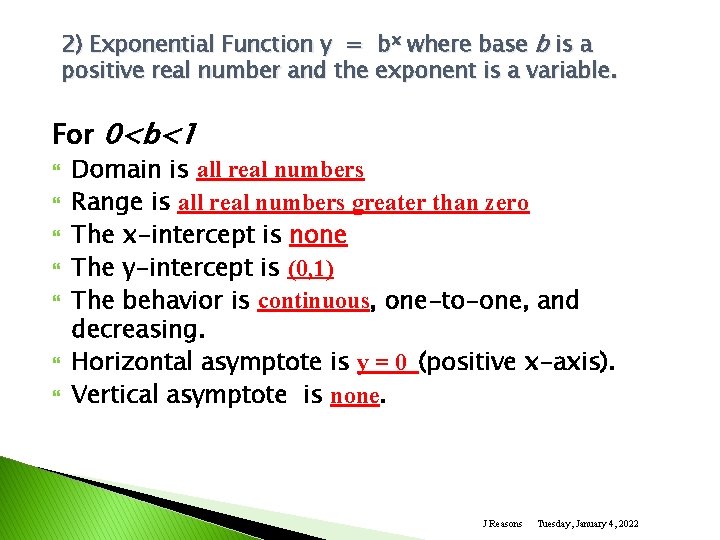
2) Exponential Function y = bx where base b is a positive real number and the exponent is a variable. For 0<b<1 Domain is all real numbers Range is all real numbers greater than zero The x-intercept is none The y-intercept is (0, 1) The behavior is continuous, one-to-one, and decreasing. Horizontal asymptote is y = 0 (positive x-axis). Vertical asymptote is none. J Reasons Tuesday, January 4, 2022
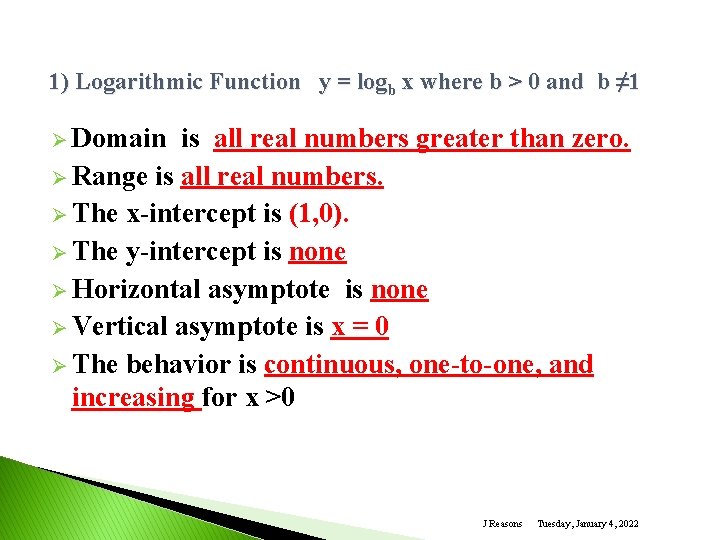
1) Logarithmic Function y = logb x where b > 0 and b ≠ 1 Ø Domain is all real numbers greater than zero. Ø Range is all real numbers. Ø The x-intercept is (1, 0). Ø The y-intercept is none Ø Horizontal asymptote is none Ø Vertical asymptote is x = 0 Ø The behavior is continuous, one-to-one, and increasing for x >0 J Reasons Tuesday, January 4, 2022
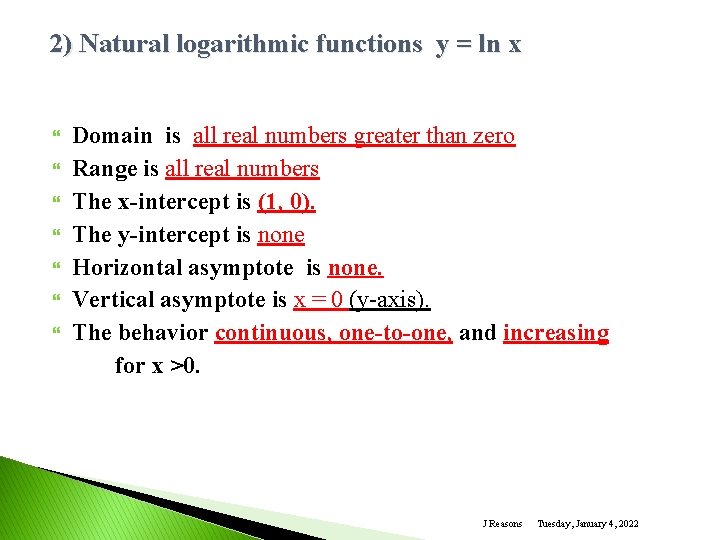
2) Natural logarithmic functions y = ln x Domain is all real numbers greater than zero Range is all real numbers The x-intercept is (1, 0). The y-intercept is none Horizontal asymptote is none. Vertical asymptote is x = 0 (y-axis). The behavior continuous, one-to-one, and increasing for x >0. J Reasons Tuesday, January 4, 2022
- Slides: 4