
1 Exp 1 Preparation of Specimens for Metallographic

- Slides: 16
1 Exp. 1: Preparation of Specimens for Metallographic Examination Eng. Ahmed Al-Afeefy Eng. Ahmed Y. Manama
2 Objective § To learn and gain experience in the preparation of metallographic specimens. § To examine and analyze the microstructures of metals and metallic alloys.
3 Introduction § Metallography is basically the study of the structures and constitution of metals and alloys, using metallurgical microscopes and magnifications, so that the physical and mechanical properties of an alloy can be related to its observed microstructure.
4 Introduction § Such microscopic studies can provide constitutional information about the specimen under investigation, including: • The size and shape of the grains, • The presence of micro defects, • The nature and distribution of secondary phases.
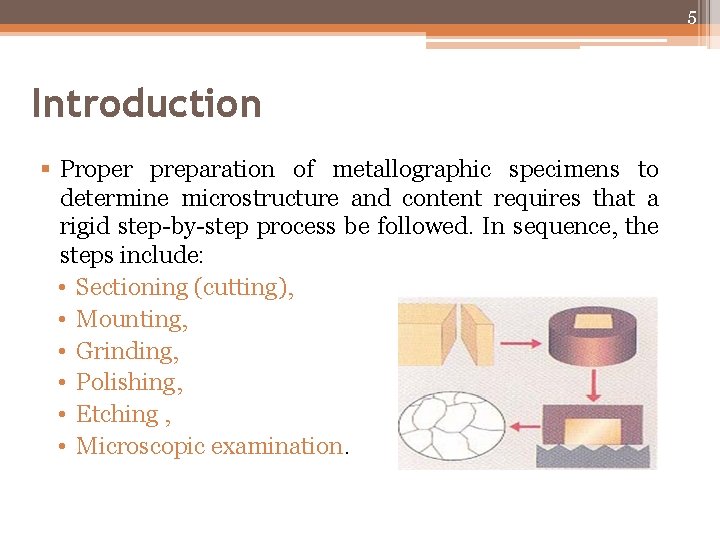
5 Introduction § Proper preparation of metallographic specimens to determine microstructure and content requires that a rigid step-by-step process be followed. In sequence, the steps include: • Sectioning (cutting), • Mounting, • Grinding, • Polishing, • Etching , • Microscopic examination.
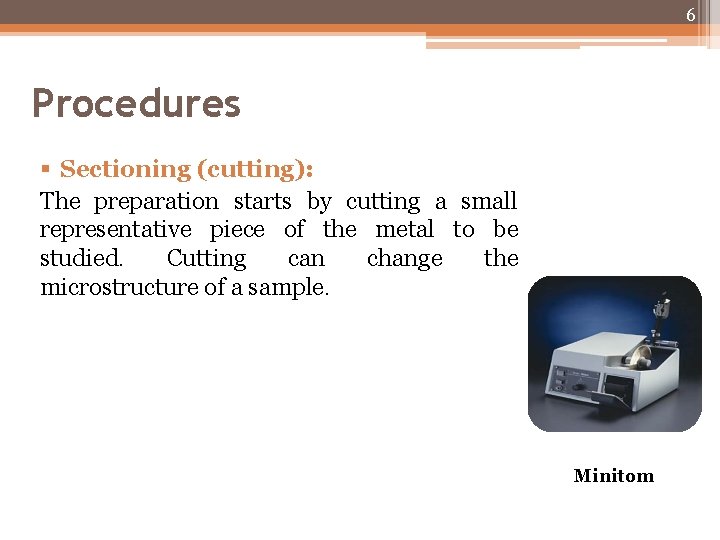
6 Procedures § Sectioning (cutting): The preparation starts by cutting a small representative piece of the metal to be studied. Cutting can change the microstructure of a sample. Minitom
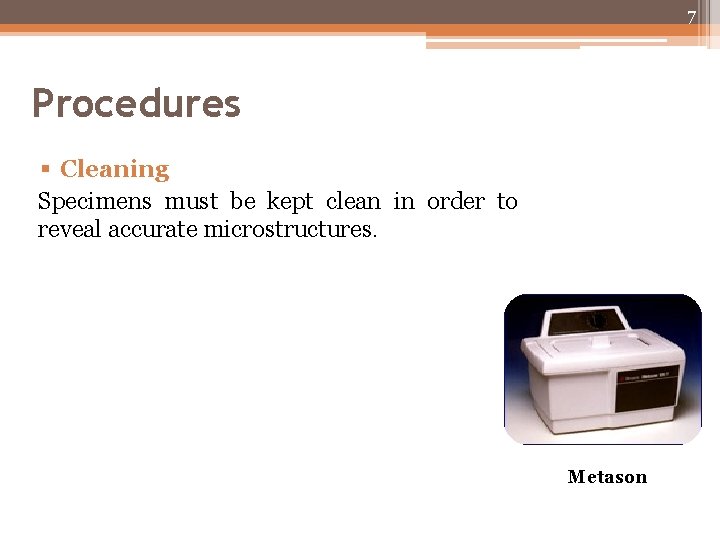
7 Procedures § Cleaning Specimens must be kept clean in order to reveal accurate microstructures. Metason
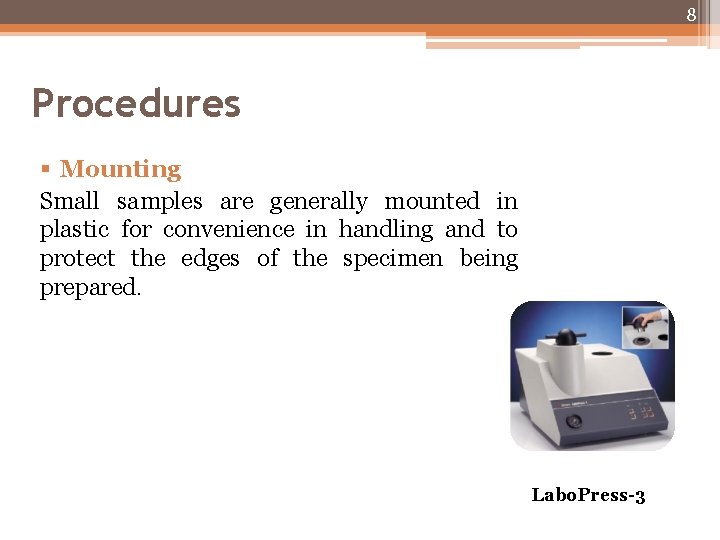
8 Procedures § Mounting Small samples are generally mounted in plastic for convenience in handling and to protect the edges of the specimen being prepared. Labo. Press-3
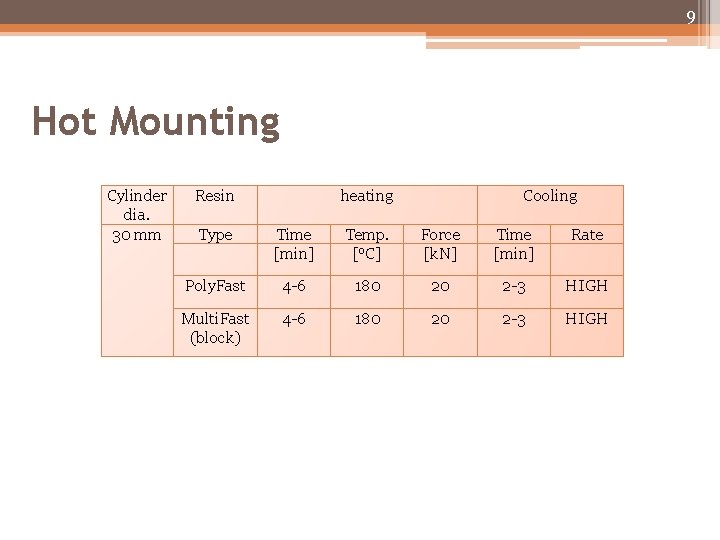
9 Hot Mounting Cylinder dia. 30 mm Resin heating Cooling Type Time [min] Temp. [o. C] Force [k. N] Time [min] Rate Poly. Fast 4 -6 180 20 2 -3 HIGH Multi. Fast (block) 4 -6 180 20 2 -3 HIGH
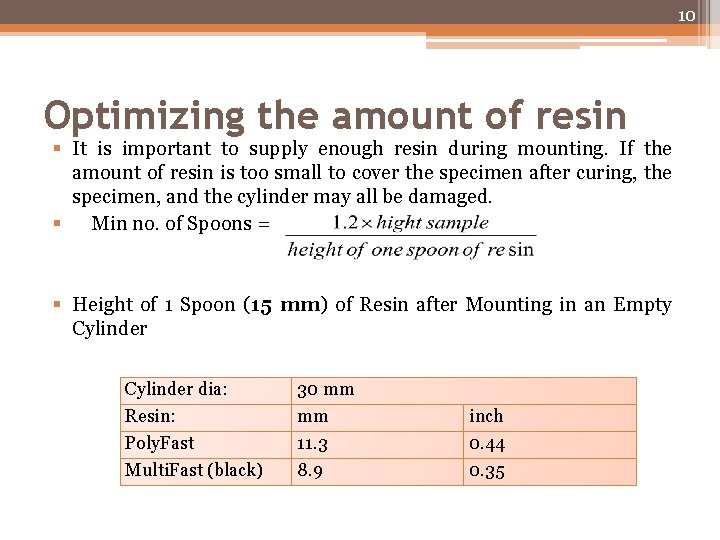
10 Optimizing the amount of resin § It is important to supply enough resin during mounting. If the amount of resin is too small to cover the specimen after curing, the specimen, and the cylinder may all be damaged. § Min no. of Spoons = § Height of 1 Spoon (15 mm) of Resin after Mounting in an Empty Cylinder dia: Resin: Poly. Fast Multi. Fast (black) 30 mm mm 11. 3 8. 9 inch 0. 44 0. 35
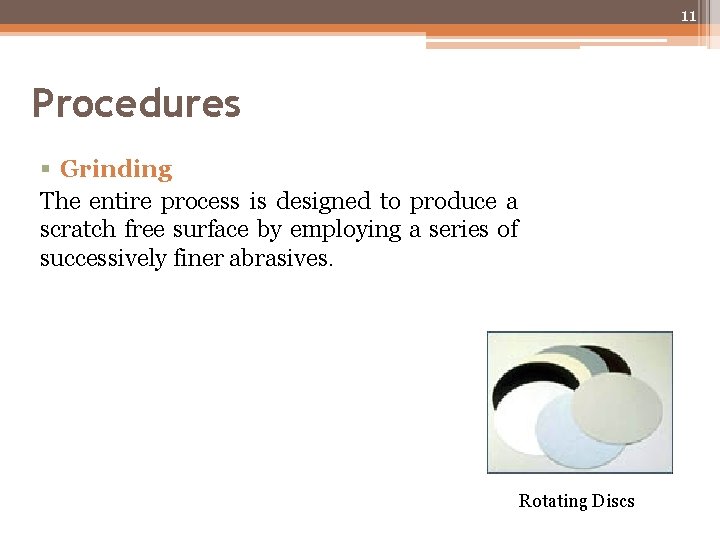
11 Procedures § Grinding The entire process is designed to produce a scratch free surface by employing a series of successively finer abrasives. Rotating Discs
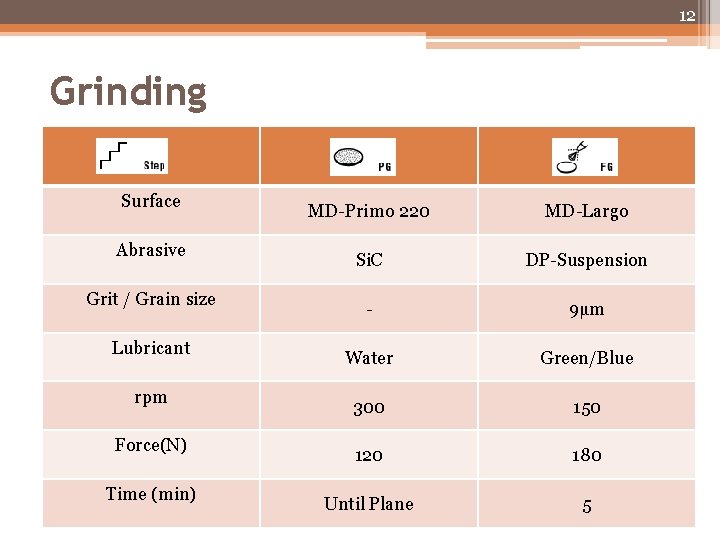
12 Grinding Surface Abrasive Grit / Grain size Lubricant rpm Force(N) Time (min) MD-Primo 220 MD-Largo Si. C DP-Suspension - 9µm Water Green/Blue 300 150 120 180 Until Plane 5
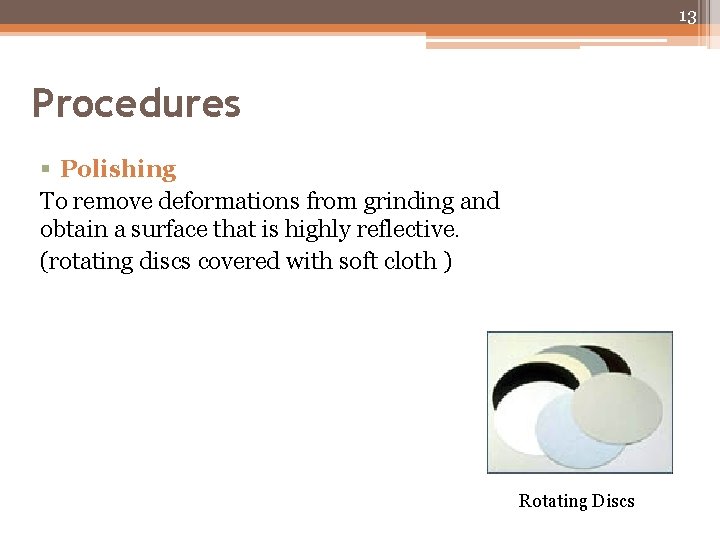
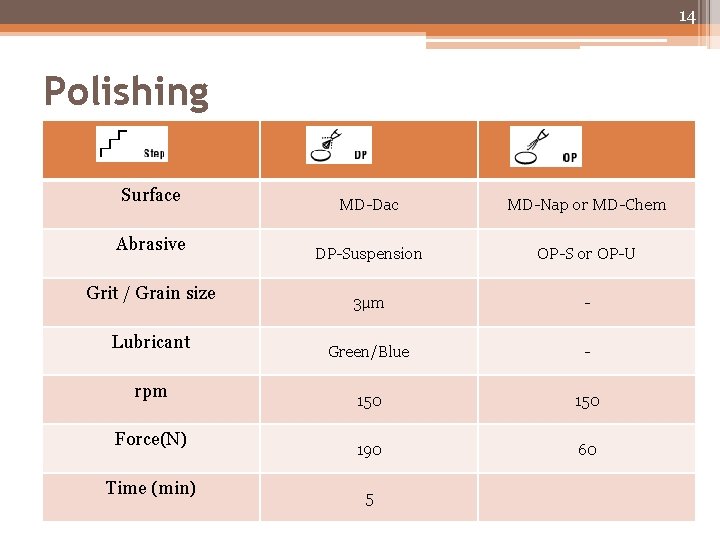
13 Procedures § Polishing To remove deformations from grinding and obtain a surface that is highly reflective. (rotating discs covered with soft cloth ) Rotating Discs
14 Polishing Surface Abrasive Grit / Grain size Lubricant rpm Force(N) Time (min) MD-Dac MD-Nap or MD-Chem DP-Suspension OP-S or OP-U 3µm - Green/Blue - 150 190 60 5
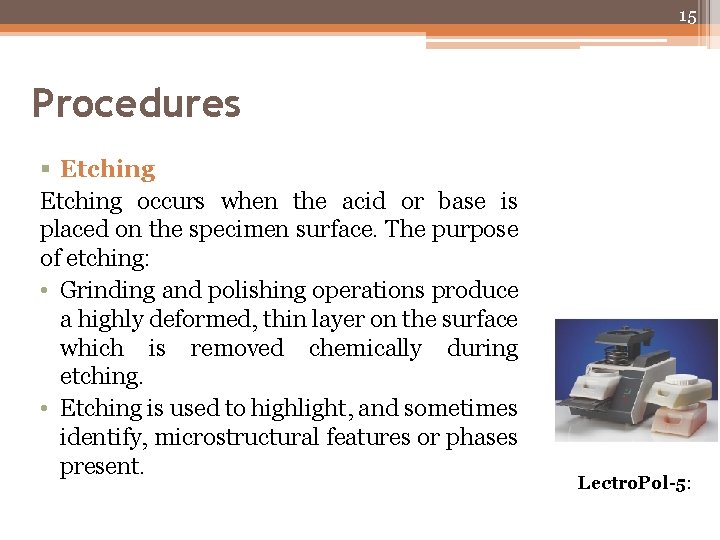
15 Procedures § Etching occurs when the acid or base is placed on the specimen surface. The purpose of etching: • Grinding and polishing operations produce a highly deformed, thin layer on the surface which is removed chemically during etching. • Etching is used to highlight, and sometimes identify, microstructural features or phases present. Lectro. Pol-5:
16 Procedures § Microscopic examination Next week