
1 EXCITABILITY 2 CONTRACTILITY 3 CONDUCTIVITY 4 TONICITY


1. EXCITABILITY 2. CONTRACTILITY 3. CONDUCTIVITY 4. TONICITY 5. REFRACTORY PERIOD

I. EXCITABILITY Definition: It is the change in potential and the consequent responses inherent to the tissues, in response to a stimulus. Stimulus: It is the change in the external environment bringing about excitation in an excitable tissue.

TYPES OF STIMULUS • • Electrical- commonly used in labs Mechanical Thermal Chemical
QUALITY OF STIMULUS • Strength of stimulus • Duration of stimulus
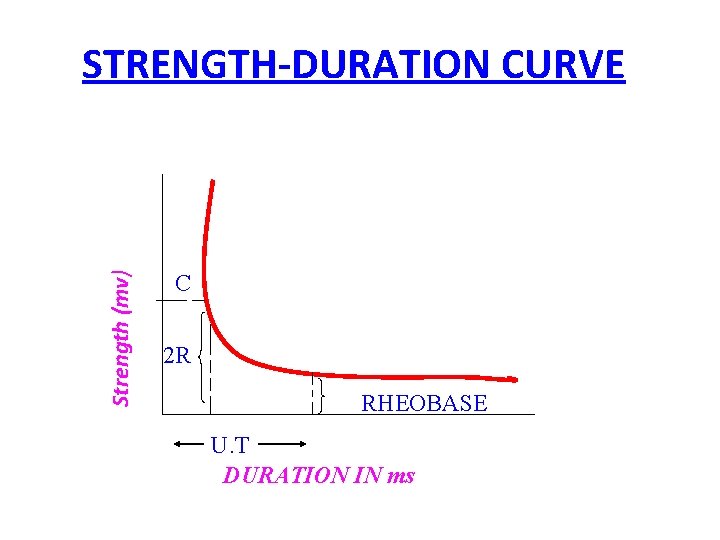
Strength (mv) STRENGTH-DURATION CURVE C 2 R RHEOBASE U. T DURATION IN ms
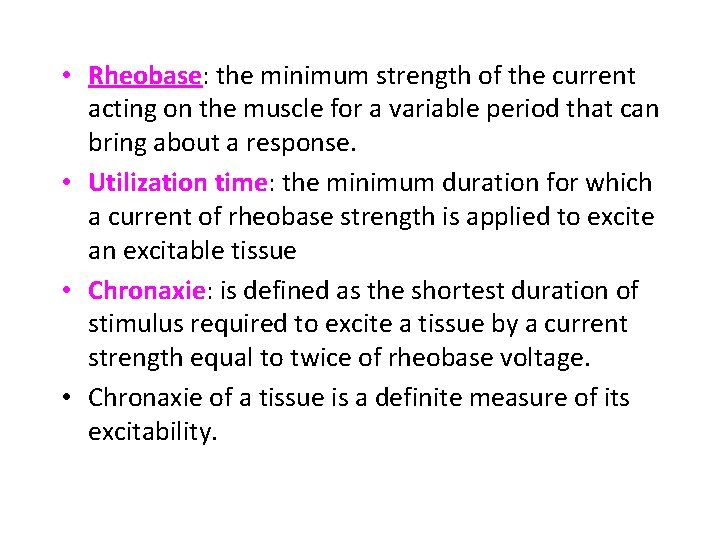
• Rheobase: the minimum strength of the current acting on the muscle for a variable period that can bring about a response. • Utilization time: the minimum duration for which a current of rheobase strength is applied to excite an excitable tissue • Chronaxie: is defined as the shortest duration of stimulus required to excite a tissue by a current strength equal to twice of rheobase voltage. • Chronaxie of a tissue is a definite measure of its excitability.
II. CONTRACTILITY • Def: internal events of the muscle which are manifested by shortening or development of tension or both. • Types of contraction: 1) isotonic contraction 2) isometric contraction
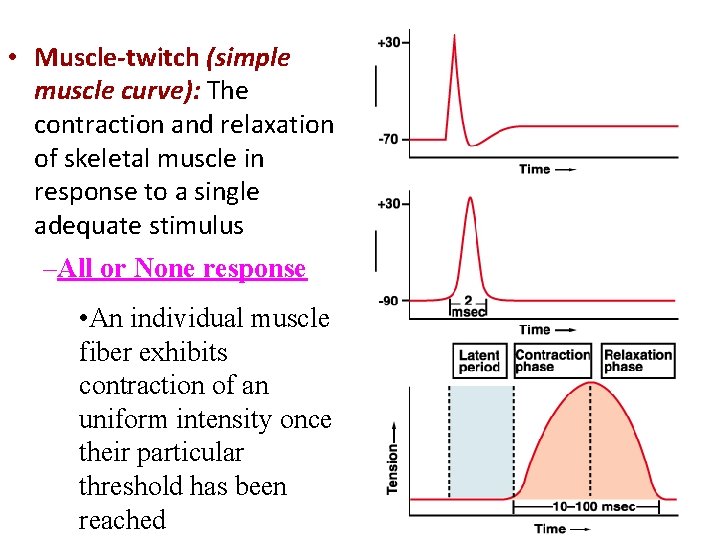
• Muscle-twitch (simple muscle curve): The contraction and relaxation of skeletal muscle in response to a single adequate stimulus –All or None response • An individual muscle fiber exhibits contraction of an uniform intensity once their particular threshold has been reached
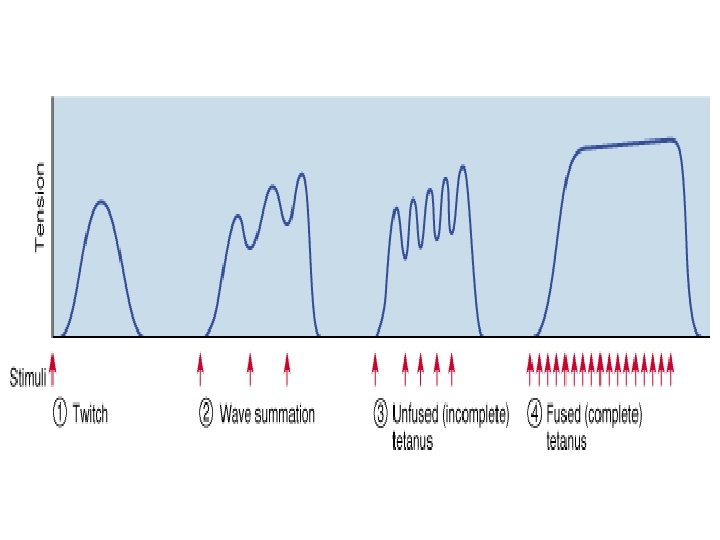
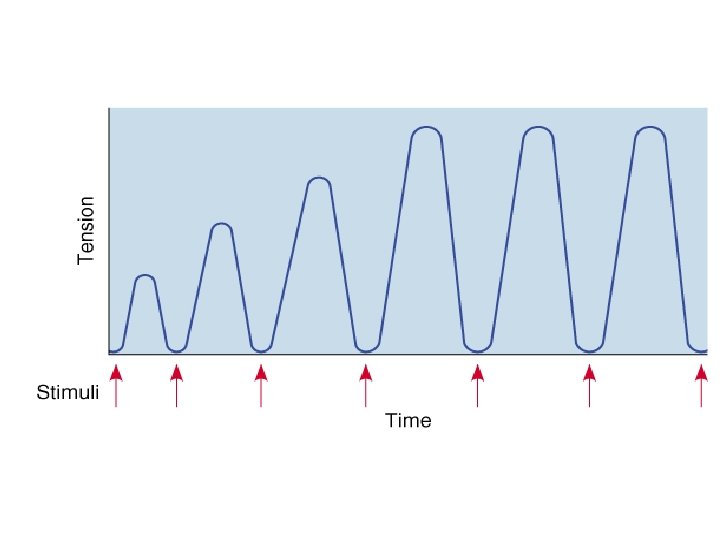
FACTORS AFFECTING CONTRACTION Effect of multiple stimuli: 1)effect of 2 successive stimuli: i) beneficial effect ii) superposition iii) summation 2) more than two stimuli: i) clonus ii) tetanus iii) treppe iv) fatigue
– Increase in the temperature –Decrease in the viscosity –Availability of more Ca++ –Ca ++ from the first contraction is not completely pumped into the saroplasmic reticulum –Second stimulus releases Ca ++ and adds to the remaining Ca ++ from the first contraction
FATIGUE • Definition: it is a decrease in the performance due to continuous and prolonged activity • Nerve is indefatigable
• Effect of load on muscle contraction • 1. Free-load • 2. After-load • Effect of temperature on muscle contraction • 1. Heat rigor • 2. Calcium rigor • 3. Rigor mortis
III. CONDUCTIVITY • Velocity of action potential conduction across skeletal muscle is 5 m/sec • In nerves it is up to 120 m/sec • Conduction is along the Sarcolemma and moves along the T-tubules
Ø V. REFRACTORY PERIOD a) Absolute refractory period b) Relative refractory period Whole of latent period is refractory Absolute refractory period (0. 05 sec) Relative refractory period (0. 05 sec) Totally it is 0. 1 sec
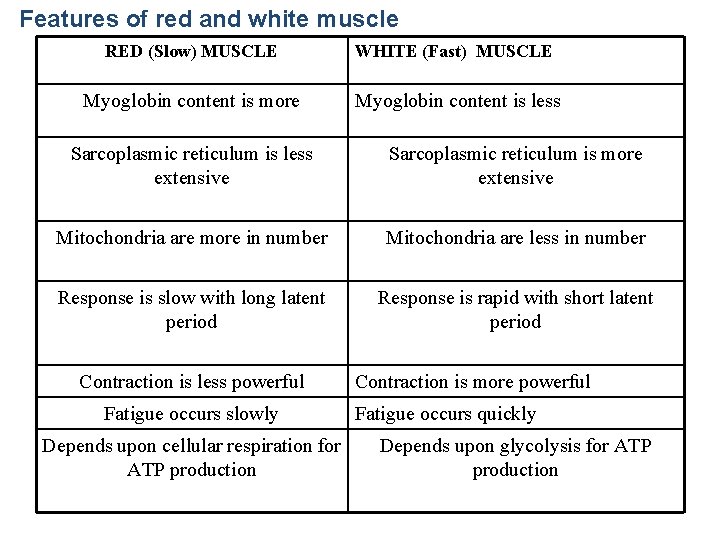
Features of red and white muscle RED (Slow) MUSCLE WHITE (Fast) MUSCLE Myoglobin content is more Myoglobin content is less Sarcoplasmic reticulum is less extensive Sarcoplasmic reticulum is more extensive Mitochondria are more in number Mitochondria are less in number Response is slow with long latent period Response is rapid with short latent period Contraction is less powerful Fatigue occurs slowly Depends upon cellular respiration for ATP production Contraction is more powerful Fatigue occurs quickly Depends upon glycolysis for ATP production
- Slides: 18