
1 EVENT BUSINESS LEVERAGING The Sydney 2000 Olympic
1 EVENT BUSINESS LEVERAGING: The Sydney 2000 Olympic Games Danny O’Brien, Ph. D. O’Brien, D. (2006). Strategic business leveraging: The Sydney 2000 Olympic Games. Annals of Tourism Research, 33(1) pp. 240 -261. doi: 10. 1016/j. annals. 2005. 10. 011
Learning objectives 2 Learning objectives include the following: 1. To understand the concept of strategic event leverage 2. To appreciate how events can be strategically leveraged for trade facilitation and foreign direct investment outcomes 3. To recognise that the benefits from large events can be extended far beyond host cities 4. To understand the role of alliance formation in event leverage 5. To consider how lessons from event business leveraging can be applied to leveraging for wider social and environmental outcomes from event hosting SMAANZ 2017
Introduction and Problem Statement You have a major event soon to be hosted in your city. Will economic benefits just ”happen”? 3 How can the massive public and commercial sector investments required to host such events be justified? By creating enduring economic (and other) benefits that last well beyond the event itself This requires getting beyond the “impact” mindset SMAANZ 2017
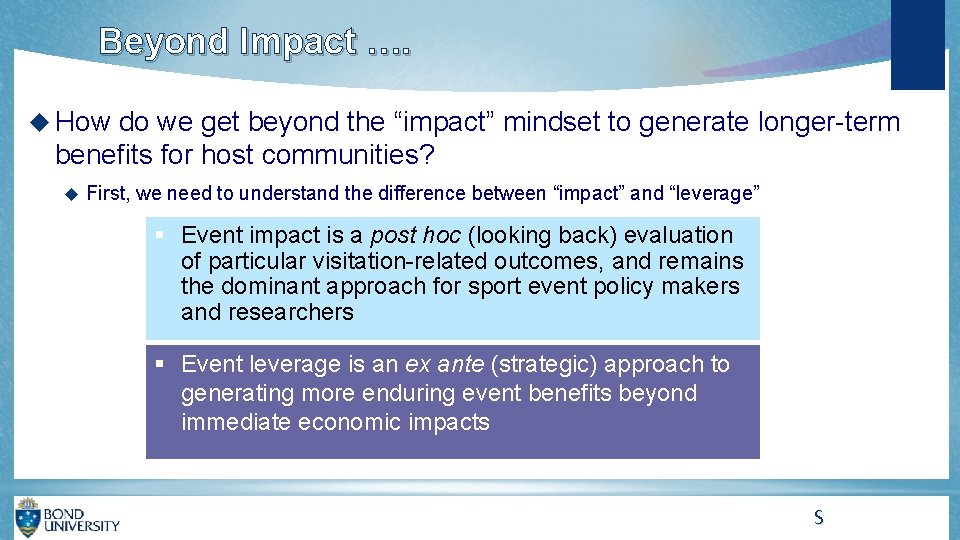
Beyond Impact …. How do we get beyond the “impact” mindset to generate longer-term benefits for host communities? First, we need to understand the difference between “impact” and “leverage” § Event impact is a post hoc (looking back) evaluation of particular visitation-related outcomes, and remains the dominant approach for sport event policy makers and researchers § Event leverage is an ex ante (strategic) approach to generating more enduring event benefits beyond immediate economic impacts SMAANZ 2017
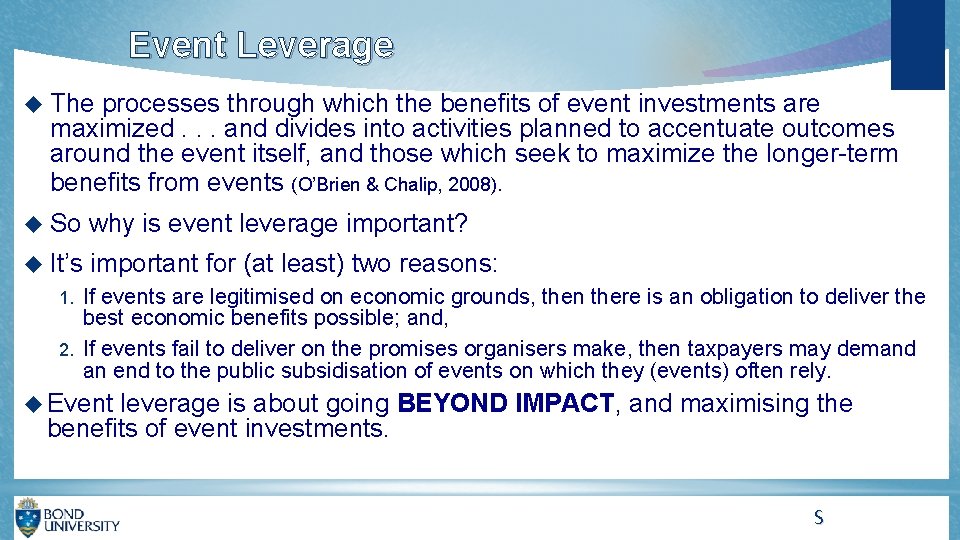
Event Leverage The processes through which the benefits of event investments are maximized. . . and divides into activities planned to accentuate outcomes around the event itself, and those which seek to maximize the longer-term benefits from events (O’Brien & Chalip, 2008). So why is event leverage important? It’s important for (at least) two reasons: 1. If events are legitimised on economic grounds, then there is an obligation to deliver the best economic benefits possible; and, 2. If events fail to deliver on the promises organisers make, then taxpayers may demand an end to the public subsidisation of events on which they (events) often rely. Event leverage is about going BEYOND IMPACT, and maximising the benefits of event investments. SMAANZ 2017
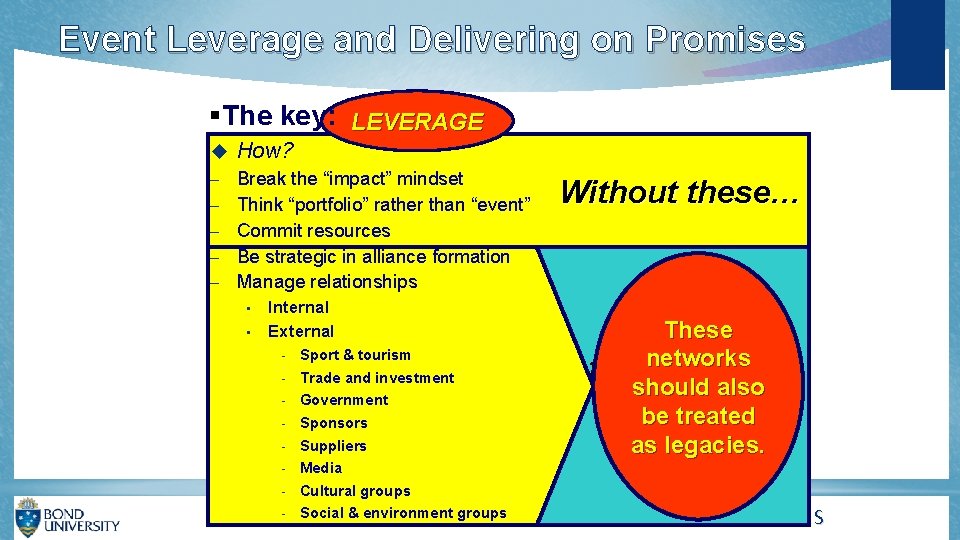
Event Leverage and Delivering on Promises §The key: LEVERAGE How? – Break the “impact” mindset Think “portfolio” rather than “event” Commit resources Be strategic in alliance formation Manage relationships – – • • Without these… Internal External - Sport & tourism - Trade and investment - Government - Sponsors - Suppliers - Media - Cultural groups - Social & environment groups … These thisnetworks becomes should also problematic be treated as legacies. SMAANZ 2017
Beyond Business Leverage …. Are there synergies among the tactics for business leverage that can apply to leverage for social and environmental outcomes? Who should drive and “own” such initiatives? Is it all about savvy alliance formation? If so, alliances among whom/what? Can we treat ecological issues in the same way as other forms of social change? Can smaller-scale, regional sport events and other sport tourism products generate similar benefits for their host communities as mega and hallmark sport events? Can they be leveraged in similar ways? SMAANZ 2017
Accentuating the Positive: Delivering on Promises “Mega events and the opportunities they present are merely the seed capital; what hosts do with that capital is the key to realizing sustainable longer-term legacies” (O’Brien, 2006, p. 258). SMAANZ 2017
- Slides: 8