
1 Establishing successful teacher learning communities Lessons learned
1 Establishing successful teacher learning communities: Lessons learned Dylan Wiliam International Conference on Assessment for Learning Fredericton, NB: 12 April 2014 www. dylanwiliam. net
Outline: five questions Where does formative assessment fit in? What makes effective teacher learning? How should teacher meetings be organized? What doesn’t get done? How do we know it’s working?
3 What makes effective teacher learning?
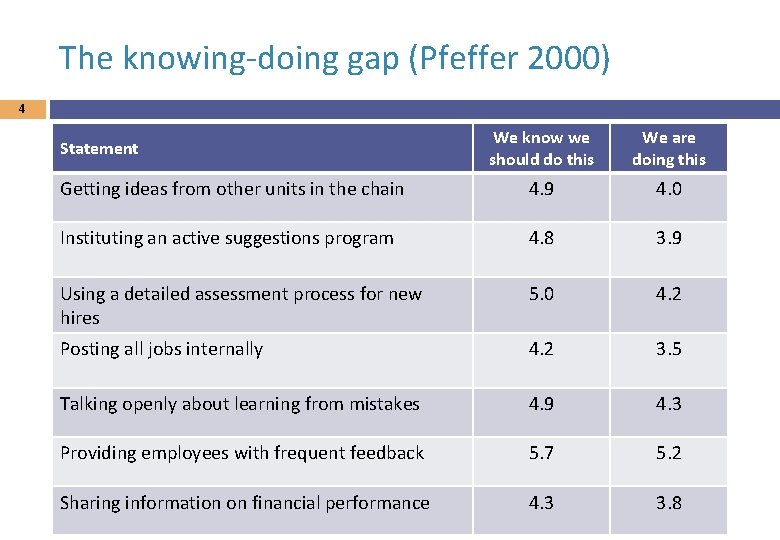
The knowing-doing gap (Pfeffer 2000) 4 We know we should do this We are doing this Getting ideas from other units in the chain 4. 9 4. 0 Instituting an active suggestions program 4. 8 3. 9 Using a detailed assessment process for new hires 5. 0 4. 2 Posting all jobs internally 4. 2 3. 5 Talking openly about learning from mistakes 4. 9 4. 3 Providing employees with frequent feedback 5. 7 5. 2 Sharing information on financial performance 4. 3 3. 8 Statement
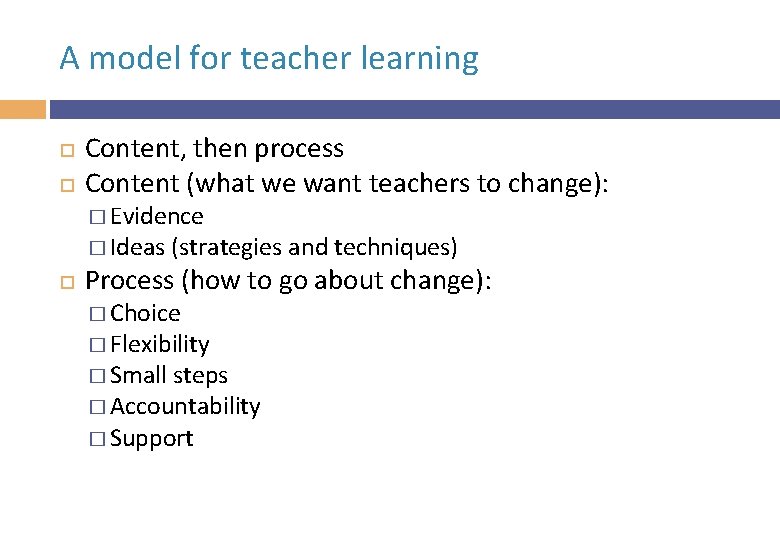
A model for teacher learning Content, then process Content (what we want teachers to change): � Evidence � Ideas (strategies and techniques) Process (how to go about change): � Choice � Flexibility � Small steps � Accountability � Support
6 Choice
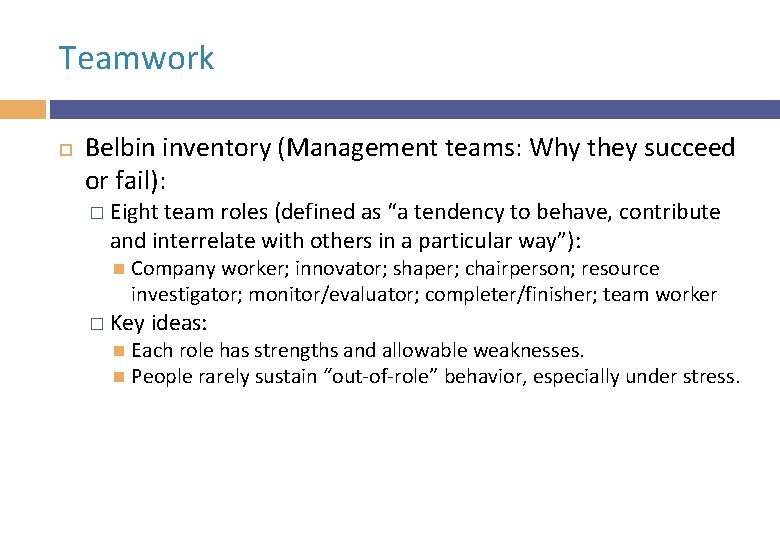
Teamwork Belbin inventory (Management teams: Why they succeed or fail): � Eight team roles (defined as “a tendency to behave, contribute and interrelate with others in a particular way”): Company worker; innovator; shaper; chairperson; resource investigator; monitor/evaluator; completer/finisher; team worker � Key ideas: Each role has strengths and allowable weaknesses. People rarely sustain “out-of-role” behavior, especially under stress.
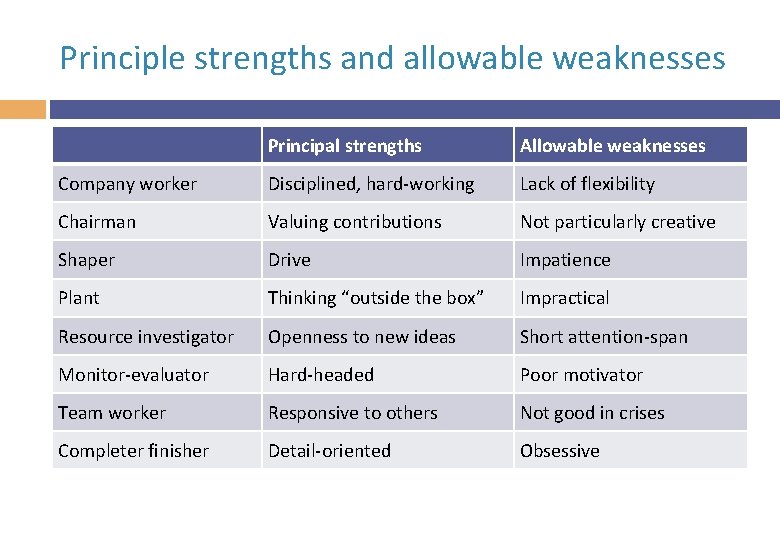
Principle strengths and allowable weaknesses Principal strengths Allowable weaknesses Company worker Disciplined, hard-working Lack of flexibility Chairman Valuing contributions Not particularly creative Shaper Drive Impatience Plant Thinking “outside the box” Impractical Resource investigator Openness to new ideas Short attention-span Monitor-evaluator Hard-headed Poor motivator Team worker Responsive to others Not good in crises Completer finisher Detail-oriented Obsessive
9 Flexibility

Context matters…

11
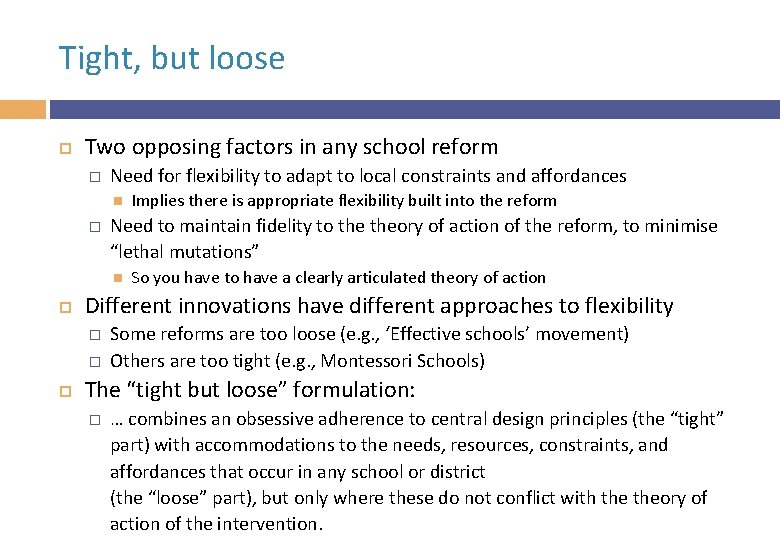
Tight, but loose Two opposing factors in any school reform � Need for flexibility to adapt to local constraints and affordances � Need to maintain fidelity to theory of action of the reform, to minimise “lethal mutations” So you have to have a clearly articulated theory of action Different innovations have different approaches to flexibility � � Implies there is appropriate flexibility built into the reform Some reforms are too loose (e. g. , ‘Effective schools’ movement) Others are too tight (e. g. , Montessori Schools) The “tight but loose” formulation: � … combines an obsessive adherence to central design principles (the “tight” part) with accommodations to the needs, resources, constraints, and affordances that occur in any school or district (the “loose” part), but only where these do not conflict with theory of action of the intervention.
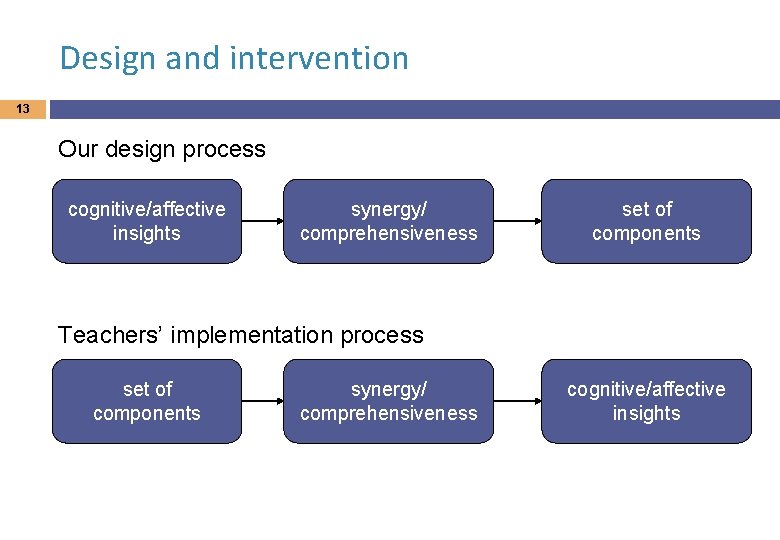
Design and intervention 13 Our design process cognitive/affective insights synergy/ comprehensiveness set of components Teachers’ implementation process set of components synergy/ comprehensiveness cognitive/affective insights
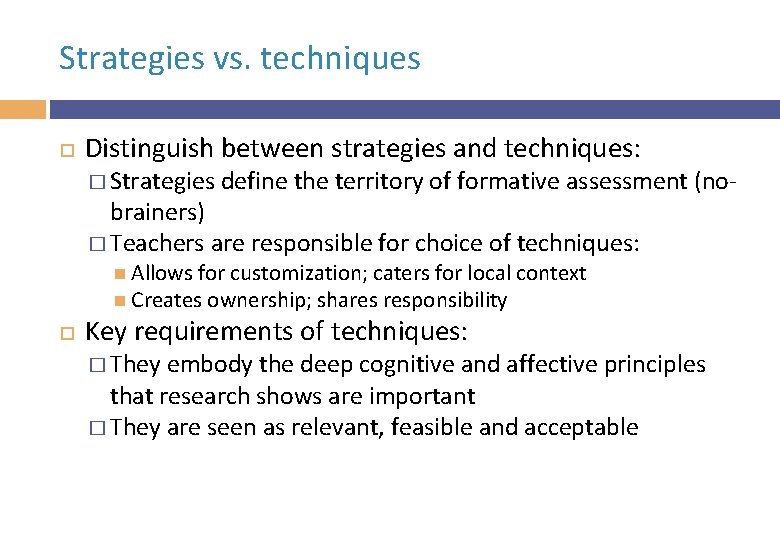
Strategies vs. techniques Distinguish between strategies and techniques: � Strategies define the territory of formative assessment (no- brainers) � Teachers are responsible for choice of techniques: Allows for customization; caters for local context Creates ownership; shares responsibility Key requirements of techniques: � They embody the deep cognitive and affective principles that research shows are important � They are seen as relevant, feasible and acceptable
15 Small steps
Why is teacher change so slow? Because of the nature of teacher expertise According to Berliner (1994), experts: � excel mainly in their own domain � develop automaticity for operations needed for their goals � are more sensitive to the task demands and social situations � are more opportunistic and flexible than novices � represent problems in qualitatively different ways than novices � have faster and more accurate pattern recognition capabilities � see richer patterns in the areas of their expertise � begin to solve problems slower but bring richer and more personal sources of information to bear
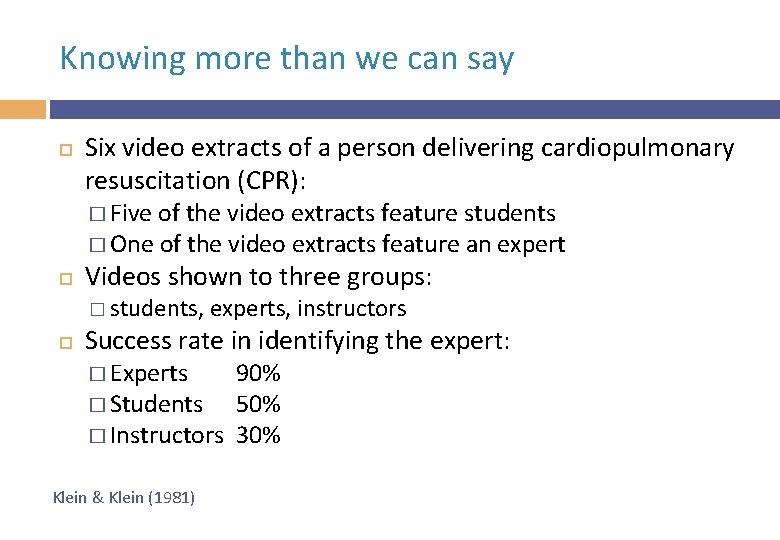
Knowing more than we can say Six video extracts of a person delivering cardiopulmonary resuscitation (CPR): � Five of the video extracts feature students � One of the video extracts feature an expert Videos shown to three groups: � students, experts, instructors Success rate in identifying the expert: � Experts 90% � Students 50% � Instructors 30% Klein & Klein (1981)
Looking at the wrong knowledge The most powerful teacher knowledge is not explicit: That’s why telling teachers what to do doesn’t work � What we know is more than we can say � And that is why most professional development has been relatively ineffective � Improving practice involves changing habits, not adding knowledge: � That’s why it’s hard � And the hardest bit is not getting new ideas into people’s heads It’s getting the old ones out That’s why it takes time But it doesn’t happen naturally: � If it did, the most experienced teachers would be the most productive, and that’s not true (Hanushek & Rivkin, 2006)
Changing, not sharing, practice The knowing-doing gap Teachers don’t need new ideas Teachers need support in implementing the ideas they already have
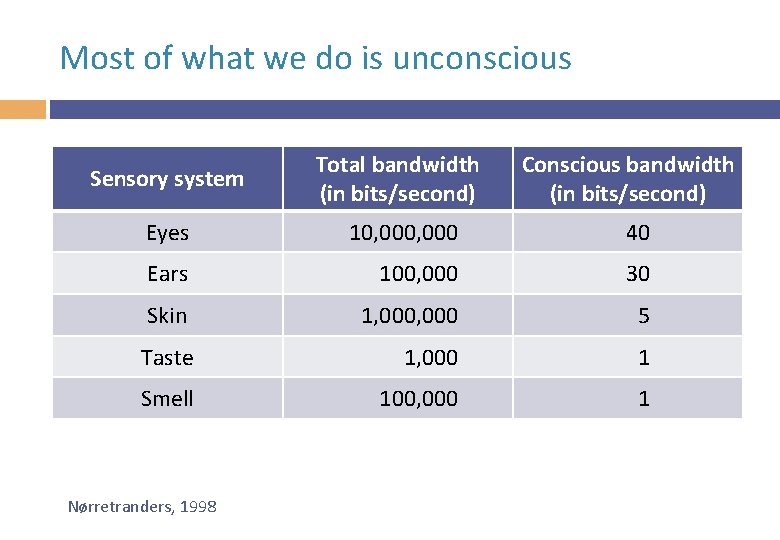
Most of what we do is unconscious Sensory system Total bandwidth (in bits/second) Eyes 10, 000 40 Ears 100, 000 30 Skin 1, 000 5 Taste 1, 000 1 Smell 100, 000 1 Nørretranders, 1998 Conscious bandwidth (in bits/second)
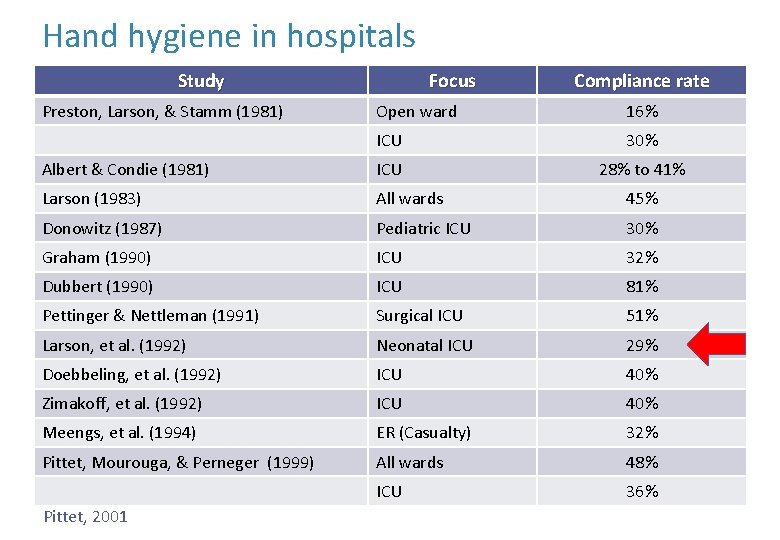
Hand hygiene in hospitals Study Preston, Larson, & Stamm (1981) Focus Compliance rate Open ward 16% ICU 30% Albert & Condie (1981) ICU 28% to 41% Larson (1983) All wards 45% Donowitz (1987) Pediatric ICU 30% Graham (1990) ICU 32% Dubbert (1990) ICU 81% Pettinger & Nettleman (1991) Surgical ICU 51% Larson, et al. (1992) Neonatal ICU 29% Doebbeling, et al. (1992) ICU 40% Zimakoff, et al. (1992) ICU 40% Meengs, et al. (1994) ER (Casualty) 32% Pittet, Mourouga, & Perneger (1999) All wards 48% ICU 36% Pittet, 2001
22 Accountability/Support
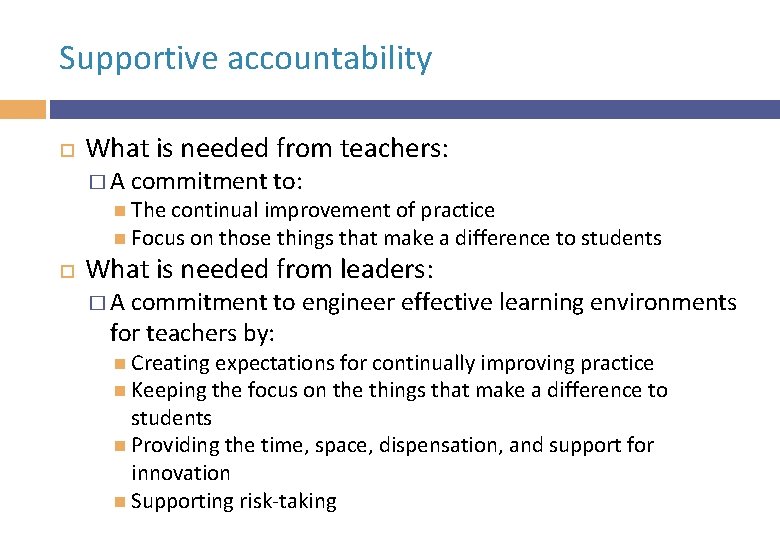
Supportive accountability What is needed from teachers: �A commitment to: The continual improvement of practice Focus on those things that make a difference to students What is needed from leaders: �A commitment to engineer effective learning environments for teachers by: Creating expectations for continually improving practice Keeping the focus on the things that make a difference to students Providing the time, space, dispensation, and support for innovation Supporting risk-taking
Planning question: 24 What are the most important things you can do to support teachers in taking risks to improve their teaching?
25 Teacher learning communities
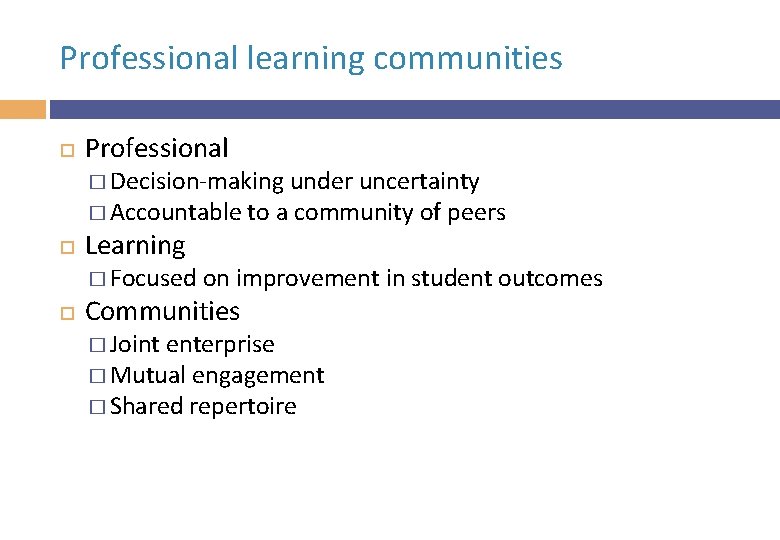
Professional learning communities Professional � Decision-making under uncertainty � Accountable to a community of peers Learning � Focused on improvement in student outcomes Communities � Joint enterprise � Mutual engagement � Shared repertoire
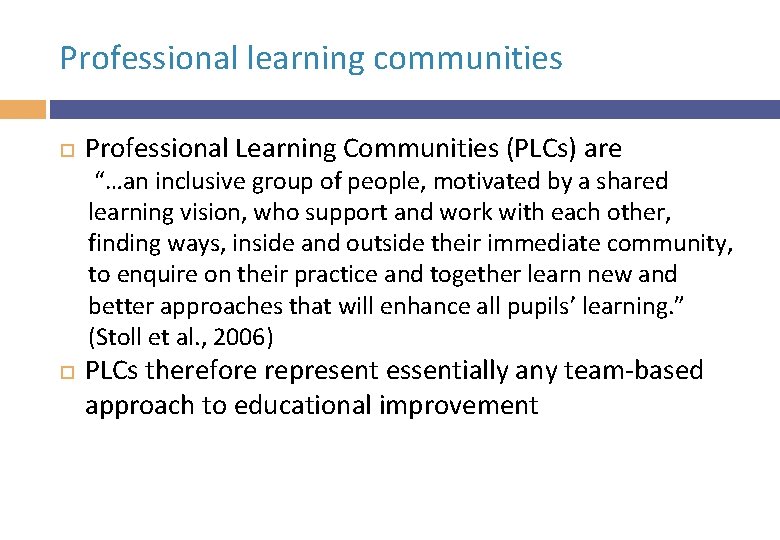
Professional learning communities Professional Learning Communities (PLCs) are “…an inclusive group of people, motivated by a shared learning vision, who support and work with each other, finding ways, inside and outside their immediate community, to enquire on their practice and together learn new and better approaches that will enhance all pupils’ learning. ” (Stoll et al. , 2006) PLCs therefore represent essentially any team-based approach to educational improvement
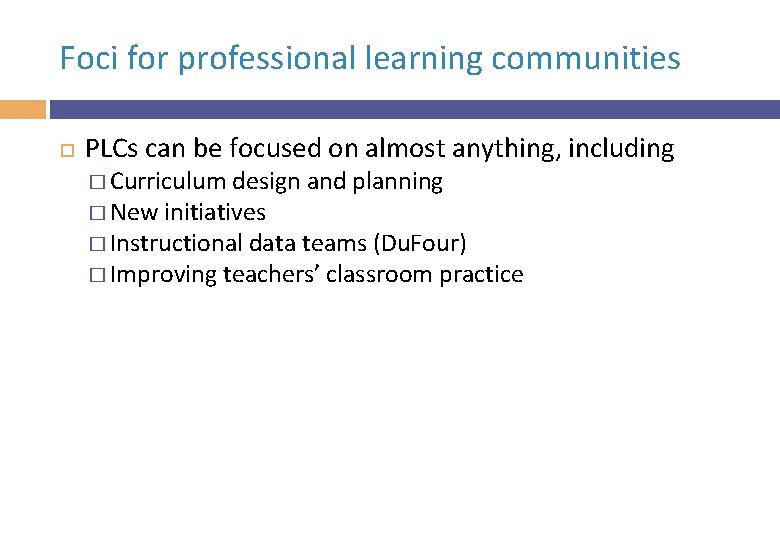
Foci for professional learning communities PLCs can be focused on almost anything, including � Curriculum design and planning � New initiatives � Instructional data teams (Du. Four) � Improving teachers’ classroom practice
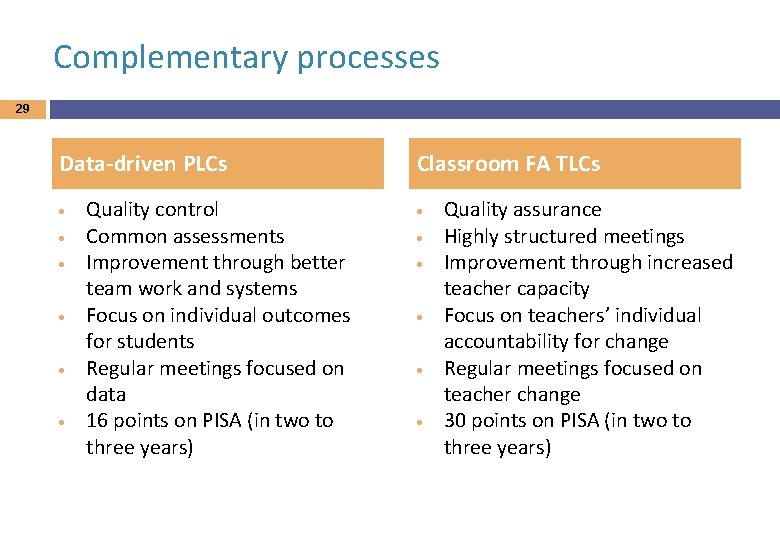
Complementary processes 29 Data-driven PLCs Quality control Common assessments Improvement through better team work and systems Focus on individual outcomes for students Regular meetings focused on data 16 points on PISA (in two to three years) Classroom FA TLCs Quality assurance Highly structured meetings Improvement through increased teacher capacity Focus on teachers’ individual accountability for change Regular meetings focused on teacher change 30 points on PISA (in two to three years)
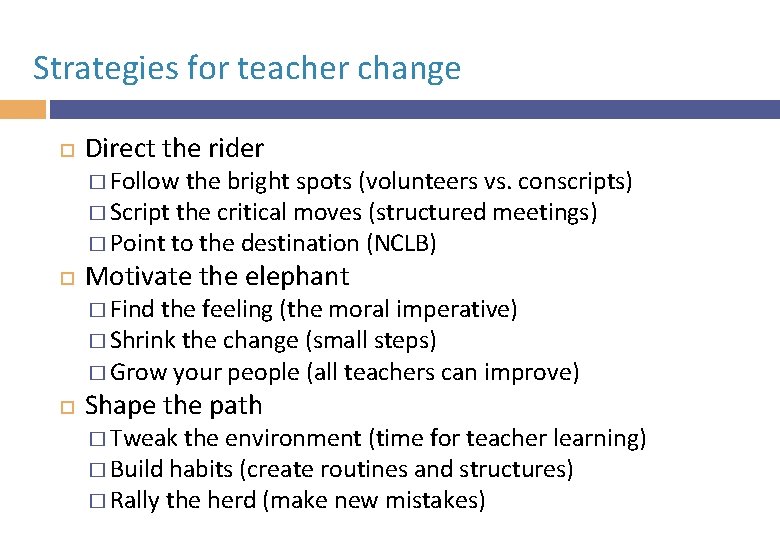
Strategies for teacher change Direct the rider � Follow the bright spots (volunteers vs. conscripts) � Script the critical moves (structured meetings) � Point to the destination (NCLB) Motivate the elephant � Find the feeling (the moral imperative) � Shrink the change (small steps) � Grow your people (all teachers can improve) Shape the path � Tweak the environment (time for teacher learning) � Build habits (create routines and structures) � Rally the herd (make new mistakes)
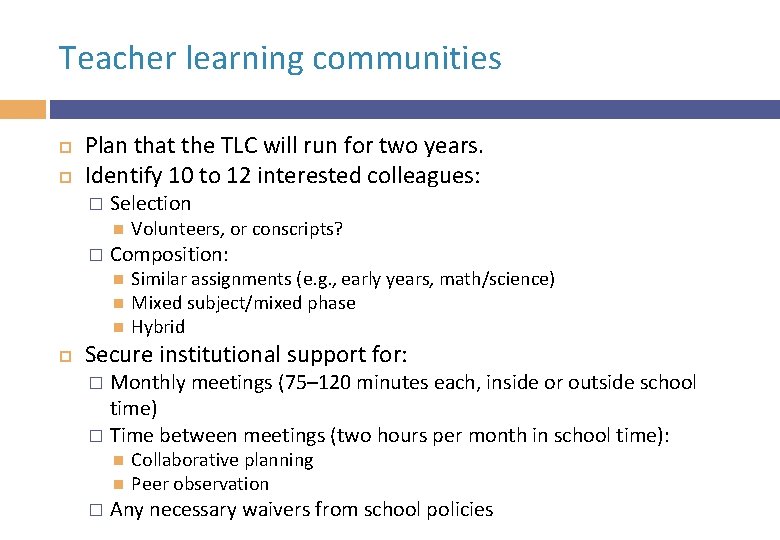
Teacher learning communities Plan that the TLC will run for two years. Identify 10 to 12 interested colleagues: � Selection � Composition: Volunteers, or conscripts? Similar assignments (e. g. , early years, math/science) Mixed subject/mixed phase Hybrid Secure institutional support for: Monthly meetings (75– 120 minutes each, inside or outside school time) � Time between meetings (two hours per month in school time): � � Collaborative planning Peer observation Any necessary waivers from school policies
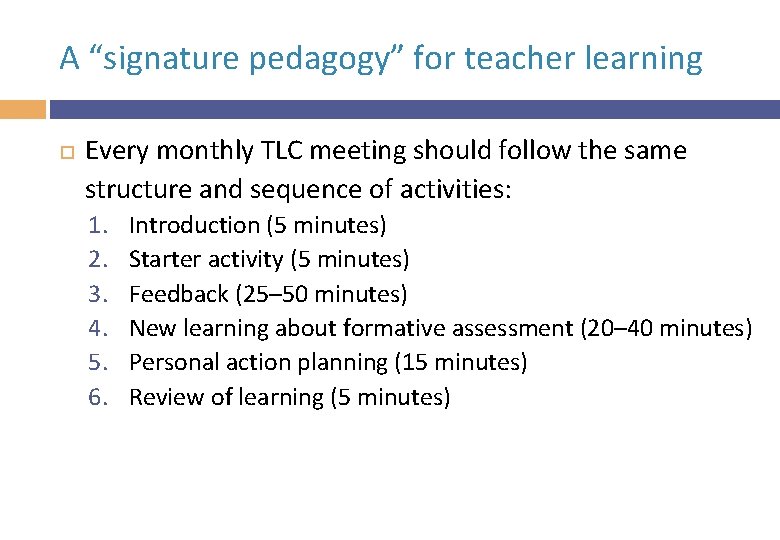
A “signature pedagogy” for teacher learning Every monthly TLC meeting should follow the same structure and sequence of activities: 1. 2. 3. 4. 5. 6. Introduction (5 minutes) Starter activity (5 minutes) Feedback (25– 50 minutes) New learning about formative assessment (20– 40 minutes) Personal action planning (15 minutes) Review of learning (5 minutes)
Activities 1, 2, 3, 5, 6: “Bookends” For each of these five activities, the process is exactly the same at each TLC meeting This provides a familiar structure for teachers to get better together � As the structure fades into the background, � The learning comes into the foreground Teachers come to the meeting knowing what is expected of them
Ground-rules for TLCs Norms of collaboration (Garmston & Wellman, 1999) Seven powerful Ps � Pausing � Paraphrasing � Probing � Putting ideas on the table (and pulling them off!) � Paying attention to self and others � Presuming positive intentions � Pursuing a balance between advocacy and inquiry
Activity 1: Introduction Sharing learning intentions for the meeting
Activity 2: Starter A variety of warm-up activities to get participants’ minds to the meeting: � Think of something you are looking forward to this year � 30 seconds to get “things off your chest” about what infuriates you about your job � 30 seconds to tell the group about something that happened within the last month and made you feel good � Think of something that happened in a lesson this year that made you smile � Think of something that one of your colleagues did last term that supported you � Go back to the TLC ‘ground rules’
Activity 3: Feedback Routines need to be established, expectations shared, and structure maintained. Similar expectations regarding preparation and engagement. � Come to the meeting knowing you will be sharing your own Af. L experiences. � Be prepared to offer constructive, thoughtfully conceived feedback to colleagues. � Be prepared to challenge ideas that may be good classroom practice but are not necessarily tightly related to formative assessment.
Activity 4: New learning about formative assessment ‘Drip-feed’ of new ideas, to increase knowledge, and to produce variety � Watch videos of classroom practice � Book study (e. g. , one chapter each month) � New formative assessment techniques
Activity 5: Personal action planning Each teacher updates his or her personal action plan Makes a specific commitment about what they will do over the coming month Arranges any support needed from colleagues � Specific date and time for peer observation
Activity 6: Wrap Did the meeting meet its intended objectives � If yes, great � If no, time to plan what to do about it
Every TLC needs a leader The job of the TLC leader(s): � To ensure that all necessary resources (including refreshments!) are available at meetings � To ensure that the agenda is followed � To maintain a collegial and supportive environment But most important of all: � It is not to be the formative assessment “expert. ”
Peer observation Run to the agenda of the observed, not the observer: � Observed teacher specifies focus of observation: � Observed teacher specifies what counts as evidence: E. g. , teacher wants to increase wait time. Provides observer with a stopwatch to log wait times. � Observed teacher owns any notes made during the observation.
Making time to “sharpen the saw”
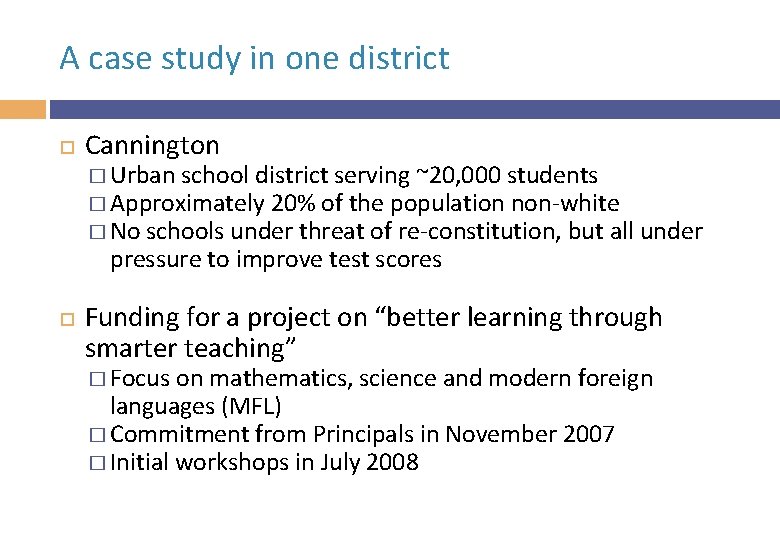
A case study in one district Cannington � Urban school district serving ~20, 000 students � Approximately 20% of the population non-white � No schools under threat of re-constitution, but all under pressure to improve test scores Funding for a project on “better learning through smarter teaching” � Focus on mathematics, science and modern foreign languages (MFL) � Commitment from Principals in November 2007 � Initial workshops in July 2008
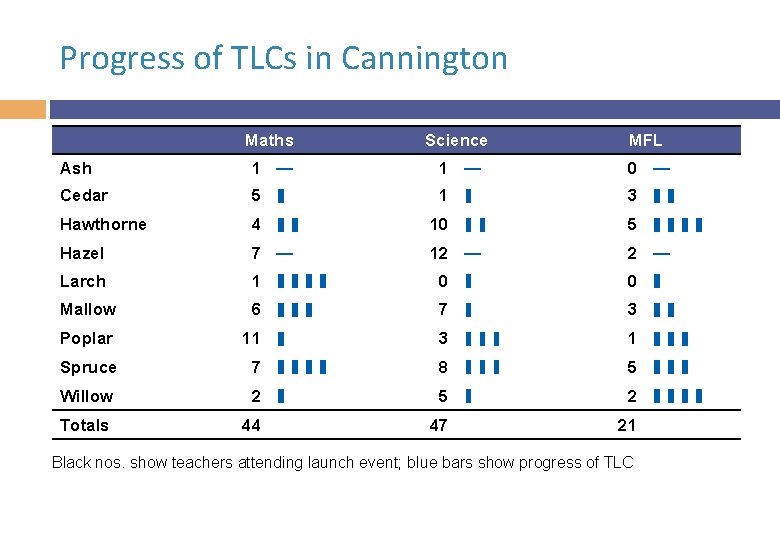
Progress of TLCs in Cannington Maths Science MFL Ash 1 — 0 — Cedar 5 ▮ 1 ▮ 3 ▮▮ Hawthorne 4 ▮▮ 10 ▮ ▮ 5 ▮▮▮▮ Hazel 7 — 12 — Larch 1 ▮▮▮▮ 0 ▮ Mallow 6 ▮▮▮ 7 ▮ 3 ▮▮▮ 1 ▮▮▮ Poplar 11 ▮ Spruce 7 ▮▮▮▮ 8 ▮▮▮ 5 ▮▮▮ Willow 2 ▮ 5 ▮ 2 ▮▮▮▮ Totals 44 47 21 Black nos. show teachers attending launch event; blue bars show progress of TLC
Planning Question: 46 What activities within your control will you give up or do less of to make formative assessment a priority?
47 How will we know if it’s working?
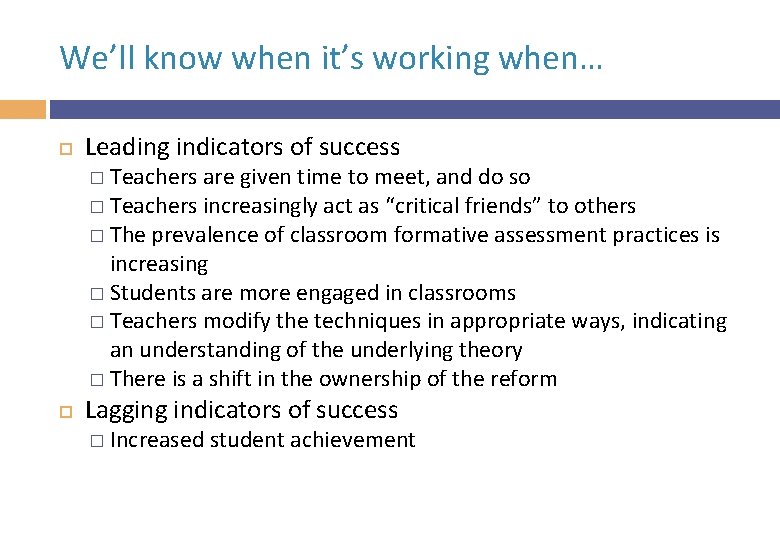
We’ll know when it’s working when… Leading indicators of success � Teachers are given time to meet, and do so � Teachers increasingly act as “critical friends” to others � The prevalence of classroom formative assessment practices is increasing � Students are more engaged in classrooms � Teachers modify the techniques in appropriate ways, indicating an understanding of the underlying theory � There is a shift in the ownership of the reform Lagging indicators of success � Increased student achievement
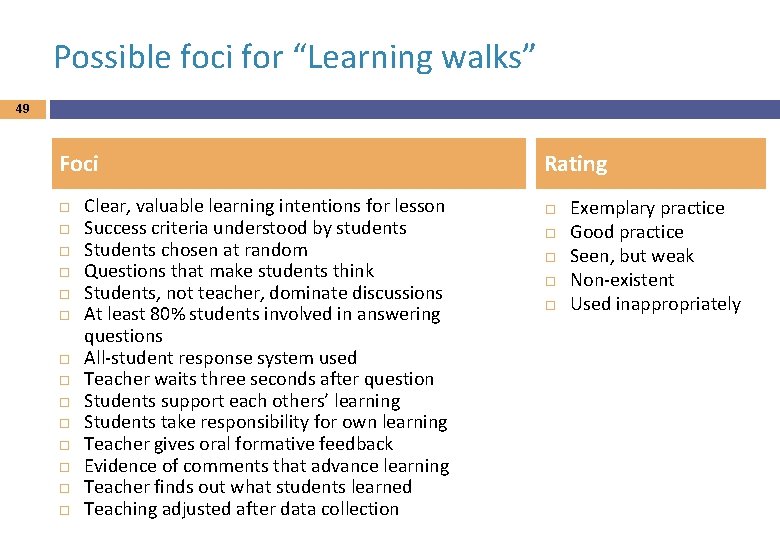
Possible foci for “Learning walks” 49 Foci Clear, valuable learning intentions for lesson Success criteria understood by students Students chosen at random Questions that make students think Students, not teacher, dominate discussions At least 80% students involved in answering questions All-student response system used Teacher waits three seconds after question Students support each others’ learning Students take responsibility for own learning Teacher gives oral formative feedback Evidence of comments that advance learning Teacher finds out what students learned Teaching adjusted after data collection Rating Exemplary practice Good practice Seen, but weak Non-existent Used inappropriately
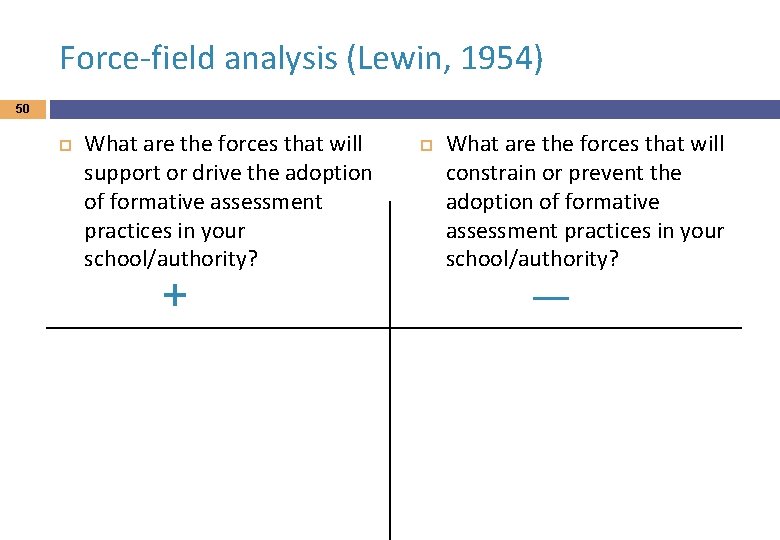
Force-field analysis (Lewin, 1954) 50 What are the forces that will support or drive the adoption of formative assessment practices in your school/authority? + What are the forces that will constrain or prevent the adoption of formative assessment practices in your school/authority? —
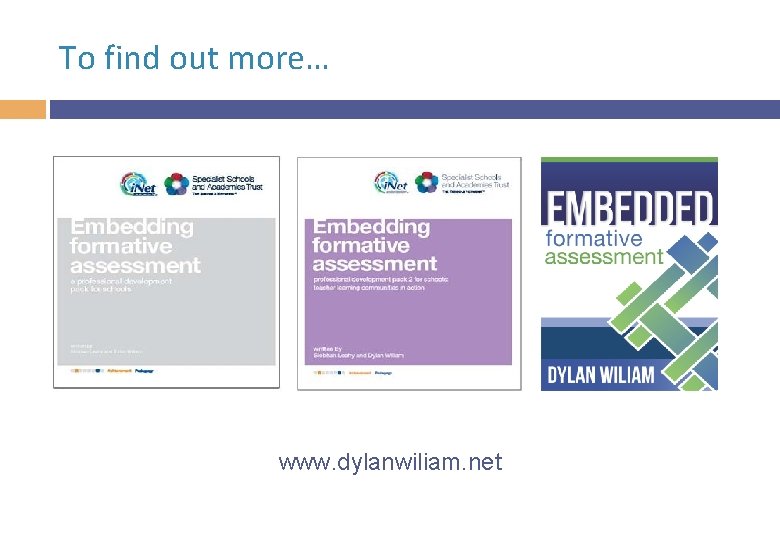
To find out more… www. dylanwiliam. net
52 Thank You www. dylanwiliam. net
- Slides: 52