
1 Essential ideas 1 5 Measurement uncertainty accuracy
- Slides: 9
1. Essential ideas 1. 5 Measurement, uncertainty, accuracy & precision • • Define accuracy & precision Distinguish exact & inexact numbers Correctly represent uncertainty in quantities using significant figures Apply proper rounding rules to computed quantities
Exact vs. inexact numbers Exact numbers don’t have uncertainty. 1. Counted values: 5 books on the table 1. Conversion factors: 12 inches / foot What about enormous numbers? • Grains of sand on a beach? • Stars in the sky? 13 Because they are exact, conversion factors don’t affect significant figures. Inexact numbers: measured by instruments • Inexact numbers have uncertainty. Imagine that I gave each student in class the same Stanley measuring tape and asked each to measure the dimensions of the room. Would all the measurements be the same? 14
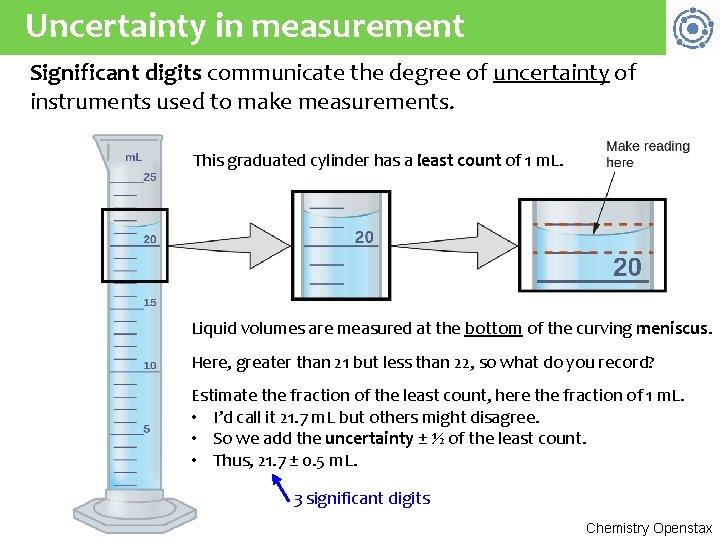
Uncertainty in measurement Significant digits communicate the degree of uncertainty of instruments used to make measurements. This graduated cylinder has a least count of 1 m. L. Liquid volumes are measured at the bottom of the curving meniscus. Here, greater than 21 but less than 22, so what do you record? Estimate the fraction of the least count, here the fraction of 1 m. L. • I’d call it 21. 7 m. L but others might disagree. • So we add the uncertainty ± ½ of the least count. • Thus, 21. 7 ± 0. 5 m. L. 3 significant digits Chemistry Openstax
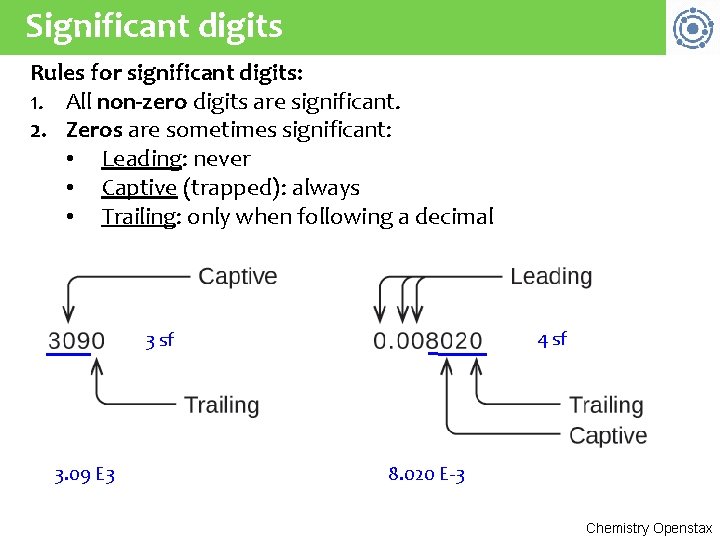
Significant digits Rules for significant digits: 1. All non-zero digits are significant. 2. Zeros are sometimes significant: • Leading: never • Captive (trapped): always • Trailing: only when following a decimal 4 sf 3. 09 E 3 8. 020 E-3 Chemistry Openstax
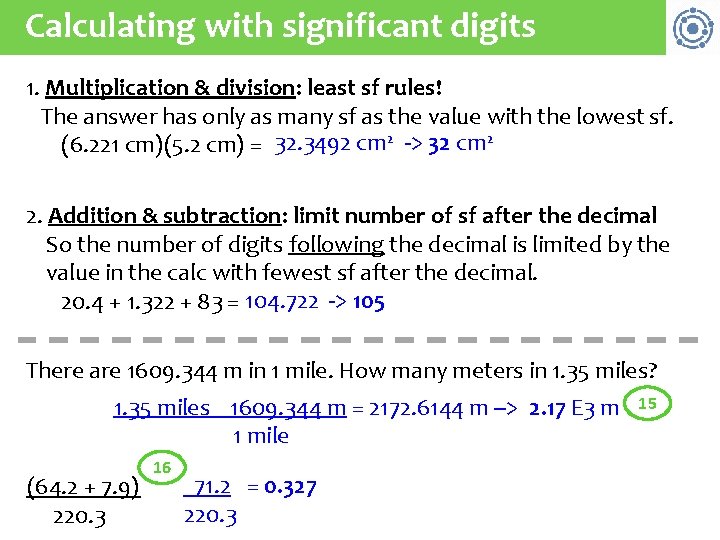
Calculating with significant digits 1. Multiplication & division: least sf rules! The answer has only as many sf as the value with the lowest sf. (6. 221 cm)(5. 2 cm) = 32. 3492 cm 2 -> 32 cm 2 2. Addition & subtraction: limit number of sf after the decimal So the number of digits following the decimal is limited by the value in the calc with fewest sf after the decimal. 20. 4 + 1. 322 + 83 = 104. 722 -> 105 There are 1609. 344 m in 1 mile. How many meters in 1. 35 miles? 1. 35 miles 1609. 344 m = 2172. 6144 m --> 2. 17 E 3 m 1 mile (64. 2 + 7. 9) 220. 3 16 71. 2 = 0. 327 220. 3 15
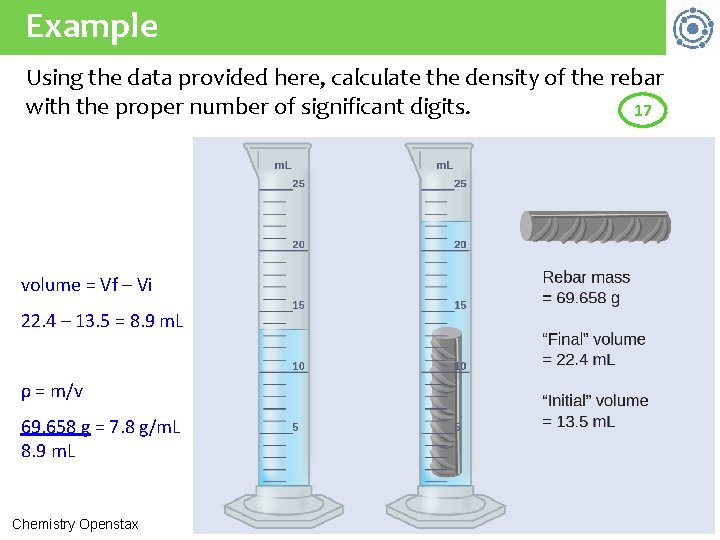
Example Using the data provided here, calculate the density of the rebar with the proper number of significant digits. 17 volume = Vf – Vi 22. 4 – 13. 5 = 8. 9 m. L ρ = m/v 69. 658 g = 7. 8 g/m. L 8. 9 m. L Chemistry Openstax
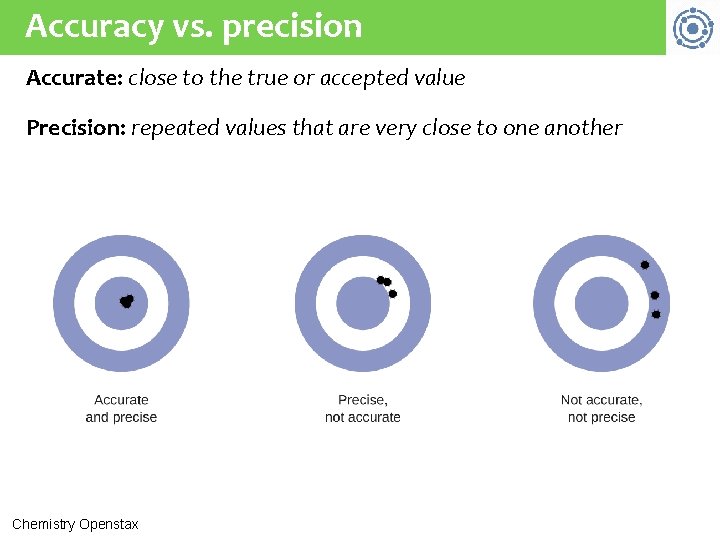
Accuracy vs. precision Accurate: close to the true or accepted value Precision: repeated values that are very close to one another Chemistry Openstax
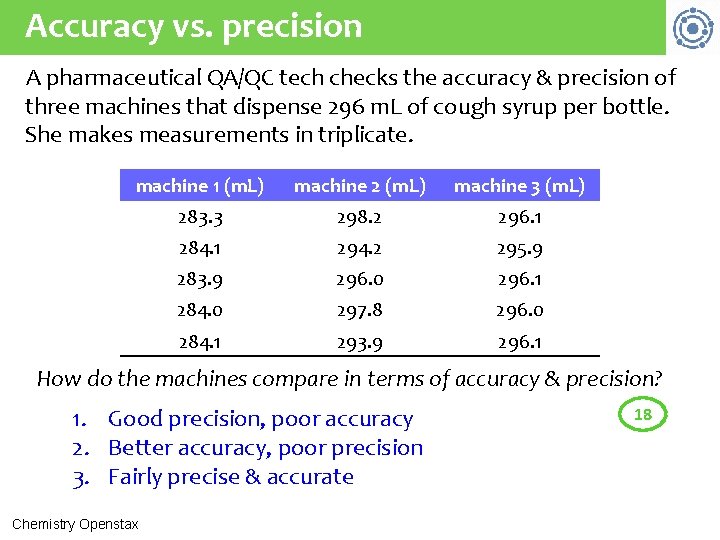
Accuracy vs. precision A pharmaceutical QA/QC tech checks the accuracy & precision of three machines that dispense 296 m. L of cough syrup per bottle. She makes measurements in triplicate. machine 1 (m. L) machine 2 (m. L) machine 3 (m. L) 283. 3 298. 2 296. 1 284. 1 294. 2 295. 9 283. 9 296. 0 296. 1 284. 0 297. 8 296. 0 284. 1 293. 9 296. 1 How do the machines compare in terms of accuracy & precision? 1. Good precision, poor accuracy 2. Better accuracy, poor precision 3. Fairly precise & accurate Chemistry Openstax 18
Can you? (1) Explain the difference between exact & inexact numbers and give examples of each? (2) Explain how to measure the volume of a liquid using the meniscus, the instrument’s least count & the digit of uncertainty? (3) Describe when zeros are significant and when they are not. (4) Describe the rules for multiplying & dividing vs. adding & subtracting with significant figures. (5) Define differentiate between accuracy and precision.