
1 ESRC Deafness Cognition and Language Research Centre

- Slides: 36
1 ESRC Deafness Cognition and Language Research Centre Appropriate cognitive assessments for deaf children-Theory of Mind, Executive Functioning and memory skills. Tanya Denmark t. denmark@ucl. ac. uk
Deaf cognition ESRC Deafness Cognition and Language Research Centre ® Cognitive assessments have been developed for users of spoken languages they are often not appropriate for deaf children. ® Deaf and hearing children have different knowledge, cognitive strategies and experiences ® Deaf signers use a different modality, often acquired outside the normal timeframe for language acquisition ® 90%+ hearing parents-Language delay can cause cognitive difficulties ® Some organic causes of deafness (eg prematurity, rubella, meningitis) lead to further cognitive difficulties. 2
Differences not impairments 3 ESRC Deafness Cognition and Language Research Centre ® Deaf children who use sign language often show above average performance on visuospatial tasks (Mayberry, 2002) ® They are faster at redirecting their visual attention from one location to another (Parasnis & Samar, 1985) ® They have greater attention to peripheral stimuli (Bavelier et al. , 2000) ® They have advantages in face discrimination and mental rotation tasks (Bettger et al. 1997, Emmorey, 1998) ® Native signers (DOD) consistently do better than non native (DOD) and are more comparable to hearing groups. This reinforces the relationship between language and cognition.
4 ESRC Deafness Cognition and Language Research Centre ® Theory of Mind
Theory of mind 5 ESRC Deafness Cognition and Language Research Centre ® To. M develops at about 4 years of age in typical hearing children. ® To. M involves understanding others’ mental states, behaviours and intentions. ® Many To. M assessments/standard tests of false belief reasoning require rather sophisticated language skills and deaf children may not understand the task ® Shick et al (2007) tested 176 children aged 3 -8 on To. M ® Children either used ASL or were oral, Doh and Dod
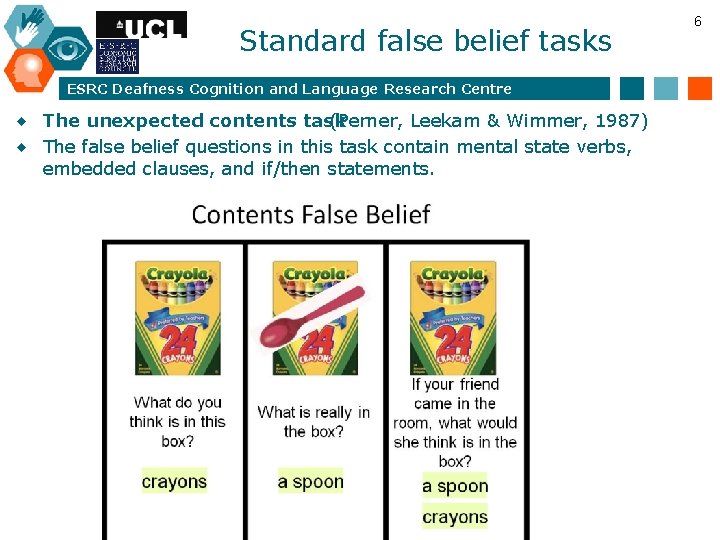
Standard false belief tasks ESRC Deafness Cognition and Language Research Centre ® The unexpected contents task (Perner, Leekam & Wimmer, 1987) ® The false belief questions in this task contain mental state verbs, embedded clauses, and if/then statements. 6
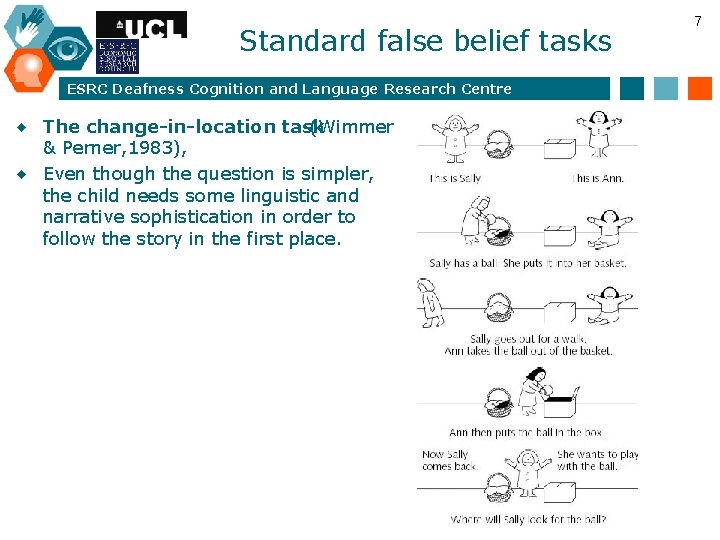
Standard false belief tasks ESRC Deafness Cognition and Language Research Centre ® The change-in-location task (Wimmer & Perner, 1983), ® Even though the question is simpler, the child needs some linguistic and narrative sophistication in order to follow the story in the first place. 7
8 ESRC Deafness Cognition and Language Research Centre ® Shick found a significant delay in Doh, regardless of ASL or oral and type of task. Dod performed identically to same-aged hearing controls. ® Do. H have delayed To. M due to language delay and lack of access to conversations
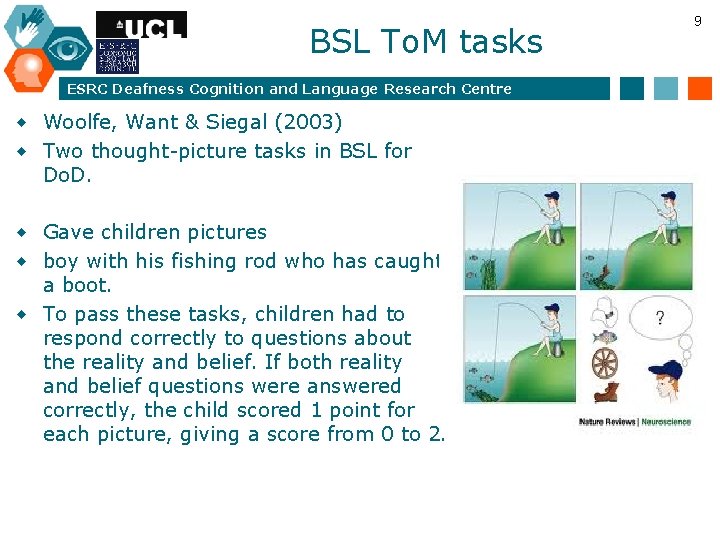
BSL To. M tasks ESRC Deafness Cognition and Language Research Centre ® Woolfe, Want & Siegal (2003) ® Two thought-picture tasks in BSL for Do. D. ® Gave children pictures ® boy with his fishing rod who has caught a boot. ® To pass these tasks, children had to respond correctly to questions about the reality and belief. If both reality and belief questions were answered correctly, the child scored 1 point for each picture, giving a score from 0 to 2. 9
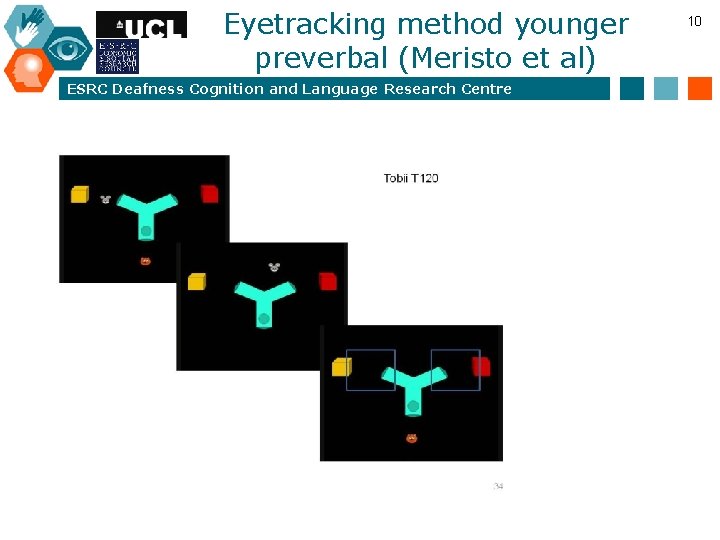
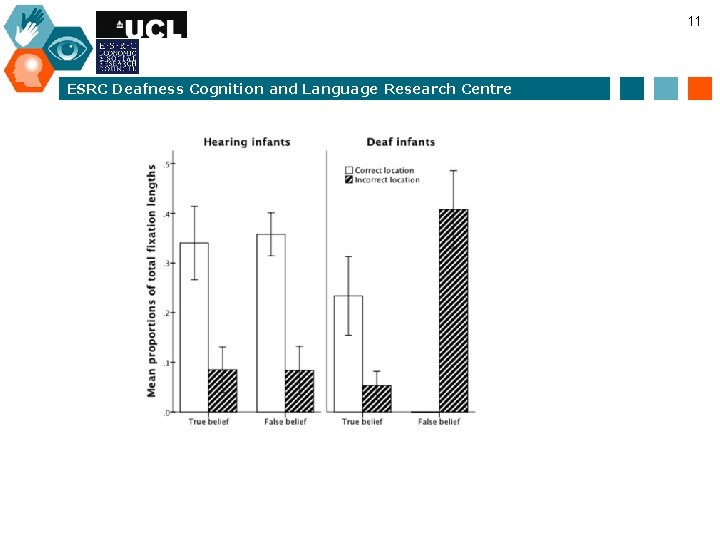
Eyetracking method younger preverbal (Meristo et al) ESRC Deafness Cognition and Language Research Centre 10
11 ESRC Deafness Cognition and Language Research Centre
12 ESRC Deafness Cognition and Language Research Centre ® Memory
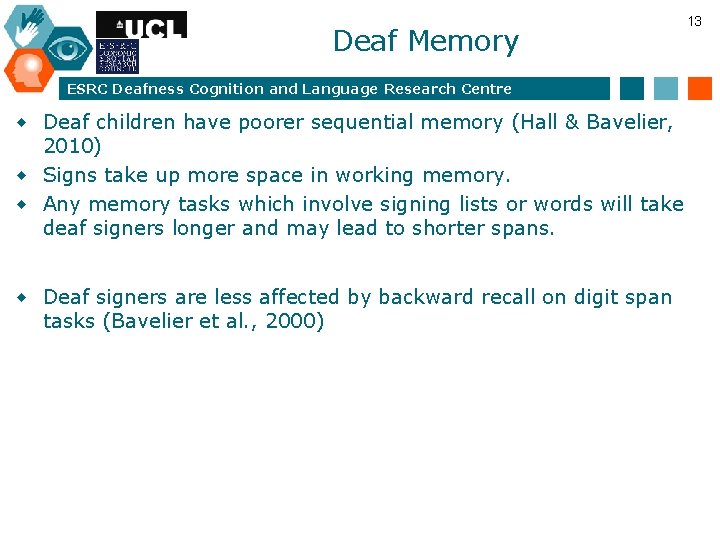
Deaf Memory ESRC Deafness Cognition and Language Research Centre ® Deaf children have poorer sequential memory (Hall & Bavelier, 2010) ® Signs take up more space in working memory. ® Any memory tasks which involve signing lists or words will take deaf signers longer and may lead to shorter spans. ® Deaf signers are less affected by backward recall on digit span tasks (Bavelier et al. , 2000) 13
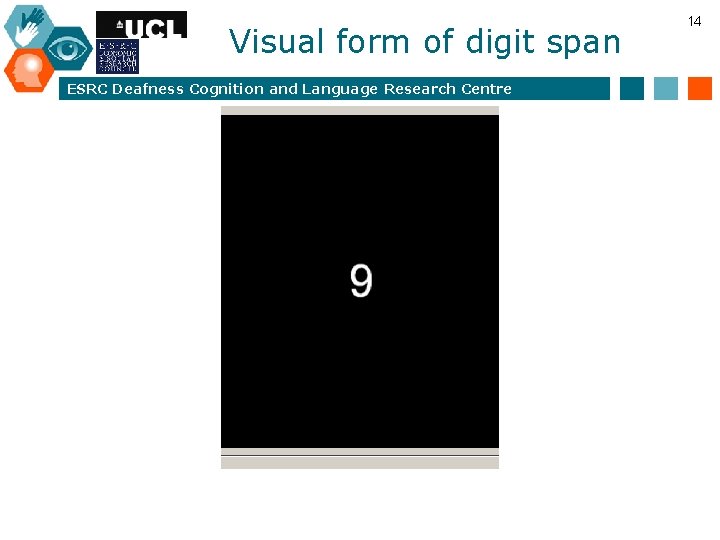
Visual form of digit span ESRC Deafness Cognition and Language Research Centre 14
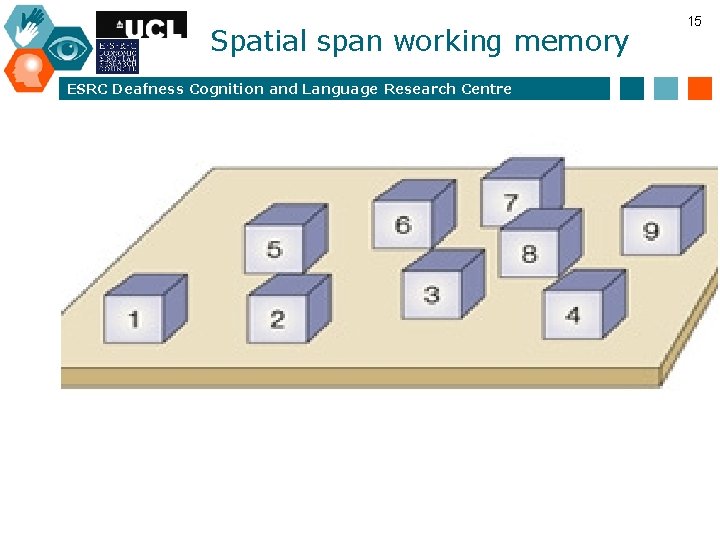
Spatial span working memory ESRC Deafness Cognition and Language Research Centre 15
16 ESRC Deafness Cognition and Language Research Centre
17 ESRC Deafness Cognition and Language Research Centre ® Executive Function
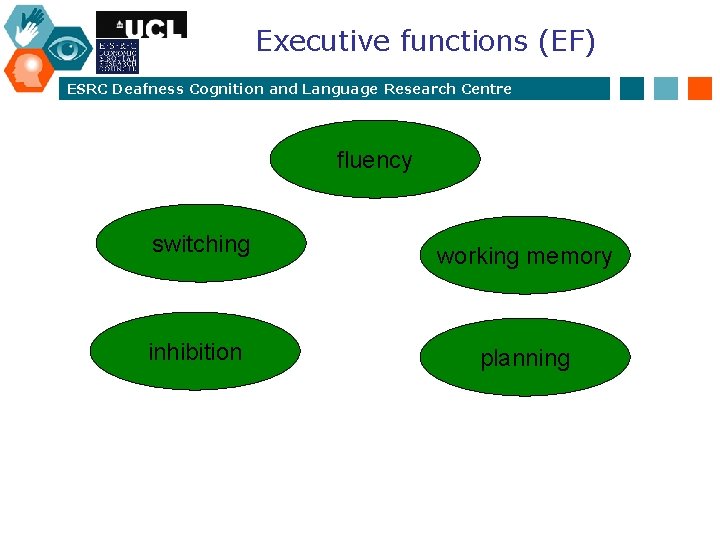
Executive functions (EF) ESRC Deafness Cognition and Language Research Centre fluency switching working memory inhibition planning
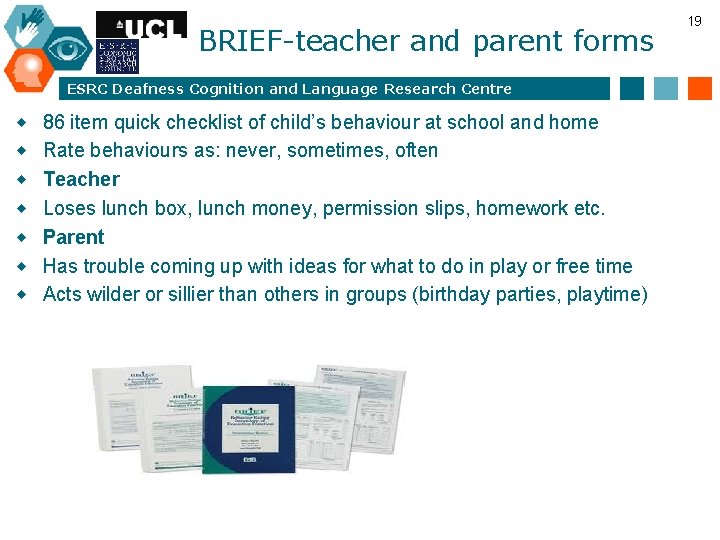
BRIEF-teacher and parent forms ESRC Deafness Cognition and Language Research Centre ® 86 item quick checklist of child’s behaviour at school and home ® Rate behaviours as: never, sometimes, often ® Teacher ® Loses lunch box, lunch money, permission slips, homework etc. ® Parent ® Has trouble coming up with ideas for what to do in play or free time ® Acts wilder or sillier than others in groups (birthday parties, playtime) 19
20 ESRC Deafness Cognition and Language Research Centre ® Deaf EF ® Deaf children (signing, oral and CI) impaired on BRIEF compared to age- matched hearing children(Figueras et al, 2008, Pisoni et al, 2008, Conrad et al, 2007, Conway et al. , 2007, Hauser et al, 2006. ) ® Higher levels of impulsivity in oral deaf children using BRIEF (Parasnis et al, 2003) ® One or two behavioural measures of EF have previously been used- card sorting task and colour trails (Hauser et al, 2006) ® Figueras et al (2008) language development and EF highly related in oral deaf 8 -12 year olds ® Deaf children with Deaf Parents have better EF abilities than those with hearing parents (Harris, 1978, Oberg, 2007, Hauser et al (2007, 2008)
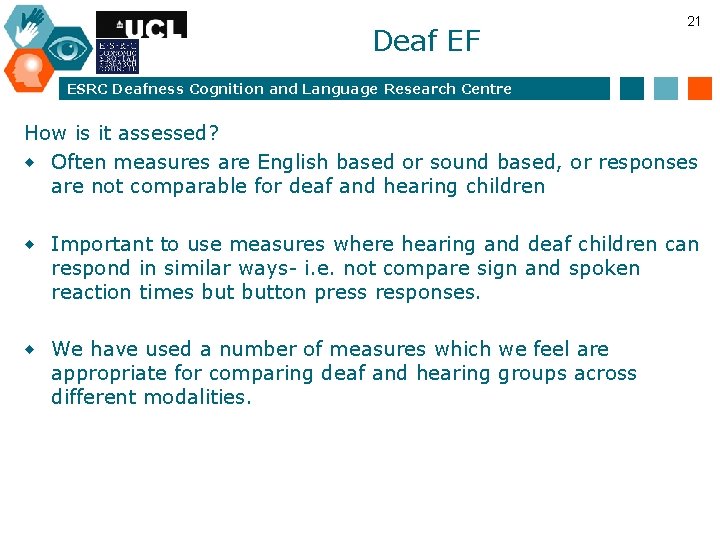
Deaf EF 21 ESRC Deafness Cognition and Language Research Centre How is it assessed? ® Often measures are English based or sound based, or responses are not comparable for deaf and hearing children ® Important to use measures where hearing and deaf children can respond in similar ways- i. e. not compare sign and spoken reaction times button press responses. ® We have used a number of measures which we feel are appropriate for comparing deaf and hearing groups across different modalities.
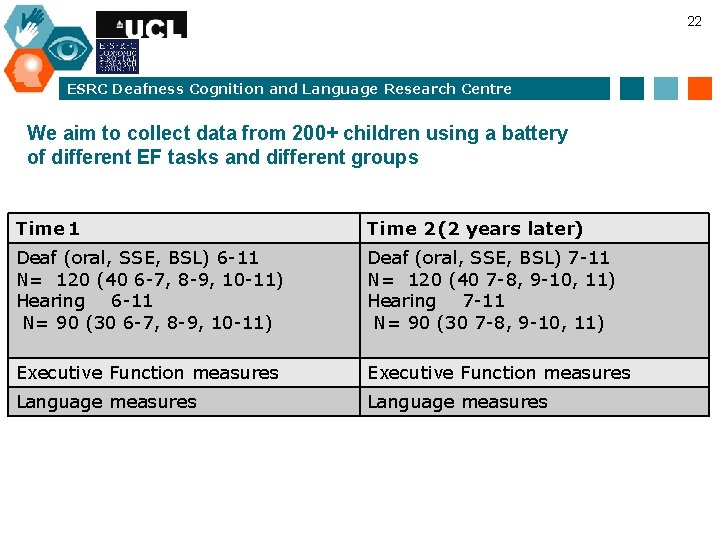
22 ESRC Deafness Cognition and Language Research Centre We aim to collect data from 200+ children using a battery of different EF tasks and different groups Time 1 Time 2 (2 years later) Deaf (oral, SSE, BSL) 6 -11 N= 120 (40 6 -7, 8 -9, 10 -11) Hearing 6 -11 N= 90 (30 6 -7, 8 -9, 10 -11) Deaf (oral, SSE, BSL) 7 -11 N= 120 (40 7 -8, 9 -10, 11) Hearing 7 -11 N= 90 (30 7 -8, 9 -10, 11) Executive Function measures Language measures
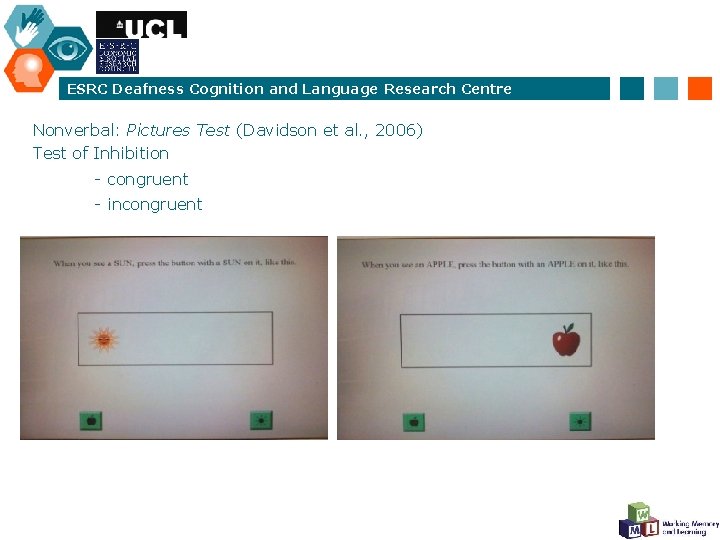
ESRC Deafness Cognition and Language Research Centre Nonverbal: Pictures Test (Davidson et al. , 2006) Test of Inhibition - congruent - incongruent
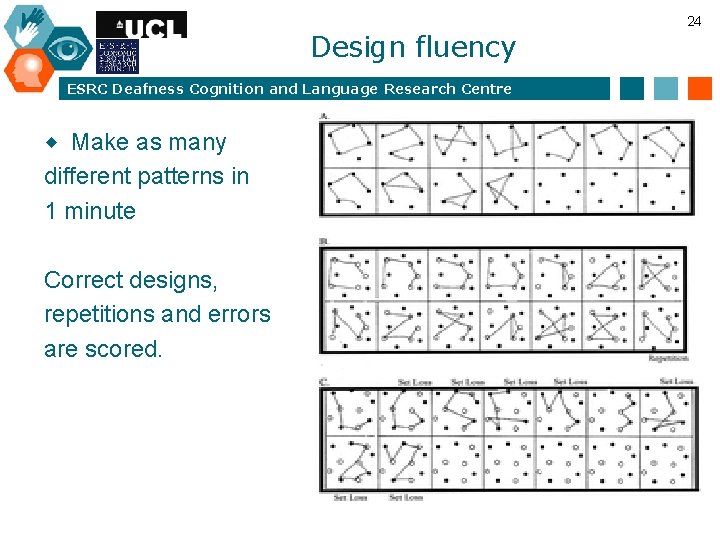
Design fluency ESRC Deafness Cognition and Language Research Centre ® Make as many different patterns in 1 minute Correct designs, repetitions and errors are scored. 24
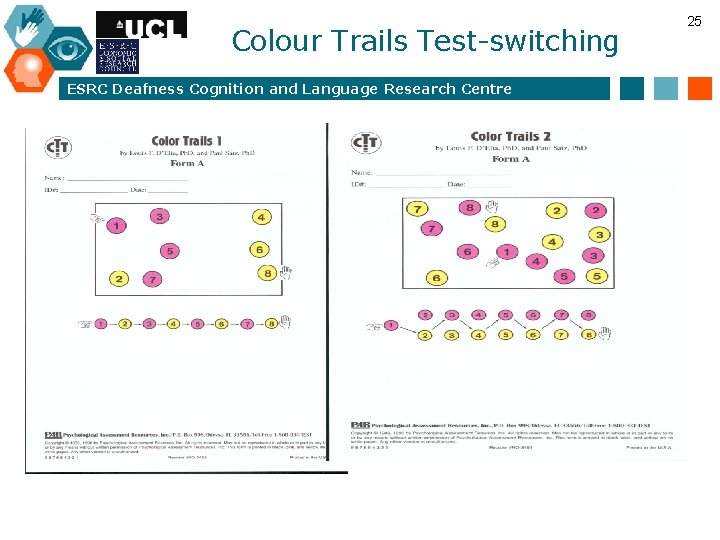
Colour Trails Test-switching ESRC Deafness Cognition and Language Research Centre 25
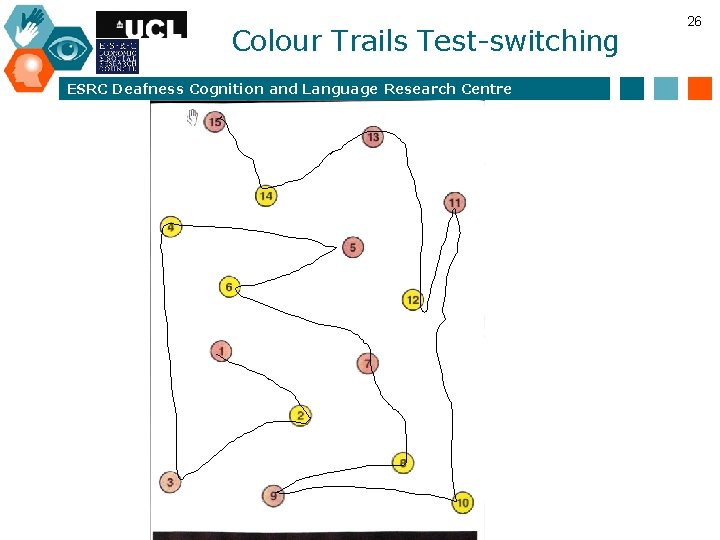
Colour Trails Test-switching ESRC Deafness Cognition and Language Research Centre 26
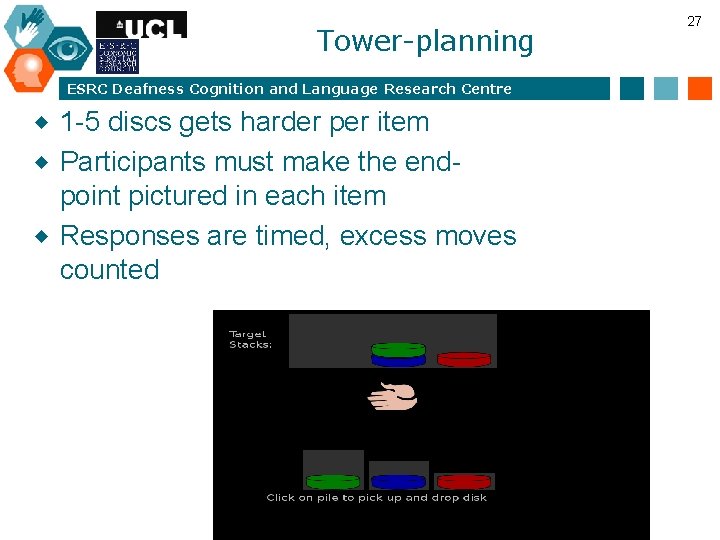
Tower-planning ESRC Deafness Cognition and Language Research Centre ® 1 -5 discs gets harder per item ® Participants must make the end- point pictured in each item ® Responses are timed, excess moves counted 27
28 ESRC Deafness Cognition and Language Research Centre
Other measures 29 ESRC Deafness Cognition and Language Research Centre Language ® Narrative-BSL test of production (Herman et al. , 2004). ® Vocabulary measure- Expressive one word picture vocabulary test (Martin & Brownell, 2010) ® Parent/teacher checklist-LPP 2 (Bebko & Mc. Kinnon, 1993) covers form, content, reference, cohesion and use-works as a screen. Non language measures ® Symbol search- processing speed ® Non verbal ability-Matrix reasoning
Parent questionnaire ESRC Deafness Cognition and Language Research Centre ® Born/became deaf ® Cause of deafness ® Language preference at school/home ® Cochlear implants/hearing aids ® Other home languages ® Level of deafness ® Family deafness/ family communication ® School type Plus many more important background variables. . . 30
Findings to date-hot off the press! 31 ESRC Deafness Cognition and Language Research Centre ® Tested 82 children to date aged between 6 -11 ® 49 deaf ® 33 hearing ® Language and EF measures work well across modalities and age groups for deaf and hearing children. ® We have found some indication that language and EF are related in BSL users to date. . . Need to check other groups e. g. nonsigners. ® We are starting to get some normative data about different groups of deaf children on EF measures which can be used in the future.
Non verbal methods 32 ESRC Deafness Cognition and Language Research Centre ® Non verbal measures are optimal for assessing deaf children ® It is important to have additional suitable verbal measures too in sign language these are lacking in research ® Verbal measures often give a greater predictive power to academic success and a greater overview of child’s ability.
Tests 33 ESRC Deafness Cognition and Language Research Centre ® Ensure tests are not at ceiling or floor ® Change presentation format- visual images, signs or pictures rather than oral or English written words ® Allow for more time ® Use an array of different suitable tests not just one test to get an overview.
Recommendations 34 ESRC Deafness Cognition and Language Research Centre ® Use the child’s preferred language, all assessors should be trained in language and culture of the child. ® Look at child’s full developmental history and background carefully-hearing loss severity and aetiology, preferred language, age of onset, amplification etc. ® Receive input from informants across contexts: teacher, parents get broad overview. ® Need formal and informal assessments, select assessment tools carefully ® Ensure you are trained in administration, scoring and interpretation of assessment
Recommendations ESRC Deafness Cognition and Language Research Centre ® Be mindful of deaf multi disability issue ® Ensure the same instructions are given to different groups e. g. deaf oral and deaf signers ® Limit visual distractions/ quiet room ® Film assessments so you can check them and score again later ® Get a 2 nd scorer- preferably blind scorer, seek feedback from deaf professionals ® Be wary of tests normed on hearing children ® Lot to consider but without assessments we have no norms 35
36 ESRC Deafness Cognition and Language Research Centre ® Thank you ® Questions?