
1 ENVIRONMENTAL SCIENCE A Study of Interrelationships Chapter
- Slides: 51
1 ENVIRONMENTAL SCIENCE A Study of Interrelationships Chapter 12 Copyright © Mc. Graw-Hill Education. Permission required for reproduction or display. 14 th Edition Land-Use Planning
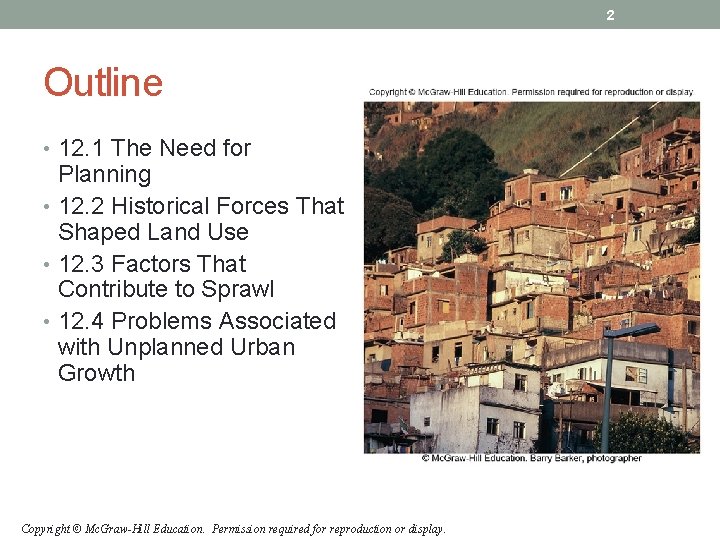
2 Outline • 12. 1 The Need for Planning • 12. 2 Historical Forces That Shaped Land Use • 12. 3 Factors That Contribute to Sprawl • 12. 4 Problems Associated with Unplanned Urban Growth Copyright © Mc. Graw-Hill Education. Permission required for reproduction or display.
3 Outline • 12. 5 Land-Use Planning Principles • 12. 6 Mechanisms for Implementing Land-Use Plans • 12. 7 Special Urban Planning Issues • 12. 8 Federal Government Land-Use Issues Copyright © Mc. Graw-Hill Education. Permission required for reproduction or display.
4 12. 1 The Need for Planning • Human development impacts upon all facets of the environment. • While most apparent in urbanized areas, there is literally no place on the globe that does not bear some evidence of the impact of humankind. • Most land-use decisions are still based primarily on economic considerations or short-term needs rather than on unique analysis of the landscape. • Once land has been converted to intensive human use, it is generally unavailable for other uses. Copyright © Mc. Graw-Hill Education. Permission required for reproduction or display.
5 12. 2 Historical Forces That Shaped Land Use • Present land use in the United States: • 52% - Crops and livestock • 44% - Forests and natural areas • 4% - Intensive human use • This pattern of land use differs greatly from original conditions experienced by immigrants from New World. • The first U. S. colonists converted landscape to farming, and then to towns and cities. Copyright © Mc. Graw-Hill Education. Permission required for reproduction or display.
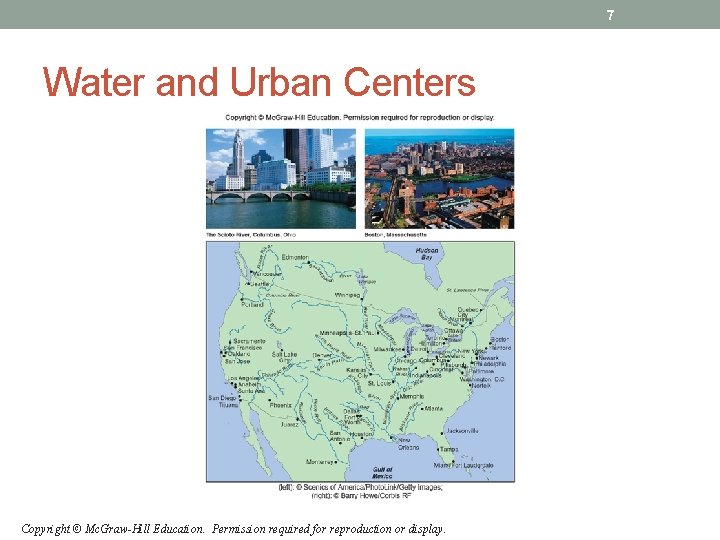
6 Waterways and Development • Waterways were the primary method of transportation in the early European settlement of North America • This allowed exploration and development of commerce. • Early towns were usually built near water and at transfer points between water systems. • The waterfront became a center of intense industrial activity. • As industrial activity increased in the cities, people began to move from rural to urban centers for the job opportunities these centers presented. Copyright © Mc. Graw-Hill Education. Permission required for reproduction or display.
7 Water and Urban Centers Copyright © Mc. Graw-Hill Education. Permission required for reproduction or display.
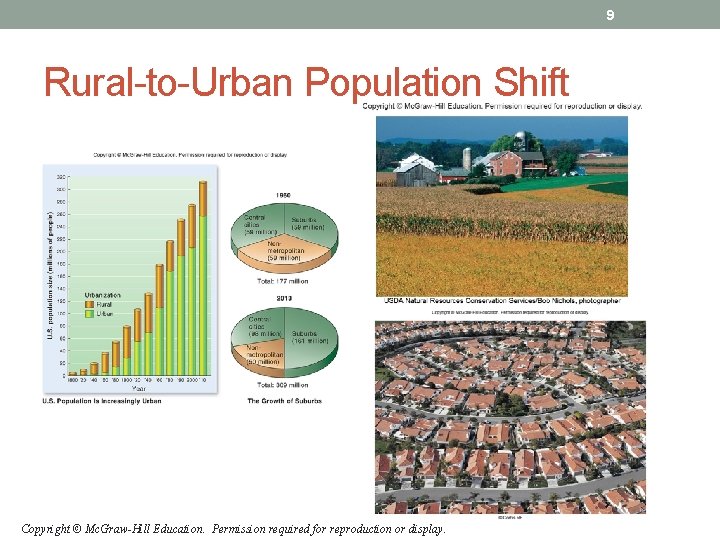
8 The Rural-to-Urban Shift • North America remained essentially rural until industrial growth began in last third of the 1800 s. • Cities grew because of: • Industrial Revolution • People migrated from farms to industrial jobs found in cities. • European immigrants • Congregated in cities where jobs were available. • Cultural, social, and artistic opportunities Copyright © Mc. Graw-Hill Education. Permission required for reproduction or display.
9 Rural-to-Urban Population Shift Copyright © Mc. Graw-Hill Education. Permission required for reproduction or display.
10 Migration from the Central City to the Suburbs • In the early stages of the Industrial Revolution, a lack of control over industry activities led to polluted, undesirable waterways. • As roads and rail transport became more common, many left the waterway areas. • Agricultural land surrounding towns was converted to housing. • Land began to be viewed as a commodity, not as a non-renewable resource to be managed. Copyright © Mc. Graw-Hill Education. Permission required for reproduction or display.
11 Characteristics of Suburbs • As cities grew, certain sections within each city began to deteriorate. • Pollution and crowding made cities undesirable places to live. • In the early 1900 s, people who could afford to move out of cities began to do so. • 1950 - 60% urban population lived in central cities. • 1990 - 30% urban population lived in central cities. Copyright © Mc. Graw-Hill Education. Permission required for reproduction or display.
12 Characteristics of Suburbs • The convenience of a personal automobile escalated decentralized housing patterns and diminished importance of mass transit. • This led to decreased energy efficiency. • It increased the cost of supplying utility services. Copyright © Mc. Graw-Hill Education. Permission required for reproduction or display.
13 Characteristics of Suburbs • Urban sprawl is a pattern of unplanned, low-density housing and commercial development outside of cities. • Land-use practices are fundamental to sustainability. Two practices that have contributed to urban sprawl are: • Zoning ordinances that isolate employment and shopping services away from housing locations. • Low-density planning aimed at creating automobile access to increasing expanses of land. Copyright © Mc. Graw-Hill Education. Permission required for reproduction or display.
14 Patterns of Urban Sprawl • Sprawl is typically characterized by: • Excessive land consumption. • Low densities in comparison with older centers. • Lack of choice in ways to travel. • Fragmented open space, wide gaps in development, and a scattered appearance. • Lack of choice in housing types and prices. • Separation of uses into distinct areas. • Repetitive one-story development. • Commercial buildings surrounded by large parking areas. • Lack of public spaces and community centers Copyright © Mc. Graw-Hill Education. Permission required for reproduction or display.
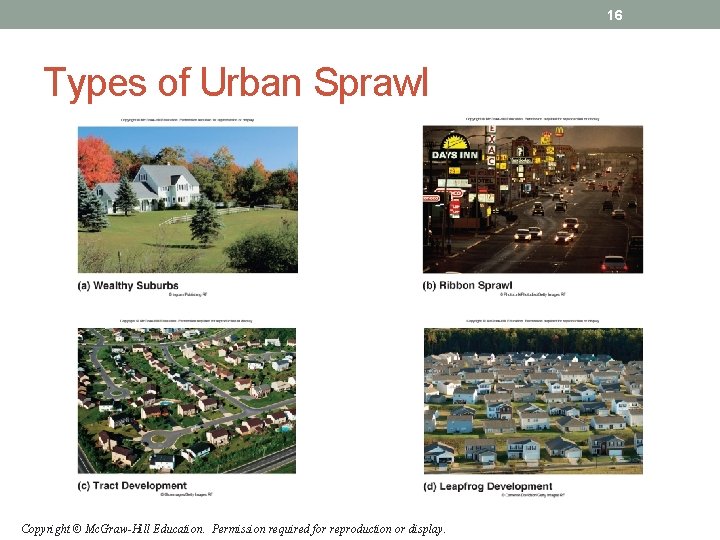
15 Patterns of Urban Sprawl • Urban sprawl occurs in three ways: • Development of exclusive, wealthy suburbs adjacent to the city. • Tract development is the construction of similar residential units over large areas. • Ribbon sprawl consists of commercial / industrial buildings lining highways connecting housing developments to the central city. • A megalopolis is a merging of cities into large, urban areas. Copyright © Mc. Graw-Hill Education. Permission required for reproduction or display.
16 Types of Urban Sprawl Copyright © Mc. Graw-Hill Education. Permission required for reproduction or display.
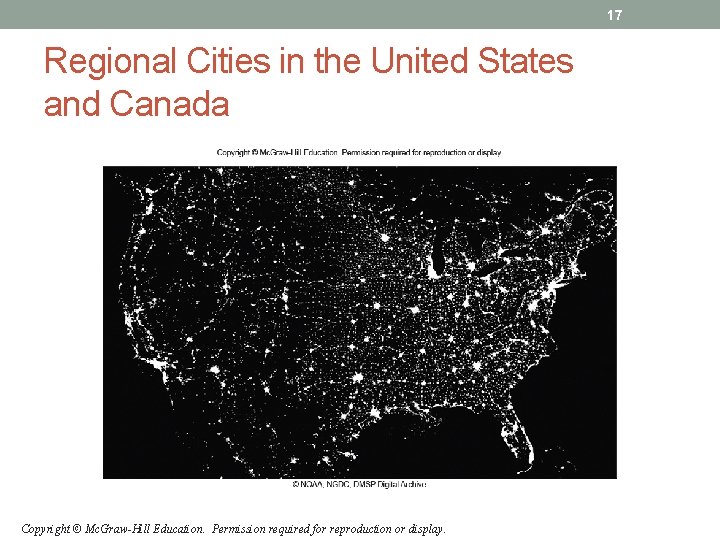
17 Regional Cities in the United States and Canada Copyright © Mc. Graw-Hill Education. Permission required for reproduction or display.
18 12. 3 Factors That Contribute to Sprawl • Lifestyle • Increased wealth of population is reflected in material possessions, particularly the automobile and homes. • A decentralized housing pattern is possible because high rate of automobile ownership allows ease of movement. • Economic • Building on agricultural land is less expensive than to build within established cities. • Tax laws encourage home ownership. Copyright © Mc. Graw-Hill Education. Permission required for reproduction or display.
19 12. 3 Factors That Contribute to Sprawl • Planning and Policy • Historically, there was little coordination of effort as to how cities should develop. • Large cities have a huge number of political jurisdictions, so coordination is difficult. • Zoning ordinances prohibit land-use mixing. • Ordinances specify minimum lot and house sizes. • Government subsidizes the development of decentralized cities. • Local governments pay some costs of extending services into new areas; costs are not passed on to builders. Copyright © Mc. Graw-Hill Education. Permission required for reproduction or display.
20 12. 4 Problems Associated with Unplanned Growth • Transportation • As cities grew, little thought was given to transportation corridors. • Establishment of new corridors stimulates growth in nearby areas, and the new corridors soon become inadequate. • Reliance on automobiles has required constant road building. • In Los Angeles, 70% of city’s surface area dedicated to automobiles. • The average person in the U. S. travels about 160 miles/week in an automobile. Copyright © Mc. Graw-Hill Education. Permission required for reproduction or display.
21 12. 4 Problems Associated with Unplanned Growth • Death of the Central City • Currently less than 10% of people work in the central city. • There is less income to support public services. • Higher Infrastructure and Energy Costs • Extension of municipal services is more costly than supplying services to areas already in the city. Copyright © Mc. Graw-Hill Education. Permission required for reproduction or display.
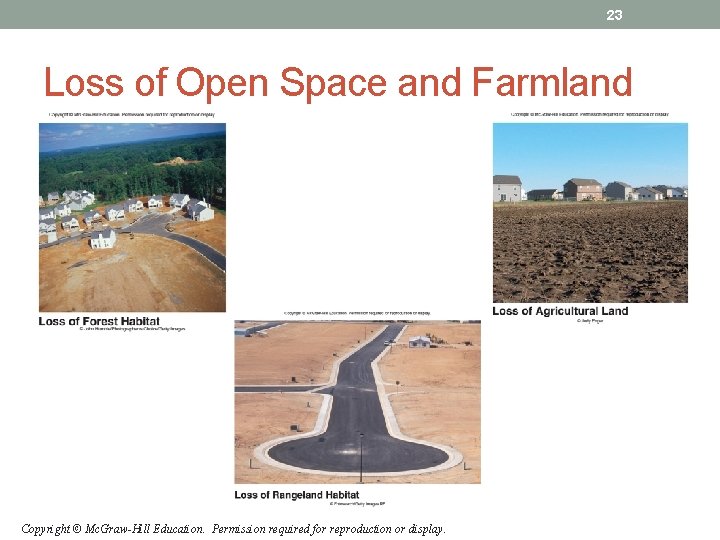
22 12. 4 Problems Associated with Unplanned Growth • Loss of Open Space and Farmland • Oftentimes open space planning is left out of development plans. • Flat, well-drained land is ideal for both farmland urban development. • Several states have established programs that provide protection to farmers who do not want to sell their land to developers. • These programs may require farmers to put their land in a conservation easement. Copyright © Mc. Graw-Hill Education. Permission required for reproduction or display.
23 Loss of Open Space and Farmland Copyright © Mc. Graw-Hill Education. Permission required for reproduction or display.
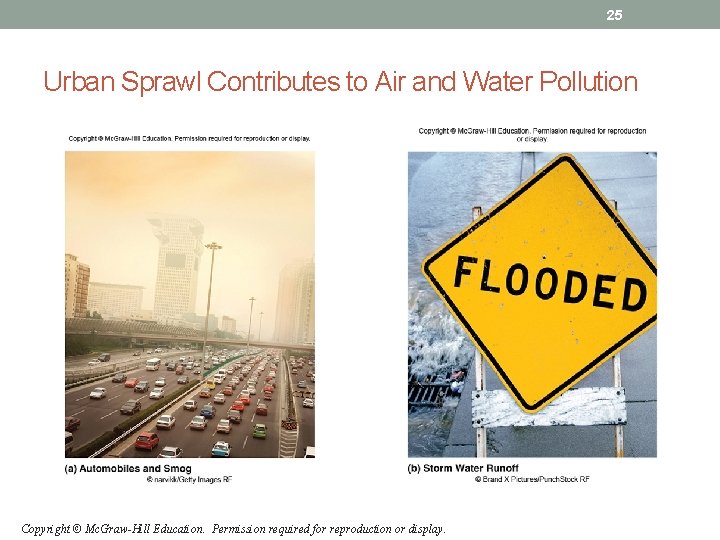
24 12. 4 Problems Associated with Unplanned Growth • Air and Water Pollution Problems • As traffic increases, so does air pollution. • A centralized, efficient public transportation system solves this problem, but it is difficult to achieve with a highly dispersed population. • Large impervious surface areas lead to high runoff and potential flooding. • Low Energy Efficiency • Automobiles are inefficient transportation. • Separation of homes and businesses requires additional driving. • Stop-and-go traffic patterns. • Single-family homes are less efficient than multifamily dwellings. Copyright © Mc. Graw-Hill Education. Permission required for reproduction or display.
25 Urban Sprawl Contributes to Air and Water Pollution Copyright © Mc. Graw-Hill Education. Permission required for reproduction or display.
26 12. 4 Problems Associated with Unplanned Growth • Floodplain Problems • Many cities are located on floodplains because they were originally established along waterways. • The flat land is attractive to developers but would be better put to use as open space or recreation. • Development increases economic losses. • Many communities have enacted floodplain zoning ordinances. Copyright © Mc. Graw-Hill Education. Permission required for reproduction or display.
27 12. 4 Problems Associated with Unplanned Growth • Wetlands Misuse • Wetlands areas that periodically are covered with water. • Many have been drained, filled, or used as landfills. • U. S. has lost 53% of wetlands since the European immigration began (not including Alaska). • Wetlands play crucial role in reproductive phase of many organisms. • They also provide sediment filtration. Copyright © Mc. Graw-Hill Education. Permission required for reproduction or display.
28 12. 4 Problems Associated with Unplanned Growth • Geology and Resource Limitations • Geological status must be considered in land-use decisions. • Building on earthquake-prone faults has led to the loss of life and property. • Building on unstable hillsides and fire-prone areas is also unwise. • Aesthetic Issues • Unpleasant odors • Disagreeable tastes • Annoying sounds • Offensive sights • It is difficult to get complete agreement on what is acceptable and when some aesthetic boundary has been crossed that is unacceptable. Copyright © Mc. Graw-Hill Education. Permission required for reproduction or display.
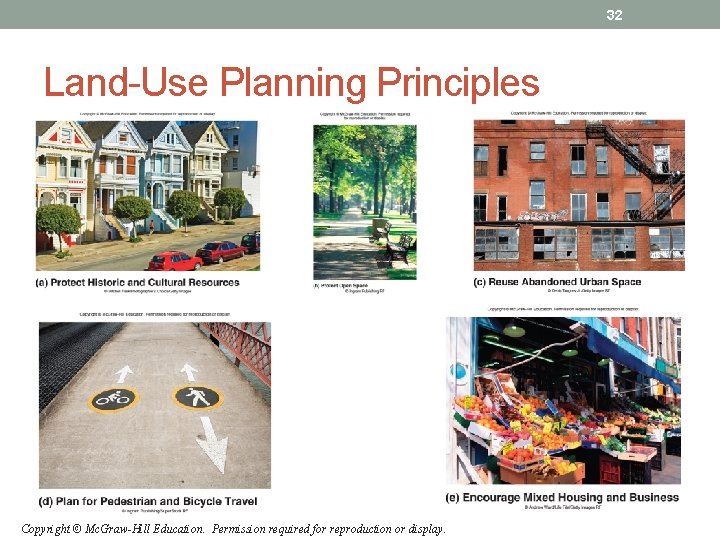
29 12. 5 Land-Use Planning Principles • Land-use planning is a process of evaluating the needs and wants of a population, the land characteristics and value, and various alternative solutions to land uses before changes are made. • Many problems outlined in the previous sections can be avoided with proper land-use planning. • A basic rule should be to make as few changes as possible. Copyright © Mc. Graw-Hill Education. Permission required for reproduction or display.
30 12. 5 Land-Use Planning Principles • When changes are needed: • Evaluate and record unique geological, geographic, and biologic features. • Preserve unique cultural or historical features. • Conserve open space and environmental features. • Recognize and calculate the cost of additional changes required to accommodate altered land use. Copyright © Mc. Graw-Hill Education. Permission required for reproduction or display.
31 12. 5 Land-Use Planning Principles • Plan for mixed uses in close proximity. • Plan for a variety of transportation options. • Set limits and require managed growth patterns with compact development. • Encourage development in areas with existing infrastructure. Copyright © Mc. Graw-Hill Education. Permission required for reproduction or display.
32 Land-Use Planning Principles Copyright © Mc. Graw-Hill Education. Permission required for reproduction or display.
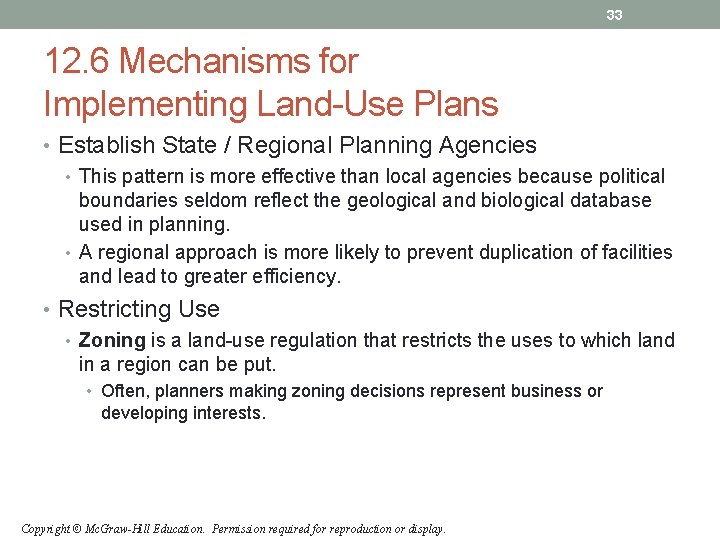
33 12. 6 Mechanisms for Implementing Land-Use Plans • Establish State / Regional Planning Agencies • This pattern is more effective than local agencies because political boundaries seldom reflect the geological and biological database used in planning. • A regional approach is more likely to prevent duplication of facilities and lead to greater efficiency. • Restricting Use • Zoning is a land-use regulation that restricts the uses to which land in a region can be put. • Often, planners making zoning decisions represent business or developing interests. Copyright © Mc. Graw-Hill Education. Permission required for reproduction or display.
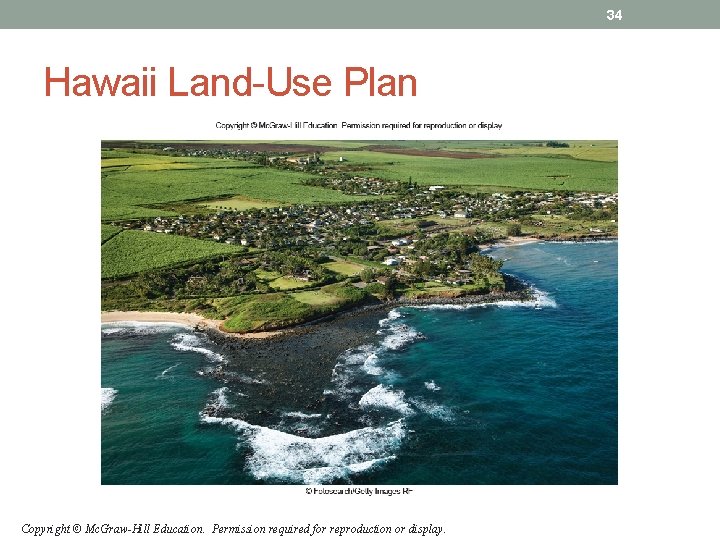
34 Hawaii Land-Use Plan Copyright © Mc. Graw-Hill Education. Permission required for reproduction or display.
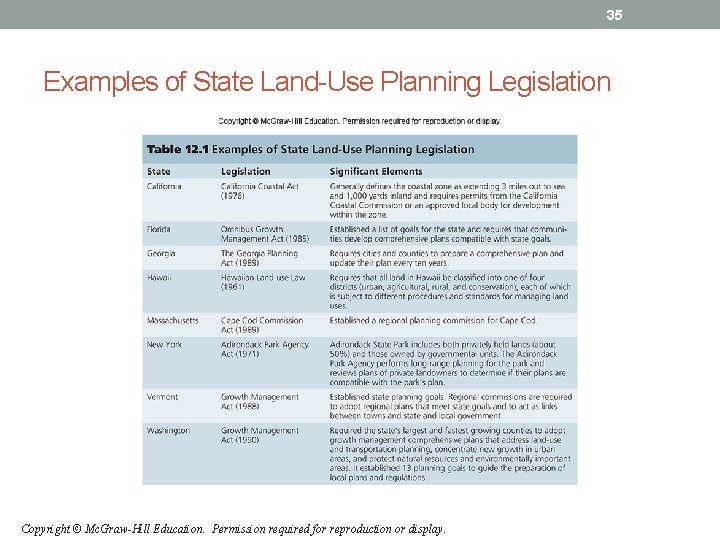
35 Examples of State Land-Use Planning Legislation Copyright © Mc. Graw-Hill Education. Permission required for reproduction or display.
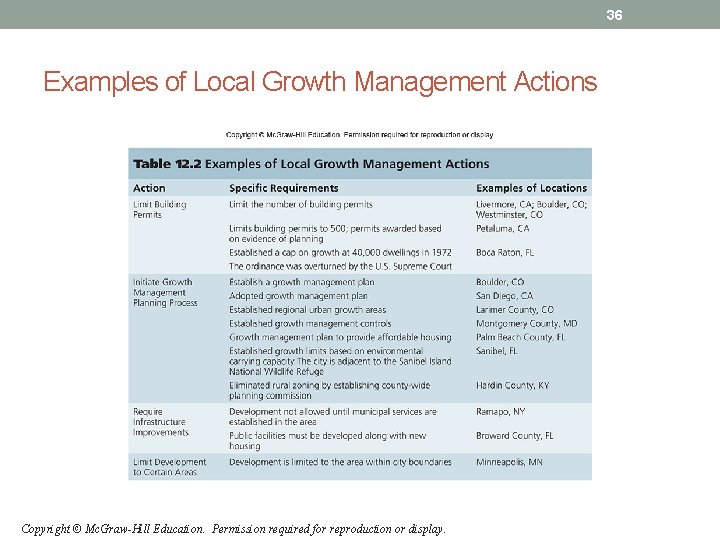
36 Examples of Local Growth Management Actions Copyright © Mc. Graw-Hill Education. Permission required for reproduction or display.
37 12. 7 Special Urban Planning Issues • Urban Transportation Planning • Urban transportation planning usually involves four goals: • Conserve energy and land resources. • Provide efficient and inexpensive transportation, particularly to those who are unable to drive. • Provide efficient transportation opportunities to suburban residents. • Reduce urban pollution. • Transportation corridors and parking facilities must be included in any urban transportation plan. Copyright © Mc. Graw-Hill Education. Permission required for reproduction or display.
38 12. 7 Special Urban Planning Issues • Mass transit in the U. S. is often underfunded and difficult to establish because: • It is only economical along heavily populated routes. • It is less convenient than the automobile. • It is extremely expensive to build / operate. • It is often crowded and uncomfortable. • The U. S. government encourages personal autos by financing highways, maintaining cheap energy policy, and not funding mass-transit projects (hidden subsidies). Copyright © Mc. Graw-Hill Education. Permission required for reproduction or display.
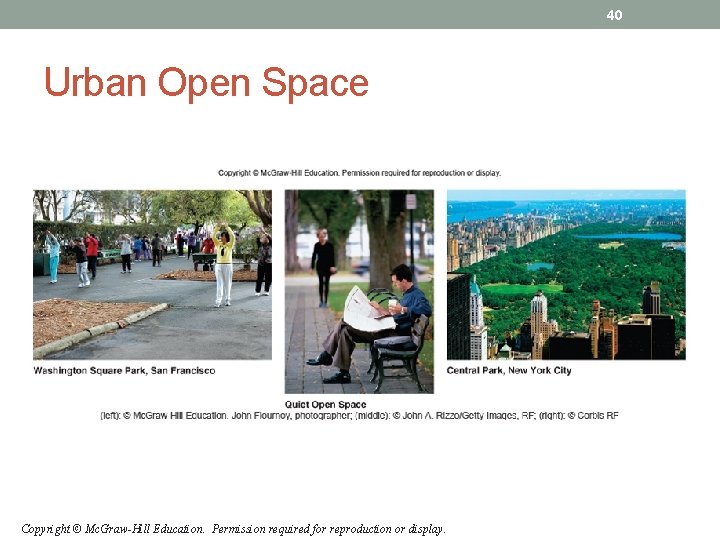
39 Urban Open Space and Recreation Planning • Nearly three-fourths of the North American population lives in urban areas. • Until recently, urban parks were considered an uneconomical use of land. • Facilities not conveniently located near residential areas may be infrequently used. • A new outgrowth of urbanization is the development of urban nature centers. Copyright © Mc. Graw-Hill Education. Permission required for reproduction or display.
40 Urban Open Space Copyright © Mc. Graw-Hill Education. Permission required for reproduction or display.
41 Redevelopment of Inner-City Areas • Special efforts must be made to revitalize the inner city. • Abandoned industrial and commercial sites remain vacant because they are expensive to clean up and renovate. • Brownfield development matches the degree of cleanup required to the intended use of the site. • Another important focus is remodeling abandoned commercial buildings into shopping centers, cultural facilities, and high-density housing. Copyright © Mc. Graw-Hill Education. Permission required for reproduction or display.
42 Smart Growth Urban Planning • Smart growth recognizes benefits of growth. • Advocates emphasize developing “livable” cities and towns. • Smart growth recognizes that quality of environment directly affects quality of life. Copyright © Mc. Graw-Hill Education. Permission required for reproduction or display.
43 Smart Growth Urban Planning • Smart Growth Principles: • Mix land uses. • Take advantage of compact building designs. • Create range of housing opportunities and choices. • Create walkable neighborhoods. • Foster distinctive, attractive communities with a strong sense of place. Copyright © Mc. Graw-Hill Education. Permission required for reproduction or display.
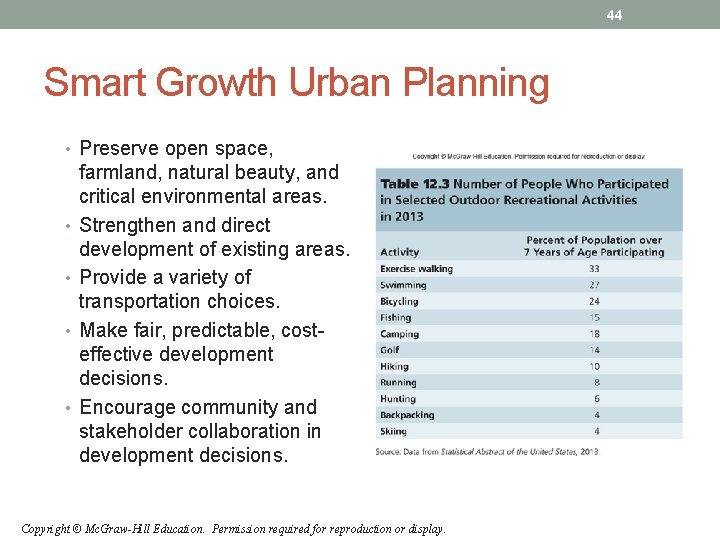
44 Smart Growth Urban Planning • Preserve open space, • • farmland, natural beauty, and critical environmental areas. Strengthen and direct development of existing areas. Provide a variety of transportation choices. Make fair, predictable, costeffective development decisions. Encourage community and stakeholder collaboration in development decisions. Copyright © Mc. Graw-Hill Education. Permission required for reproduction or display.
45 Smart Growth Urban Planning • One aspect of smart growth is the building of “green buildings. ” • Green buildings are built using a standard called Leadership in Energy and Environmental Design (LEED). • The guidelines call for using recycled materials, ensuring better ventilation in buildings, reducing water and energy use, and other goals. Copyright © Mc. Graw-Hill Education. Permission required for reproduction or display.
46 Smart Growth Urban Planning • Characteristics of high-performance green building are: • Low-water-flow fixtures are installed on faucets. • Buildings’ energy use is tested by an outside expert. • Products used do not contribute to ozone layer depletion. • Occupants have outside views, including natural day lighting of work surfaces. Copyright © Mc. Graw-Hill Education. Permission required for reproduction or display.
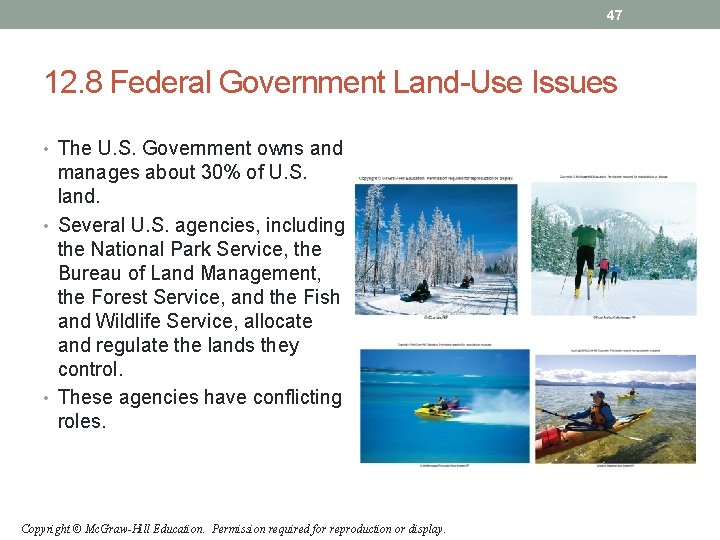
47 12. 8 Federal Government Land-Use Issues • The U. S. Government owns and manages about 30% of U. S. land. • Several U. S. agencies, including the National Park Service, the Bureau of Land Management, the Forest Service, and the Fish and Wildlife Service, allocate and regulate the lands they control. • These agencies have conflicting roles. Copyright © Mc. Graw-Hill Education. Permission required for reproduction or display.
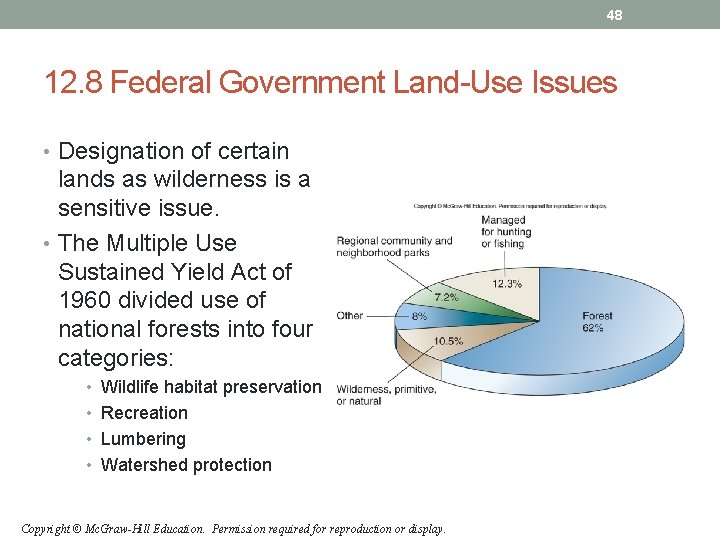
48 12. 8 Federal Government Land-Use Issues • Designation of certain lands as wilderness is a sensitive issue. • The Multiple Use Sustained Yield Act of 1960 divided use of national forests into four categories: • Wildlife habitat preservation • Recreation • Lumbering • Watershed protection Copyright © Mc. Graw-Hill Education. Permission required for reproduction or display.
49 12. 8 Federal Government Land-Use Issues • Many people want to use the natural world for recreational purposes because nature can provide challenges lacking in day-to-day life. • Conflicts develop because some activities cannot occur in the same place at the same time. • Groups argue that because they pay taxes, they have a right to use it as they wish. Copyright © Mc. Graw-Hill Education. Permission required for reproduction or display.
50 Summary • Waterways served as transportation corridors that allowed for the exploration of new land for the transport of goods. • Urban centers began as small towns located near water. • Several factors resulted in the shift of the population from rural to urban. • Unregulated industrial development in cities led to degradation of waterfronts and stimulated the development of suburbs. • Many problems have resulted from unplanned growth. Copyright © Mc. Graw-Hill Education. Permission required for reproduction or display.
51 Summary • Land-use planning involves gathering data, projecting needs, and developing mechanisms for implementing the plan. • Establishing regional planning agencies, purchasing land or its development rights, and enacting zoning ordinances are ways to implement land-use planning. • Federal governments own and manage large amounts of land, so national policy must be developed. • Often federal policy is a compromise between competing uses and land is managed for multiple uses. Copyright © Mc. Graw-Hill Education. Permission required for reproduction or display.