
1 Enhancing Demand Response Signal Verification in Automated

- Slides: 13
1 Enhancing Demand Response Signal Verification in Automated Demand Response Systems Daisuke Mashima, Ulrich Herberg, and Wei-Peng Chen SEDN (Solutions for Electricity Distribution Networks) Group Fujitsu Laboratories of America, Inc.
2 What is Open. ADR? • Internationally-recognized, and the most widely adopted standard for automated demand response • Defined as a subset of OASIS Energy Interoperation version 1. 0 • The latest 2. 0 b profile was released in August, 2013.
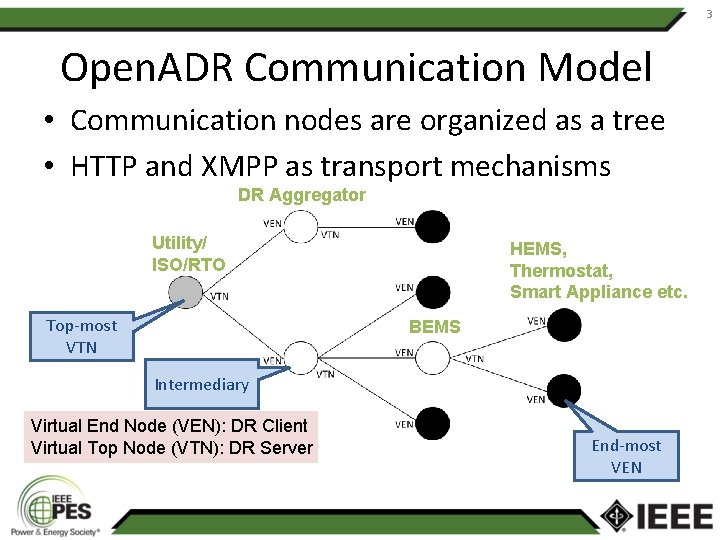
3 Open. ADR Communication Model • Communication nodes are organized as a tree • HTTP and XMPP as transport mechanisms DR Aggregator Utility/ ISO/RTO Top-most VTN HEMS, Thermostat, Smart Appliance etc. BEMS Intermediary Virtual End Node (VEN): DR Client Virtual Top Node (VTN): DR Server End-most VEN
4 Security in Open. ADR • Mandates use of TLS with client authentication – All nodes are equipped with a key pair and certificate – Message (e. g. , DR event signal) integrity and confidentiality – Mutual Authentication • Optionally supports XML Signature for nonrepudiation • Sufficient for establishing one-hop security, but…
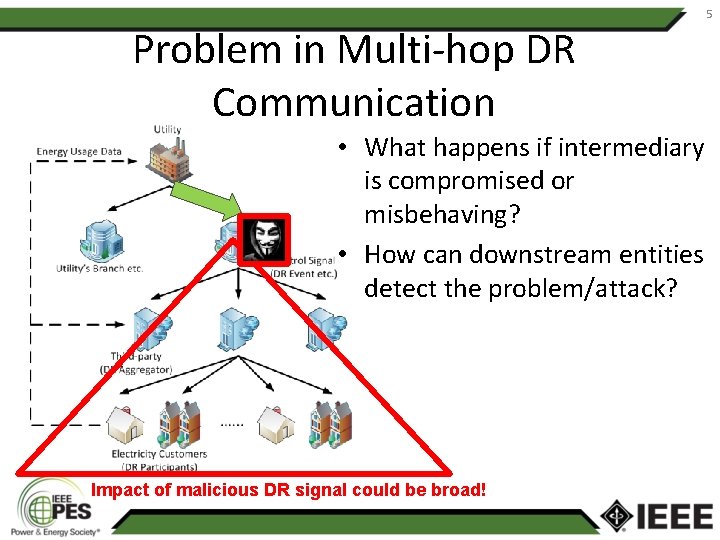
Problem in Multi-hop DR Communication • What happens if intermediary is compromised or misbehaving? • How can downstream entities detect the problem/attack? Impact of malicious DR signal could be broad! 5
6 Proposed Solution • Provide end-most VENs with verifiable information to make informed decision – Entities involved in DR signal distribution path – Contents of the DR signal issued by the top-most VTN. • Does not violate Open. ADR 2. 0 specification – In Open. ADR 2. 0 b schema, ei. Event: event. Descriptor: vtn. Comment can accommodate arbitrary text data, under which we can embed additional data.
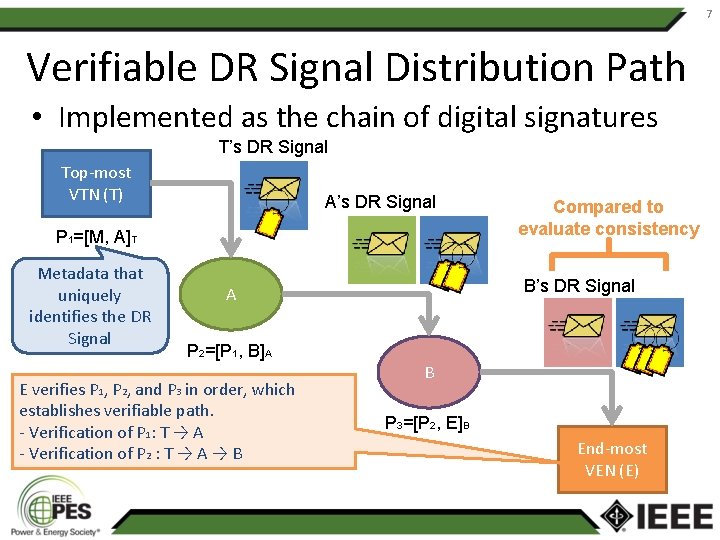
7 Verifiable DR Signal Distribution Path • Implemented as the chain of digital signatures T’s DR Signal Top-most VTN (T) A’s DR Signal P 1=[M, A]T Metadata that uniquely identifies the DR Signal Compared to evaluate consistency B’s DR Signal A P 2=[P 1, B]A E verifies P 1, P 2, and P 3 in order, which establishes verifiable path. - Verification of P 1: T → A - Verification of P 2 : T → A → B B P 3=[P 2, E]B End-most VEN (E)
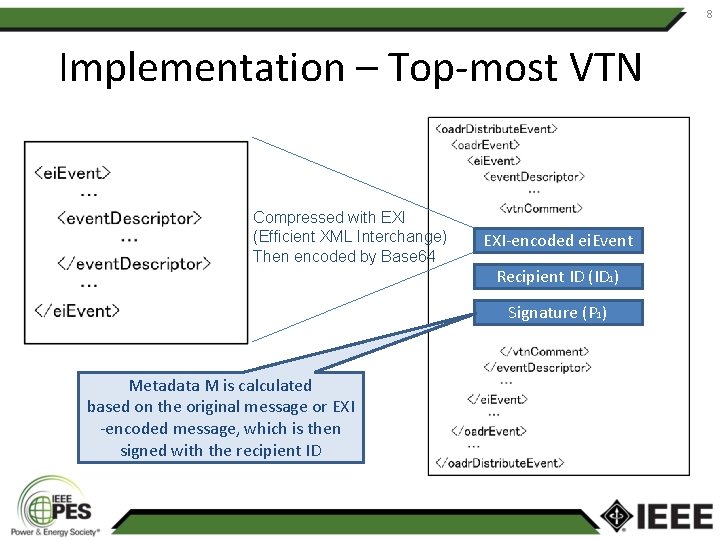
8 Implementation – Top-most VTN Compressed with EXI (Efficient XML Interchange) Then encoded by Base 64 EXI-encoded ei. Event Recipient ID (ID 1) Signature (P 1) Metadata M is calculated based on the original message or EXI -encoded message, which is then signed with the recipient ID
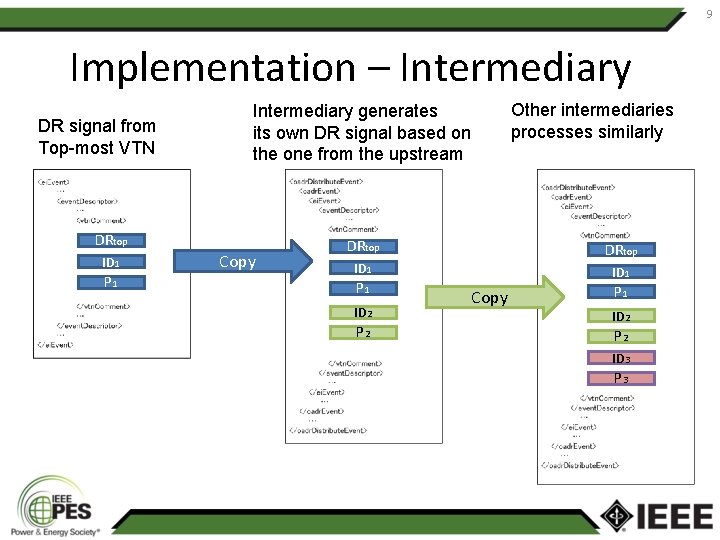
9 Implementation – Intermediary DR signal from Top-most VTN DRtop ID 1 P 1 Other intermediaries processes similarly Intermediary generates its own DR signal based on the one from the upstream Copy DRtop ID 1 P 1 ID 2 P 2 ID 1 Copy P 1 ID 2 P 2 ID 3 P 3
10 Extension for Privacy • DR signal issued by the top-most VTN may contain information that end-most VEN does not “need to know”. • It is desired to allow intermediaries to appropriately hide some portion of the top-most VTN’s DR event signal, without invalidating the discussed schema. • Redactable signature scheme to create M and P 1 – Implemented Merkle Hash Tree based scheme – Please refer to the paper for more detail.
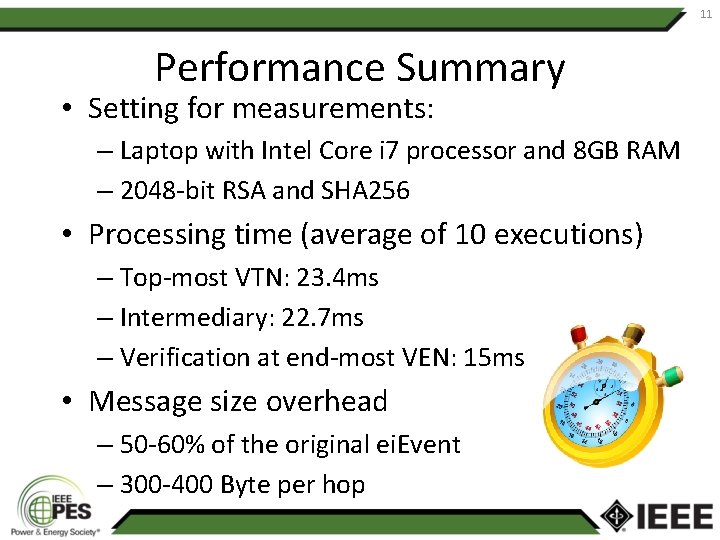
11 Performance Summary • Setting for measurements: – Laptop with Intel Core i 7 processor and 8 GB RAM – 2048 -bit RSA and SHA 256 • Processing time (average of 10 executions) – Top-most VTN: 23. 4 ms – Intermediary: 22. 7 ms – Verification at end-most VEN: 15 ms • Message size overhead – 50 -60% of the original ei. Event – 300 -400 Byte per hop
12 Conclusions • Implemented extended DR event signal verification under Open. ADR specification – Verifiable DR signal distribution path – Verification of semantic consistency of DR signals – Can be integrated into existing Open. ADR systems • Future Direction – Improve the scheme for lower overheads – Proposal to Open. ADR Alliance
13 Thanks! Please direct your questions and comments to: dmashima@us. fujitsu. com