
1 Enabling Full Profile CMP Metrology and Modeling
1 Enabling Full Profile CMP Metrology and Modeling SFR Workshop May 24, 2001 Runzi Chang, Costas Spanos Berkeley, CA 2001 GOAL: Develop periodic grating metrology to support integrated CMP model by 9/30/2001. 5/24/2001
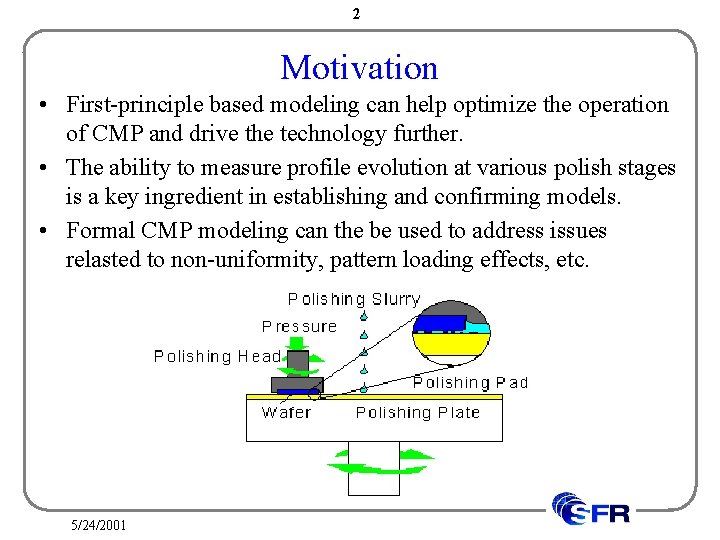
2 Motivation • First-principle based modeling can help optimize the operation of CMP and drive the technology further. • The ability to measure profile evolution at various polish stages is a key ingredient in establishing and confirming models. • Formal CMP modeling can the be used to address issues relasted to non-uniformity, pattern loading effects, etc. 5/24/2001
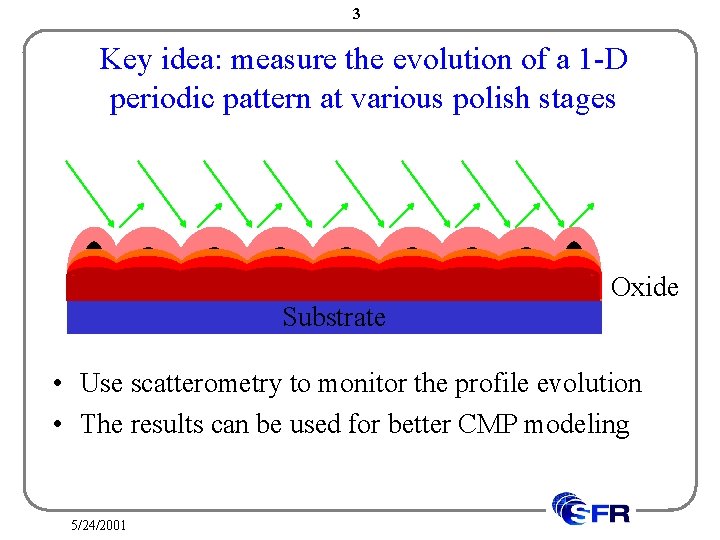
3 Key idea: measure the evolution of a 1 -D periodic pattern at various polish stages Substrate Oxide • Use scatterometry to monitor the profile evolution • The results can be used for better CMP modeling 5/24/2001
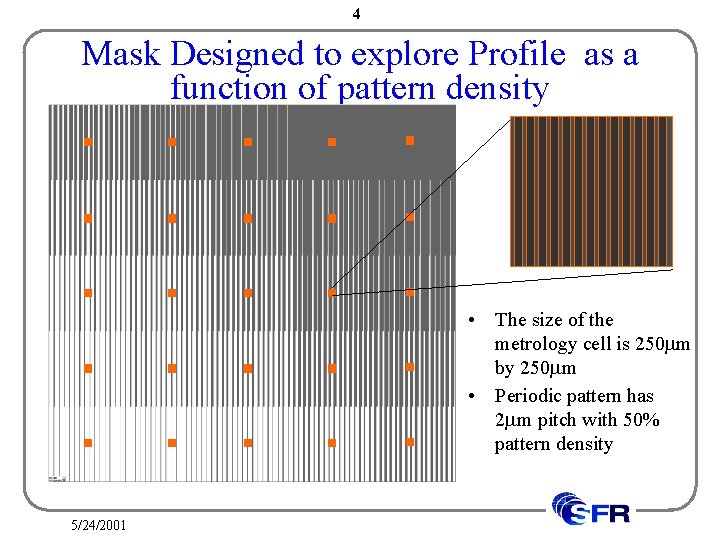
4 Mask Designed to explore Profile as a function of pattern density • The size of the metrology cell is 250 m by 250 m • Periodic pattern has 2 m pitch with 50% pattern density 5/24/2001
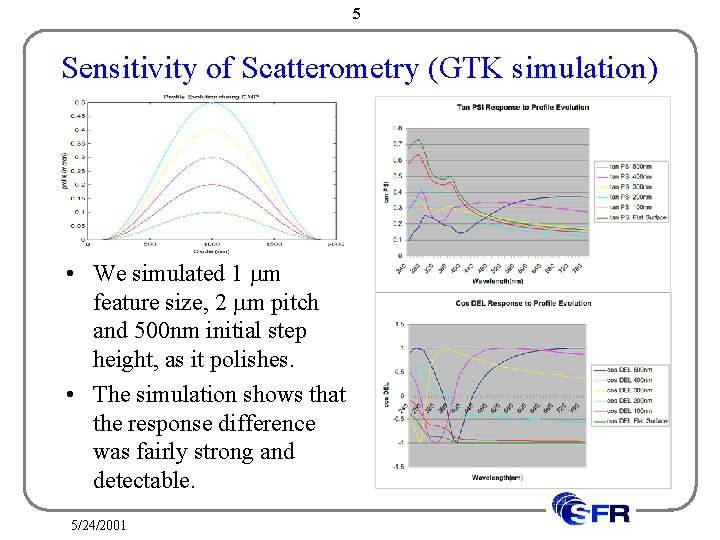
5 Sensitivity of Scatterometry (GTK simulation) • We simulated 1 m feature size, 2 m pitch and 500 nm initial step height, as it polishes. • The simulation shows that the response difference was fairly strong and detectable. 5/24/2001

6 Characterization Experiments Wafer # Down Force (psi) Table Speed (rpm) Slurry Flow (ml/min) 1 4 40 50 2 8 40 50 3 4 40 150 4 8 40 150 5 8 80 50 6 4 80 50 7 8 80 150 8 4 80 150 9 6 60 100 11 6 60 100 5/24/2001 Initial profiles Sopra/AFM CMP AFM (AMD/SDC) • Three one-minute polishing steps were done using the DOE parameters Wafer cleaning Nanospec Thickness measurement Sopra Spectroscopic ellipsometer
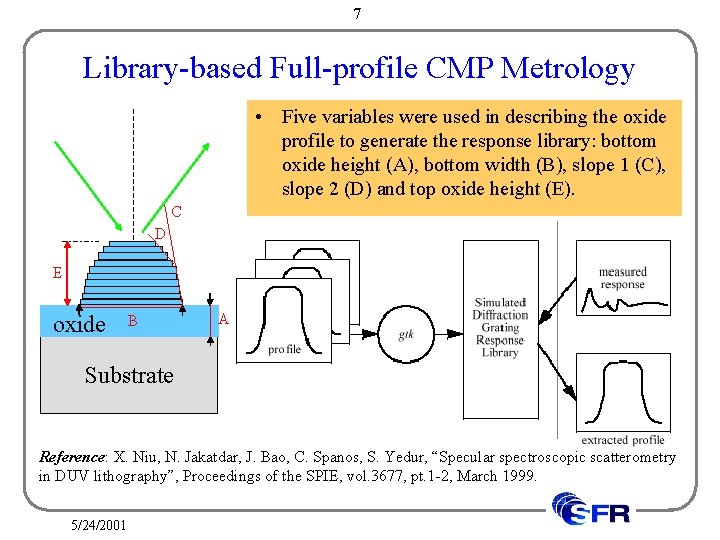
7 Library-based Full-profile CMP Metrology • Five variables were used in describing the oxide profile to generate the response library: bottom oxide height (A), bottom width (B), slope 1 (C), slope 2 (D) and top oxide height (E). C D E oxide B A Substrate Reference: X. Niu, N. Jakatdar, J. Bao, C. Spanos, S. Yedur, “Specular spectroscopic scatterometry in DUV lithography”, Proceedings of the SPIE, vol. 3677, pt. 1 -2, March 1999. 5/24/2001
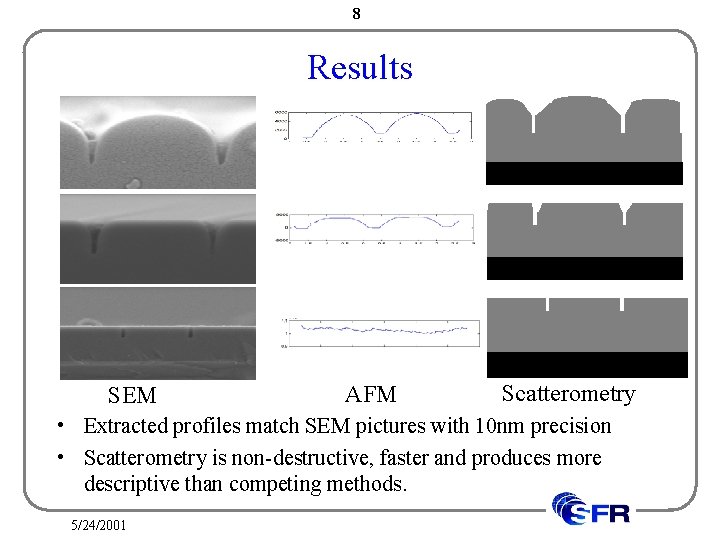
8 Results SEM AFM Scatterometry • Extracted profiles match SEM pictures with 10 nm precision • Scatterometry is non-destructive, faster and produces more descriptive than competing methods. 5/24/2001
9 Conclusions and 2002 / 2003 Goals • We have demonstrated that scatterometry, in conjunction with specialized profile libraries, can be used for complete profile evaluation during polish. • This method has been demonstrated on clean, dry samples. It will be interesting to examine the feasibility of using wet samples, for in-situ/in-line deployment of full-profile CMP metrology. Our next goals are: Integrate initial chemical models into basic CMP model; Validate predicted pattern development (with Dornfeld and Talbot), by 9/30/2002. Develop comprehensive chemical and mechanical model (with Dornfeld and Talbot); Perform experimental and metrological validation, by 9/30/2003. 5/24/2001
- Slides: 9