
1 EMPLOYEE DUE PROCESS IRA WEISS ESQ ANNEMARIE
- Slides: 24
1 EMPLOYEE DUE PROCESS IRA WEISS, ESQ. ANNEMARIE K. HARR, ESQ.
2 Due Process for School Employees Public school employees, whether they are members of a collective bargaining unit or not, enjoy certain legal protections related to their employment. • Public school employees who belong to a union may have even greater rights and protections, which have been negotiated for under their collective bargaining agreements (CBAs). • The following information is general legal information and not intended to guide individual employees; every case is different. If you need advice, ask your union or consult an attorney. • © WBK Legal 2019 This presentation is informational only and does not constitute legal advice.
3 Weingarten Rights • Rule: Unionized employee has right upon request to aid of union representative before and during investigatory interview conducted by employer from which employee reasonably believes discipline may result • Derives from 1975 U. S. Supreme Court case affecting private-sector employees; extended to Pennsylvania public school employees by PLRB in 1981 • Investigatory interviews: “individual encounters with [employee’s] employer in which performance was an issue in the discussion and had a specific bearing on that employee’s job security” © WBK Legal 2019 This presentation is informational only and does not constitute legal advice.
4 Weingarten Rights, continued § Union – not employee – is entitled to choose representative, if reasonably available and no extenuating circumstances § Employee has right to private consultation with union representative before investigatory interview; also, during interview if “reasonable grounds” for doing so © WBK Legal 2019 This presentation is informational only and does not constitute legal advice.
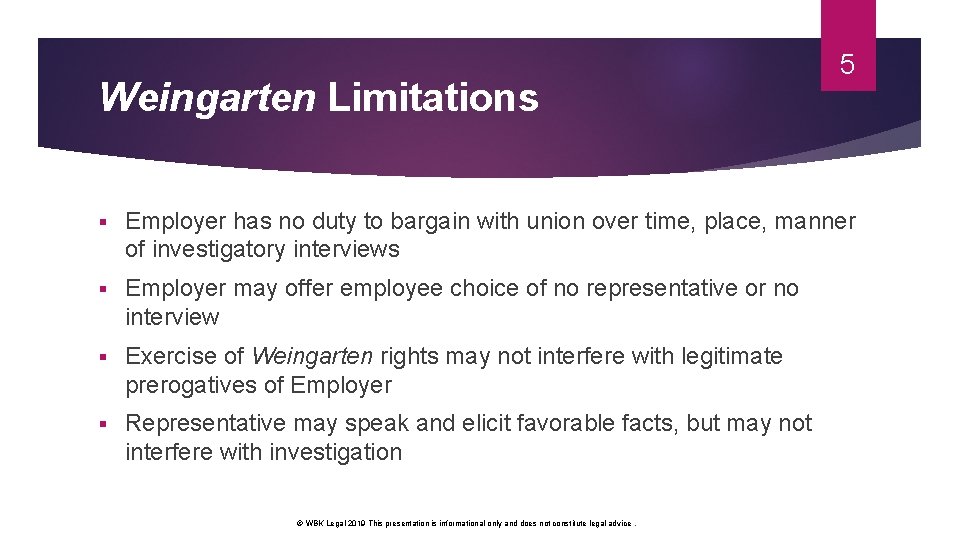
Weingarten Limitations 5 § Employer has no duty to bargain with union over time, place, manner of investigatory interviews § Employer may offer employee choice of no representative or no interview § Exercise of Weingarten rights may not interfere with legitimate prerogatives of Employer § Representative may speak and elicit favorable facts, but may not interfere with investigation © WBK Legal 2019 This presentation is informational only and does not constitute legal advice.
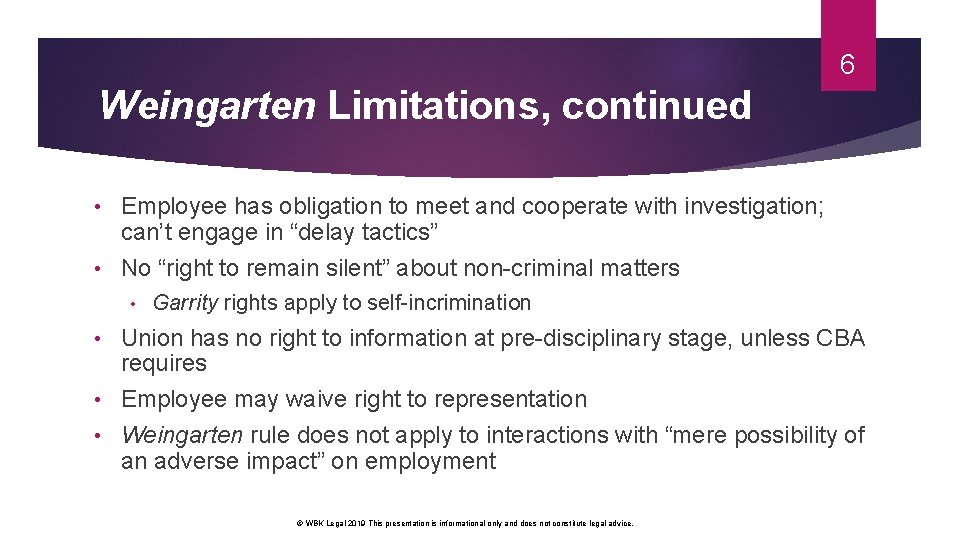
6 Weingarten Limitations, continued Employee has obligation to meet and cooperate with investigation; can’t engage in “delay tactics” • No “right to remain silent” about non-criminal matters • • Garrity rights apply to self-incrimination Union has no right to information at pre-disciplinary stage, unless CBA requires • Employee may waive right to representation • Weingarten rule does not apply to interactions with “mere possibility of an adverse impact” on employment • © WBK Legal 2019 This presentation is informational only and does not constitute legal advice.
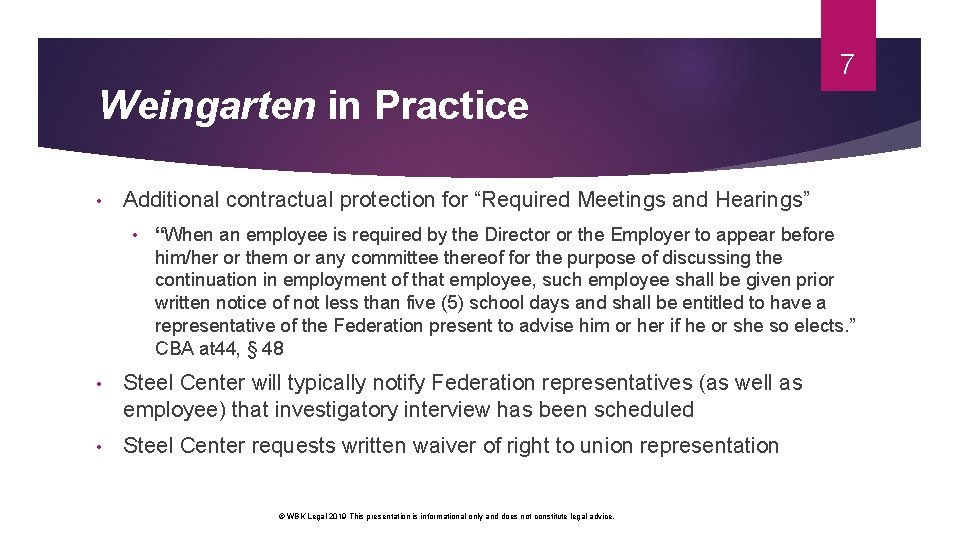
7 Weingarten in Practice • Additional contractual protection for “Required Meetings and Hearings” • “When an employee is required by the Director or the Employer to appear before him/her or them or any committee thereof for the purpose of discussing the continuation in employment of that employee, such employee shall be given prior written notice of not less than five (5) school days and shall be entitled to have a representative of the Federation present to advise him or her if he or she so elects. ” CBA at 44, § 48 • Steel Center will typically notify Federation representatives (as well as employee) that investigatory interview has been scheduled • Steel Center requests written waiver of right to union representation © WBK Legal 2019 This presentation is informational only and does not constitute legal advice.
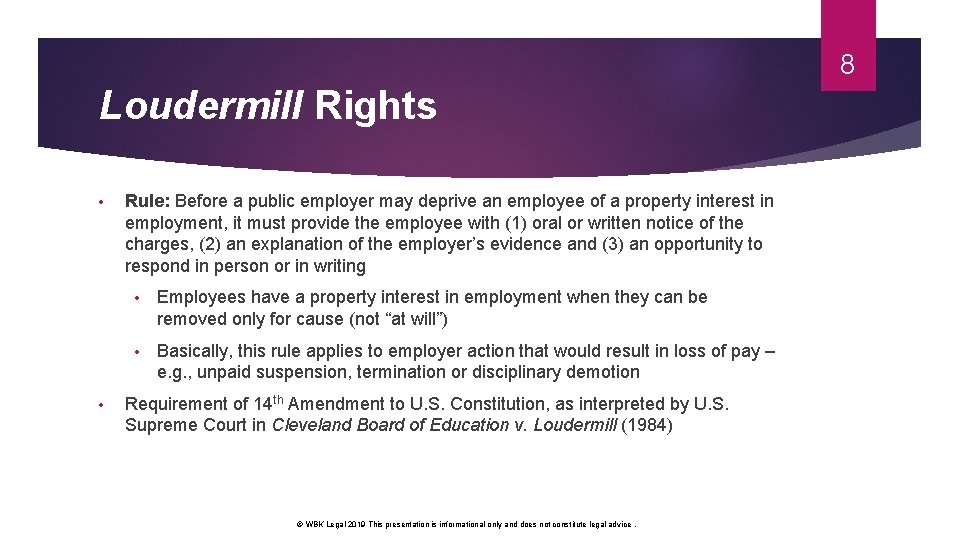
8 Loudermill Rights • • Rule: Before a public employer may deprive an employee of a property interest in employment, it must provide the employee with (1) oral or written notice of the charges, (2) an explanation of the employer’s evidence and (3) an opportunity to respond in person or in writing • Employees have a property interest in employment when they can be removed only for cause (not “at will”) • Basically, this rule applies to employer action that would result in loss of pay – e. g. , unpaid suspension, termination or disciplinary demotion Requirement of 14 th Amendment to U. S. Constitution, as interpreted by U. S. Supreme Court in Cleveland Board of Education v. Loudermill (1984) © WBK Legal 2019 This presentation is informational only and does not constitute legal advice .
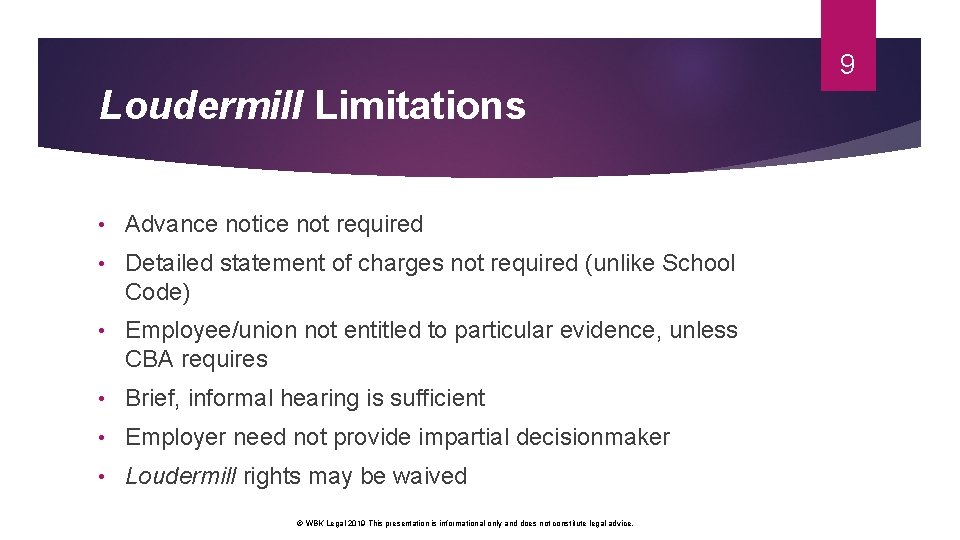
9 Loudermill Limitations • Advance notice not required • Detailed statement of charges not required (unlike School Code) • Employee/union not entitled to particular evidence, unless CBA requires • Brief, informal hearing is sufficient • Employer need not provide impartial decisionmaker • Loudermill rights may be waived © WBK Legal 2019 This presentation is informational only and does not constitute legal advice.
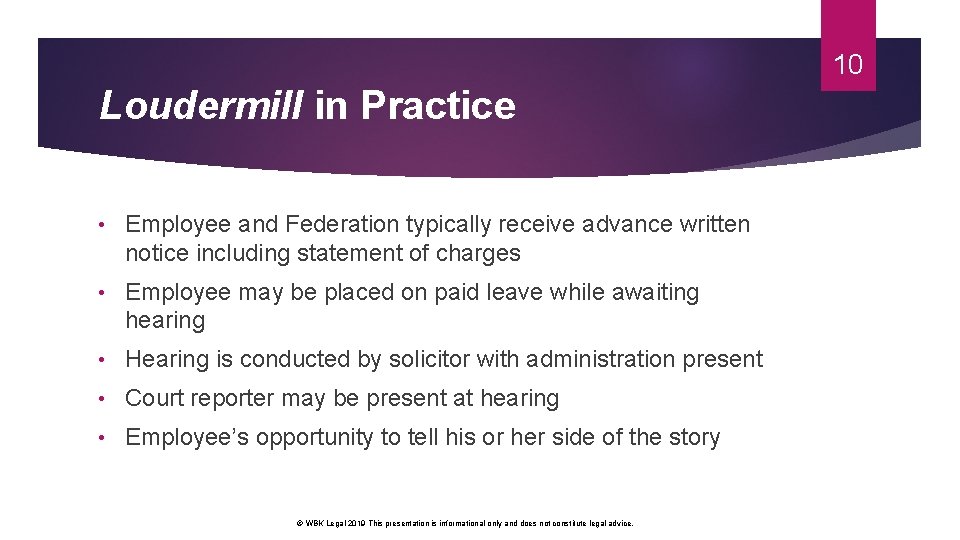
10 Loudermill in Practice • Employee and Federation typically receive advance written notice including statement of charges • Employee may be placed on paid leave while awaiting hearing • Hearing is conducted by solicitor with administration present • Court reporter may be present at hearing • Employee’s opportunity to tell his or her side of the story © WBK Legal 2019 This presentation is informational only and does not constitute legal advice.
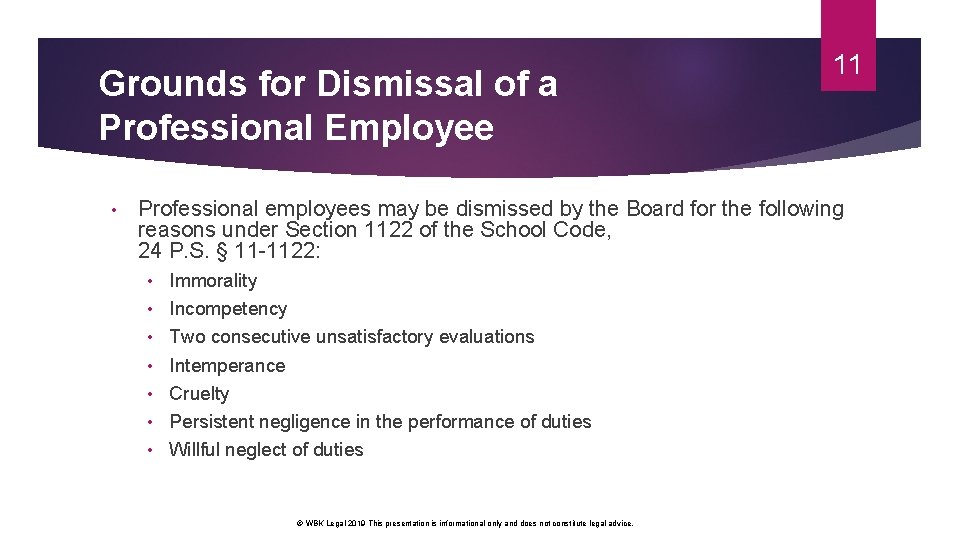
Grounds for Dismissal of a Professional Employee • 11 Professional employees may be dismissed by the Board for the following reasons under Section 1122 of the School Code, 24 P. S. § 11 -1122: • • Immorality Incompetency Two consecutive unsatisfactory evaluations Intemperance Cruelty Persistent negligence in the performance of duties Willful neglect of duties © WBK Legal 2019 This presentation is informational only and does not constitute legal advice.
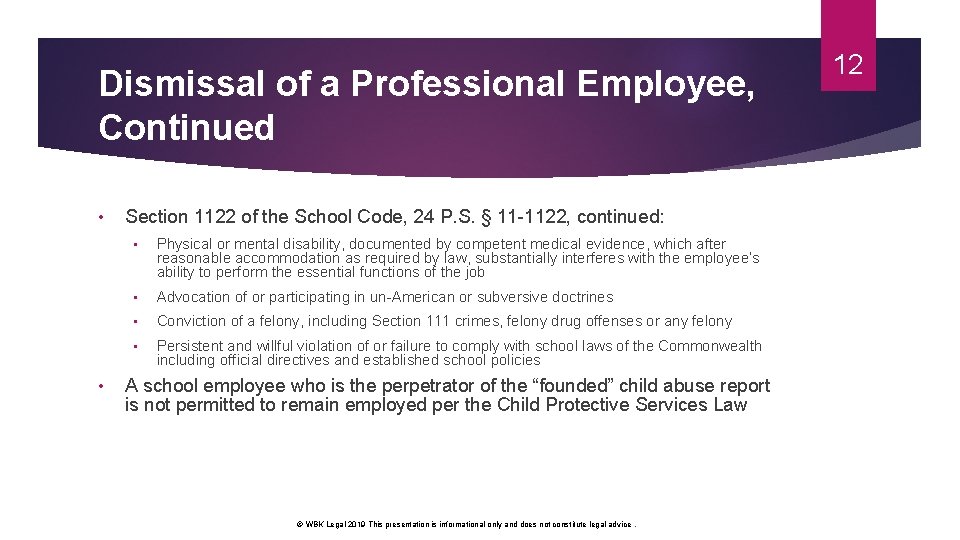
Dismissal of a Professional Employee, Continued • • Section 1122 of the School Code, 24 P. S. § 11 -1122, continued: • Physical or mental disability, documented by competent medical evidence, which after reasonable accommodation as required by law, substantially interferes with the employee’s ability to perform the essential functions of the job • Advocation of or participating in un-American or subversive doctrines • Conviction of a felony, including Section 111 crimes, felony drug offenses or any felony • Persistent and willful violation of or failure to comply with school laws of the Commonwealth including official directives and established school policies A school employee who is the perpetrator of the “founded” child abuse report is not permitted to remain employed per the Child Protective Services Law © WBK Legal 2019 This presentation is informational only and does not constitute legal advice . 12
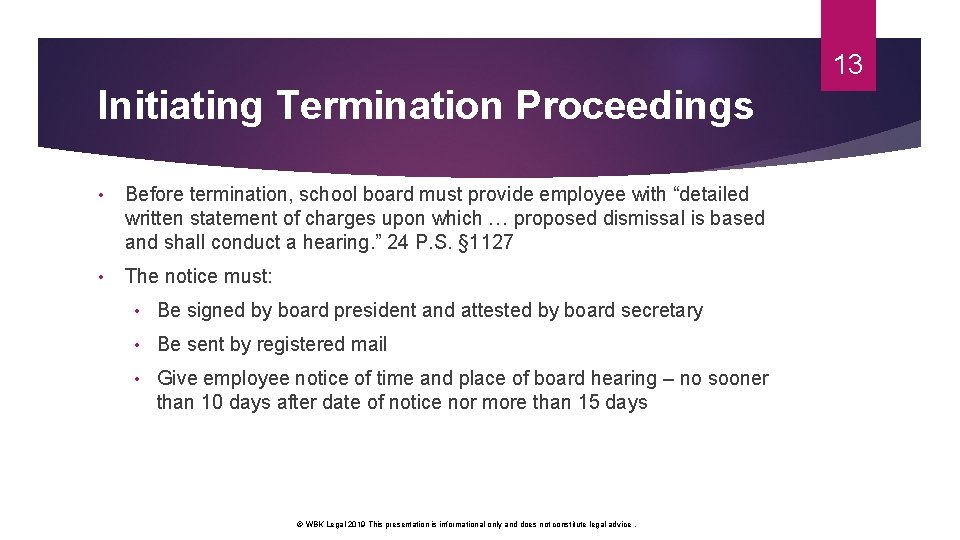
13 Initiating Termination Proceedings • Before termination, school board must provide employee with “detailed written statement of charges upon which … proposed dismissal is based and shall conduct a hearing. ” 24 P. S. § 1127 • The notice must: • Be signed by board president and attested by board secretary • Be sent by registered mail • Give employee notice of time and place of board hearing – no sooner than 10 days after date of notice nor more than 15 days © WBK Legal 2019 This presentation is informational only and does not constitute legal advice .
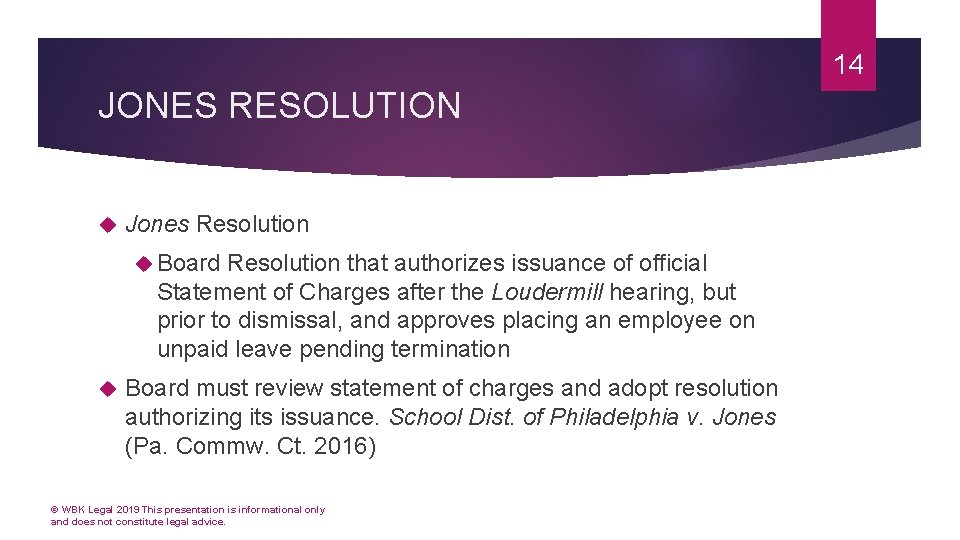
14 JONES RESOLUTION Jones Resolution Board Resolution that authorizes issuance of official Statement of Charges after the Loudermill hearing, but prior to dismissal, and approves placing an employee on unpaid leave pending termination Board must review statement of charges and adopt resolution authorizing its issuance. School Dist. of Philadelphia v. Jones (Pa. Commw. Ct. 2016) © WBK Legal 2019 This presentation is informational only and does not constitute legal advice.
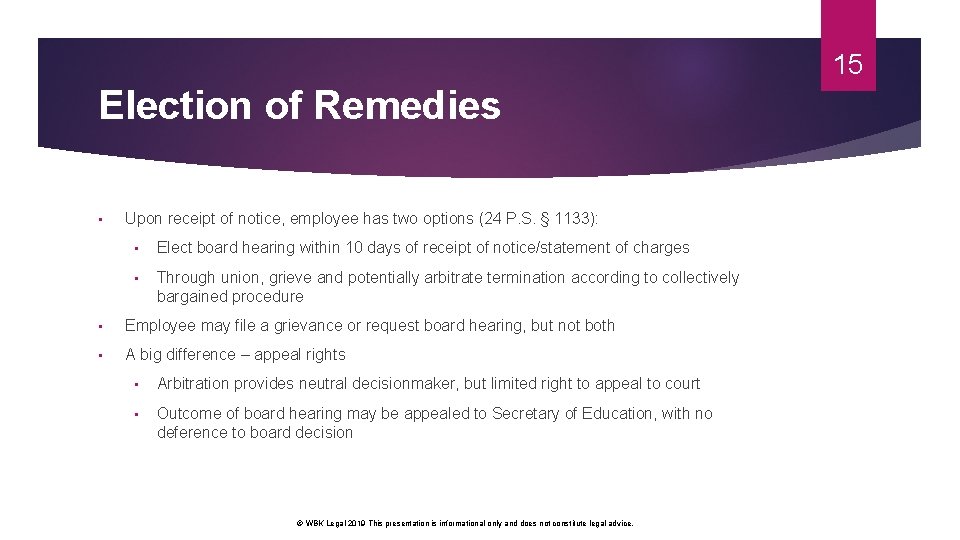
15 Election of Remedies • Upon receipt of notice, employee has two options (24 P. S. § 1133): • Elect board hearing within 10 days of receipt of notice/statement of charges • Through union, grieve and potentially arbitrate termination according to collectively bargained procedure • Employee may file a grievance or request board hearing, but not both • A big difference – appeal rights • Arbitration provides neutral decisionmaker, but limited right to appeal to court • Outcome of board hearing may be appealed to Secretary of Education, with no deference to board decision © WBK Legal 2019 This presentation is informational only and does not constitute legal advice.
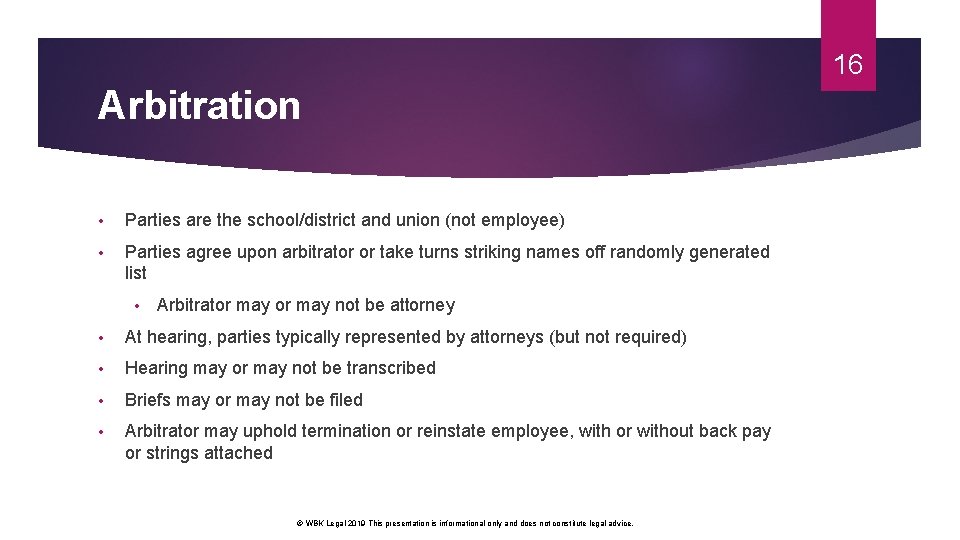
16 Arbitration • Parties are the school/district and union (not employee) • Parties agree upon arbitrator or take turns striking names off randomly generated list • Arbitrator may not be attorney • At hearing, parties typically represented by attorneys (but not required) • Hearing may or may not be transcribed • Briefs may or may not be filed • Arbitrator may uphold termination or reinstate employee, with or without back pay or strings attached © WBK Legal 2019 This presentation is informational only and does not constitute legal advice.
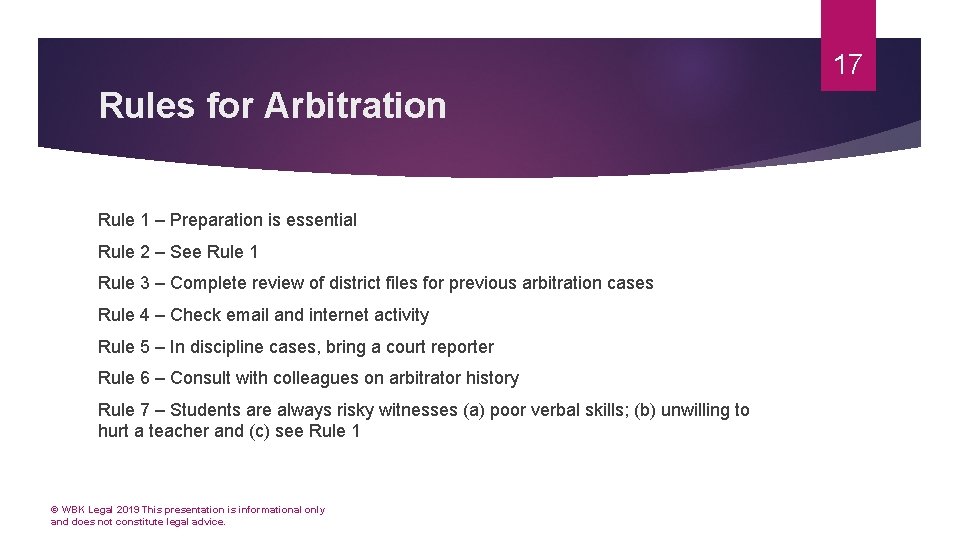
17 Rules for Arbitration Rule 1 – Preparation is essential Rule 2 – See Rule 1 Rule 3 – Complete review of district files for previous arbitration cases Rule 4 – Check email and internet activity Rule 5 – In discipline cases, bring a court reporter Rule 6 – Consult with colleagues on arbitrator history Rule 7 – Students are always risky witnesses (a) poor verbal skills; (b) unwilling to hurt a teacher and (c) see Rule 1 © WBK Legal 2019 This presentation is informational only and does not constitute legal advice.
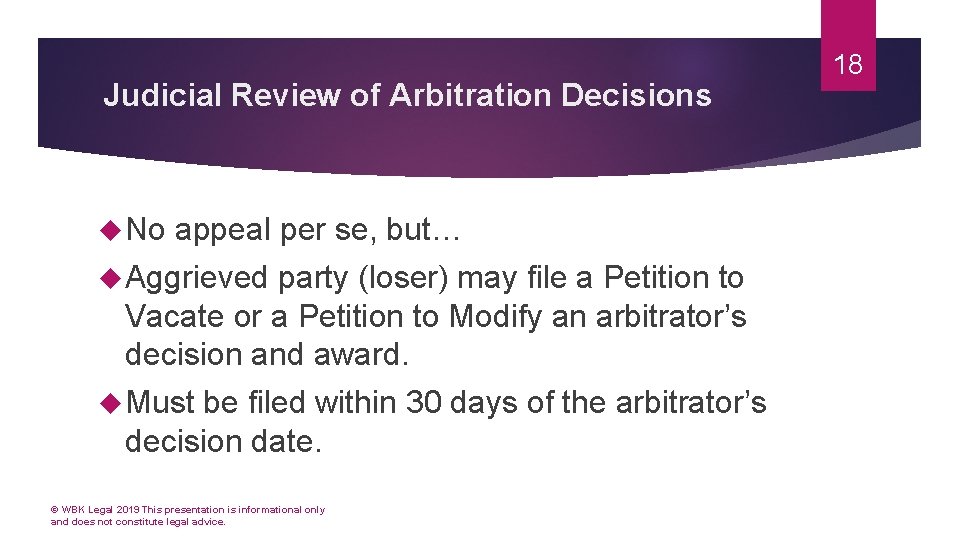
Judicial Review of Arbitration Decisions No appeal per se, but… Aggrieved party (loser) may file a Petition to Vacate or a Petition to Modify an arbitrator’s decision and award. Must be filed within 30 days of the arbitrator’s decision date. © WBK Legal 2019 This presentation is informational only and does not constitute legal advice. 18
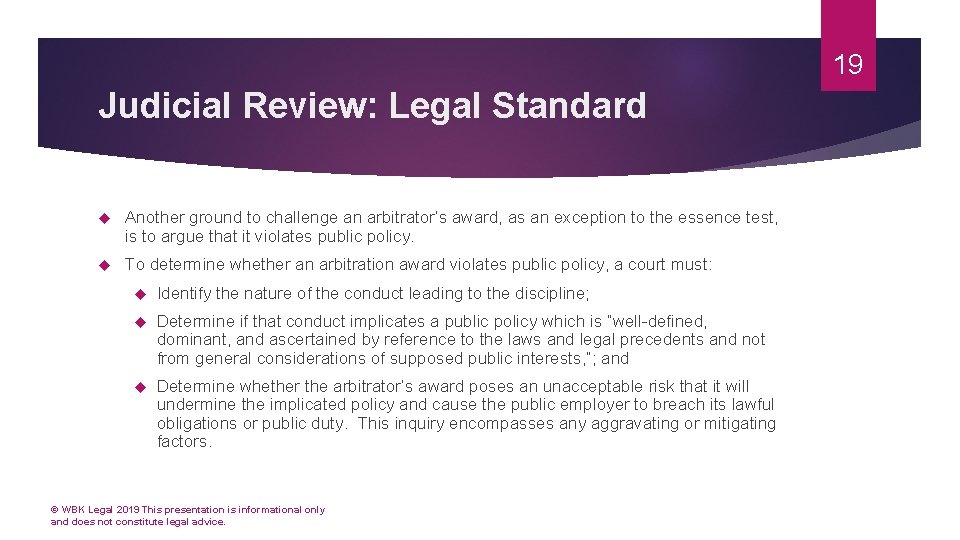
19 Judicial Review: Legal Standard Another ground to challenge an arbitrator’s award, as an exception to the essence test, is to argue that it violates public policy. To determine whether an arbitration award violates public policy, a court must: Identify the nature of the conduct leading to the discipline; Determine if that conduct implicates a public policy which is “well-defined, dominant, and ascertained by reference to the laws and legal precedents and not from general considerations of supposed public interests, ”; and Determine whether the arbitrator’s award poses an unacceptable risk that it will undermine the implicated policy and cause the public employer to breach its lawful obligations or public duty. This inquiry encompasses any aggravating or mitigating factors. © WBK Legal 2019 This presentation is informational only and does not constitute legal advice.
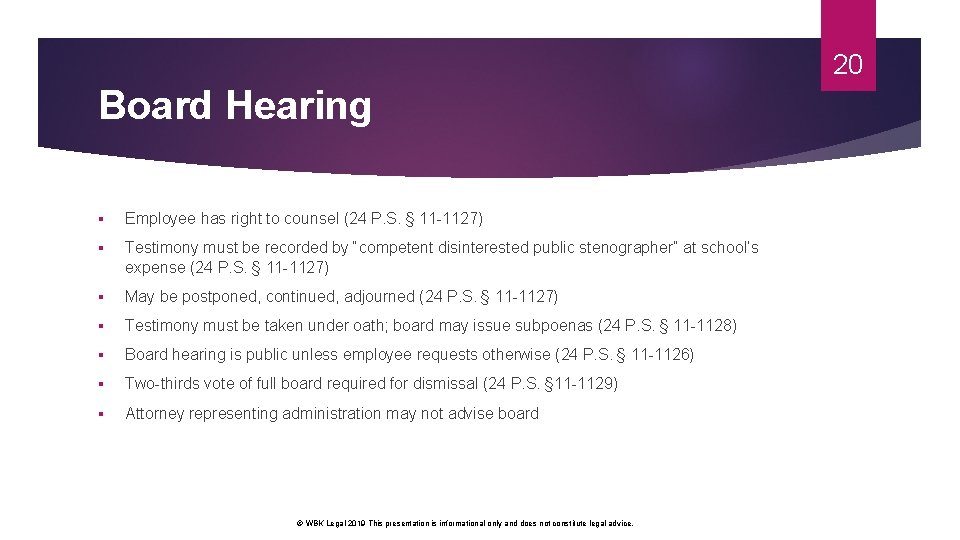
20 Board Hearing § Employee has right to counsel (24 P. S. § 11 -1127) § Testimony must be recorded by “competent disinterested public stenographer” at school’s expense (24 P. S. § 11 -1127) § May be postponed, continued, adjourned (24 P. S. § 11 -1127) § Testimony must be taken under oath; board may issue subpoenas (24 P. S. § 11 -1128) § Board hearing is public unless employee requests otherwise (24 P. S. § 11 -1126) § Two-thirds vote of full board required for dismissal (24 P. S. § 11 -1129) § Attorney representing administration may not advise board © WBK Legal 2019 This presentation is informational only and does not constitute legal advice.
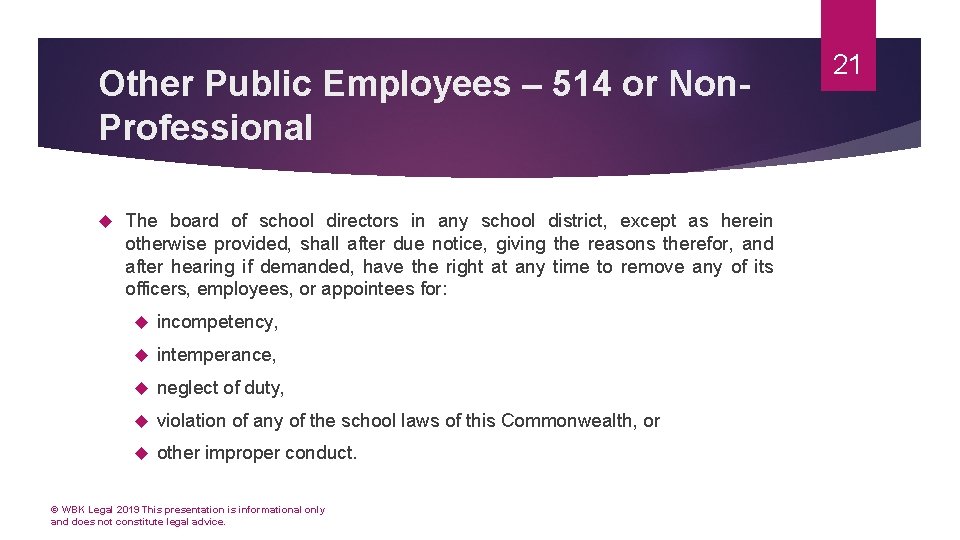
Other Public Employees – 514 or Non. Professional The board of school directors in any school district, except as herein otherwise provided, shall after due notice, giving the reasons therefor, and after hearing if demanded, have the right at any time to remove any of its officers, employees, or appointees for: incompetency, intemperance, neglect of duty, violation of any of the school laws of this Commonwealth, or other improper conduct. © WBK Legal 2019 This presentation is informational only and does not constitute legal advice. 21
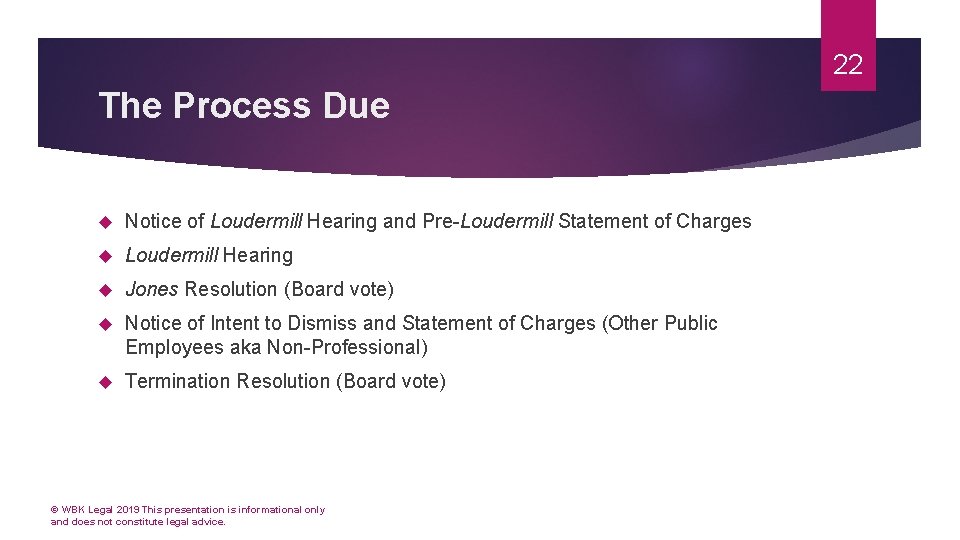
22 The Process Due Notice of Loudermill Hearing and Pre-Loudermill Statement of Charges Loudermill Hearing Jones Resolution (Board vote) Notice of Intent to Dismiss and Statement of Charges (Other Public Employees aka Non-Professional) Termination Resolution (Board vote) © WBK Legal 2019 This presentation is informational only and does not constitute legal advice.
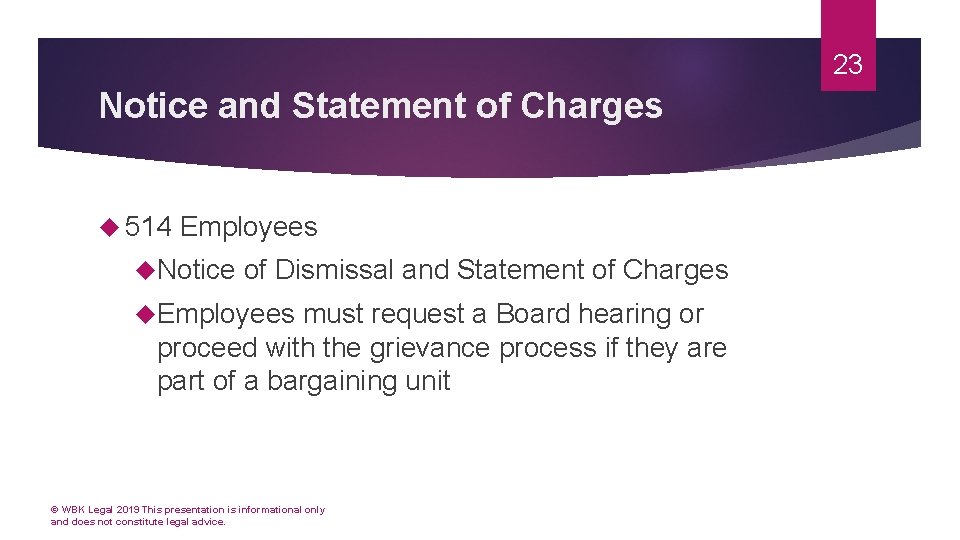
23 Notice and Statement of Charges 514 Employees Notice of Dismissal and Statement of Charges Employees must request a Board hearing or proceed with the grievance process if they are part of a bargaining unit © WBK Legal 2019 This presentation is informational only and does not constitute legal advice.
24 Thank You! Additional comments or questions: Ira Weiss, Esquire iweiss@wbklegal. com Annemarie K. Harr, Esquire aharr@wbklegal. com Weiss Burkardt Kramer, LLC 445 Fort Pitt Blvd. , Suite 503 Pittsburgh, PA 15219 Phone: (412) 391 -9890 © WBK Legal 2019 This presentation is informational only and does not constitute legal advice.