
1 EKT 472 Object Oriented Programming Inheritance Polymorphism
1 EKT 472: Object Oriented Programming Inheritance, Polymorphism, Interface and Abstract Class
2 Inheritance: Definition inheritance: a parent-child relationship between classes allows sharing of the behavior of the parent class into its child classes one of the major benefits of object-oriented programming (OOP) is this code sharing between classes through inheritance child class can add new behavior or override existing behavior from parent
3 Inheritance terms superclass, base class, parent class: terms to describe the parent in the relationship, which shares its functionality subclass, derived class, child class: terms to describe the child in the relationship, which accepts functionality from its parent extend, inherit, derive: become a subclass of another class
4 Inheritance in Java, you specify another class as your parent by using the keyword extends public class Checking. Account extends Bank. Account { the objects of your class will now receive all of the state (fields) and behavior (methods) of the parent class constructors and static methods/fields are not inherited by default, a class's parent is Object Java forces a class to have exactly one parent ("single inheritance") other languages (C++) allow multiple inheritance
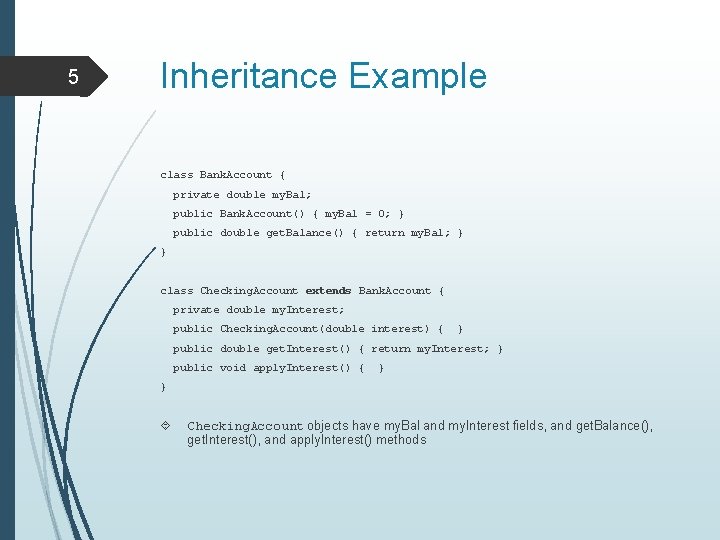
5 Inheritance Example class Bank. Account { private double my. Bal; public Bank. Account() { my. Bal = 0; } public double get. Balance() { return my. Bal; } } class Checking. Account extends Bank. Account { private double my. Interest; public Checking. Account(double interest) { } public double get. Interest() { return my. Interest; } public void apply. Interest() { } } Checking. Account objects have my. Bal and my. Interest fields, and get. Balance(), get. Interest(), and apply. Interest() methods
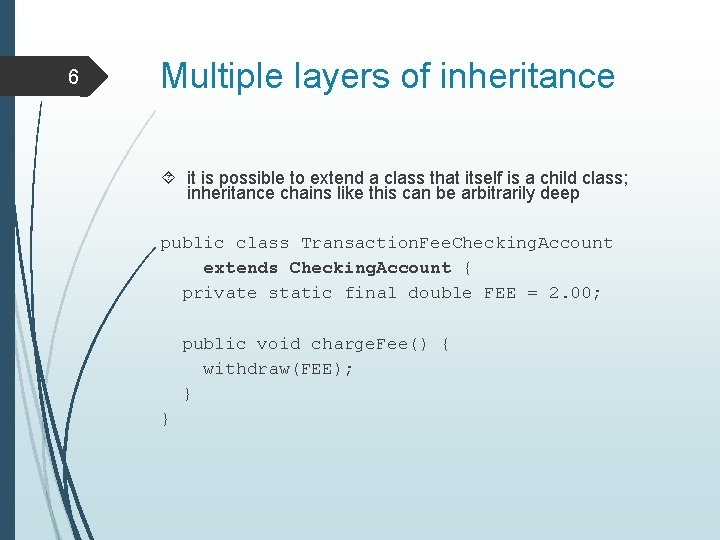
6 Multiple layers of inheritance it is possible to extend a class that itself is a child class; inheritance chains like this can be arbitrarily deep public class Transaction. Fee. Checking. Account extends Checking. Account { private static final double FEE = 2. 00; public void charge. Fee() { withdraw(FEE); } }
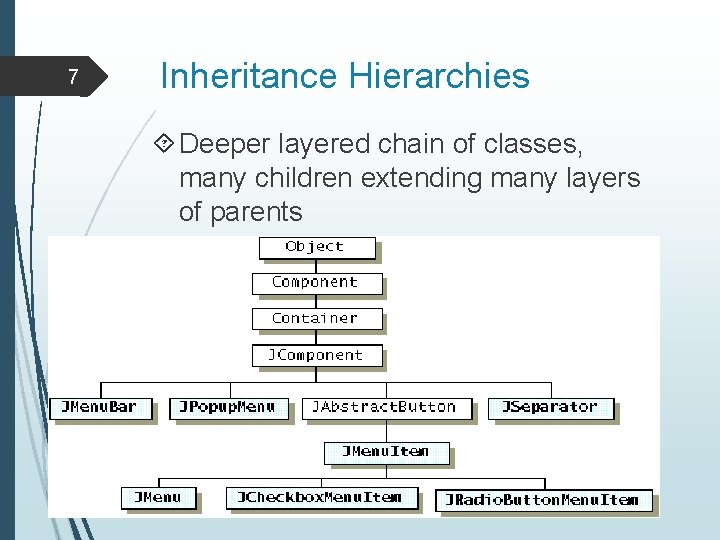
7 Inheritance Hierarchies Deeper layered chain of classes, many children extending many layers of parents
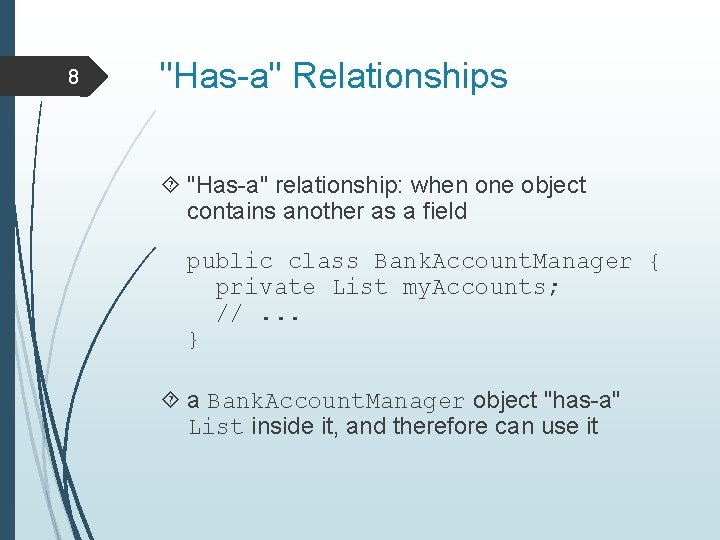
8 "Has-a" Relationships "Has-a" relationship: when one object contains another as a field public class Bank. Account. Manager { private List my. Accounts; //. . . } a Bank. Account. Manager object "has-a" List inside it, and therefore can use it
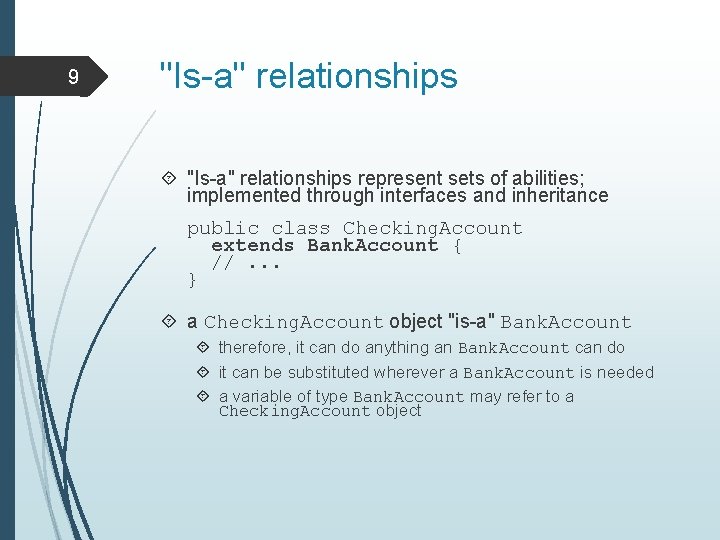
9 "Is-a" relationships represent sets of abilities; implemented through interfaces and inheritance public class Checking. Account extends Bank. Account { //. . . } a Checking. Account object "is-a" Bank. Account therefore, it can do anything an Bank. Account can do it can be substituted wherever a Bank. Account is needed a variable of type Bank. Account may refer to a Checking. Account object
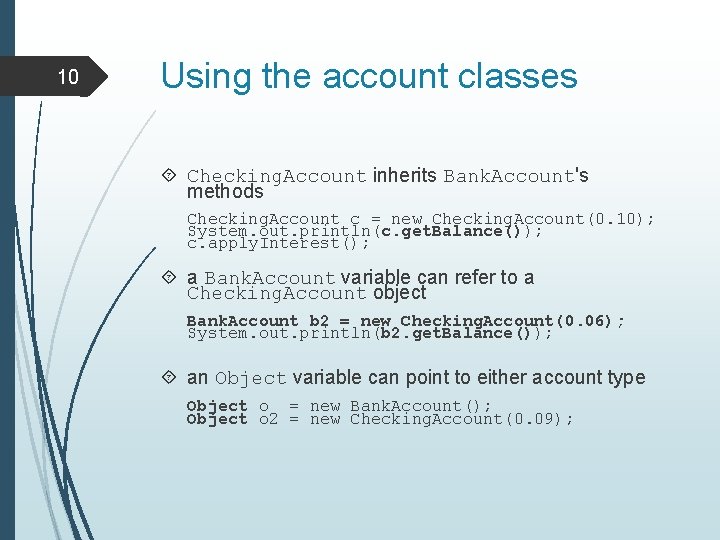
10 Using the account classes Checking. Account inherits Bank. Account's methods Checking. Account c = new Checking. Account(0. 10); System. out. println(c. get. Balance()); c. apply. Interest(); a Bank. Account variable can refer to a Checking. Account object Bank. Account b 2 = new Checking. Account(0. 06); System. out. println(b 2. get. Balance()); an Object variable can point to either account type Object o = new Bank. Account(); Object o 2 = new Checking. Account(0. 09);
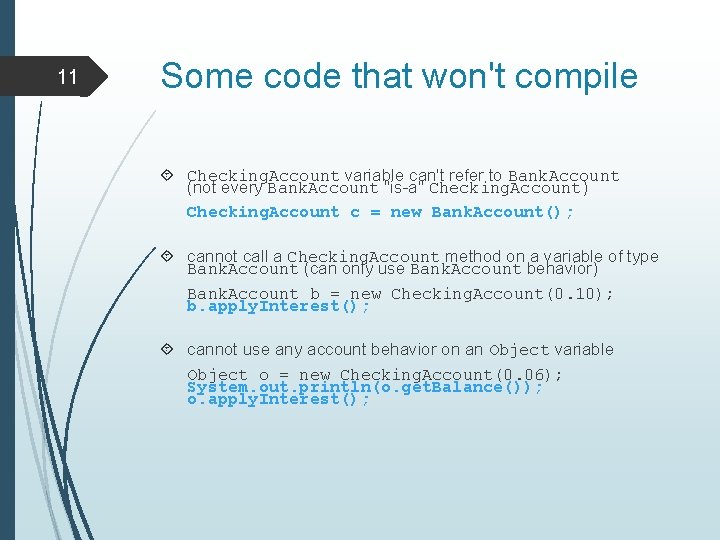
11 Some code that won't compile Checking. Account variable can't refer to Bank. Account (not every Bank. Account "is-a" Checking. Account) Checking. Account c = new Bank. Account(); cannot call a Checking. Account method on a variable of type Bank. Account (can only use Bank. Account behavior) Bank. Account b = new Checking. Account(0. 10); b. apply. Interest(); cannot use any account behavior on an Object variable Object o = new Checking. Account(0. 06); System. out. println(o. get. Balance()); o. apply. Interest();
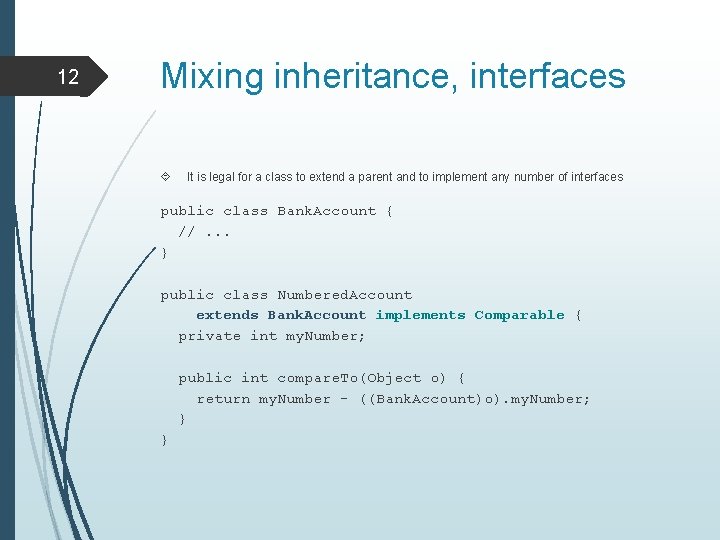
12 Mixing inheritance, interfaces It is legal for a class to extend a parent and to implement any number of interfaces public class Bank. Account { //. . . } public class Numbered. Account extends Bank. Account implements Comparable { private int my. Number; public int compare. To(Object o) { return my. Number - ((Bank. Account)o). my. Number; } }
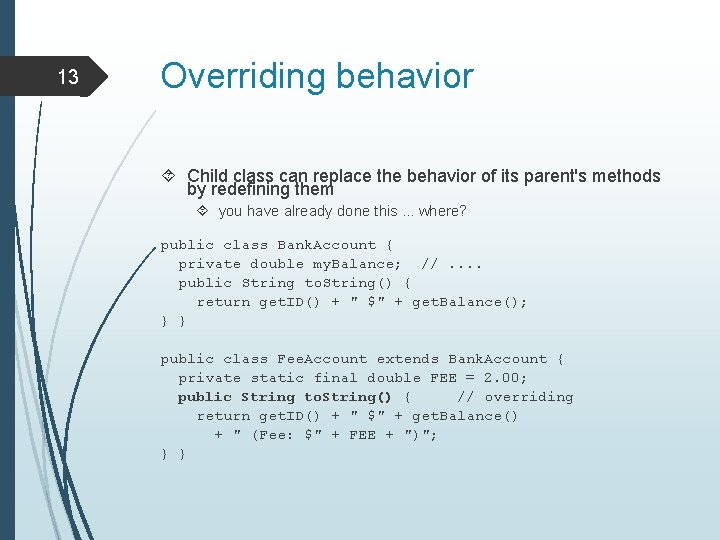
13 Overriding behavior Child class can replace the behavior of its parent's methods by redefining them you have already done this. . . where? public class Bank. Account { private double my. Balance; //. . public String to. String() { return get. ID() + " $" + get. Balance(); } } public class Fee. Account extends Bank. Account { private static final double FEE = 2. 00; public String to. String() { // overriding return get. ID() + " $" + get. Balance() + " (Fee: $" + FEE + ")"; } }
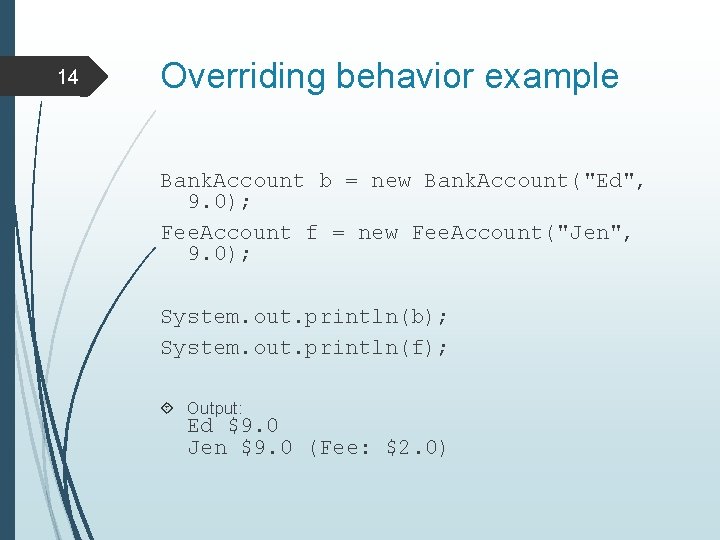
14 Overriding behavior example Bank. Account b = new Bank. Account("Ed", 9. 0); Fee. Account f = new Fee. Account("Jen", 9. 0); System. out. println(b); System. out. println(f); Output: Ed $9. 0 Jen $9. 0 (Fee: $2. 0)
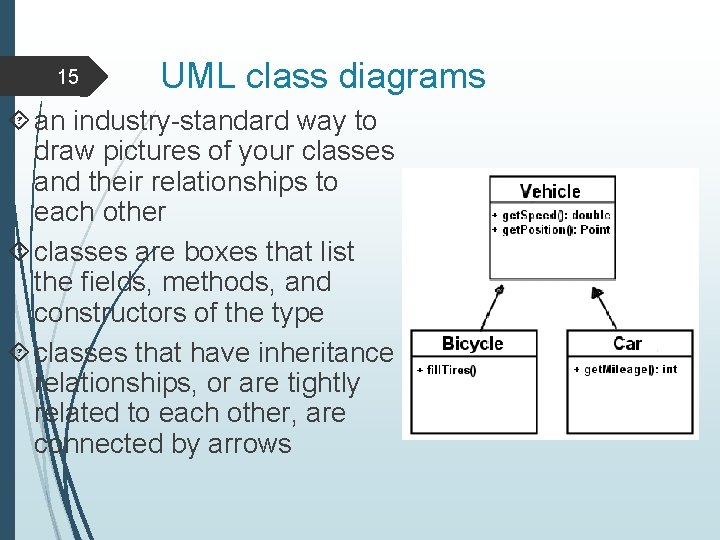
15 UML class diagrams an industry-standard way to draw pictures of your classes and their relationships to each other classes are boxes that list the fields, methods, and constructors of the type classes that have inheritance relationships, or are tightly related to each other, are connected by arrows
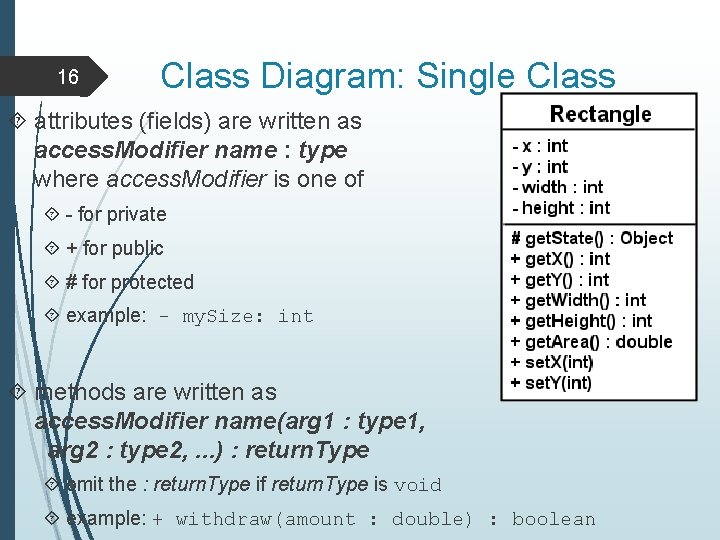
16 Class Diagram: Single Class attributes (fields) are written as access. Modifier name : type where access. Modifier is one of - for private + for public # for protected example: - my. Size: int methods are written as access. Modifier name(arg 1 : type 1, arg 2 : type 2, . . . ) : return. Type omit the : return. Type if return. Type is void example: + withdraw(amount : double) : boolean
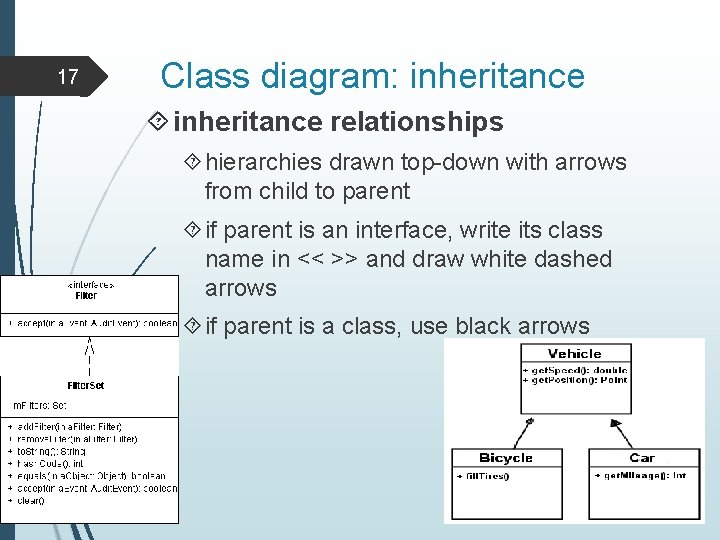
17 Class diagram: inheritance relationships hierarchies drawn top-down with arrows from child to parent if parent is an interface, write its class name in << >> and draw white dashed arrows if parent is a class, use black arrows
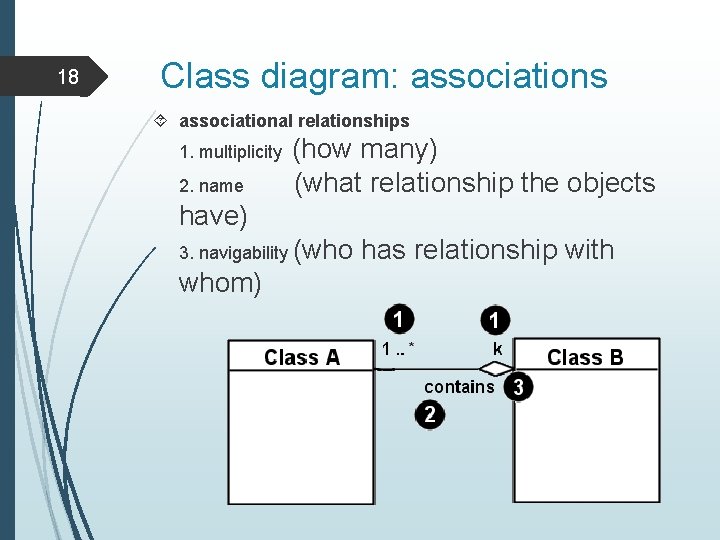
18 Class diagram: associations associational relationships 1. multiplicity 2. name (how many) (what relationship the objects have) 3. navigability (who whom) has relationship with
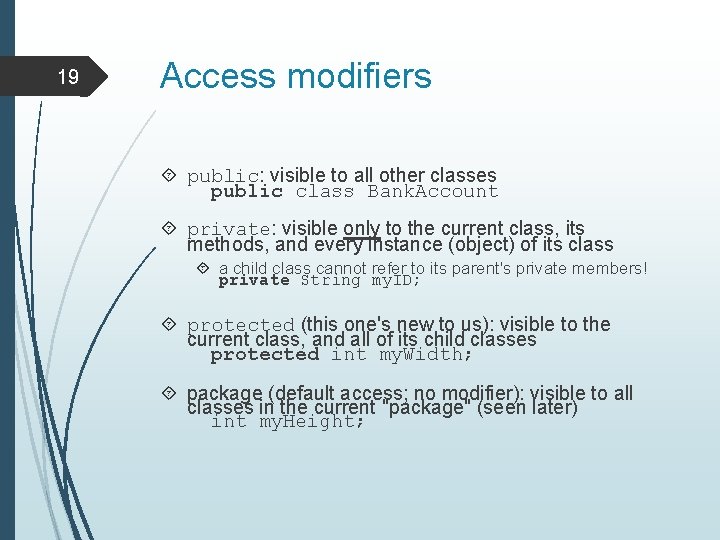
19 Access modifiers public: visible to all other classes public class Bank. Account private: visible only to the current class, its methods, and every instance (object) of its class a child class cannot refer to its parent's private members! private String my. ID; protected (this one's new to us): visible to the current class, and all of its child classes protected int my. Width; package (default access; no modifier): visible to all classes in the current "package" (seen later) int my. Height;
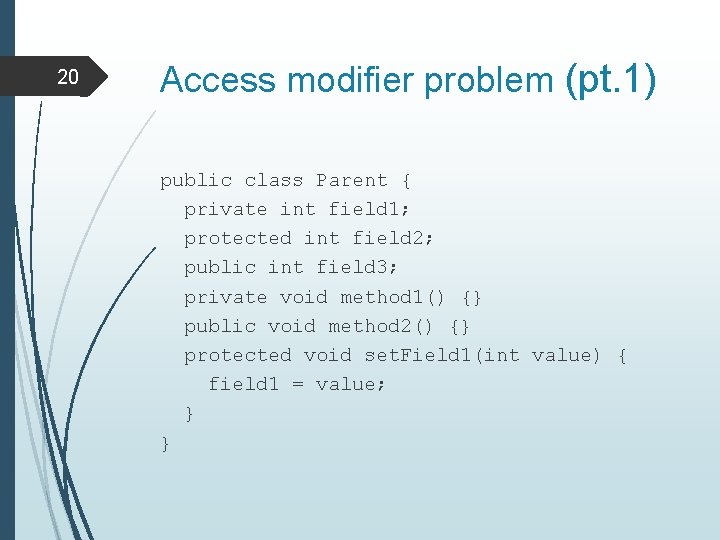
20 Access modifier problem (pt. 1) public class Parent { private int field 1; protected int field 2; public int field 3; private void method 1() {} public void method 2() {} protected void set. Field 1(int value) { field 1 = value; } }
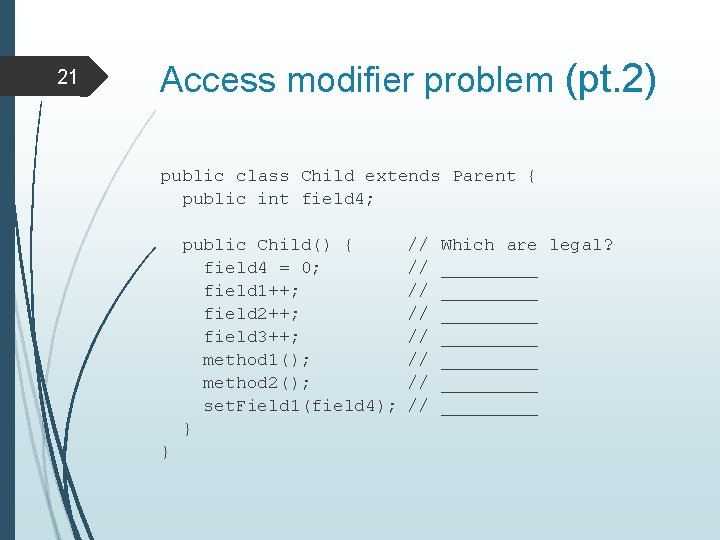
21 Access modifier problem (pt. 2) public class Child extends Parent { public int field 4; public Child() { field 4 = 0; field 1++; field 2++; field 3++; method 1(); method 2(); set. Field 1(field 4); } } // // Which are legal? _________ _________
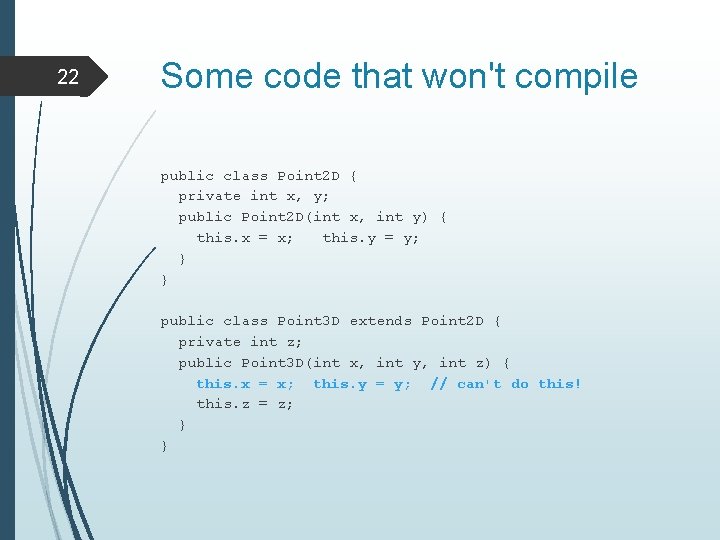
22 Some code that won't compile public class Point 2 D { private int x, y; public Point 2 D(int x, int y) { this. x = x; this. y = y; } } public class Point 3 D extends Point 2 D { private int z; public Point 3 D(int x, int y, int z) { this. x = x; this. y = y; // can't do this! this. z = z; } }
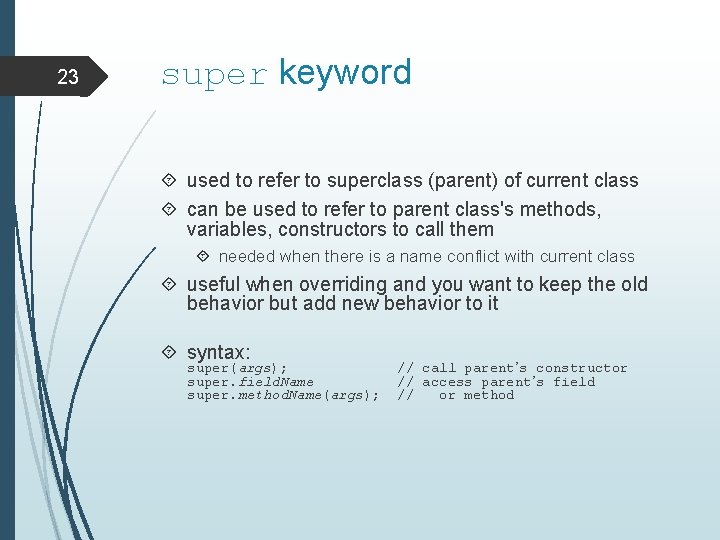
23 super keyword used to refer to superclass (parent) of current class can be used to refer to parent class's methods, variables, constructors to call them needed when there is a name conflict with current class useful when overriding and you want to keep the old behavior but add new behavior to it syntax: super(args); super. field. Name super. method. Name(args); // call parent’s constructor // access parent’s field // or method
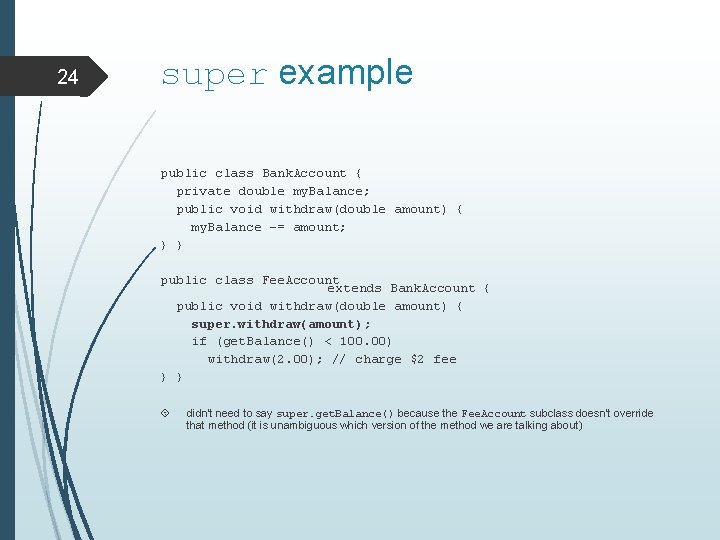
24 super example public class Bank. Account { private double my. Balance; public void withdraw(double amount) { my. Balance -= amount; } } public class Fee. Account extends Bank. Account { public void withdraw(double amount) { super. withdraw(amount); if (get. Balance() < 100. 00) withdraw(2. 00); // charge $2 fee } } didn't need to say super. get. Balance() because the Fee. Account subclass doesn't override that method (it is unambiguous which version of the method we are talking about)
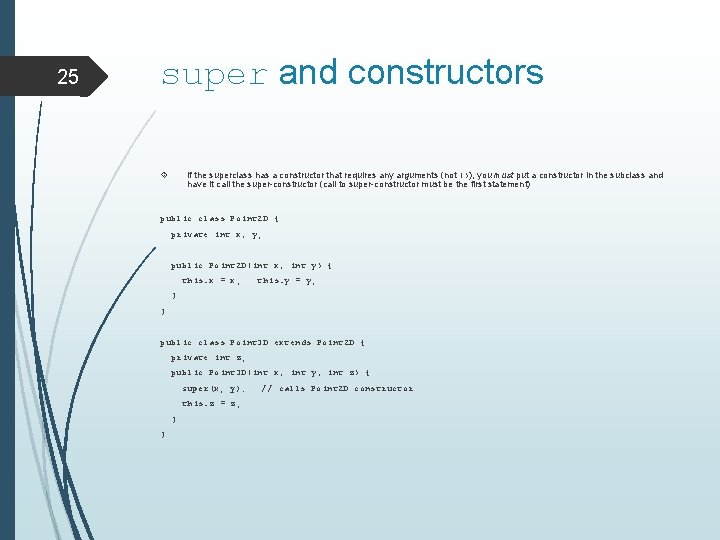
25 super and constructors if the superclass has a constructor that requires any arguments (not ()), you must put a constructor in the subclass and have it call the super-constructor (call to super-constructor must be the first statement) public class Point 2 D { private int x, y; public Point 2 D(int x, int y) { this. x = x; this. y = y; } } public class Point 3 D extends Point 2 D { private int z; public Point 3 D(int x, int y, int z) { super(x, y); this. z = z; } } // calls Point 2 D constructor
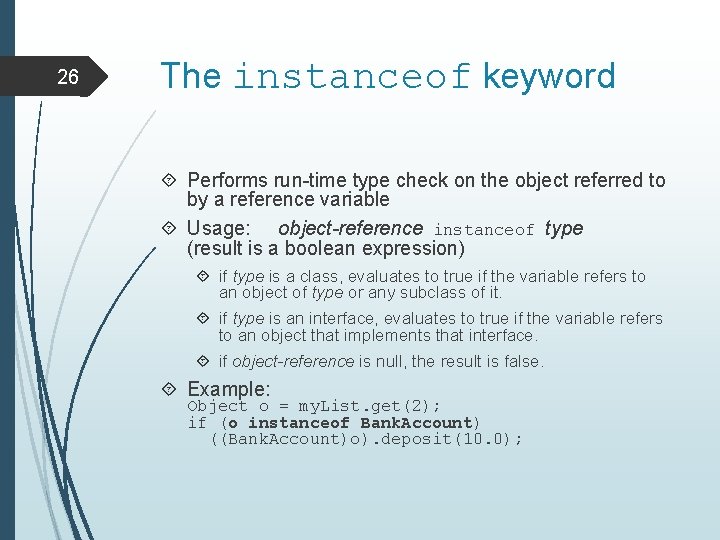
26 The instanceof keyword Performs run-time type check on the object referred to by a reference variable Usage: object-reference instanceof type (result is a boolean expression) if type is a class, evaluates to true if the variable refers to an object of type or any subclass of it. if type is an interface, evaluates to true if the variable refers to an object that implements that interface. if object-reference is null, the result is false. Example: Object o = my. List. get(2); if (o instanceof Bank. Account) ((Bank. Account)o). deposit(10. 0);
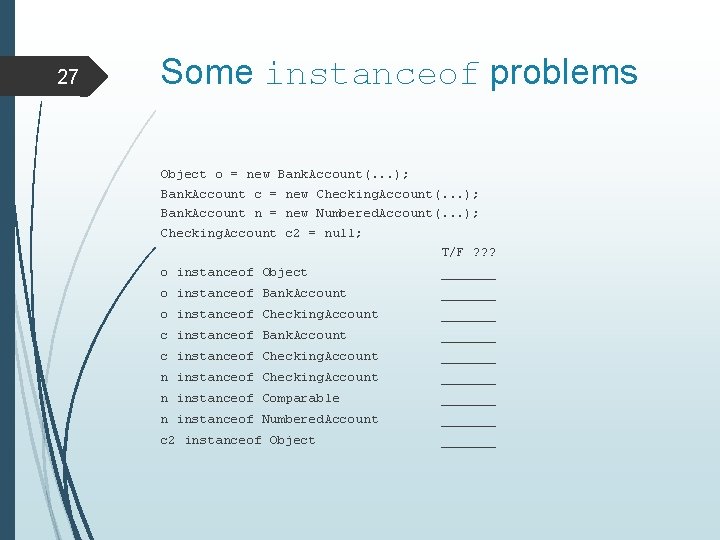
27 Some instanceof problems Object o = new Bank. Account(. . . ); Bank. Account c = new Checking. Account(. . . ); Bank. Account n = new Numbered. Account(. . . ); Checking. Account c 2 = null; T/F ? ? ? o instanceof Object _______ o instanceof Bank. Account _______ o instanceof Checking. Account _______ c instanceof Bank. Account _______ c instanceof Checking. Account _______ n instanceof Comparable _______ n instanceof Numbered. Account _______ c 2 instanceof Object _______
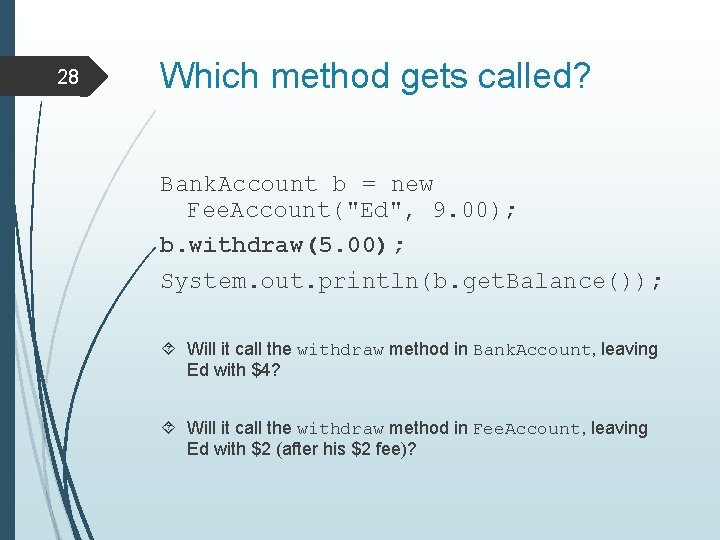
28 Which method gets called? Bank. Account b = new Fee. Account("Ed", 9. 00); b. withdraw(5. 00); System. out. println(b. get. Balance()); Will it call the withdraw method in Bank. Account, leaving Ed with $4? Will it call the withdraw method in Fee. Account, leaving Ed with $2 (after his $2 fee)?
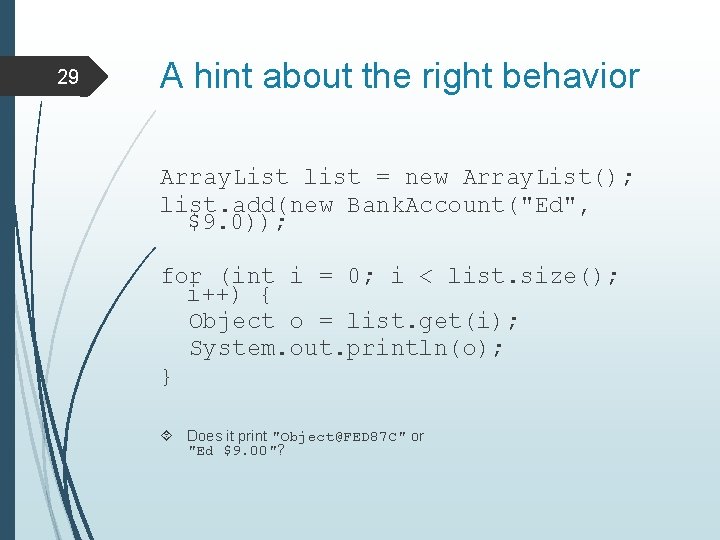
29 A hint about the right behavior Array. List list = new Array. List(); list. add(new Bank. Account("Ed", $9. 0)); for (int i = 0; i < list. size(); i++) { Object o = list. get(i); System. out. println(o); } Does it print "Object@FED 87 C" or "Ed $9. 00"?
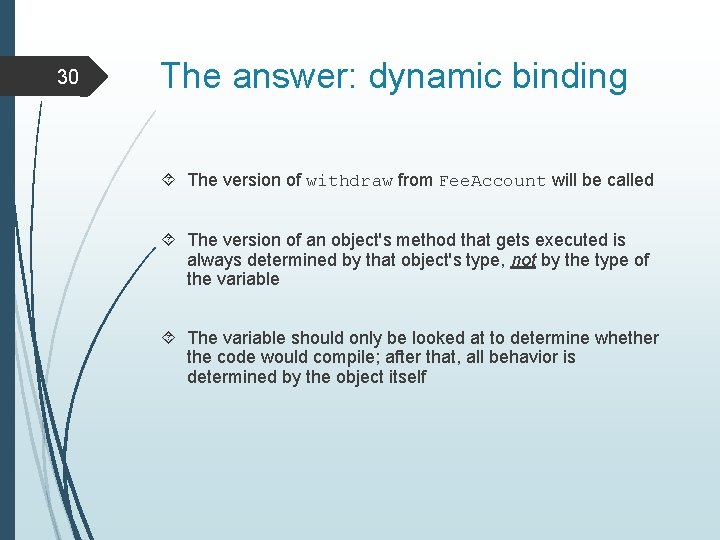
30 The answer: dynamic binding The version of withdraw from Fee. Account will be called The version of an object's method that gets executed is always determined by that object's type, not by the type of the variable The variable should only be looked at to determine whether the code would compile; after that, all behavior is determined by the object itself
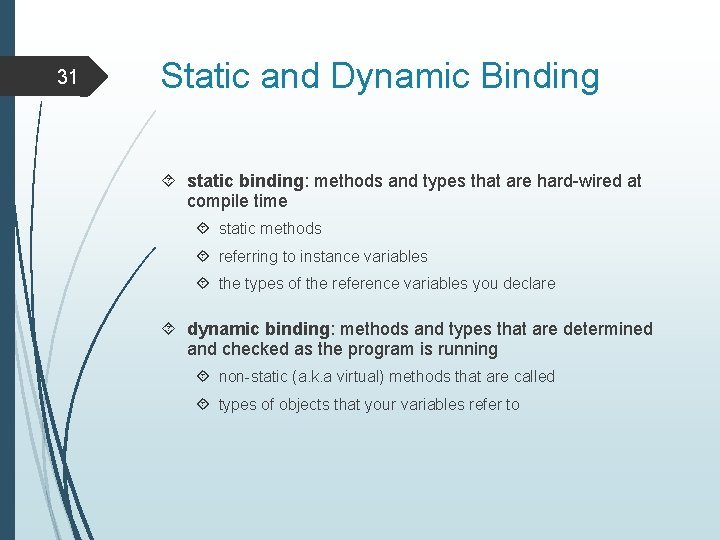
31 Static and Dynamic Binding static binding: methods and types that are hard-wired at compile time static methods referring to instance variables the types of the reference variables you declare dynamic binding: methods and types that are determined and checked as the program is running non-static (a. k. a virtual) methods that are called types of objects that your variables refer to
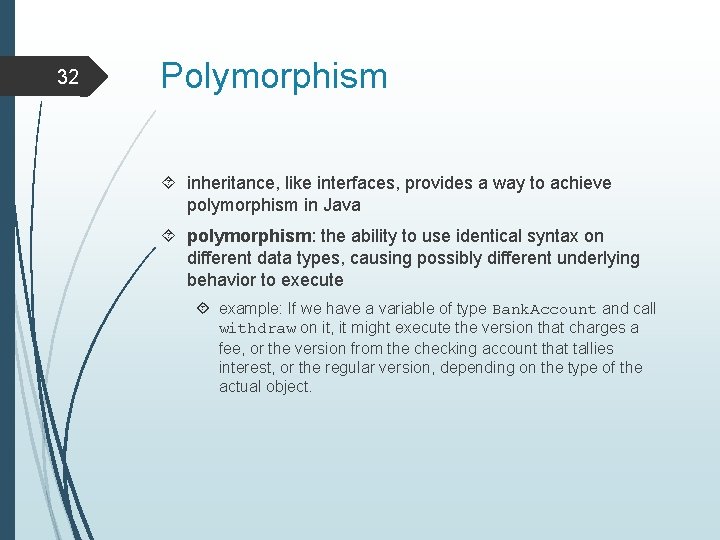
32 Polymorphism inheritance, like interfaces, provides a way to achieve polymorphism in Java polymorphism: the ability to use identical syntax on different data types, causing possibly different underlying behavior to execute example: If we have a variable of type Bank. Account and call withdraw on it, it might execute the version that charges a fee, or the version from the checking account that tallies interest, or the regular version, depending on the type of the actual object.
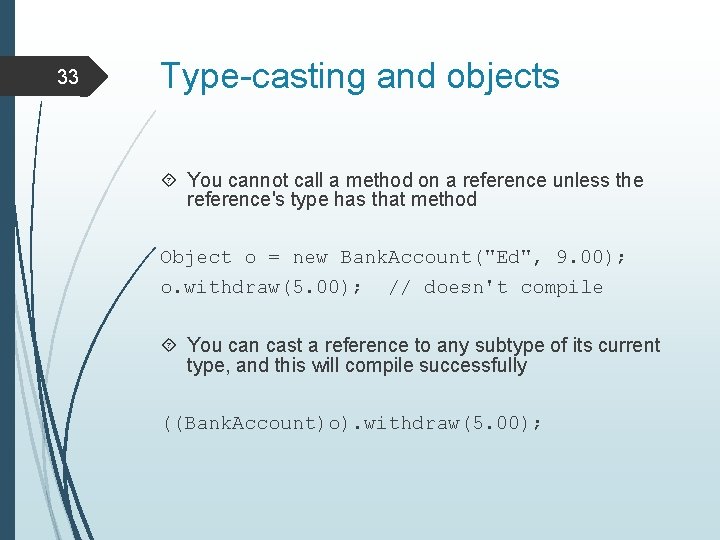
33 Type-casting and objects You cannot call a method on a reference unless the reference's type has that method Object o = new Bank. Account("Ed", 9. 00); o. withdraw(5. 00); // doesn't compile You can cast a reference to any subtype of its current type, and this will compile successfully ((Bank. Account)o). withdraw(5. 00);
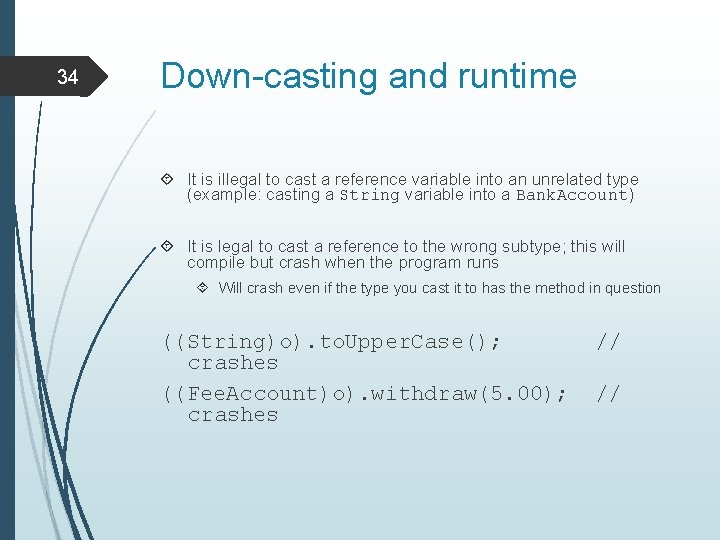
34 Down-casting and runtime It is illegal to cast a reference variable into an unrelated type (example: casting a String variable into a Bank. Account) It is legal to cast a reference to the wrong subtype; this will compile but crash when the program runs Will crash even if the type you cast it to has the method in question ((String)o). to. Upper. Case(); crashes ((Fee. Account)o). withdraw(5. 00); crashes // //
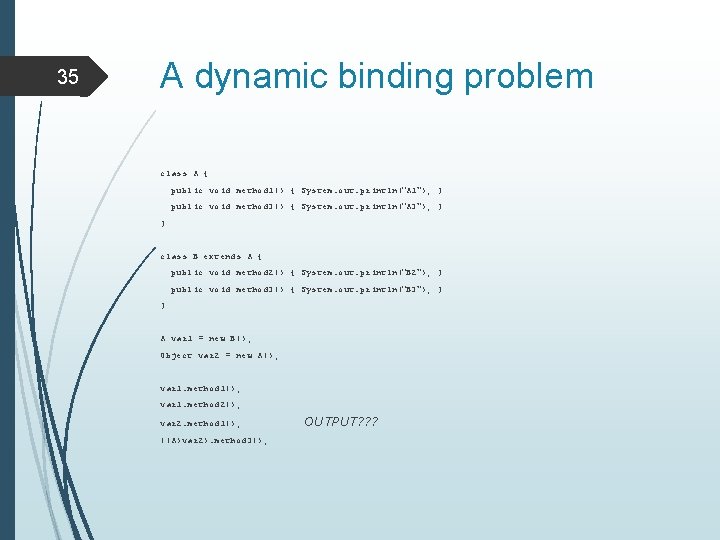
35 A dynamic binding problem class A { public void method 1() { System. out. println(“A 1”); } public void method 3() { System. out. println(“A 3”); } } class B extends A { public void method 2() { System. out. println(“B 2”); } public void method 3() { System. out. println(“B 3”); } } A var 1 = new B(); Object var 2 = new A(); var 1. method 1(); var 1. method 2(); var 2. method 1(); ((A)var 2). method 3(); OUTPUT? ? ?
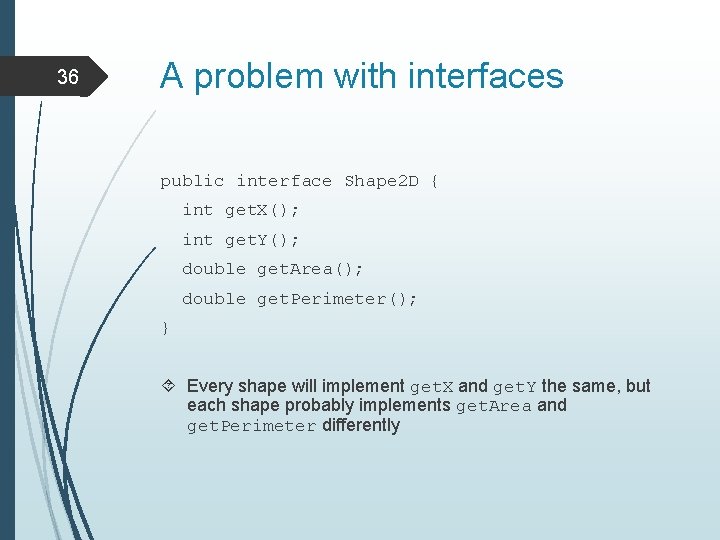
36 A problem with interfaces public interface Shape 2 D { int get. X(); int get. Y(); double get. Area(); double get. Perimeter(); } Every shape will implement get. X and get. Y the same, but each shape probably implements get. Area and get. Perimeter differently
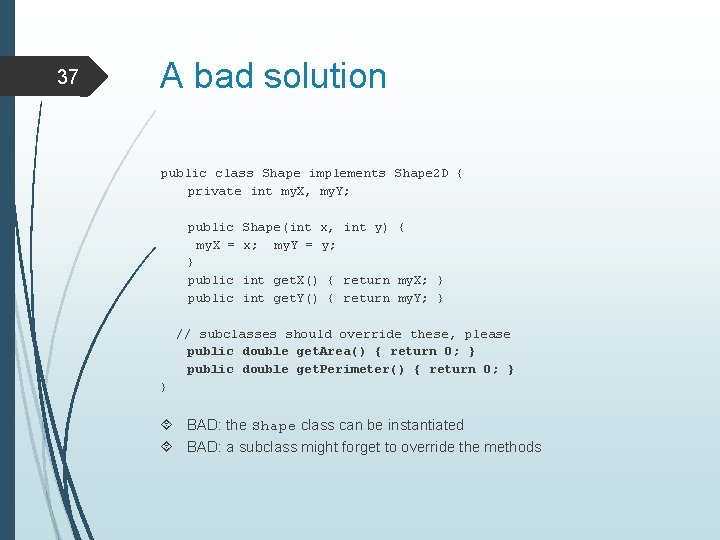
37 A bad solution public class Shape implements Shape 2 D { private int my. X, my. Y; public my. X = } public Shape(int x, int y) { x; my. Y = y; int get. X() { return my. X; } int get. Y() { return my. Y; } // subclasses should override these, please public double get. Area() { return 0; } public double get. Perimeter() { return 0; } } BAD: the Shape class can be instantiated BAD: a subclass might forget to override the methods
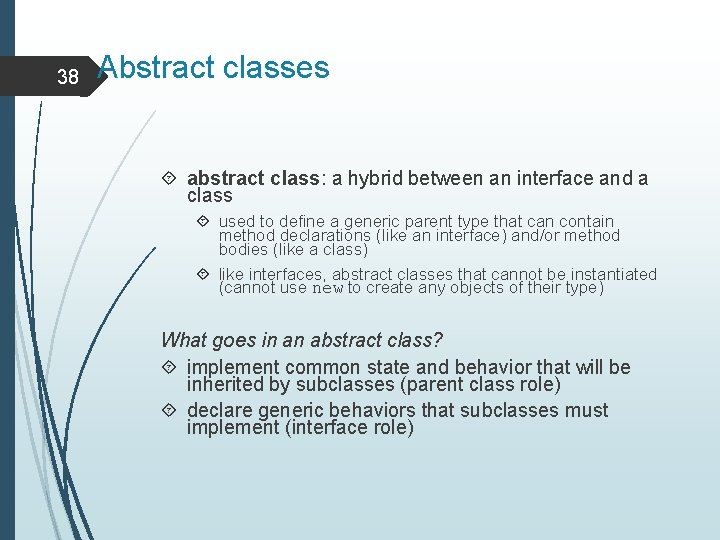
38 Abstract classes abstract class: a hybrid between an interface and a class used to define a generic parent type that can contain method declarations (like an interface) and/or method bodies (like a class) like interfaces, abstract classes that cannot be instantiated (cannot use new to create any objects of their type) What goes in an abstract class? implement common state and behavior that will be inherited by subclasses (parent class role) declare generic behaviors that subclasses must implement (interface role)
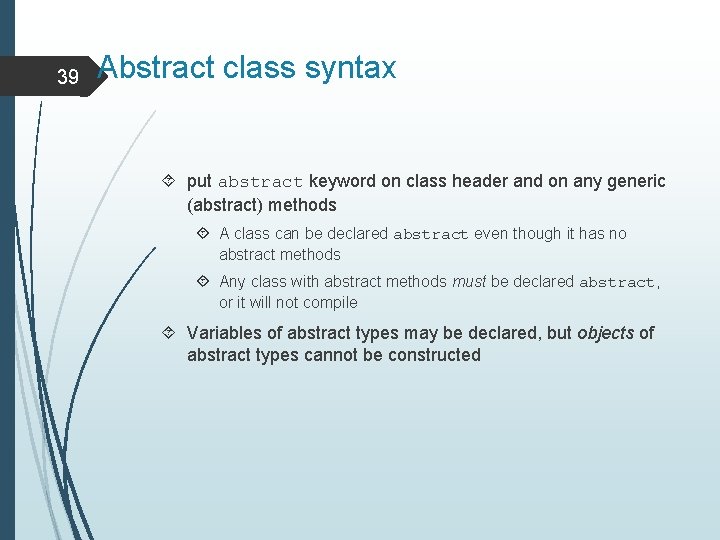
39 Abstract class syntax put abstract keyword on class header and on any generic (abstract) methods A class can be declared abstract even though it has no abstract methods Any class with abstract methods must be declared abstract, or it will not compile Variables of abstract types may be declared, but objects of abstract types cannot be constructed
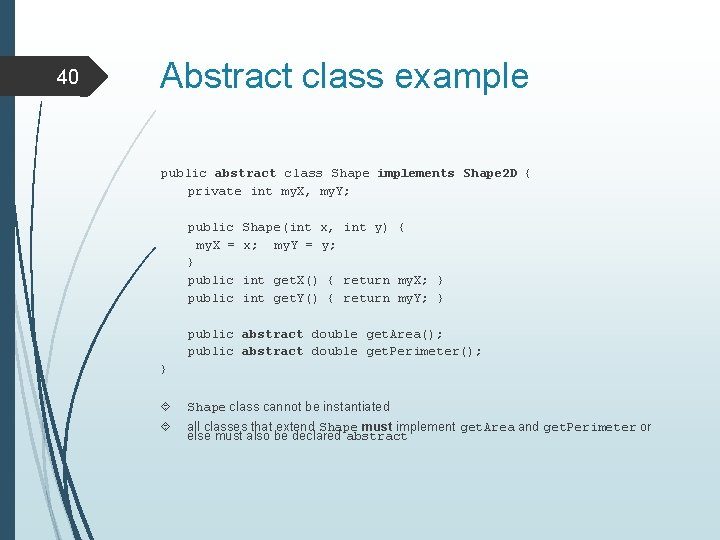
40 Abstract class example public abstract class Shape implements Shape 2 D { private int my. X, my. Y; public my. X = } public Shape(int x, int y) { x; my. Y = y; int get. X() { return my. X; } int get. Y() { return my. Y; } public abstract double get. Area(); public abstract double get. Perimeter(); } Shape class cannot be instantiated all classes that extend Shape must implement get. Area and get. Perimeter or else must also be declared abstract
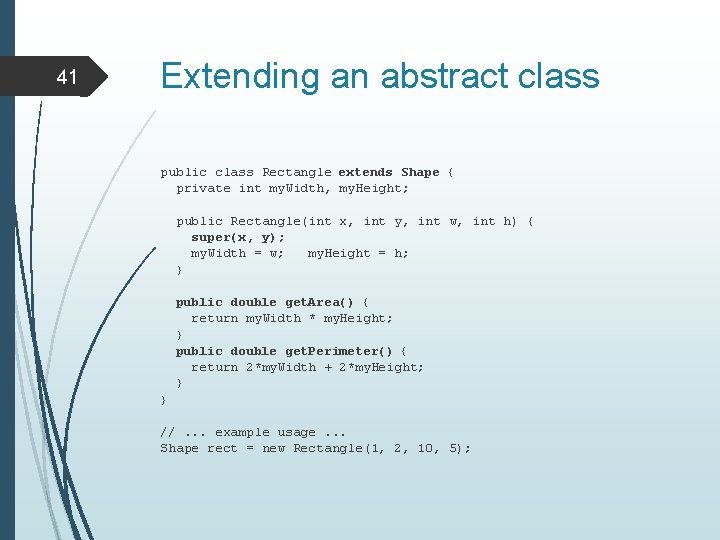
41 Extending an abstract class public class Rectangle extends Shape { private int my. Width, my. Height; public Rectangle(int x, int y, int w, int h) { super(x, y); my. Width = w; my. Height = h; } public double get. Area() { return my. Width * my. Height; } public double get. Perimeter() { return 2*my. Width + 2*my. Height; } } //. . . example usage. . . Shape rect = new Rectangle(1, 2, 10, 5);
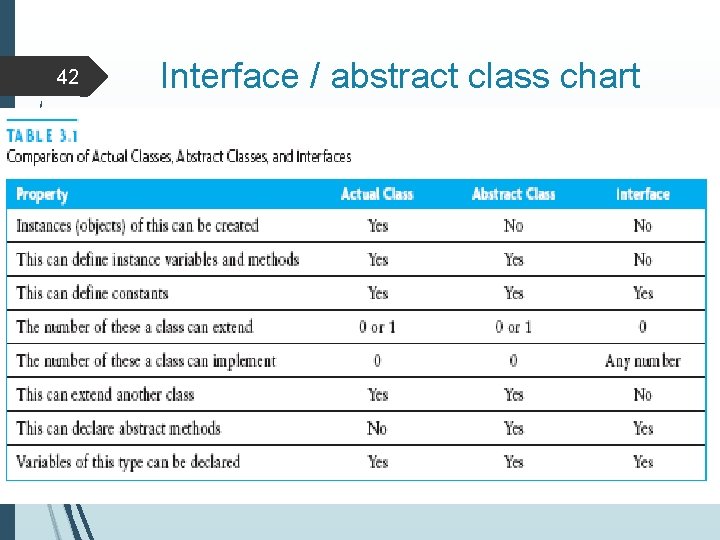
42 Interface / abstract class chart
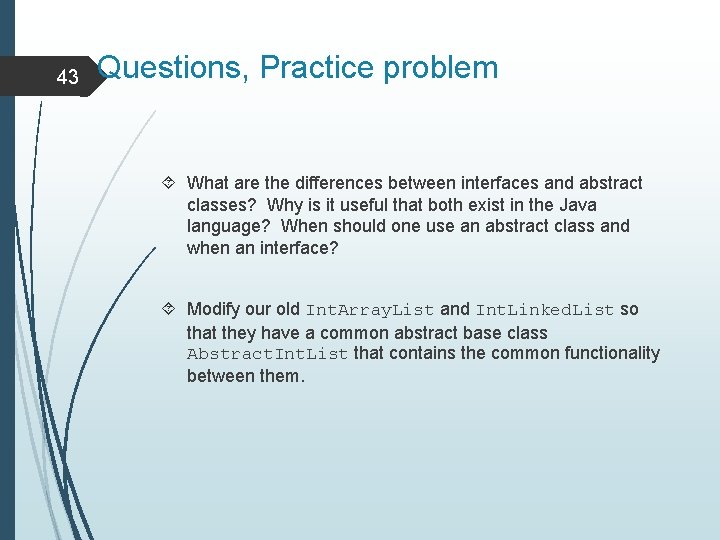
43 Questions, Practice problem What are the differences between interfaces and abstract classes? Why is it useful that both exist in the Java language? When should one use an abstract class and when an interface? Modify our old Int. Array. List and Int. Linked. List so that they have a common abstract base class Abstract. Int. List that contains the common functionality between them.
44 Inner classes inner class: a class defined inside of another class can be created as static or non-static we will focus on standard non-static inner classes usefulness: inner classes can be "hidden" from other classes (encapsulation at class level) useful when implementing data structures (e. g. linked lists) or for GUI programming
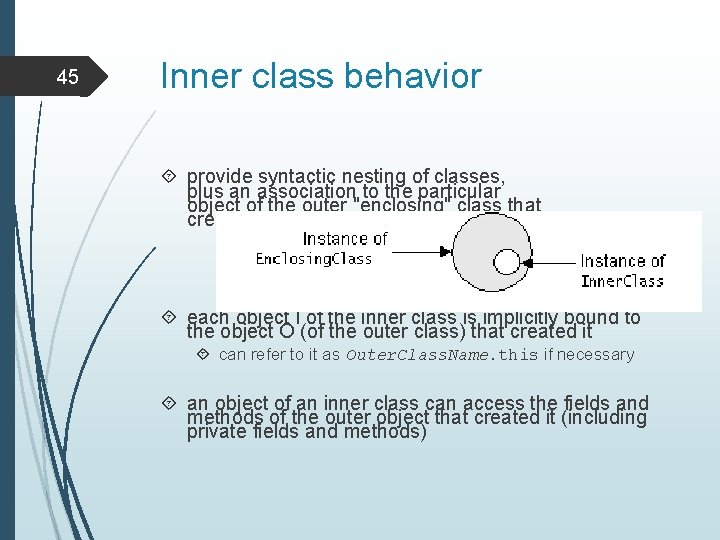
45 Inner class behavior provide syntactic nesting of classes, plus an association to the particular object of the outer "enclosing" class that created them each object I of the inner class is implicitly bound to the object O (of the outer class) that created it can refer to it as Outer. Class. Name. this if necessary an object of an inner class can access the fields and methods of the outer object that created it (including private fields and methods)
![46 Inner class example public class My. Array. List { private Object[] items; public](http://slidetodoc.com/presentation_image_h/1e40b542bcd8d2b8cd462bdc4bd239b4/image-46.jpg "46 Inner class example public class My. Array. List { private Object[] items; public")
46 Inner class example public class My. Array. List { private Object[] items; public Iterator iterator() { return new My. Iterator(); } private class My. Iterator implements Iterator { int index = 0; public boolean has. Next() { return current. Item < size(); } public Object next() { if (!has. Next()) throw new No. Such. Element. Exception(); else return items[index++]; } } }
47 References Koffman/Wolfgang Ch. 3, pp. 125 -149, 155 -159; Appendix B. 1, pp. 738 -744 The Java Tutorial: Implementing Nested Classes. http: //java. sun. com/docs/books/tutorial/java/ java. OO/nested. html The Java Tutorial: Inheritance. http: //java. sun. com/docs/books/tutorial/java/ concepts/inheritance. html
- Slides: 47