
1 e Chapter 9 Charismatic and Transformational Leadership

- Slides: 21
1 e. Chapter 9 Charismatic and Transformational Leadership Copyright © 2005 South-Western. All rights reserved. Power. Point Presentation by Charlie Cook
Chapter Objectives After completing this chapter, you should be able to: n Understand the difference between charismatic/ transformational leadership and non-charismatic/ transactional leadership. n Understand the difference between strong and weak charisma. n Critically analyze the charismatic and transformational approach to leadership. n Explain why charismatic leadership is so often associated with tyrants and dictators. n Evaluate various explanations of the basis of charismatic and transformational leadership. Copyright © 2005 South-Western. All rights reserved. 2
Charisma and Its Forms • Charisma Defined Ø The special personal quality or power of an individual making him or her capable of influencing or inspiring large numbers of people through their perceived social relationship to that person. Copyright © 2005 South-Western. All rights reserved. 3
Charisma and Its Forms • Strong Charisma (Max Weber) Ø Rare individuals so different from everyone else that they represent a pure form of charisma. • Elements of Strong Charisma: Ø An individual of exceptional powers or qualities Ø A social crisis and a prophecy Ø A radical solution to the crisis offered by the individual Ø Devoted followers, attracted to the individual’s transcendent powers Ø Repeated successes affirming the charismatic Copyright © 2005 South-Western. All rights reserved. 4
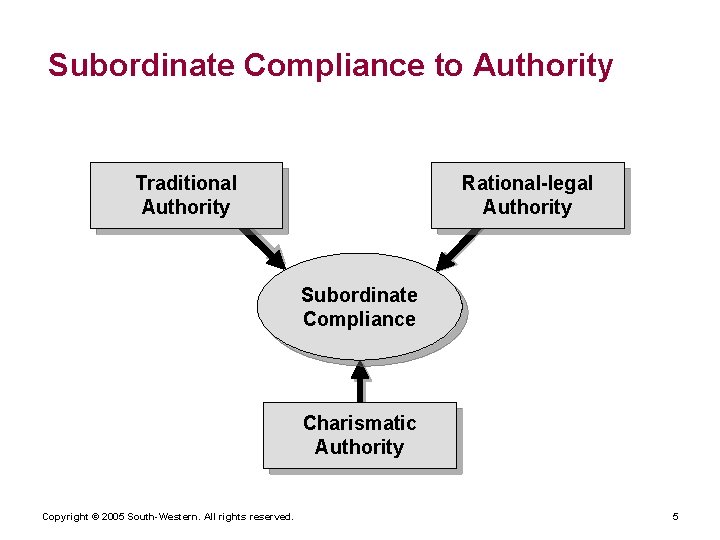
Subordinate Compliance to Authority Traditional Authority Rational-legal Authority Subordinate Compliance Charismatic Authority Copyright © 2005 South-Western. All rights reserved. 5
Forms of Legitimate Authority • Traditional (Inherited) Authority Ø The subordinate’s belief in the sacred nature of the office. • Rational-legal Authority Ø The subordinate’s belief that compliance contributes to the order and security of the subordinate’s existence. • Charismatic Authority Ø The subordinate’s belief in the righteousness of the personal powers of a charismatic individual. Copyright © 2005 South-Western. All rights reserved. 6
Charisma and Its Forms (cont’d) • Weak (Organizational) Charisma Ø A personal quality, possessed in varying degrees by many individuals, that emerges under certain conditions to affect an available audience. • Elements of Weak Charisma (House) Ø A relationship based on mutual, shared ideological (as opposed to material) values. Ø A leader who has accomplished unusual feats through the sacrifices of loyal, trusting followers. Ø A complex set of personal characteristics and/or behaviors of a charismatic individual. Copyright © 2005 South-Western. All rights reserved. 7
Reflective Questions ▼ • Are celebrities, film stars, and pop idols necessarily charismatic? • Do they intend to be? Copyright © 2005 South-Western. All rights reserved. 8
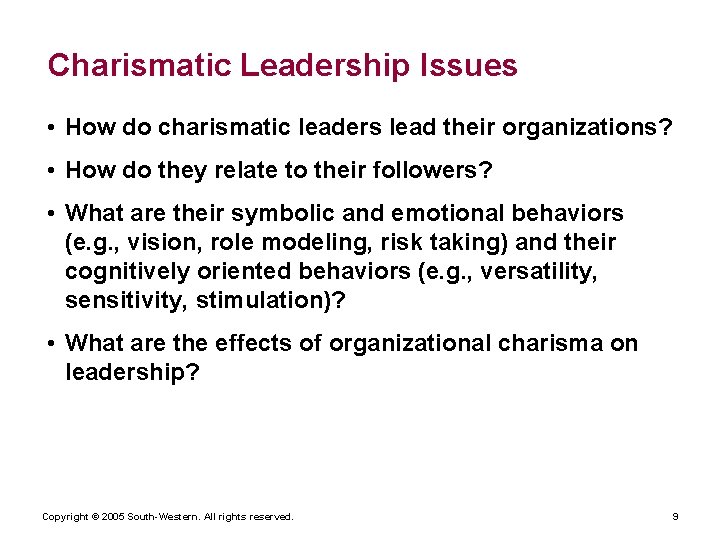
Charismatic Leadership Issues • How do charismatic leaders lead their organizations? • How do they relate to their followers? • What are their symbolic and emotional behaviors (e. g. , vision, role modeling, risk taking) and their cognitively oriented behaviors (e. g. , versatility, sensitivity, stimulation)? • What are the effects of organizational charisma on leadership? Copyright © 2005 South-Western. All rights reserved. 9
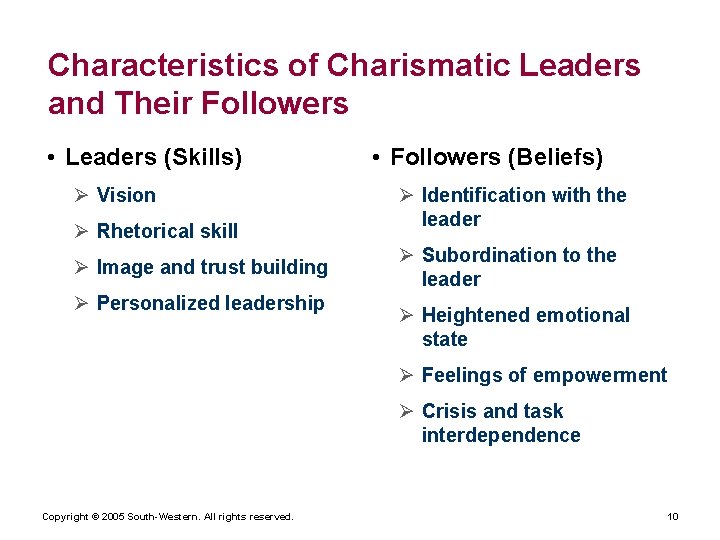
Characteristics of Charismatic Leaders and Their Followers • Leaders (Skills) Ø Vision Ø Rhetorical skill Ø Image and trust building Ø Personalized leadership • Followers (Beliefs) Ø Identification with the leader Ø Subordination to the leader Ø Heightened emotional state Ø Feelings of empowerment Ø Crisis and task interdependence Copyright © 2005 South-Western. All rights reserved. 10
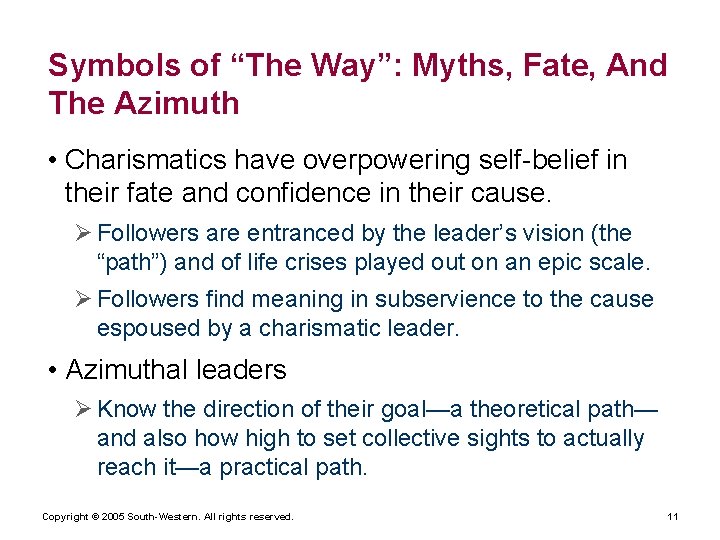
Symbols of “The Way”: Myths, Fate, And The Azimuth • Charismatics have overpowering self-belief in their fate and confidence in their cause. Ø Followers are entranced by the leader’s vision (the “path”) and of life crises played out on an epic scale. Ø Followers find meaning in subservience to the cause espoused by a charismatic leader. • Azimuthal leaders Ø Know the direction of their goal—a theoretical path— and also how high to set collective sights to actually reach it—a practical path. Copyright © 2005 South-Western. All rights reserved. 11
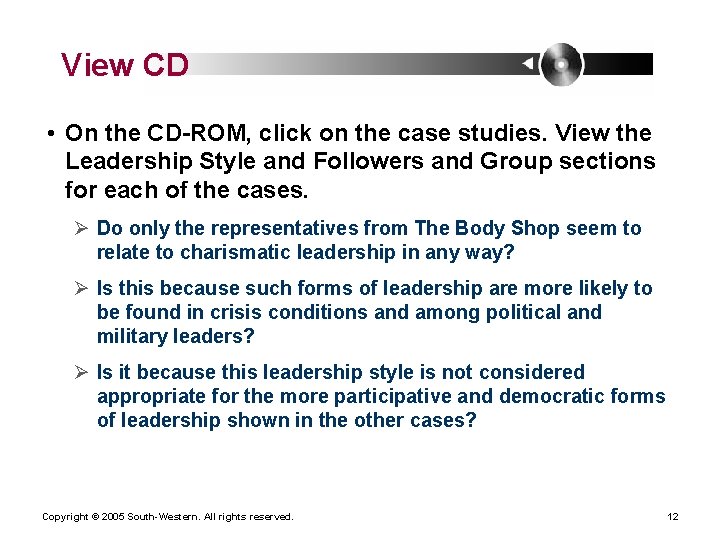
View CD • On the CD-ROM, click on the case studies. View the Leadership Style and Followers and Group sections for each of the cases. Ø Do only the representatives from The Body Shop seem to relate to charismatic leadership in any way? Ø Is this because such forms of leadership are more likely to be found in crisis conditions and among political and military leaders? Ø Is it because this leadership style is not considered appropriate for the more participative and democratic forms of leadership shown in the other cases? Copyright © 2005 South-Western. All rights reserved. 12
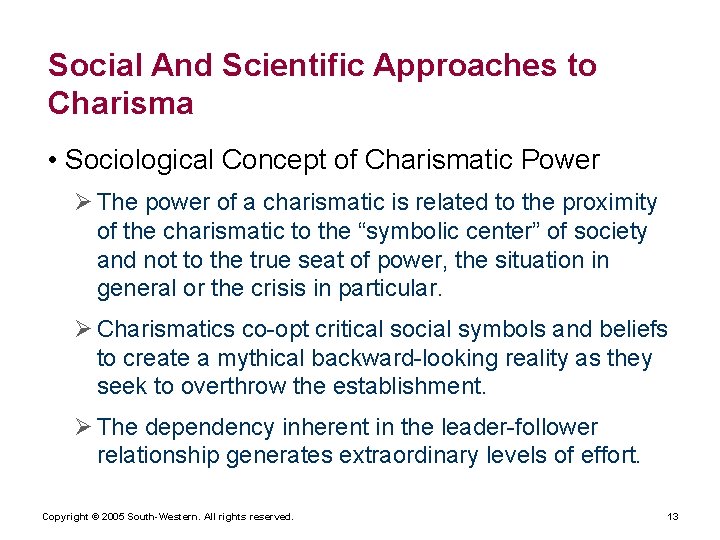
Social And Scientific Approaches to Charisma • Sociological Concept of Charismatic Power Ø The power of a charismatic is related to the proximity of the charismatic to the “symbolic center” of society and not to the true seat of power, the situation in general or the crisis in particular. Ø Charismatics co-opt critical social symbols and beliefs to create a mythical backward-looking reality as they seek to overthrow the establishment. Ø The dependency inherent in the leader-follower relationship generates extraordinary levels of effort. Copyright © 2005 South-Western. All rights reserved. 13
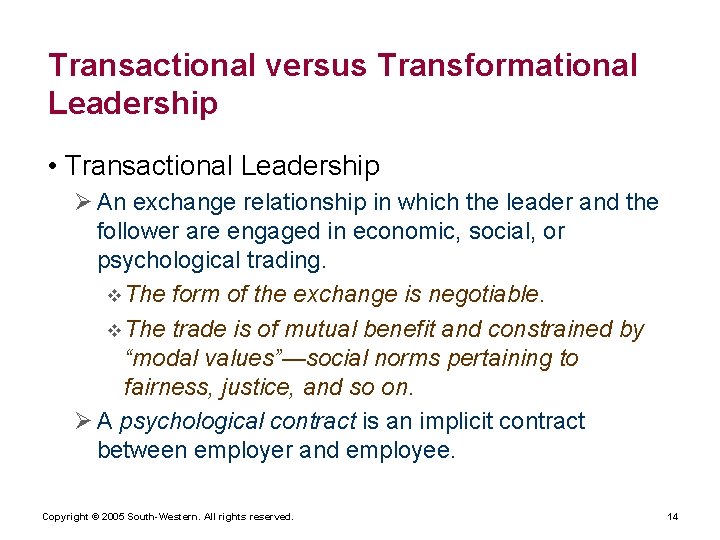
Transactional versus Transformational Leadership • Transactional Leadership Ø An exchange relationship in which the leader and the follower are engaged in economic, social, or psychological trading. v The form of the exchange is negotiable. v The trade is of mutual benefit and constrained by “modal values”—social norms pertaining to fairness, justice, and so on. Ø A psychological contract is an implicit contract between employer and employee. Copyright © 2005 South-Western. All rights reserved. 14
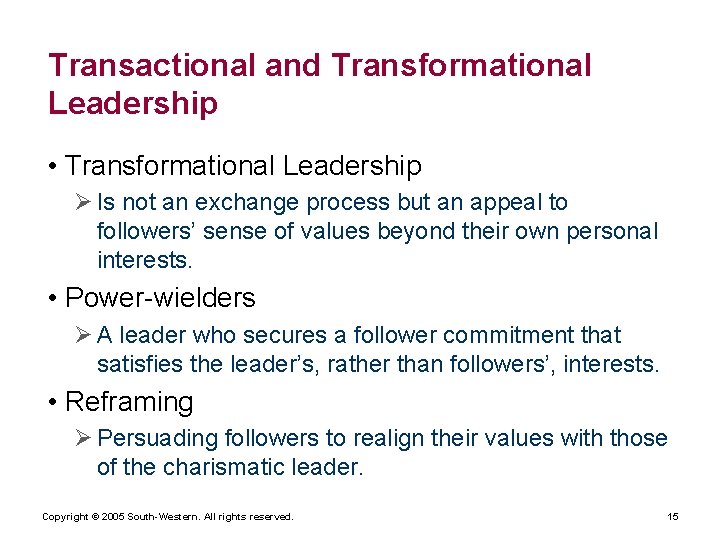
Transactional and Transformational Leadership • Transformational Leadership Ø Is not an exchange process but an appeal to followers’ sense of values beyond their own personal interests. • Power-wielders Ø A leader who secures a follower commitment that satisfies the leader’s, rather than followers’, interests. • Reframing Ø Persuading followers to realign their values with those of the charismatic leader. Copyright © 2005 South-Western. All rights reserved. 15
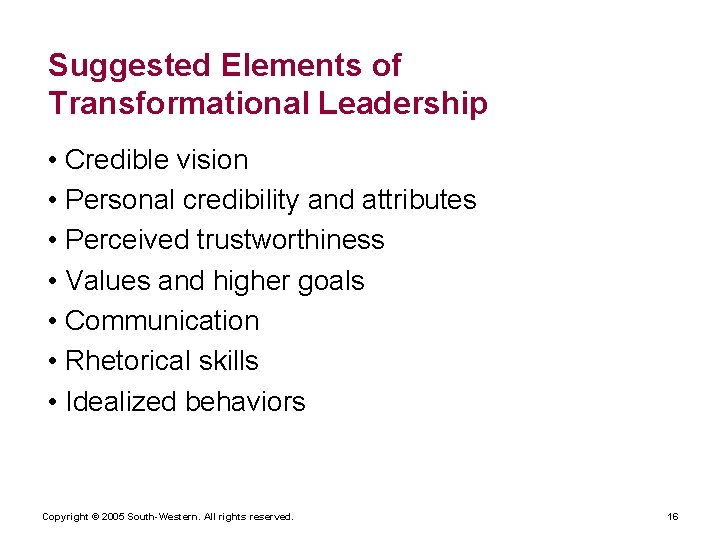
Suggested Elements of Transformational Leadership • Credible vision • Personal credibility and attributes • Perceived trustworthiness • Values and higher goals • Communication • Rhetorical skills • Idealized behaviors Copyright © 2005 South-Western. All rights reserved. 16
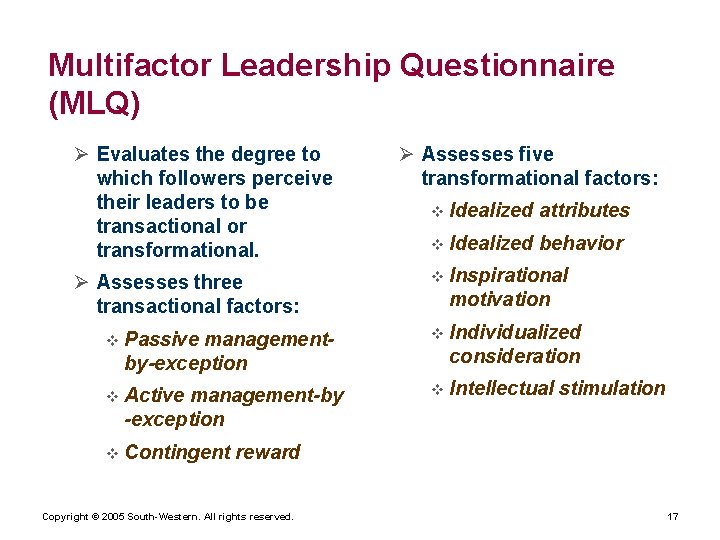
Multifactor Leadership Questionnaire (MLQ) Ø Evaluates the degree to which followers perceive their leaders to be transactional or transformational. Ø Assesses three transactional factors: Ø Assesses five transformational factors: v Idealized attributes v Idealized behavior v Inspirational motivation v Passive managementby-exception v Individualized consideration v Active management-by -exception v Intellectual stimulation v Contingent reward Copyright © 2005 South-Western. All rights reserved. 17
The Ethics of Charismatic and Transformational Leadership • Considerations involving: Ø Blind obedience versus sublimation of self by followers in their relationship with charismatic leaders Ø Psychologically “healthy” versus “unhealthy” charismatic leaders Ø “Socialized” versus “personalized” charismatic leaders Ø Power-wielders versus leaders Copyright © 2005 South-Western. All rights reserved. 18
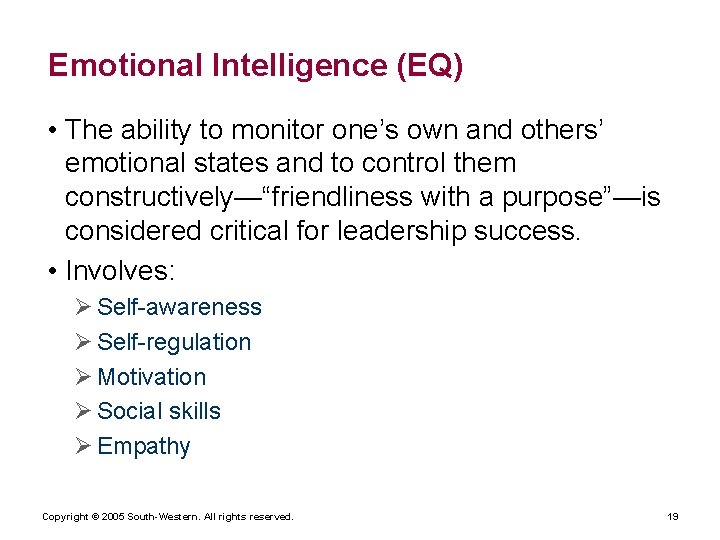
Emotional Intelligence (EQ) • The ability to monitor one’s own and others’ emotional states and to control them constructively—“friendliness with a purpose”—is considered critical for leadership success. • Involves: Ø Self-awareness Ø Self-regulation Ø Motivation Ø Social skills Ø Empathy Copyright © 2005 South-Western. All rights reserved. 19
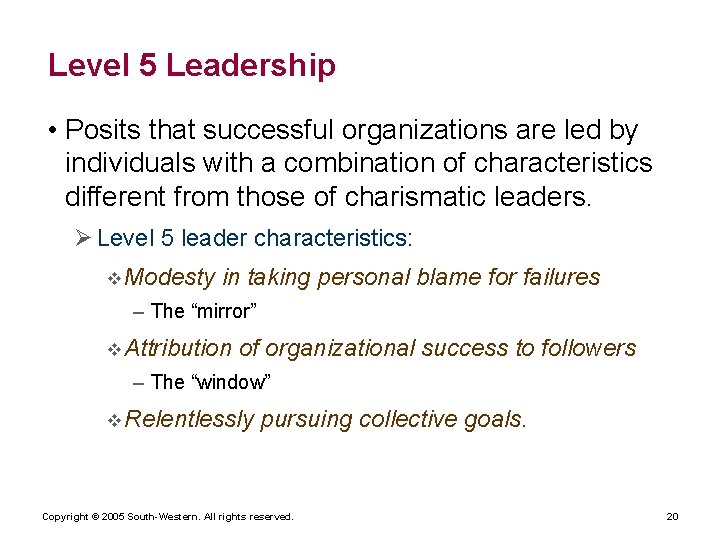
Level 5 Leadership • Posits that successful organizations are led by individuals with a combination of characteristics different from those of charismatic leaders. Ø Level 5 leader characteristics: v Modesty in taking personal blame for failures – The “mirror” v Attribution of organizational success to followers – The “window” v Relentlessly pursuing collective goals. Copyright © 2005 South-Western. All rights reserved. 20
Reflective Question ▼ • How useful are the concepts of emotional intelligence (EQ) and Level 5 leadership in explaining the role of charisma in leadership? Copyright © 2005 South-Western. All rights reserved. 21