
1 e Chapter 4 Classical Views of Leadership
- Slides: 17
1 e. Chapter 4 Classical Views of Leadership Copyright © 2005 South-Western. All rights reserved. Power. Point Presentation by Charlie Cook
Chapter Objectives After completing this chapter, you should be able to: n Trace classical writings on leadership and explain their importance in understanding contemporary issues. n Evaluate the diverse forms of prescriptive advice offered to leaders in the classical literature. n Critically assess the various forms of legitimation constructed by classical writers to justify the predominant position of leaders. Copyright © 2005 South-Western. All rights reserved. 2
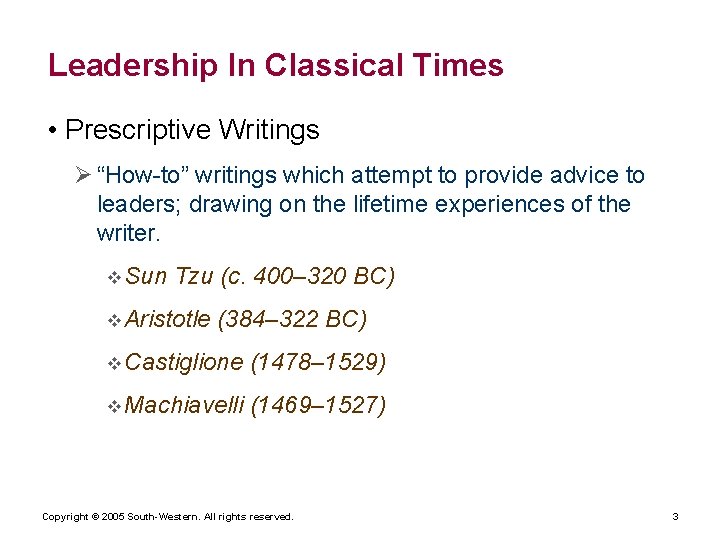
Leadership In Classical Times • Prescriptive Writings Ø “How-to” writings which attempt to provide advice to leaders; drawing on the lifetime experiences of the writer. v Sun Tzu (c. 400– 320 BC) v Aristotle (384– 322 BC) v Castiglione (1478– 1529) v Machiavelli (1469– 1527) Copyright © 2005 South-Western. All rights reserved. 3
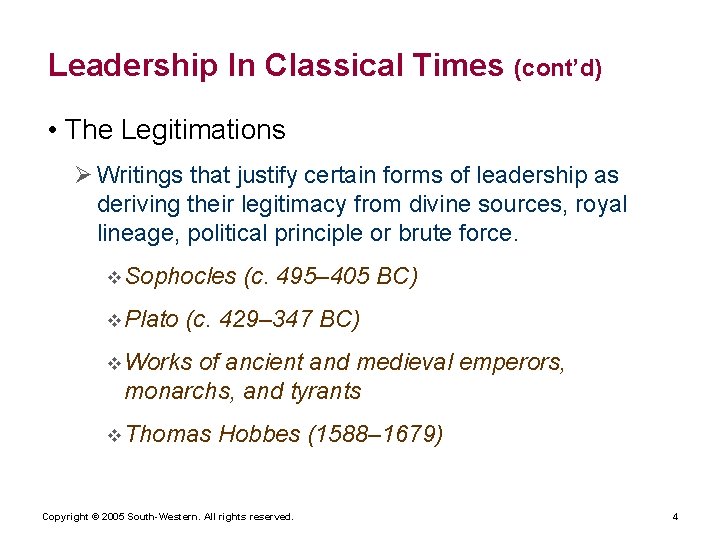
Leadership In Classical Times (cont’d) • The Legitimations Ø Writings that justify certain forms of leadership as deriving their legitimacy from divine sources, royal lineage, political principle or brute force. v Sophocles v Plato (c. 495– 405 BC) (c. 429– 347 BC) v Works of ancient and medieval emperors, monarchs, and tyrants v Thomas Hobbes (1588– 1679) Copyright © 2005 South-Western. All rights reserved. 4
Why Study the Classical Literature of Leadership? • The framework of contemporary leadership theories originates in the classical writings. • The content of classical writings is relevant today. • Classical writings offer interesting answers to complex leadership questions that still have not been fully resolved. Copyright © 2005 South-Western. All rights reserved. 5
Sources of Classical Literature • History is written by the winners: Be wary of sources Ø Leaders either write their own histories or have them professionally written to provide a material record of unusual or extraordinary events that make them look like good leaders. Caveat: Ø Military leadership in war was a critical component of the early practice of leadership. v The binary hierarchy of modern organizations (managers and workers) is reflected the division of ancient armies into officers and troops. Copyright © 2005 South-Western. All rights reserved. 6
The Prescriptions • Aristotle On Rhetorical Leadership Ø Rhetoric: the art of persuasion in which emotion and power are influential features. v Truth and justice are stronger than lies and injustice, “false” rhetoric would not be able to overturn them. v Rhetoric persuades through emotion, not reason. Ø Rhetorical skills have great significance for contemporary leaders intent on enabling their followers to see the rationality of the arguments they put forth. Copyright © 2005 South-Western. All rights reserved. 7
The Prescriptions (cont’d) • Sun Tzu’s The Art of War Ø Provides conversational sketches of the most crucial elements of strategy and tactics for military leaders. v The art of war is the art of avoiding unnecessary conflict. v Avoid expensive head-on conflicts if possible. v Leave a “golden bridge, ” an escape route for your enemy to retreat across. v Burn your own bridges—commit yourself or suffer the penalty. v Take independent action when necessary. Copyright © 2005 South-Western. All rights reserved. 8
The Prescriptions (cont’d) • Castiglione’s The Book of the Courtier Ø Sought to explain the success and failure of leaders. v Followers, in blind obedience, may carry out orders that are erroneous or dishonorable. v Leaders may begin to listen only to advice that supports their views (hubris) and become increasingly isolated as they become more powerful. Copyright © 2005 South-Western. All rights reserved. 9
The Prescriptions (cont’d) • Machiavelli’s The Prince Ø Offered real-world advice to leaders on how and when they should act to do whatever is necessary for the greater good and protect the community. v Leadership is not popularity; it is being respected (feared and effective) without being hated. v Ruthless princes: power is the essence of society, and organization has to be imposed on society by leaders to prevent anarchy. v Commitment by the people to the state is important. Copyright © 2005 South-Western. All rights reserved. 10
View CD • Go to the CD-ROM and work through the Classical Leadership section. • Then read Machiavelli’s The Prince. (There is a short selection from the book in Grint, 1997 b. ) Ø To what extent does The Prince embody lessons in organizational leadership? Copyright © 2005 South-Western. All rights reserved. 11
Reflective Question ▼ • Read Chapter 1 in Jay’s Management and Machiavelli (1994), and Chapter 13 in The New Machiavelli by Mc. Alpine. • Go to the Web site of General Motors, Apple Computer, Microsoft, or any other company you have studied. • Also, visit “alternative” Web sites that provide radically different interpretations of the leadership skills of various corporate leaders. Ø http: //www. ihatestarbucks. com, http: //www. nikesucks. com, http: //www. mcspotlight. org, and http: //www. blueovalnews. com • Using the insights into Machiavelli’s work provided in this chapter and information from the Web sites, answer the following question: Ø To what extent, if at all, do you agree with Mc. Alpine’s view that “it is necessary to be a ruthless tyrant in order to succeed in business”? Copyright © 2005 South-Western. All rights reserved. 12
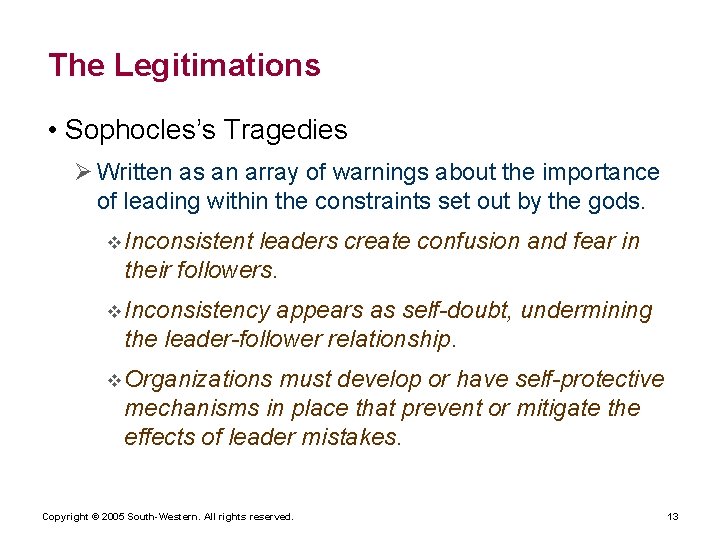
The Legitimations • Sophocles’s Tragedies Ø Written as an array of warnings about the importance of leading within the constraints set out by the gods. v Inconsistent leaders create confusion and fear in their followers. v Inconsistency appears as self-doubt, undermining the leader-follower relationship. v Organizations must develop or have self-protective mechanisms in place that prevent or mitigate the effects of leader mistakes. Copyright © 2005 South-Western. All rights reserved. 13
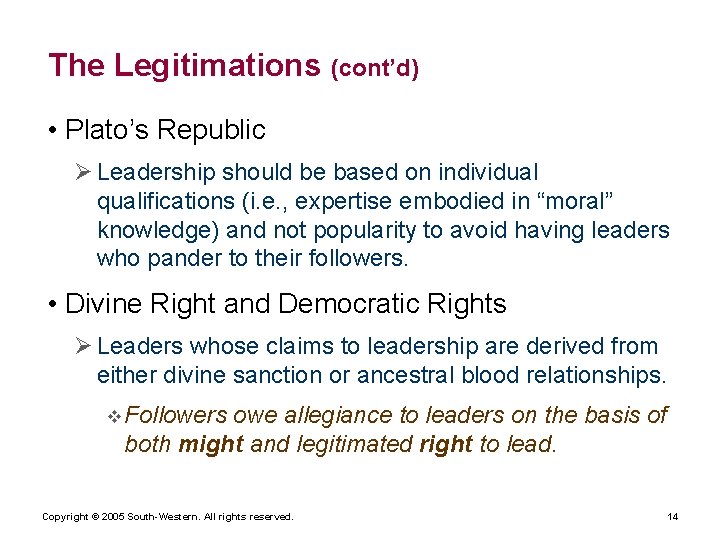
The Legitimations (cont’d) • Plato’s Republic Ø Leadership should be based on individual qualifications (i. e. , expertise embodied in “moral” knowledge) and not popularity to avoid having leaders who pander to their followers. • Divine Right and Democratic Rights Ø Leaders whose claims to leadership are derived from either divine sanction or ancestral blood relationships. v Followers owe allegiance to leaders on the basis of both might and legitimated right to lead. Copyright © 2005 South-Western. All rights reserved. 14
Reflective Questions ▼ • If history does not repeat itself, can leaders learn anything from it? • Why have leaders throughout history concerned themselves with legitimacy? Copyright © 2005 South-Western. All rights reserved. 15
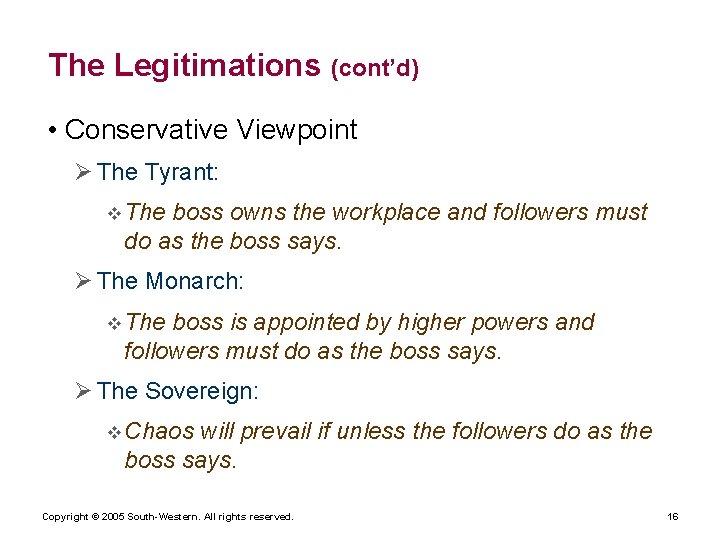
The Legitimations (cont’d) • Conservative Viewpoint Ø The Tyrant: v The boss owns the workplace and followers must do as the boss says. Ø The Monarch: v The boss is appointed by higher powers and followers must do as the boss says. Ø The Sovereign: v Chaos will prevail if unless the followers do as the boss says. Copyright © 2005 South-Western. All rights reserved. 16
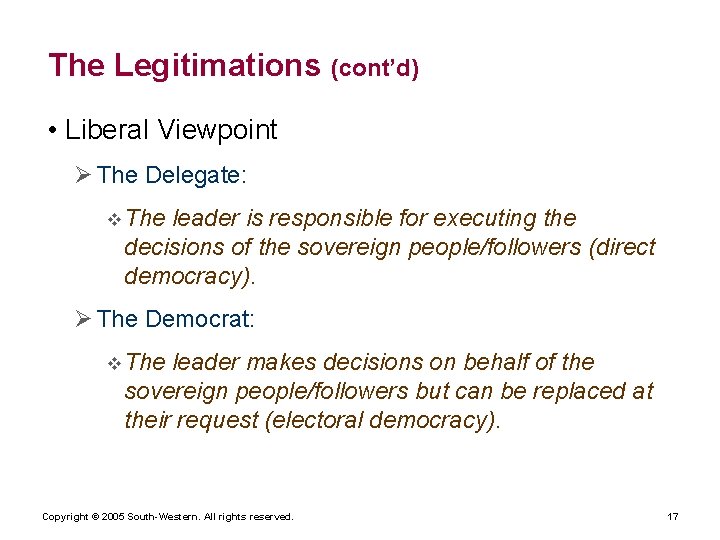
The Legitimations (cont’d) • Liberal Viewpoint Ø The Delegate: v The leader is responsible for executing the decisions of the sovereign people/followers (direct democracy). Ø The Democrat: v The leader makes decisions on behalf of the sovereign people/followers but can be replaced at their request (electoral democracy). Copyright © 2005 South-Western. All rights reserved. 17