
1 Does the structure of the onions cells





- Slides: 26
1. Does the structure of the onion’s cells determine its overall size and shape? Explain. 2. If one cell were changed or damaged, would it affect the overall structure or function of the plant? 3. If one cell is not important to the survival of the plant, why is each individual cell still important overall?
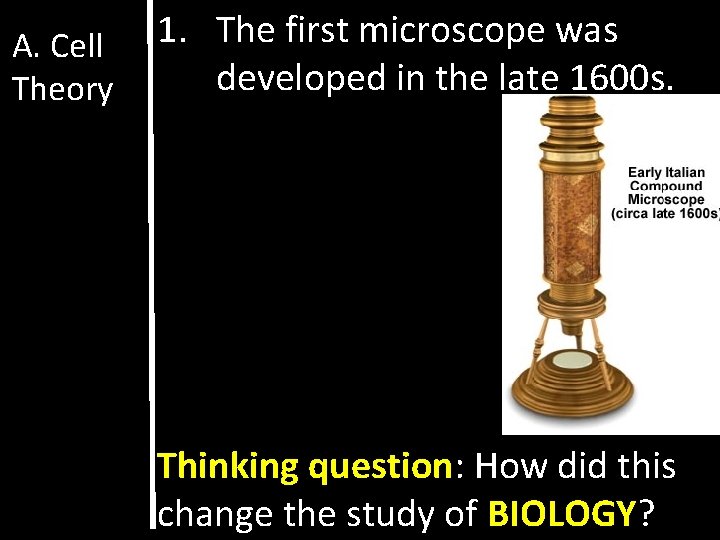
A. Cell Theory 1. The first microscope was developed in the late 1600 s. Thinking question: How did this change the study of BIOLOGY?
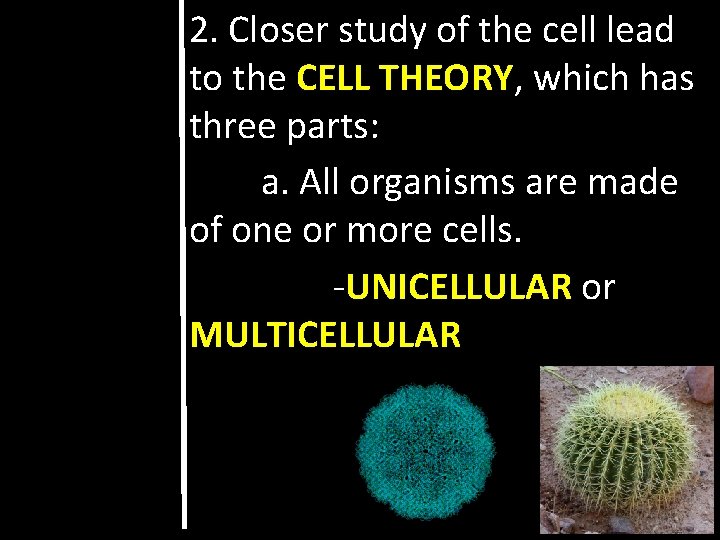
2. Closer study of the cell lead to the CELL THEORY, which has three parts: a. All organisms are made of one or more cells. -UNICELLULAR or MULTICELLULAR
b. Cells are the basic unit of structure/organization of all living things. Thinking question: What are the levels of organization? -Cells, Tissues, Organ Systems, Organism
c. Cells can only arise from previously existing cells. -UNICELLULAR organisms reproduce; MULTICELLULAR organisms replace dead cells Cell Theory Vid
B. Microscope Technology 1. Different microscopes are designed to view different objects. a. COMPOUND LIGHT MICROSCOPES use light to make something appear larger.
-They magnify up to 1000 times their size, and are used to study things at a CELLULAR level.
b. ELECTRON MICROSCOPES magnify objects up to 500, 000 times their size. -They are used to study objects at an atomic level.
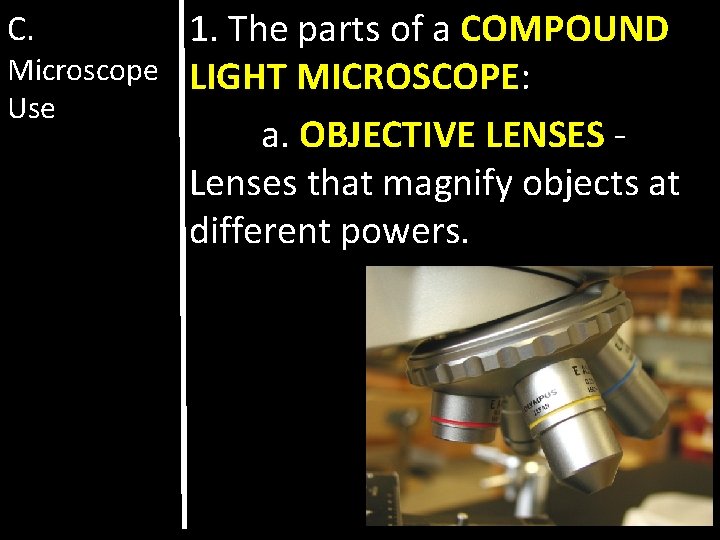
C. Microscope Use 1. The parts of a COMPOUND LIGHT MICROSCOPE: a. OBJECTIVE LENSES Lenses that magnify objects at different powers.
-There are three levels of magnification of objective lenses: -Low power – 4 x -Medium power – 10 x -High power – 40 x
b. The EYEPIECE is the lens you look through. Its magnification is 10 x. -Total magnification of an object is 10 x the amount of the objective lens. Ex: The 40 x objective lens magnifies at 400 times an object’s size.
c. The ARM attaches the lens to the bottom (for safe holding).
d. Slides are clipped to the STAGE for examination.
e. The DIAPHRAGM allows you to adjust the light coming through the stage. - More light is needed to view certain specimen.
f. COARSE FOCUS (larger knob) moves the stage up/down very quickly. g. FINE FOCUS (smaller knob) focuses the image slowly and carefully.
h. The LIGHT source illuminates your slide. i. The BASE supports the instrument.
Label the Microscope
C. Cell Types 1. Every cell has a PLASMA MEMBRANE, a boundary that controls what enters and leaves the cell.
a. Most cells contain DNA, and can break down molecules to make energy.
b. There are two kinds of cells, EUKARYOTIC and PROKARYOTIC cells. Thinking question: What is the difference between them?
2. EUKARYOTIC CELLS contain ORGANELLES, small structures that do special jobs. a. They have a NUCLEUS, an ORGANELLE which holds the DNA.
b. Most EUKARYOTES are multicellular organisms, though some are single celled (ex: amoeba, paramecia, yeast).
3. PROKARYOTIC CELLS do not contain ORGANELLES. a. Their DNA floats around inside the cell because there is no NUCLEUS.
b. All PROKARYOTES are simple, single-celled organisms. Most bacteria are PROKARYOTES.
4. PROKARYOTIC CELLS are smaller than EUKARYOTIC CELLS. https: //www. youtube. com/watch? v=z. Ztc. MBTQa. S 4 Thinking question: Why?
5. ALL CELLS CONTAIN: – Plasma Membrane – Cytoplasm – Ribosomes – DNA