
1 DNA 2 DNA stands for deoxyribose nucleic
1
DNA 2 DNA stands for deoxyribose nucleic acid This chemical substance is present in the nucleus of all cells in all living organisms DNA controls all the chemical changes which take place in cells The kind of cell which is formed, (muscle, blood, nerve etc) is controlled by DNA The kind of organism which is produced (buttercup, giraffe, herring, human etc) is controlled by DNA
DNA molecule DNA is a very large molecule made up of a long chain of sub-units The sub-units are called nucleotides Each nucleotide is made up of a sugar called deoxyribose a phosphate group -PO 4 and an nitrogenous base (A, T, C, G) 3
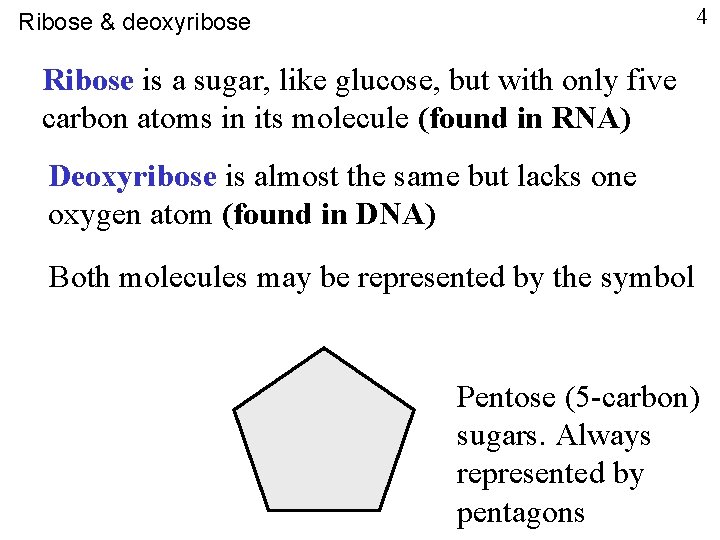
4 Ribose & deoxyribose Ribose is a sugar, like glucose, but with only five carbon atoms in its molecule (found in RNA) Deoxyribose is almost the same but lacks one oxygen atom (found in DNA) Both molecules may be represented by the symbol Pentose (5 -carbon) sugars. Always represented by pentagons
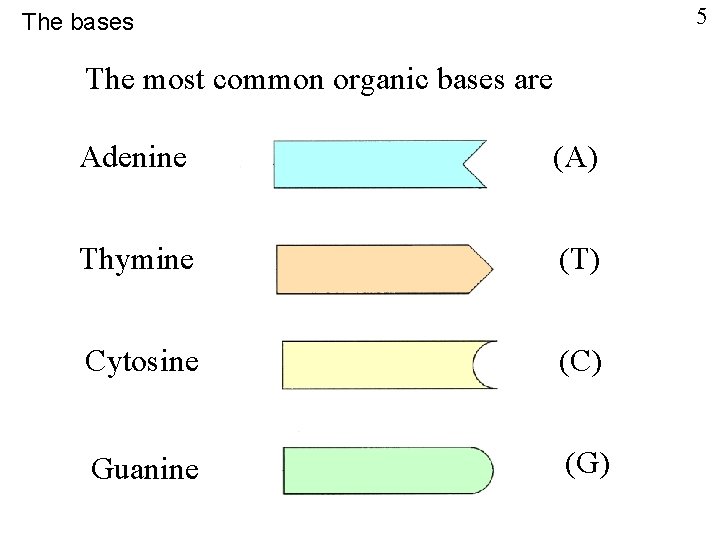
5 The bases The most common organic bases are Adenine (A) Thymine (T) Cytosine (C) Guanine (G)
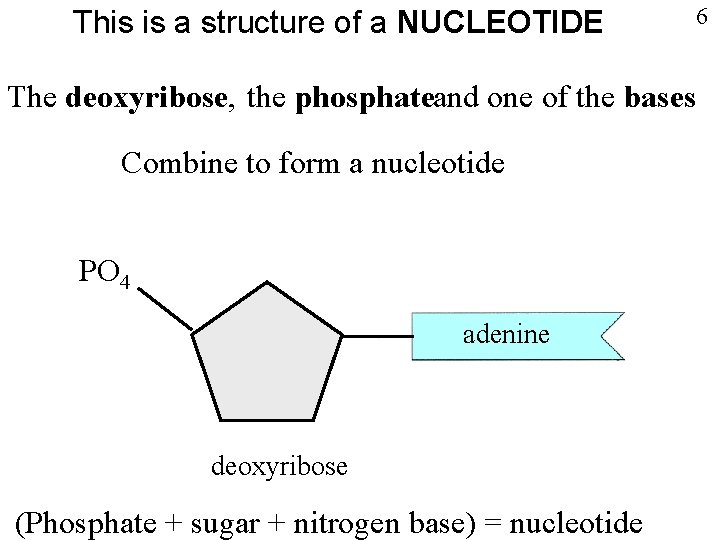
This is a structure of a NUCLEOTIDE 6 The deoxyribose, the phosphateand one of the bases Combine to form a nucleotide PO 4 adenine deoxyribose (Phosphate + sugar + nitrogen base) = nucleotide
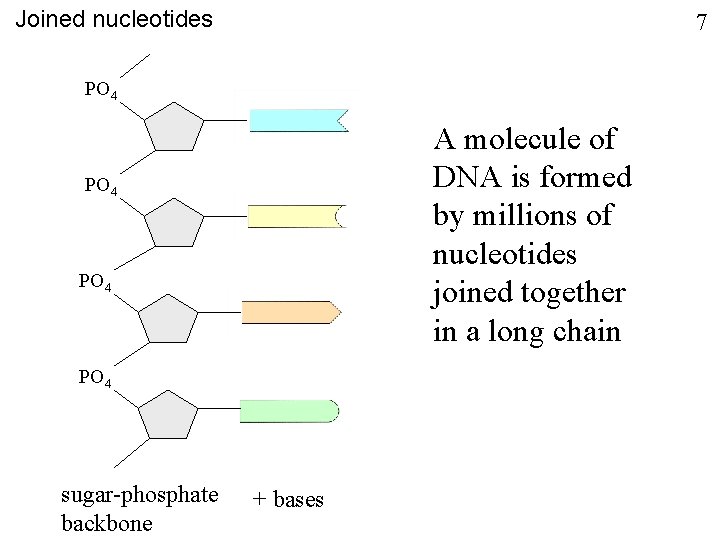
Joined nucleotides 7 PO 4 A molecule of DNA is formed by millions of nucleotides joined together in a long chain PO 4 sugar-phosphate backbone + bases
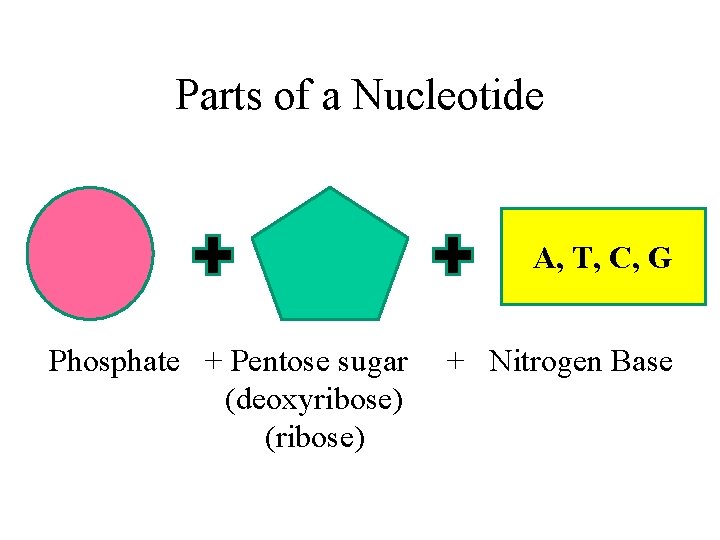
Parts of a Nucleotide A, T, C, G Phosphate + Pentose sugar (deoxyribose) (ribose) + Nitrogen Base
8 In fact, the DNA usually consists of a double strand of nucleotides The sugar-phosphate chains are on the outside and the strands are held together by chemical bonds between the bases
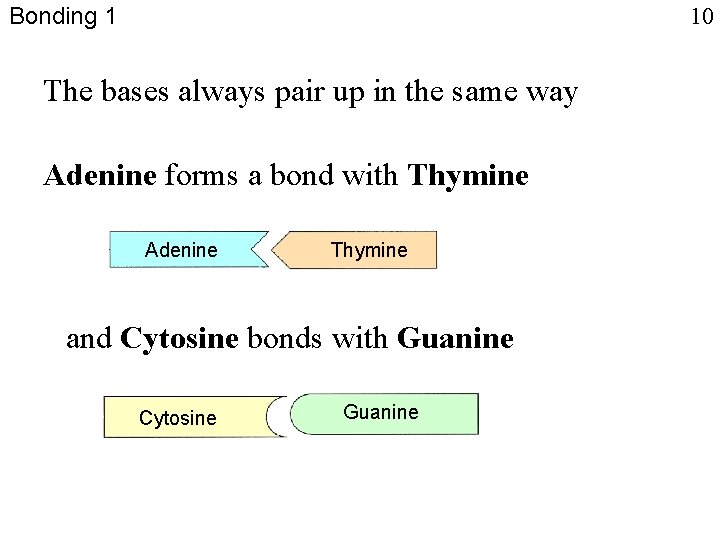
Bonding 1 10 The bases always pair up in the same way Adenine forms a bond with Thymine Adenine Thymine and Cytosine bonds with Guanine Cytosine Guanine
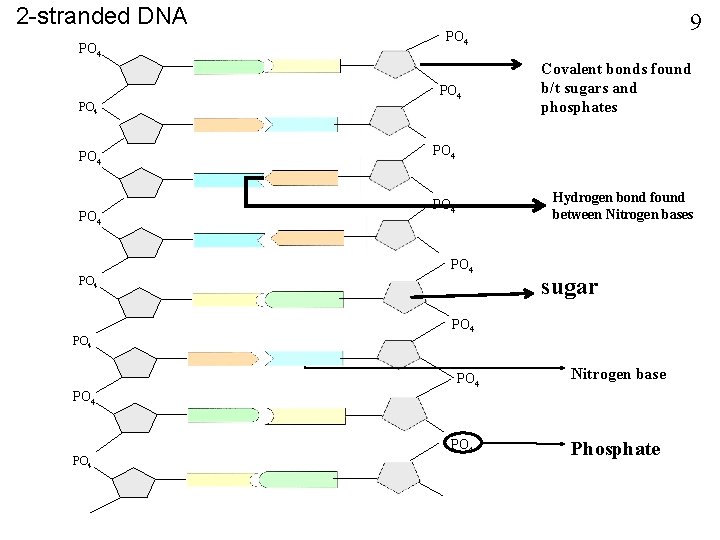
2 -stranded DNA PO 4 PO 4 9 PO 4 Covalent bonds found b/t sugars and phosphates PO 4 Hydrogen bond found between Nitrogen bases PO 4 sugar PO 4 Nitrogen base PO 4 Phosphate
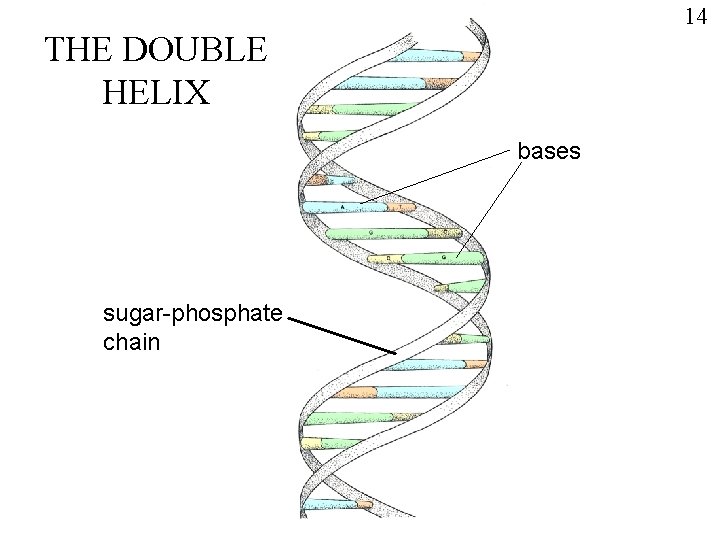
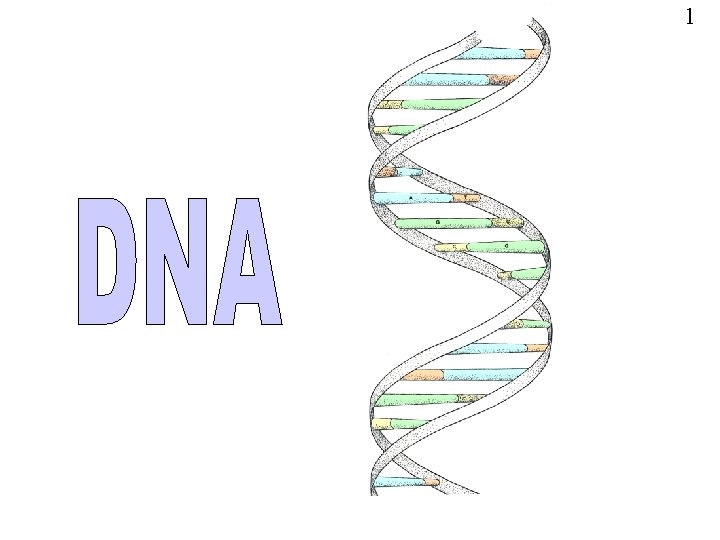
14 THE DOUBLE HELIX bases sugar-phosphate chain
The paired strands are coiled into a spiral called 13 A DOUBLE HELIX The term “Double Helix” was coined by two British Scientists named James Watson and Francis Crick in the 1950 s. . . but should they have received the Nobel Prize? ? If you haven’t already done so. Do a quick search and read about Watson & Crick and Rosalind Franklin. On my webpage, there are questions for you to answer in your notes
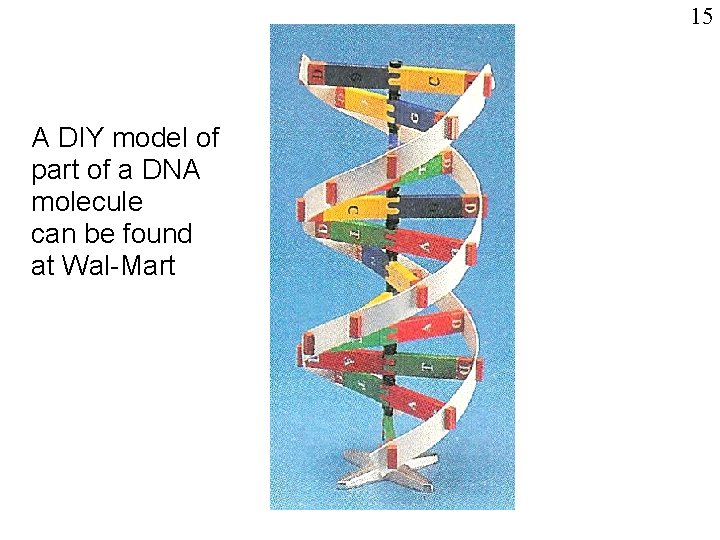
15 A DIY model of part of a DNA molecule can be found at Wal-Mart
DNA replication 16 1. Before a cell divides, the DNA strands unwind and separate 2. Each strand makes a new partner by adding the appropriate nucleotides 3. The result is that there are now two doublestranded DNA molecules in the nucleus 4. So that when the cell divides, each nucleus contains identical DNA 5. This process is called replication
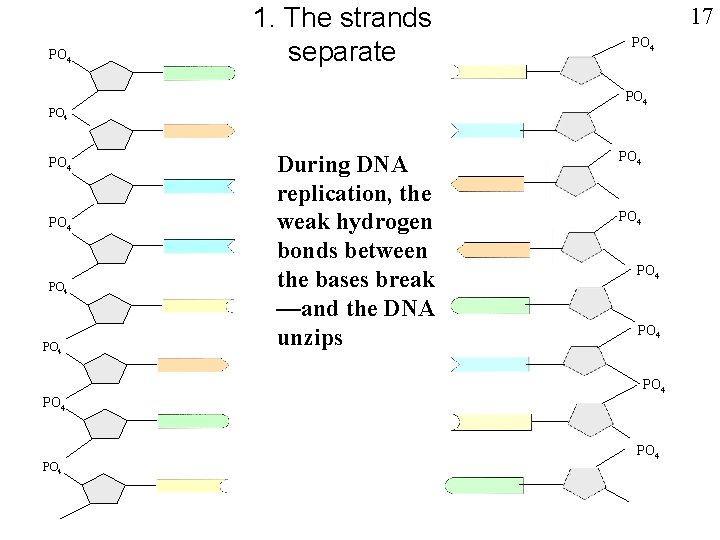
PO 4 1. The strands separate PO 4 PO 4 17 During DNA replication, the weak hydrogen bonds between the bases break —and the DNA unzips PO 4 PO 4
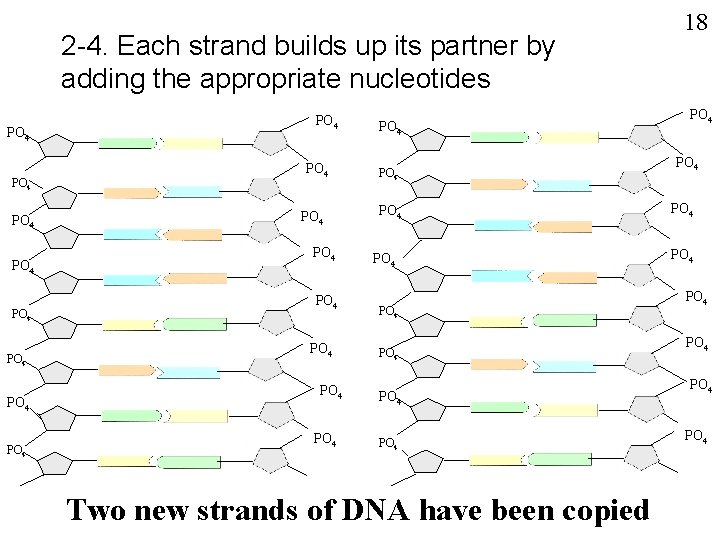
2 -4. Each strand builds up its partner by adding the appropriate nucleotides PO 4 PO 4 PO 4 PO 4 PO 4 PO 4 Two new strands of DNA have been copied 18 PO 4 PO 4
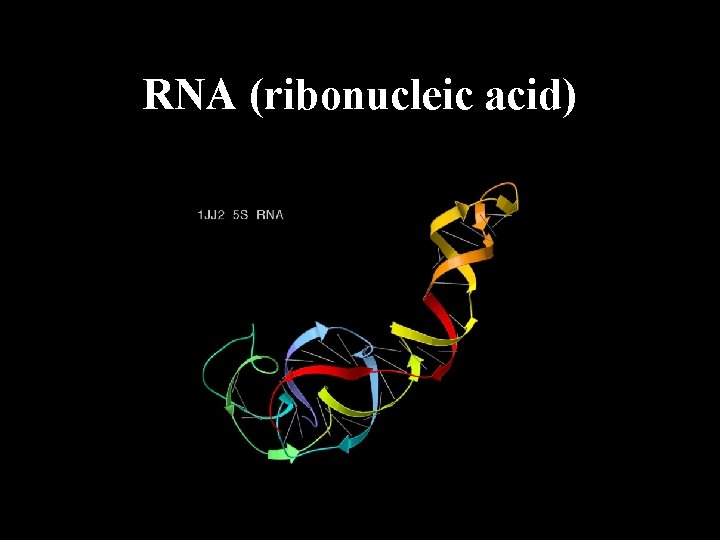
RNA (ribonucleic acid)
Ribonucleic Acid • Single stranded form of DNA • Responsible for Protein synthesis (making proteins) • Travels to the ribosomes (since the DNA cannot leave the nucleus), and aids in protein synthesis There are three types: • Messenger RNA (m. RNA)-brings message from DNA • Ribosomal RNA (r. RNA)- makes structure of ribosome • Transfer RNA (t. RNA)-transfers the amino acid to the site of protein synthesis
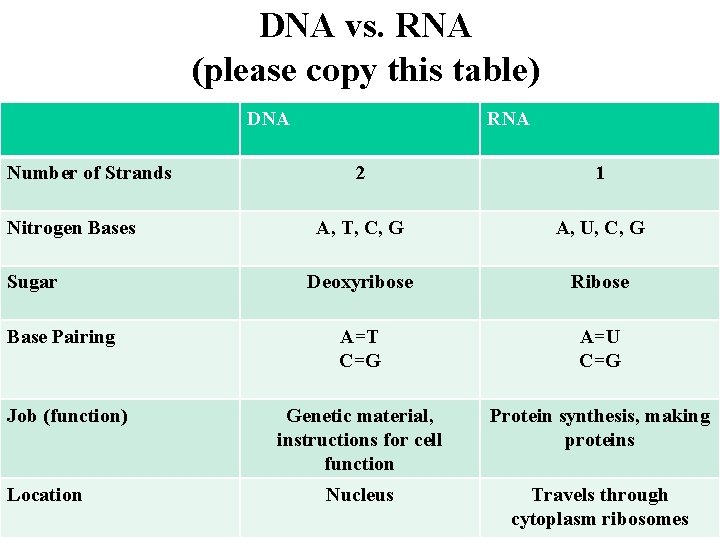
DNA vs. RNA (please copy this table) DNA Number of Strands Nitrogen Bases Sugar Base Pairing Job (function) Location RNA 2 1 A, T, C, G A, U, C, G Deoxyribose Ribose A=T C=G A=U C=G Genetic material, instructions for cell function Protein synthesis, making proteins Nucleus Travels through cytoplasm ribosomes
DNA to Proteins Protein Synthesis
Instructions for making proteins • DNA inside of the nucleus gives instructions for protein synthesis. • The DNA cannot leave the nucleus, so the m. RNA must travel to the ribosomes • The RNA helps the ribosomes to make proteins.
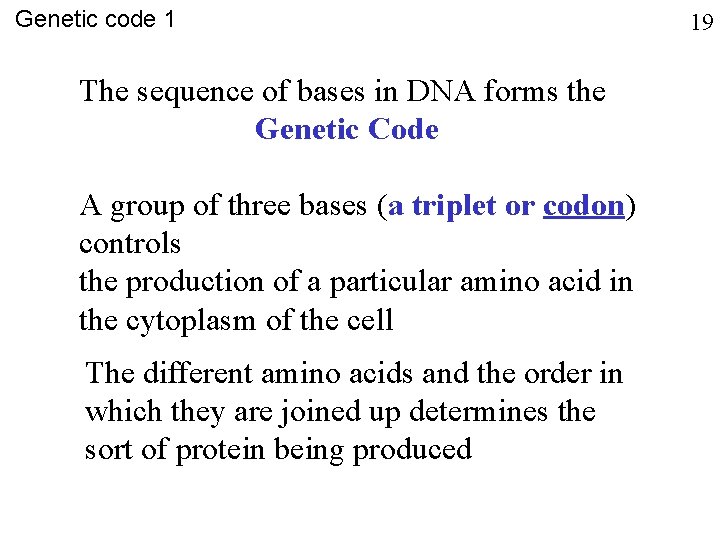
Genetic code 1 The sequence of bases in DNA forms the Genetic Code A group of three bases (a triplet or codon) controls the production of a particular amino acid in the cytoplasm of the cell The different amino acids and the order in which they are joined up determines the sort of protein being produced 19
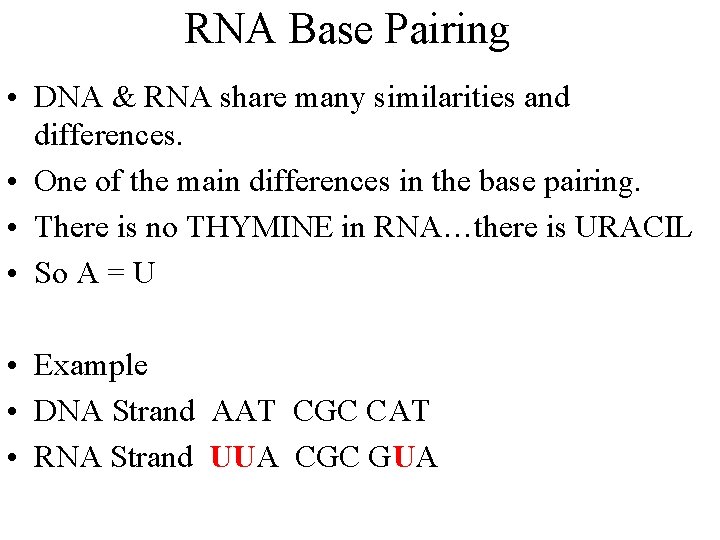
RNA Base Pairing • DNA & RNA share many similarities and differences. • One of the main differences in the base pairing. • There is no THYMINE in RNA…there is URACIL • So A = U • Example • DNA Strand AAT CGC CAT • RNA Strand UUA CGC GUA
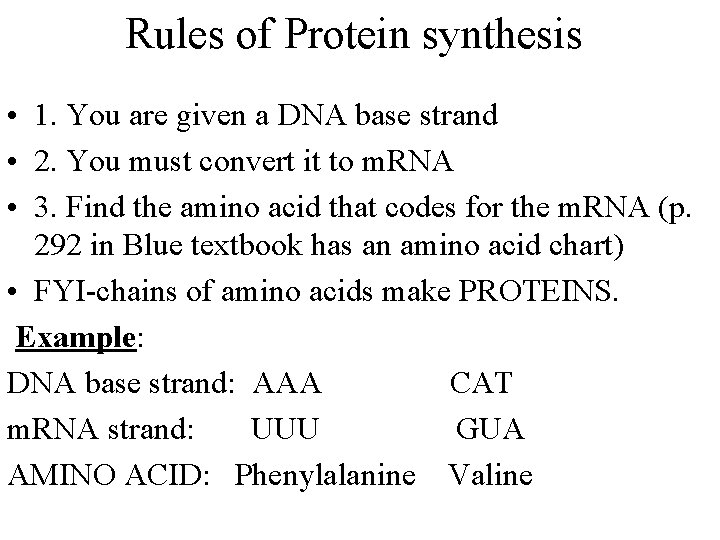
Rules of Protein synthesis • 1. You are given a DNA base strand • 2. You must convert it to m. RNA • 3. Find the amino acid that codes for the m. RNA (p. 292 in Blue textbook has an amino acid chart) • FYI-chains of amino acids make PROTEINS. Example: DNA base strand: AAA CAT m. RNA strand: UUU GUA AMINO ACID: Phenylalanine Valine
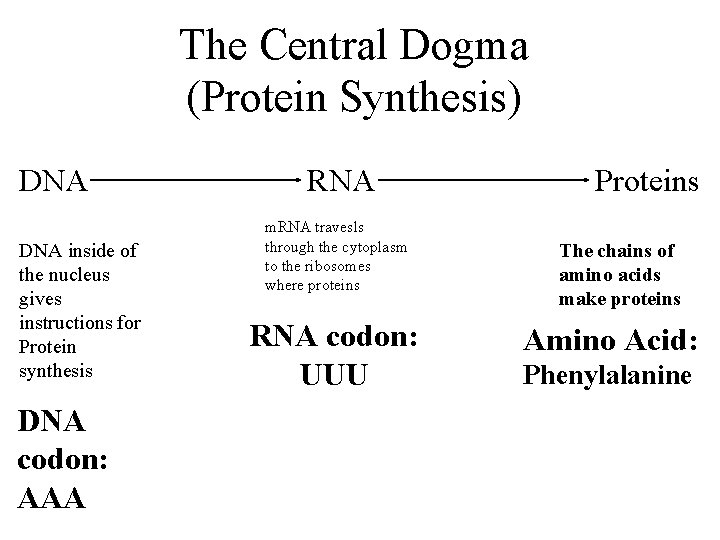
The Central Dogma (Protein Synthesis) DNA inside of the nucleus gives instructions for Protein synthesis DNA codon: AAA RNA m. RNA travesls through the cytoplasm to the ribosomes where proteins RNA codon: UUU Proteins The chains of amino acids make proteins Amino Acid: Phenylalanine
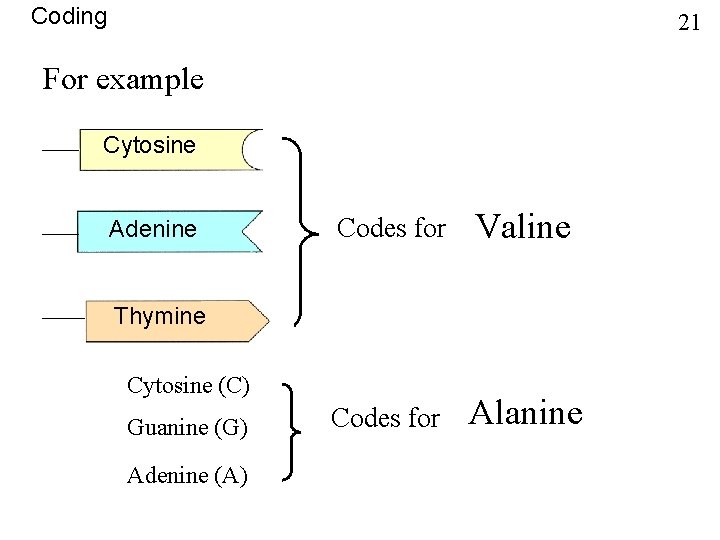
Coding 21 For example Cytosine Adenine Codes for Valine Codes for Alanine Thymine Cytosine (C) Guanine (G) Adenine (A)
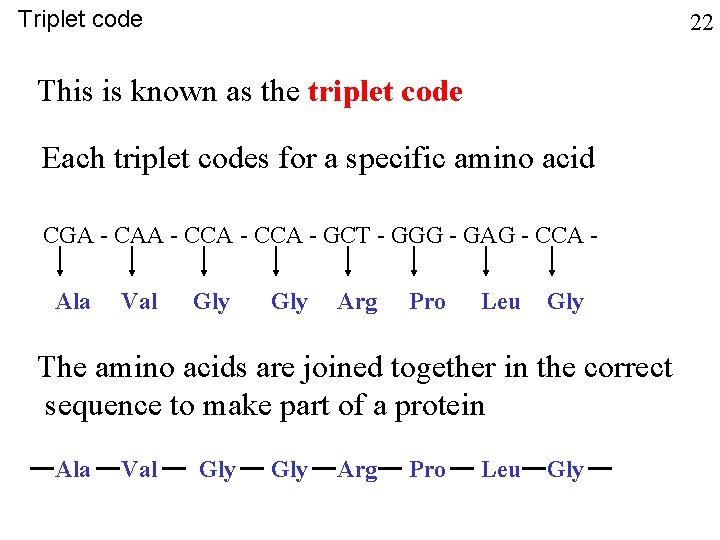
Triplet code 22 This is known as the triplet code Each triplet codes for a specific amino acid CGA - CAA - CCA - GCT - GGG - GAG - CCA Ala Val Gly Arg Pro Leu Gly The amino acids are joined together in the correct sequence to make part of a protein Ala Val Gly Arg Pro Leu Gly
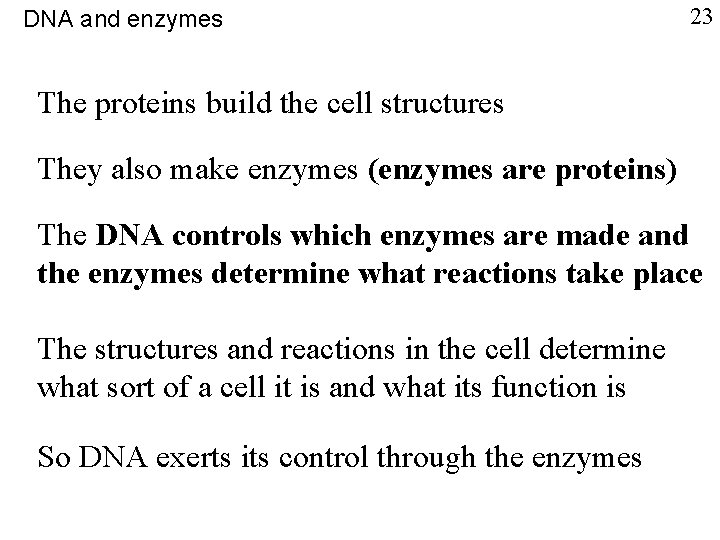
DNA and enzymes 23 The proteins build the cell structures They also make enzymes (enzymes are proteins) The DNA controls which enzymes are made and the enzymes determine what reactions take place The structures and reactions in the cell determine what sort of a cell it is and what its function is So DNA exerts its control through the enzymes
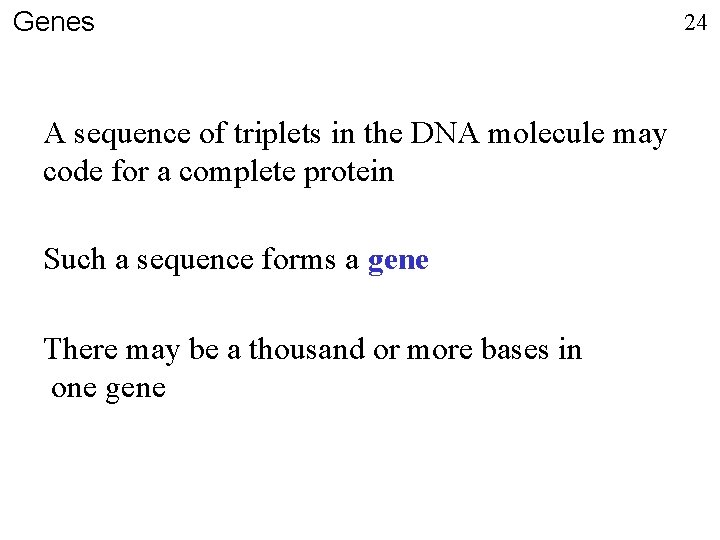
Genes A sequence of triplets in the DNA molecule may code for a complete protein Such a sequence forms a gene There may be a thousand or more bases in one gene 24
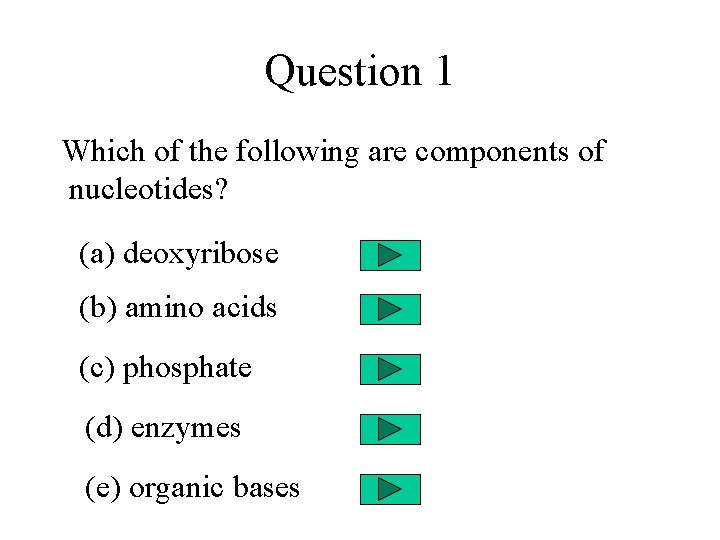
Question 1 Which of the following are components of nucleotides? (a) deoxyribose (b) amino acids (c) phosphate (d) enzymes (e) organic bases
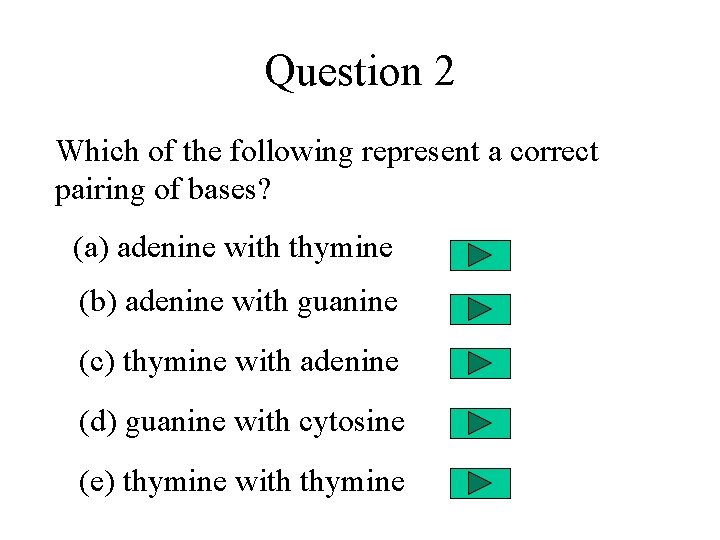
Question 2 Which of the following represent a correct pairing of bases? (a) adenine with thymine (b) adenine with guanine (c) thymine with adenine (d) guanine with cytosine (e) thymine with thymine
Question 3 DNA molecules are formed from (a) organic bases (b) amino acids (c) deoxyribose (d) nucleotides
Question 4 Which of the following are organic bases? (a) Valine (b) Guanine (c) Thymine (d) Serine
Question 5 Replication of DNA occurs (a) During cell division (b) before cell division (c) at any time
Question 6 A nucleotide triplet codes for (a) a protein (b) an amino acid (c) an enzyme (d) an organic base
Answer CORRECT
Answer INCORRECT
- Slides: 38