
1 Dilbert United Feature Syndicate Keith Vander Linden
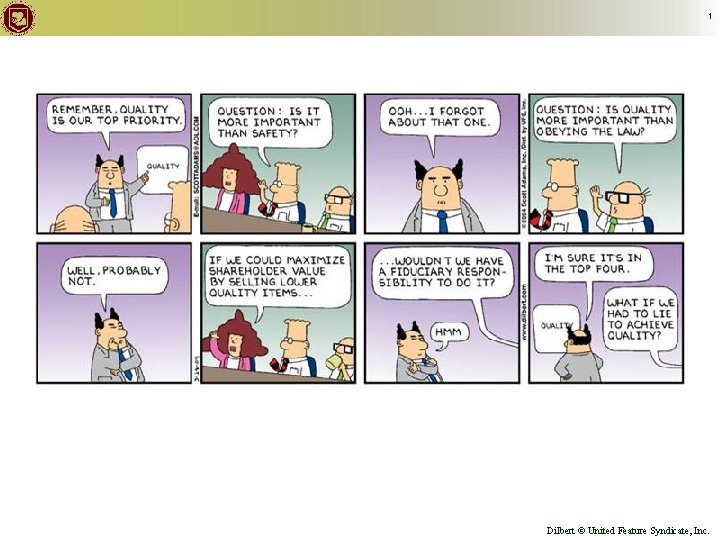
1 Dilbert © United Feature Syndicate, © Keith Vander Linden, Inc. 2009
3 Software Quality ● ● Introduction Testing Traditional software testing – Test-Driven software development – ● ● ● Configuration Management Process Improvement Metrics Be not ashamed of mistakes and thus make them crimes. -Shūjīng, #17 © Keith Vander Linden, 2009
4 Introduction ● What is quality? adherence to specifications – high degree of excellence – ● Ensuring quality: – Validation – Verification © Keith Vander Linden, 2009
5 Elements of Quality ● Utility ● Reliability ● Robustness ● Performance ● Correctness © Keith Vander Linden, 2009
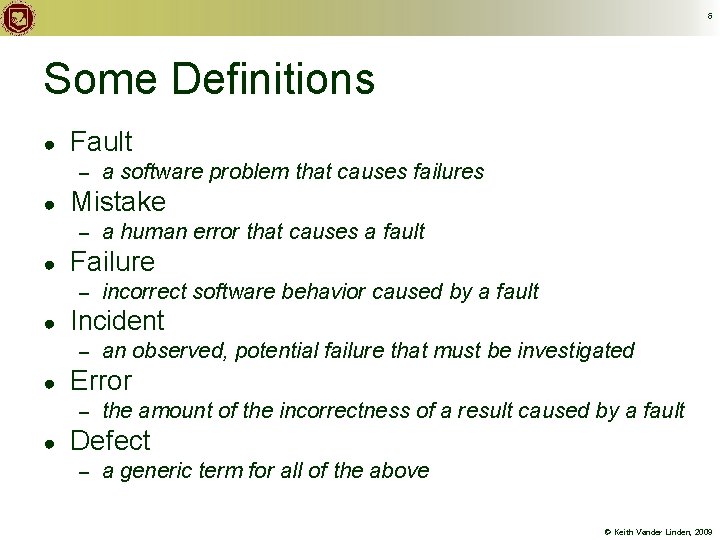
6 Some Definitions ● Fault – ● Mistake – ● an observed, potential failure that must be investigated Error – ● incorrect software behavior caused by a fault Incident – ● a human error that causes a fault Failure – ● a software problem that causes failures the amount of the incorrectness of a result caused by a fault Defect – a generic term for all of the above © Keith Vander Linden, 2009
7 Traditional Software Testing ● ● ● Software testing is the process of investigating and establishing the quality of a software system. Overview of Traditional Software Testing Traditional Approaches: Non-execution-based testing – Execution-based testing – © Keith Vander Linden, 2009
8 Testing: Principles ● Testing is not a proof of correctness. ● Exhaustive testing is not possible. ● Testing is context-dependent. ● Defects tend to cluster. ● Link tests to their test basis. ● Build testability into the product. © Keith Vander Linden, 2009
9 Testing: Management ● ● Testing doesn’t just happen; it should be managed. Testing should be: – Continuous – Pervasive – Meticulous – Independent © Keith Vander Linden, 2009
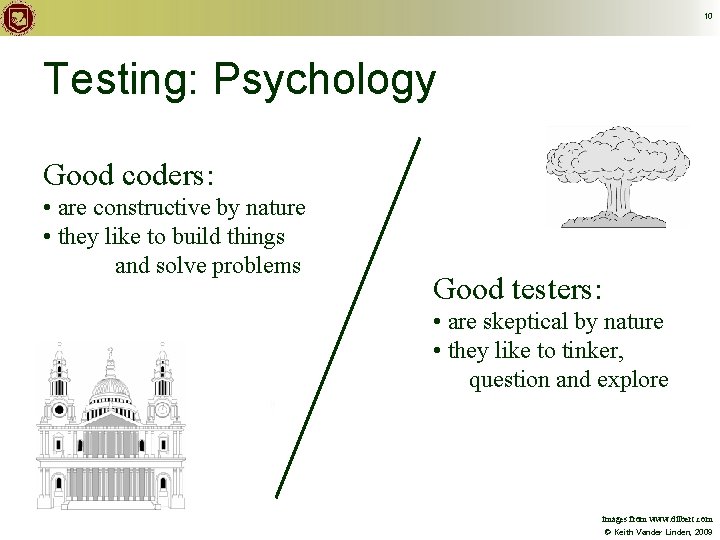
10 Testing: Psychology Good coders: • are constructive by nature • they like to build things and solve problems Good testers: • are skeptical by nature • they like to tinker, question and explore images from www. dilbert. com © Keith Vander Linden, 2009
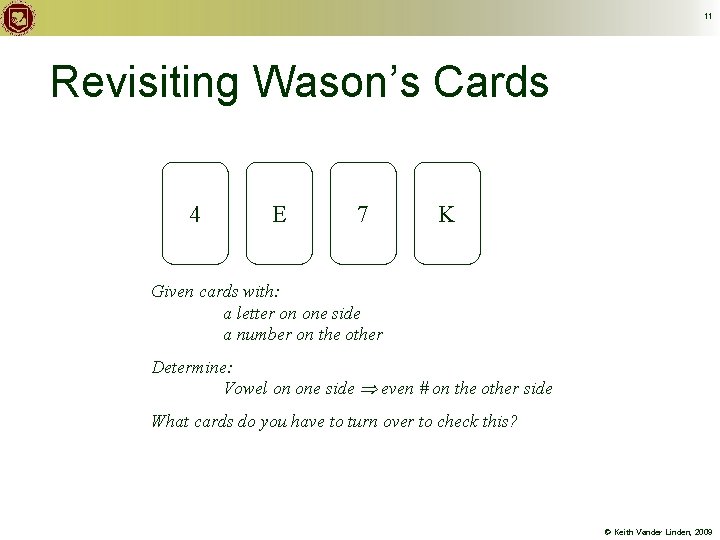
11 Revisiting Wason’s Cards 4 E 7 K Given cards with: a letter on one side a number on the other Determine: Vowel on one side even # on the other side What cards do you have to turn over to check this? © Keith Vander Linden, 2009
12 Non-Execution-Based Testing ● Non-execution-based testing exposes faults by studying a software system. Advantages: ● Approaches: ● – Review – Inspections © Keith Vander Linden, 2009
13 Technical Review ● Roles: Facilitator – Recorder – Producer(s) – Reviewers – ● Process – Before: – During: – After: © Keith Vander Linden, 2009
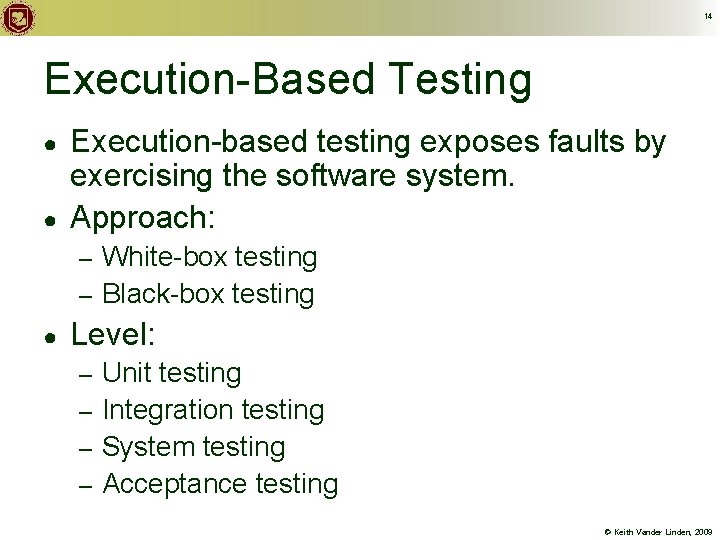
14 Execution-Based Testing ● ● Execution-based testing exposes faults by exercising the software system. Approach: White-box testing – Black-box testing – ● Level: Unit testing – Integration testing – System testing – Acceptance testing – © Keith Vander Linden, 2009
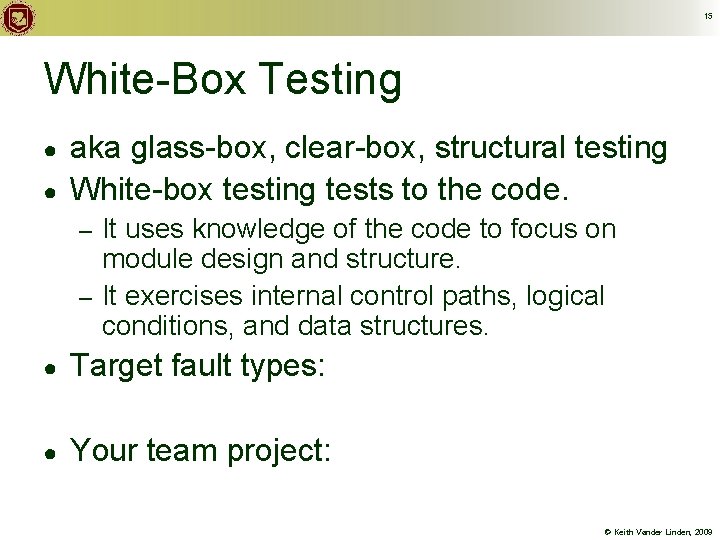
15 White-Box Testing ● ● aka glass-box, clear-box, structural testing White-box testing tests to the code. It uses knowledge of the code to focus on module design and structure. – It exercises internal control paths, logical conditions, and data structures. – ● Target fault types: ● Your team project: © Keith Vander Linden, 2009
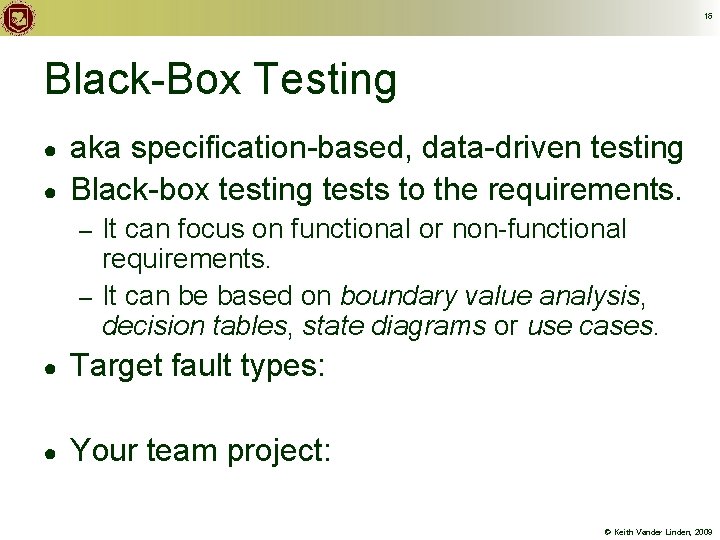
16 Black-Box Testing ● ● aka specification-based, data-driven testing Black-box testing tests to the requirements. It can focus on functional or non-functional requirements. – It can be based on boundary value analysis, decision tables, state diagrams or use cases. – ● Target fault types: ● Your team project: © Keith Vander Linden, 2009
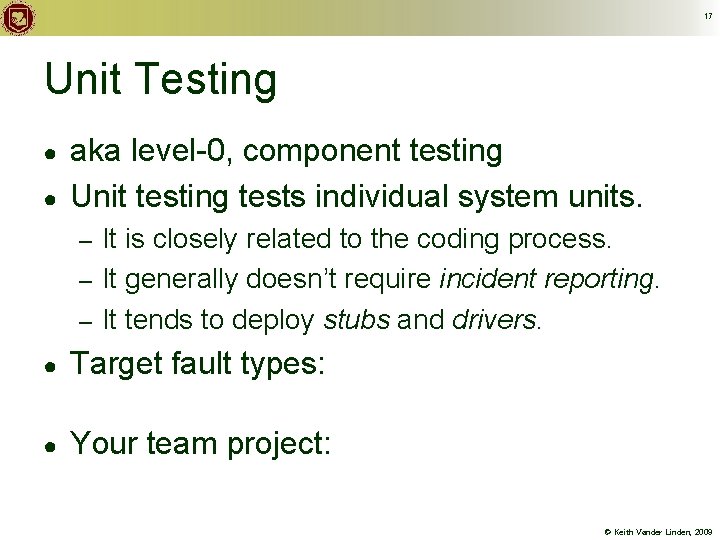
17 Unit Testing ● ● aka level-0, component testing Unit testing tests individual system units. It is closely related to the coding process. – It generally doesn’t require incident reporting. – It tends to deploy stubs and drivers. – ● Target fault types: ● Your team project: © Keith Vander Linden, 2009
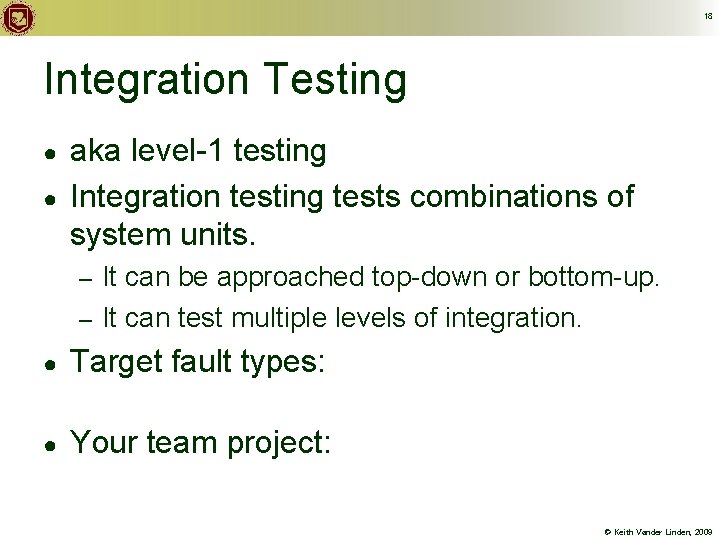
18 Integration Testing ● ● aka level-1 testing Integration testing tests combinations of system units. It can be approached top-down or bottom-up. – It can test multiple levels of integration. – ● Target fault types: ● Your team project: © Keith Vander Linden, 2009
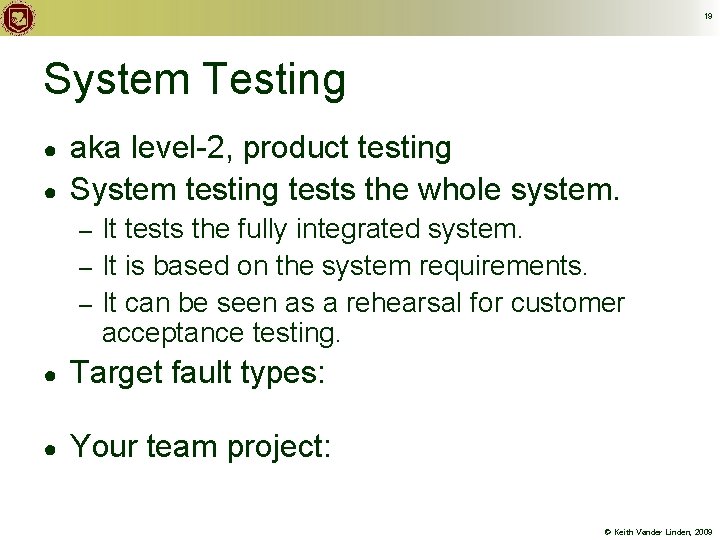
19 System Testing ● ● aka level-2, product testing System testing tests the whole system. It tests the fully integrated system. – It is based on the system requirements. – It can be seen as a rehearsal for customer acceptance testing. – ● Target fault types: ● Your team project: © Keith Vander Linden, 2009
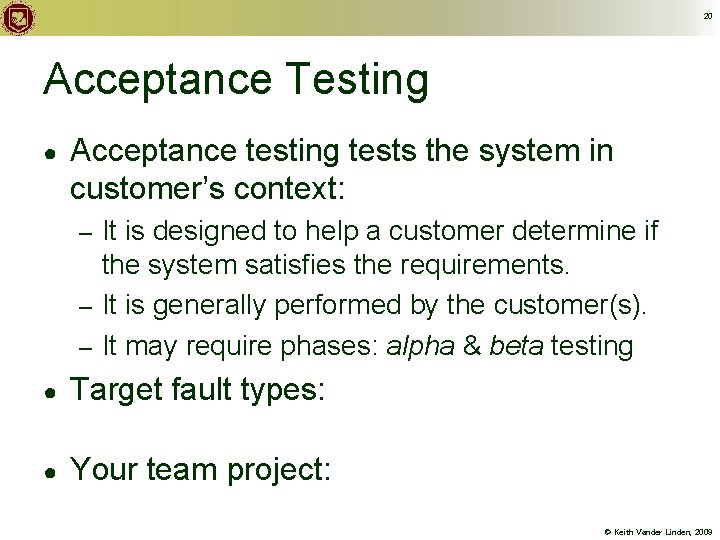
20 Acceptance Testing ● Acceptance testing tests the system in customer’s context: It is designed to help a customer determine if the system satisfies the requirements. – It is generally performed by the customer(s). – It may require phases: alpha & beta testing – ● Target fault types: ● Your team project: © Keith Vander Linden, 2009
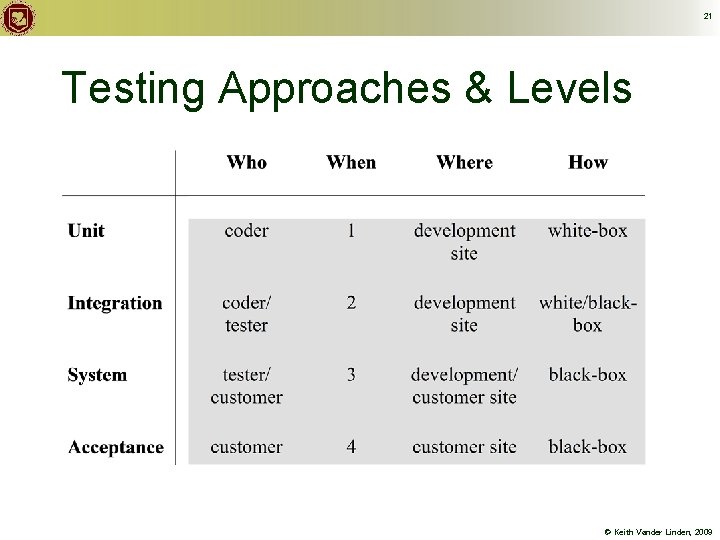
21 Testing Approaches & Levels © Keith Vander Linden, 2009
22 Testing Changes to the System ● ● As the system changes, test suites can be run multiple times, for differing reasons: – Confirmation testing – Regression testing Automated testing is attractive for test suites that are executed frequently. © Keith Vander Linden, 2009
23 Testing Databases ● ● Organizations value information, but they tend not to test their database systems. Things to test with respect to databases: Database structure and integrity – Data loading & extracting – Application integrity – ● Use separate database sandboxes to separate development, release, and production databases. © Keith Vander Linden, 2009
24 Test Documentation ● ● ● Can range from formal to informal, depending on the context. Each test case in a test suite contains: – Test basis – Test data – Test script Your team project: © Keith Vander Linden, 2009
25 Debugging ● ● Testing ≠ debugging. Document all incidents. Techniques: – Brute force – Backtracking – Cause elimination Your team project: © Keith Vander Linden, 2009
26 Test-Driven Development ● ● In test-driven development, the tests are written before the code. Advantages of doing this: © Keith Vander Linden, 2009
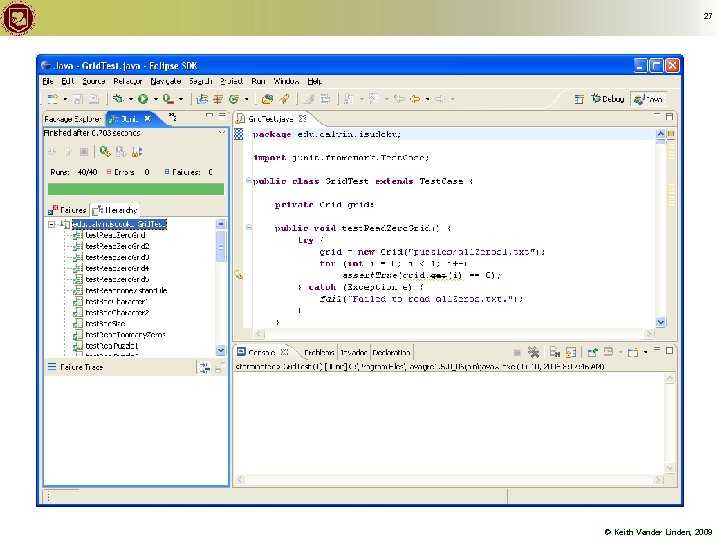
27 © Keith Vander Linden, 2009
28 Refactoring ● ● Refactoring is disciplined approach to behavior-preserving modification. Issues: What to refactor – When to refactor – How to refactor – © Keith Vander Linden, 2009
29 Refactoring Patterns ● ● There are many well-known refactorings. Examples: Rename – Extract method – Extract constant – Replace constructor with factory – © Keith Vander Linden, 2009
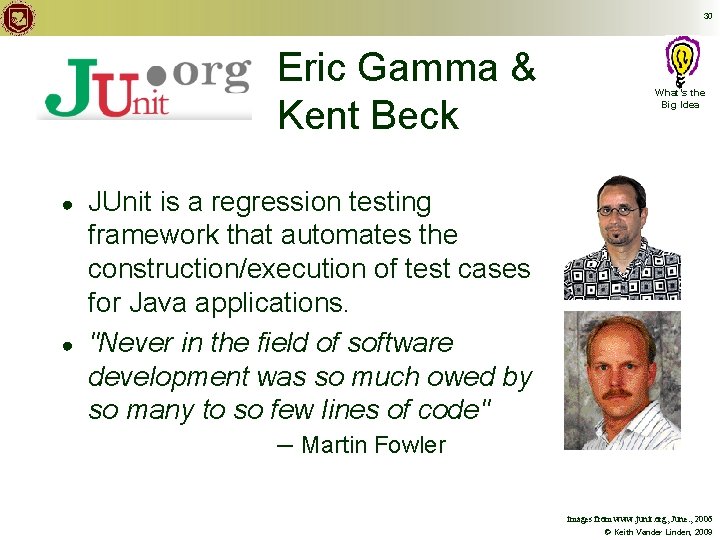
30 Eric Gamma & Kent Beck ● ● What’s the Big Idea JUnit is a regression testing framework that automates the construction/execution of test cases for Java applications. "Never in the field of software development was so much owed by so many to so few lines of code" – Martin Fowler images from www. junit. org, June. , 2006 © Keith Vander Linden, 2009
31 Configuration Management ● Software configuration management (SCM) is the process of managing the integrity of a software system throughout its evolution. It controls all system artifacts: ● It involves a range of activities: ● © Keith Vander Linden, 2009
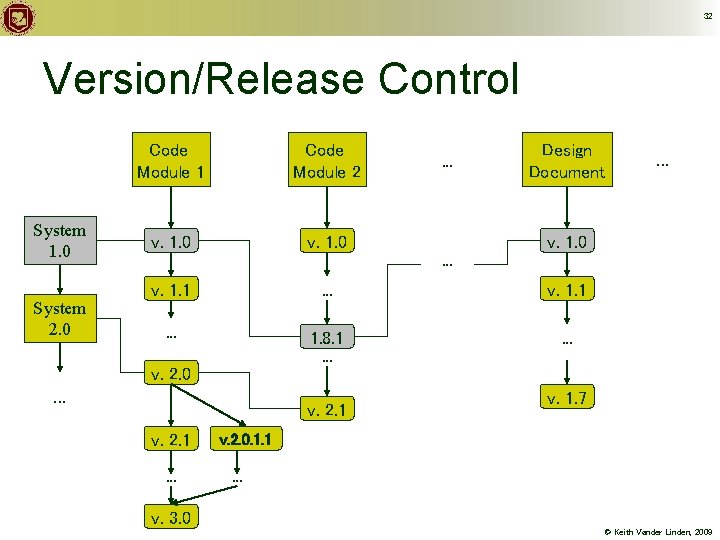
32 Version/Release Control System 1. 0 System 2. 0 Code Module 1 Code Module 2 v. 1. 0 . . . Design Document . . . v. 1. 0. . . v. 1. 1 . . . 1. 8. 1. . . v. 2. 0. . . v. 2. 1. . . v. 1. 7 v. 2. 0. 1. 1 . . . v. 3. 0 © Keith Vander Linden, 2009
33 Change Management ● ● Change must be managed. The process: 1. A stakeholder submits a change request 2. If the change is valid, then assign someone to: a. Engineer the change. b. Submit change plan request. c. If change plan is approved, then: i. Commit changes to system. ii. Document their link to the change request. © Keith Vander Linden, 2009
34 Build Support ● ● System building is the process of compiling, linking and configuring a complete system. Build tools can be configured to: Recompile modules only when necessary – Automatically run tests – Run periodically (or continuously) – © Keith Vander Linden, 2009
35 Process Improvement ● ● ● Process matters. Software engineering is a young discipline with weak (but improving) process. Process improvement iteratively assesses and modifies software processes, e. g. : Capability-Maturity Model Integrated (CMMI) – ISO 9000 – Personal/Team Software Processes (PSP/TSP) – © Keith Vander Linden, 2009
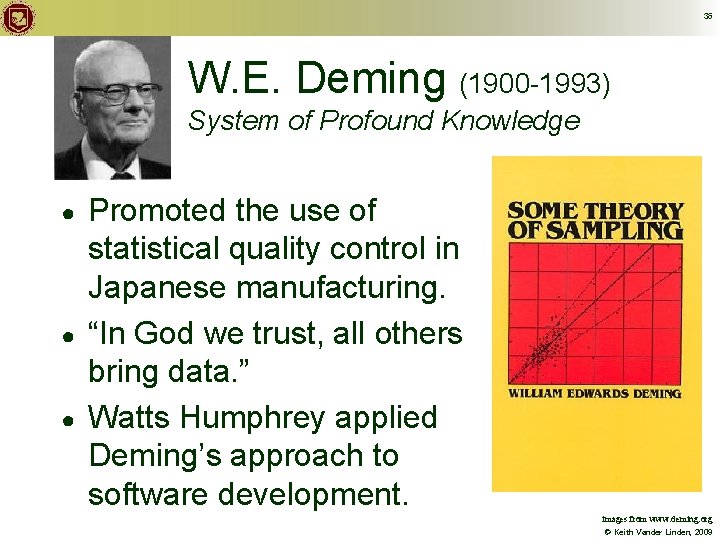
36 W. E. Deming (1900 -1993) System of Profound Knowledge ● ● ● Promoted the use of statistical quality control in Japanese manufacturing. “In God we trust, all others bring data. ” Watts Humphrey applied Deming’s approach to software development. images from www. deming. org © Keith Vander Linden, 2009
37 Capability Maturity Model Integrated ● ● ● CMMI is a process improvement framework developed by CMU’s SEI. It integrates earlier approaches, including SEI’s own CMM. It provides two models of process appraisal: Continuous – Staged – image from www. sei. cmu. edu © Keith Vander Linden, 2009
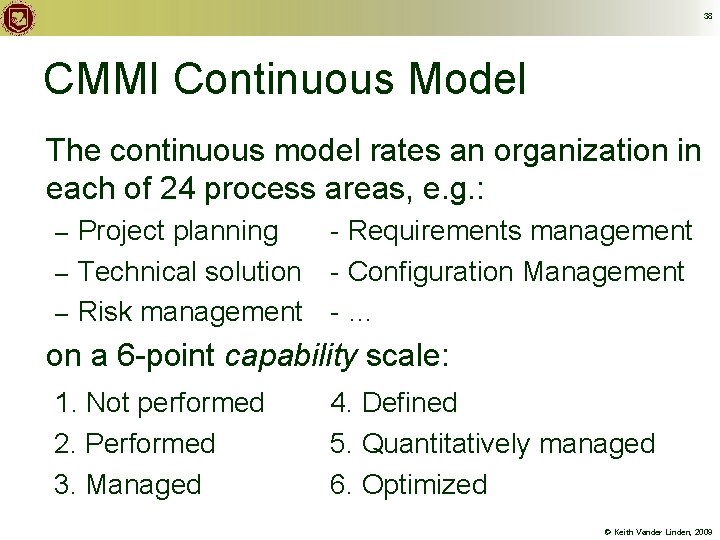
38 CMMI Continuous Model The continuous model rates an organization in each of 24 process areas, e. g. : Project planning - Requirements management – Technical solution - Configuration Management – Risk management - … – on a 6 -point capability scale: 1. Not performed 2. Performed 3. Managed 4. Defined 5. Quantitatively managed 6. Optimized © Keith Vander Linden, 2009
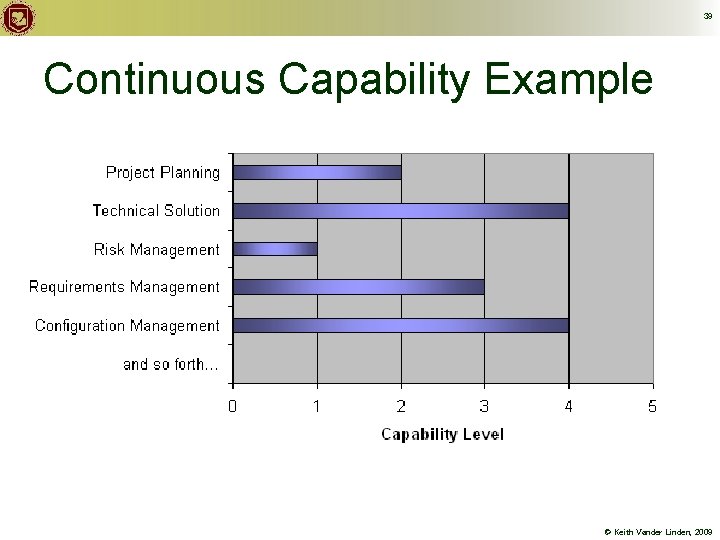
39 Continuous Capability Example © Keith Vander Linden, 2009
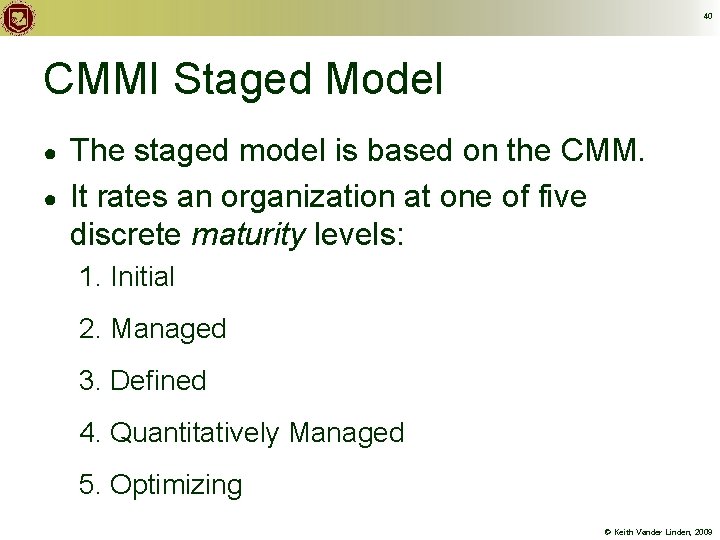
40 CMMI Staged Model ● ● The staged model is based on the CMM. It rates an organization at one of five discrete maturity levels: 1. Initial 2. Managed 3. Defined 4. Quantitatively Managed 5. Optimizing © Keith Vander Linden, 2009
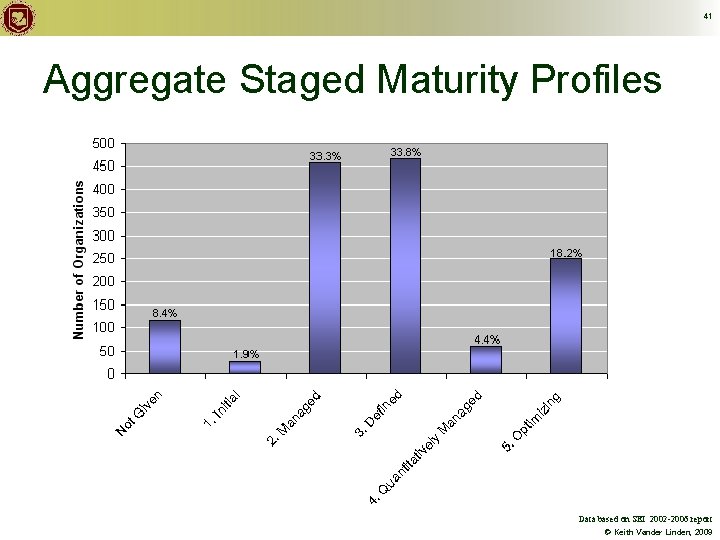
41 Aggregate Staged Maturity Profiles Data based on SEI 2002 -2006 report © Keith Vander Linden, 2009
42 CMMI Cost/Benefit Analysis ● Costs ● Benefits Data based on SEI 2002 -2006 report © Keith Vander Linden, 2009
43 Implementing Process Improvement ● To implement CMMI process improvement: Treat improvement as a technical project. – Understand your current process. – Get support from all levels. – Create and sustain a culture of improvement. – ● Things to keep in mind: Improvement takes time/discipline. – Improvement is done by a project not to it. – from www. cmmifaq. info/#10 © Keith Vander Linden, 2009
44 ISO 9000 ● ISO 9000 is a series of related standards. It was produced by the International Standards Organization (starting in 1987). – It is applicable to quality control in many industries. – ● It is similar but distinct from CMMI: Both seek process improvement. – They have different emphases on documentation and metrics. – You can comply with one but not the other. – image from www. iso. org © Keith Vander Linden, 2009
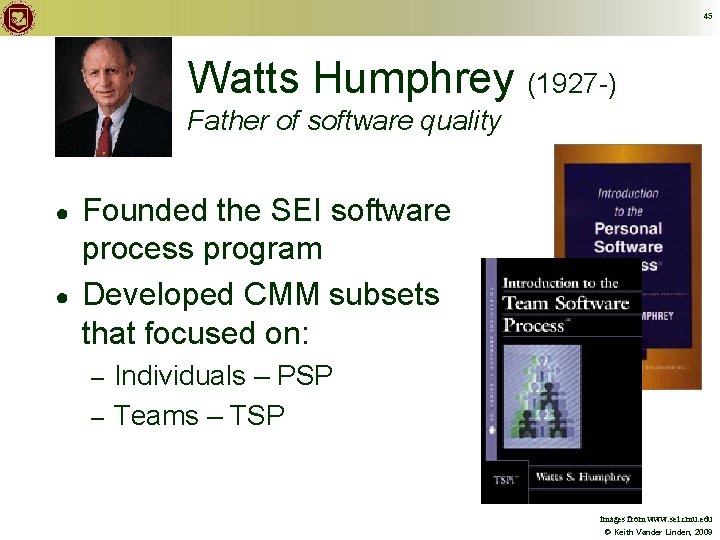
45 Watts Humphrey (1927 -) Father of software quality ● ● Founded the SEI software process program Developed CMM subsets that focused on: Individuals – PSP – Teams – TSP – images from www. sei. cmu. edu © Keith Vander Linden, 2009
46 Baseball and Statistics ● ● ● ● ● batting average homeruns RBIs ERA stolen bases on-base % runs scored hits bases on balls ● ● ● ● ● doubles triples total bases won-lost games pitched saves innings pitched strike-outs complete games shut-outs image from http: //www. whitecaps-baseball. com/ © Keith Vander Linden, 2009
47 Ice skating and Statistics ● ● Skating is rated on a scale of 10. It tends to be more subjective. Image from http: //www. icesk 8. com © Keith Vander Linden, 2009
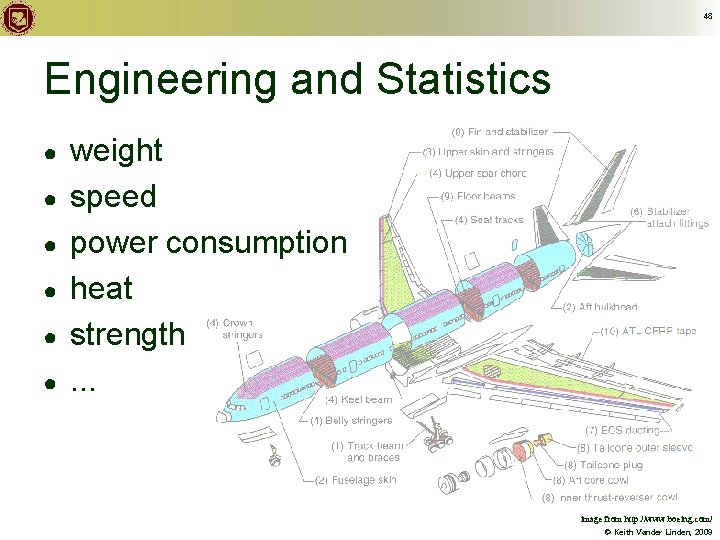
48 Engineering and Statistics ● ● ● weight speed power consumption heat strength. . . image from http: //www. boeing. com/ © Keith Vander Linden, 2009
49 Software Metrics ● Key points on metrics: Measurement is fundamental to engineering and science. – Measurement in SE is subjective and currently under debate. – ● What to measure: The software process – The software product – Software quality – © Keith Vander Linden, 2009
50 Software process metrics ● Defect rates (by coder/module) ● Faults found in development or total faults ● Lines of code written (by coder/group) ● Staff turn-over © Keith Vander Linden, 2009
51 Software product metrics ● Cost ● Duration ● Effort ● Size/complexity ● Quality © Keith Vander Linden, 2009
52 Software Size/Complexity Metrics ● Lines of Code (LOC): The most common measure – It has problems – ● Function Points: more complicated than LOC – Better than LOC, but still has problems – ● For OO systems: # of classes – amount of data or methods per class – © Keith Vander Linden, 2009
53 Software Quality Metrics ● Product operation: defects/KLOC or defects/time interval – Mean time between failure (MTBF) – others? – • • ● Product revision: – ● security usability Mean time to change (MTTC) Product transition: – Time to port © Keith Vander Linden, 2009
54 Metric Characteristics ● Objective vs. Subjective ● Direct vs. Indirect ● Public vs. Private © Keith Vander Linden, 2009
55 Implementing Metrics ● ● Not many companies use sophisticated metrics analysis. Things to keep in mind: Don’t use metrics to appraise or threaten individuals. – Clearly define the metrics and set clear goals for their collection and use. – Don’t focus on only 1 or 2 metrics. – © Keith Vander Linden, 2009
56 Principles ● ● Metrics should be as direct as possible. Use automated tools. Deploy proper statistics. You can measure anything. © Keith Vander Linden, 2009
- Slides: 55