
1 Digital APPLICATIONS C Arm DSA Radiation Dose
- Slides: 54
1 Digital APPLICATIONS C- Arm & DSA & Radiation Dose July 2008 For RT 255 – SPRING
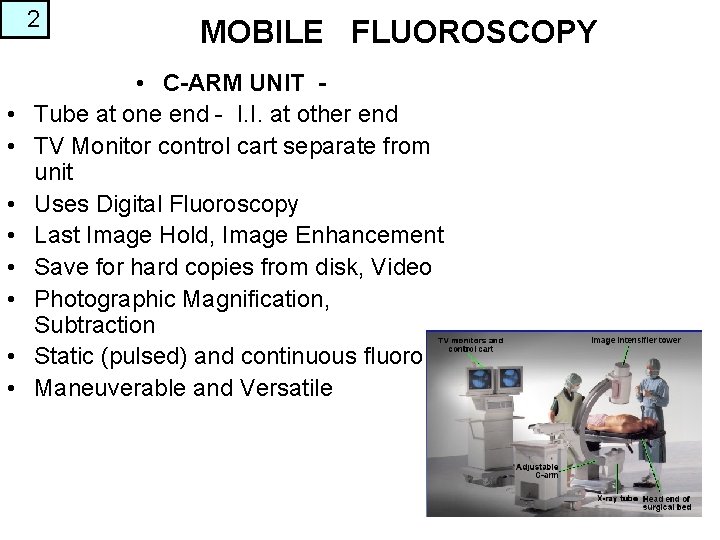
2 • • MOBILE FLUOROSCOPY • C-ARM UNIT Tube at one end - I. I. at other end TV Monitor control cart separate from unit Uses Digital Fluoroscopy Last Image Hold, Image Enhancement Save for hard copies from disk, Video Photographic Magnification, Subtraction Static (pulsed) and continuous fluoro Maneuverable and Versatile
3
4 RADIATION PROTECTION Remember the “Cardinal Rules” FLUOROSCOPIC • • Minimum source to skin distance = 12” Preferred SSD OF 18” Distance from tube and patient ↓ Distance from II to the patient 5 min Audible Alarm At least. 25 mm lead apron to be worn 5 R/min – 10 R/min BOOST – 20 R/min • 2. 2 R/ma @ 80 k. Vp
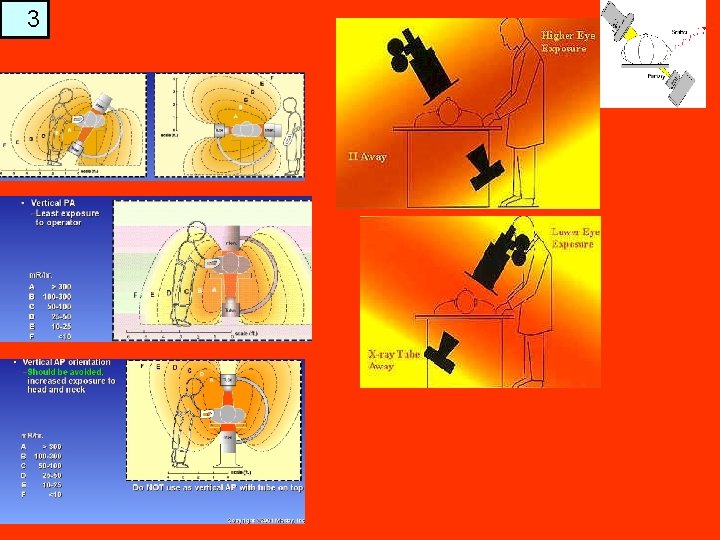
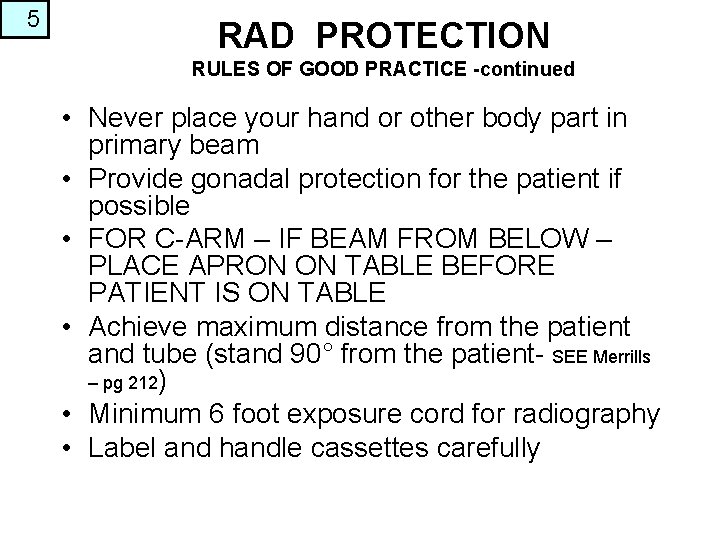
5 RAD PROTECTION RULES OF GOOD PRACTICE -continued • Never place your hand or other body part in primary beam • Provide gonadal protection for the patient if possible • FOR C-ARM – IF BEAM FROM BELOW – PLACE APRON ON TABLE BEFORE PATIENT IS ON TABLE • Achieve maximum distance from the patient and tube (stand 90° from the patient- SEE Merrills – pg 212) • Minimum 6 foot exposure cord for radiography • Label and handle cassettes carefully
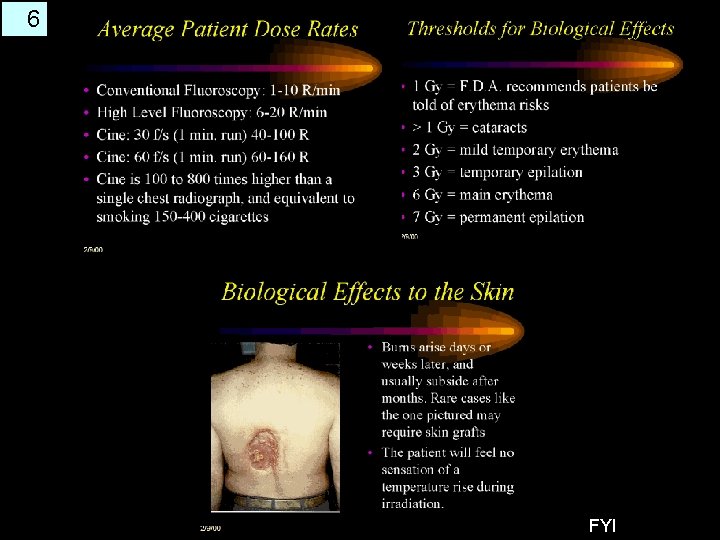
6 FYI
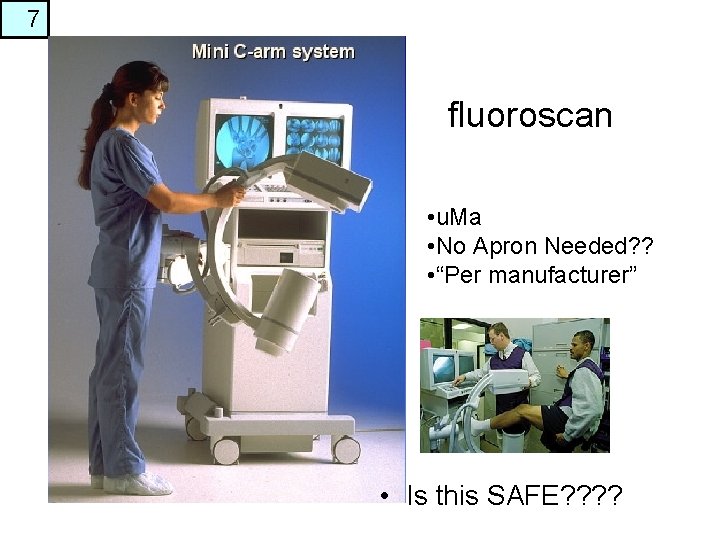
7 fluoroscan • u. Ma • No Apron Needed? ? • “Per manufacturer” • Is this SAFE? ?
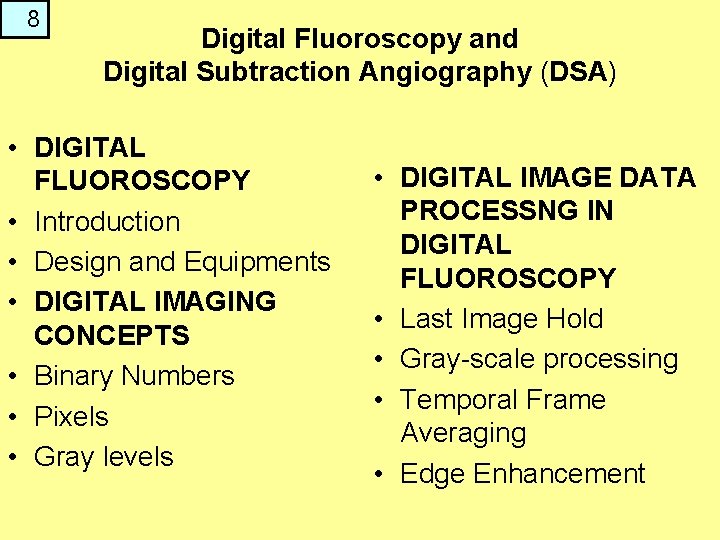
8 Digital Fluoroscopy and Digital Subtraction Angiography (DSA) • DIGITAL FLUOROSCOPY • Introduction • Design and Equipments • DIGITAL IMAGING CONCEPTS • Binary Numbers • Pixels • Gray levels • DIGITAL IMAGE DATA PROCESSNG IN DIGITAL FLUOROSCOPY • Last Image Hold • Gray-scale processing • Temporal Frame Averaging • Edge Enhancement
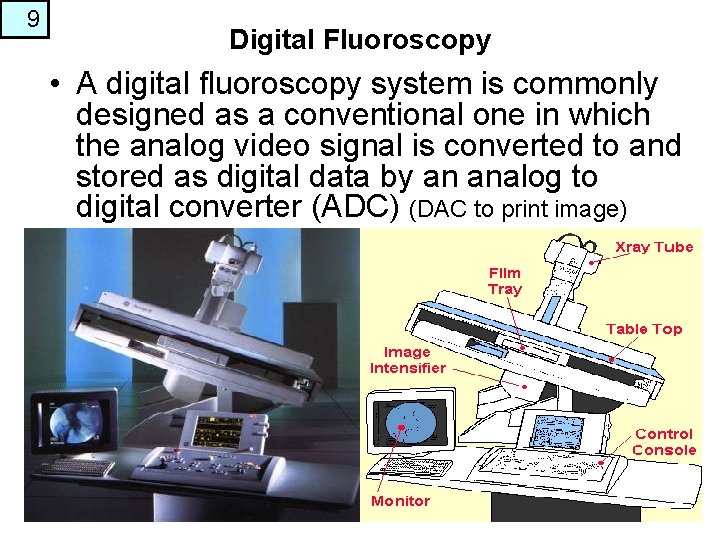
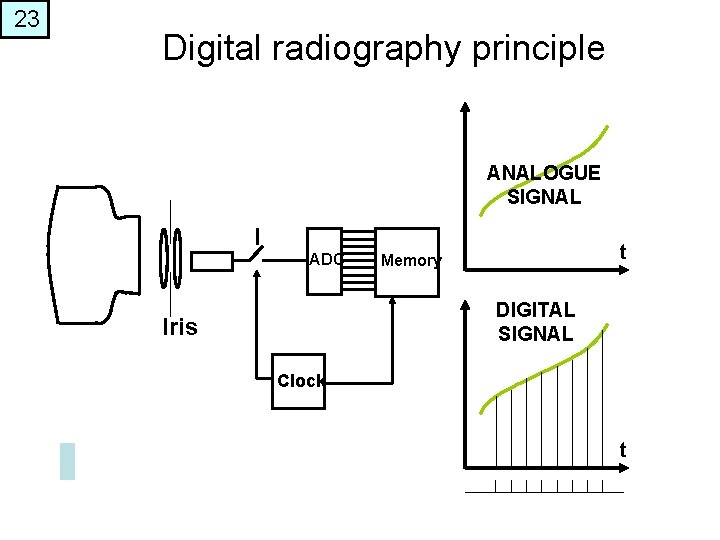
9 Digital Fluoroscopy • A digital fluoroscopy system is commonly designed as a conventional one in which the analog video signal is converted to and stored as digital data by an analog to digital converter (ADC) (DAC to print image)
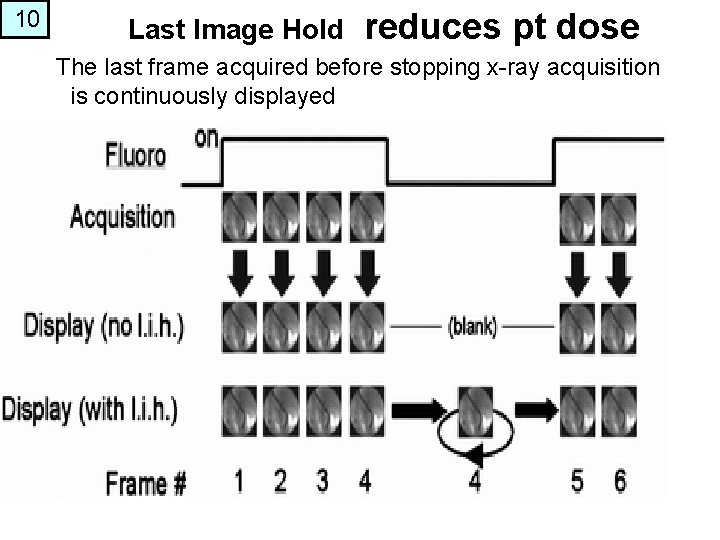
10 Last Image Hold reduces pt dose The last frame acquired before stopping x-ray acquisition is continuously displayed
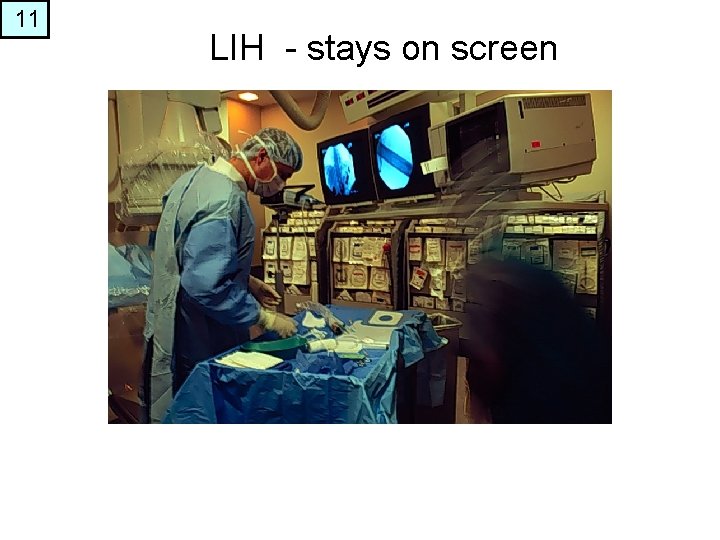
11 LIH - stays on screen
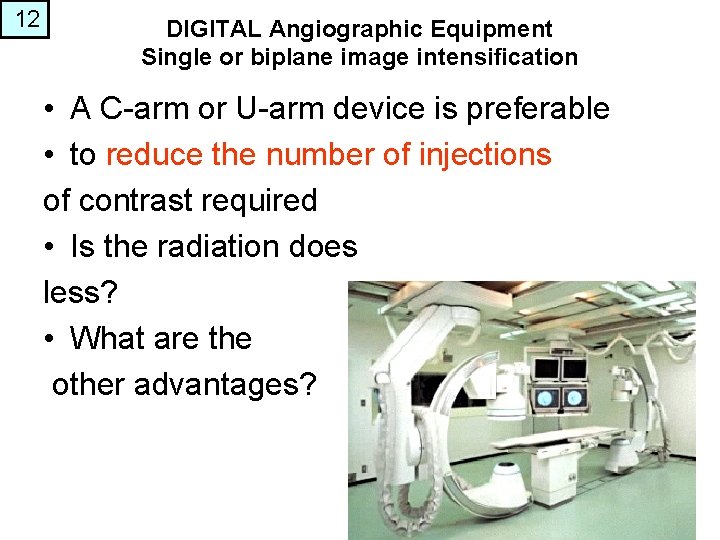
12 DIGITAL Angiographic Equipment Single or biplane image intensification • A C-arm or U-arm device is preferable • to reduce the number of injections of contrast required • Is the radiation does less? • What are the other advantages?
13 Bi Plane Digital Angio Equipment • • Less Time for Procedure Less contrast for patient BUT - Not Less Radiation ALSO Can POST PROCESS And use DSA faster processing time than film No “jammed” films
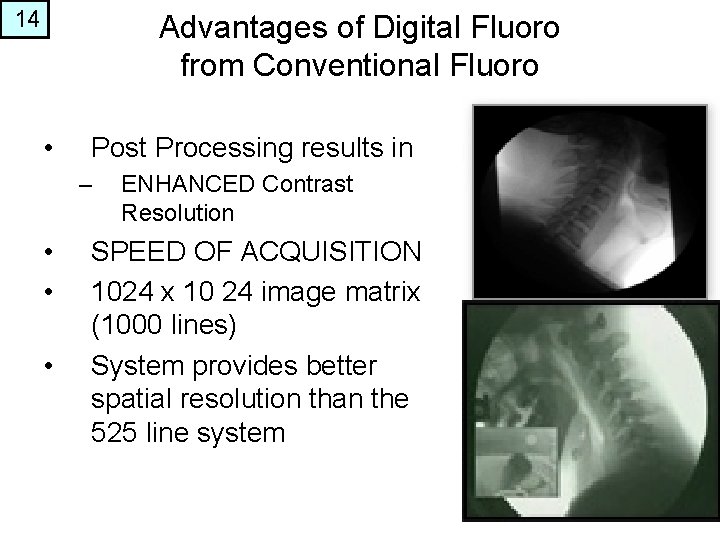
14 Advantages of Digital Fluoro from Conventional Fluoro • Post Processing results in – • • • ENHANCED Contrast Resolution SPEED OF ACQUISITION 1024 x 10 24 image matrix (1000 lines) System provides better spatial resolution than the 525 line system
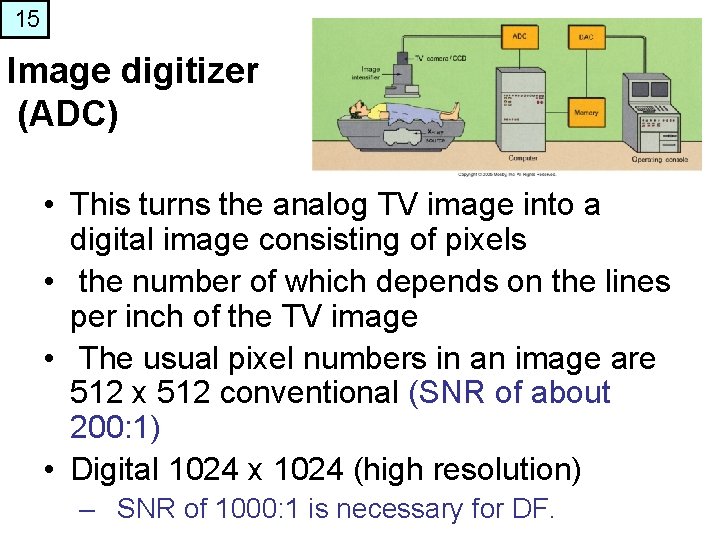
15 Image digitizer (ADC) • This turns the analog TV image into a digital image consisting of pixels • the number of which depends on the lines per inch of the TV image • The usual pixel numbers in an image are 512 x 512 conventional (SNR of about 200: 1) • Digital 1024 x 1024 (high resolution) – SNR of 1000: 1 is necessary for DF.
16 TV progressive scanning • 30 images/sec acquired in the 512× 512 matrix mode • But higher spatial resolution image is required for 1024 × 1024 mode • then only 8 images per second can be acquired. • This limitation on data transfer is imposed by the time required to conduct the enormous quantities of data from one segment of memory to another.
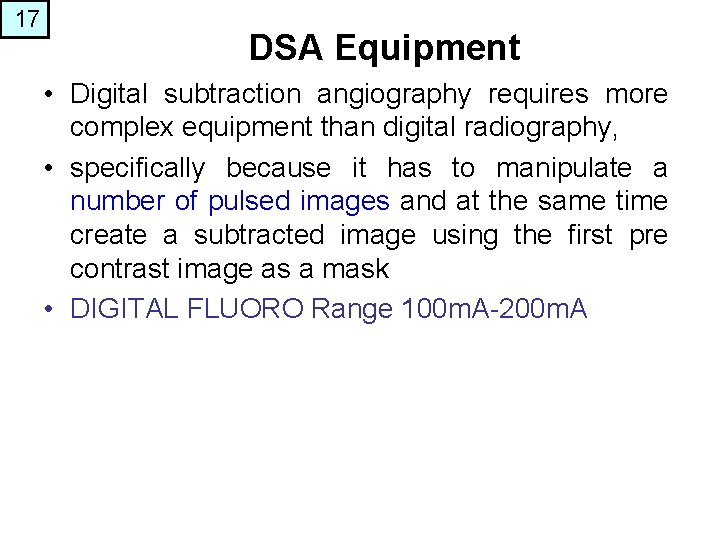
17 DSA Equipment • Digital subtraction angiography requires more complex equipment than digital radiography, • specifically because it has to manipulate a number of pulsed images and at the same time create a subtracted image using the first pre contrast image as a mask • DIGITAL FLUORO Range 100 m. A-200 m. A
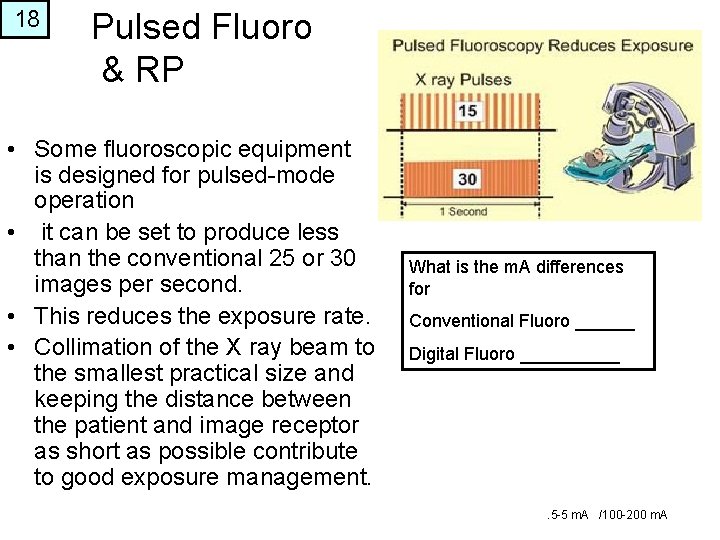
18 Pulsed Fluoro & RP • Some fluoroscopic equipment is designed for pulsed-mode operation • it can be set to produce less than the conventional 25 or 30 images per second. • This reduces the exposure rate. • Collimation of the X ray beam to the smallest practical size and keeping the distance between the patient and image receptor as short as possible contribute to good exposure management. What is the m. A differences for Conventional Fluoro ______ Digital Fluoro _____ . 5 -5 m. A /100 -200 m. A
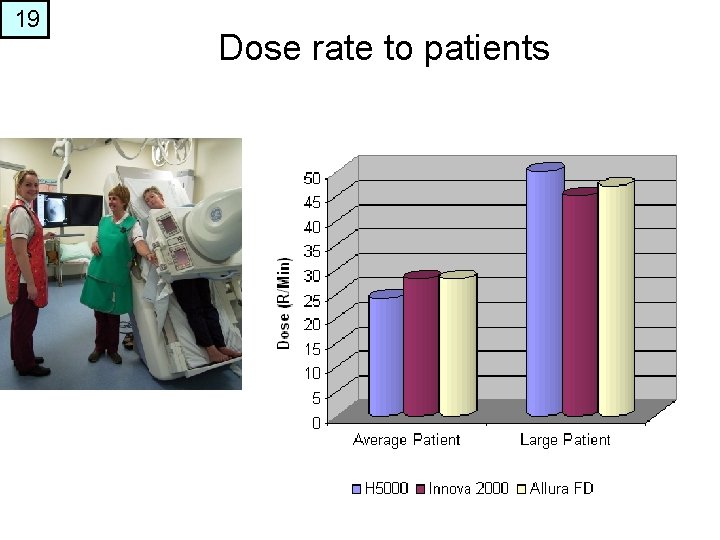
19 Dose rate to patients
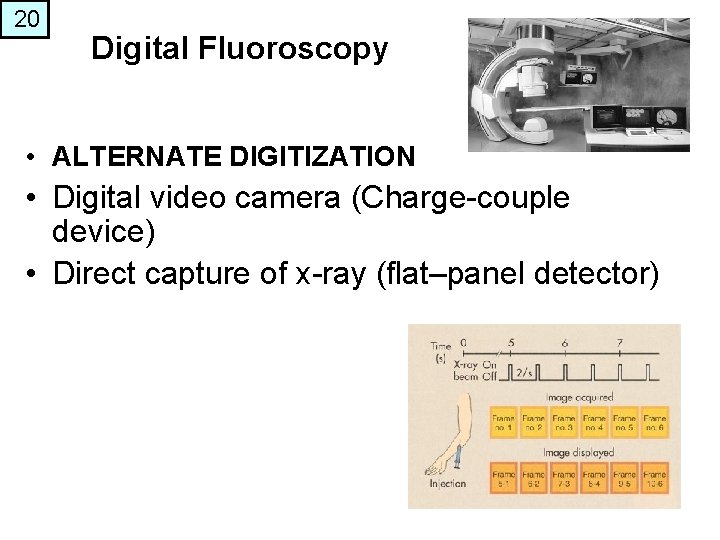
20 Digital Fluoroscopy • ALTERNATE DIGITIZATION • Digital video camera (Charge-couple device) • Direct capture of x-ray (flat–panel detector)
21 DF • • Reduces Pt DOSE Uses High Voltage generator Tube operates in Radiographic Mode So PULSE programming keeps tube from overheating • 1 - 10 second image acquisition • Generator can switch off/on rapidly = – INTERROGATION TIME (ON TIME) – Extinction time ( Switched OFF)
22 Digital Fluoroscopy and Digital Subtraction Angiography (DSA) • DIGITAL IMAGE DATA PROCESSNG IN DIGITAL FLUOROSCOPY • Last Image Hold • Gray-scale processing • Temporal Frame Averaging • Edge Enhancement • MORE LINEAR RESPONSE than F/S
23 Digital radiography principle ANALOGUE SIGNAL I ADC t Memory DIGITAL SIGNAL Iris Clock t
24 Digital Fluoroscopy- CCD • Digital video camera (Charge-couple device) • CCD is a solid state device that converts visible light photons to electrons • layer of cyrstalline silicon – e’s • The electron signal is read pixel by pixel and an image is formed Fast – very little lag time • First used by Military
25 Digital Fluoroscopy • Use CCD to generate electronic signal • Signal is sent to ADC • Allows for post processing and electronic storage and distribution • BETTER RESOLUTION WITH DIGITAL UNITS
26 Video Camera Charged Coupled Devices (CCD) • Operate at lower voltages than video tubes • More durable than video tubes • Semiconducting device • Emits electrons in proportion to amount of light striking photoelectric cathode • Fast discharge eliminates lag
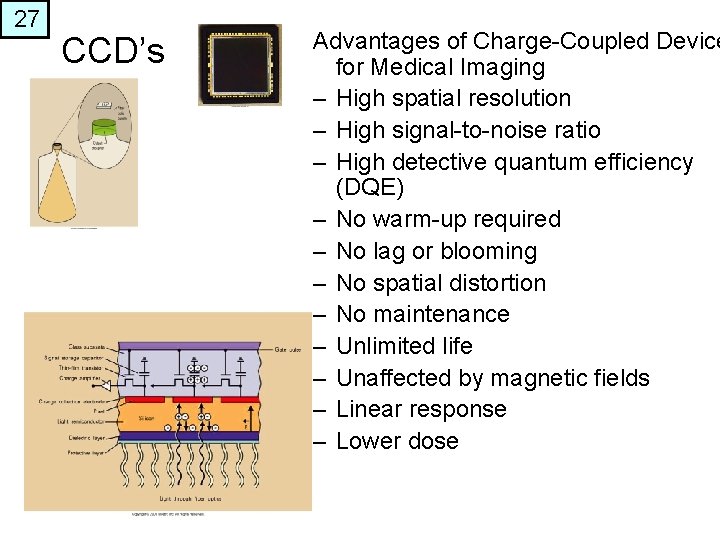
27 CCD’s Advantages of Charge-Coupled Device for Medical Imaging – High spatial resolution – High signal-to-noise ratio – High detective quantum efficiency (DQE) – No warm-up required – No lag or blooming – No spatial distortion – No maintenance – Unlimited life – Unaffected by magnetic fields – Linear response – Lower dose
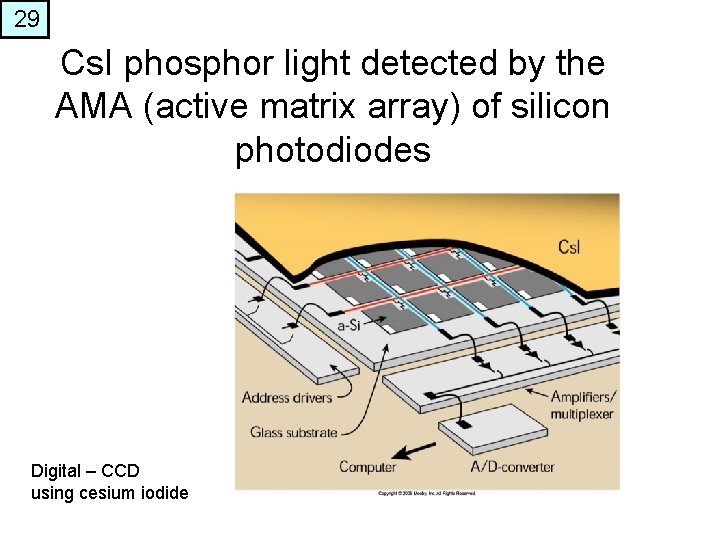
28 Newer Digital Fluoroscopy • Image intensifier output screen coupled to TFTs • TFT photodiodes are connected to each pixel element • Resolution limited in favor of radiation exposure concerns • Direct capture of x-ray (flat–panel detector) asilicon a-selenium. Exit x-rays interact with Cs. I scintillation phosphor to produce light • The light interact with the a-Si to produce a signal • The TFT stores the signal until readout, one pixel at a time
29 Cs. I phosphor light detected by the AMA (active matrix array) of silicon photodiodes Digital – CCD using cesium iodide
30 Direct or Indirect Capture TFT • IN -DIRECT – Cs. I phoshor coated on a-Si photodiode = light when exposed • High DQE = lower dose • DIRECT - a- Se (selenium) creates electron holes – no light spread = better spatial resolution
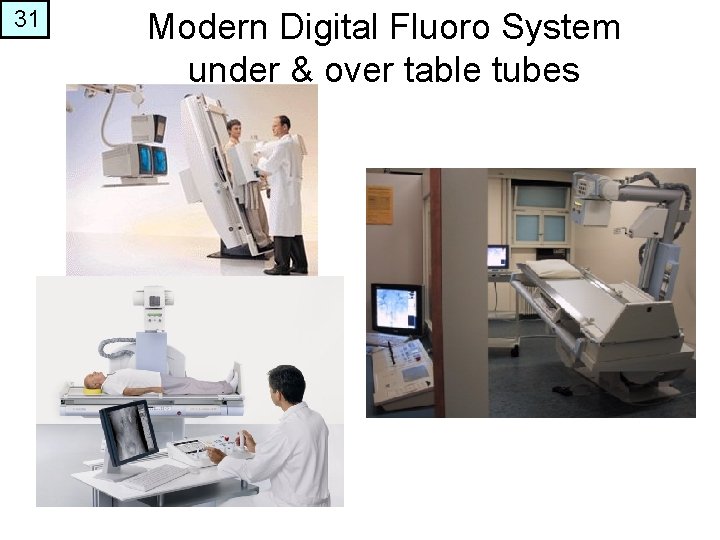
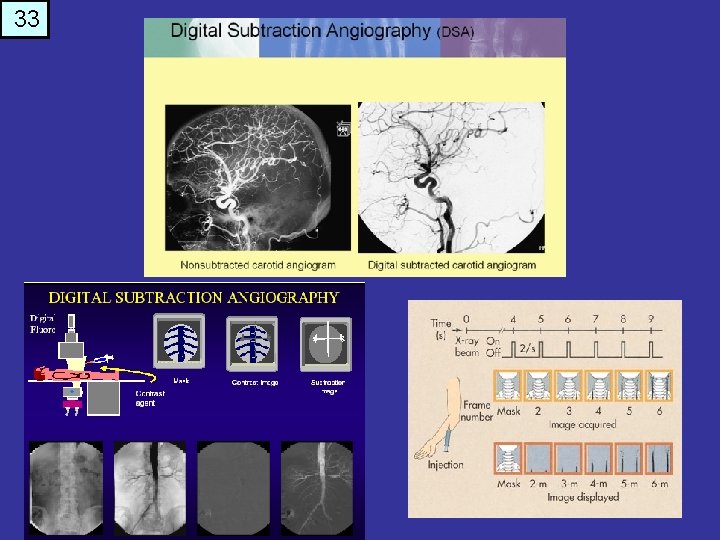
31 Modern Digital Fluoro System under & over table tubes
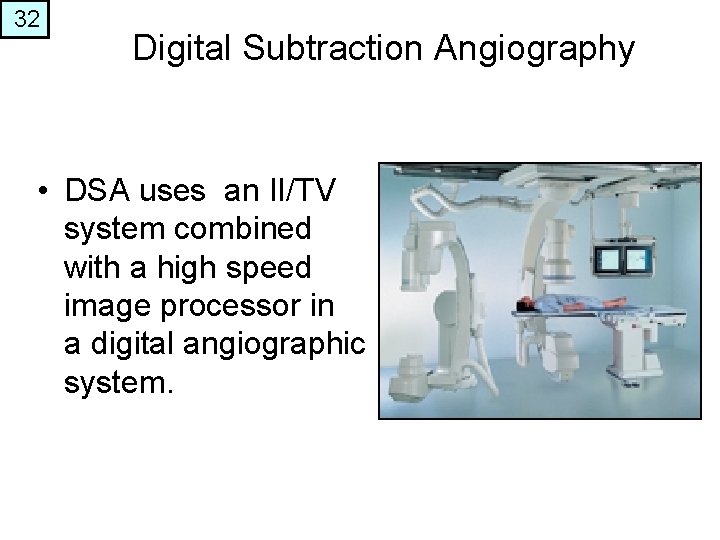
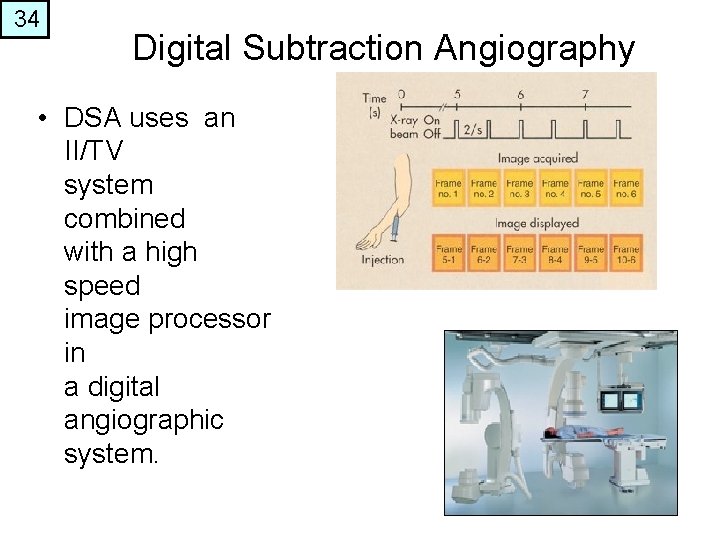
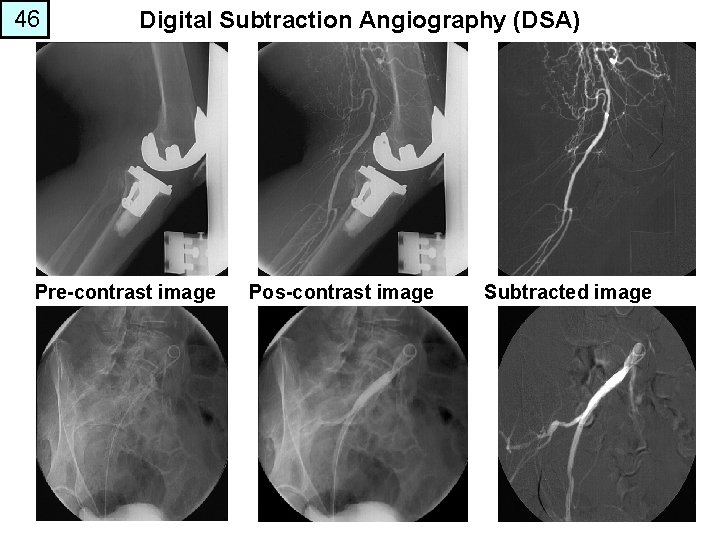
32 Digital Subtraction Angiography • DSA uses an II/TV system combined with a high speed image processor in a digital angiographic system.
33
34 Digital Subtraction Angiography • DSA uses an II/TV system combined with a high speed image processor in a digital angiographic system.
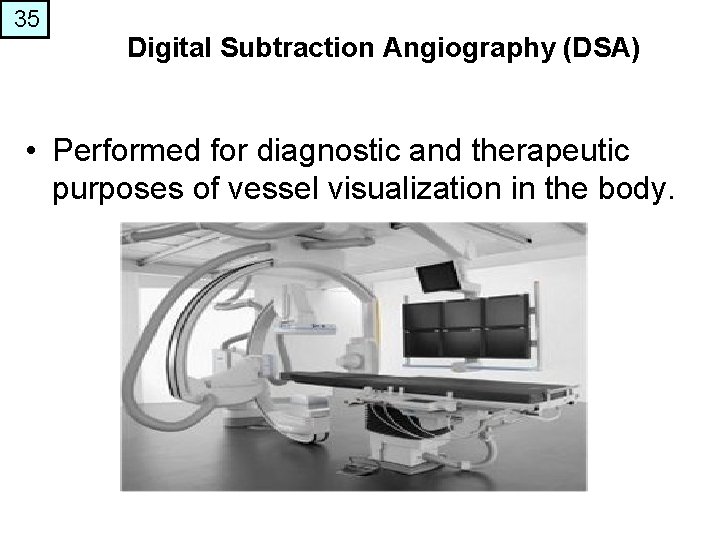
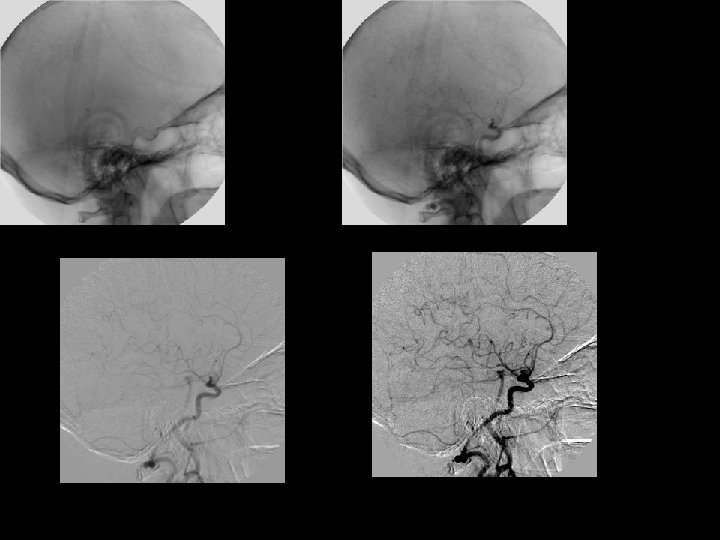
35 Digital Subtraction Angiography (DSA) • Performed for diagnostic and therapeutic purposes of vessel visualization in the body.
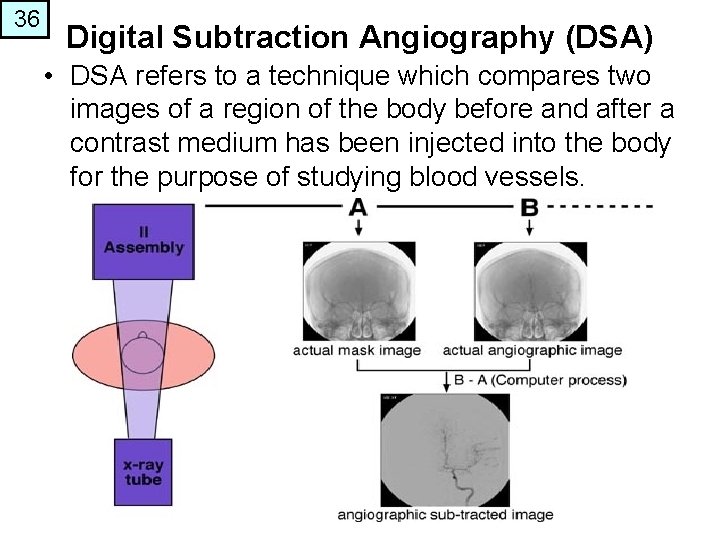
36 Digital Subtraction Angiography (DSA) • DSA refers to a technique which compares two images of a region of the body before and after a contrast medium has been injected into the body for the purpose of studying blood vessels.
37
38 Digital Imaging Concepts • FUNDAMENTALS • Binary numbers • Pixels • Gray levels
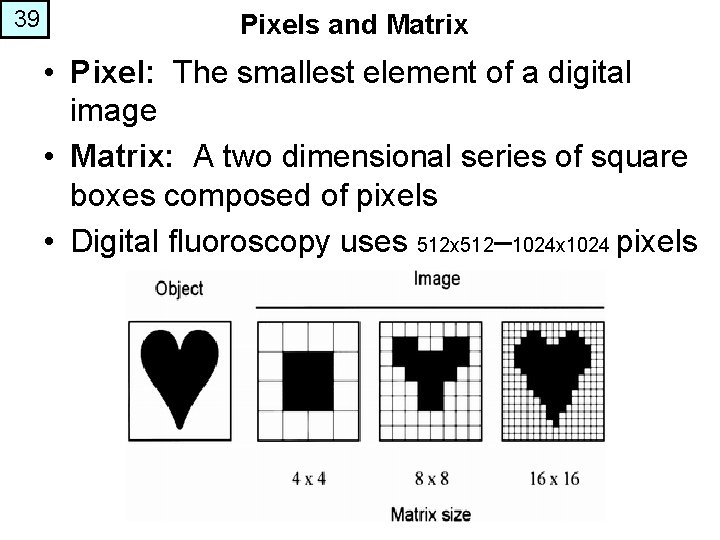
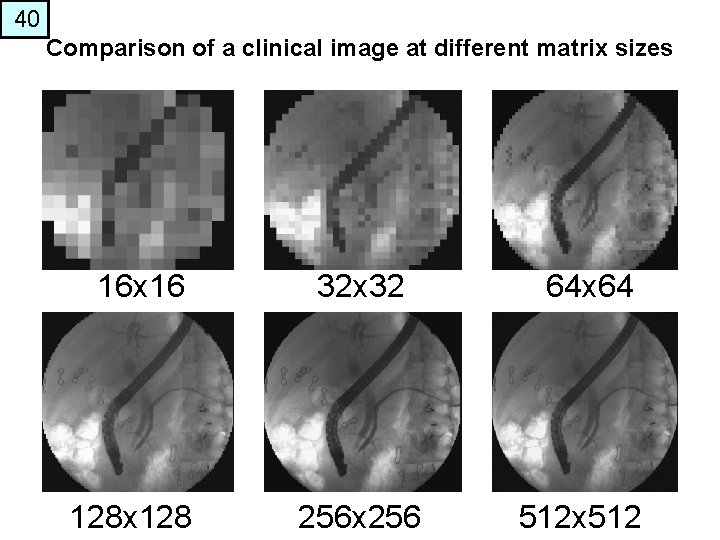
39 Pixels and Matrix • Pixel: The smallest element of a digital image • Matrix: A two dimensional series of square boxes composed of pixels • Digital fluoroscopy uses 512 x 512– 1024 x 1024 pixels
40 Comparison of a clinical image at different matrix sizes 16 x 16 32 x 32 64 x 64 128 x 128 256 x 256 512 x 512
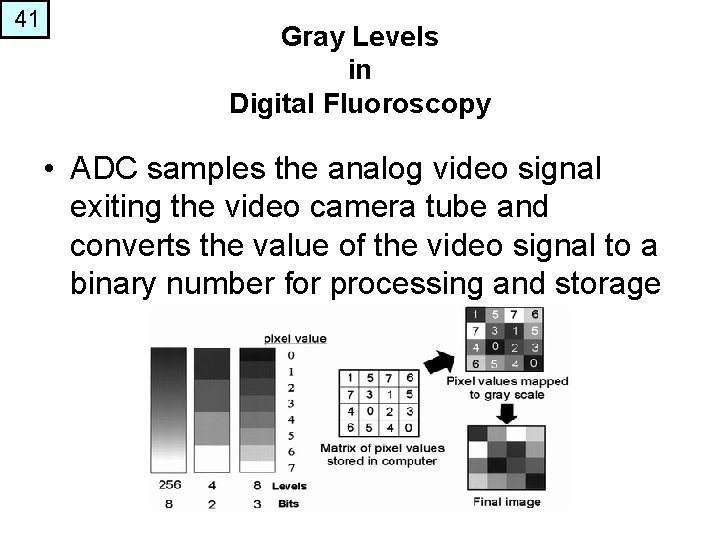
41 Gray Levels in Digital Fluoroscopy • ADC samples the analog video signal exiting the video camera tube and converts the value of the video signal to a binary number for processing and storage
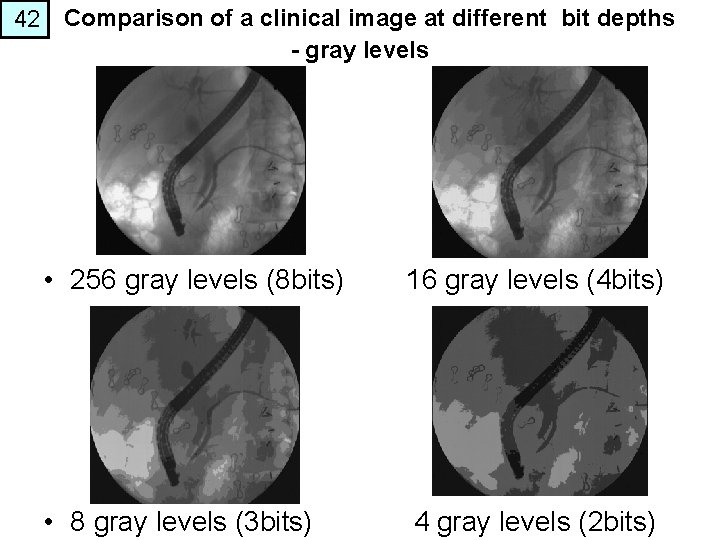
42 Comparison of a clinical image at different bit depths - gray levels • 256 gray levels (8 bits) 16 gray levels (4 bits) • 8 gray levels (3 bits) 4 gray levels (2 bits)
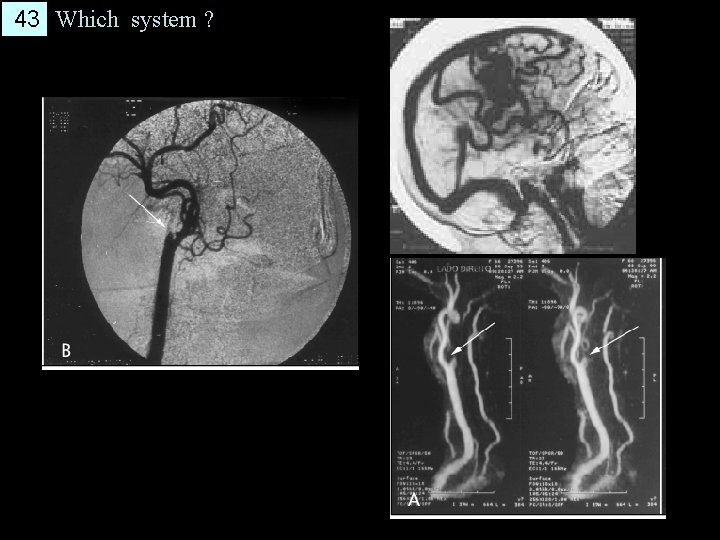
43 Which system ?
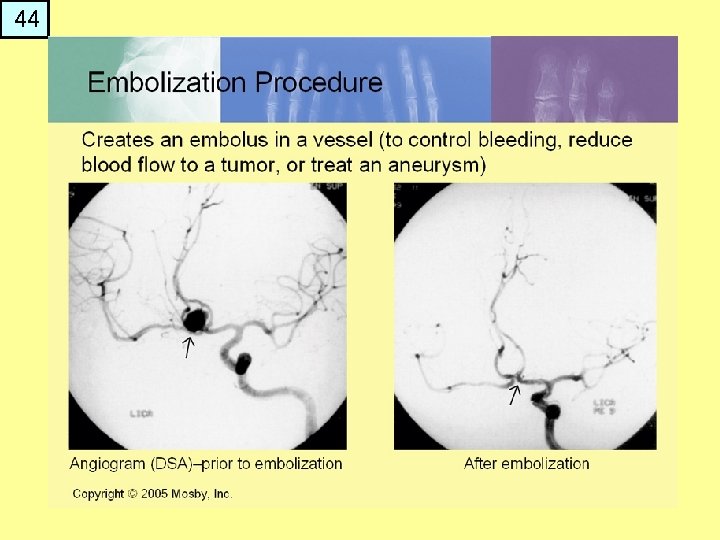
44
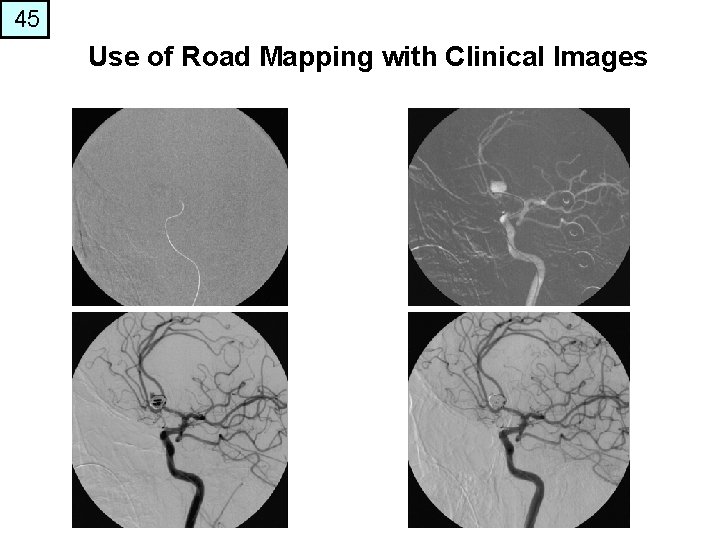
45 Use of Road Mapping with Clinical Images • .
46 Digital Subtraction Angiography (DSA) Pre-contrast image Pos-contrast image Subtracted image
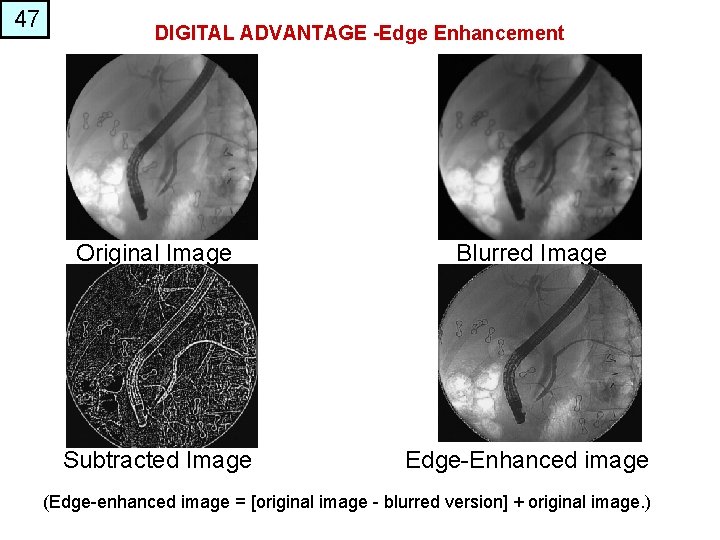
47 DIGITAL ADVANTAGE -Edge Enhancement Original Image Blurred Image Subtracted Image Edge-Enhanced image (Edge-enhanced image = [original image - blurred version] + original image. )
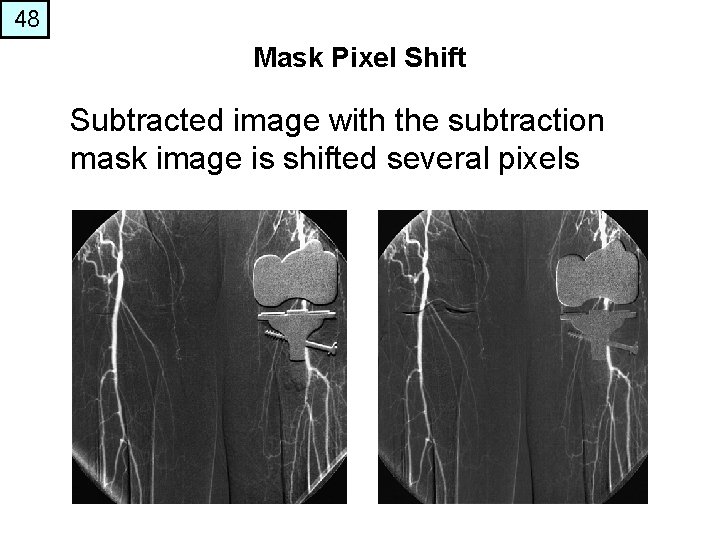
48 Mask Pixel Shift Subtracted image with the subtraction mask image is shifted several pixels
49 DSA • MISREGISTRATION – CAUSED BY PATIENT MOTION – CAUSES BLURRING OF IMAGE • RE-REGISTATION MAY BE ABLE TO FIX THIS MY SHIFTING PIXELS • SEE PG 416 Bushong
50 CINE Equipment • Cine radiography. • Fluoroscopy unit with TV monitor: • Single or biplane fluoroscopy units are available. • Video equipment – DIGITAL RECORDING • Other image recording devices: Images can be acquired and stored in a digital format (postprocessing). This is the fundamental principle of DSA.
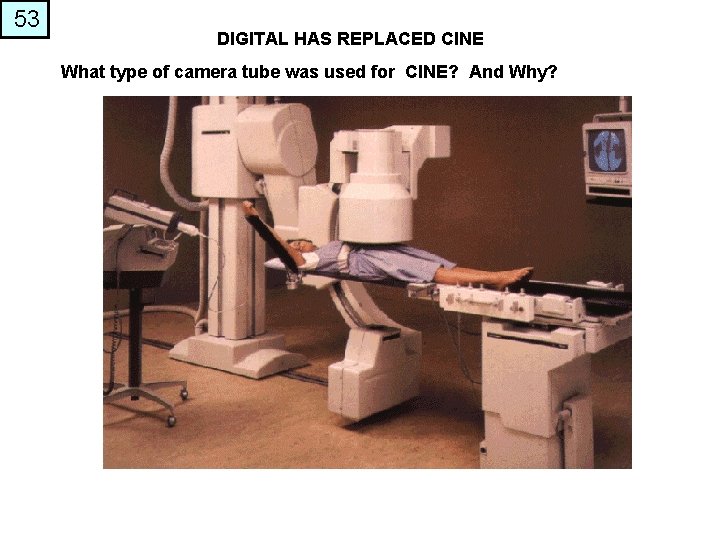
51 Cinefluorgraphy aka CINE • • 35 or 16 mm roll film (movie film) 35 mm ↑ patient dose / 16 mm – higher quality images produced 30 f/sec in US – (60 frames / sec) • THIS MODALITY = HIGHEST PATIENT DOSE (10 X greater than fluoro) • (VS SINGLE EX DOSE IS ↓)
52 Cine • Cinefluorography is used most often in cardiology and neuroradiology. • The procedure uses a movie camera to record the image from the image intensifier. • These units cause the greatest patient doses of all diagnostic • Patient exposure can be minimized in radiographic procedures, although they provide very a number of ways. high image quality. The most obvious • The high patient dose results means of limiting from the length of the exposure is to limit procedure and relatively high the time the beam is inherent dose rate. on. • For this reason special care • CINE - 2 m. R per must be taken to ensure that patients are exposed at frame (60 f/sec) minimum acceptable levels. • 400 mr per “look”
53 DIGITAL HAS REPLACED CINE What type of camera tube was used for CINE? And Why?
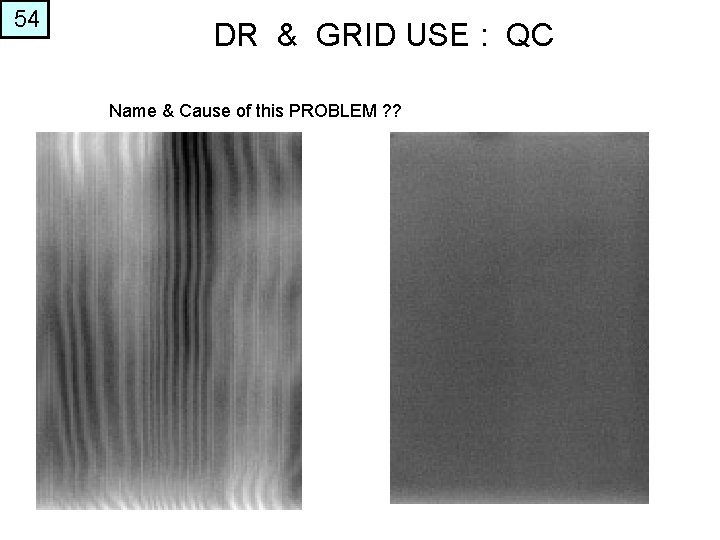
54 DR & GRID USE : QC Name & Cause of this PROBLEM ? ?