
1 Differentiator Course Fundamentals of Biomedical Engineering Presenter
1 Differentiator Course: Fundamentals of Biomedical Engineering Presenter: Mahyar Bolhassani October 2019
Types of Differentiators 1 2 2 Passive differentiators ü RC circuits Active differentiators: Op-amp, transistors… ühigher output voltage ümuch lower output resistance
3 What is a differentiator? Ø One of the fundamental electronic circuits to perform mathematical operation Øproduces a voltage output which is directly proportional to the input voltage’s rate-ofchange with respect to time
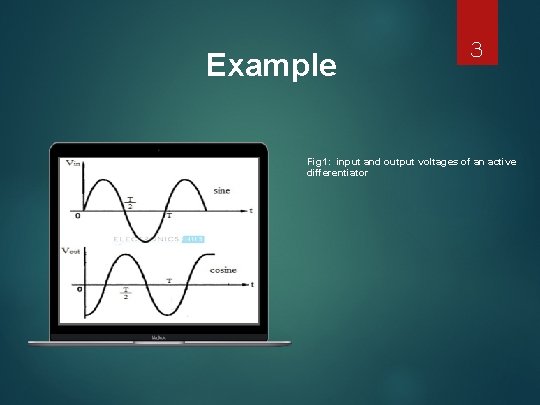
Example 3 Fig 1: input and output voltages of an active differentiator
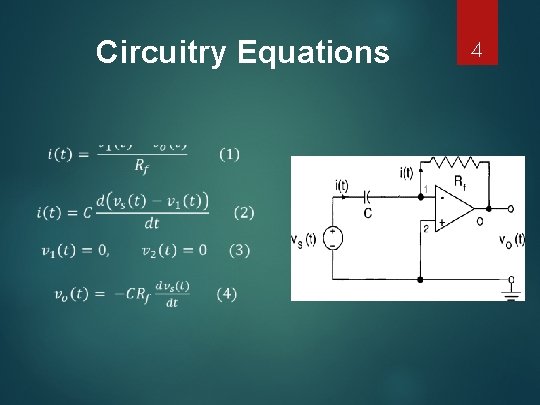
Circuitry Equations 4
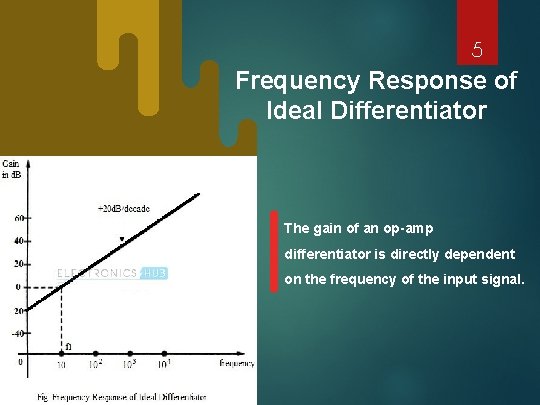
5 Frequency Response of Ideal Differentiator The gain of an op-amp differentiator is directly dependent on the frequency of the input signal.
Instability phenomenon 6 • Input impedance decrease with increasing frequency • Gain increases at high frequencies • Amplifying noise signals at high frequencies • Oscillation occurs
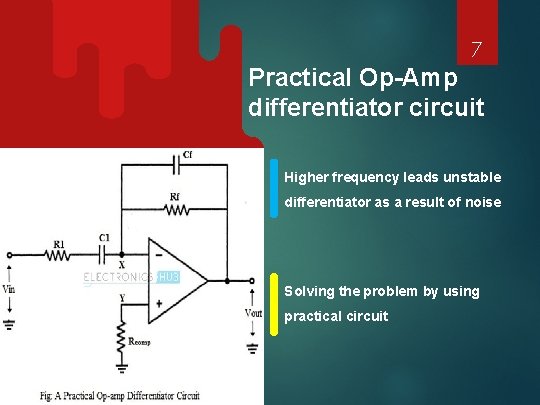
7 Practical Op-Amp differentiator circuit Higher frequency leads unstable differentiator as a result of noise Solving the problem by using practical circuit
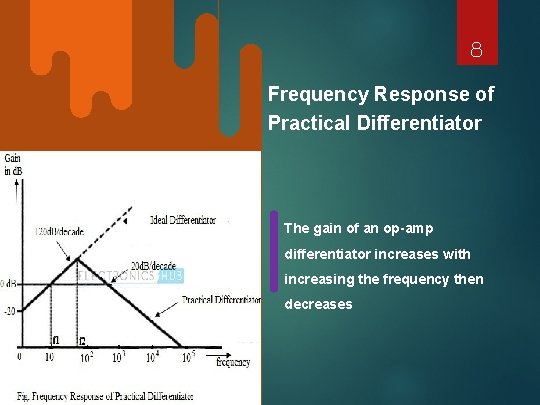
8 Frequency Response of Practical Differentiator The gain of an op-amp differentiator increases with increasing the frequency then decreases
9 Applications of Op-amp Differentiator 01 Differentiators operate as High Pass Filter. 02 Analog PID Controllers, and analog computers
10 References § https: //controlstation. com/pid-control/ § P. B. de Moura. Oliveira***J. Boaventura. Cunha, Blending Artificial Intelligence into PID Controller Design: A Biomedical Engineering Experiment § https: //www. sciencedirect. com/science/article/pii/B 9780080572284 500124 § https: //www. allaboutcircuits. com/textbook/semiconductors/chpt 8/differentiator-integrator-circuits/

11 Thank You
- Slides: 12