
1 Development of Superconducting Tunnel Junction Photon Detector

- Slides: 14
1 Development of Superconducting Tunnel Junction Photon Detector with SOI Preamplifier board to Search for Radiative decays of Cosmic Background Neutrino Tsukuba Global Science Week 2014 Takuya Okudaira 1, Shinhong Kim 1, Yuji Takeuchi 1, Kota Kasahara 1, Ren Senzaki 1, Koya Moriuchi 1 Kenichi Takemasa 1, Kenji Kiuchi 1, Tatsuya Ichimura 1, Masahiro Kanamaru 1, Hirokazu Ikeda 2, Shuji Matsuura 2, Takehiro Wada 2, Hirokazu Ishino 3, Atsuko Kibayashi 3, Satoru Mima 4, Takuo Yoshida 5, Ryuta Hirose 5, Yukihiro Kato 6, Masashi Hazumi 7, Yasuo Arai 7 , Erik Ramberg 8, Jonghee Yoo 8, Mark Kozlovsky 8, Paul Rubinov 8, Dmitri Sergatskov 8, and Soo-Bong Kim 9 University of Tsukuba 1, JAXA/ISAS 2, Okayama University 3, RIKEN 4 University of Fukui 5, Kinki University 6, KEK 7 , Fermilab 8, Seoul National University 9
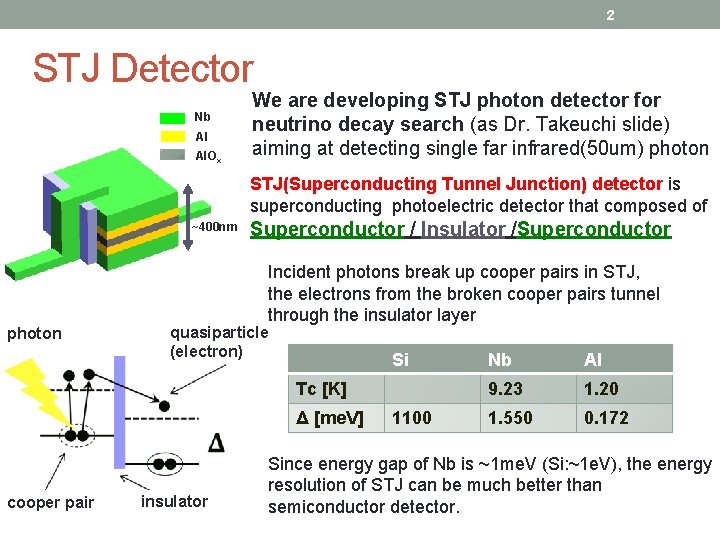
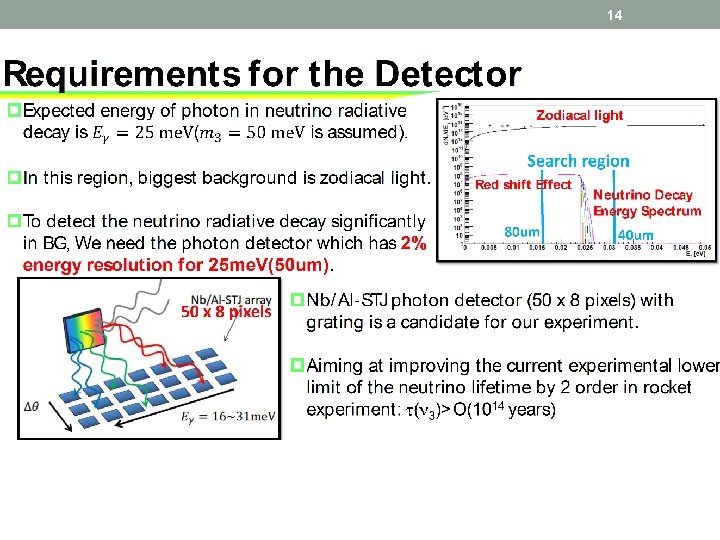
2 STJ Detector Nb Al Al. Ox We are developing STJ photon detector for neutrino decay search (as Dr. Takeuchi slide) aiming at detecting single far infrared(50 um) photon STJ(Superconducting Tunnel Junction) detector is superconducting photoelectric detector that composed of ~400 nm photon Superconductor / Insulator /Superconductor Incident photons break up cooper pairs in STJ, the electrons from the broken cooper pairs tunnel through the insulator layer quasiparticle (electron) Si Tc [K] Δ [me. V] cooper pair insulator 1100 Nb Al 9. 23 1. 20 1. 550 0. 172 Since energy gap of Nb is ~1 me. V (Si: ~1 e. V), the energy resolution of STJ can be much better than semiconductor detector.
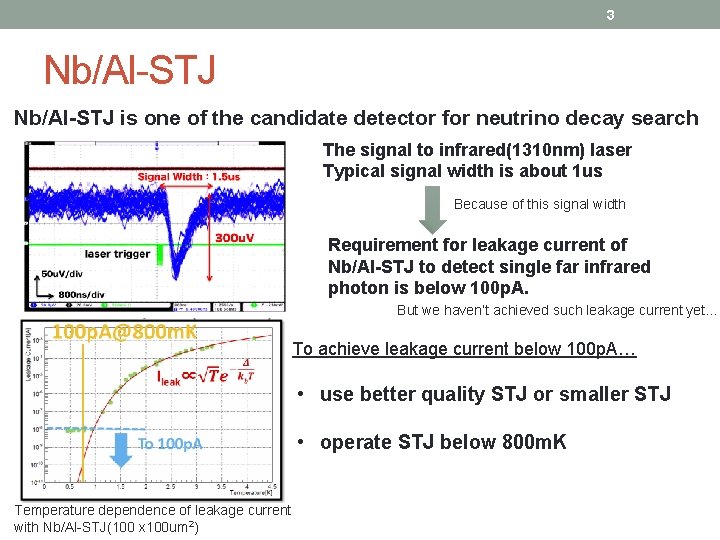
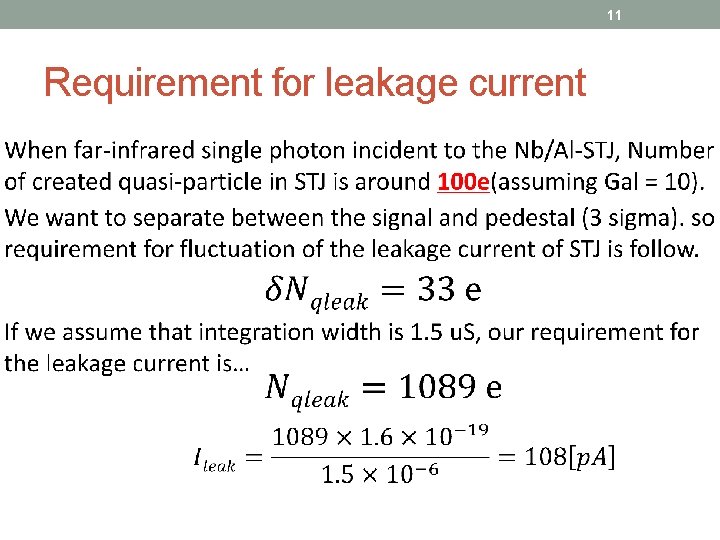
3 Nb/Al-STJ is one of the candidate detector for neutrino decay search The signal to infrared(1310 nm) laser Typical signal width is about 1 us Because of this signal width Requirement for leakage current of Nb/Al-STJ to detect single far infrared photon is below 100 p. A. But we haven’t achieved such leakage current yet… To achieve leakage current below 100 p. A… • use better quality STJ or smaller STJ • operate STJ below 800 m. K Temperature dependence of leakage current with Nb/Al-STJ(100 x 100 um 2)
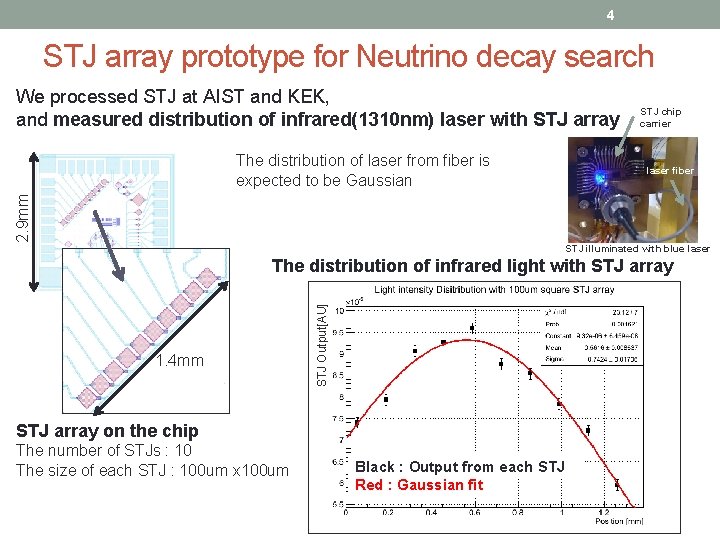
4 STJ array prototype for Neutrino decay search We processed STJ at AIST and KEK, and measured distribution of infrared(1310 nm) laser with STJ array laser fiber 2. 9 mm The distribution of laser from fiber is expected to be Gaussian STJ chip carrier STJ illuminated with blue laser 1. 4 mm STJ Output[AU] The distribution of infrared light with STJ array on the chip The number of STJs : 10 The size of each STJ : 100 um x 100 um Black : Output from each STJ Red : Gaussian fit
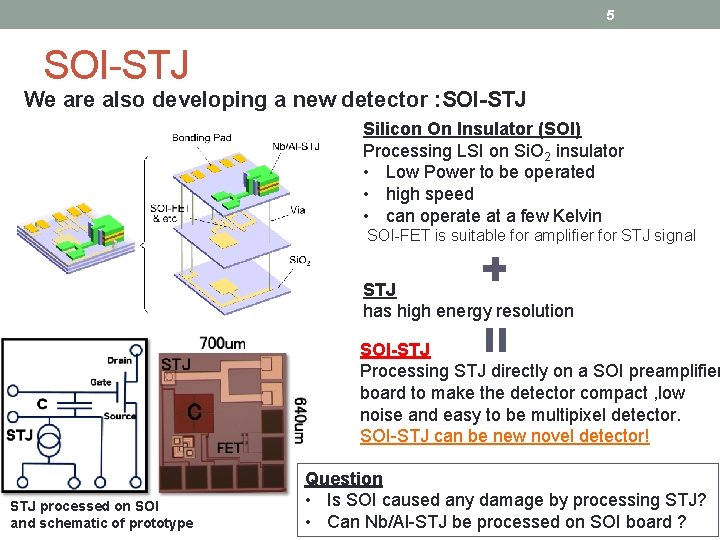
5 SOI-STJ We are also developing a new detector : SOI-STJ Silicon On Insulator (SOI) Processing LSI on Si. O 2 insulator • Low Power to be operated • high speed • can operate at a few Kelvin SOI-FET is suitable for amplifier for STJ signal STJ has high energy resolution SOI-STJ Processing STJ directly on a SOI preamplifier board to make the detector compact , low noise and easy to be multipixel detector. SOI-STJ can be new novel detector! STJ processed on SOI and schematic of prototype Question • Is SOI caused any damage by processing STJ? • Can Nb/Al-STJ be processed on SOI board ?
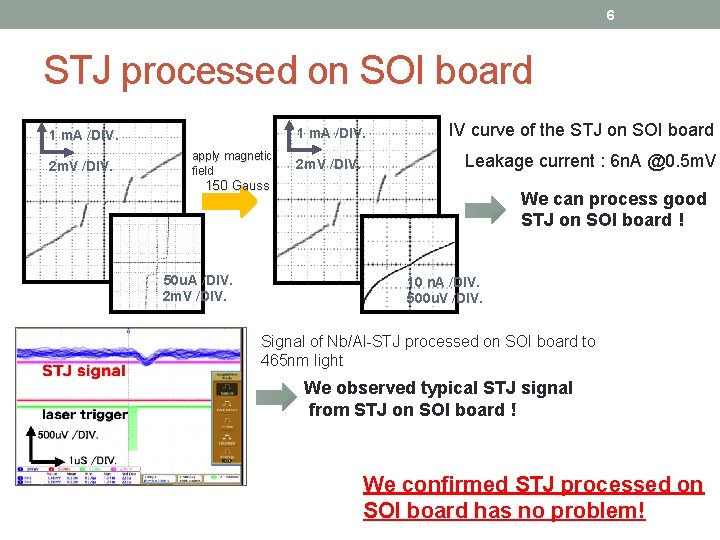
6 STJ processed on SOI board 1 m. A /DIV. 2 m. V /DIV. apply magnetic field 2 m. V /DIV. IV curve of the STJ on SOI board Leakage current : 6 n. A @0. 5 m. V 150 Gauss 50 u. A /DIV. 2 m. V /DIV. We can process good STJ on SOI board! 10 n. A /DIV. 500 u. V /DIV. Signal of Nb/Al-STJ processed on SOI board to 465 nm light We observed typical STJ signal from STJ on SOI board! We confirmed STJ processed on SOI board has no problem!
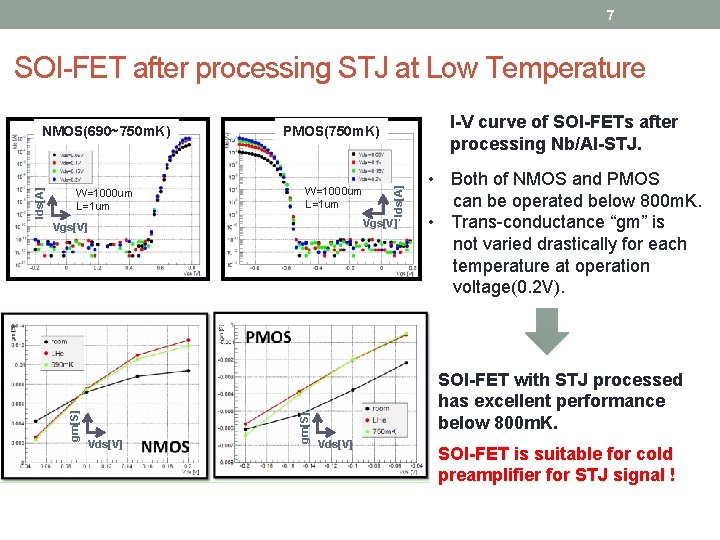
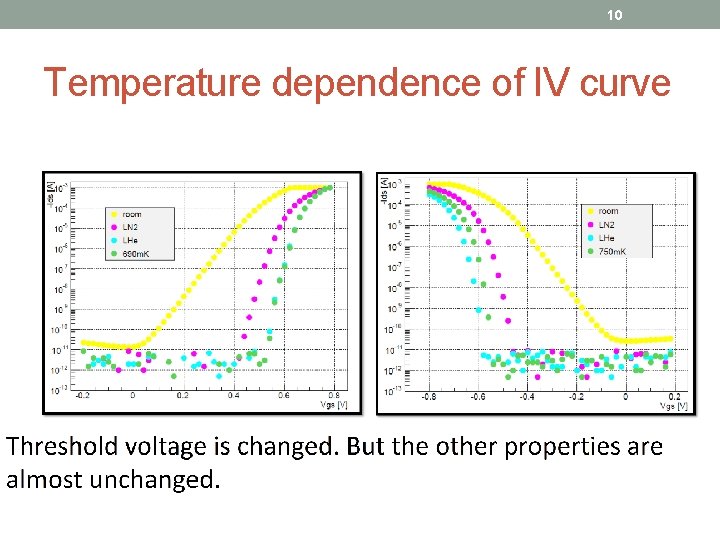
7 SOI-FET after processing STJ at Low Temperature I-V curve of SOI-FETs after processing Nb/Al-STJ. PMOS(750 m. K) W=1000 um L=1 um -Ids[A] W=1000 um L=1 um Vgs[V] Vds[V] gm[S] Vgs[V] gm[S] Ids[A] NMOS(690~750 m. K) • Both of NMOS and PMOS can be operated below 800 m. K. • Trans-conductance “gm” is not varied drastically for each temperature at operation voltage(0. 2 V). SOI-FET with STJ processed has excellent performance below 800 m. K. Vds[V] SOI-FET is suitable for cold preamplifier for STJ signal !
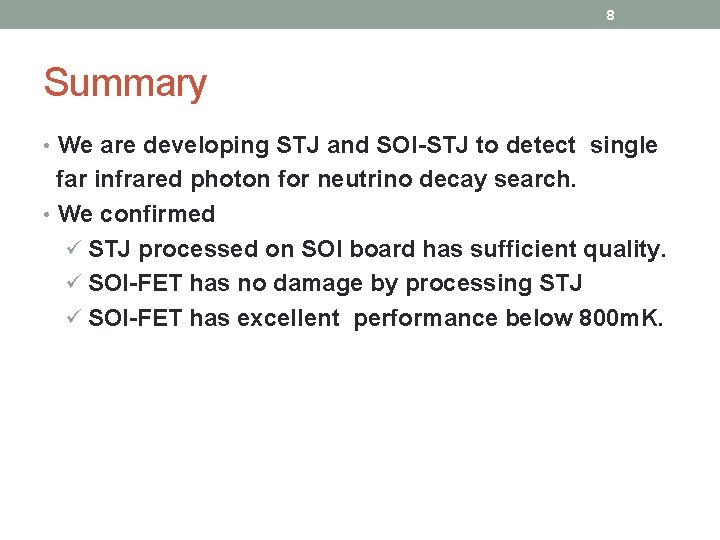
8 Summary • We are developing STJ and SOI-STJ to detect single far infrared photon for neutrino decay search. • We confirmed ü STJ processed on SOI board has sufficient quality. ü SOI-FET has no damage by processing STJ ü SOI-FET has excellent performance below 800 m. K.
9 BUCK UP
10 Temperature dependence of IV curve
11 Requirement for leakage current
12
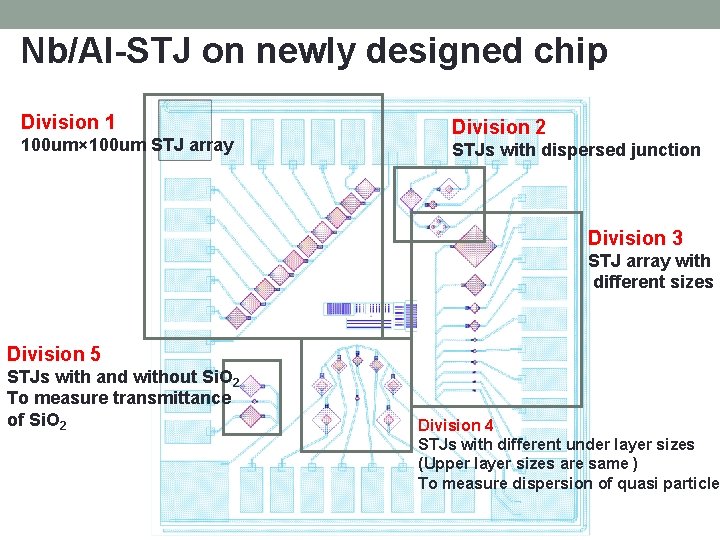
Nb/Al-STJ on newly designed chip Division 1 100 um× 100 um STJ array Division 2 STJs with dispersed junction Division 3 STJ array with different sizes Division 5 STJs with and without Si. O 2 To measure transmittance of Si. O 2 Division 4 STJs with different under layer sizes (Upper layer sizes are same ) To measure dispersion of quasi particle
14