
1 Development of Lithium Batteries for Powering Sensor

1 Development of Lithium Batteries for Powering Sensor Arrays SFR Workshop November 8, 2000 Nelson Chong, James Lim, Jeff Sakamoto and Bruce Dunn Los Angeles, CA 2001 GOAL: To develop a thermally robust inorganic electrolyte and integrate lid to battery encapsulation scheme by 9/30/2001. 11/8/2000
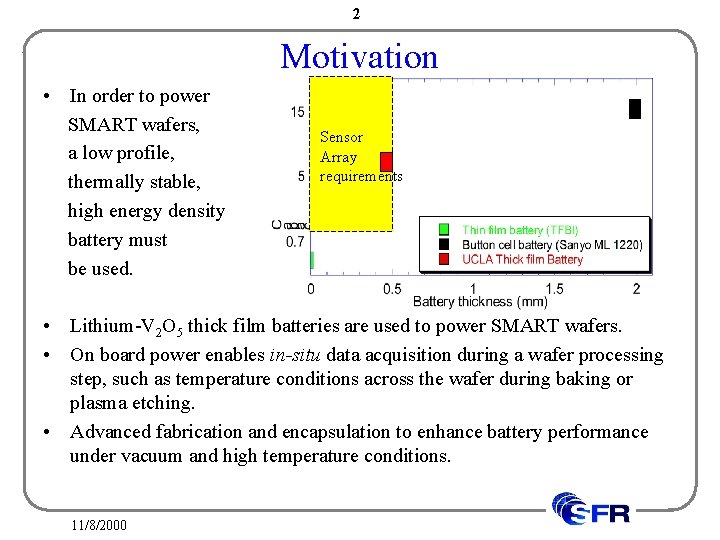
2 Motivation • In order to power SMART wafers, a low profile, thermally stable, high energy density battery must be used. Sensor Array requirements • Lithium-V 2 O 5 thick film batteries are used to power SMART wafers. • On board power enables in-situ data acquisition during a wafer processing step, such as temperature conditions across the wafer during baking or plasma etching. • Advanced fabrication and encapsulation to enhance battery performance under vacuum and high temperature conditions. 11/8/2000
3 11/8/2000
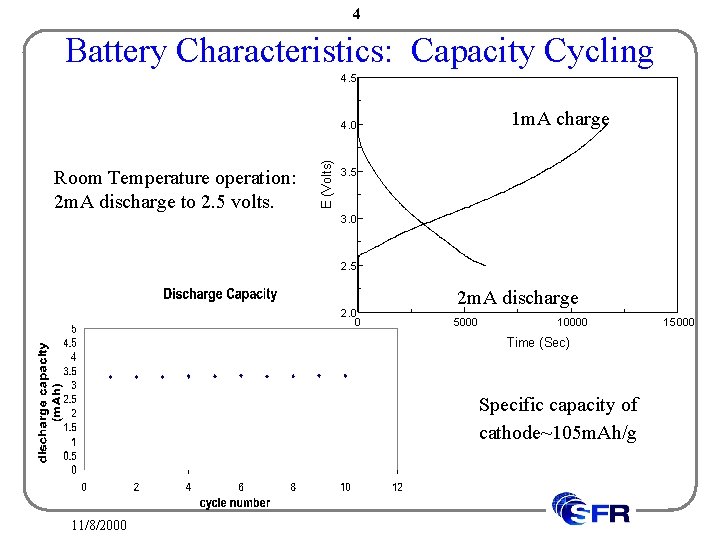
4 Battery Characteristics: Capacity Cycling 4. 5 1 m. A charge Room Temperature operation: 2 m. A discharge to 2. 5 volts. E (Volts) 4. 0 3. 5 3. 0 2. 5 2. 0 0 2 m. A discharge 5000 10000 Time (Sec) Specific capacity of cathode~105 m. Ah/g 11/8/2000 15000
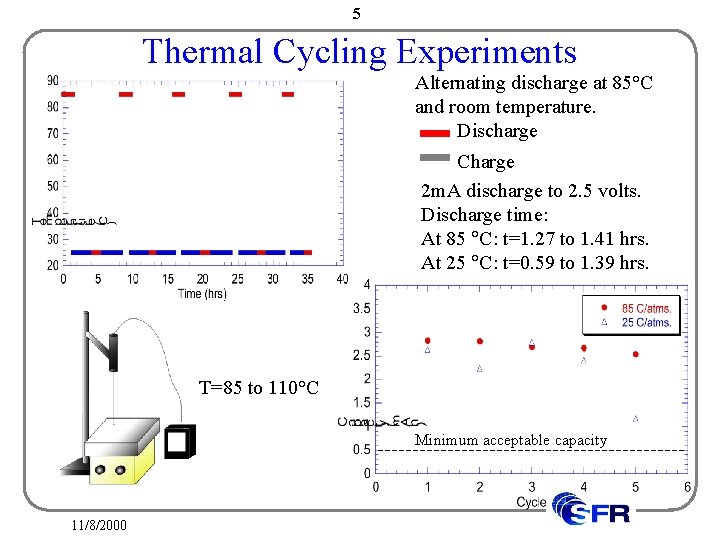
5 Thermal Cycling Experiments Alternating discharge at 85°C and room temperature. Discharge Charge 2 m. A discharge to 2. 5 volts. Discharge time: At 85 C: t=1. 27 to 1. 41 hrs. At 25 C: t=0. 59 to 1. 39 hrs. T=85 to 110°C Minimum acceptable capacity 11/8/2000

6 Battery Encapsulation and Lid Design Encapsulation with 5 minute epoxy Cure time= 5 mins. 11/8/2000 Encapsulation with low viscosity epoxy (EP 30 from Master Bond) Viscosity=400 to 500 cps at room temperature. Cure time=18 to 24 hrs at room temperature
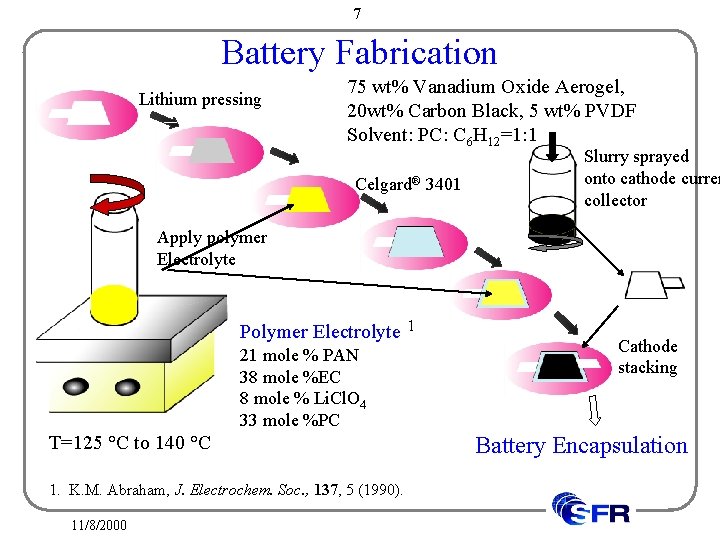
7 Battery Fabrication Lithium pressing 75 wt% Vanadium Oxide Aerogel, 20 wt% Carbon Black, 5 wt% PVDF Solvent: PC: C 6 H 12=1: 1 Celgard® 3401 Slurry sprayed onto cathode curren collector Apply polymer Electrolyte Polymer Electrolyte 21 mole % PAN 38 mole %EC 8 mole % Li. Cl. O 4 33 mole %PC T=125 °C to 140 °C 1. K. M. Abraham, J. Electrochem. Soc. , 137, 5 (1990). 11/8/2000 1 Cathode stacking Battery Encapsulation

8 Inorganic/Organic Electrolyte Fumed Silica R 805 particles/aggregates Electrolyte 1 M Li Imide 0. 5 cc PC 2. 5 cc PEGdm 250 Battery successfully prepared with inorganic/organic Electrolyte (170 m. Ah/g) *Ref. J. Fan, P. Fedkiw J. Electrochem. Soc. Vol. 144, No. 2, Feb. 1997 Thermal stability 137 o. C Thixotropic properties Li+ conduction liquid polymer 11/8/2000 Silica Network van der Waals; electrostatic interactions; hydrogen bonding
9 2002 and 2003 Goals Integrate the inorganic electrolyte into the battery structure. Develop an in-situ lithium formation process by 9/30/2003. Battery operation between room temperature and 150 o. C. Battery survivability to soldering operations by 9/30/2003. 11/8/2000
- Slides: 9