
1 Description of Nonequilibrium evolution of Longrange Interacting
1 Description of Non-equilibrium evolution of Long-range Interacting Systems based on Generalized Entropy Kyoto University Masa-aki SAKAGAMI Collaboration with T. Kaneyama (Kyoto U. ) A. Taruya (RESCEU, Tokyo U. )
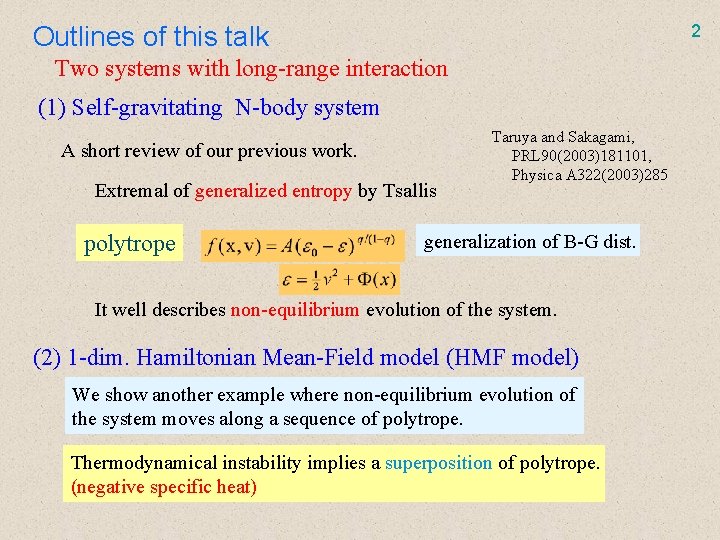
Outlines of this talk 2 Two systems with long-range interaction (1) Self-gravitating N-body system A short review of our previous work. Extremal of generalized entropy by Tsallis polytrope Taruya and Sakagami, PRL 90(2003)181101, Physica A 322(2003)285 generalization of B-G dist. It well describes non-equilibrium evolution of the system. (2) 1 -dim. Hamiltonian Mean-Field model (HMF model) We show another example where non-equilibrium evolution of the system moves along a sequence of polytrope. Thermodynamical instability implies a superposition of polytrope. (negative specific heat)

Self-gravitating N-body System A System with N Particles (stars) (N>>1) Particles interact with Newtonian gravity each other Typical example of a system under long-range force Key word Negative Specific Heat Long-term (thermodynamic) instability Gravothermal instability Antonov 1962 Lynden-Bell & Wood 1968 3
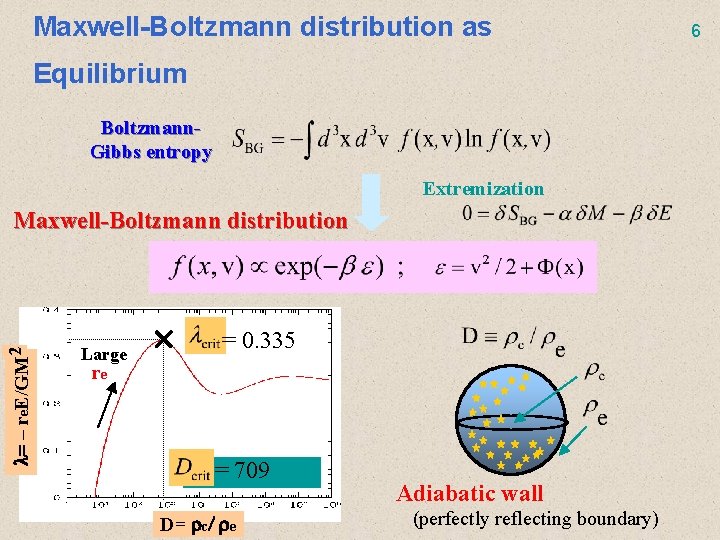
Maxwell-Boltzmann distribution as Equilibrium Boltzmann. Gibbs entropy Extremization l= – re. E/GM 2 Maxwell-Boltzmann distribution Large = 0. 335 re = 709 D= rc/ re Adiabatic wall (perfectly reflecting boundary) 6
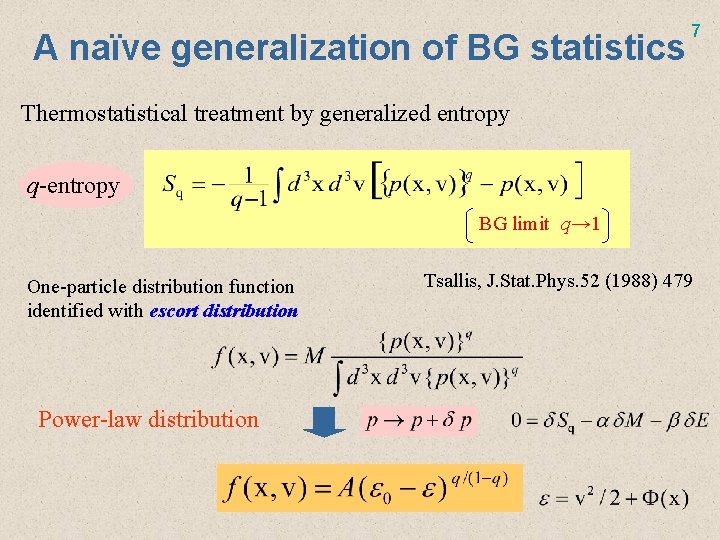
A naïve generalization of BG statistics 7 Thermostatistical treatment by generalized entropy q-entropy BG limit q→ 1 One-particle distribution function identified with escort distribution Power-law distribution Tsallis, J. Stat. Phys. 52 (1988) 479
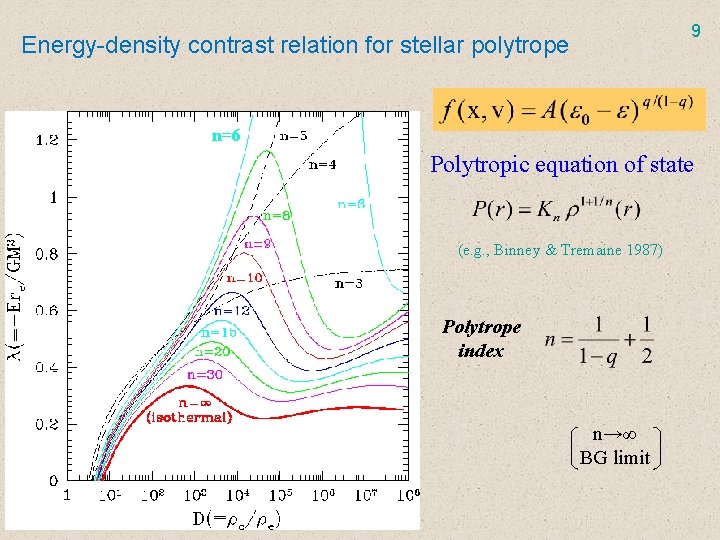
9 Energy-density contrast relation for stellar polytrope n=6 Polytropic equation of state (e. g. , Binney & Tremaine 1987) Polytrope index n→∞ BG limit
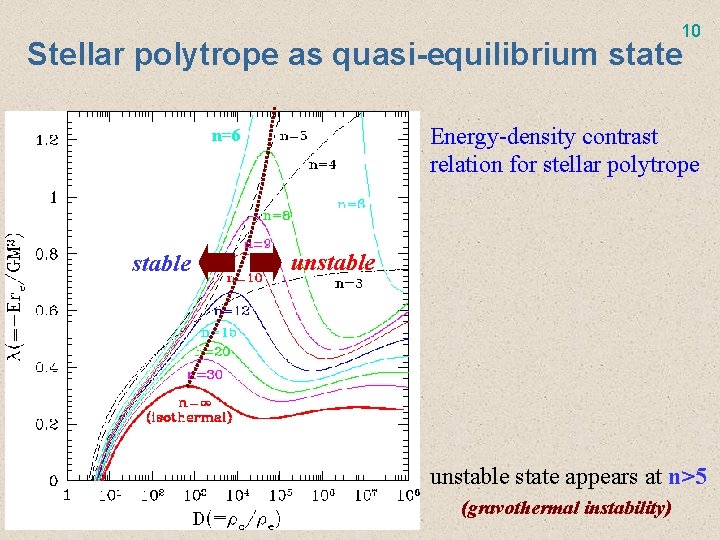
10 Stellar polytrope as quasi-equilibrium state Energy-density contrast relation for stellar polytrope n=6 stable unstable state appears at n>5 (gravothermal instability)
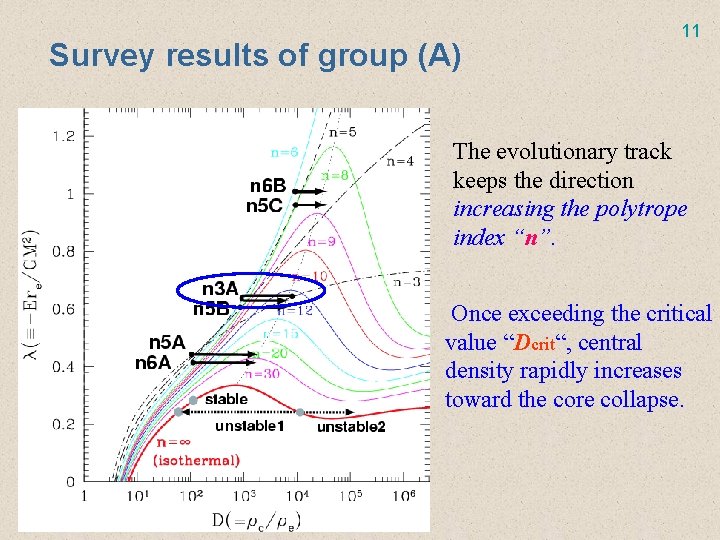
Survey results of group (A) 11 The evolutionary track keeps the direction increasing the polytrope index “n”. Once exceeding the critical value “Dcrit“, central density rapidly increases toward the core collapse.
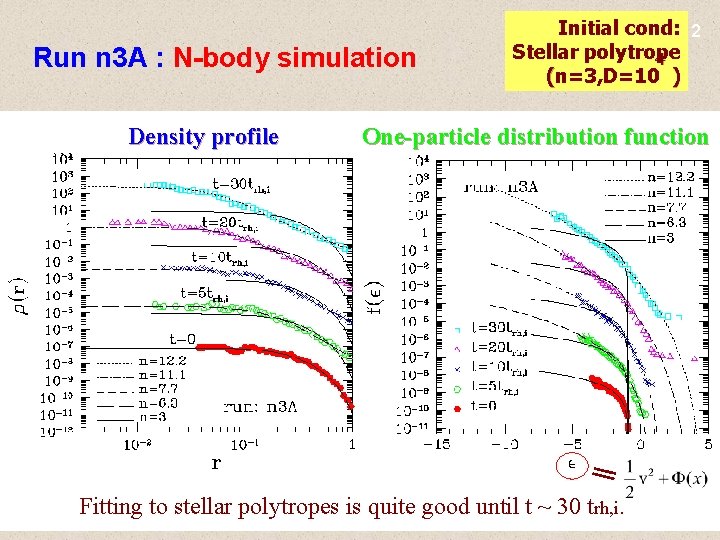
Run n 3 A : N-body simulation Density profile Initial cond: 12 Stellar polytrope 4 (n=3, D=10 ) One-particle distribution function Fitting to stellar polytropes is quite good until t ~ 30 trh, i.
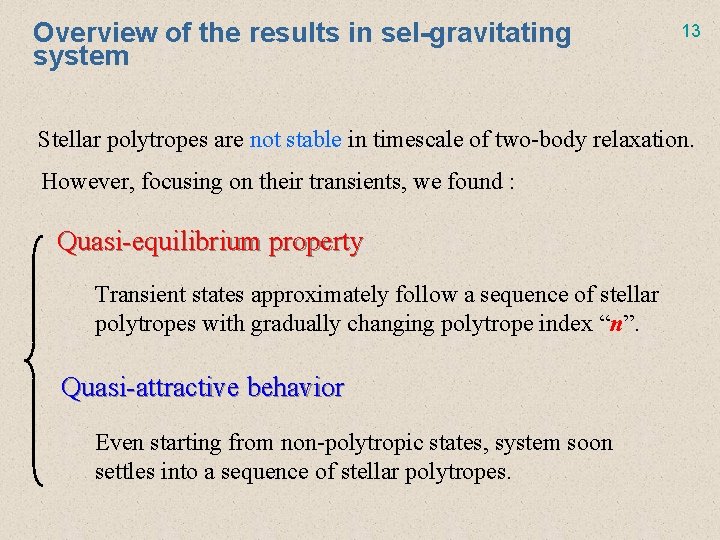
Overview of the results in sel-gravitating system 13 Stellar polytropes are not stable in timescale of two-body relaxation. However, focusing on their transients, we found : Quasi-equilibrium property Transient states approximately follow a sequence of stellar polytropes with gradually changing polytrope index “n”. Quasi-attractive behavior Even starting from non-polytropic states, system soon settles into a sequence of stellar polytropes.
14 Application of generalized entropy and polytrope to another long-range interacting system, 1 -dimensional Hamiltonian mean-field model 1 D-HMF model Antoni and Ruffo, PRE 52(1995)2361
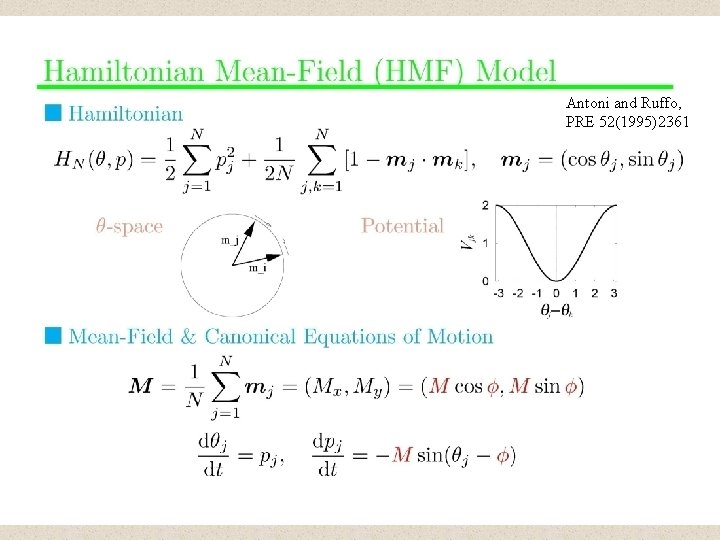
15 Antoni and Ruffo, PRE 52(1995)2361
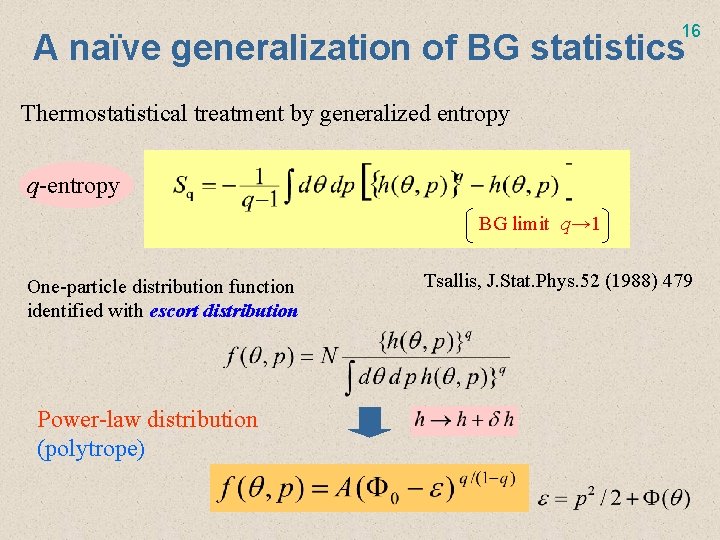
16 A naïve generalization of BG statistics Thermostatistical treatment by generalized entropy q-entropy BG limit q→ 1 One-particle distribution function identified with escort distribution Power-law distribution (polytrope) Tsallis, J. Stat. Phys. 52 (1988) 479
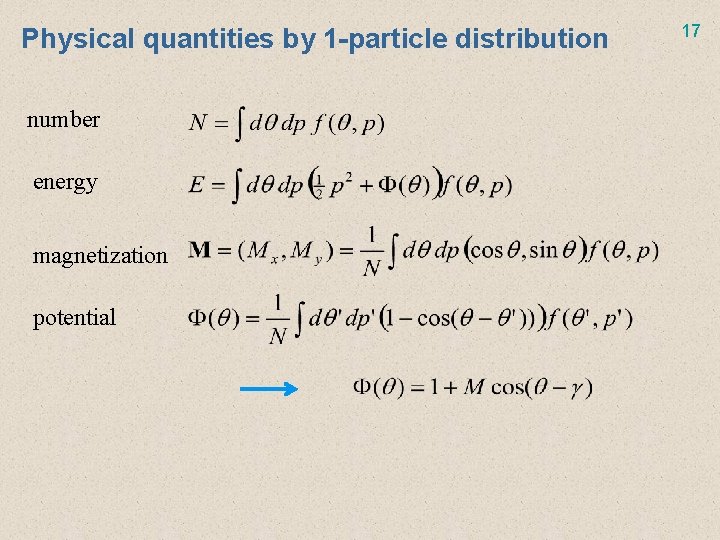
Physical quantities by 1 -particle distribution number energy magnetization potential 17
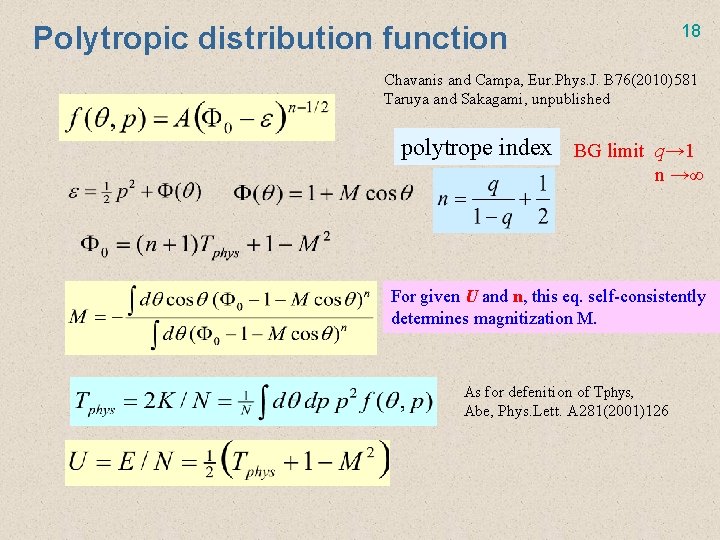
Polytropic distribution function 18 Chavanis and Campa, Eur. Phys. J. B 76(2010)581 Taruya and Sakagami, unpublished polytrope index BG limit q→ 1 n →∞ For given U and n, this eq. self-consistently determines magnitization M. As for defenition of Tphys, Abe, Phys. Lett. A 281(2001)126
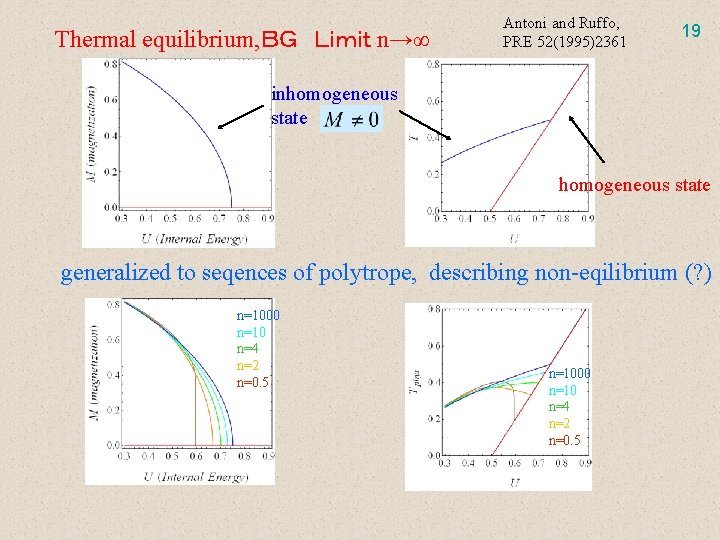
Thermal equilibrium, BG Limit n→∞ Antoni and Ruffo, PRE 52(1995)2361 19 inhomogeneous state generalized to seqences of polytrope, describing non-eqilibrium (? ) n=1000 n=10 n=4 n=2 n=0. 5
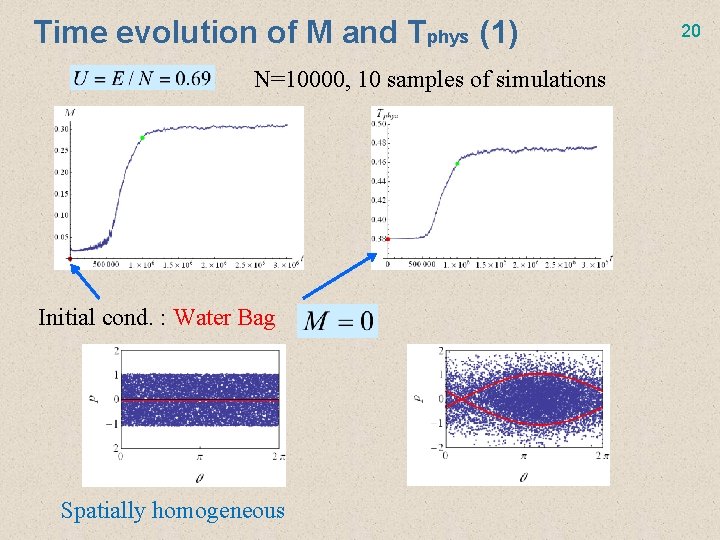
Time evolution of M and Tphys (1) N=10000, 10 samples of simulations Initial cond. : Water Bag Spatially homogeneous 20
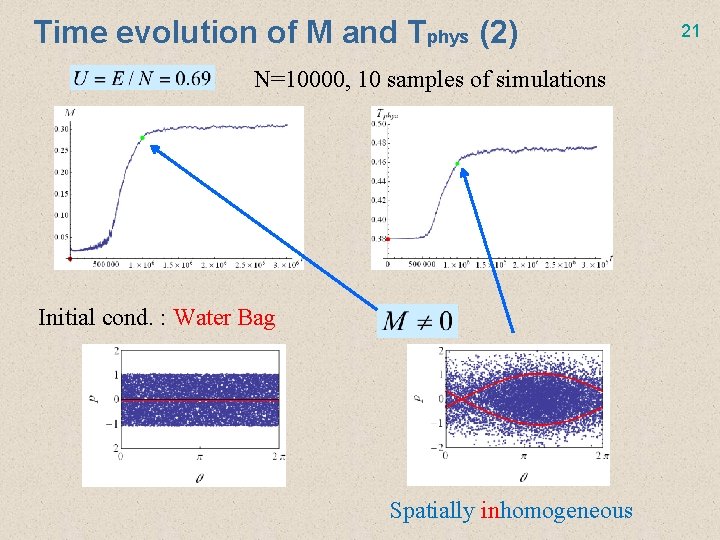
Time evolution of M and Tphys (2) N=10000, 10 samples of simulations Initial cond. : Water Bag Spatially inhomogeneous 21
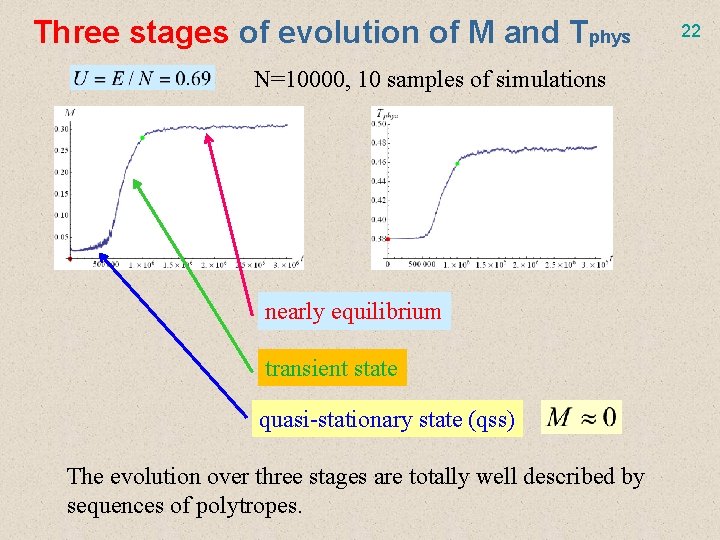
Three stages of evolution of M and Tphys N=10000, 10 samples of simulations nearly equilibrium transient state quasi-stationary state (qss) The evolution over three stages are totally well described by sequences of polytropes. 22
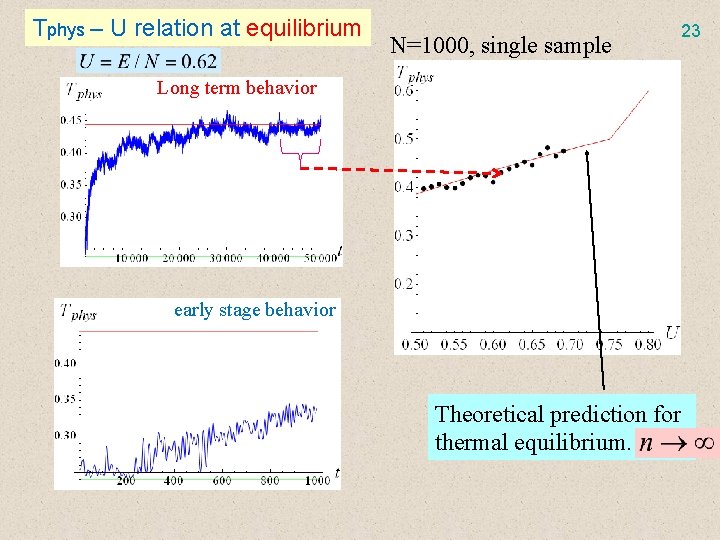
Tphys – U relation at equilibrium N=1000, single sample 23 Long term behavior early stage behavior Theoretical prediction for thermal equilibrium.
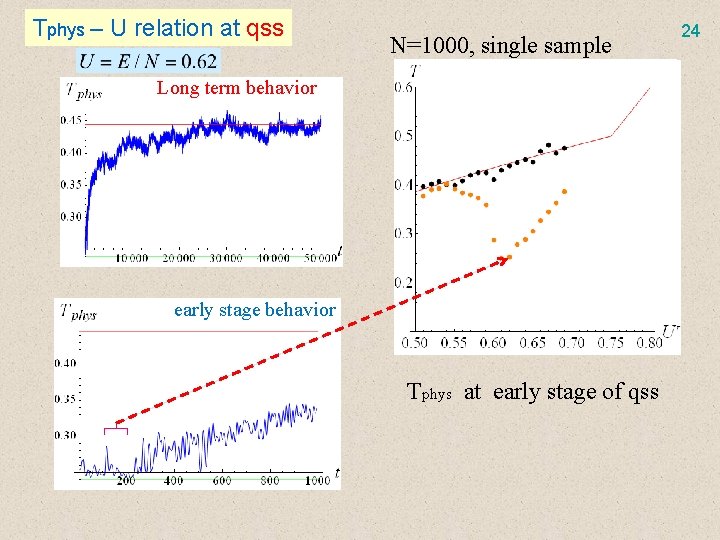
Tphys – U relation at qss N=1000, single sample Long term behavior early stage behavior Tphys at early stage of qss 24
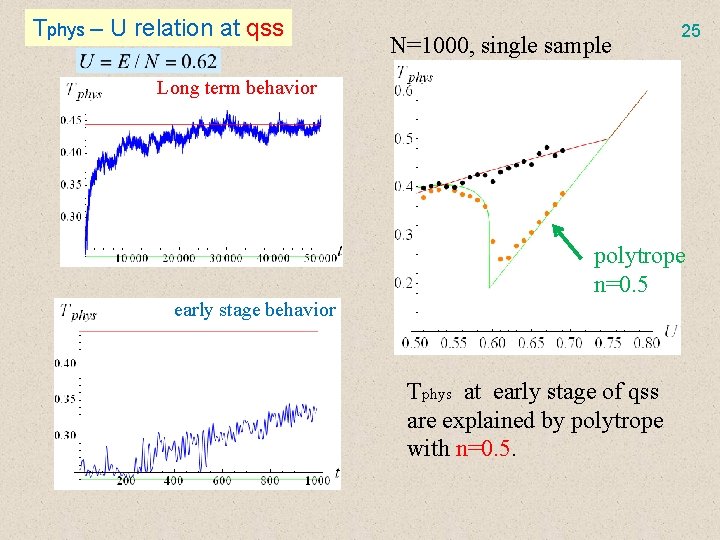
Tphys – U relation at qss N=1000, single sample 25 Long term behavior polytrope n=0. 5 early stage behavior Tphys at early stage of qss are explained by polytrope with n=0. 5.
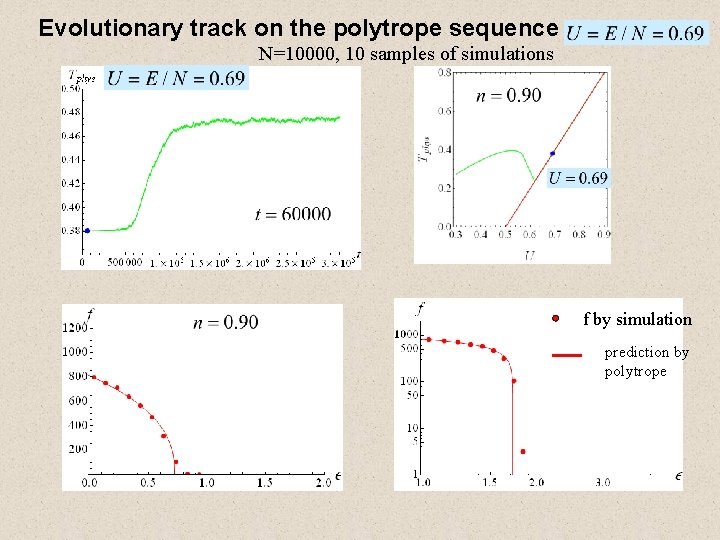
Evolutionary track on the polytrope sequence 26 N=10000, 10 samples of simulations f by simulation prediction by polytrope
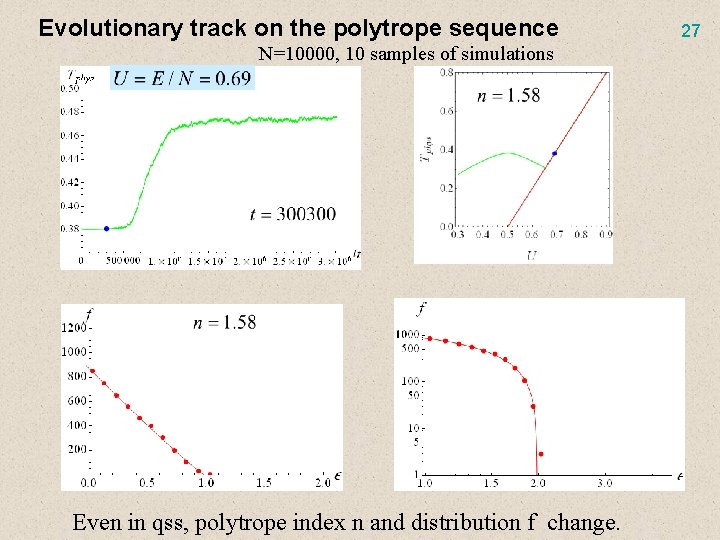
Evolutionary track on the polytrope sequence N=10000, 10 samples of simulations Even in qss, polytrope index n and distribution f change. 27
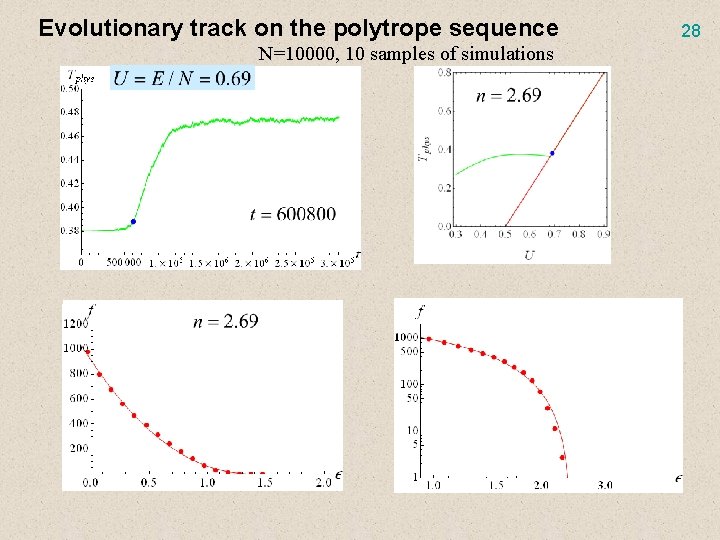
Evolutionary track on the polytrope sequence N=10000, 10 samples of simulations 28
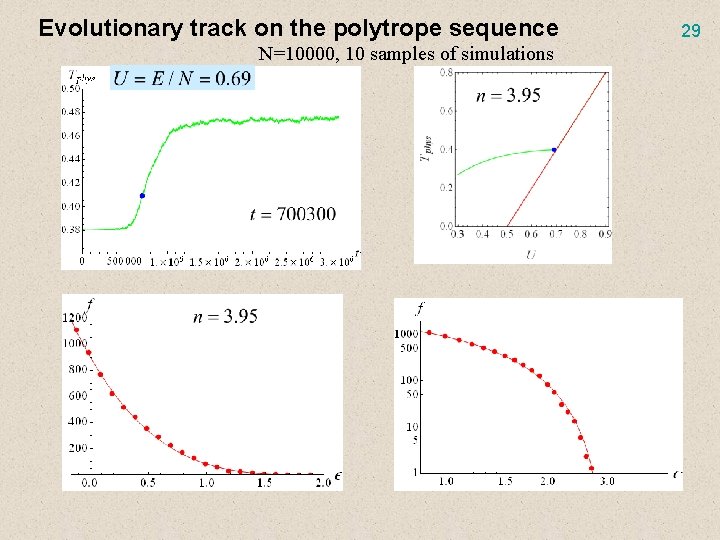
Evolutionary track on the polytrope sequence N=10000, 10 samples of simulations 29
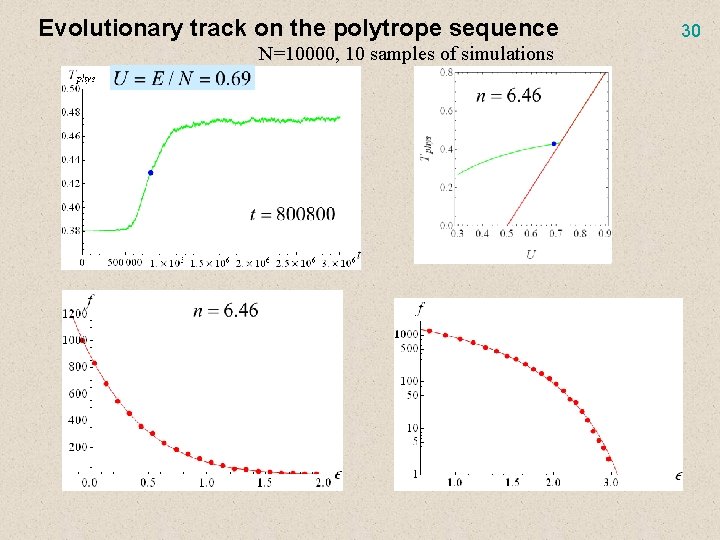
Evolutionary track on the polytrope sequence N=10000, 10 samples of simulations 30
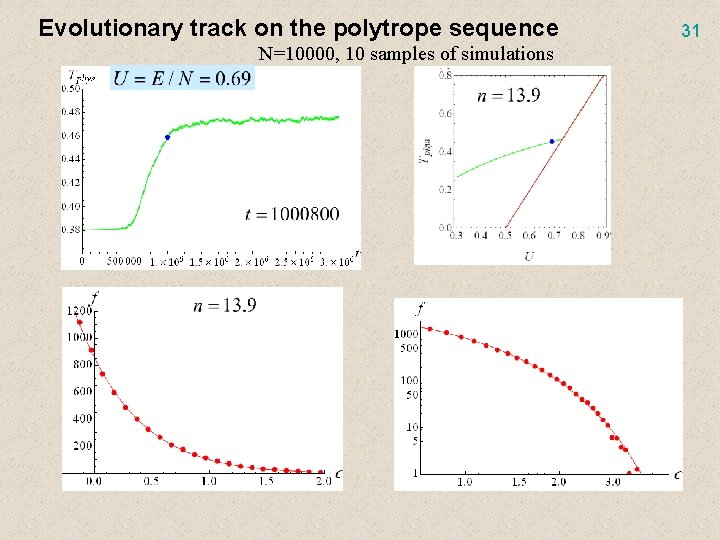
Evolutionary track on the polytrope sequence N=10000, 10 samples of simulations 31
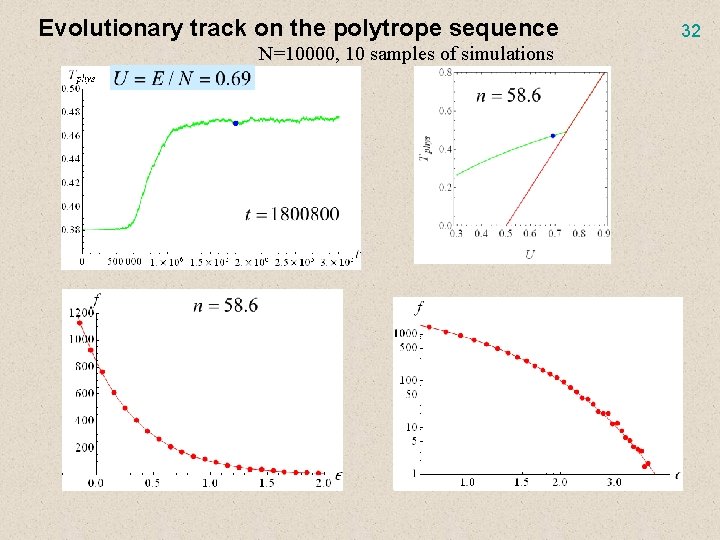
Evolutionary track on the polytrope sequence N=10000, 10 samples of simulations 32
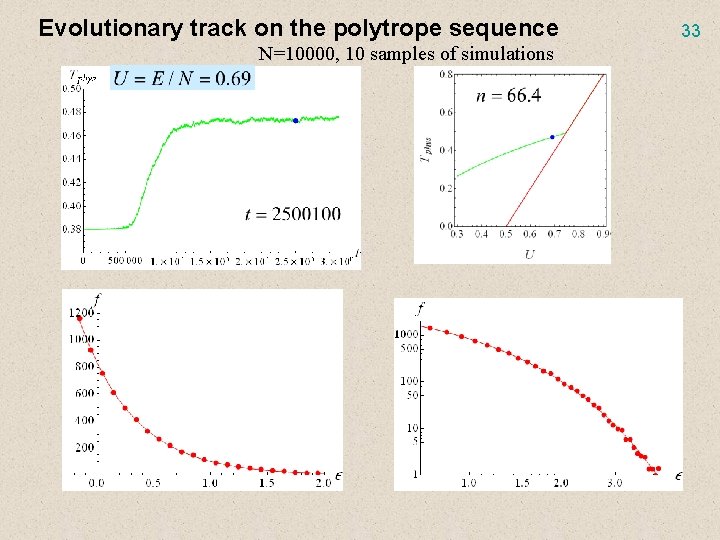
Evolutionary track on the polytrope sequence N=10000, 10 samples of simulations 33
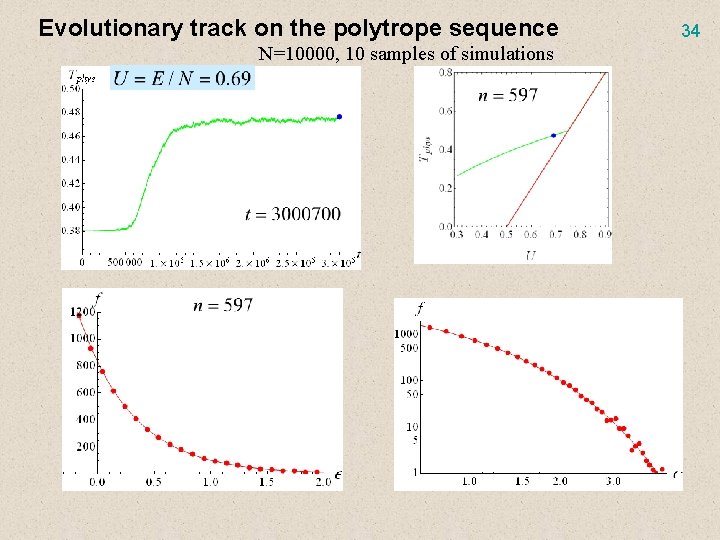
Evolutionary track on the polytrope sequence N=10000, 10 samples of simulations 34
35 Failure of single polytrope description due to Thermodynamical instability (negative specific heat).

36 Stellar polytrope as quasi-equilibrium state Energy-density contrast relation for stellar polytrope n=6 stable unstable state appears at n>5 (gravothermal instability)
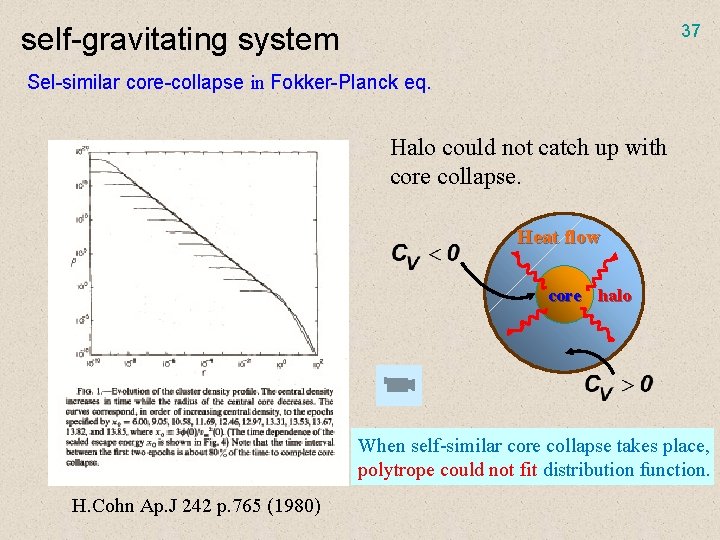
37 self-gravitating system Sel-similar core-collapse in Fokker-Planck eq. Halo could not catch up with core collapse. Heat flow core halo When self-similar core collapse takes place, polytrope could not fit distribution function. H. Cohn Ap. J 242 p. 765 (1980)
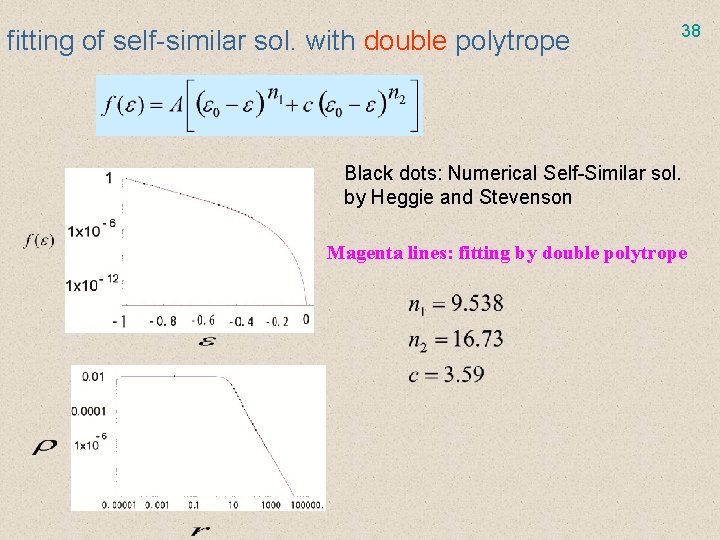
fitting of self-similar sol. with double polytrope 38 Black dots: Numerical Self-Similar sol. by Heggie and Stevenson Magenta lines: fitting by double polytrope
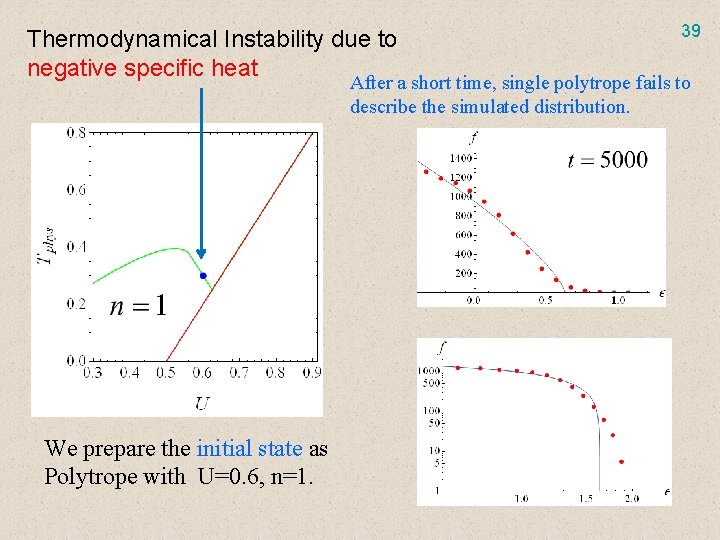
Thermodynamical Instability due to negative specific heat 39 After a short time, single polytrope fails to describe the simulated distribution. We prepare the initial state as Polytrope with U=0. 6, n=1.
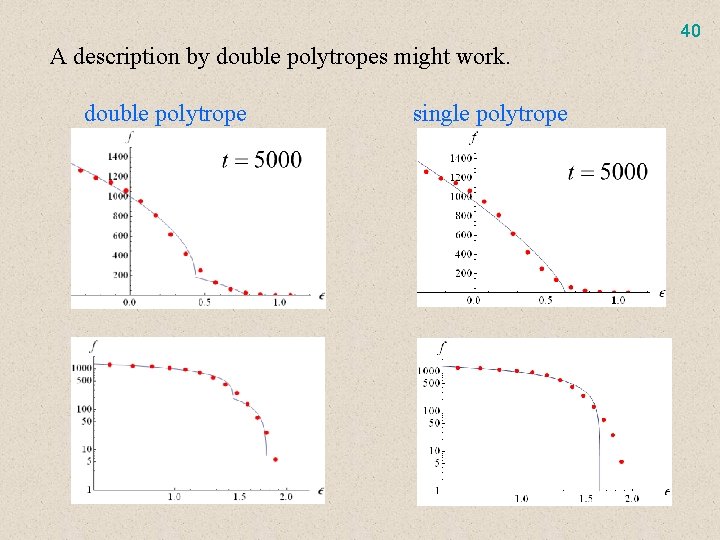
40 A description by double polytropes might work. double polytrope single polytrope
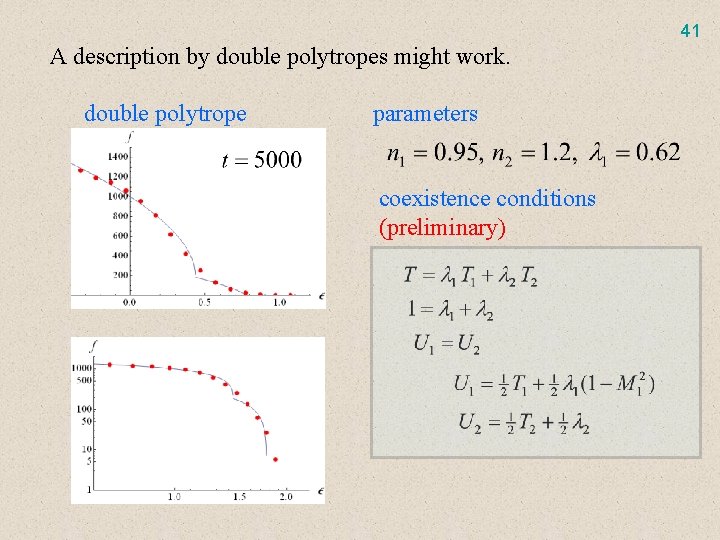
41 A description by double polytropes might work. double polytrope parameters coexistence conditions (preliminary)
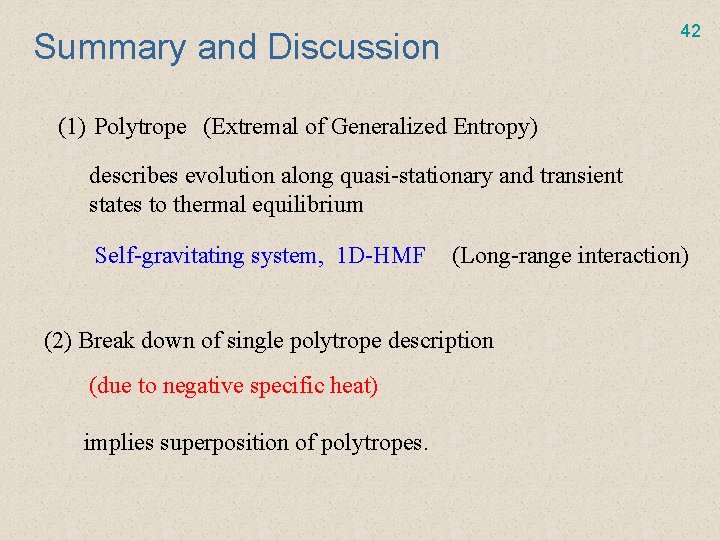
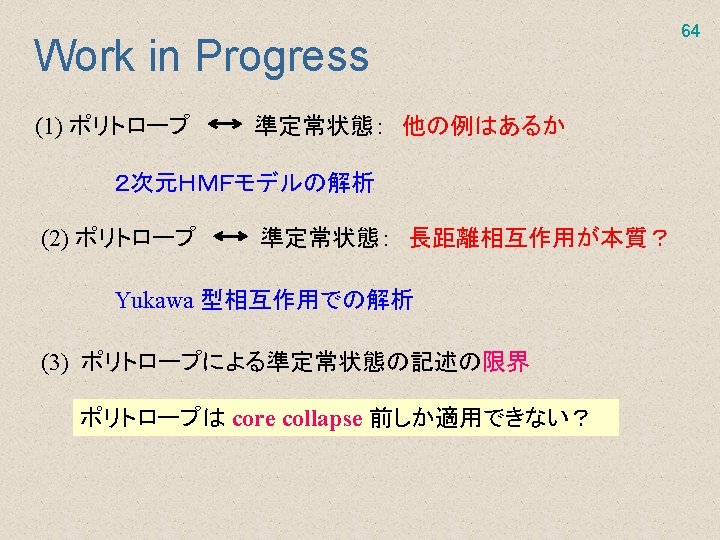
42 Summary and Discussion (1) Polytrope (Extremal of Generalized Entropy) describes evolution along quasi-stationary and transient states to thermal equilibrium Self-gravitating system, 1 D-HMF (Long-range interaction) (2) Break down of single polytrope description (due to negative specific heat) implies superposition of polytropes.
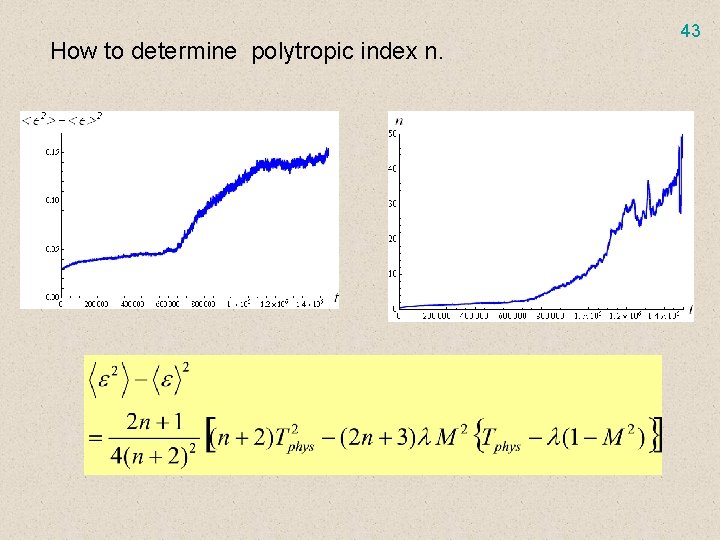
How to determine polytropic index n. 43

44

45
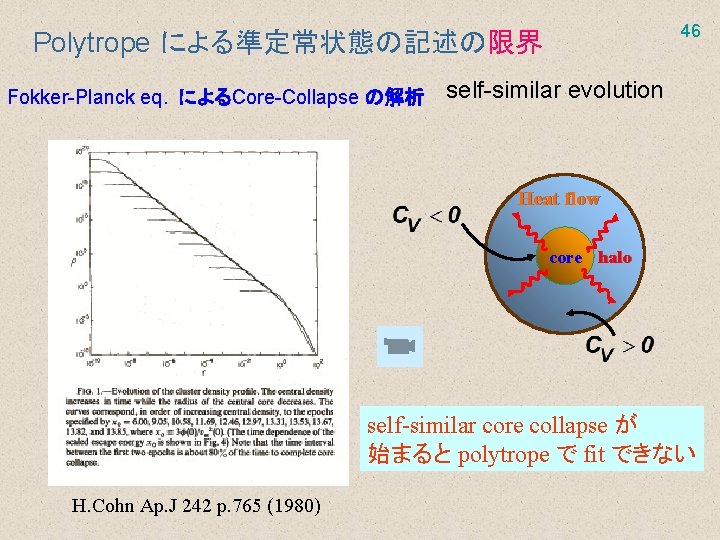
46 Polytrope による準定常状態の記述の限界 Fokker-Planck eq. によるCore-Collapse の解析 self-similar evolution Heat flow core halo self-similar core collapse が 始まると polytrope で fit できない H. Cohn Ap. J 242 p. 765 (1980)
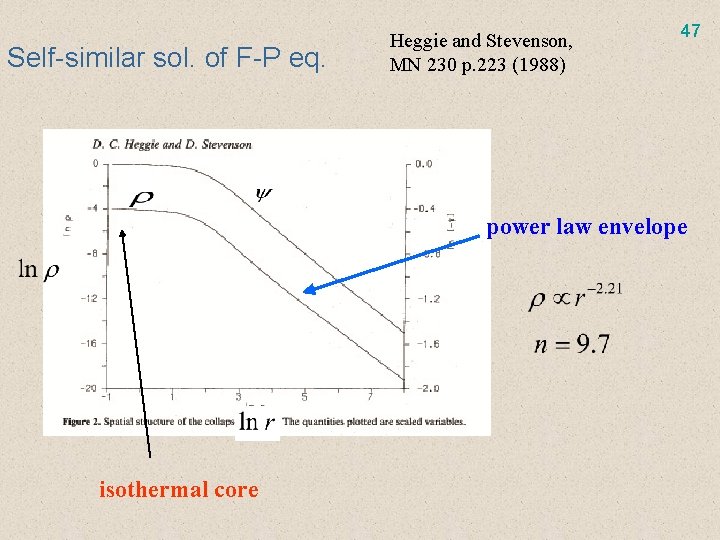
Self-similar sol. of F-P eq. Heggie and Stevenson, MN 230 p. 223 (1988) 47 power law envelope isothermal core
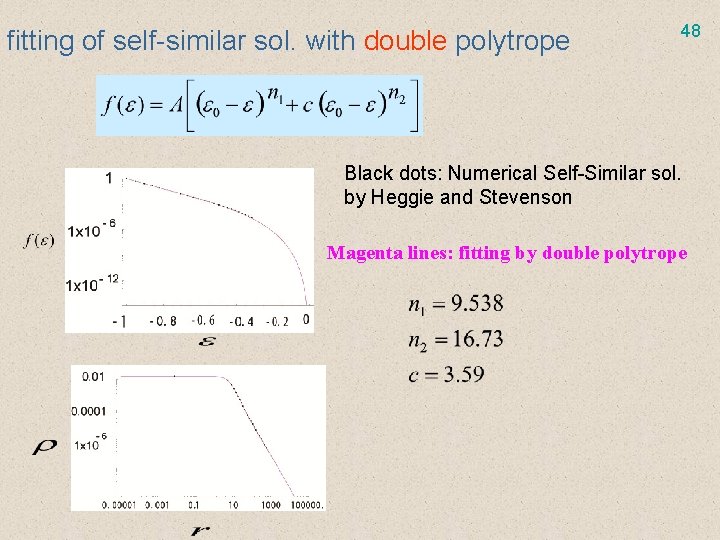
fitting of self-similar sol. with double polytrope 48 Black dots: Numerical Self-Similar sol. by Heggie and Stevenson Magenta lines: fitting by double polytrope
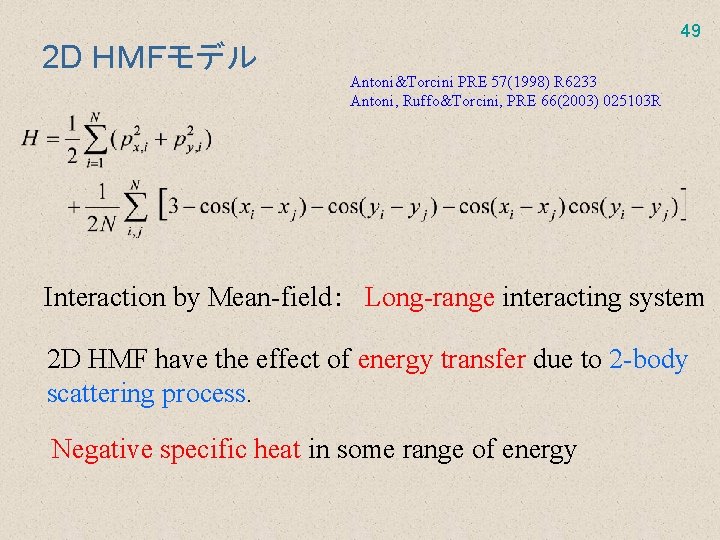
2 D HMFモデル 49 Antoni&Torcini PRE 57(1998) R 6233 Antoni, Ruffo&Torcini, PRE 66(2003) 025103 R Interaction by Mean-field: Long-range interacting system 2 D HMF have the effect of energy transfer due to 2 -body scattering process. Negative specific heat in some range of energy

50
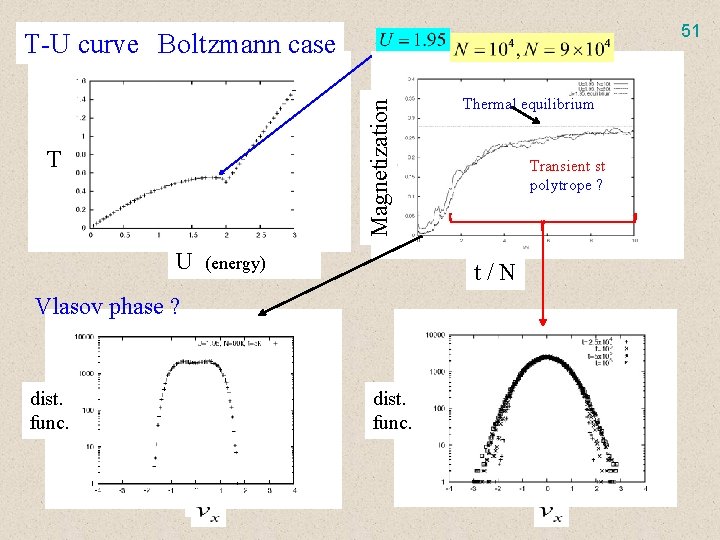
51 Magnetization T-U curve Boltzmann case T U (energy) Transient st polytrope ? t/N Vlasov phase ? dist. func. Thermal equilibrium dist. func.
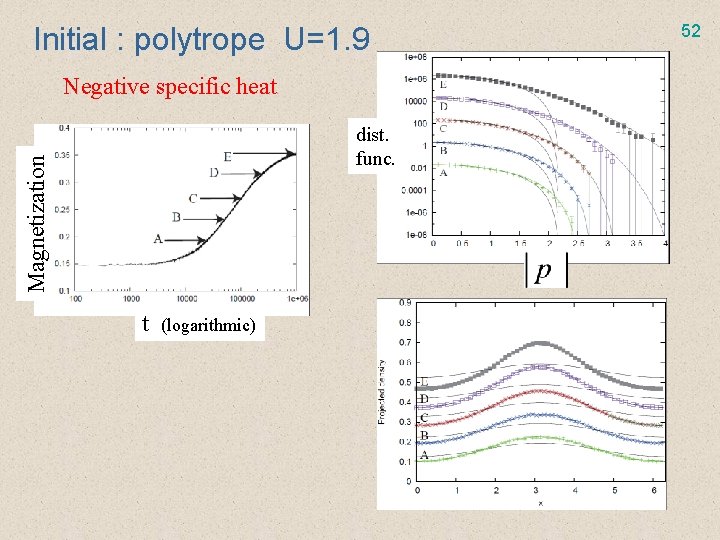
Initial : polytrope U=1. 9 Negative specific heat Magnetization dist. func. t (logarithmic) 52
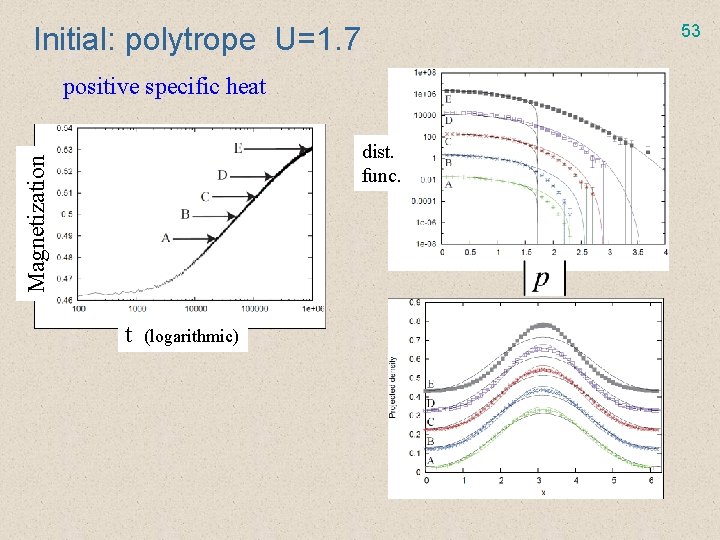
53 Initial: polytrope U=1. 7 positive specific heat Magnetization dist. func. t (logarithmic)
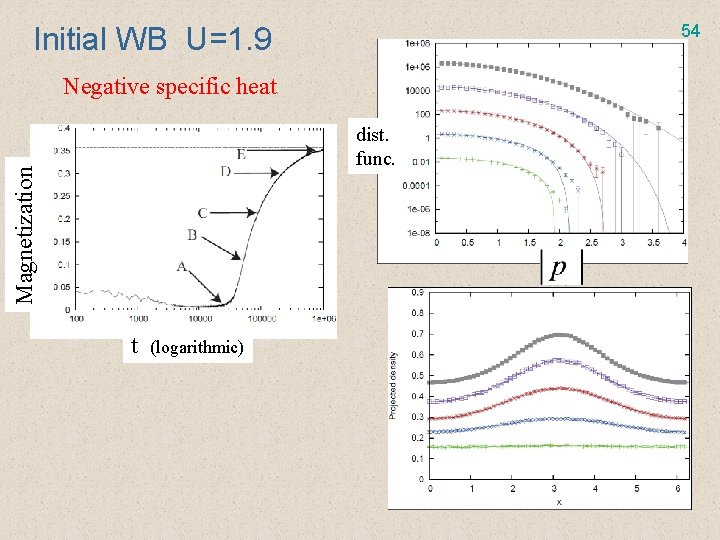
54 Initial WB U=1. 9 Negative specific heat Magnetization dist. func. t (logarithmic)
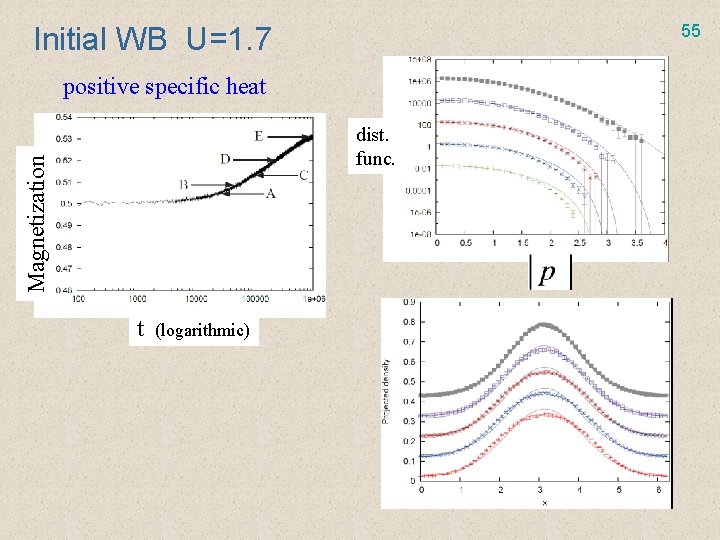
55 Initial WB U=1. 7 positive specific heat Magnetization dist. func. t (logarithmic)
56 How to derive the evolution equation for polytropic index, q or n. self-gravitating systems
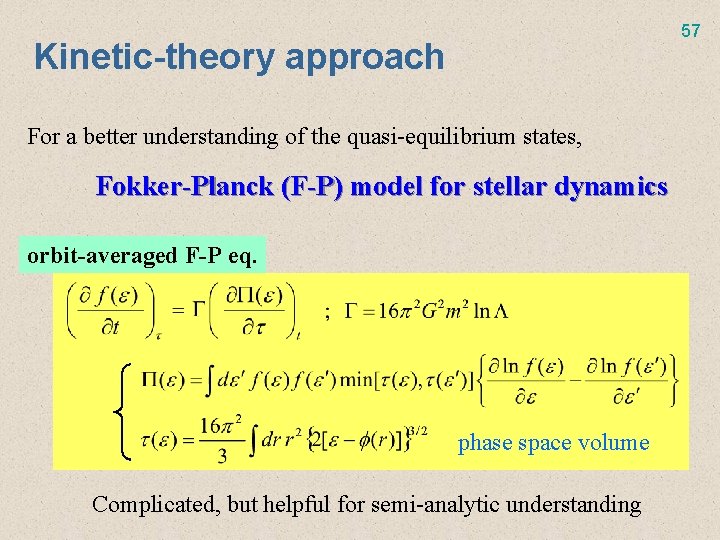
57 Kinetic-theory approach For a better understanding of the quasi-equilibrium states, Fokker-Planck (F-P) model for stellar dynamics orbit-averaged F-P eq. phase space volume Complicated, but helpful for semi-analytic understanding
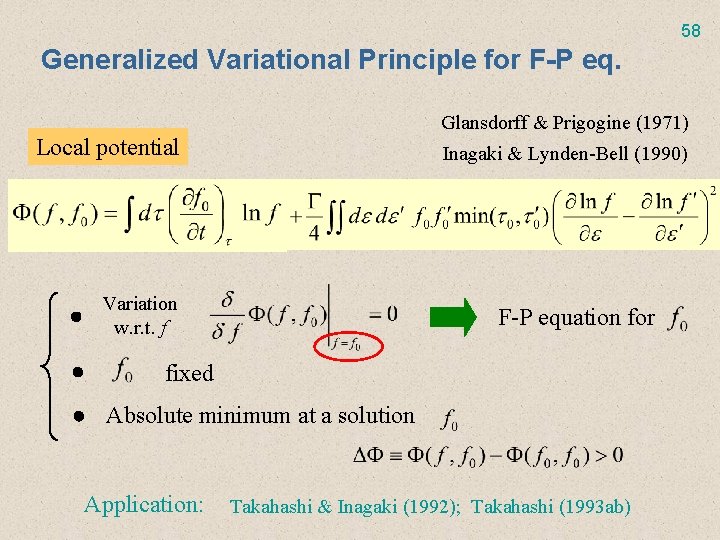
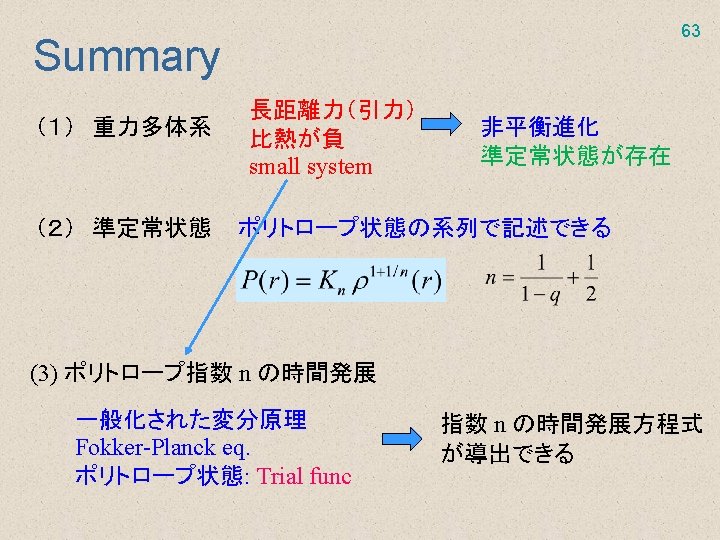
58 Generalized Variational Principle for F-P eq. Glansdorff & Prigogine (1971) Local potential Inagaki & Lynden-Bell (1990) Variation w. r. t. f F-P equation for fixed Absolute minimum at a solution Application: Takahashi & Inagaki (1992); Takahashi (1993 ab)
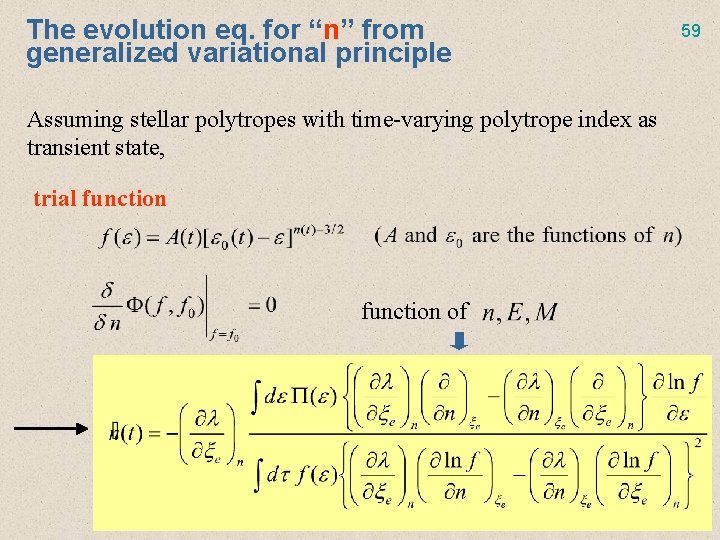
The evolution eq. for “n” from generalized variational principle Assuming stellar polytropes with time-varying polytrope index as transient state, trial function of 59
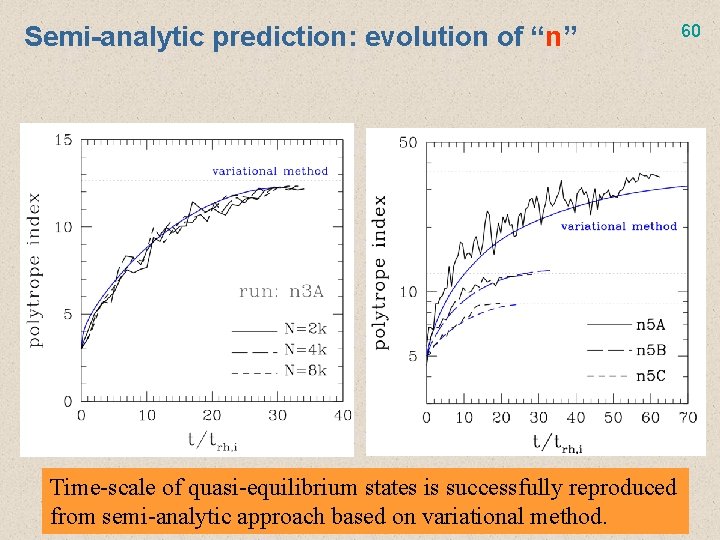
Semi-analytic prediction: evolution of “n” Time evolution of polytrope index “n” fitted to N-body simulations Time-scale of quasi-equilibrium states is successfully reproduced from semi-analytic approach based on variational method. 60
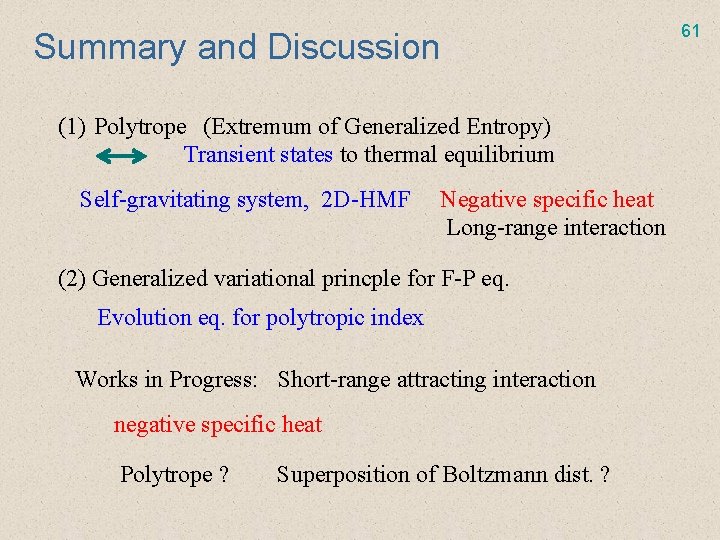
Summary and Discussion (1) Polytrope (Extremum of Generalized Entropy) Transient states to thermal equilibrium Self-gravitating system, 2 D-HMF Negative specific heat Long-range interaction (2) Generalized variational princple for F-P eq. Evolution eq. for polytropic index Works in Progress: Short-range attracting interaction negative specific heat Polytrope ? Superposition of Boltzmann dist. ? 61

62
- Slides: 61