
1 Describe how fungi use hyphae to obtain
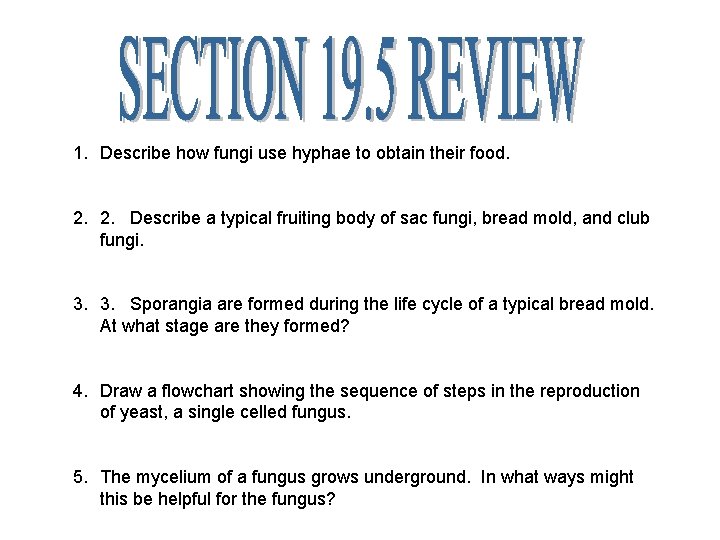
1. Describe how fungi use hyphae to obtain their food. 2. 2. Describe a typical fruiting body of sac fungi, bread mold, and club fungi. 3. 3. Sporangia are formed during the life cycle of a typical bread mold. At what stage are they formed? 4. Draw a flowchart showing the sequence of steps in the reproduction of yeast, a single celled fungus. 5. The mycelium of a fungus grows underground. In what ways might this be helpful for the fungus?
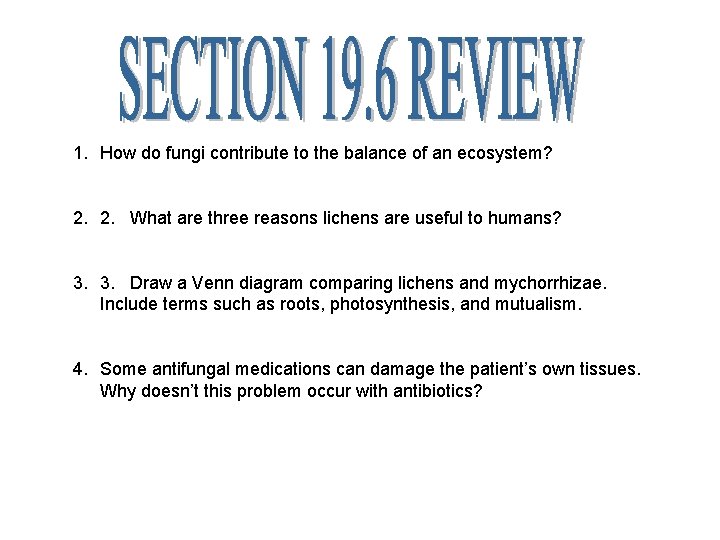
1. How do fungi contribute to the balance of an ecosystem? 2. 2. What are three reasons lichens are useful to humans? 3. 3. Draw a Venn diagram comparing lichens and mychorrhizae. Include terms such as roots, photosynthesis, and mutualism. 4. Some antifungal medications can damage the patient’s own tissues. Why doesn’t this problem occur with antibiotics?
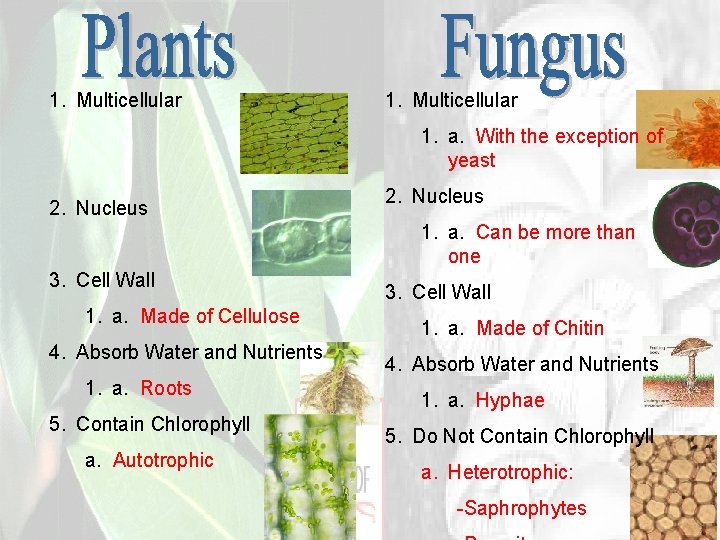
1. Multicellular 1. a. With the exception of yeast 2. Nucleus 1. a. Can be more than one 3. Cell Wall 1. a. Made of Cellulose 4. Absorb Water and Nutrients 1. a. Roots 5. Contain Chlorophyll a. Autotrophic 3. Cell Wall 1. a. Made of Chitin 4. Absorb Water and Nutrients 1. a. Hyphae 5. Do Not Contain Chlorophyll a. Heterotrophic: -Saphrophytes
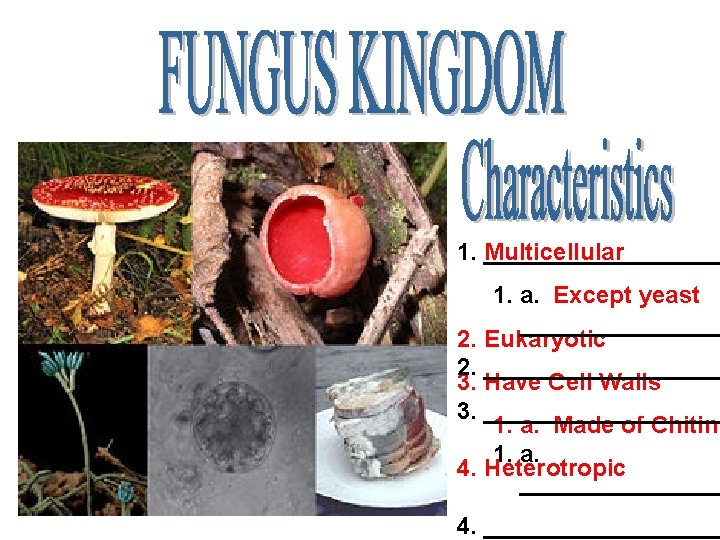
1. _________ Multicellular 1. a. Except yeast ________ 2. Eukaryotic 2. _________ 3. Have Cell Walls 3. _________ 1. a. Made of Chitin 1. a. 4. Heterotropic ________ 4. _________
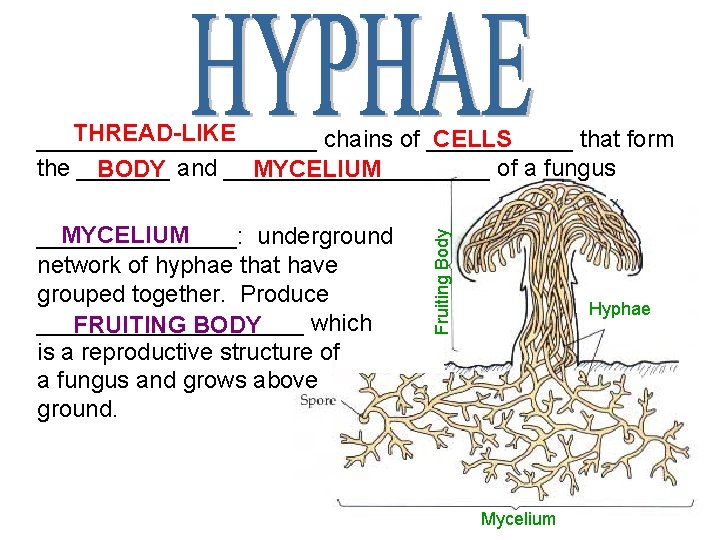
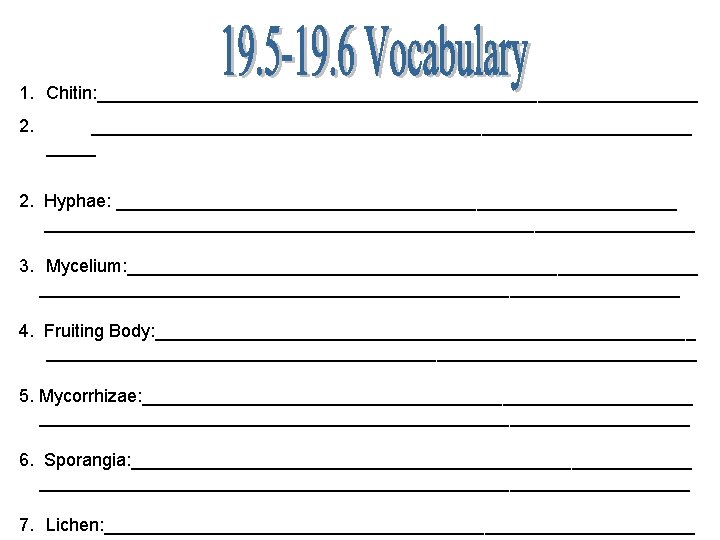
MYCELIUM ________: underground network of hyphae that have grouped together. Produce __________ which FRUITING BODY is a reproductive structure of a fungus and grows above ground. Fruiting Body THREAD-LIKE ___________ chains of ______ CELLS that form the _______ of a fungus BODY and __________ MYCELIUM Hyphae Mycelium

ENZYMES Hyphae secrete ____________ to break down dead/living NUTRIENTS material. Once the material is broken down into simpler _________, HYPHAE the food is absorbed through the fungus’ __________ Pieces of ___________ can __________ and form into BREAK OFF HYPHAE new fungi. (ASEXUAL _________________ REPRODUCTION) FUSE Hyphae can _________ together and create _________________ (SEXUAL REPRODUCTION) NEW HYPHAE
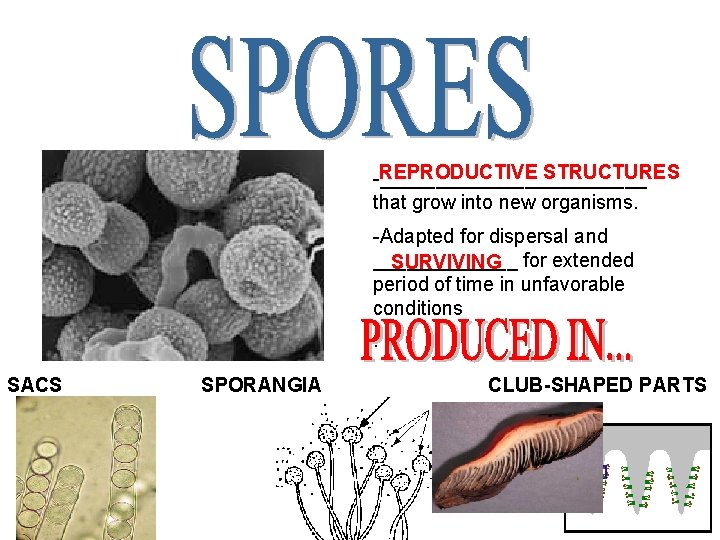
STRUCTURES -REPRODUCTIVE ____________ that grow into new organisms. -Adapted for dispersal and _______ SURVIVING for extended period of time in unfavorable conditions. SACS SPORANGIA CLUB-SHAPED PARTS

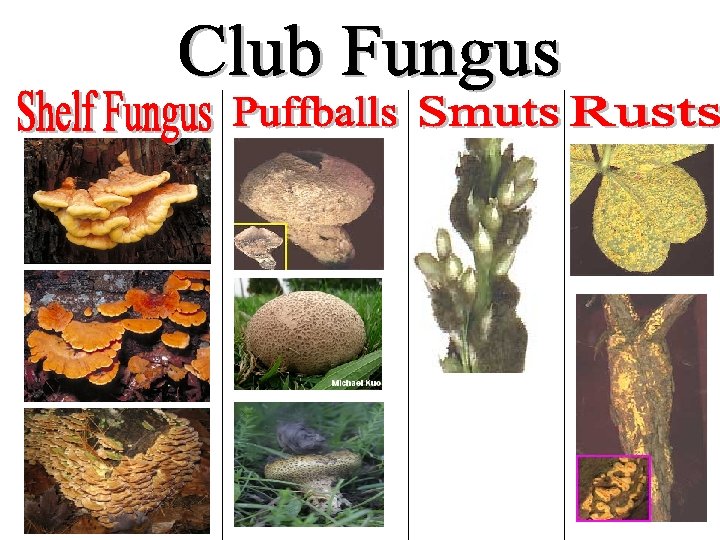
PRIMITIVE FUNGI ________ Chytridiomycota SAC FUNGI _________ Ascomycota SP 0 RANGIA FUNGI ________ Zygomycota 1. Smallest/Simplest 1. Form a sac called ascus 2. Mostly aquatic 2. 3. Spores with Flagella Ascus contains spores for 2. reproduction 4. 5. 3. Yeasts, Penicillium, Decomposers or parasites morels, truffles Chytrids 1. 3. CLUB FUNGI ________ Basidiomycota 1. Contain club-shaped parts that produce spores for reproduction. 2. Range for molds on spoiled food to fungi used to ferment foods 3. Club parts produce spores for reproduction Contain sporangia Sporangia produce spores for reproduction Contain mushrooms, puffballs, shelf (bracket) fungi. Also include rusts and smuts
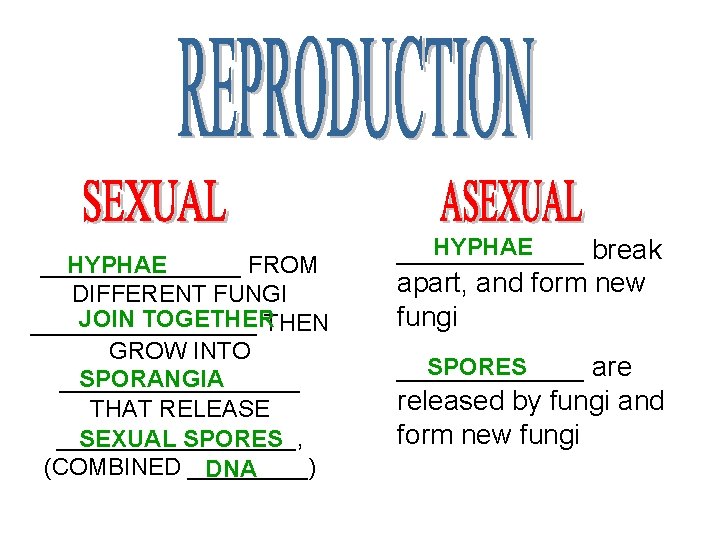
________ HYPHAE FROM DIFFERENT FUNGI JOIN TOGETHERTHEN _________ GROW INTO SPORANGIA _________ THAT RELEASE _________, SEXUAL SPORES (COMBINED _____) DNA HYPHAE ______ break apart, and form new fungi SPORES ______ are released by fungi and form new fungi
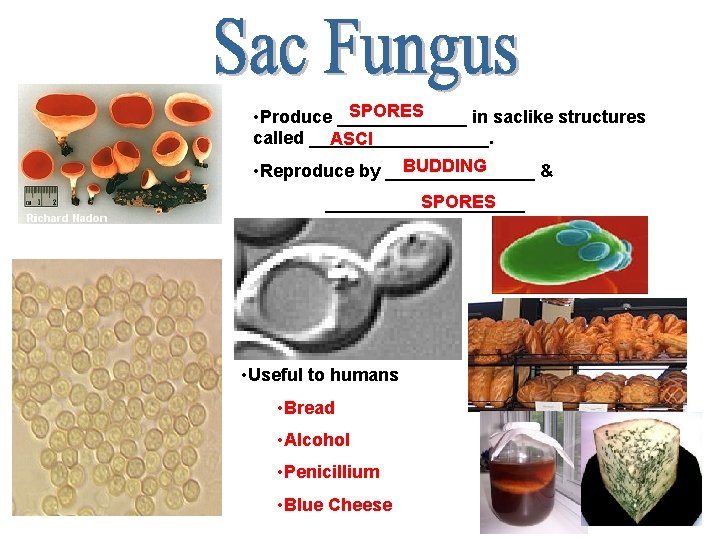
SPORES • Produce _______ in saclike structures called _________. ASCI BUDDING • Reproduce by ________ & SPORES __________ • Useful to humans • Bread • Alcohol • Penicillium • Blue Cheese
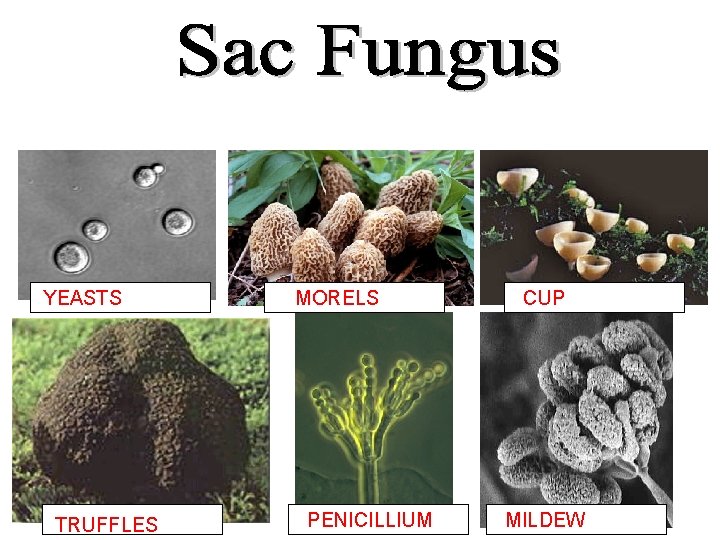
YEASTS TRUFFLES MORELS PENICILLIUM CUP MILDEW
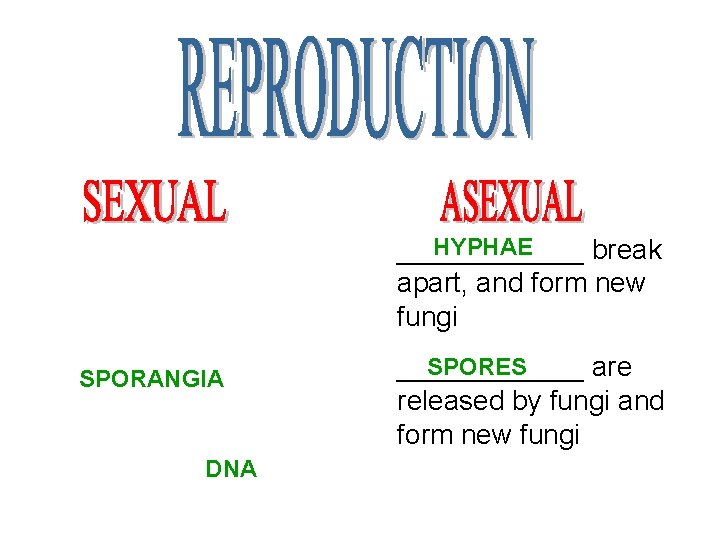
HYPHAE ______ break apart, and form new fungi SPORANGIA DNA SPORES ______ are released by fungi and form new fungi
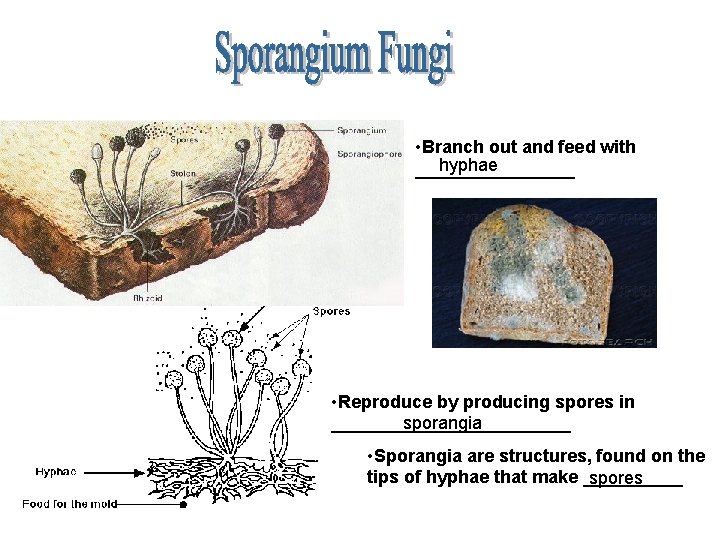
• Branch out and feed with hyphae ________ • Reproduce by producing spores in sporangia ____________ • Sporangia are structures, found on the tips of hyphae that make _____ spores

CAP GILLS STIPE HYPHAE (MYCELIUM) • Form Branches of MYCELIUM __________ underground • Have gills under their _________ that house the CAP CLUB LIKE PARTS _____________ that produce. SPORES _______ for _________. REPRODUCTION • Spores are found IN BETWEEN GILLS _________________________________ ON CLUB LIKE PARTS!
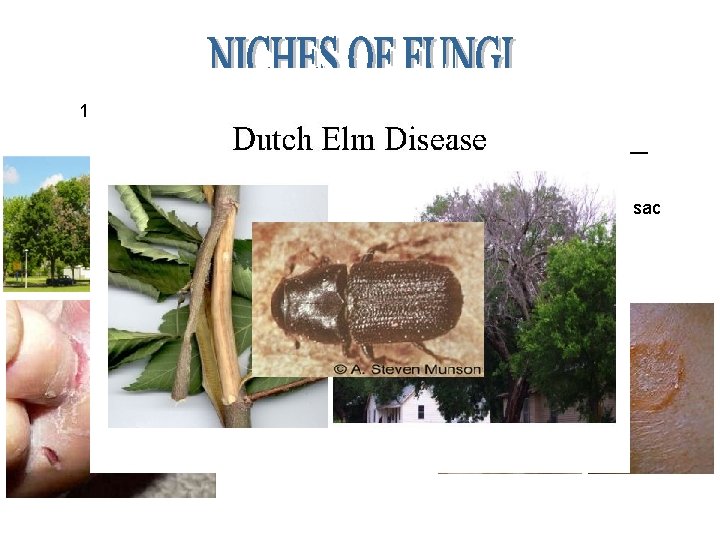
PARASITES 1. ________________: PATHOGENIC DISEASE a. Can be ___________ and cause _______ b. * In Plants: DUTCH ELM DISEASE - ____________ caused by sac c. fungus d. e. f. g. h. i. FRUIT - Destroy __________ crops * In Humans: ATHLETE’S FOOT - __________ NAIL FUNGUS - __________ RING WORM - __________ YEAST INFECTIONS - __________
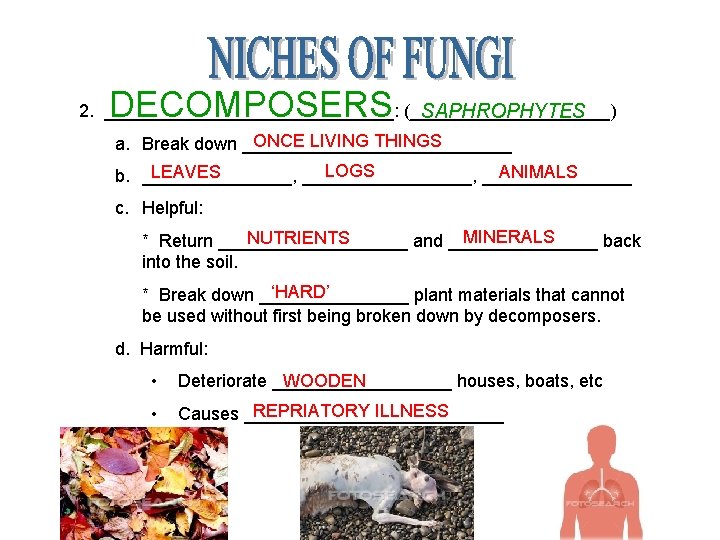
DECOMPOSERS 2. _______________: (__________) SAPHROPHYTES ONCE LIVING THINGS a. Break down ______________ LOGS LEAVES ANIMALS b. _______________, _________ c. Helpful: MINERALS NUTRIENTS * Return __________ and ________ back into the soil. ‘HARD’ * Break down ________ plant materials that cannot be used without first being broken down by decomposers. d. Harmful: • Deteriorate _________ houses, boats, etc WOODEN • REPRIATORY ILLNESS Causes _____________
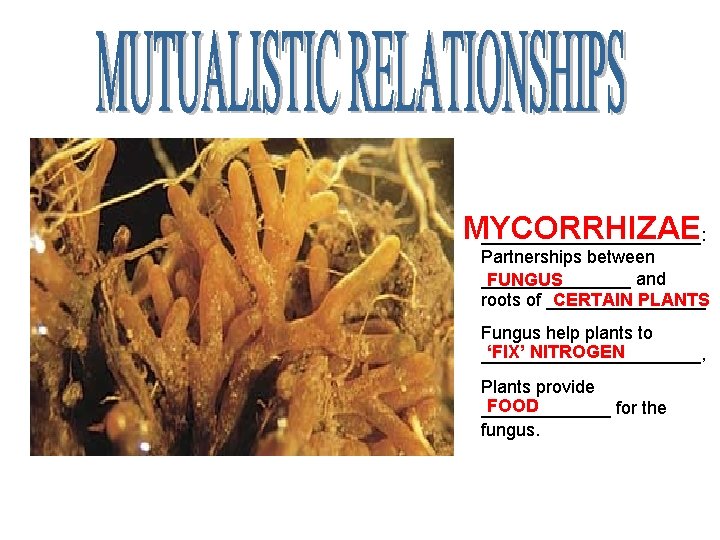
MYCORRHIZAE ___________: Partnerships between ________ and FUNGUS CERTAIN PLANTS roots of ________ Fungus help plants to ‘FIX’ NITROGEN ___________, Plants provide FOOD _______ for the fungus.
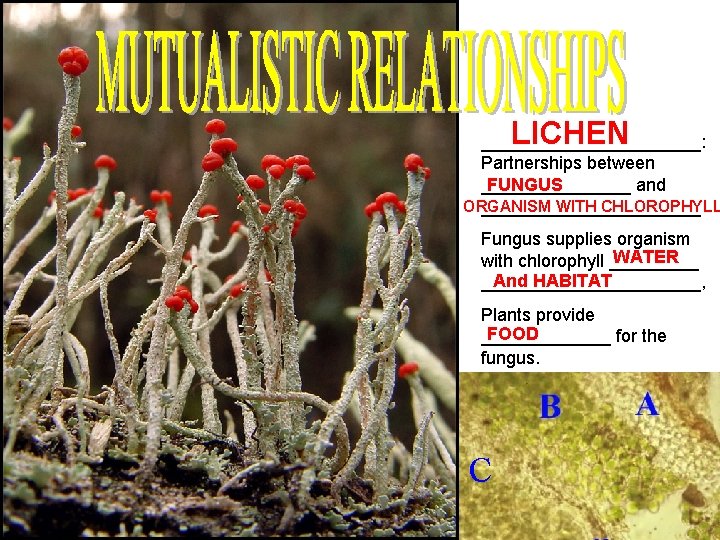
LICHEN ___________: Partnerships between ________ and FUNGUS ORGANISM WITH CHLOROPHYLL ___________ Fungus supplies organism WATER with chlorophyll _____ And HABITAT ___________, Plants provide FOOD _______ for the fungus. C
- Slides: 20