
1 Delphi International Program Cyprus Professional Development Study


- Slides: 42
1 Delphi International Program Cyprus Professional Development Study Tour in the Nonprofit Sector July 19, 2005
2 “Just as a city’s physical infrastructure crumbles over time if it is not maintained, so it is with nonprofit infrastructure. While the signs of erosion are rarely dramatic in one year, prolonged neglect will ultimately result in their total breakdown—and the collapse of the programs they operate…” Joyce Bove and Lawrence Mandell “…both nonprofit managers and those that fund them must recognize that excellence in programmatic innovation and implementation are insufficient for nonprofits to achieve lasting results. Great programs need great organizations behind them. ” Venture Philanthropy Partners “Nonprofits can’t be helped by embracing different reforms as their popularity increases or wanes. ‘They must set priorities carefully and invest their scarce reform energy on a handful of priorities’ “. Paul Light 2
3 Workshop Agenda • • • Introductions What would you like to get out of this training? Capacity Building Overview Capacity Building Assessment Frameworks Capacity Building General Assessment Questions Capacity Building Methodologies Capacity Building Lessons Learned Session Debrief Adjourn 3
4 INTRODUCTIONS • Your name • The organization you are representing? • Your role with the organization? • Biggest challenge your organization is facing? 4
5 WHAT WOULD YOU LIKE TO GET OUT OF THIS SESSION? 5
6 CAPACITY BUILDING OVERVIEW 6
7 What Is Capacity Building? The ability of nonprofit organizations to fulfill their missions in an effective manner. (John S. and James L. Knight Foundation) HOW WOULD YOU DEFINE CAPACITY BUILDING? 7
8 Challenges Confronting American NGOs • • Increased demand for services Increased complexity of client needs Increased competition for resources Decreased resource pool proportionate to need – Impact of economy on private foundation endowments – Shifting public funding priorities • Myopic nature of foundation and government funding • Increased pressure to perform (accountability for outcomes) • Threat of for-profit competition 8
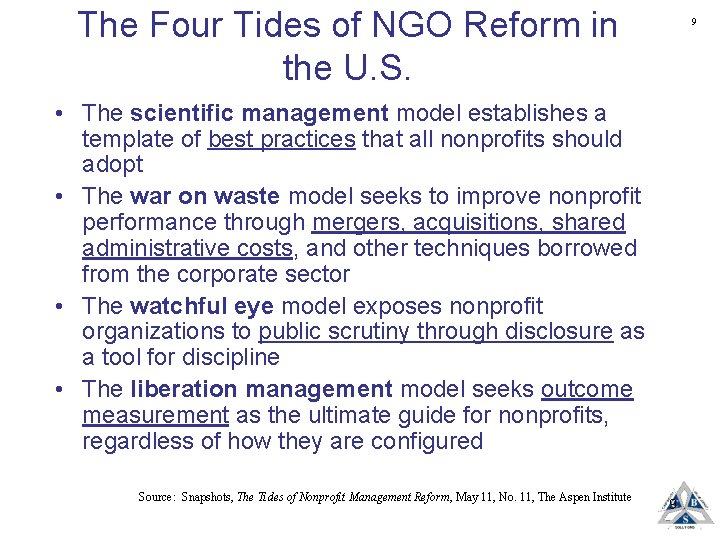
The Four Tides of NGO Reform in the U. S. 9 • The scientific management model establishes a template of best practices that all nonprofits should adopt • The war on waste model seeks to improve nonprofit performance through mergers, acquisitions, shared administrative costs, and other techniques borrowed from the corporate sector • The watchful eye model exposes nonprofit organizations to public scrutiny through disclosure as a tool for discipline • The liberation management model seeks outcome measurement as the ultimate guide for nonprofits, regardless of how they are configured Source: Snapshots, The Tides of Nonprofit Management Reform, May 11, No. 11, The Aspen Institute 9
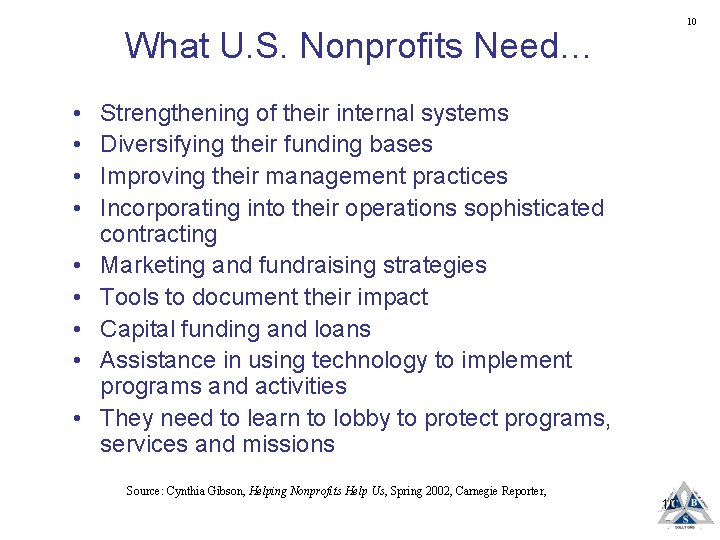
10 What U. S. Nonprofits Need… • • • Strengthening of their internal systems Diversifying their funding bases Improving their management practices Incorporating into their operations sophisticated contracting Marketing and fundraising strategies Tools to document their impact Capital funding and loans Assistance in using technology to implement programs and activities They need to learn to lobby to protect programs, services and missions Source: Cynthia Gibson, Helping Nonprofits Help Us, Spring 2002, Carnegie Reporter, 10
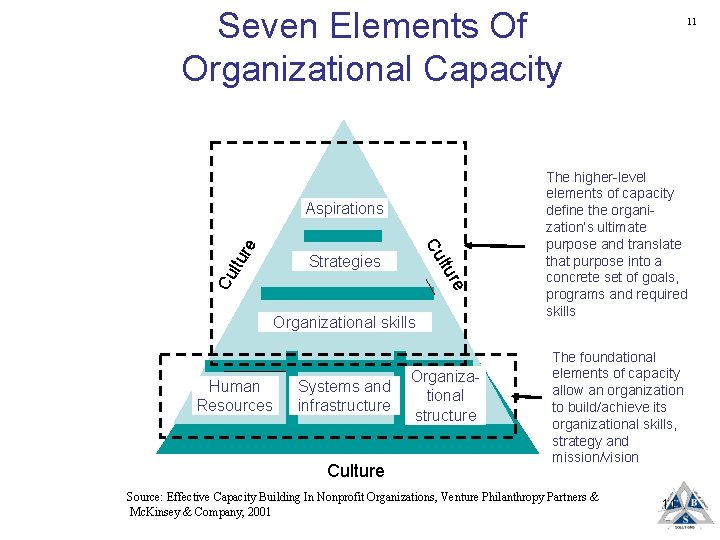
Seven Elements Of Organizational Capacity Strategies re ltu Cu re Aspirations Organizational skills Human Resources Systems and infrastructure Culture Organizational structure 11 The higher-level elements of capacity define the organization’s ultimate purpose and translate that purpose into a concrete set of goals, programs and required skills The foundational elements of capacity allow an organization to build/achieve its organizational skills, strategy and mission/vision Source: Effective Capacity Building In Nonprofit Organizations, Venture Philanthropy Partners & Mc. Kinsey & Company, 2001 11
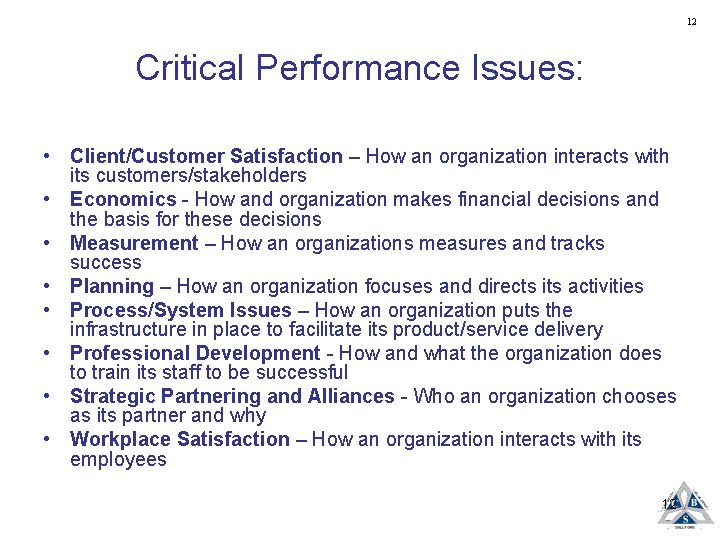
12 Critical Performance Issues: • Client/Customer Satisfaction – How an organization interacts with its customers/stakeholders • Economics - How and organization makes financial decisions and the basis for these decisions • Measurement – How an organizations measures and tracks success • Planning – How an organization focuses and directs its activities • Process/System Issues – How an organization puts the infrastructure in place to facilitate its product/service delivery • Professional Development - How and what the organization does to train its staff to be successful • Strategic Partnering and Alliances - Who an organization chooses as its partner and why • Workplace Satisfaction – How an organization interacts with its employees 12
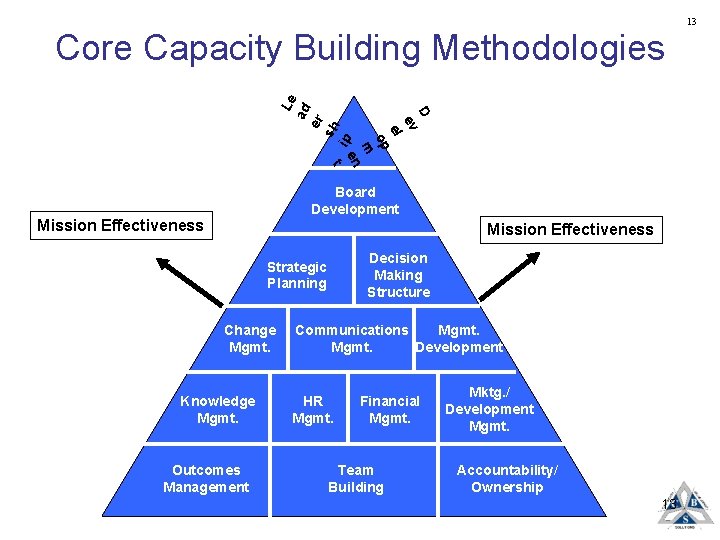
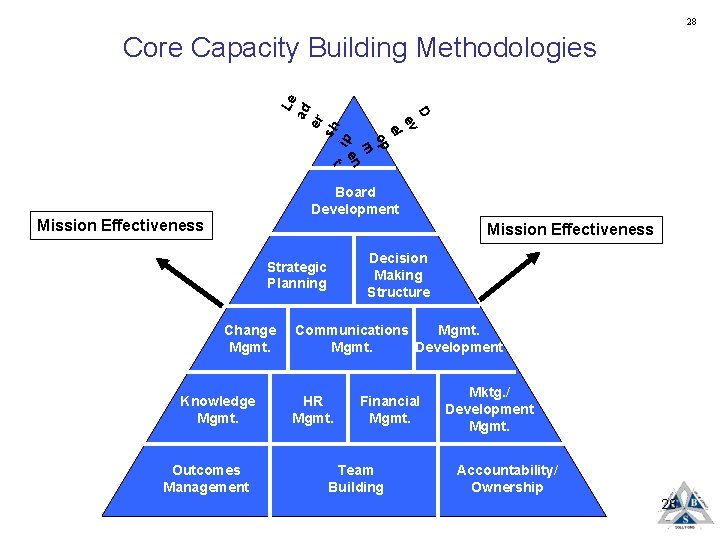
D Le ad er sh ip Core Capacity Building Methodologies ev el op m en t Board Development Mission Effectiveness Decision Making Structure Strategic Planning Change Mgmt. Knowledge Mgmt. Outcomes Management Communications Mgmt. Development HR Mgmt. Financial Mgmt. Team Building Mktg. / Development Mgmt. Accountability/ Ownership 13 13
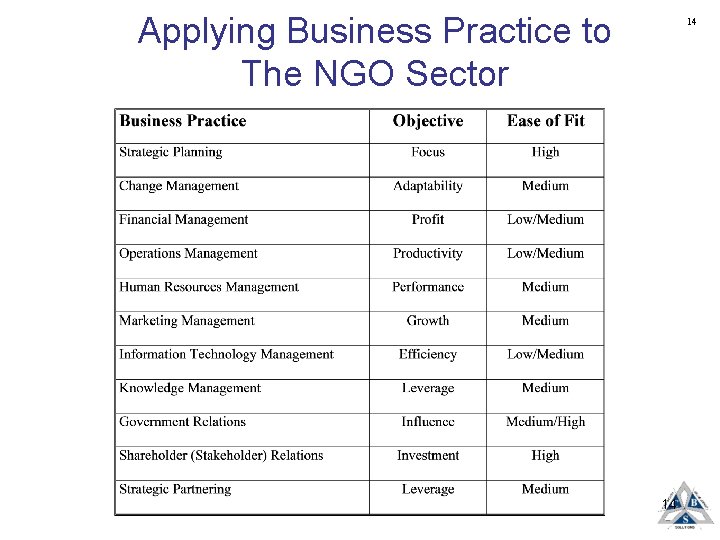
Applying Business Practice to The NGO Sector 14 14
15 What are your capacity building needs? 15
16 CAPACITY BUILDING ASSESSMENT FRAMEWORKS Select Examples 16
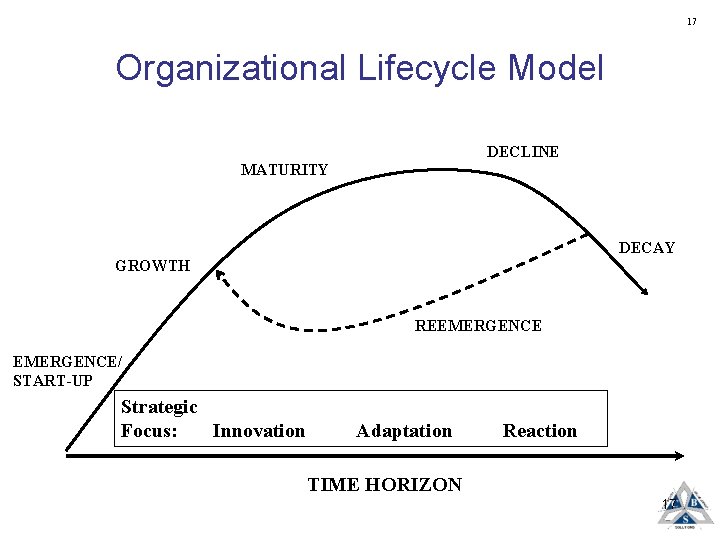
17 Organizational Lifecycle Model DECLINE MATURITY DECAY GROWTH REEMERGENCE/ START-UP Strategic Focus: Innovation Adaptation Reaction TIME HORIZON 17
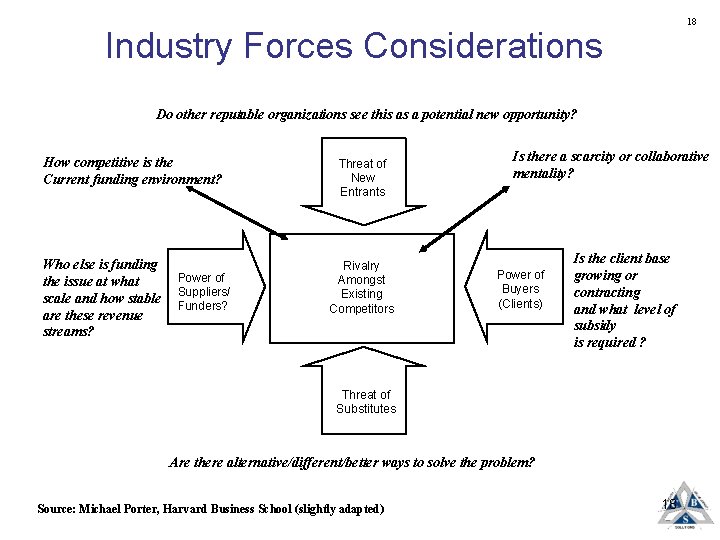
18 Industry Forces Considerations Do other reputable organizations see this as a potential new opportunity? How competitive is the Current funding environment? Who else is funding the issue at what scale and how stable are these revenue streams? Power of Suppliers/ Funders? Threat of New Entrants Rivalry Amongst Existing Competitors Is there a scarcity or collaborative mentality? Power of Buyers (Clients) Is the client base growing or contracting and what level of subsidy is required ? Threat of Substitutes Are there alternative/different/better ways to solve the problem? Source: Michael Porter, Harvard Business School (slightly adapted) 18
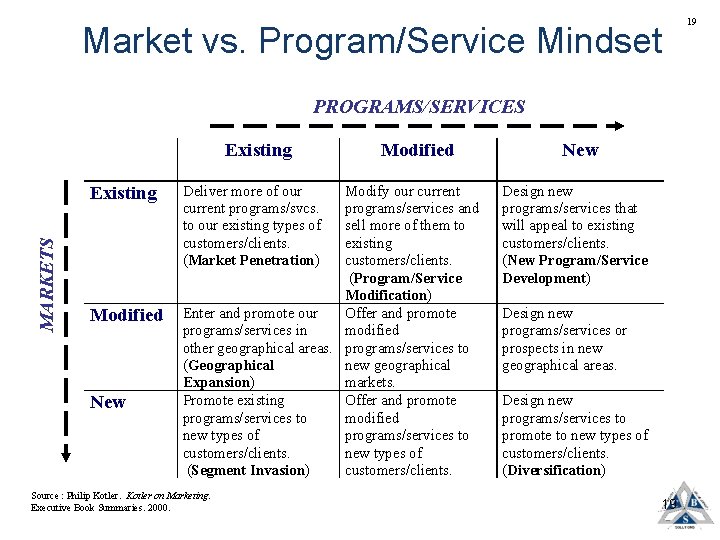
Market vs. Program/Service Mindset PROGRAMS/SERVICES Existing MARKETS Existing Modified New Deliver more of our current programs/svcs. to our existing types of customers/clients. (Market Penetration) Modified Modify our current programs/services and sell more of them to existing customers/clients. (Program/Service Modification) Enter and promote our Offer and promote programs/services in modified other geographical areas. programs/services to (Geographical new geographical Expansion) markets. Promote existing Offer and promote programs/services to modified new types of programs/services to customers/clients. new types of (Segment Invasion) customers/clients. Source : Philip Kotler on Marketing. Executive Book Summaries. 2000. New Design new programs/services that will appeal to existing customers/clients. (New Program/Service Development) Design new programs/services or prospects in new geographical areas. Design new programs/services to promote to new types of customers/clients. (Diversification) 19 19
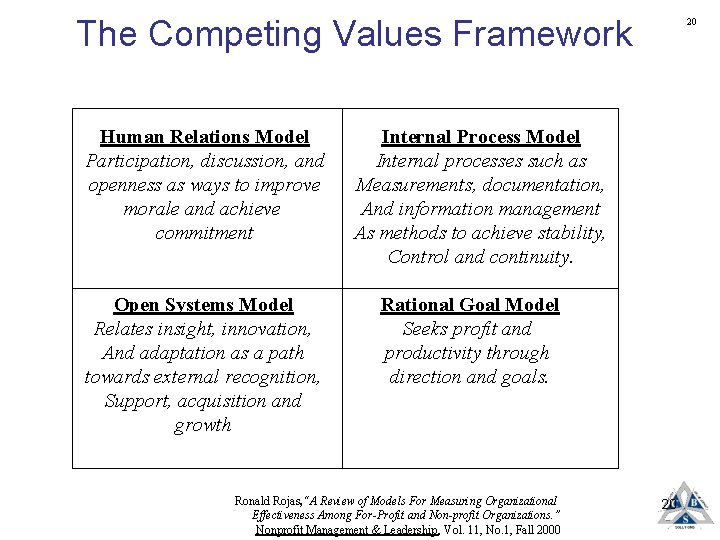
The Competing Values Framework Human Relations Model Participation, discussion, and openness as ways to improve morale and achieve commitment Open Systems Model Relates insight, innovation, And adaptation as a path towards external recognition, Support, acquisition and growth 20 Internal Process Model Internal processes such as Measurements, documentation, And information management As methods to achieve stability, Control and continuity. Rational Goal Model Seeks profit and productivity through direction and goals. Ronald Rojas, “A Review of Models For Measuring Organizational Effectiveness Among For-Profit and Non-profit Organizations. ” Nonprofit Management & Leadership, Vol. 11, No. 1, Fall 2000 20
21 CAPACITY BUILDING GENERAL ASSESSMENT QUESTIONS 21
22 Seven Key Capacity Building Assessment Questions 1. 2. 3. 4. 5. 6. 7. Which reform agenda seems to be most prevalent in the organizations thinking and how will this affect their capacity needs? Where does the organization fit on the Organizational Lifecycle framework and how will this impact their capacity needs? How are the 5 Forces of its industry affecting the organization and how will this affect their capacity needs? What is the organization’s growth strategy (market or product) and how will this impact their capacity needs? What is the relative size of the organization and how much market discipline does it have? Which values framework is the organization operating under and how will this affect their capacity needs? Where are the major capacity building methodology gaps? Why? 22
23 More Detailed Capacity Assessment Questions • Accountability: Does the organization hold people accountable for their results? How? • Adaptability: Is the organization adaptive and able to respond well to changing industry dynamics? • Asset Leverage: Does the organization do a good job of leveraging the assets it has at its disposal? • Attitude: Does the organization foster a clear high performance environment? • Board Effectiveness: Is the board considered a strong organizational asset? • Collaboration: Does the organization have a track record of collaborating well with other entities? • Creativity: To what extent does the organization cultivate a creative environment? 23
24 More Detailed Capacity Assessment Questions • Crisis Management: What is the organization's track record of dealing with crisis situations? And, are they in a constant sate of crisis? • Culture for Change: Does the organization historically embrace change or avoid it? • Entrepreneurial Culture: Does the organization possess an obvious "can do" attitude where things get done despite obstacles? • Financial Management: How strong is the organization’s current economic situation? What is its related capacity to absorb risk? • Human Resource Management: Does the organization effectively understand implement HR strategies that create a positive work environment for staff? • Information Technology: Does the organization effectively leverage technology to its benefit? 24
25 More Detailed Capacity Assessment Questions • Integrity of Purpose: Is it consistently clear to you and other stakeholders what the organization stands for and how it uses the information to access funding? • Leadership Vision: Does every staff person you talk to understand the values, vision and direction of the organization? • Management Talent: Does the organization have a strong base of management talent? • Marketing/Business Development: Does the organization effectively market its programs and services? • Market Leadership: Is the organization considered a market leader by its peer group? • Network of Support: Does the organization have a broad and deep network of supporters? • Operational Redundancy: Does the organization have the back-up capacity “bench strength” to support key roles and programs? 25
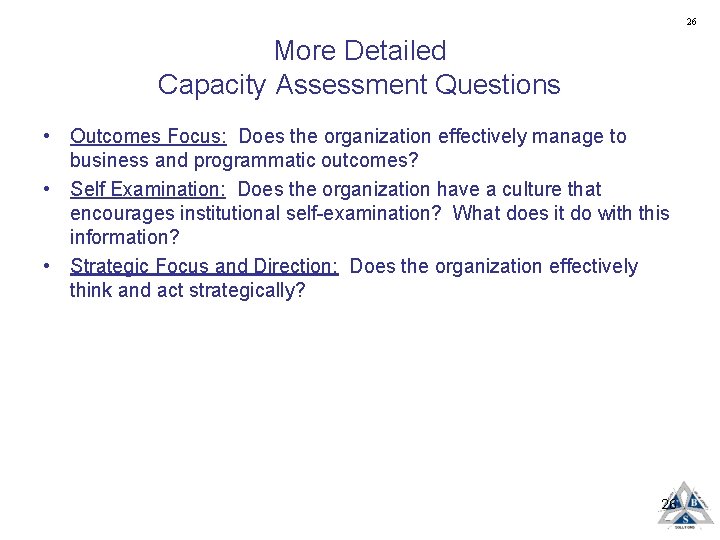
26 More Detailed Capacity Assessment Questions • Outcomes Focus: Does the organization effectively manage to business and programmatic outcomes? • Self Examination: Does the organization have a culture that encourages institutional self-examination? What does it do with this information? • Strategic Focus and Direction: Does the organization effectively think and act strategically? 26
27 Capacity Building Methodologies Note: Three examples in this section. Please see full overview document for more detailed information 27
28 D Le ad er sh ip Core Capacity Building Methodologies ev el op m en t Board Development Mission Effectiveness Decision Making Structure Strategic Planning Change Mgmt. Knowledge Mgmt. Outcomes Management Communications Mgmt. Development HR Mgmt. Financial Mgmt. Team Building Mktg. / Development Mgmt. Accountability/ Ownership 28
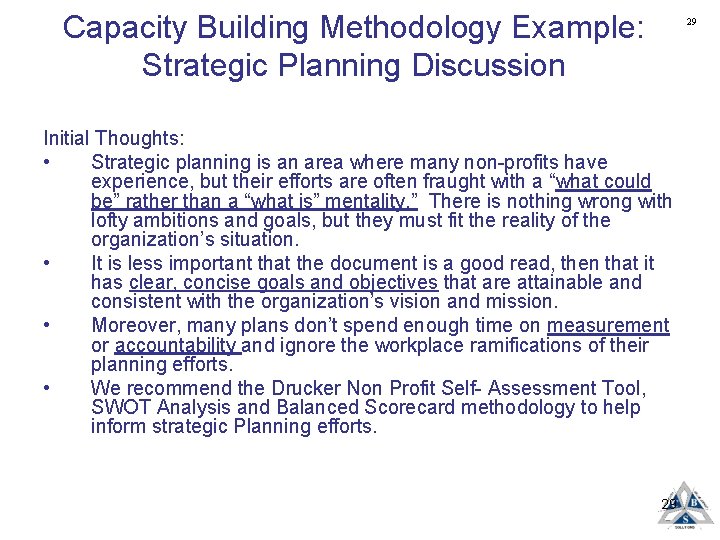
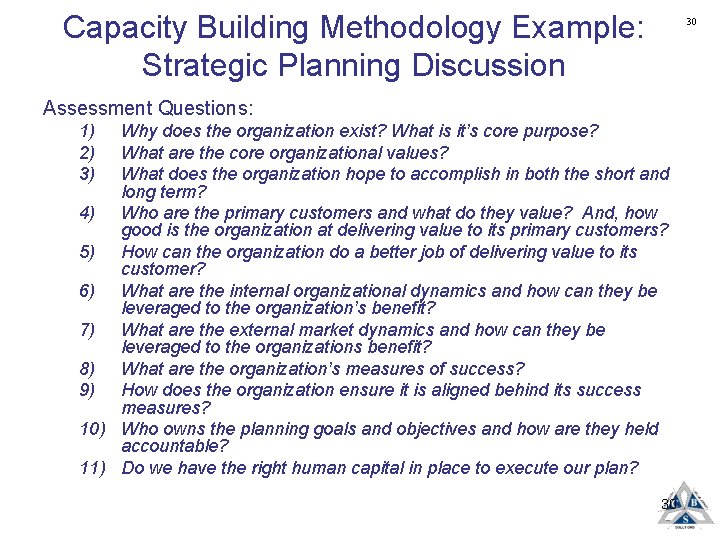
Capacity Building Methodology Example: Strategic Planning Discussion 29 Initial Thoughts: • Strategic planning is an area where many non-profits have experience, but their efforts are often fraught with a “what could be” rather than a “what is” mentality. ” There is nothing wrong with lofty ambitions and goals, but they must fit the reality of the organization’s situation. • It is less important that the document is a good read, then that it has clear, concise goals and objectives that are attainable and consistent with the organization’s vision and mission. • Moreover, many plans don’t spend enough time on measurement or accountability and ignore the workplace ramifications of their planning efforts. • We recommend the Drucker Non Profit Self- Assessment Tool, SWOT Analysis and Balanced Scorecard methodology to help inform strategic Planning efforts. 29
Capacity Building Methodology Example: Strategic Planning Discussion 30 Assessment Questions: 1) 2) 3) Why does the organization exist? What is it’s core purpose? What are the core organizational values? What does the organization hope to accomplish in both the short and long term? 4) Who are the primary customers and what do they value? And, how good is the organization at delivering value to its primary customers? 5) How can the organization do a better job of delivering value to its customer? 6) What are the internal organizational dynamics and how can they be leveraged to the organization’s benefit? 7) What are the external market dynamics and how can they be leveraged to the organizations benefit? 8) What are the organization’s measures of success? 9) How does the organization ensure it is aligned behind its success measures? 10) Who owns the planning goals and objectives and how are they held accountable? 11) Do we have the right human capital in place to execute our plan? 30
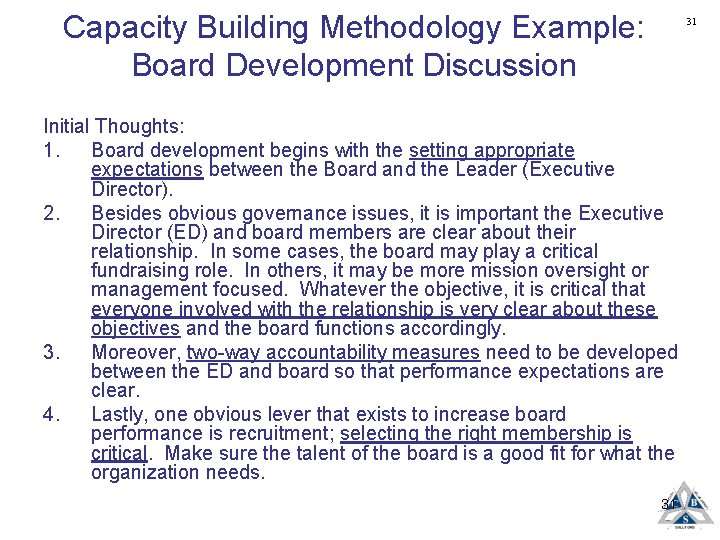
Capacity Building Methodology Example: Board Development Discussion 31 Initial Thoughts: 1. Board development begins with the setting appropriate expectations between the Board and the Leader (Executive Director). 2. Besides obvious governance issues, it is important the Executive Director (ED) and board members are clear about their relationship. In some cases, the board may play a critical fundraising role. In others, it may be more mission oversight or management focused. Whatever the objective, it is critical that everyone involved with the relationship is very clear about these objectives and the board functions accordingly. 3. Moreover, two-way accountability measures need to be developed between the ED and board so that performance expectations are clear. 4. Lastly, one obvious lever that exists to increase board performance is recruitment; selecting the right membership is critical. Make sure the talent of the board is a good fit for what the organization needs. 31
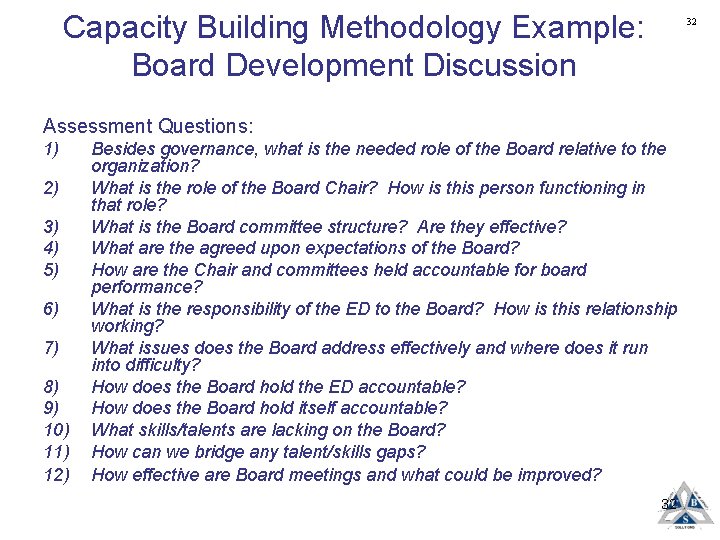
Capacity Building Methodology Example: Board Development Discussion 32 Assessment Questions: 1) 2) 3) 4) 5) 6) 7) 8) 9) 10) 11) 12) Besides governance, what is the needed role of the Board relative to the organization? What is the role of the Board Chair? How is this person functioning in that role? What is the Board committee structure? Are they effective? What are the agreed upon expectations of the Board? How are the Chair and committees held accountable for board performance? What is the responsibility of the ED to the Board? How is this relationship working? What issues does the Board address effectively and where does it run into difficulty? How does the Board hold the ED accountable? How does the Board hold itself accountable? What skills/talents are lacking on the Board? How can we bridge any talent/skills gaps? How effective are Board meetings and what could be improved? 32
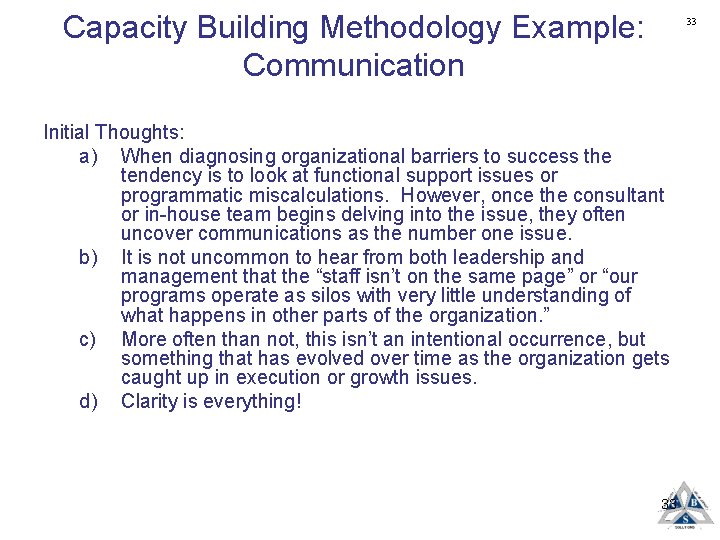
Capacity Building Methodology Example: Communication 33 Initial Thoughts: a) When diagnosing organizational barriers to success the tendency is to look at functional support issues or programmatic miscalculations. However, once the consultant or in-house team begins delving into the issue, they often uncover communications as the number one issue. b) It is not uncommon to hear from both leadership and management that the “staff isn’t on the same page” or “our programs operate as silos with very little understanding of what happens in other parts of the organization. ” c) More often than not, this isn’t an intentional occurrence, but something that has evolved over time as the organization gets caught up in execution or growth issues. d) Clarity is everything! 33
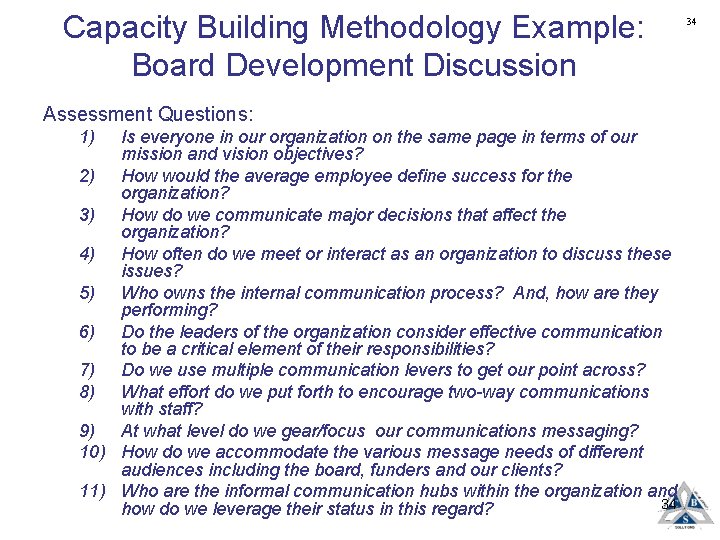
Capacity Building Methodology Example: Board Development Discussion Assessment Questions: 1) Is everyone in our organization on the same page in terms of our mission and vision objectives? 2) How would the average employee define success for the organization? 3) How do we communicate major decisions that affect the organization? 4) How often do we meet or interact as an organization to discuss these issues? 5) Who owns the internal communication process? And, how are they performing? 6) Do the leaders of the organization consider effective communication to be a critical element of their responsibilities? 7) Do we use multiple communication levers to get our point across? 8) What effort do we put forth to encourage two-way communications with staff? 9) At what level do we gear/focus our communications messaging? 10) How do we accommodate the various message needs of different audiences including the board, funders and our clients? 11) Who are the informal communication hubs within the organization and 34 how do we leverage their status in this regard? 34
35 CAPACITY BUILDING LESSONS LEARNED 35
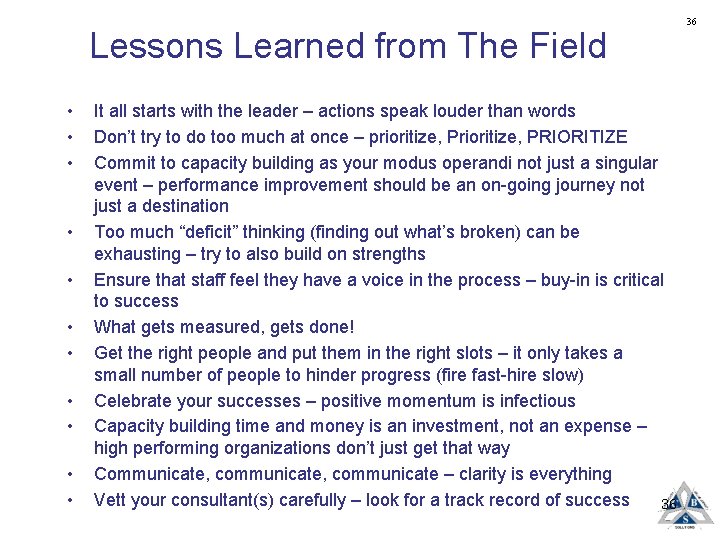
Lessons Learned from The Field • • • It all starts with the leader – actions speak louder than words Don’t try to do too much at once – prioritize, PRIORITIZE Commit to capacity building as your modus operandi not just a singular event – performance improvement should be an on-going journey not just a destination Too much “deficit” thinking (finding out what’s broken) can be exhausting – try to also build on strengths Ensure that staff feel they have a voice in the process – buy-in is critical to success What gets measured, gets done! Get the right people and put them in the right slots – it only takes a small number of people to hinder progress (fire fast-hire slow) Celebrate your successes – positive momentum is infectious Capacity building time and money is an investment, not an expense – high performing organizations don’t just get that way Communicate, communicate – clarity is everything Vett your consultant(s) carefully – look for a track record of success 36 36
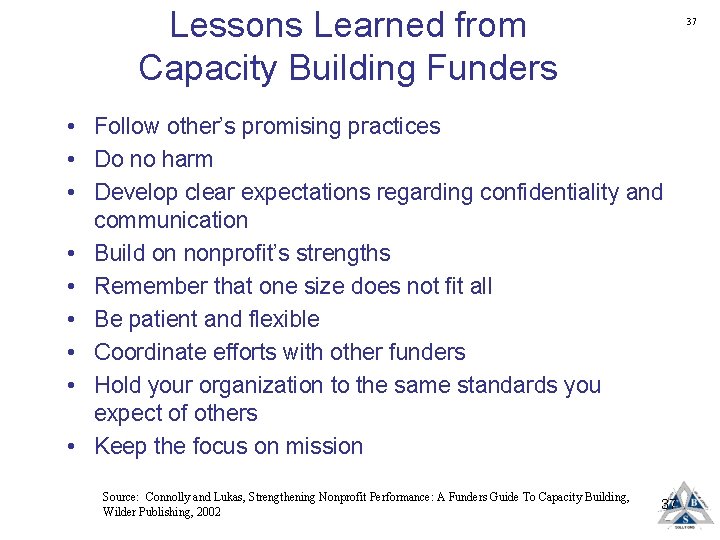
Lessons Learned from Capacity Building Funders 37 • Follow other’s promising practices • Do no harm • Develop clear expectations regarding confidentiality and communication • Build on nonprofit’s strengths • Remember that one size does not fit all • Be patient and flexible • Coordinate efforts with other funders • Hold your organization to the same standards you expect of others • Keep the focus on mission Source: Connolly and Lukas, Strengthening Nonprofit Performance: A Funders Guide To Capacity Building, Wilder Publishing, 2002 37
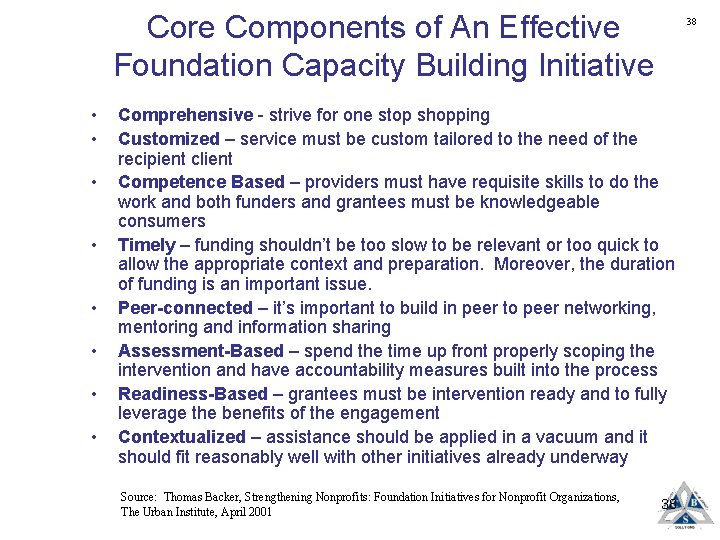
Core Components of An Effective Foundation Capacity Building Initiative • • 38 Comprehensive - strive for one stop shopping Customized – service must be custom tailored to the need of the recipient client Competence Based – providers must have requisite skills to do the work and both funders and grantees must be knowledgeable consumers Timely – funding shouldn’t be too slow to be relevant or too quick to allow the appropriate context and preparation. Moreover, the duration of funding is an important issue. Peer-connected – it’s important to build in peer to peer networking, mentoring and information sharing Assessment-Based – spend the time up front properly scoping the intervention and have accountability measures built into the process Readiness-Based – grantees must be intervention ready and to fully leverage the benefits of the engagement Contextualized – assistance should be applied in a vacuum and it should fit reasonably well with other initiatives already underway Source: Thomas Backer, Strengthening Nonprofits: Foundation Initiatives for Nonprofit Organizations, The Urban Institute, April 2001 38
39 SESSION WRAP-UP 39
40 Session Wrap-Up What Did We Learn Today? What can we do with this knowledge? • • • 40
41 “He/She is the best leader who most fully understands the nature of things, so that his/her plans are not doomed to ultimate failure; who possesses an active, far-ranging imagination which can see many possibilities; who has a sense of values, so that among possibilities he/she is able to choose the most excellent; who has a sense of order, to give form, design and program to the values and purposes he/she selects; who has practical sense and judgment, and so uses the most feasible means to accomplish his/her ends; and who has the energy and enthusiasm to carry his/her plans persistently toward fruition. ” --- Arthur E. Morgan 41
42 Ed Robinson President Capacity Building Solutions Inc. / TEC Chair Group #663 301/624 -5686 robin_ed@capacity-building. com http: //www. capacity-building. com 42