
1 Date 20121025 Author Yosi Mass Yehoshua Sagiv






![15 IR Relevance l (normalize) l (- ∞ ; Rmax] → interval [0; 1]](https://slidetodoc.com/presentation_image/b314fe03451a555d703f73d32f3944cc/image-15.jpg "15 IR Relevance l (normalize) l (- ∞ ; Rmax] → interval [0; 1]")





- Slides: 28
1 Date : 2012/10/25 Author : Yosi Mass, Yehoshua Sagiv Source : WSDM’ 12 Speaker : Er-Gang Liu Advisor : Dr. Jia-ling Koh
2 Outline • Introduction • Language Model • Ranking Answers • IR Relevance (Language Model) • Language Models for Data Graphs • Normalization • Structural weights • Graph Weights • Experiment • Conclusion
3 Outline • Introduction • Language Model • Ranking Answers • IR Relevance (Language Model) • Language Models for Data Graphs • Normalization • Structural weights • Graph Weights • Experiment • Conclusion
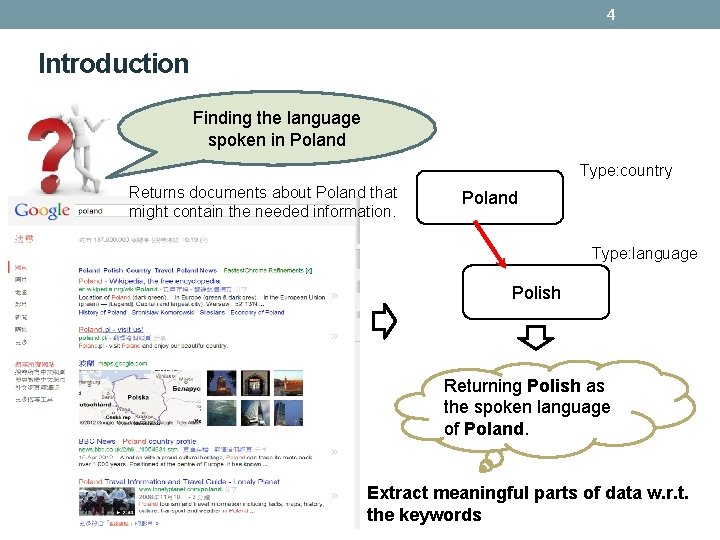
4 Introduction Finding the language spoken in Poland Type: country Returns documents about Poland that might contain the needed information. Poland Type: language Polish Returning Polish as the spoken language of Poland. Extract meaningful parts of data w. r. t. the keywords
Introduction - Data Graph l l l Structural node : tuple , Keyword node : keywords Edges : foreign-key references Edges and nodes may have weights Weak relationships are penalized by large weights Keywords
6 Introduction - Goal • Efficiently generating answer (Candidate answer) Using the algorithm to create a node for each keyword of the given query, and then add edges from keyword to all the nodes of the data graph that contain keyword. K. Golenberg, B. Kimelfeld, and Y. Sagiv. Keyword proximity search in complex data graphs. In SIGMOD, 2008. • Ranking the candidate answers (This Paper focus on) Finding methods for effectively ranking the generated answers according to their relevance to the user.
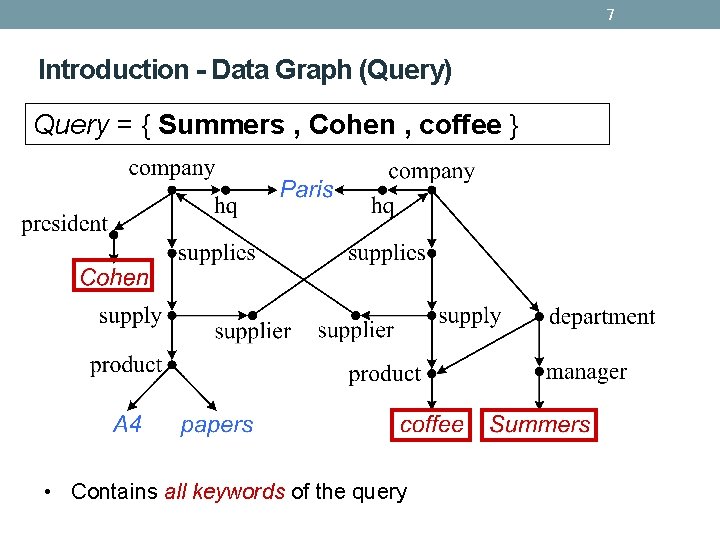
7 Introduction - Data Graph (Query) Query = { Summers , Cohen , coffee } • Contains all keywords of the query
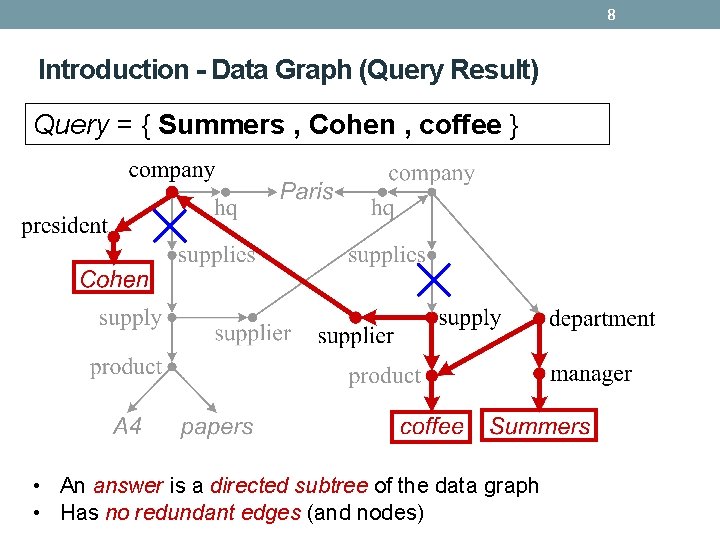
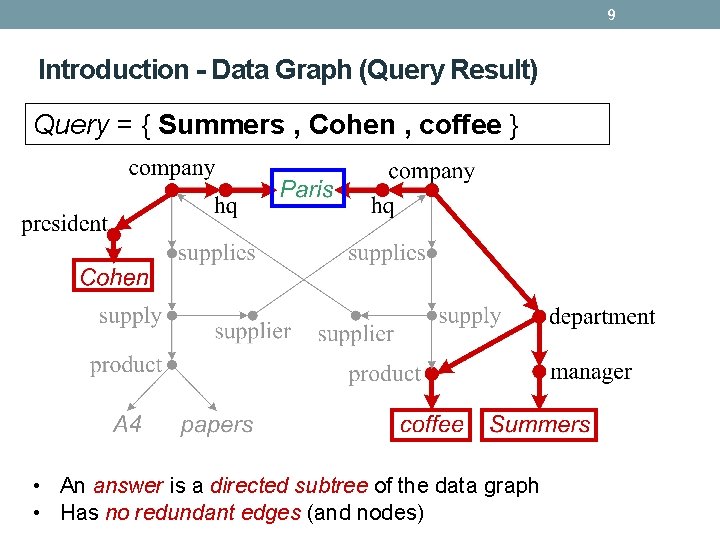
8 Introduction - Data Graph (Query Result) Query = { Summers , Cohen , coffee } • An answer is a directed subtree of the data graph • Has no redundant edges (and nodes)
9 Introduction - Data Graph (Query Result) Query = { Summers , Cohen , coffee } • An answer is a directed subtree of the data graph • Has no redundant edges (and nodes)
10 Outline • Introduction • Language Model • Ranking Answers • IR Relevance (Language Model) • Language Models for Data Graphs • Normalization • Structural weights • Graph Weights • Experiment • Conclusion
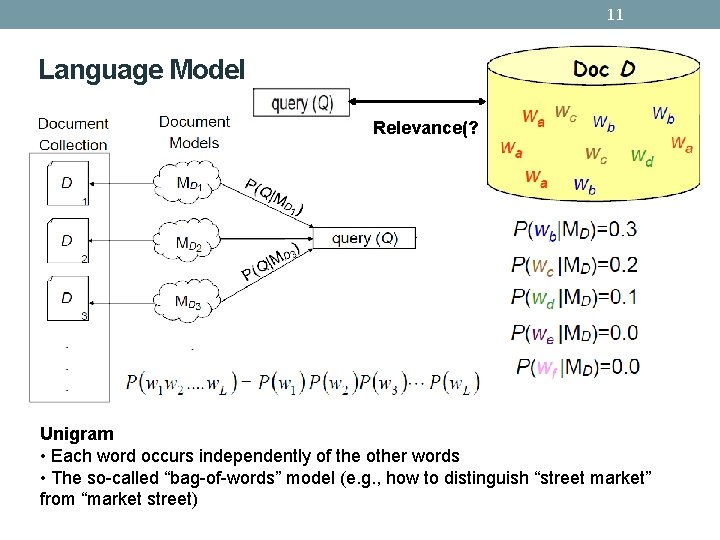
11 Language Model Relevance(? Unigram • Each word occurs independently of the other words • The so-called “bag-of-words” model (e. g. , how to distinguish “street market” from “market street)
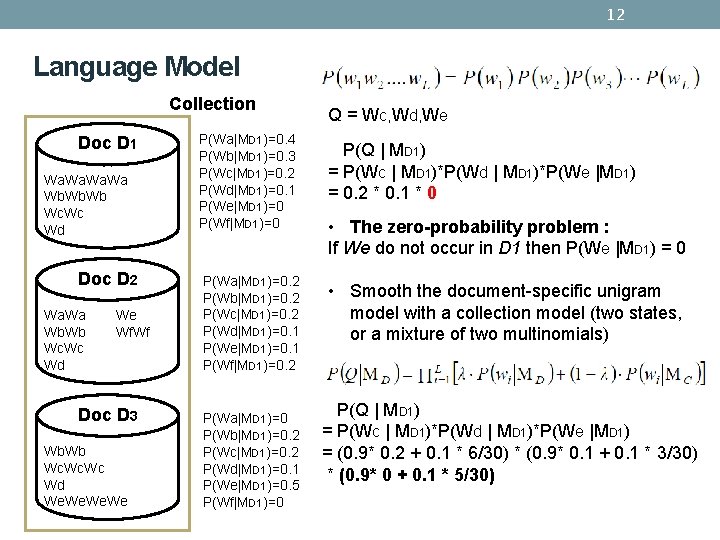
12 Language Model Collection Doc D 1 Wa. Wa. Wa Wb. Wb Wc. Wc Wd Doc D 2 Wa. Wa Wb. Wb Wc. Wc Wd We Wf. Wf Doc D 3 Wb. Wb Wc. Wc Wd We. We. We P(Wa|MD 1)=0. 4 P(Wb|MD 1)=0. 3 P(Wc|MD 1)=0. 2 P(Wd|MD 1)=0. 1 P(We|MD 1)=0 P(Wf|MD 1)=0 P(Wa|MD 1)=0. 2 P(Wb|MD 1)=0. 2 P(Wc|MD 1)=0. 2 P(Wd|MD 1)=0. 1 P(We|MD 1)=0. 1 P(Wf|MD 1)=0. 2 P(Wa|MD 1)=0 P(Wb|MD 1)=0. 2 P(Wc|MD 1)=0. 2 P(Wd|MD 1)=0. 1 P(We|MD 1)=0. 5 P(Wf|MD 1)=0 Q = Wc, Wd, We P(Q | MD 1) = P(Wc | MD 1)*P(Wd | MD 1)*P(We |MD 1) = 0. 2 * 0. 1 * 0 • The zero-probability problem : If We do not occur in D 1 then P(We |MD 1) = 0 • Smooth the document-specific unigram model with a collection model (two states, or a mixture of two multinomials) P(Q | MD 1) = P(Wc | MD 1)*P(Wd | MD 1)*P(We |MD 1) = (0. 9* 0. 2 + 0. 1 * 6/30) * (0. 9* 0. 1 + 0. 1 * 3/30) * (0. 9* 0 + 0. 1 * 5/30)
13 Outline • Introduction • Language Model • Ranking Answers • IR Relevance (Language Model) • Language Models for Data Graphs • Normalization • Structural weights • Graph Weights • Experiment • Conclusion
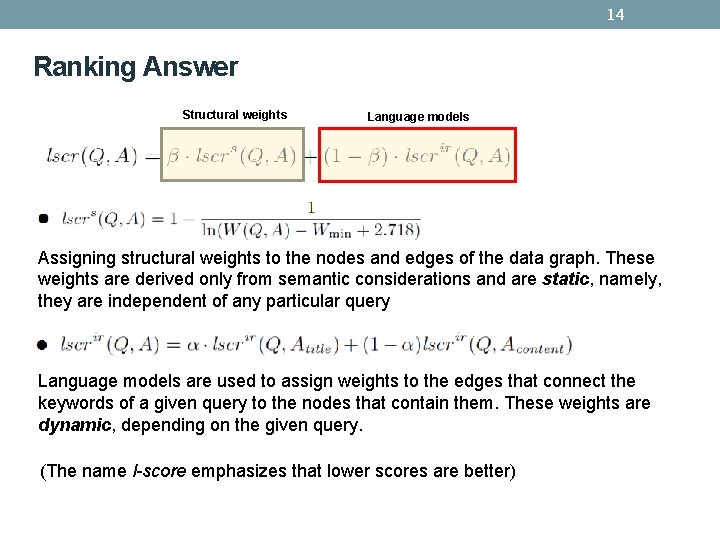
14 Ranking Answer Structural weights Language models Assigning structural weights to the nodes and edges of the data graph. These weights are derived only from semantic considerations and are static, namely, they are independent of any particular query Language models are used to assign weights to the edges that connect the keywords of a given query to the nodes that contain them. These weights are dynamic, depending on the given query. (The name l-score emphasizes that lower scores are better)
15 IR Relevance l (normalize) l (- ∞ ; Rmax] → interval [0; 1] ) l MAX:ln( - Rmax min:ln( - (-∞) + Rmax + 2. 718 ) = ln (2. 718) = 1 , 2. 718 ) = ln (∞ ) = ∞ , = 1 - 1 = 0 = 1 - 1/ ∞ = 1 l Using logarithm in the above equation so that lscr ir(Q; Af ) will not grow too fast as R(Q; Af ) l Avoid underflow when taking the product of many probabilities.
16 Outline • Introduction • Language Model • Ranking Answers • IR Relevance (Language Model) • Language Models for Data Graphs • Normalization • Structural weights • Graph Weights • Experiment • Conclusion
17 Graph Weights - Weight of an Node Static weights of nodes Static weights of edges Idg(v) = 1 : The weight of a node v, denoted by w(v), is , interval [0; static and depends on its incoming edges 1] ln( 1. 718 + 1 ) = ln (2. 718) = 1 , w(v) = 1 (max) v Idg(v) = 3 : v ln( 1. 718 + 3 ) = ln (4. 718) = 1. 55 , w(v) = 0. 645 The more incoming edges there are, the lower the weight is, which means that nodes with many incoming edges are more important.
18 Graph Weights - Weight of an Edge Static weights of edges • Let fdg(e) be the number of edges that have the same type as e and are from u to nodes with the same type as v. • An edge with fewer similar edges is more unique and, hence, describes a stronger semantic relationship between its nodes. • Let tdg(e) be the number of edges that have the same type as e, emanate from nodes with the same type as u and point to v. Strongest!
19 Outline • Introduction • Language Model • Ranking Answers • IR Relevance (Language Model) • Language Models for Data Graphs • Normalization • Structural weights • Graph Weights • Experiment • Conclusion
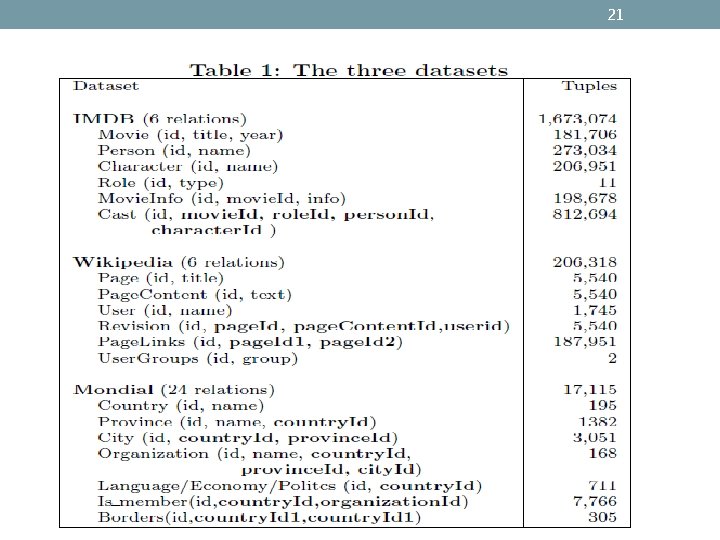
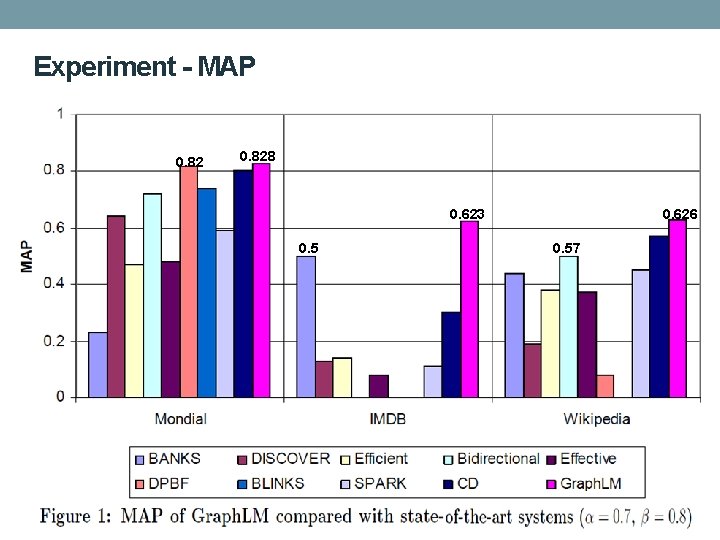
20 Experiment Datasets: Subsets of Wikipedia, IMDB and Mondial Web databases Queries: 50 queries for each dataset including Metrics: Mean Average Precision (MAP) The number of top-1 relevant results Reciprocal rank
21
Experiment - MAP 0. 828 0. 626 0. 623 0. 57
Experiment – Top 1 & RR
24 Experiment - MRR 0. 97 0. 891 0. 925 0. 86 1 0. 924
25 Outline • Introduction • Language Model • Ranking Answers • IR Relevance (Language Model) • Language Models for Data Graphs • Normalization • Structural weights • Graph Weights • Experiment • Conclusion
26 Conclusion • Presenting a novel and effective ranking technique for keyword search over data graphs. • language models • structural weights • Conclude that systems for keyword search can also be used as effective retrieval engines
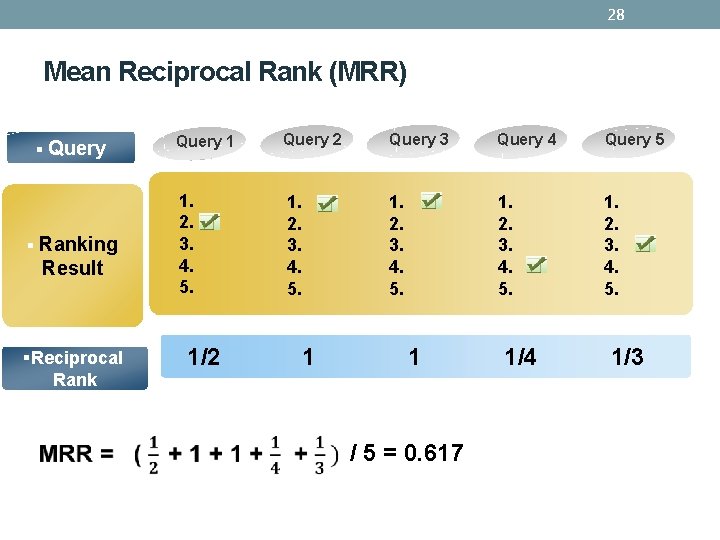
27 • MAP(Mean Average Precision) Topic 1 : There are 4 relative document ‧ rank : 1, 2, 4, 7 Topic 2 : There are 5 relative document ‧ rank : 1, 3 , 5 , 7 , 10 Topic 1 Average Precision : (1/1+2/2+3/4+4/7)/4=0. 83。 Topic 2 Average Precision : (1/1+2/3+3/5+4/7+5/10)/5=0. 45。 MAP= (0. 83+0. 45)/2=0. 64。 • Reciprocal Rank Topic 1 Reciprocal Rank : (1+1/2+1/4+1/7)/4=0. 473。 Topic 2 Reciprocal Rank : (1+1/3+1/5+1/7+1/10)/5=0. 354。 MRR= (0. 473+0. 354)/2=0. 4135。
28 Mean Reciprocal Rank (MRR) § Query § Ranking Result §Reciprocal Rank Query 1 Query 2 Query 3 Query 4 Query 5 1. 2. 3. 4. 5. 1/2 1 1 / 5 = 0. 617 1/4 1/3