
1 D Kinematics Free Fall Galileo Galilei l

- Slides: 12
1 -D Kinematics Free Fall
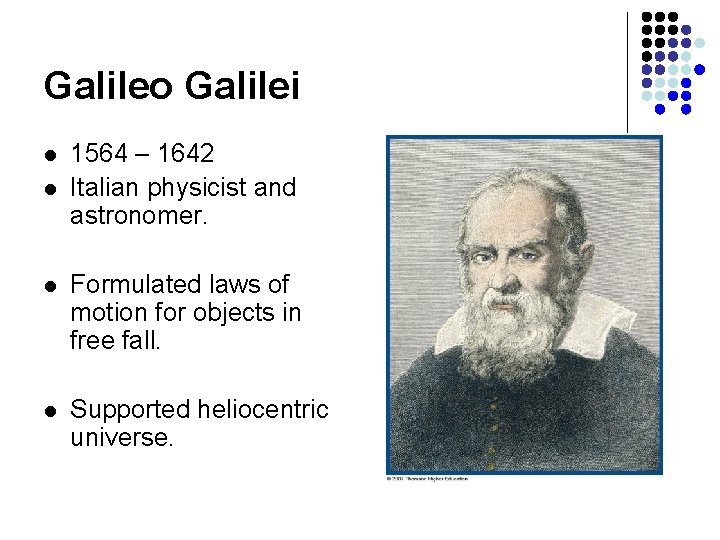
Galileo Galilei l l 1564 – 1642 Italian physicist and astronomer. l Formulated laws of motion for objects in free fall. l Supported heliocentric universe.
Freely Falling Objects l A freely falling object is moving under the influence of gravity alone. l l We will neglect air resistance. Acceleration does not depend on the launching conditions of the object: l l l Dropped – released from rest Launched downward Launched upward
Acceleration of Freely Falling Object l The acceleration of an object in free fall is directed downward, regardless of the initial motion. l Its magnitude is constant, g = 9. 80 m/s 2 l l g decreases with altitude g varies with latitude, Earth crust composition, etc 9. 80 m/s 2 is the average at the Earth’s surface It doesn’t come with a negative sign included
Acceleration of Free Fall l Free fall motion is constantly accelerated motion in one dimension. l Let upward be positive l Use: l l kinematic equations with ay = -g = - 9. 80 m/s 2
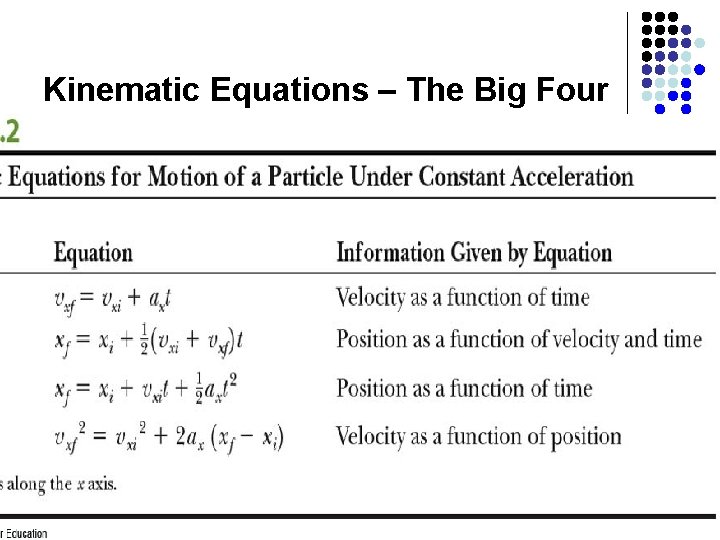
Kinematic Equations – The Big Four
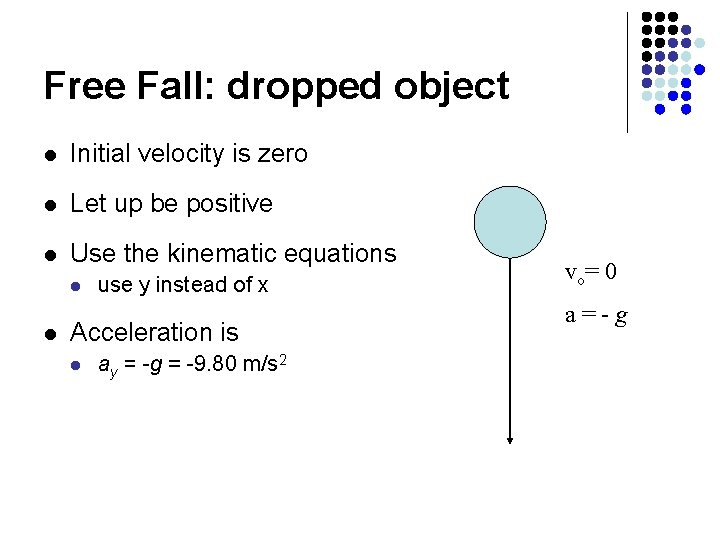
Free Fall: dropped object l Initial velocity is zero l Let up be positive l Use the kinematic equations l l use y instead of x Acceleration is l ay = -g = -9. 80 m/s 2 vo= 0 a=-g
Free Fall: object launched downward l ay = -g = -9. 80 m/s 2 l Initial velocity vy, i < 0 l With upward being positive, initial velocity will be negative vo≠ 0 a = -g
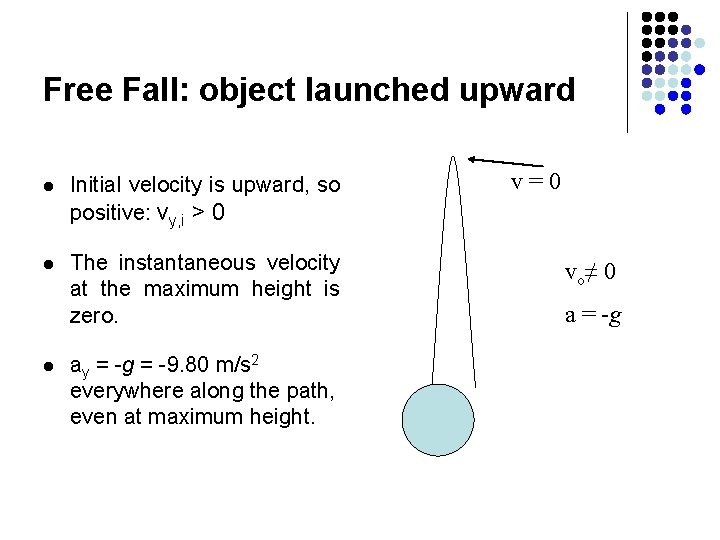
Free Fall: object launched upward l Initial velocity is upward, so positive: vy, i > 0 l The instantaneous velocity at the maximum height is zero. l ay = -g = -9. 80 m/s 2 everywhere along the path, even at maximum height. v=0 vo≠ 0 a = -g
Object Launched Upward. l If the motion is symmetrical, i. e. end point coincides with start point: l l l Then tup = tdown Then vfinal = -vinitial If the motion is not symmetrical: l Break the motion into various parts l Generally up and down
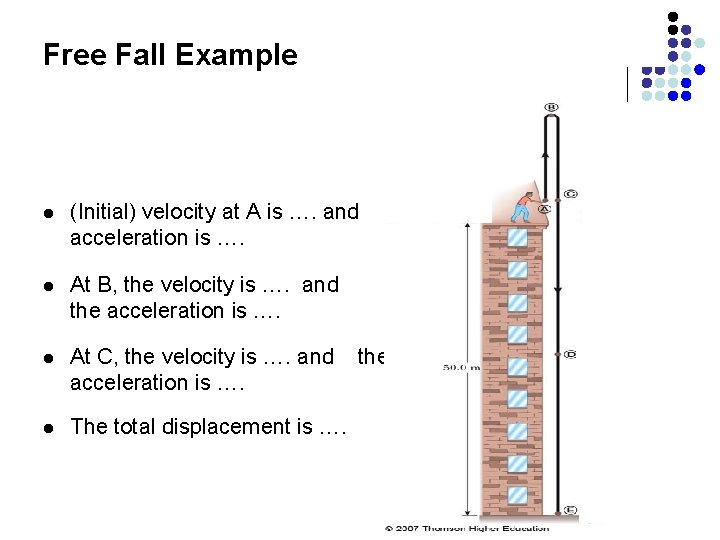
Free Fall Example l (Initial) velocity at A is …. and acceleration is …. l At B, the velocity is …. and the acceleration is …. l At C, the velocity is …. and acceleration is …. l The total displacement is …. the
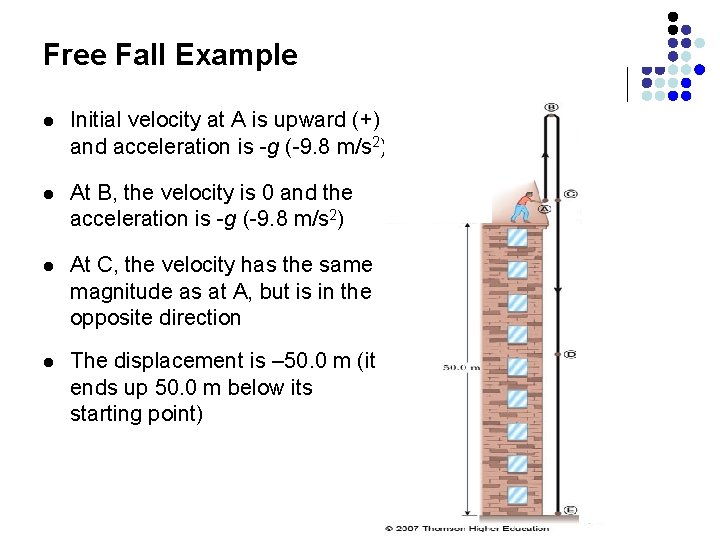
Free Fall Example l Initial velocity at A is upward (+) and acceleration is -g (-9. 8 m/s 2) l At B, the velocity is 0 and the acceleration is -g (-9. 8 m/s 2) l At C, the velocity has the same magnitude as at A, but is in the opposite direction l The displacement is – 50. 0 m (it ends up 50. 0 m below its starting point)