
1 CS340 Introduction to Computer Networking Lecture 6
- Slides: 27
1 CS-340 Introduction to Computer Networking Lecture 6: TCP Steve Tarzia Many diagrams & slides are adapted from those by J. F Kurose and K. W. Ross
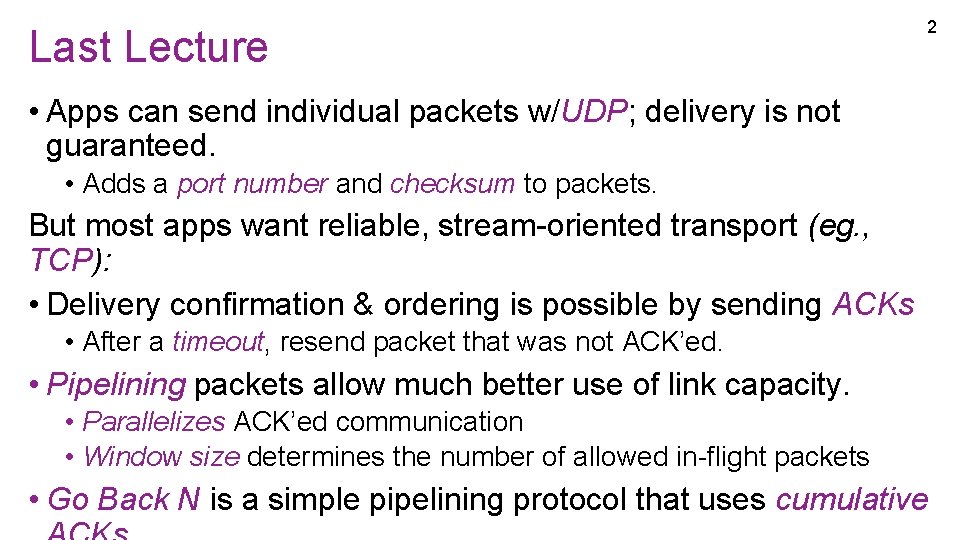
Last Lecture 2 • Apps can send individual packets w/UDP; delivery is not guaranteed. • Adds a port number and checksum to packets. But most apps want reliable, stream-oriented transport (eg. , TCP): • Delivery confirmation & ordering is possible by sending ACKs • After a timeout, resend packet that was not ACK’ed. • Pipelining packets allow much better use of link capacity. • Parallelizes ACK’ed communication • Window size determines the number of allowed in-flight packets • Go Back N is a simple pipelining protocol that uses cumulative
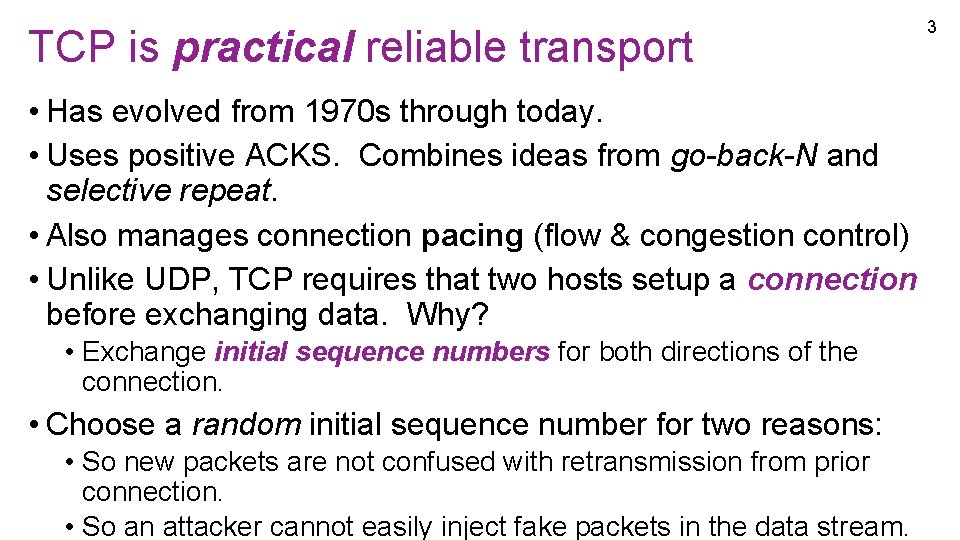
TCP is practical reliable transport • Has evolved from 1970 s through today. • Uses positive ACKS. Combines ideas from go-back-N and selective repeat. • Also manages connection pacing (flow & congestion control) • Unlike UDP, TCP requires that two hosts setup a connection before exchanging data. Why? • Exchange initial sequence numbers for both directions of the connection. • Choose a random initial sequence number for two reasons: • So new packets are not confused with retransmission from prior connection. • So an attacker cannot easily inject fake packets in the data stream. 3
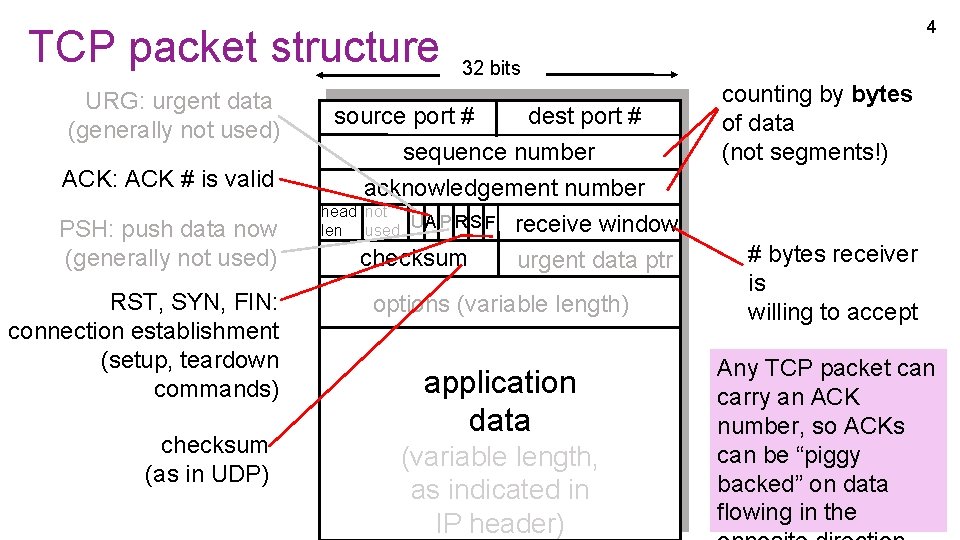
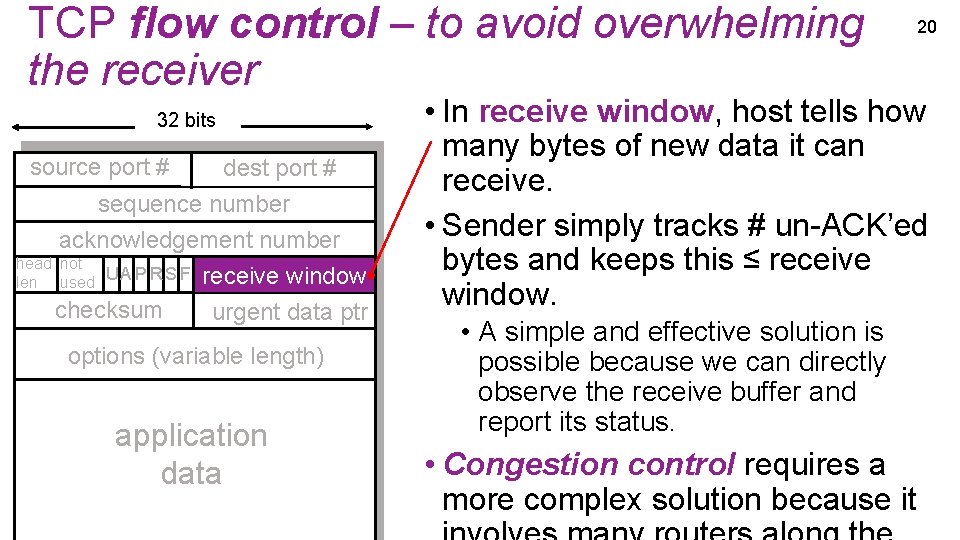
TCP packet structure URG: urgent data (generally not used) ACK: ACK # is valid PSH: push data now (generally not used) RST, SYN, FIN: connection establishment (setup, teardown commands) checksum (as in UDP) 4 32 bits source port # dest port # sequence number acknowledgement number head not U A P R S F receive window len used checksum urgent data ptr options (variable length) application data (variable length, as indicated in IP header) counting by bytes of data (not segments!) # bytes receiver is willing to accept Any TCP packet can carry an ACK number, so ACKs can be “piggy backed” on data flowing in the
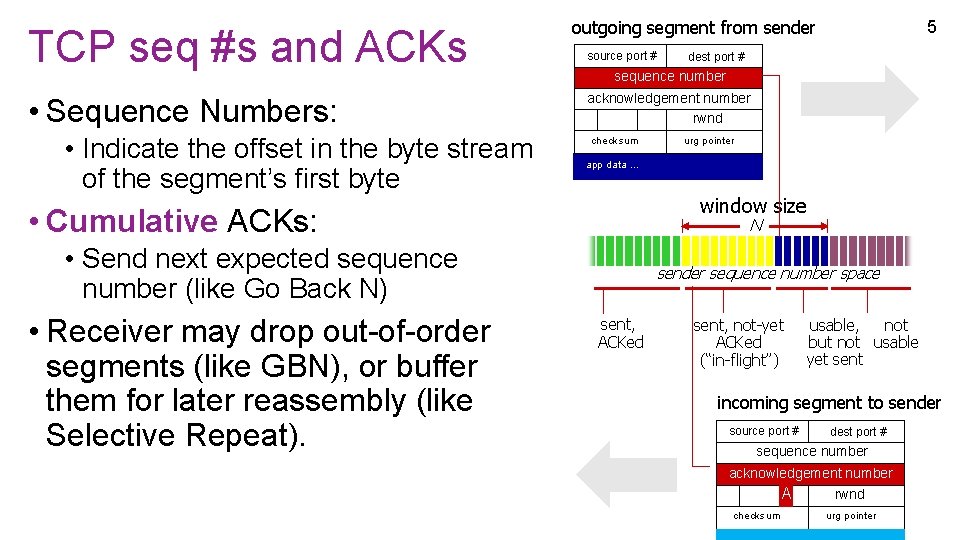
TCP seq #s and ACKs • Sequence Numbers: • Indicate the offset in the byte stream of the segment’s first byte outgoing segment from sender source port # dest port # sequence number acknowledgement number rwnd checksum urg pointer app data … window size • Cumulative ACKs: N • Send next expected sequence number (like Go Back N) • Receiver may drop out-of-order segments (like GBN), or buffer them for later reassembly (like Selective Repeat). 5 sender sequence number space sent, ACKed sent, not-yet ACKed (“in-flight”) usable, not but not usable yet sent incoming segment to sender source port # dest port # sequence number acknowledgement number rwnd A checksum urg pointer
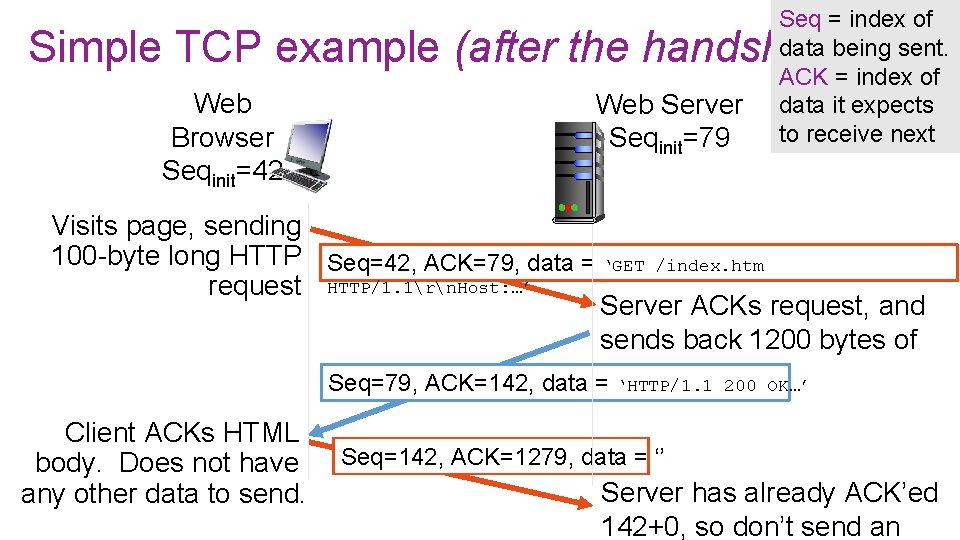
Seq = index of 6 data being sent. ACK = index of data it expects to receive next Simple TCP example (after the handshake) Web Browser Seqinit=42 Web Server Seqinit=79 Visits page, sending 100 -byte long HTTP Seq=42, ACK=79, data = ‘GET /index. htm request HTTP/1. 1rn. Host: …’ Server ACKs request, and sends back 1200 bytes of Seq=79, ACK=142, data =HTML ‘HTTP/1. 1 200 OK…’ Client ACKs HTML body. Does not have any other data to send. Seq=142, ACK=1279, data = ‘’ Server has already ACK’ed 142+0, so don’t send an
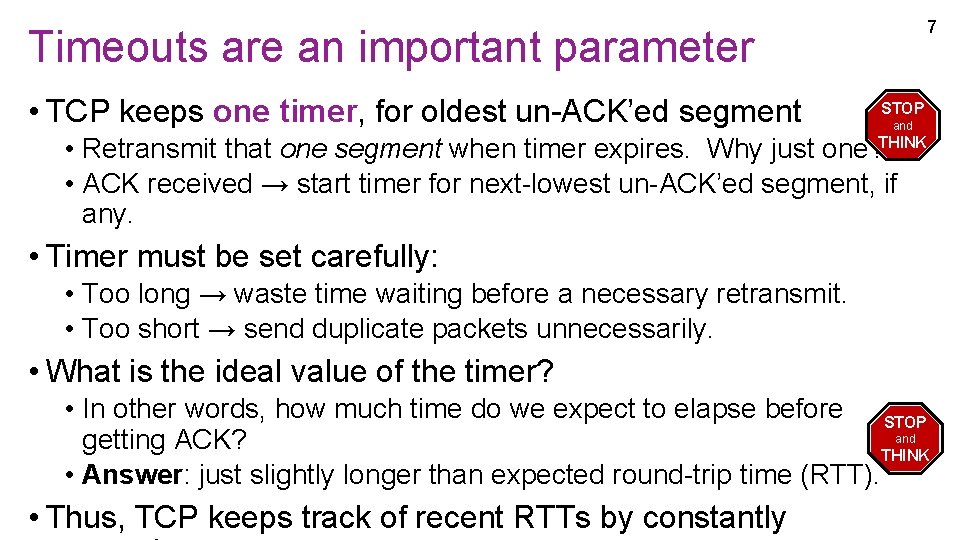
7 Timeouts are an important parameter • TCP keeps one timer, for oldest un-ACK’ed segment STOP and • Retransmit that one segment when timer expires. Why just one? THINK • ACK received → start timer for next-lowest un-ACK’ed segment, if any. • Timer must be set carefully: • Too long → waste time waiting before a necessary retransmit. • Too short → send duplicate packets unnecessarily. • What is the ideal value of the timer? • In other words, how much time do we expect to elapse before STOP and getting ACK? THINK • Answer: just slightly longer than expected round-trip time (RTT). • Thus, TCP keeps track of recent RTTs by constantly
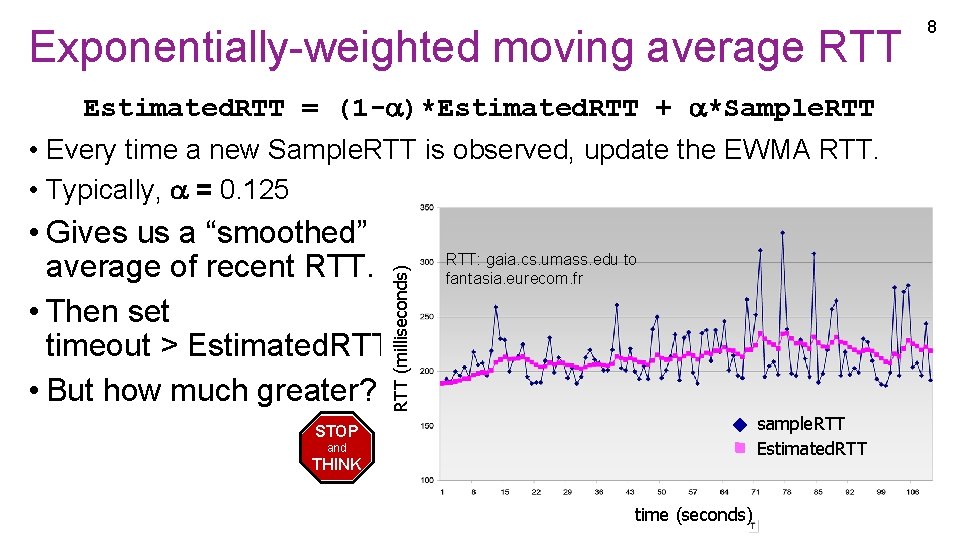
Exponentially-weighted moving average RTT Estimated. RTT = (1 - )*Estimated. RTT + *Sample. RTT • Every time a new Sample. RTT is observed, update the EWMA RTT. • Typically, = 0. 125 RTT (milliseconds) • Gives us a “smoothed” average of recent RTT. • Then set timeout > Estimated. RTT • But how much greater? RTT: gaia. cs. umass. edu to fantasia. eurecom. fr sample. RTT Estimated. RTT STOP and THINK time (seconds) 8
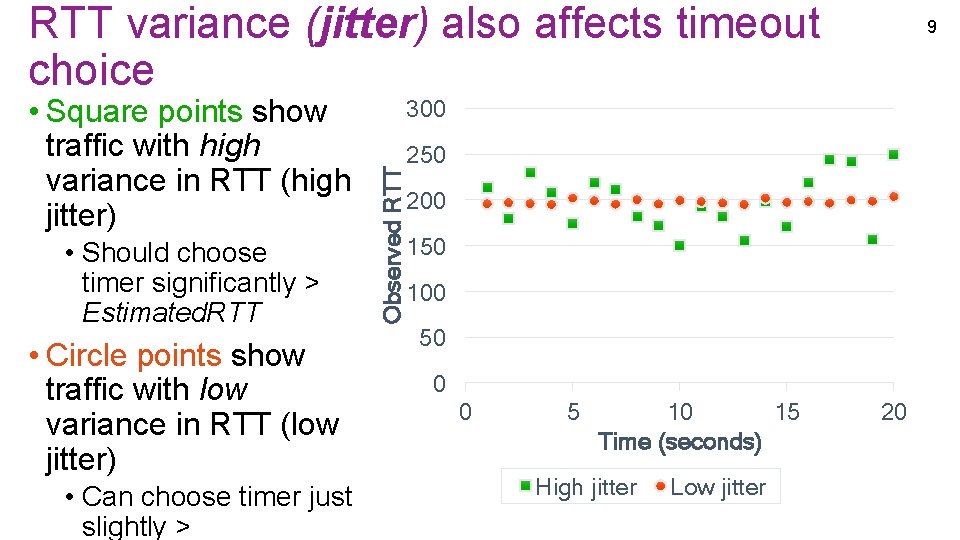
RTT variance (jitter) also affects timeout choice • Should choose timer significantly > Estimated. RTT • Circle points show traffic with low variance in RTT (low jitter) • Can choose timer just slightly > 300 Observed RTT • Square points show traffic with high variance in RTT (high jitter) 9 250 200 150 100 50 0 0 5 10 15 Time (seconds) High jitter Low jitter 20
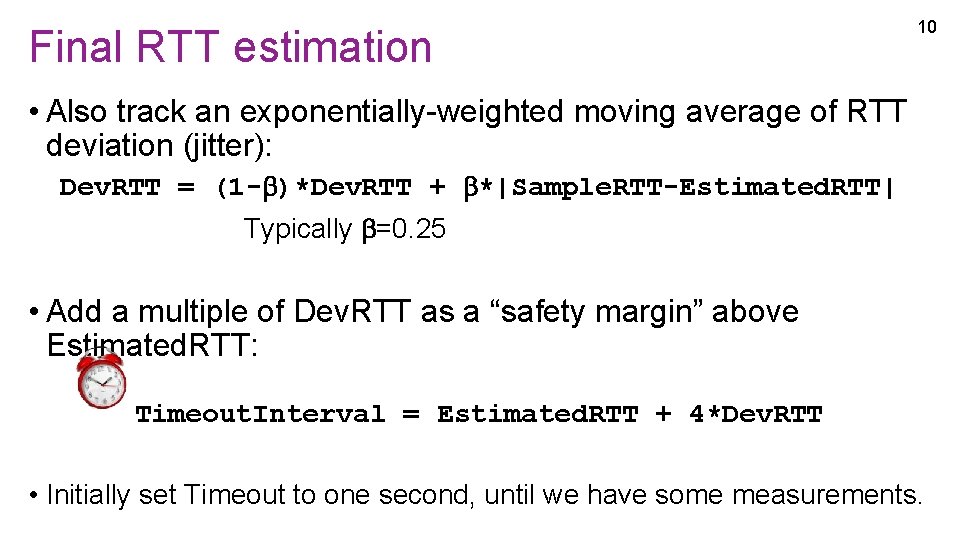
Final RTT estimation 10 • Also track an exponentially-weighted moving average of RTT deviation (jitter): Dev. RTT = (1 - )*Dev. RTT + *|Sample. RTT-Estimated. RTT| Typically =0. 25 • Add a multiple of Dev. RTT as a “safety margin” above Estimated. RTT: Timeout. Interval = Estimated. RTT + 4*Dev. RTT • Initially set Timeout to one second, until we have some measurements.
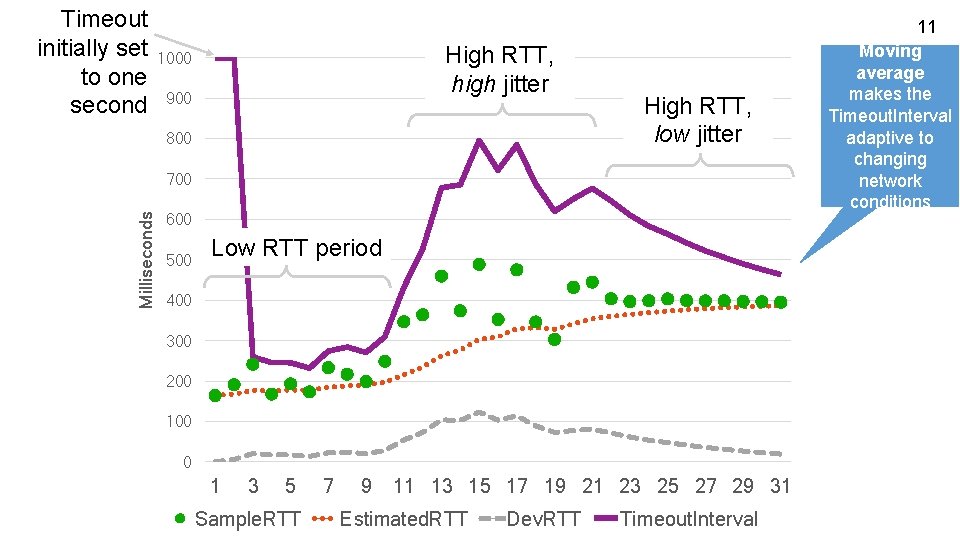
Timeout initially set to one second High RTT, high jitter 1000 900 800 High RTT, low jitter Milliseconds 700 600 500 Low RTT period 400 300 200 100 0 1 3 5 Sample. RTT 7 9 11 13 15 17 19 21 23 25 27 29 31 Estimated. RTT Dev. RTT Timeout. Interval 11 Moving average makes the Timeout. Interval adaptive to changing network conditions
12 Intermission
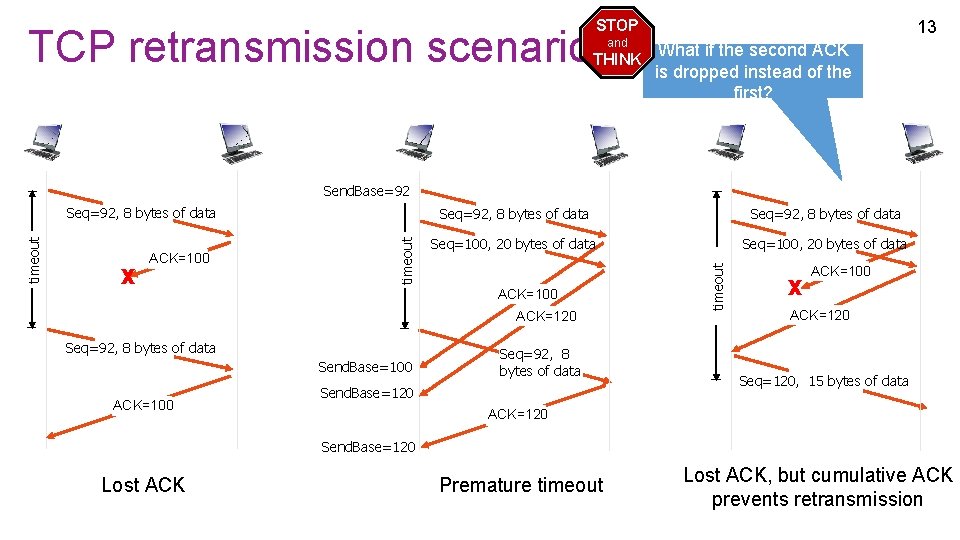
STOP TCP retransmission scenarios and THINK 13 What if the second ACK is dropped instead of the first? Send. Base=92 Seq=92, 8 bytes of data Seq=100, 20 bytes of data ACK=100 ACK=120 Seq=92, 8 bytes of data Send. Base=100 ACK=100 Seq=92, 8 bytes of data Send. Base=120 timeout X ACK=100 timeout Seq=92, 8 bytes of data X ACK=100 ACK=120 Seq=120, 15 bytes of data ACK=120 Send. Base=120 Lost ACK Premature timeout Lost ACK, but cumulative ACK prevents retransmission
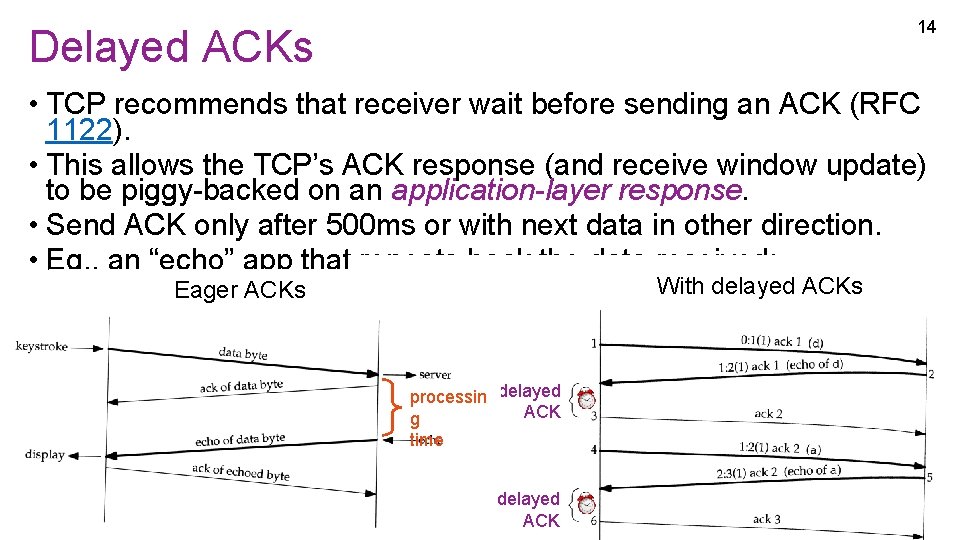
14 Delayed ACKs • TCP recommends that receiver wait before sending an ACK (RFC 1122). • This allows the TCP’s ACK response (and receive window update) to be piggy-backed on an application-layer response. • Send ACK only after 500 ms or with next data in other direction. • Eg. , an “echo” app that repeats back the data received: With delayed ACKs Eager ACKs processin delayed ACK g time delayed ACK
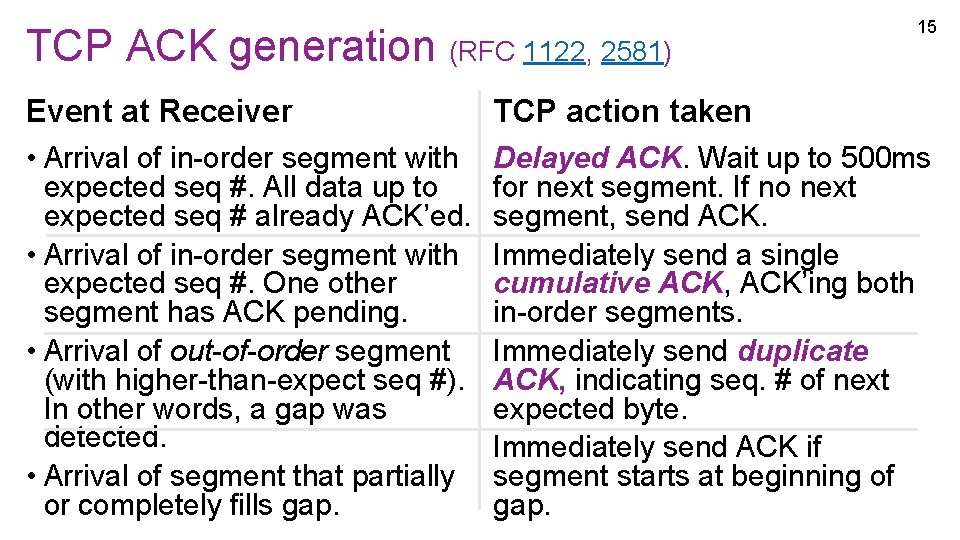
TCP ACK generation (RFC 1122, 2581) Event at Receiver • Arrival of in-order segment with 15 TCP action taken Delayed ACK. Wait up to 500 ms for next segment. If no next expected seq #. All data up to expected seq # already ACK’ed. segment, send ACK. • Arrival of in-order segment with Immediately send a single cumulative ACK, ACK’ing both expected seq #. One other in-order segments. segment has ACK pending. • Arrival of out-of-order segment Immediately send duplicate (with higher-than-expect seq #). ACK, indicating seq. # of next expected byte. In other words, a gap was detected. Immediately send ACK if • Arrival of segment that partially segment starts at beginning of gap. or completely fills gap.
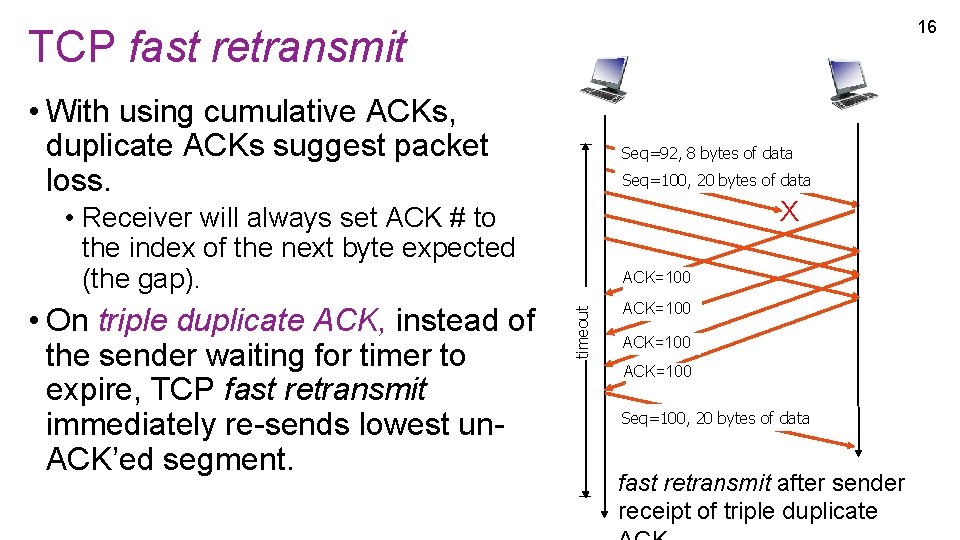
16 TCP fast retransmit • With using cumulative ACKs, duplicate ACKs suggest packet loss. Seq=92, 8 bytes of data Seq=100, 20 bytes of data X • Receiver will always set ACK # to the index of the next byte expected (the gap). timeout • On triple duplicate ACK, instead of the sender waiting for timer to expire, TCP fast retransmit immediately re-sends lowest un. ACK’ed segment. ACK=100 Seq=100, 20 bytes of data fast retransmit after sender receipt of triple duplicate
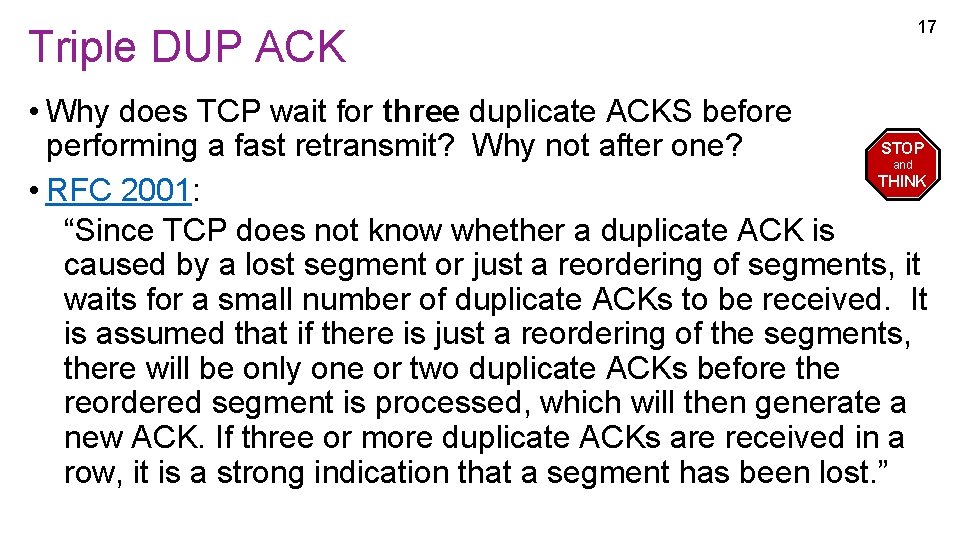
17 Triple DUP ACK • Why does TCP wait for three duplicate ACKS before STOP performing a fast retransmit? Why not after one? THINK • RFC 2001: “Since TCP does not know whether a duplicate ACK is caused by a lost segment or just a reordering of segments, it waits for a small number of duplicate ACKs to be received. It is assumed that if there is just a reordering of the segments, there will be only one or two duplicate ACKs before the reordered segment is processed, which will then generate a new ACK. If three or more duplicate ACKs are received in a row, it is a strong indication that a segment has been lost. ” and
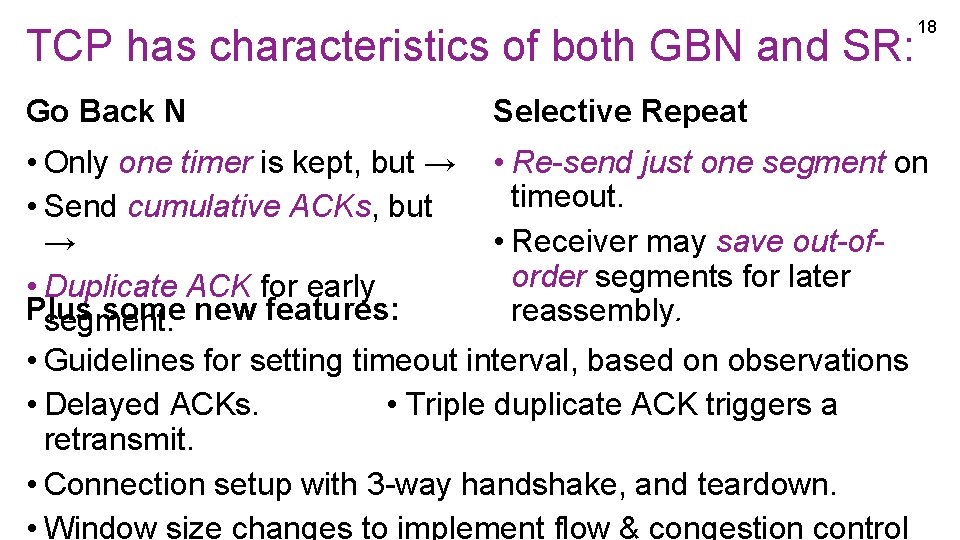
TCP has characteristics of both GBN and SR: Go Back N 18 Selective Repeat • Only one timer is kept, but → • Re-send just one segment on timeout. • Send cumulative ACKs, but • Receiver may save out-of→ order segments for later • Duplicate ACK for early Plus some new features: reassembly. segment. • Guidelines for setting timeout interval, based on observations • Delayed ACKs. • Triple duplicate ACK triggers a retransmit. • Connection setup with 3 -way handshake, and teardown. • Window size changes to implement flow & congestion control
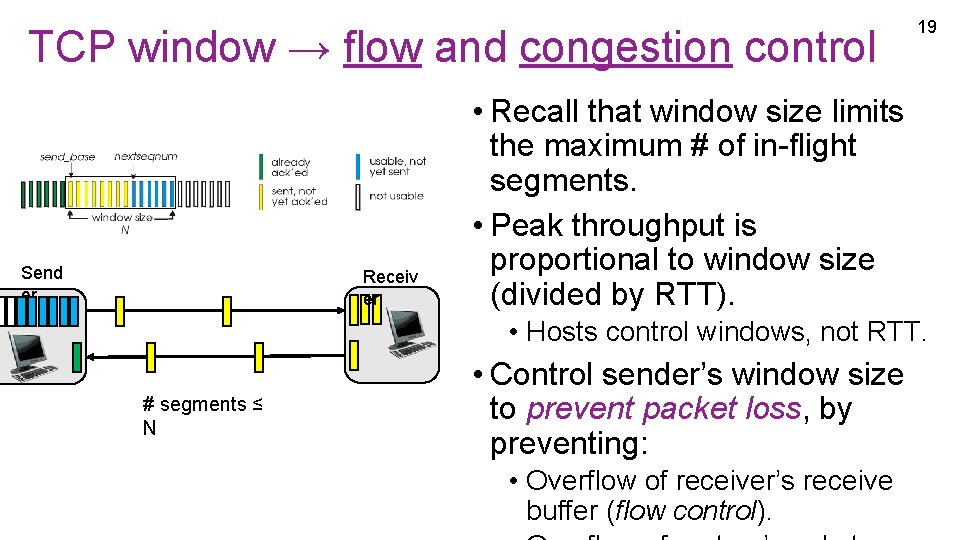
TCP window → flow and congestion control Send er Receiv er 19 • Recall that window size limits the maximum # of in-flight segments. • Peak throughput is proportional to window size (divided by RTT). • Hosts control windows, not RTT. # segments ≤ N • Control sender’s window size to prevent packet loss, by preventing: • Overflow of receiver’s receive buffer (flow control).
TCP flow control – to avoid overwhelming the receiver 32 bits source port # dest port # sequence number acknowledgement number head not U A P R S F receive window len used checksum urgent data ptr options (variable length) application data 20 • In receive window, host tells how many bytes of new data it can receive. • Sender simply tracks # un-ACK’ed bytes and keeps this ≤ receive window. • A simple and effective solution is possible because we can directly observe the receive buffer and report its status. • Congestion control requires a more complex solution because it
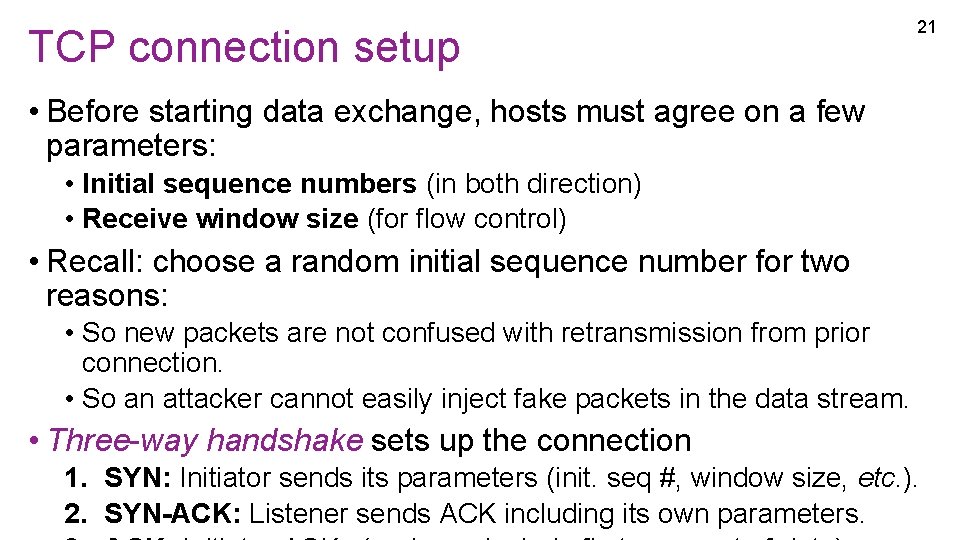
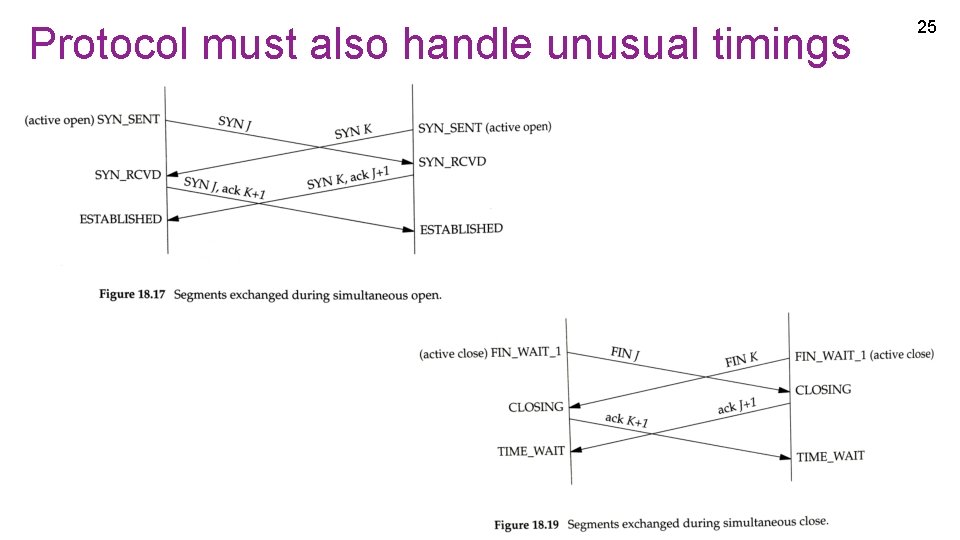
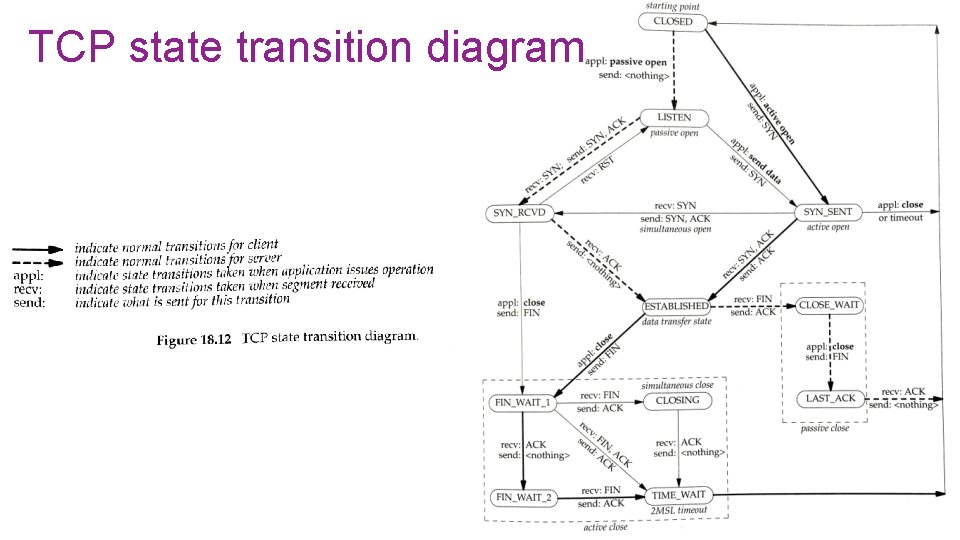
TCP connection setup 21 • Before starting data exchange, hosts must agree on a few parameters: • Initial sequence numbers (in both direction) • Receive window size (for flow control) • Recall: choose a random initial sequence number for two reasons: • So new packets are not confused with retransmission from prior connection. • So an attacker cannot easily inject fake packets in the data stream. • Three-way handshake sets up the connection 1. SYN: Initiator sends its parameters (init. seq #, window size, etc. ). 2. SYN-ACK: Listener sends ACK including its own parameters.
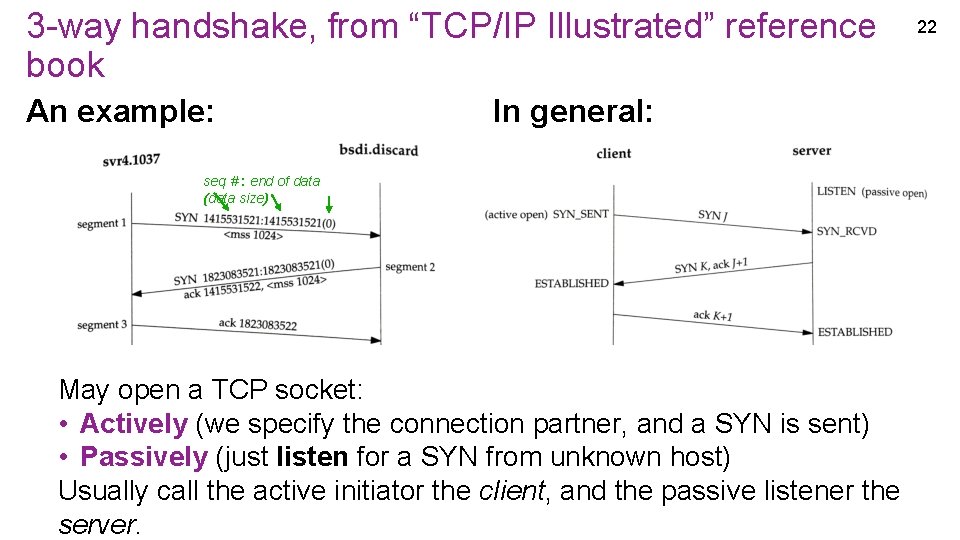
3 -way handshake, from “TCP/IP Illustrated” reference book An example: In general: seq # : end of data (data size) May open a TCP socket: • Actively (we specify the connection partner, and a SYN is sent) • Passively (just listen for a SYN from unknown host) Usually call the active initiator the client, and the passive listener the server. 22
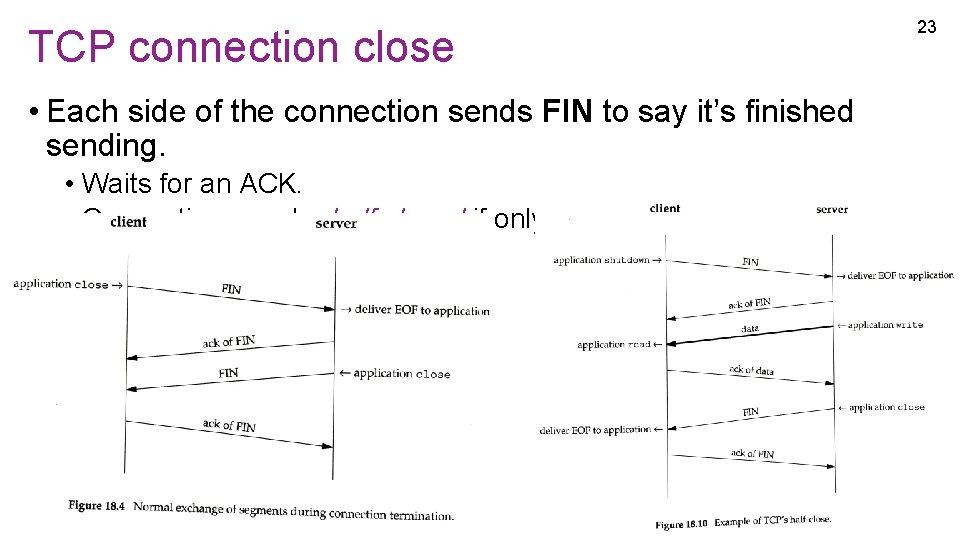
TCP connection close • Each side of the connection sends FIN to say it’s finished sending. • Waits for an ACK. • Connection may be half closed if only one side is done sending. 23
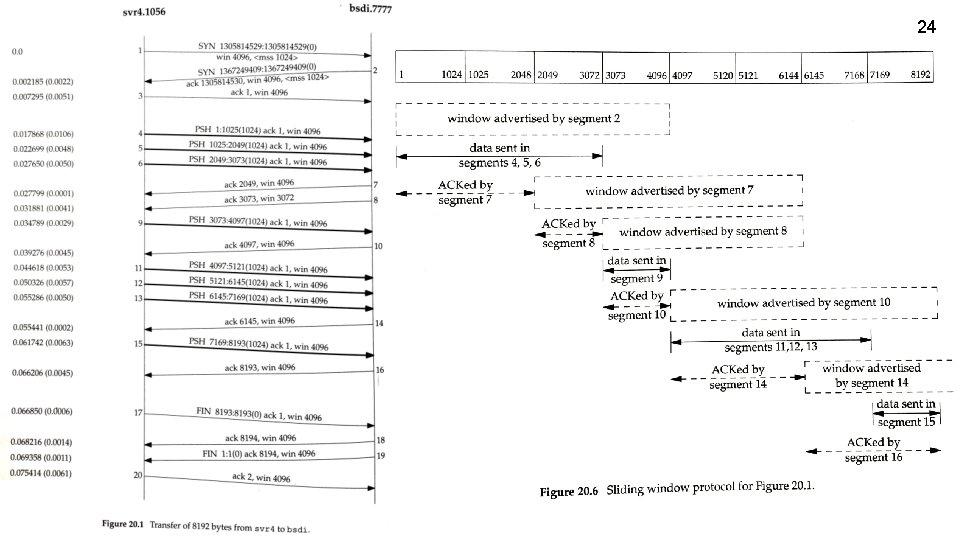
24
Protocol must also handle unusual timings 25
TCP state transition diagram 26
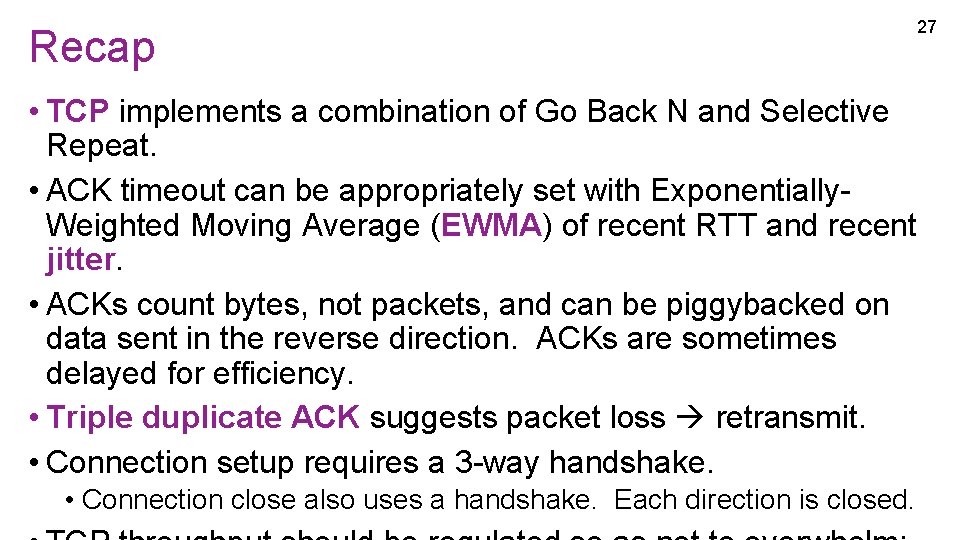
Recap • TCP implements a combination of Go Back N and Selective Repeat. • ACK timeout can be appropriately set with Exponentially. Weighted Moving Average (EWMA) of recent RTT and recent jitter. • ACKs count bytes, not packets, and can be piggybacked on data sent in the reverse direction. ACKs are sometimes delayed for efficiency. • Triple duplicate ACK suggests packet loss retransmit. • Connection setup requires a 3 -way handshake. • Connection close also uses a handshake. Each direction is closed. 27