
1 CS 461 ARTIFICIAL INTELLIGENCE Computer Science Department

![Standard search formulation Nx. D WA WA WA NT T N layers [Nx. D]x[(N-1)x.](https://slidetodoc.com/presentation_image_h2/926b0586999e0e0599585b768506760f/image-11.jpg "Standard search formulation Nx. D WA WA WA NT T N layers [Nx. D]x[(N-1)x.")


![Backpropagation - MRV [R, B, G] [R] [R, B, G] 26 -Jan-22 [R, B,](https://slidetodoc.com/presentation_image_h2/926b0586999e0e0599585b768506760f/image-22.jpg "Backpropagation - MRV [R, B, G] [R] [R, B, G] 26 -Jan-22 [R, B,")
![Backpropagation - MRV [R, B, G] [R] [R, B, G] 26 -Jan-22 [R, B,](https://slidetodoc.com/presentation_image_h2/926b0586999e0e0599585b768506760f/image-23.jpg "Backpropagation - MRV [R, B, G] [R] [R, B, G] 26 -Jan-22 [R, B,")
![Backpropagation - MRV [R, B, G] [R] [R, B, G] 26 -Jan-22 [R, B,](https://slidetodoc.com/presentation_image_h2/926b0586999e0e0599585b768506760f/image-24.jpg "Backpropagation - MRV [R, B, G] [R] [R, B, G] 26 -Jan-22 [R, B,")
![Backpropagation - MRV [R, B, G] [R] [R, B, G] 26 -Jan-22 [R, B,](https://slidetodoc.com/presentation_image_h2/926b0586999e0e0599585b768506760f/image-25.jpg "Backpropagation - MRV [R, B, G] [R] [R, B, G] 26 -Jan-22 [R, B,")
![Backpropagation - MRV [R, B, G] [R] [R, B, G] 26 -Jan-22 [R, B,](https://slidetodoc.com/presentation_image_h2/926b0586999e0e0599585b768506760f/image-26.jpg "Backpropagation - MRV [R, B, G] [R] [R, B, G] 26 -Jan-22 [R, B,")
![Backpropagation - MRV [R, B, G] [R] [R, B, G] Solution !!! 26 -Jan-22](https://slidetodoc.com/presentation_image_h2/926b0586999e0e0599585b768506760f/image-27.jpg "Backpropagation - MRV [R, B, G] [R] [R, B, G] Solution !!! 26 -Jan-22")

![Backpropagation - MCV [R, B, G] 4 arcs 2 arcs [R] 3 arcs [R,](https://slidetodoc.com/presentation_image_h2/926b0586999e0e0599585b768506760f/image-29.jpg "Backpropagation - MCV [R, B, G] 4 arcs 2 arcs [R] 3 arcs [R,")
![Backpropagation - MCV [R, B, G] 4 arcs 2 arcs [R] 3 arcs [R,](https://slidetodoc.com/presentation_image_h2/926b0586999e0e0599585b768506760f/image-30.jpg "Backpropagation - MCV [R, B, G] 4 arcs 2 arcs [R] 3 arcs [R,")
![Backpropagation - MCV [R, B, G] 4 arcs 2 arcs [R] 3 arcs [R,](https://slidetodoc.com/presentation_image_h2/926b0586999e0e0599585b768506760f/image-31.jpg "Backpropagation - MCV [R, B, G] 4 arcs 2 arcs [R] 3 arcs [R,")
![Backpropagation - MCV [R, B, G] 4 arcs 2 arcs [R] 3 arcs [R,](https://slidetodoc.com/presentation_image_h2/926b0586999e0e0599585b768506760f/image-32.jpg "Backpropagation - MCV [R, B, G] 4 arcs 2 arcs [R] 3 arcs [R,")
![Backpropagation - MCV [R, B, G] 4 arcs 2 arcs [R] Dead End 3](https://slidetodoc.com/presentation_image_h2/926b0586999e0e0599585b768506760f/image-33.jpg "Backpropagation - MCV [R, B, G] 4 arcs 2 arcs [R] Dead End 3")
![Backpropagation - MCV [R, B, G] 4 arcs 2 arcs [R] 3 arcs [R,](https://slidetodoc.com/presentation_image_h2/926b0586999e0e0599585b768506760f/image-34.jpg "Backpropagation - MCV [R, B, G] 4 arcs 2 arcs [R] 3 arcs [R,")
![Backpropagation - MCV [R, B, G] 4 arcs 2 arcs [R] 3 arcs [R,](https://slidetodoc.com/presentation_image_h2/926b0586999e0e0599585b768506760f/image-35.jpg "Backpropagation - MCV [R, B, G] 4 arcs 2 arcs [R] 3 arcs [R,")
![Backpropagation - MCV [R, B, G] 4 arcs 2 arcs [R] 3 arcs [R,](https://slidetodoc.com/presentation_image_h2/926b0586999e0e0599585b768506760f/image-36.jpg "Backpropagation - MCV [R, B, G] 4 arcs 2 arcs [R] 3 arcs [R,")
![Backpropagation - MCV [R, B, G] 4 arcs 2 arcs [R] Dead End 3](https://slidetodoc.com/presentation_image_h2/926b0586999e0e0599585b768506760f/image-37.jpg "Backpropagation - MCV [R, B, G] 4 arcs 2 arcs [R] Dead End 3")
![Backpropagation - MCV [R, B, G] 4 arcs 2 arcs [R] 3 arcs [R,](https://slidetodoc.com/presentation_image_h2/926b0586999e0e0599585b768506760f/image-38.jpg "Backpropagation - MCV [R, B, G] 4 arcs 2 arcs [R] 3 arcs [R,")
![Backpropagation - MCV [R, B, G] 4 arcs 2 arcs [R] 3 arcs [R,](https://slidetodoc.com/presentation_image_h2/926b0586999e0e0599585b768506760f/image-39.jpg "Backpropagation - MCV [R, B, G] 4 arcs 2 arcs [R] 3 arcs [R,")
![Backpropagation - MCV [R, B, G] 4 arcs 2 arcs [R] 3 arcs [R,](https://slidetodoc.com/presentation_image_h2/926b0586999e0e0599585b768506760f/image-40.jpg "Backpropagation - MCV [R, B, G] 4 arcs 2 arcs [R] 3 arcs [R,")
![Backpropagation - MCV [R, B, G] 4 arcs 2 arcs [R] 3 arcs [R,](https://slidetodoc.com/presentation_image_h2/926b0586999e0e0599585b768506760f/image-41.jpg "Backpropagation - MCV [R, B, G] 4 arcs 2 arcs [R] 3 arcs [R,")
![Backpropagation - MCV [R, B, G] 4 arcs 2 arcs [R] 3 arcs [R,](https://slidetodoc.com/presentation_image_h2/926b0586999e0e0599585b768506760f/image-42.jpg "Backpropagation - MCV [R, B, G] 4 arcs 2 arcs [R] 3 arcs [R,")
![Back-propagation LCV [R, B, G] 4 arcs 2 arcs [R] 3 arcs [R, B,](https://slidetodoc.com/presentation_image_h2/926b0586999e0e0599585b768506760f/image-44.jpg "Back-propagation LCV [R, B, G] 4 arcs 2 arcs [R] 3 arcs [R, B,")
![Back-propagation LCV [R, B, G] 4 arcs 2 arcs [R] 3 arcs [R, B,](https://slidetodoc.com/presentation_image_h2/926b0586999e0e0599585b768506760f/image-45.jpg "Back-propagation LCV [R, B, G] 4 arcs 2 arcs [R] 3 arcs [R, B,")
![Back-propagation LCV [R, B, G] 4 arcs 2 arcs [R] 3 arcs [R, B,](https://slidetodoc.com/presentation_image_h2/926b0586999e0e0599585b768506760f/image-46.jpg "Back-propagation LCV [R, B, G] 4 arcs 2 arcs [R] 3 arcs [R, B,")
![Back-propagation LCV [R, B, G] 4 arcs 2 arcs [R] 3 arcs [R, B,](https://slidetodoc.com/presentation_image_h2/926b0586999e0e0599585b768506760f/image-47.jpg "Back-propagation LCV [R, B, G] 4 arcs 2 arcs [R] 3 arcs [R, B,")
![Back-propagation LCV [R, B, G] 4 arcs 2 arcs [R] 3 arcs [R, B,](https://slidetodoc.com/presentation_image_h2/926b0586999e0e0599585b768506760f/image-48.jpg "Back-propagation LCV [R, B, G] 4 arcs 2 arcs [R] 3 arcs [R, B,")
![Back-propagation LCV [R, B, G] 4 arcs 2 arcs [R] 3 arcs Dead End](https://slidetodoc.com/presentation_image_h2/926b0586999e0e0599585b768506760f/image-49.jpg "Back-propagation LCV [R, B, G] 4 arcs 2 arcs [R] 3 arcs Dead End")
![Back-propagation LCV [R, B, G] 4 arcs 2 arcs [R] 3 arcs [R, B,](https://slidetodoc.com/presentation_image_h2/926b0586999e0e0599585b768506760f/image-50.jpg "Back-propagation LCV [R, B, G] 4 arcs 2 arcs [R] 3 arcs [R, B,")
![Back-propagation LCV [R, B, G] 4 arcs 2 arcs [R] 3 arcs [R, B,](https://slidetodoc.com/presentation_image_h2/926b0586999e0e0599585b768506760f/image-51.jpg "Back-propagation LCV [R, B, G] 4 arcs 2 arcs [R] 3 arcs [R, B,")
![Back-propagation LCV [R, B, G] 4 arcs 2 arcs [R] 3 arcs [R, B,](https://slidetodoc.com/presentation_image_h2/926b0586999e0e0599585b768506760f/image-52.jpg "Back-propagation LCV [R, B, G] 4 arcs 2 arcs [R] 3 arcs [R, B,")
![Back-propagation LCV [R, B, G] 4 arcs 2 arcs [R] 3 arcs Solution !!!](https://slidetodoc.com/presentation_image_h2/926b0586999e0e0599585b768506760f/image-53.jpg "Back-propagation LCV [R, B, G] 4 arcs 2 arcs [R] 3 arcs Solution !!!")





![Arc consistency AC 3 [R, B, G] [R] [R, B, G] 26 -Jan-22 [R,](https://slidetodoc.com/presentation_image_h2/926b0586999e0e0599585b768506760f/image-78.jpg "Arc consistency AC 3 [R, B, G] [R] [R, B, G] 26 -Jan-22 [R,")
![Arc consistency AC 3 [ , B, G] [R] [R, B, G] 26 -Jan-22](https://slidetodoc.com/presentation_image_h2/926b0586999e0e0599585b768506760f/image-79.jpg "Arc consistency AC 3 [ , B, G] [R] [R, B, G] 26 -Jan-22")
![Arc consistency AC 3 [ , B, G] [R] [ , B, G] 26](https://slidetodoc.com/presentation_image_h2/926b0586999e0e0599585b768506760f/image-80.jpg "Arc consistency AC 3 [ , B, G] [R] [ , B, G] 26")
![Arc consistency AC 3 [ , B, G] [R] [ , B, G] 26](https://slidetodoc.com/presentation_image_h2/926b0586999e0e0599585b768506760f/image-81.jpg "Arc consistency AC 3 [ , B, G] [R] [ , B, G] 26")
![Arc consistency AC 3 [ , B, G] [R] [ , B, G] 26](https://slidetodoc.com/presentation_image_h2/926b0586999e0e0599585b768506760f/image-82.jpg "Arc consistency AC 3 [ , B, G] [R] [ , B, G] 26")
![Arc consistency AC 3 [ , B, G] [R] [ , B, G] 26](https://slidetodoc.com/presentation_image_h2/926b0586999e0e0599585b768506760f/image-83.jpg "Arc consistency AC 3 [ , B, G] [R] [ , B, G] 26")
![Arc consistency AC 3 [ , B, G] [R] [ , B, G] 26](https://slidetodoc.com/presentation_image_h2/926b0586999e0e0599585b768506760f/image-84.jpg "Arc consistency AC 3 [ , B, G] [R] [ , B, G] 26")
![Arc consistency AC 3 [ , B, G] [R] [ , B, G] 26](https://slidetodoc.com/presentation_image_h2/926b0586999e0e0599585b768506760f/image-85.jpg "Arc consistency AC 3 [ , B, G] [R] [ , B, G] 26")
![Arc consistency AC 3 [ , B, ] [R, B, G] [R] [ ,](https://slidetodoc.com/presentation_image_h2/926b0586999e0e0599585b768506760f/image-86.jpg "Arc consistency AC 3 [ , B, ] [R, B, G] [R] [ ,")
![Arc consistency AC 3 [ , B, ] [R, , G] [ , B,](https://slidetodoc.com/presentation_image_h2/926b0586999e0e0599585b768506760f/image-87.jpg "Arc consistency AC 3 [ , B, ] [R, , G] [ , B,")
![Arc consistency AC 3 [ , B, ] [R, , G] [R] [ ,](https://slidetodoc.com/presentation_image_h2/926b0586999e0e0599585b768506760f/image-88.jpg "Arc consistency AC 3 [ , B, ] [R, , G] [R] [ ,")
![Arc consistency AC 3 [ , B, ] [R, , G] [R] [ ,](https://slidetodoc.com/presentation_image_h2/926b0586999e0e0599585b768506760f/image-89.jpg "Arc consistency AC 3 [ , B, ] [R, , G] [R] [ ,")
![Arc consistency AC 3 [ , B, ] [R, , G] [R] [ ,](https://slidetodoc.com/presentation_image_h2/926b0586999e0e0599585b768506760f/image-90.jpg "Arc consistency AC 3 [ , B, ] [R, , G] [R] [ ,")
![Arc consistency AC 3 [ , B, ] [ , , G] [R] [](https://slidetodoc.com/presentation_image_h2/926b0586999e0e0599585b768506760f/image-91.jpg "Arc consistency AC 3 [ , B, ] [ , , G] [R] [")
![Arc consistency AC 3 [ , B, ] [ , , G] [R] [](https://slidetodoc.com/presentation_image_h2/926b0586999e0e0599585b768506760f/image-92.jpg "Arc consistency AC 3 [ , B, ] [ , , G] [R] [")
![Arc consistency AC 3 [ , B, ] [ , , G] [R] [](https://slidetodoc.com/presentation_image_h2/926b0586999e0e0599585b768506760f/image-93.jpg "Arc consistency AC 3 [ , B, ] [ , , G] [R] [")
![Arc consistency AC 3 [ , B, ] [ , , G] [R, ,](https://slidetodoc.com/presentation_image_h2/926b0586999e0e0599585b768506760f/image-94.jpg "Arc consistency AC 3 [ , B, ] [ , , G] [R, ,")

- Slides: 97
1 CS 461: ARTIFICIAL INTELLIGENCE Computer Science Department Lecture 6: Constraint Satisfaction Problems
Outline Constraint Satisfaction Problems (CSP) Backtracking search for CSPs Local search for CSPs 26 -Jan-22 Computer Science Department
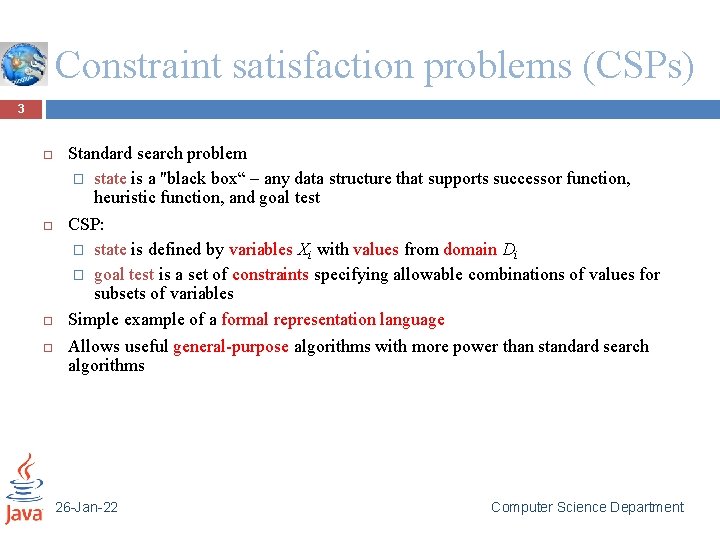
Constraint satisfaction problems (CSPs) 3 Standard search problem � state is a "black box“ – any data structure that supports successor function, heuristic function, and goal test CSP: � state is defined by variables Xi with values from domain Di � goal test is a set of constraints specifying allowable combinations of values for subsets of variables Simple example of a formal representation language Allows useful general-purpose algorithms with more power than standard search algorithms 26 -Jan-22 Computer Science Department
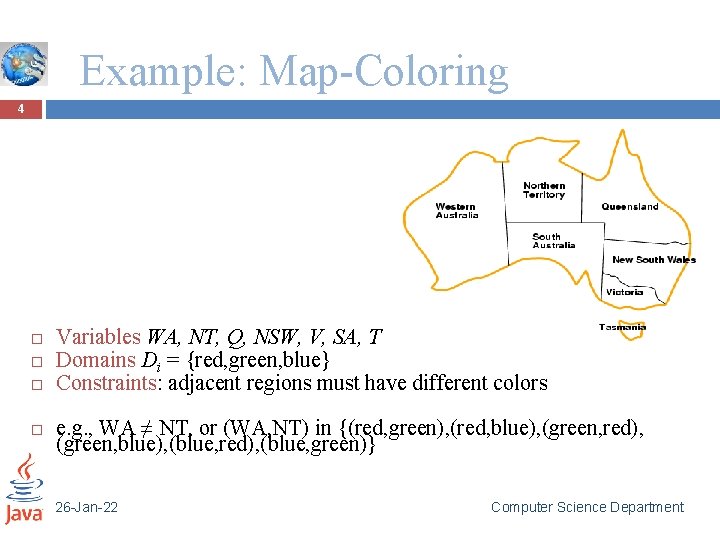
Example: Map-Coloring 4 Variables WA, NT, Q, NSW, V, SA, T Domains Di = {red, green, blue} Constraints: adjacent regions must have different colors e. g. , WA ≠ NT, or (WA, NT) in {(red, green), (red, blue), (green, red), (green, blue), (blue, red), (blue, green)} 26 -Jan-22 Computer Science Department
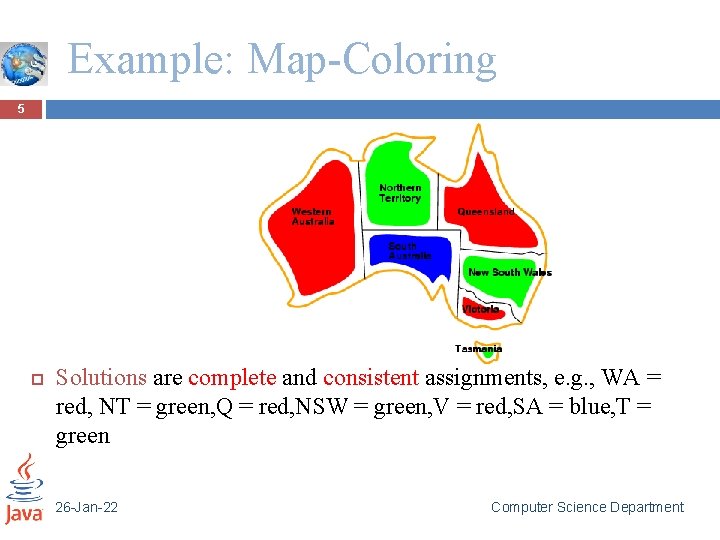
Example: Map-Coloring 5 Solutions are complete and consistent assignments, e. g. , WA = red, NT = green, Q = red, NSW = green, V = red, SA = blue, T = green 26 -Jan-22 Computer Science Department
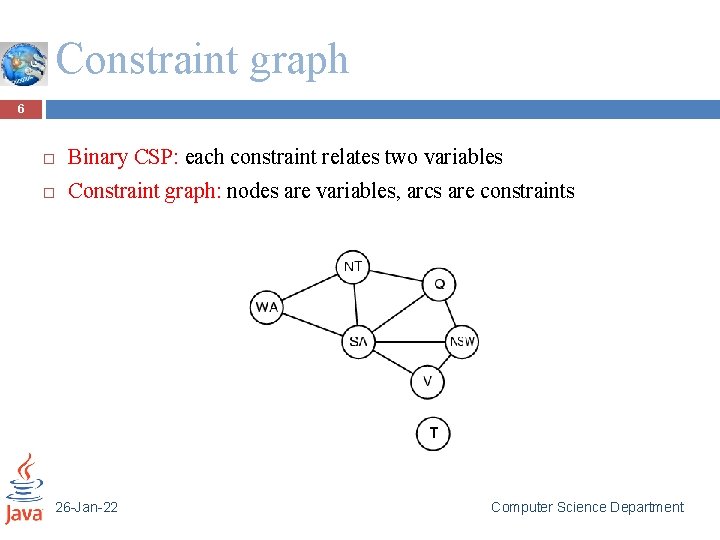
Constraint graph 6 Binary CSP: each constraint relates two variables Constraint graph: nodes are variables, arcs are constraints 26 -Jan-22 Computer Science Department
Varieties of CSPs 7 Discrete variables � finite domains: n variables, domain size d O(dn) complete assignments e. g. , Boolean CSPs, incl. ~Boolean satisfiability (NP-complete) � infinite domains: integers, strings, etc. e. g. , job scheduling, variables are start/end days for each job need a constraint language, e. g. , Start. Job 1 + 5 ≤ Start. Job 3 Continuous variables � e. g. , start/end times for Hubble Space Telescope observations � linear constraints solvable in polynomial time by linear programming 26 -Jan-22 Computer Science Department
Varieties of constraints 8 Unary constraints involve a single variable, � e. g. , SA ≠ green Binary constraints involve pairs of variables, � e. g. , SA ≠ WA Higher-order constraints involve 3 or more variables, � e. g. , cryptarithmetic column constraints 26 -Jan-22 Computer Science Department
Real-world CSPs 9 Assignment problems � e. g. , who teaches what class Timetabling problems � e. g. , which class is offered when and where? Transportation scheduling Factory scheduling Notice that many real-world problems involve real-valued variables 26 -Jan-22 Computer Science Department
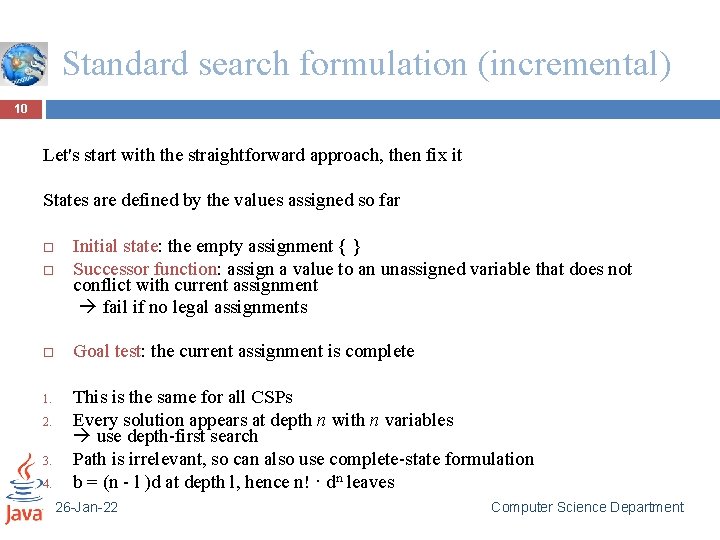
Standard search formulation (incremental) 10 Let's start with the straightforward approach, then fix it States are defined by the values assigned so far Initial state: the empty assignment { } Successor function: assign a value to an unassigned variable that does not conflict with current assignment fail if no legal assignments Goal test: the current assignment is complete 1. 2. 3. 4. This is the same for all CSPs Every solution appears at depth n with n variables use depth-first search Path is irrelevant, so can also use complete-state formulation b = (n - l )d at depth l, hence n! · dn leaves 26 -Jan-22 Computer Science Department
Standard search formulation Nx. D WA WA WA NT T N layers [Nx. D]x[(N-1)x. D] WA WA WA NT NT WA Equal! N! x DN There are N! x DN nodes in the tree but only DN distinct states? ? 26 -Jan-22 Computer Science Department
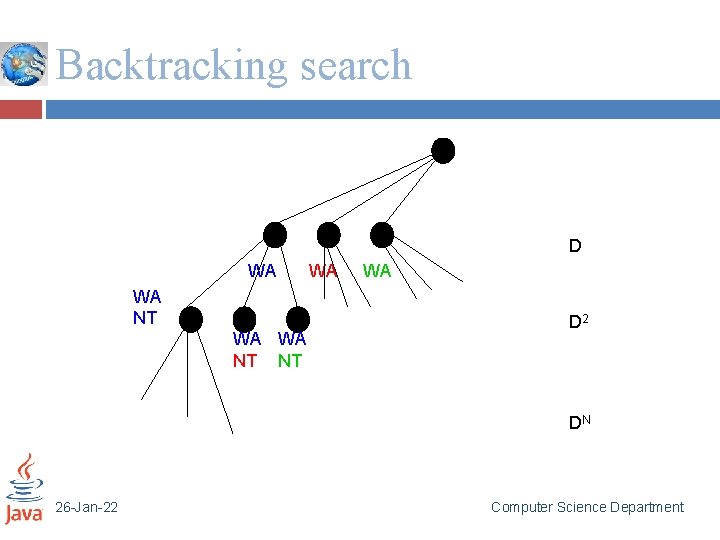
Backtracking search 12 Variable assignments are commutative}, i. e. , [ WA = red then NT = green ] same as [ NT = green then WA = red ] Only need to consider assignments to a single variable at each node Depth-first search for CSPs with single-variable assignments is called backtracking search Backtracking search is the basic uninformed algorithm for CSPs Can solve n-queens for n ≈ 25 26 -Jan-22 Computer Science Department
Backtracking search D WA WA NT NT WA WA D 2 DN 26 -Jan-22 Computer Science Department
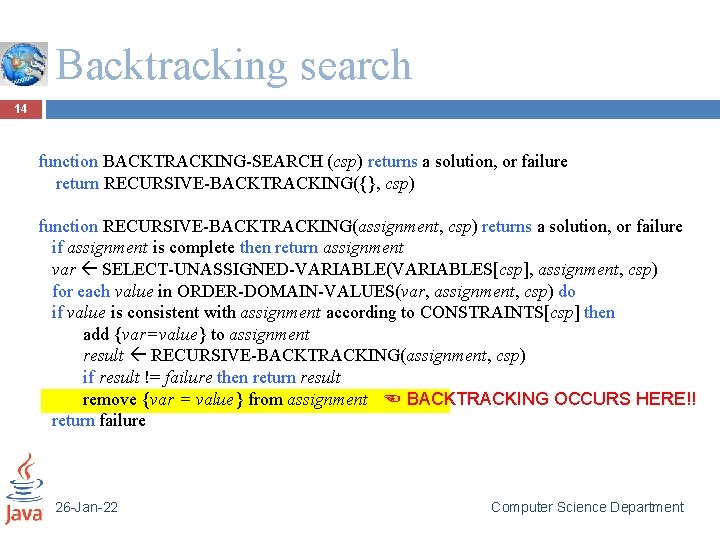
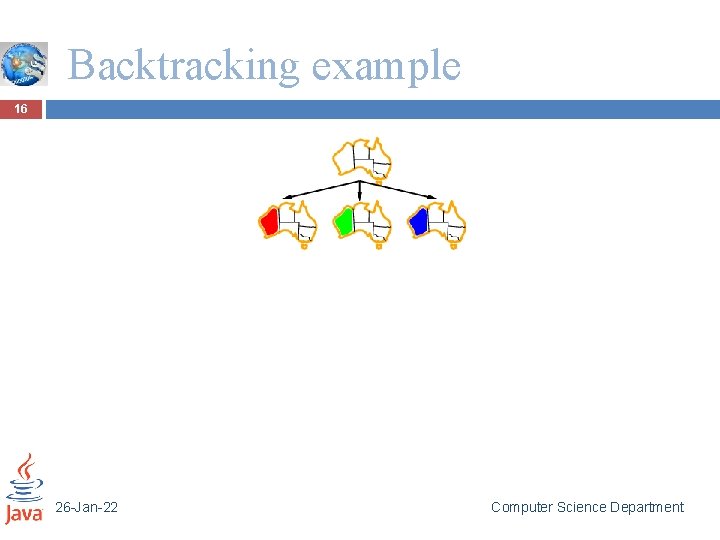
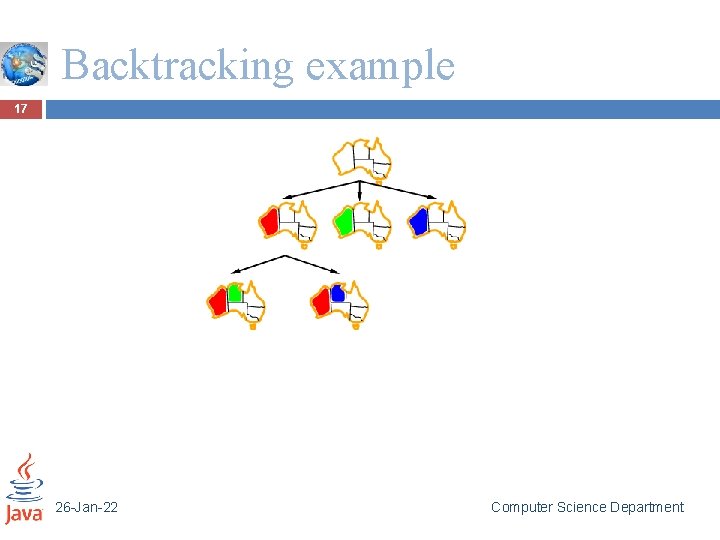
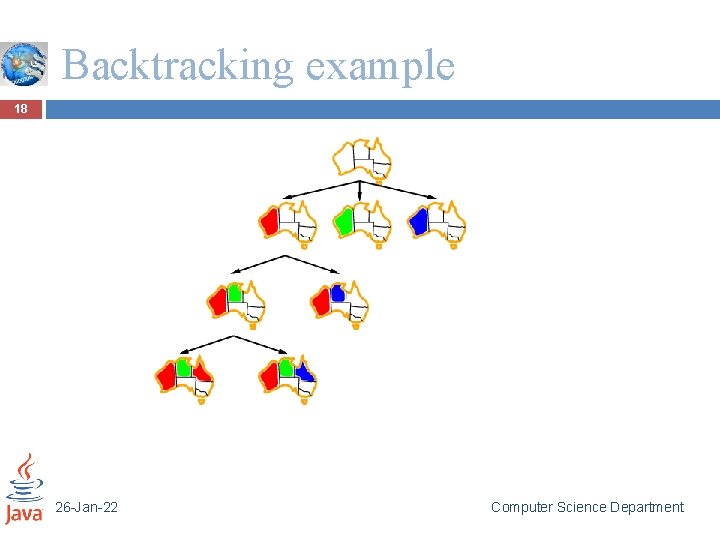
Backtracking search 14 function BACKTRACKING-SEARCH (csp) returns a solution, or failure return RECURSIVE-BACKTRACKING({}, csp) function RECURSIVE-BACKTRACKING(assignment, csp) returns a solution, or failure if assignment is complete then return assignment var SELECT-UNASSIGNED-VARIABLE(VARIABLES[csp], assignment, csp) for each value in ORDER-DOMAIN-VALUES(var, assignment, csp) do if value is consistent with assignment according to CONSTRAINTS[csp] then add {var=value} to assignment result RECURSIVE-BACKTRACKING(assignment, csp) if result != failure then return result remove {var = value} from assignment ☜ BACKTRACKING OCCURS HERE!! return failure 26 -Jan-22 Computer Science Department
Backtracking example 15 26 -Jan-22 Computer Science Department
Backtracking example 16 26 -Jan-22 Computer Science Department
Backtracking example 17 26 -Jan-22 Computer Science Department
Backtracking example 18 26 -Jan-22 Computer Science Department
Improving backtracking efficiency 19 General-purpose methods can give huge gains in speed: � Which variable should be assigned next? � In what order should its values be tried? � Can we detect inevitable failure early? 26 -Jan-22 Computer Science Department
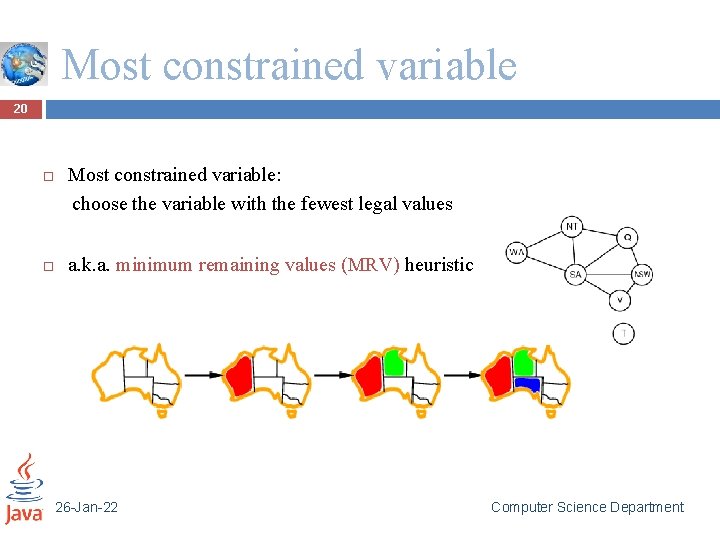
Most constrained variable 20 Most constrained variable: choose the variable with the fewest legal values a. k. a. minimum remaining values (MRV) heuristic 26 -Jan-22 Computer Science Department
Backpropagation. MRV minimum remaining values choose the variable with the fewest legal values 26 -Jan-22 Computer Science Department
Backpropagation - MRV [R, B, G] [R] [R, B, G] 26 -Jan-22 [R, B, G] Computer Science Department
Backpropagation - MRV [R, B, G] [R] [R, B, G] 26 -Jan-22 [R, B, G] Computer Science Department
Backpropagation - MRV [R, B, G] [R] [R, B, G] 26 -Jan-22 [R, B, G] Computer Science Department
Backpropagation - MRV [R, B, G] [R] [R, B, G] 26 -Jan-22 [R, B, G] Computer Science Department
Backpropagation - MRV [R, B, G] [R] [R, B, G] 26 -Jan-22 [R, B, G] Computer Science Department
Backpropagation - MRV [R, B, G] [R] [R, B, G] Solution !!! 26 -Jan-22 Computer Science Department
Most constraining variable 28 Tie-breaker among most constrained variables Most constraining variable: � choose the variable with the most constraints on remaining variables (most edges in graph) 26 -Jan-22 Computer Science Department
Backpropagation - MCV [R, B, G] 4 arcs 2 arcs [R] 3 arcs [R, B, G] 26 -Jan-22 [R, B, G] Computer Science Department
Backpropagation - MCV [R, B, G] 4 arcs 2 arcs [R] 3 arcs [R, B, G] 26 -Jan-22 [R, B, G] Computer Science Department
Backpropagation - MCV [R, B, G] 4 arcs 2 arcs [R] 3 arcs [R, B, G] 26 -Jan-22 [R, B, G] Computer Science Department
Backpropagation - MCV [R, B, G] 4 arcs 2 arcs [R] 3 arcs [R, B, G] 26 -Jan-22 [R, B, G] Computer Science Department
Backpropagation - MCV [R, B, G] 4 arcs 2 arcs [R] Dead End 3 arcs [R, B, G] 26 -Jan-22 [R, B, G] Computer Science Department
Backpropagation - MCV [R, B, G] 4 arcs 2 arcs [R] 3 arcs [R, B, G] 26 -Jan-22 [R, B, G] Computer Science Department
Backpropagation - MCV [R, B, G] 4 arcs 2 arcs [R] 3 arcs [R, B, G] 26 -Jan-22 [R, B, G] Computer Science Department
Backpropagation - MCV [R, B, G] 4 arcs 2 arcs [R] 3 arcs [R, B, G] 26 -Jan-22 [R, B, G] Computer Science Department
Backpropagation - MCV [R, B, G] 4 arcs 2 arcs [R] Dead End 3 arcs [R, B, G] 26 -Jan-22 [R, B, G] Computer Science Department
Backpropagation - MCV [R, B, G] 4 arcs 2 arcs [R] 3 arcs [R, B, G] 26 -Jan-22 [R, B, G] Computer Science Department
Backpropagation - MCV [R, B, G] 4 arcs 2 arcs [R] 3 arcs [R, B, G] 26 -Jan-22 [R, B, G] Computer Science Department
Backpropagation - MCV [R, B, G] 4 arcs 2 arcs [R] 3 arcs [R, B, G] 26 -Jan-22 [R, B, G] Computer Science Department
Backpropagation - MCV [R, B, G] 4 arcs 2 arcs [R] 3 arcs [R, B, G] 26 -Jan-22 [R, B, G] Computer Science Department
Backpropagation - MCV [R, B, G] 4 arcs 2 arcs [R] 3 arcs [R, B, G] Solution !!! 26 -Jan-22 Computer Science Department
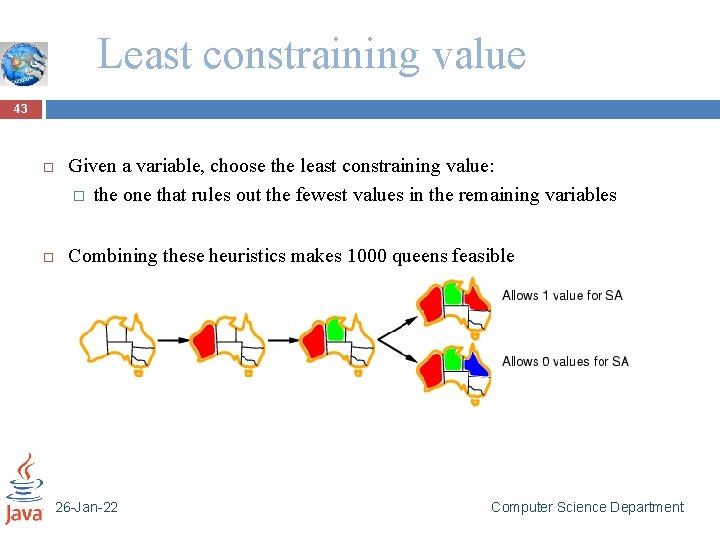
Least constraining value 43 Given a variable, choose the least constraining value: � the one that rules out the fewest values in the remaining variables Combining these heuristics makes 1000 queens feasible 26 -Jan-22 Computer Science Department
Back-propagation LCV [R, B, G] 4 arcs 2 arcs [R] 3 arcs [R, B, G] 26 -Jan-22 [R, B, G] Computer Science Department
Back-propagation LCV [R, B, G] 4 arcs 2 arcs [R] 3 arcs [R, B, G] 26 -Jan-22 [R, B, G] Computer Science Department
Back-propagation LCV [R, B, G] 4 arcs 2 arcs [R] 3 arcs [R, B, G] 26 -Jan-22 [R, B, G] Computer Science Department
Back-propagation LCV [R, B, G] 4 arcs 2 arcs [R] 3 arcs [R, B, G] 26 -Jan-22 [R, B, G] Computer Science Department
Back-propagation LCV [R, B, G] 4 arcs 2 arcs [R] 3 arcs [R, B, G] 26 -Jan-22 [R, B, G] Computer Science Department
Back-propagation LCV [R, B, G] 4 arcs 2 arcs [R] 3 arcs Dead End 26 -Jan-22 [R, B, G] Computer Science Department
Back-propagation LCV [R, B, G] 4 arcs 2 arcs [R] 3 arcs [R, B, G] 26 -Jan-22 [R, B, G] Computer Science Department
Back-propagation LCV [R, B, G] 4 arcs 2 arcs [R] 3 arcs [R, B, G] 26 -Jan-22 [R, B, G] Computer Science Department
Back-propagation LCV [R, B, G] 4 arcs 2 arcs [R] 3 arcs [R, B, G] 26 -Jan-22 [R, B, G] Computer Science Department
Back-propagation LCV [R, B, G] 4 arcs 2 arcs [R] 3 arcs Solution !!! 26 -Jan-22 [R, B, G] Computer Science Department
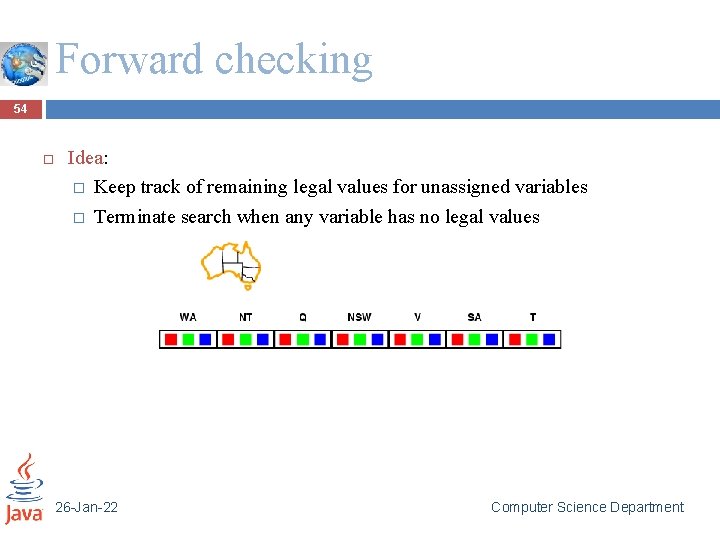
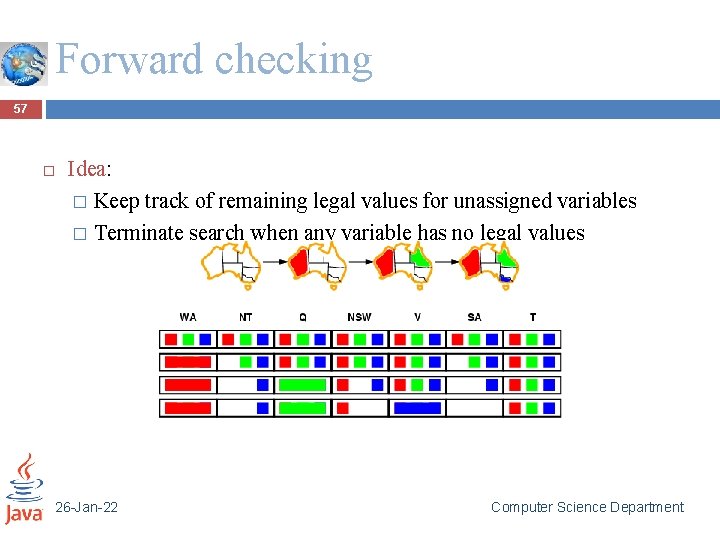
Forward checking 54 Idea: � Keep track of remaining legal values for unassigned variables � Terminate search when any variable has no legal values 26 -Jan-22 Computer Science Department
Forward checking 55 Idea: � Keep track of remaining legal values for unassigned variables � Terminate search when any variable has no legal values 26 -Jan-22 Computer Science Department
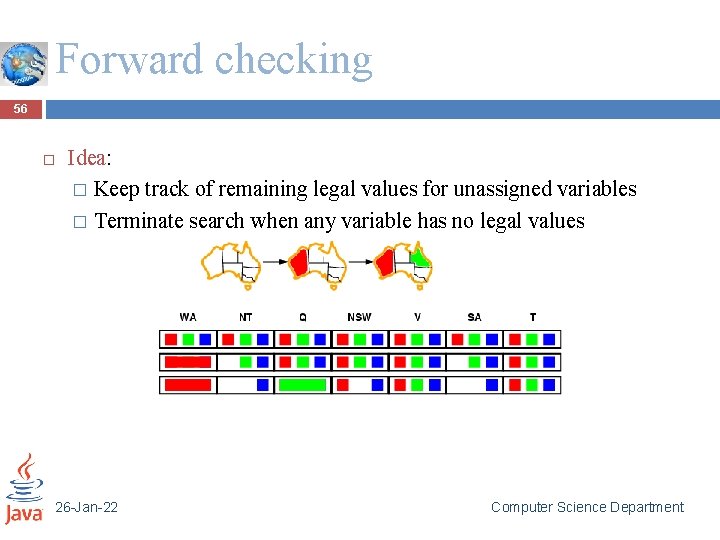
Forward checking 56 Idea: � Keep track of remaining legal values for unassigned variables � Terminate search when any variable has no legal values 26 -Jan-22 Computer Science Department
Forward checking 57 Idea: � Keep track of remaining legal values for unassigned variables � Terminate search when any variable has no legal values 26 -Jan-22 Computer Science Department
Forward Checking Example 26 -Jan-22 Computer Science Department
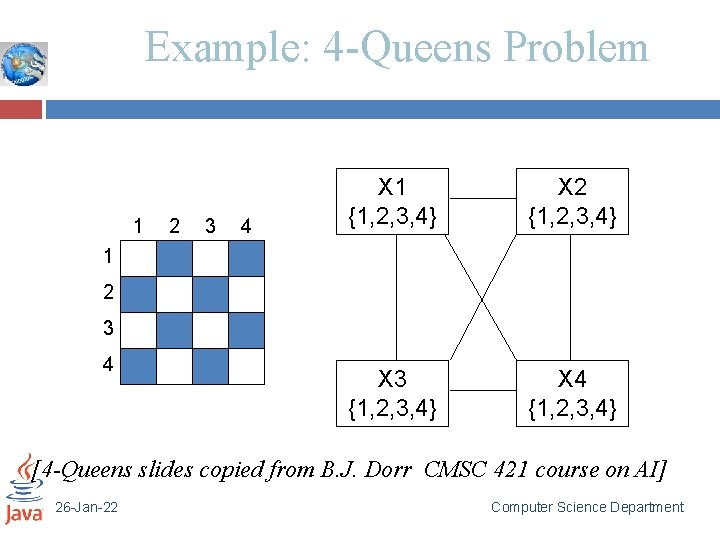
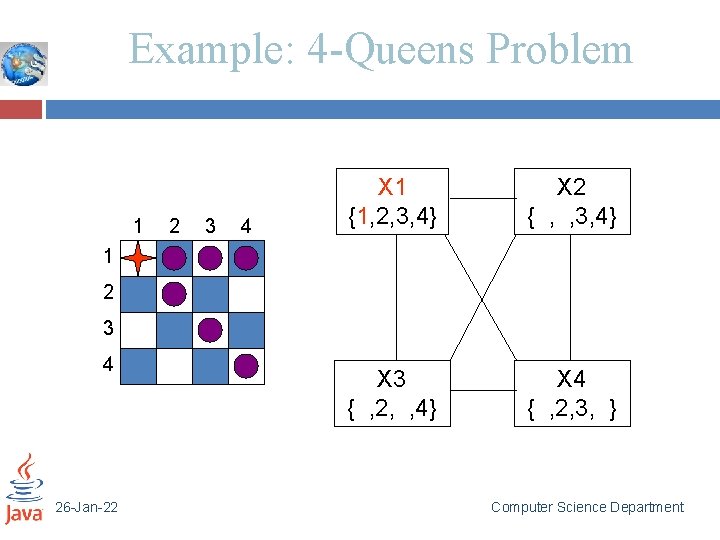
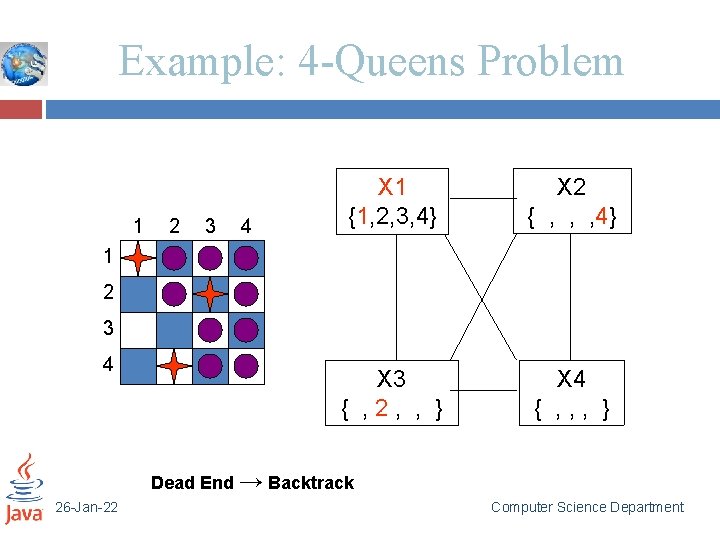
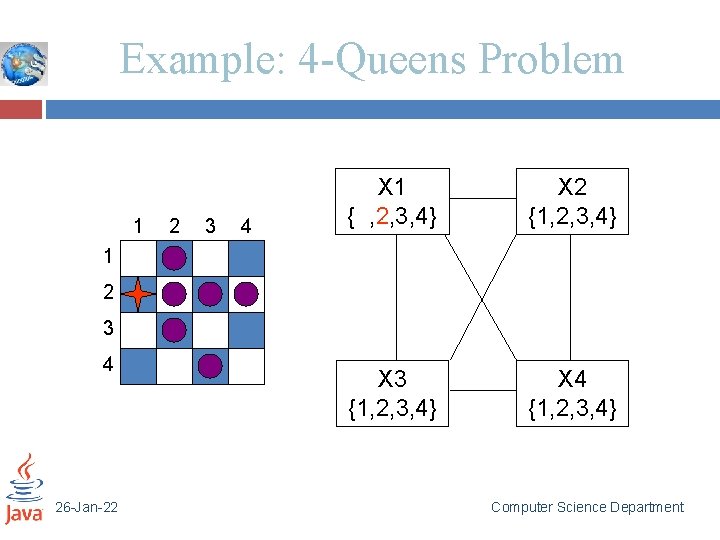
Example: 4 -Queens Problem 1 2 3 4 X 1 {1, 2, 3, 4} X 2 {1, 2, 3, 4} X 3 {1, 2, 3, 4} X 4 {1, 2, 3, 4} 1 2 3 4 [4 -Queens slides copied from B. J. Dorr CMSC 421 course on AI] 26 -Jan-22 Computer Science Department
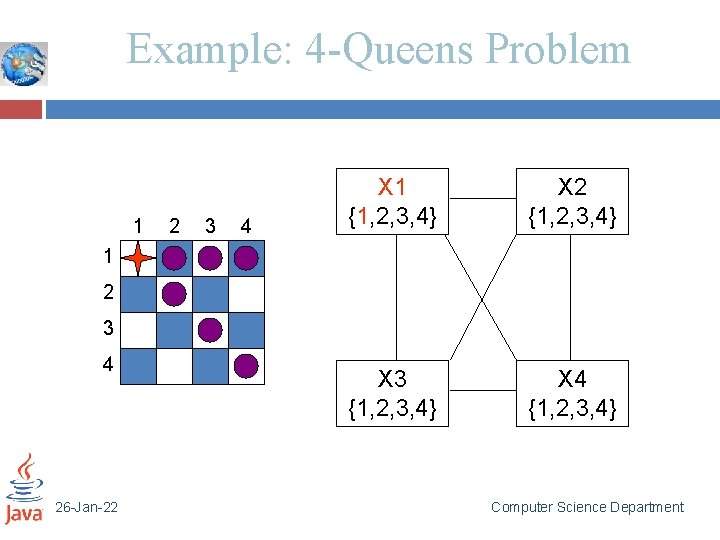
Example: 4 -Queens Problem 1 2 3 4 X 1 {1, 2, 3, 4} X 2 {1, 2, 3, 4} X 3 {1, 2, 3, 4} X 4 {1, 2, 3, 4} 1 2 3 4 26 -Jan-22 Computer Science Department
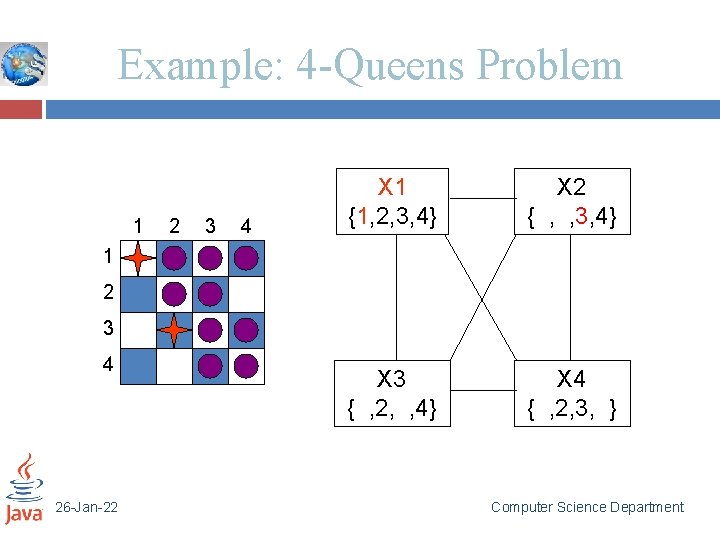
Example: 4 -Queens Problem 1 2 3 4 X 1 {1, 2, 3, 4} X 2 { , , 3, 4} X 3 { , 2, , 4} X 4 { , 2, 3, } 1 2 3 4 26 -Jan-22 Computer Science Department
Example: 4 -Queens Problem 1 2 3 4 X 1 {1, 2, 3, 4} X 2 { , , 3, 4} X 3 { , 2, , 4} X 4 { , 2, 3, } 1 2 3 4 26 -Jan-22 Computer Science Department
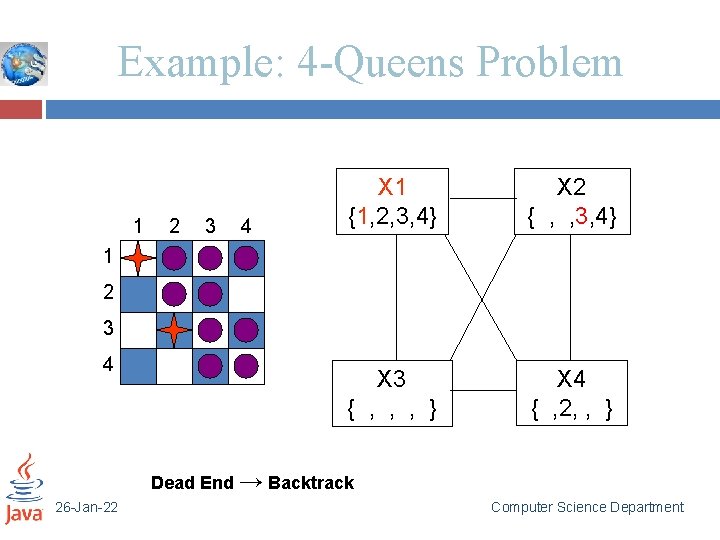
Example: 4 -Queens Problem 1 2 3 4 X 1 {1, 2, 3, 4} X 2 { , , 3, 4} X 3 { , , , } X 4 { , 2, , } 1 2 3 4 Dead End → Backtrack 26 -Jan-22 Computer Science Department
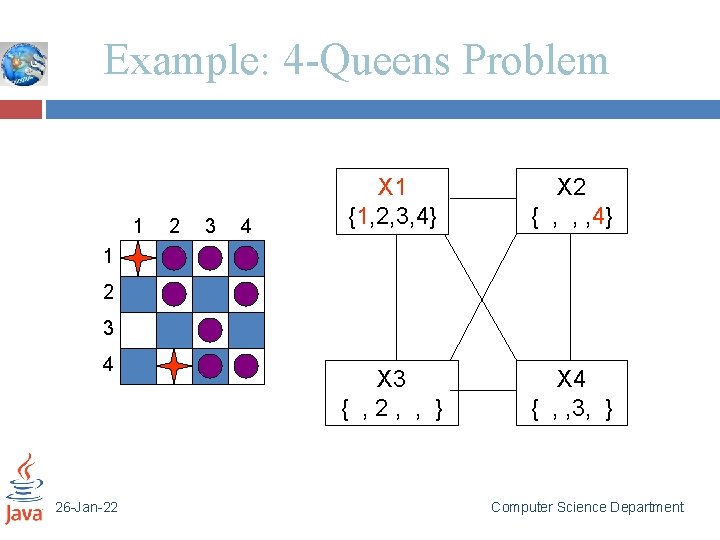
Example: 4 -Queens Problem 1 2 3 4 X 1 {1, 2, 3, 4} X 2 { , , , 4} X 3 { , 2, , } X 4 { , , 3, } 1 2 3 4 26 -Jan-22 Computer Science Department
Example: 4 -Queens Problem 1 2 3 4 X 1 {1, 2, 3, 4} X 2 { , , , 4} X 3 { , 2, , } X 4 { , , , } 1 2 3 4 Dead End → Backtrack 26 -Jan-22 Computer Science Department
Example: 4 -Queens Problem 1 2 3 4 X 1 { , 2, 3, 4} X 2 {1, 2, 3, 4} X 3 {1, 2, 3, 4} X 4 {1, 2, 3, 4} 1 2 3 4 26 -Jan-22 Computer Science Department
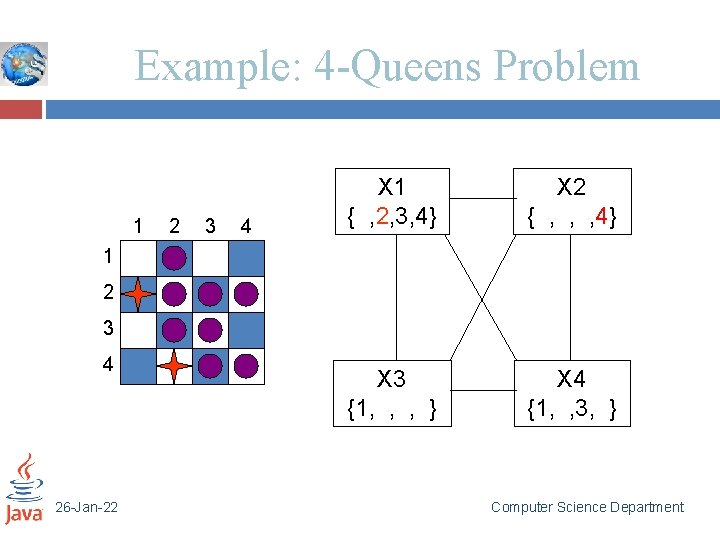
Example: 4 -Queens Problem 1 2 3 4 X 1 { , 2, 3, 4} X 2 { , , , 4} X 3 {1, , 3, } X 4 {1, , 3, 4} 1 2 3 4 26 -Jan-22 Computer Science Department
Example: 4 -Queens Problem 1 2 3 4 X 1 { , 2, 3, 4} X 2 { , , , 4} X 3 {1, , 3, } X 4 {1, , 3, 4} 1 2 3 4 26 -Jan-22 Computer Science Department
Example: 4 -Queens Problem 1 2 3 4 X 1 { , 2, 3, 4} X 2 { , , , 4} X 3 {1, , , } X 4 {1, , 3, } 1 2 3 4 26 -Jan-22 Computer Science Department
Example: 4 -Queens Problem 1 2 3 4 X 1 { , 2, 3, 4} X 2 { , , , 4} X 3 {1, , , } X 4 {1, , 3, } 1 2 3 4 26 -Jan-22 Computer Science Department
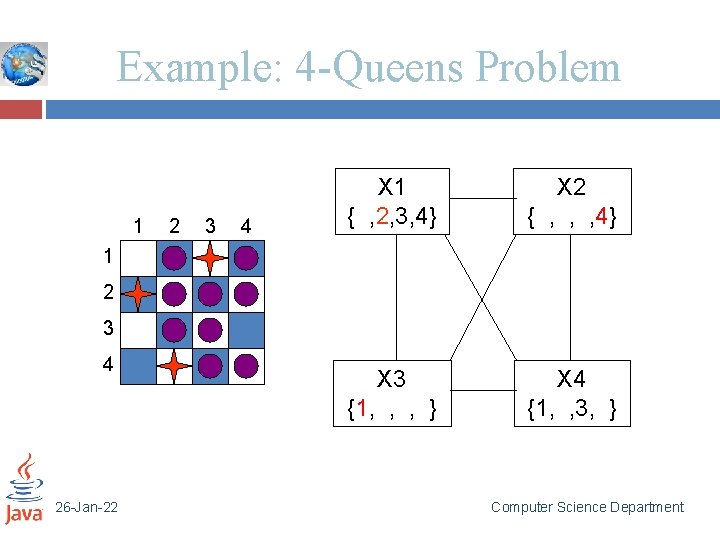
Example: 4 -Queens Problem 1 2 3 4 X 1 { , 2, 3, 4} X 2 { , , , 4} X 3 {1, , , } X 4 { , , 3, } 1 2 3 4 26 -Jan-22 Computer Science Department
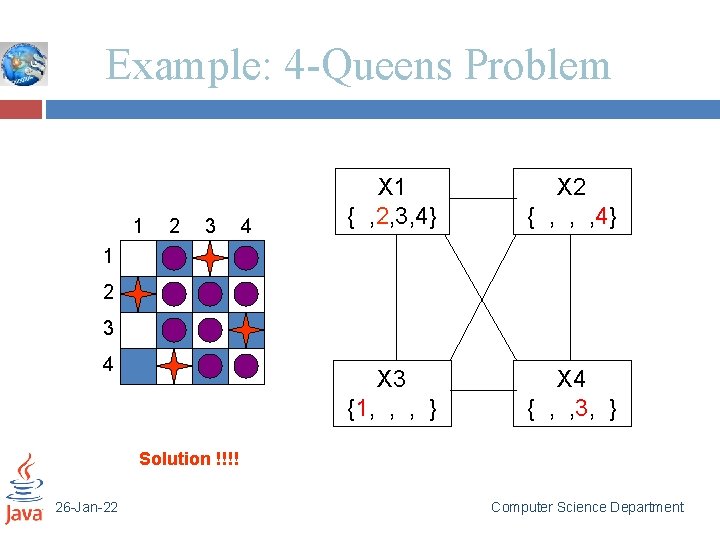
Example: 4 -Queens Problem 1 2 3 4 X 1 { , 2, 3, 4} X 2 { , , , 4} X 3 {1, , , } X 4 { , , 3, } 1 2 3 4 Solution !!!! 26 -Jan-22 Computer Science Department
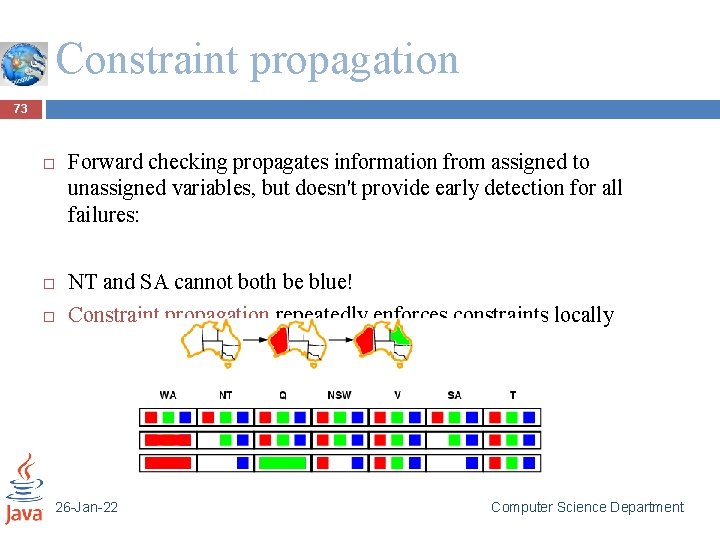
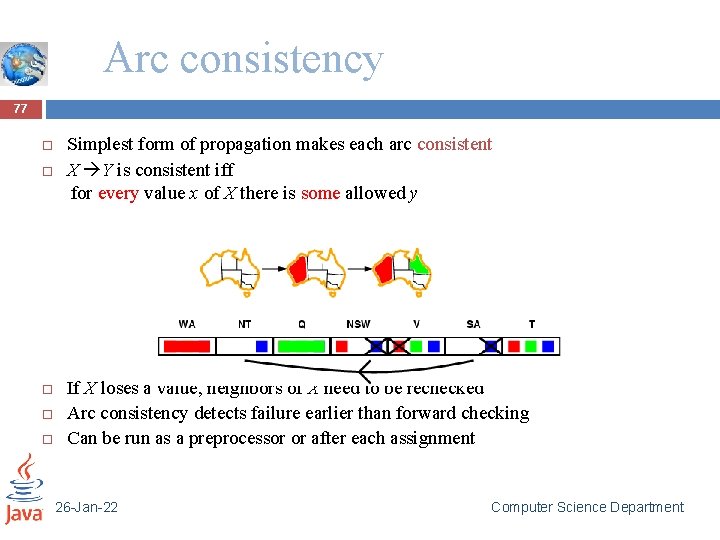
Constraint propagation 73 Forward checking propagates information from assigned to unassigned variables, but doesn't provide early detection for all failures: NT and SA cannot both be blue! Constraint propagation repeatedly enforces constraints locally 26 -Jan-22 Computer Science Department
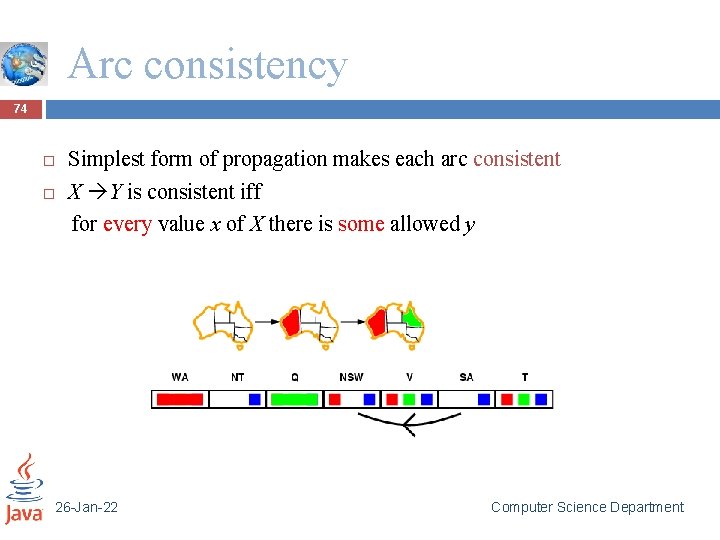
Arc consistency 74 Simplest form of propagation makes each arc consistent X Y is consistent iff for every value x of X there is some allowed y 26 -Jan-22 Computer Science Department
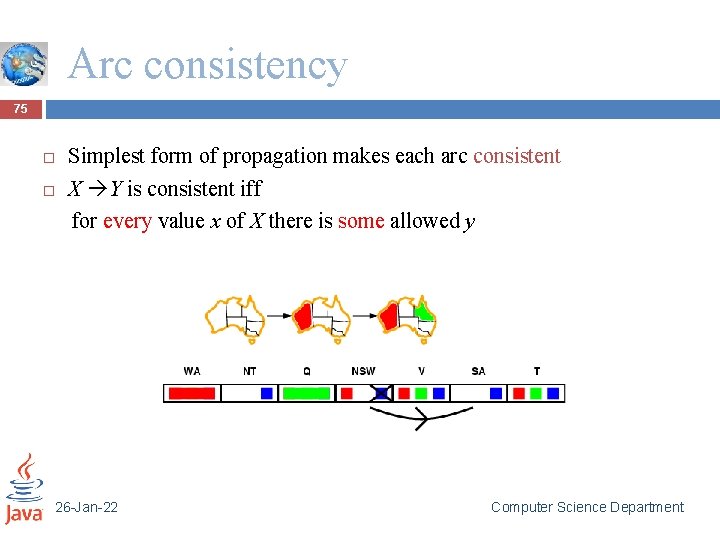
Arc consistency 75 Simplest form of propagation makes each arc consistent X Y is consistent iff for every value x of X there is some allowed y 26 -Jan-22 Computer Science Department
Arc consistency 76 Simplest form of propagation makes each arc consistent X Y is consistent iff for every value x of X there is some allowed y If X loses a value, neighbors of X need to be rechecked 26 -Jan-22 Computer Science Department
Arc consistency 77 Simplest form of propagation makes each arc consistent X Y is consistent iff for every value x of X there is some allowed y If X loses a value, neighbors of X need to be rechecked Arc consistency detects failure earlier than forward checking Can be run as a preprocessor or after each assignment 26 -Jan-22 Computer Science Department
Arc consistency AC 3 [R, B, G] [R] [R, B, G] 26 -Jan-22 [R, B, G] Computer Science Department
Arc consistency AC 3 [ , B, G] [R] [R, B, G] 26 -Jan-22 [R, B, G] Computer Science Department
Arc consistency AC 3 [ , B, G] [R] [ , B, G] 26 -Jan-22 [R, B, G] Computer Science Department
Arc consistency AC 3 [ , B, G] [R] [ , B, G] 26 -Jan-22 [R, B, G] Computer Science Department
Arc consistency AC 3 [ , B, G] [R] [ , B, G] 26 -Jan-22 [R, B, G] Computer Science Department
Arc consistency AC 3 [ , B, G] [R] [ , B, G] 26 -Jan-22 [R, B, G] Computer Science Department
Arc consistency AC 3 [ , B, G] [R] [ , B, G] 26 -Jan-22 [R, B, G] Computer Science Department
Arc consistency AC 3 [ , B, G] [R] [ , B, G] 26 -Jan-22 [R, B, G] Computer Science Department
Arc consistency AC 3 [ , B, ] [R, B, G] [R] [ , B, G] 26 -Jan-22 [R, B, G] Computer Science Department
Arc consistency AC 3 [ , B, ] [R, , G] [ , B, G] [R] 26 -Jan-22 Computer Science Department
Arc consistency AC 3 [ , B, ] [R, , G] [R] [ , B, G] 26 -Jan-22 [R, , G] Computer Science Department
Arc consistency AC 3 [ , B, ] [R, , G] [R] [ , , G] 26 -Jan-22 [R, , G] Computer Science Department
Arc consistency AC 3 [ , B, ] [R, , G] [R] [ , , G] 26 -Jan-22 [R, , ] Computer Science Department
Arc consistency AC 3 [ , B, ] [ , , G] [R] [ , , G] 26 -Jan-22 [R, , ] Computer Science Department
Arc consistency AC 3 [ , B, ] [ , , G] [R] [ , , G] 26 -Jan-22 [R, , ] Computer Science Department
Arc consistency AC 3 [ , B, ] [ , , G] [R] [ , , G] 26 -Jan-22 [R, , ] Computer Science Department
Arc consistency AC 3 [ , B, ] [ , , G] [R, , ] Solution !!! 26 -Jan-22 Computer Science Department
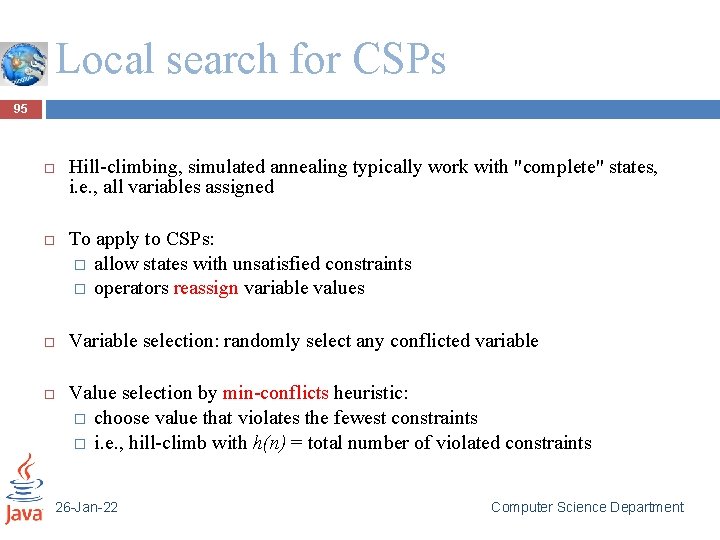
Local search for CSPs 95 Hill-climbing, simulated annealing typically work with "complete" states, i. e. , all variables assigned To apply to CSPs: � allow states with unsatisfied constraints � operators reassign variable values Variable selection: randomly select any conflicted variable Value selection by min-conflicts heuristic: � choose value that violates the fewest constraints � i. e. , hill-climb with h(n) = total number of violated constraints 26 -Jan-22 Computer Science Department
Example: 4 -Queens 96 States: 4 queens in 4 columns (44 = 256 states) Actions: move queen in column Goal test: no attacks Evaluation: h(n) = number of attacks Given random initial state, can solve n-queens in almost constant time for arbitrary n with high probability (e. g. , n = 10, 000) 26 -Jan-22 Computer Science Department
Summary 97 CSPs are a special kind of problem: � states defined by values of a fixed set of variables � goal test defined by constraints on variable values Backtracking = depth-first search with one variable assigned per node Variable ordering and value selection heuristics help significantly Forward checking prevents assignments that guarantee later failure Constraint propagation (e. g. , arc consistency) does additional work to constrain values and detect inconsistencies Iterative min-conflicts is usually effective in practice 26 -Jan-22 Computer Science Department