
1 Creating and Implementing College Preparatory Courses TexasStyle
- Slides: 35
1 Creating and Implementing College Preparatory Courses Texas-Style http: //untavatar. org
Creating and Implementing College Preparatory Courses Texas-Style NISOD International Conference on Teaching and Leadership Excellence Austin, TX May 25, 2015 Mary M. Harris, University of North Texas M. Jean Keller, University of North Texas http: //untavatar. org 2
3 Presentation Overview What is AVATAR and why is it needed? 2. What is the AVATAR College Preparatory Course (CPC) Project? 3. How does AVATAR CPC compare with national trends in transitional course offering? 4. What can we learn from one year of Texas transitional course experience? 1.
4 What is AVATAR and why is it needed?
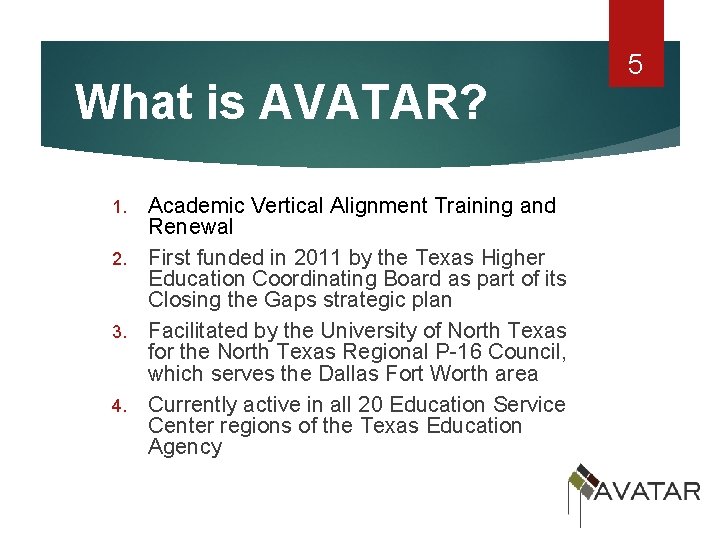
What is AVATAR? Academic Vertical Alignment Training and Renewal 2. First funded in 2011 by the Texas Higher Education Coordinating Board as part of its Closing the Gaps strategic plan 3. Facilitated by the University of North Texas for the North Texas Regional P-16 Council, which serves the Dallas Fort Worth area 4. Currently active in all 20 Education Service Center regions of the Texas Education Agency 1. 5
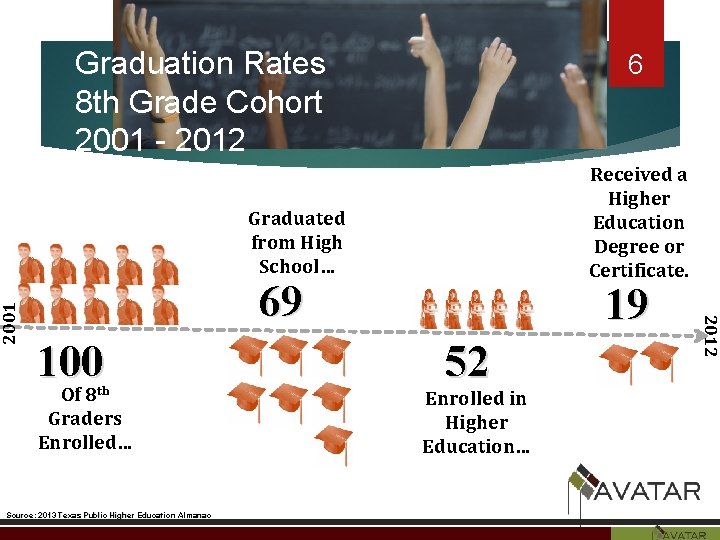
Graduation Rates 8 th Grade Cohort 2001 - 2012 6 Received a Higher Education Degree or Certificate. 69 100 Of 8 th Graders Enrolled… Source: 2013 Texas Public Higher Education Almanac 19 52 Enrolled in Higher Education… 2012 2001 Graduated from High School…
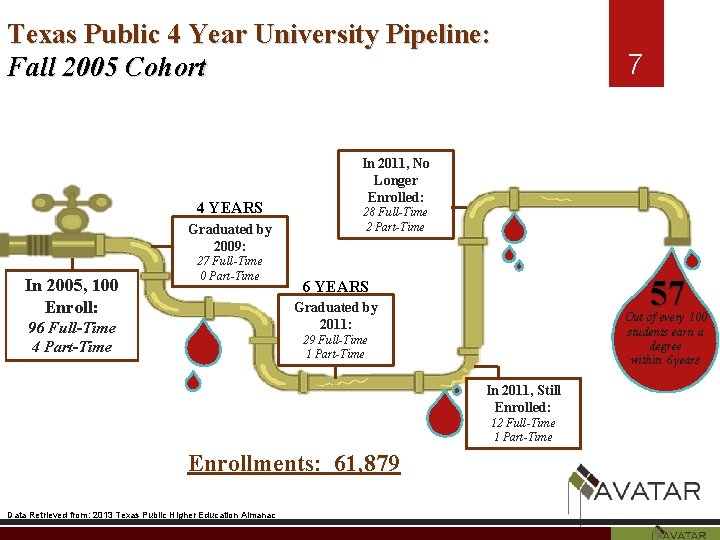
Texas Public 4 Year University Pipeline: Fall 2005 Cohort 4 YEARS Graduated by 2009: In 2005, 100 Enroll: 27 Full-Time 0 Part-Time In 2011, No Longer Enrolled: 28 Full-Time 2 Part-Time 57 6 YEARS Graduated by 2011: 96 Full-Time 4 Part-Time Out of every 100 students earn a degree within 6 years 29 Full-Time 1 Part-Time In 2011, Still Enrolled: 12 Full-Time 1 Part-Time Enrollments: 61, 879 Data Retrieved from: 2013 Texas Public Higher Education Almanac 7
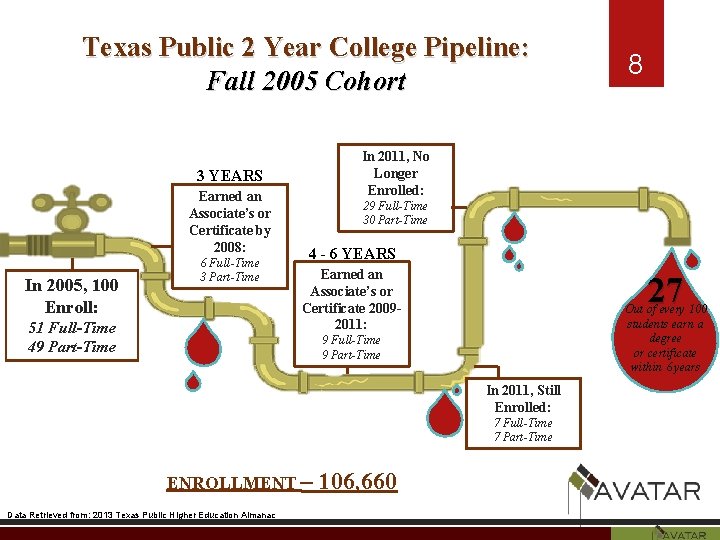
Texas Public 2 Year College Pipeline: Fall 2005 Cohort In 2011, No Longer Enrolled: 3 YEARS Earned an Associate’s or Certificate by 2008: In 2005, 100 Enroll: 6 Full-Time 3 Part-Time 51 Full-Time 49 Part-Time 29 Full-Time 30 Part-Time 4 - 6 YEARS Earned an Associate’s or Certificate 20092011: 27 Out of every 100 students earn a degree or certificate within 6 years 9 Full-Time 9 Part-Time In 2011, Still Enrolled: 7 Full-Time 7 Part-Time ENROLLMENT – Data Retrieved from: 2013 Texas Public Higher Education Almanac 8 106, 660
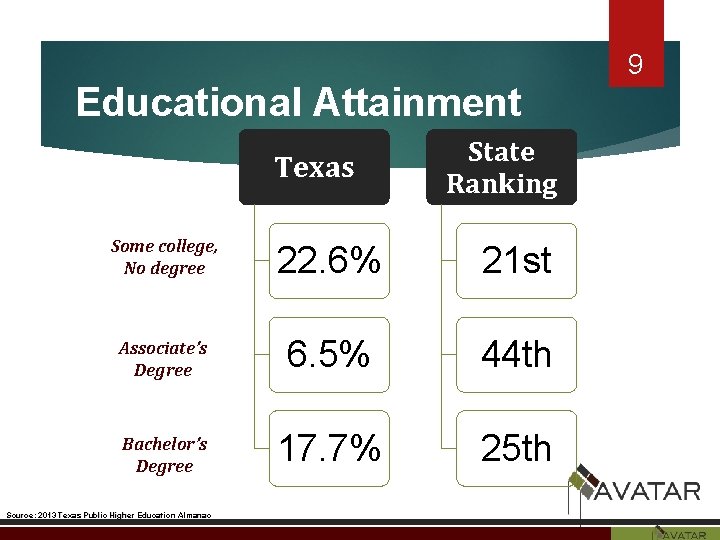
Educational Attainment Texas State Ranking Some college, No degree 22. 6% 21 st Associate’s Degree 6. 5% 44 th Bachelor’s Degree 17. 7% 25 th Source: 2013 Texas Public Higher Education Almanac 9
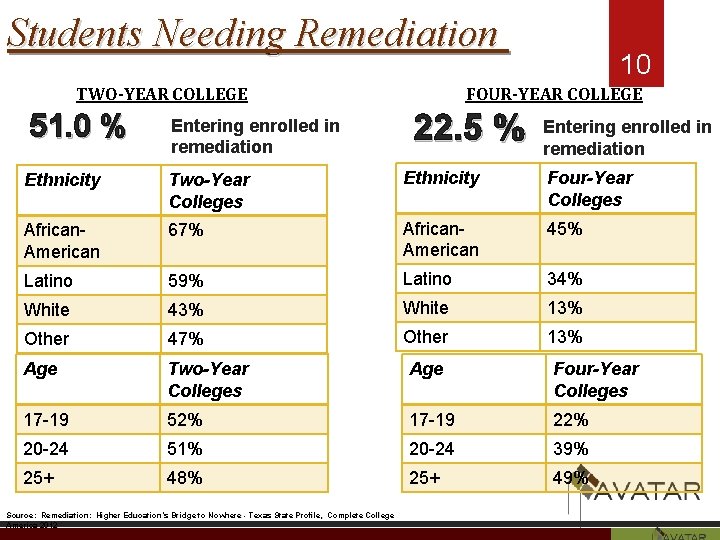
Students Needing Remediation TWO-YEAR COLLEGE 10 FOUR-YEAR COLLEGE 22. 5 % 51. 0 % Entering enrolled in remediation Ethnicity Two-Year Colleges Ethnicity Four-Year Colleges African. American 67% African. American 45% Latino 59% Latino 34% White 43% White 13% Other 47% Other 13% Age Two-Year Colleges Age Four-Year Colleges 17 -19 52% 17 -19 22% 20 -24 51% 20 -24 39% 25+ 48% 25+ 49% Source: Remediation: Higher Education’s Bridge to Nowhere - Texas State Profile, Complete College America 2012 Entering enrolled in remediation
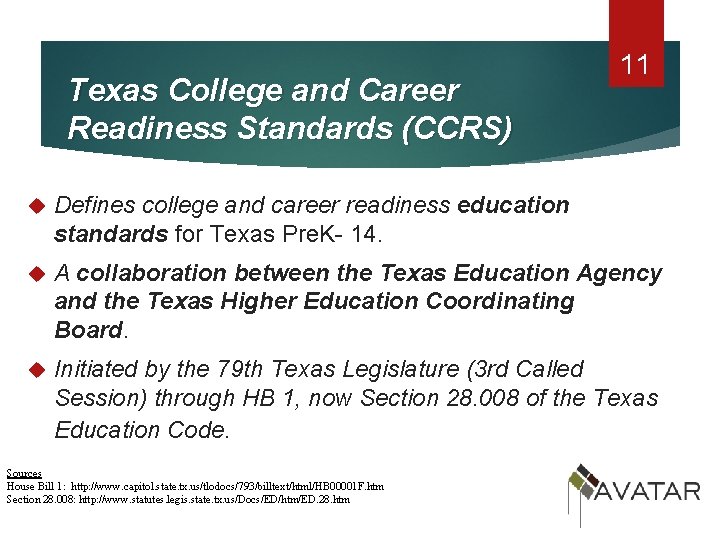
Texas College and Career Readiness Standards (CCRS) 11 Defines college and career readiness education standards for Texas Pre. K- 14. A collaboration between the Texas Education Agency and the Texas Higher Education Coordinating Board. Initiated by the 79 th Texas Legislature (3 rd Called Session) through HB 1, now Section 28. 008 of the Texas Education Code. Sources House Bill 1: http: //www. capitol. state. tx. us/tlodocs/793/billtext/html/HB 00001 F. htm Section 28. 008: http: //www. statutes. legis. state. tx. us/Docs/ED/htm/ED. 28. htm
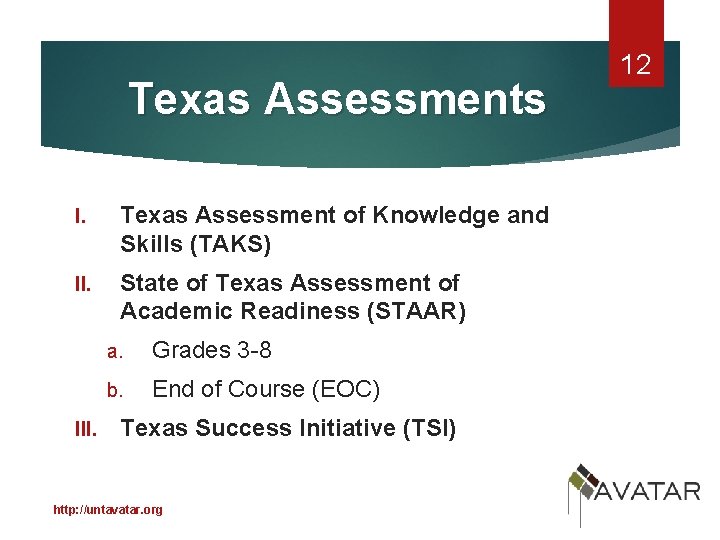
Texas Assessments I. Texas Assessment of Knowledge and Skills (TAKS) II. State of Texas Assessment of Academic Readiness (STAAR) III. a. Grades 3 -8 b. End of Course (EOC) Texas Success Initiative (TSI) http: //untavatar. org 12
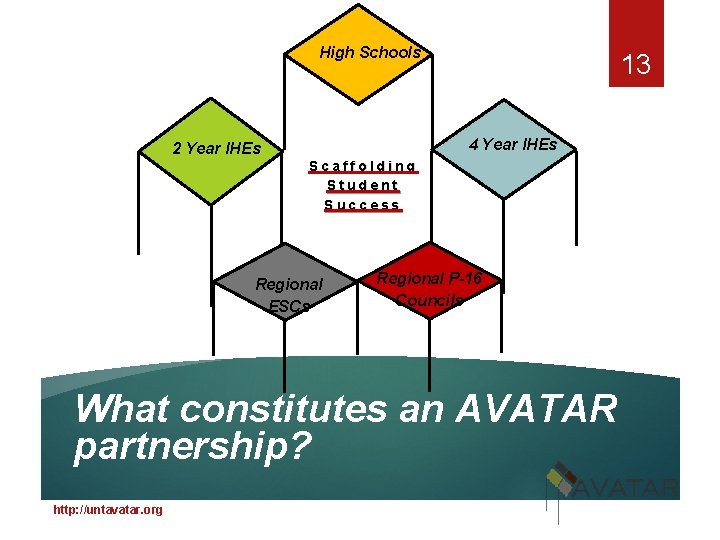
High Schools 13 4 Year IHEs 2 Year IHEs Scaffolding Student Success Regional ESCs Regional P-16 Councils What constitutes an AVATAR partnership? http: //untavatar. org
What are the purposes of AVATAR? Assure success for students as they move from high school to college and the workforce 2. Vertically align the curriculum of courses in selected disciplines 3. Base alignment decisions on local needs and interests 4. Support partnerships in implementing HB 5 CPC mandate 1. 14
AVATAR is a Process Creates and builds relationships through ongoing critical conversations Uses regional data to make alignment decisions Develops shared understanding of college and career readiness and success for students Identifies and implements intentional actions to promote student success Evaluates, sustains, and shares vertical alignment work http: //untavatar. org 15
16 What is the AVATAR College Preparatory Course project?
What are College Preparatory Courses as defined by HB 5 (Texas Legislature, 2013) Offered in English language arts and mathematics by school districts in collaboration with colleges 2. Offered for high school students who are not college ready 3. May enable students to be exempt from the TSI (Texas Success Initiative) 4. Evaluated annually by school district and college partners 1. 17
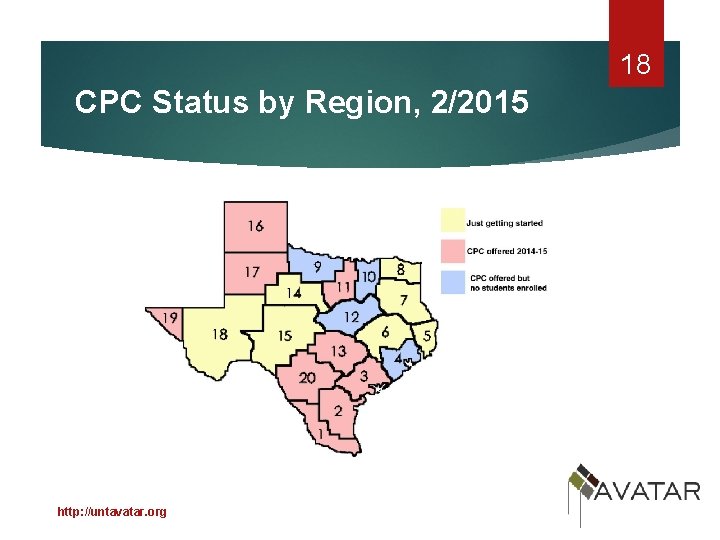
18 CPC Status by Region, 2/2015 http: //untavatar. org
19 How does AVATAR CPC compare with national trends in transitional course offering? http: //untavatar. org
20 Transitional Courses Nationally Offered in 29 states, all efforts recent. 8 states have initiatives led by an SEA or HEA. Courses are offered in English and, more often, mathematics and are offered face to face and online, with curriculum usually developed by local high schools. No definitive research, but leading work in El Paso through experiments of Southern Regional Education Board funded by Bill and Melinda Gates Foundation. Implementation of Common Core and related assessments pushes focus on student performance. Reference: Barnett, E. A. , Fay, M. P. , Trimble, M. J. , & Pheatt, L. (2013) Reshaping the College Transition: Early College Readiness Assessments and Transition Curricula in Four States. NY: Community College Research Center, Teachers College, Columbia University
Rationale for Transitional Courses 21 Almost half of students nationally place into at least one remedial course at college entry. Even academically prepared students may lack “college knowledge” and critical skills. Vertical alignment of curriculum is supported by research in a standards-based environment. The earliest possible intervention is the least costly in public and individual resources. Reference: Barnett, E. A. , Fay, M. P. , Trimble, M. J. , & Pheatt, L. (2013) Reshaping the College Transition: Early College Readiness Assessments and Transition Curricula in Four States. NY: Community College Research Center, Teachers College, Columbia University.
TX CPC’s and transitional courses in NY, TN, CA, WV Similarities 1. Courses offered in mathematics and/or English 2. Student placement determined by state-adopted tests (although local option in TX) 3. Transitional courses may meet high school graduation requirement 4. Leadership for offering and design of courses by school districts with college partners Notable about TX CPC’s 1. TX College and Career Readiness Standards 2. Enrollment a choice of the student 3. Extent of local control over curriculum and implementation 22
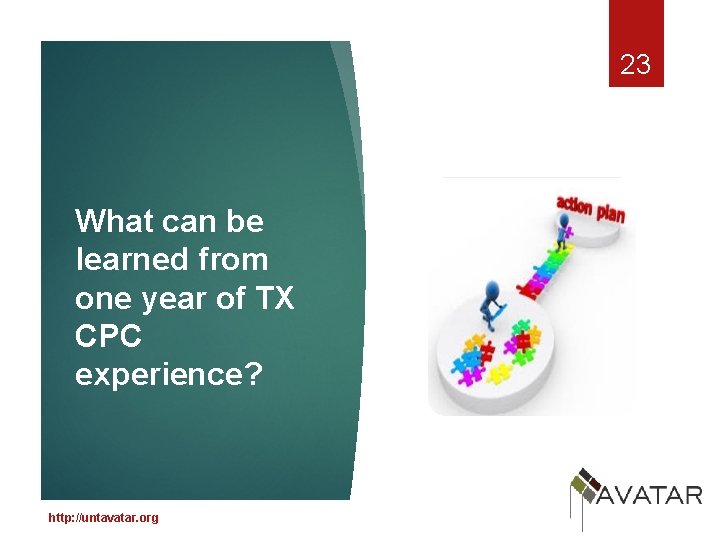
23 What can be learned from one year of TX CPC experience? http: //untavatar. org
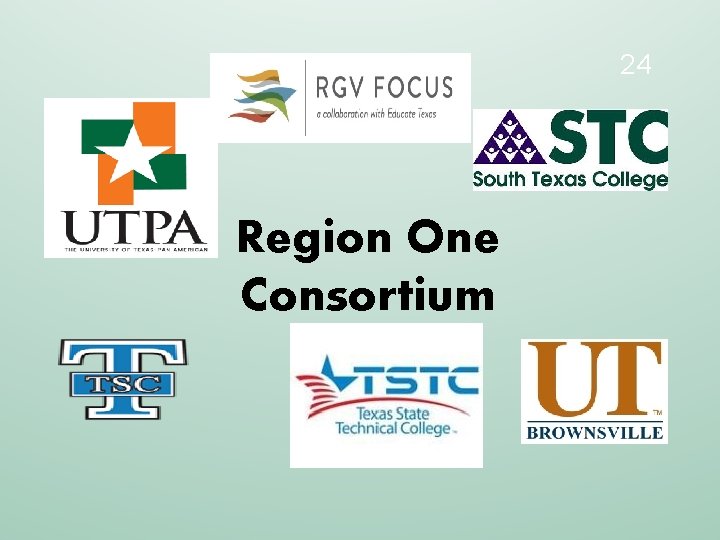
24 Region One Consortium
25 Regional Goals Collaboratively create two-semester online courses providing an opportunity for students to demonstrate college readiness in mathematics and/or English Language Arts while still in high school Ensure students are able to begin taking credit bearing courses their first year of college http: //untavatar. org
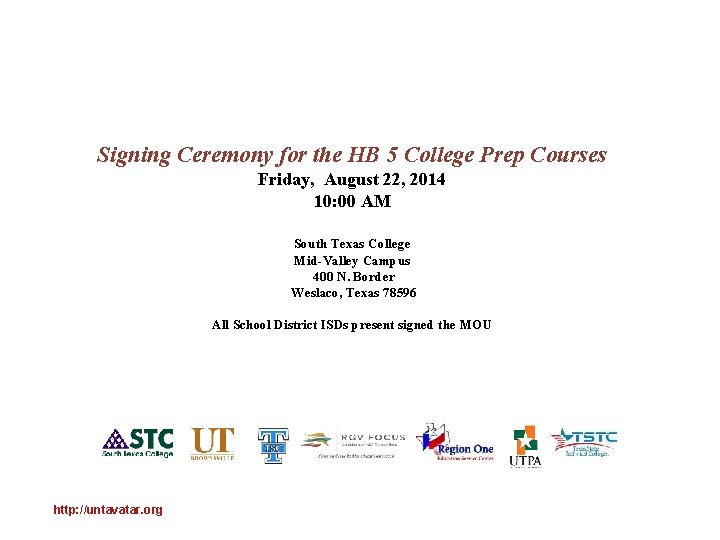
26 You’re Invited … Save the Date Signing Ceremony for the HB 5 College Prep Courses Friday, August 22, 2014 10: 00 AM South Texas College Mid-Valley Campus 400 N. Border Weslaco, Texas 78596 All School District ISDs present signed the MOU http: //untavatar. org
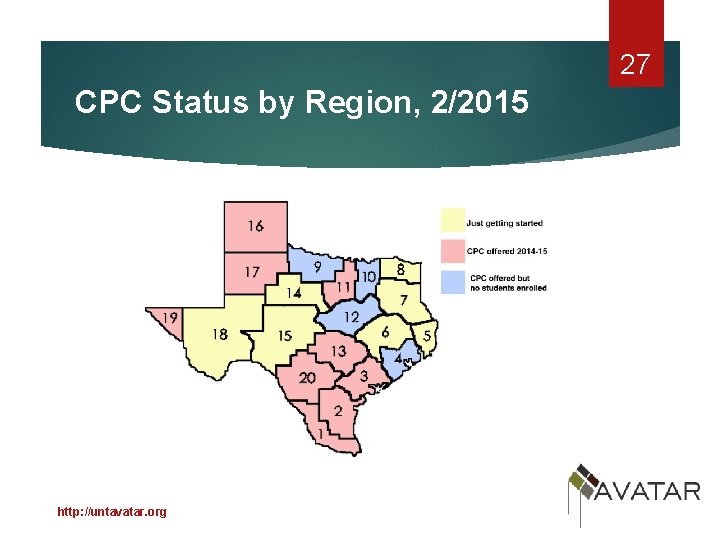
27 CPC Status by Region, 2/2015 http: //untavatar. org
28 Issues: Statewide draw What happens to a student who successfully completes a CPC but wants to enroll in a college not included in the local partnership?
29 Issues: Horizontal alignment How can receiving colleges be sure CPC’s completed by entering students are of equal rigor and provided common content knowledge? How can receiving colleges be sure that assessments and criteria used in grading the entering students were equal and applied fairly? How can receiving colleges be sure that the teachers assigned to the transitional courses were well qualified?
30 Issues: TSI exemption? HB 5 specified exemption from the TSI for one year after CPC completion. This precludes students other than high school seniors from taking CPC’s. Is this right? What if a senior delays starting college for a good reason? What if a junior wants to be college ready? Some colleges agree to an MOU that requires the passing the TSI for CPC completion. Others agree to performance measures other than the TSI. Is this fair? Is it right? What is college readiness anyway? What if a student enrolled in a CPC independently passes the TSI? Should he/she be allowed to drop? Is the goal of a CPC college readiness or test prep?
31 Issues: Data sharing Some colleges have sought contact information for students enrolled in CPC’s for recruitment but were not provided this information due to FERPA. HB 5 specified partnership evaluation of CPC’s over time. This requires knowledge of student enrollment and outcomes, but data sharing was typically not part of local MOUs. Through CPC numbers designated by the state, the TEA can track student enrollment. No other provision has been made for state level study of this phenomenon.
32 Comments and Suggestions http: //untavatar. org
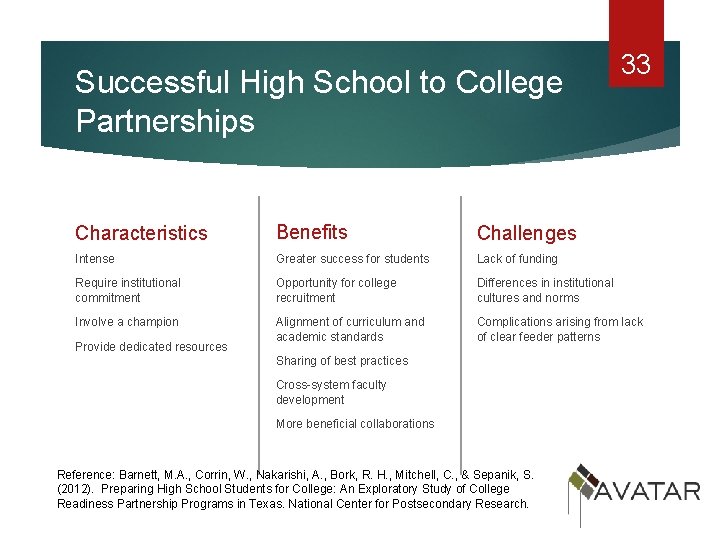
Successful High School to College Partnerships 33 Characteristics Benefits Challenges Intense Greater success for students Lack of funding Require institutional commitment Opportunity for college recruitment Differences in institutional cultures and norms Involve a champion Alignment of curriculum and academic standards Complications arising from lack of clear feeder patterns Provide dedicated resources Sharing of best practices Cross-system faculty development More beneficial collaborations Reference: Barnett, M. A. , Corrin, W. , Nakarishi, A. , Bork, R. H. , Mitchell, C. , & Sepanik, S. (2012). Preparing High School Students for College: An Exploratory Study of College Readiness Partnership Programs in Texas. National Center for Postsecondary Research.
34 Contact Information M Jean Keller Mary M Harris Professor and Acting Vice President Regent Professor Emerita Director, AVATAR Co-director, AVATAR University of North Texas Jean. keller@unt. edu Denton, TX 940 565 -3427 Mary. harris@unt. edu 940 367 -3026 University of North Texas Denton, TX
35 References Barnett, M. A. , Corrin, W. , Nakarishi, A. , Bork, R. H. , Mitchell, C. , & Sepanik, S. (2012). Preparing High School Students for College: An Exploratory Study of College Readiness Partnership Programs in Texas. National Center for Postsecondary Research. Barnett, E. A. , Fay, M. P. , Trimble, M. J. , & Pheatt, L. (2013) Reshaping the College Transition: Early College Readiness Assessments and Transition Curricula in Four States. NY: Community College Research Center, Teachers College, Columbia University. Harris, M. , & Keller, J. (2015). Results of AVATAR Regional College Preparatory Course Survey. Texas College and Career Readiness Network Digest, 13, March-April. Available at http: //bit. ly/1 Ko. Yu. QS