
1 Correction 2 Meaning of Probability 3 3
1. Correction. 2. Meaning of Probability 3. 3. Axioms of Probability 4. Addition rule 5. Multiplication rules 6. Examples Correction from end of last time: # of possible 2 -card hands = choose(52, 2) = 1326, not 221. P(A A ) = 1/1326. P(AA) = Choose(4, 2)/1326 = 1/221.
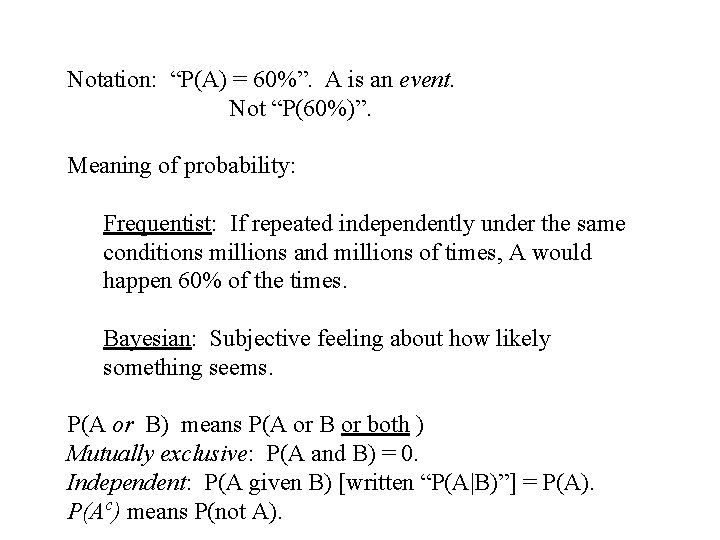
Notation: “P(A) = 60%”. A is an event. Not “P(60%)”. Meaning of probability: Frequentist: If repeated independently under the same conditions millions and millions of times, A would happen 60% of the times. Bayesian: Subjective feeling about how likely something seems. P(A or B) means P(A or B or both ) Mutually exclusive: P(A and B) = 0. Independent: P(A given B) [written “P(A|B)”] = P(A). P(Ac) means P(not A).
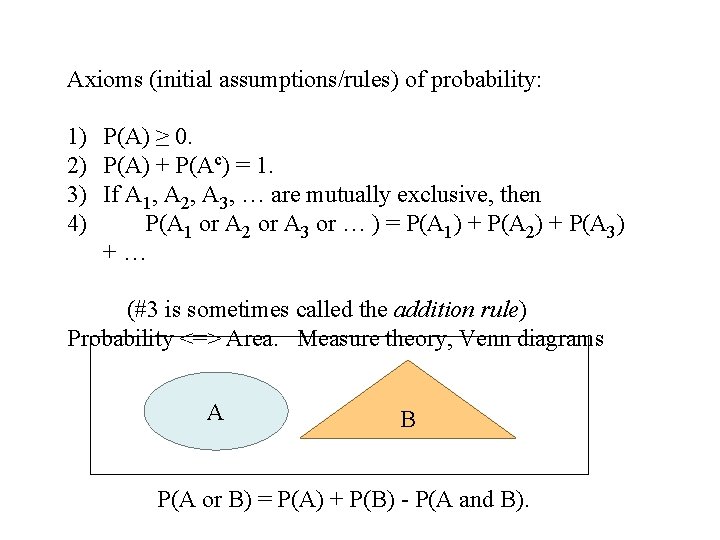
Axioms (initial assumptions/rules) of probability: 1) P(A) ≥ 0. 2) P(A) + P(Ac) = 1. 3) If A 1, A 2, A 3, … are mutually exclusive, then 4) P(A 1 or A 2 or A 3 or … ) = P(A 1) + P(A 2) + P(A 3) +… (#3 is sometimes called the addition rule) Probability <=> Area. Measure theory, Venn diagrams A B P(A or B) = P(A) + P(B) - P(A and B).
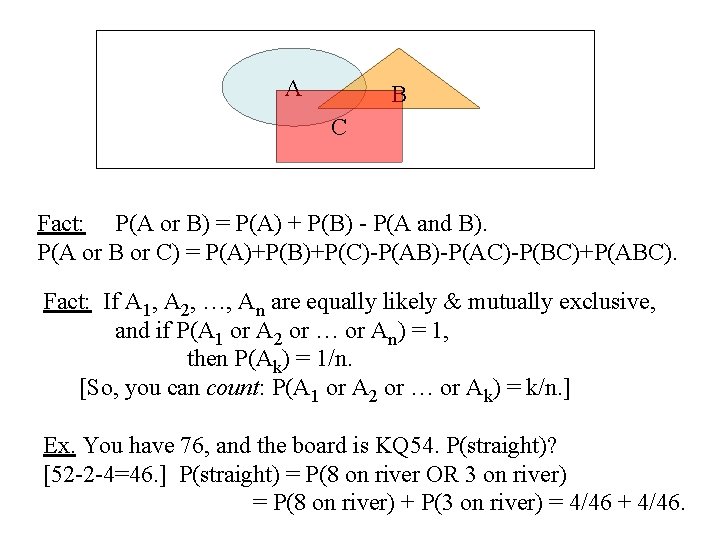
A B C Fact: P(A or B) = P(A) + P(B) - P(A and B). P(A or B or C) = P(A)+P(B)+P(C)-P(AB)-P(AC)-P(BC)+P(ABC). Fact: If A 1, A 2, …, An are equally likely & mutually exclusive, and if P(A 1 or A 2 or … or An) = 1, then P(Ak) = 1/n. [So, you can count: P(A 1 or A 2 or … or Ak) = k/n. ] Ex. You have 76, and the board is KQ 54. P(straight)? [52 -2 -4=46. ] P(straight) = P(8 on river OR 3 on river) = P(8 on river) + P(3 on river) = 4/46 + 4/46.
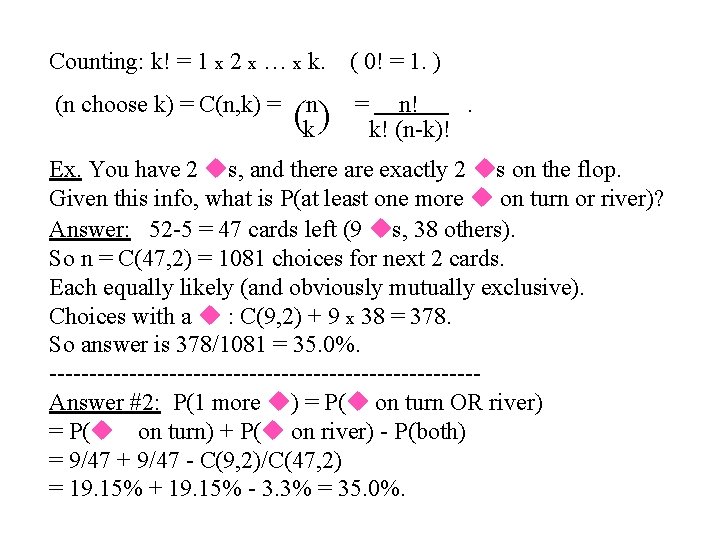
Counting: k! = 1 x 2 x … x k. ( 0! = 1. ) (n choose k) = C(n, k) = = n k () n!. k! (n-k)! Ex. You have 2 us, and there are exactly 2 us on the flop. Given this info, what is P(at least one more u on turn or river)? Answer: 52 -5 = 47 cards left (9 us, 38 others). So n = C(47, 2) = 1081 choices for next 2 cards. Each equally likely (and obviously mutually exclusive). Choices with a u : C(9, 2) + 9 x 38 = 378. So answer is 378/1081 = 35. 0%. ---------------------------Answer #2: P(1 more u) = P(u on turn OR river) = P(u on turn) + P(u on river) - P(both) = 9/47 + 9/47 - C(9, 2)/C(47, 2) = 19. 15% + 19. 15% - 3. 3% = 35. 0%.
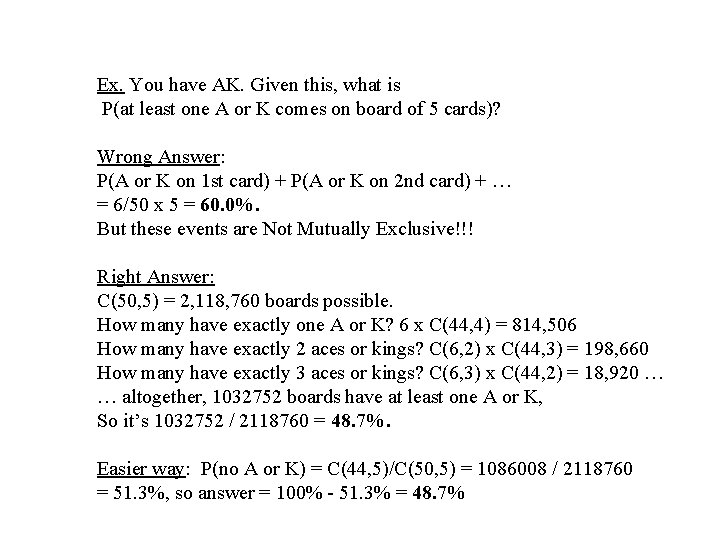
Ex. You have AK. Given this, what is P(at least one A or K comes on board of 5 cards)? Wrong Answer: P(A or K on 1 st card) + P(A or K on 2 nd card) + … = 6/50 x 5 = 60. 0%. But these events are Not Mutually Exclusive!!! Right Answer: C(50, 5) = 2, 118, 760 boards possible. How many have exactly one A or K? 6 x C(44, 4) = 814, 506 How many have exactly 2 aces or kings? C(6, 2) x C(44, 3) = 198, 660 How many have exactly 3 aces or kings? C(6, 3) x C(44, 2) = 18, 920 … … altogether, 1032752 boards have at least one A or K, So it’s 1032752 / 2118760 = 48. 7%. Easier way: P(no A or K) = C(44, 5)/C(50, 5) = 1086008 / 2118760 = 51. 3%, so answer = 100% - 51. 3% = 48. 7%
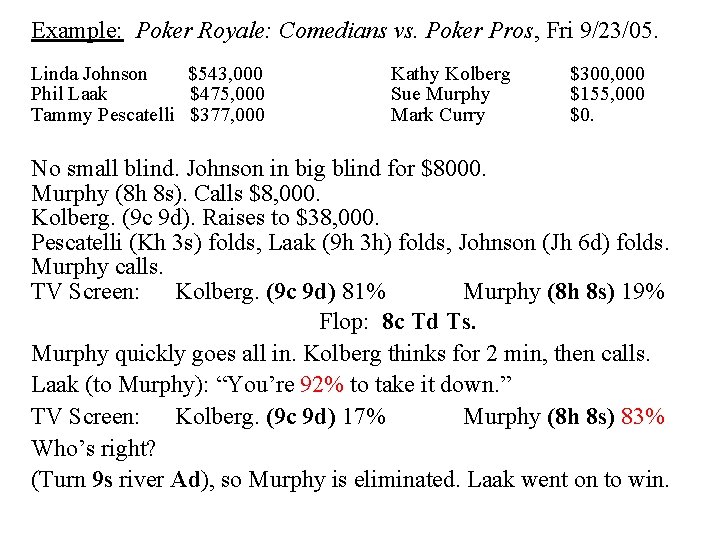
Example: Poker Royale: Comedians vs. Poker Pros, Fri 9/23/05. Linda Johnson $543, 000 Phil Laak $475, 000 Tammy Pescatelli $377, 000 Kathy Kolberg Sue Murphy Mark Curry $300, 000 $155, 000 $0. No small blind. Johnson in big blind for $8000. Murphy (8 h 8 s). Calls $8, 000. Kolberg. (9 c 9 d). Raises to $38, 000. Pescatelli (Kh 3 s) folds, Laak (9 h 3 h) folds, Johnson (Jh 6 d) folds. Murphy calls. TV Screen: Kolberg. (9 c 9 d) 81% Murphy (8 h 8 s) 19% Flop: 8 c Td Ts. Murphy quickly goes all in. Kolberg thinks for 2 min, then calls. Laak (to Murphy): “You’re 92% to take it down. ” TV Screen: Kolberg. (9 c 9 d) 17% Murphy (8 h 8 s) 83% Who’s right? (Turn 9 s river Ad), so Murphy is eliminated. Laak went on to win.
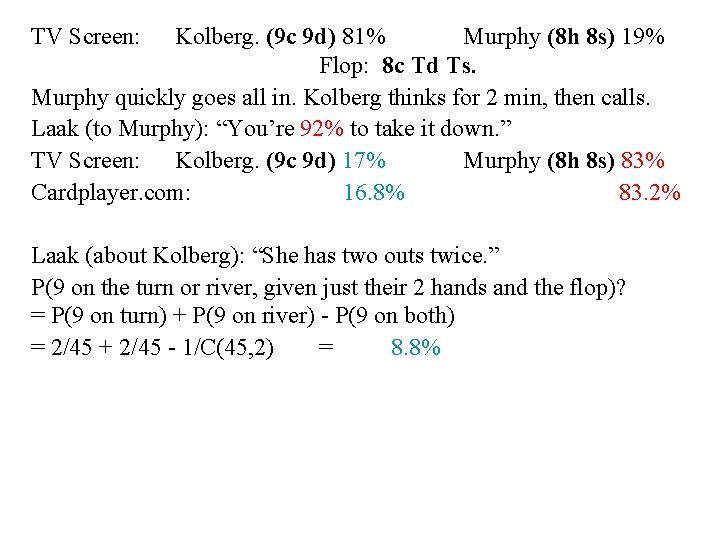
TV Screen: Kolberg. (9 c 9 d) 81% Murphy (8 h 8 s) 19% Flop: 8 c Td Ts. Murphy quickly goes all in. Kolberg thinks for 2 min, then calls. Laak (to Murphy): “You’re 92% to take it down. ” TV Screen: Kolberg. (9 c 9 d) 17% Murphy (8 h 8 s) 83% Cardplayer. com: 16. 8% 83. 2% Laak (about Kolberg): “She has two outs twice. ” P(9 on the turn or river, given just their 2 hands and the flop)? = P(9 on turn) + P(9 on river) - P(9 on both) = 2/45 + 2/45 - 1/C(45, 2) = 8. 8%Given other players’ 6 cards? Laak had a 9, so it’s 1/39 + 1/39 = 5. 1%
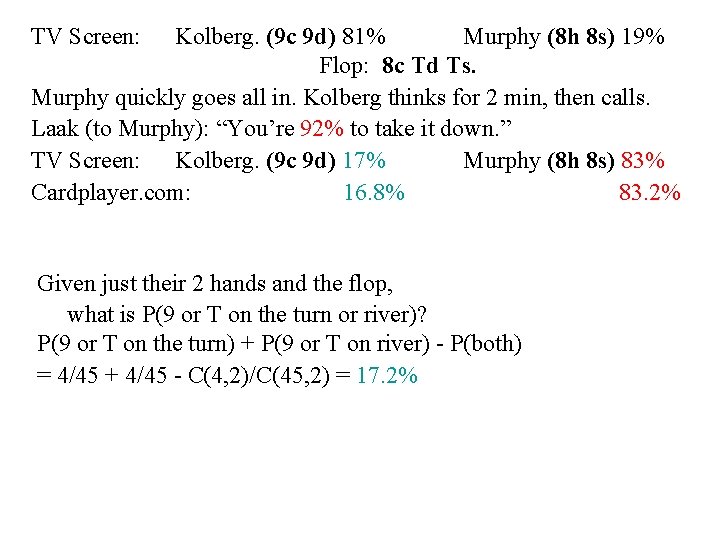
TV Screen: Kolberg. (9 c 9 d) 81% Murphy (8 h 8 s) 19% Flop: 8 c Td Ts. Murphy quickly goes all in. Kolberg thinks for 2 min, then calls. Laak (to Murphy): “You’re 92% to take it down. ” TV Screen: Kolberg. (9 c 9 d) 17% Murphy (8 h 8 s) 83% Cardplayer. com: 16. 8% 83. 2% Given just their 2 hands and the flop, what is P(9 or T on the turn or river)? P(9 or T on the turn) + P(9 or T on river) - P(both) = 4/45 + 4/45 - C(4, 2)/C(45, 2) = 17. 2%
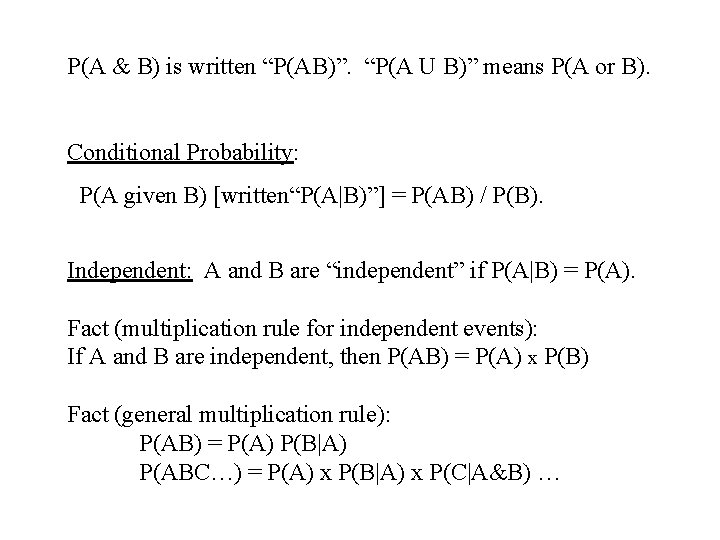
P(A & B) is written “P(AB)”. “P(A U B)” means P(A or B). Conditional Probability: P(A given B) [written“P(A|B)”] = P(AB) / P(B). Independent: A and B are “independent” if P(A|B) = P(A). Fact (multiplication rule for independent events): If A and B are independent, then P(AB) = P(A) x P(B) Fact (general multiplication rule): P(AB) = P(A) P(B|A) P(ABC…) = P(A) x P(B|A) x P(C|A&B) …
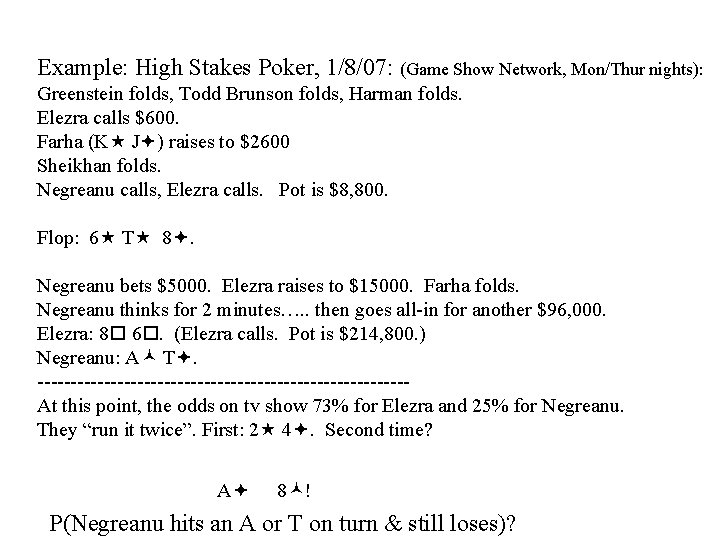
Example: High Stakes Poker, 1/8/07: (Game Show Network, Mon/Thur nights): Greenstein folds, Todd Brunson folds, Harman folds. Elezra calls $600. Farha (K J ) raises to $2600 Sheikhan folds. Negreanu calls, Elezra calls. Pot is $8, 800. Flop: 6 T 8. Negreanu bets $5000. Elezra raises to $15000. Farha folds. Negreanu thinks for 2 minutes…. . then goes all-in for another $96, 000. Elezra: 8 6. (Elezra calls. Pot is $214, 800. ) Negreanu: A T. ----------------------------At this point, the odds on tv show 73% for Elezra and 25% for Negreanu. They “run it twice”. First: 2 4. Second time? A 8 ! P(Negreanu hits an A or T on turn & still loses)?
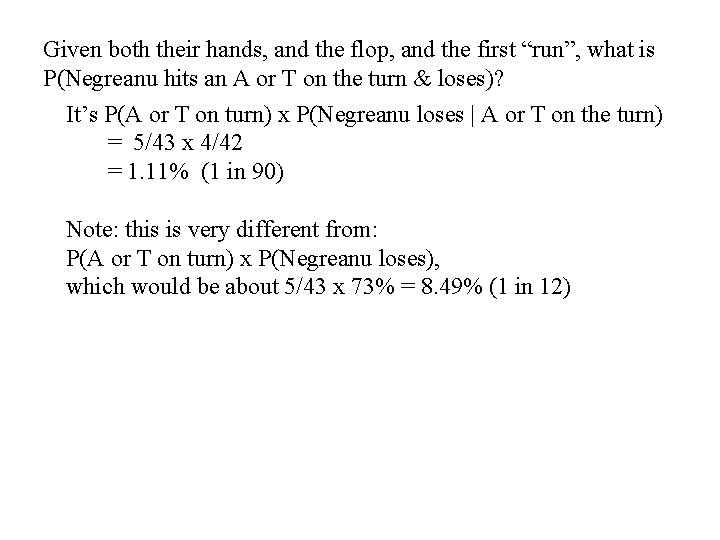
Given both their hands, and the flop, and the first “run”, what is P(Negreanu hits an A or T on the turn & loses)? It’s P(A or T on turn) x P(Negreanu loses | A or T on the turn) = 5/43 x 4/42 = 1. 11% (1 in 90) Note: this is very different from: P(A or T on turn) x P(Negreanu loses), which would be about 5/43 x 73% = 8. 49% (1 in 12)
- Slides: 12