
1 Corporate Valuation n DCFWACC Method n APV


- Slides: 26
1 Corporate Valuation n DCF-WACC Method n APV Method n FTE Method n We will learn the DCF-WACC method, the most widely used method.
2 Corporate Valuation: Two types of assets that a company owns. n Operating assets n Non-operating assets (or financial assets)
3 Operating Assets n Operating assets are tangible, such as buildings, machines, inventory. n They generate free cash flows. n The PV of their expected future free cash flows, discounted at the WACC, is the value of operations.
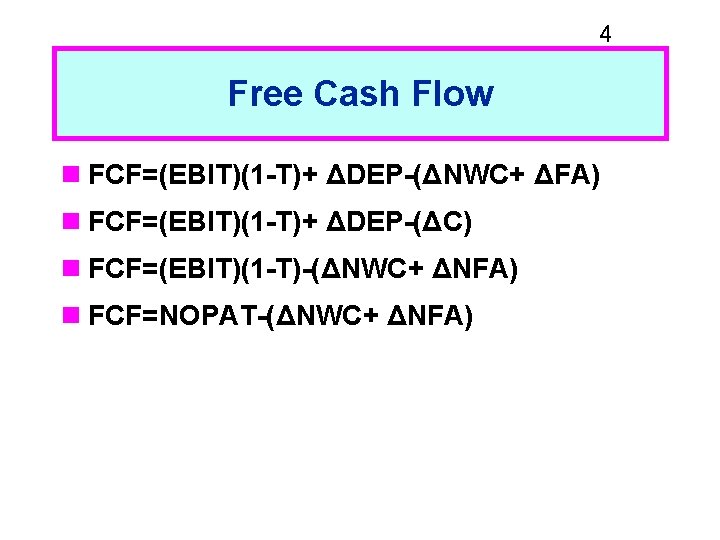
4 Free Cash Flow n FCF=(EBIT)(1 -T)+ ΔDEP-(ΔNWC+ ΔFA) n FCF=(EBIT)(1 -T)+ ΔDEP-(ΔC) n FCF=(EBIT)(1 -T)-(ΔNWC+ ΔNFA) n FCF=NOPAT-(ΔNWC+ ΔNFA)
5 Value of Operations
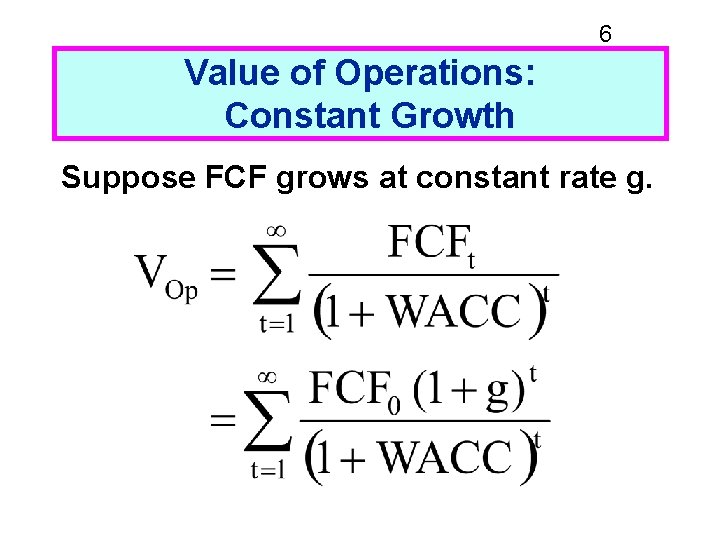
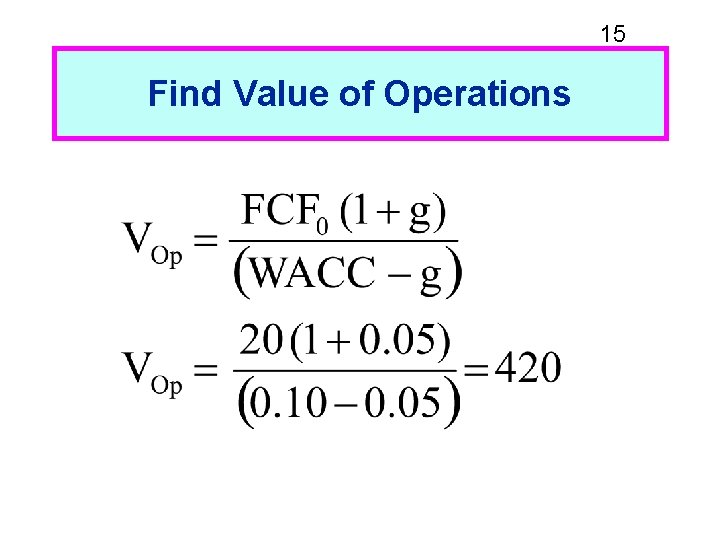
6 Value of Operations: Constant Growth Suppose FCF grows at constant rate g.
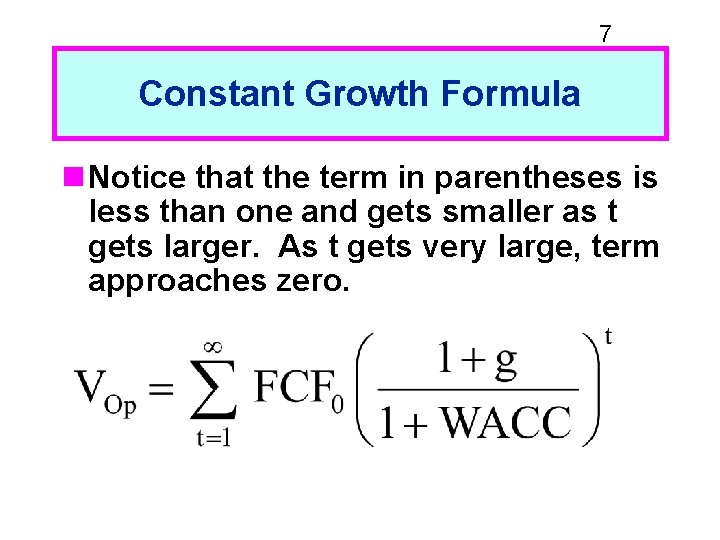
7 Constant Growth Formula n Notice that the term in parentheses is less than one and gets smaller as t gets larger. As t gets very large, term approaches zero.
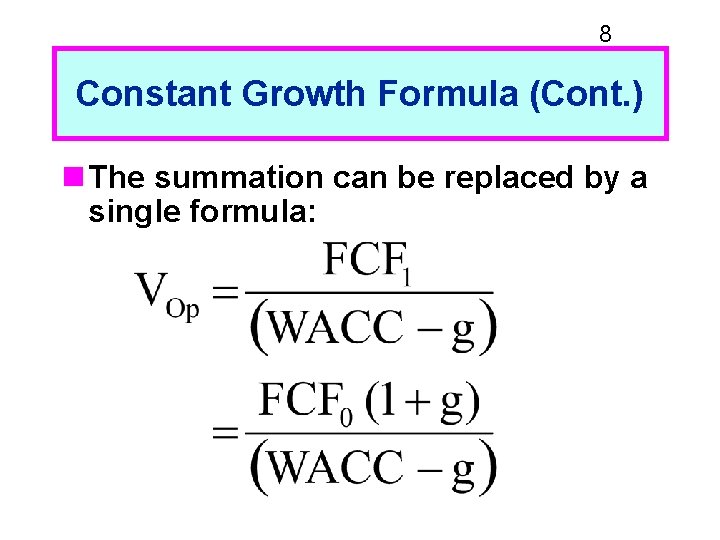
8 Constant Growth Formula (Cont. ) n The summation can be replaced by a single formula:
9 Nonoperating Assets n Marketable securities n Ownership of non-controlling interest in another company n Value of nonoperating assets usually is very close to figure that is reported on balance sheets.
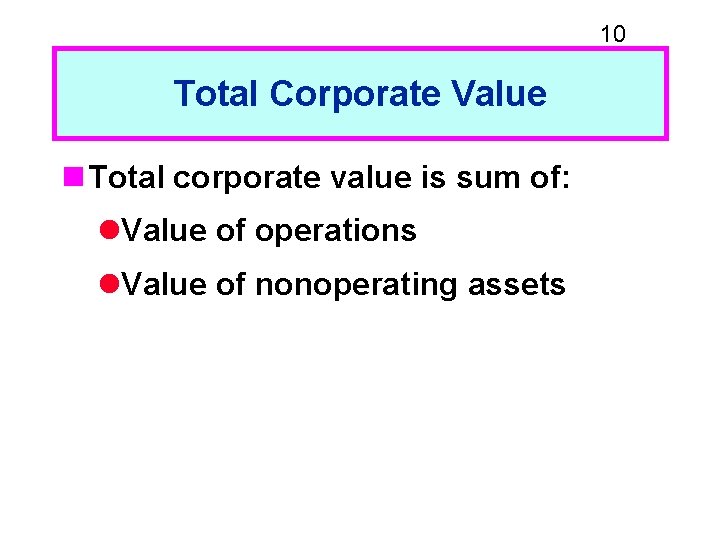
10 Total Corporate Value n Total corporate value is sum of: l. Value of operations l. Value of nonoperating assets
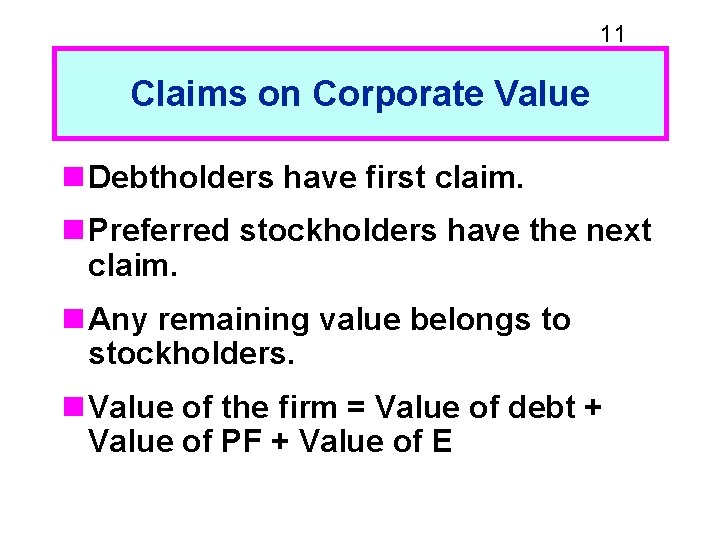
11 Claims on Corporate Value n Debtholders have first claim. n Preferred stockholders have the next claim. n Any remaining value belongs to stockholders. n Value of the firm = Value of debt + Value of PF + Value of E
12 Valuation Analysis n Value of firm = value of operating assets + value of non-operating assets n Value of the firm = Value of debt + Value of PF + Value of E n V=D+PF+E n E=V-D-PF n Value per share =P=E/N where N is the number of shares o/s
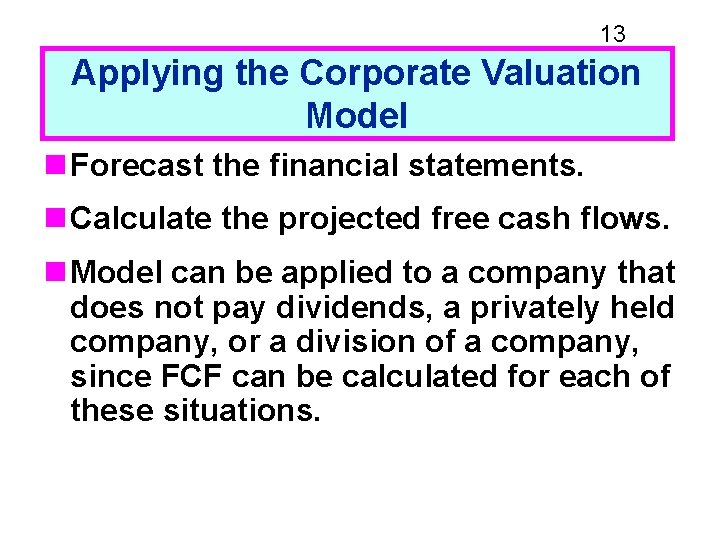
13 Applying the Corporate Valuation Model n Forecast the financial statements. n Calculate the projected free cash flows. n Model can be applied to a company that does not pay dividends, a privately held company, or a division of a company, since FCF can be calculated for each of these situations.
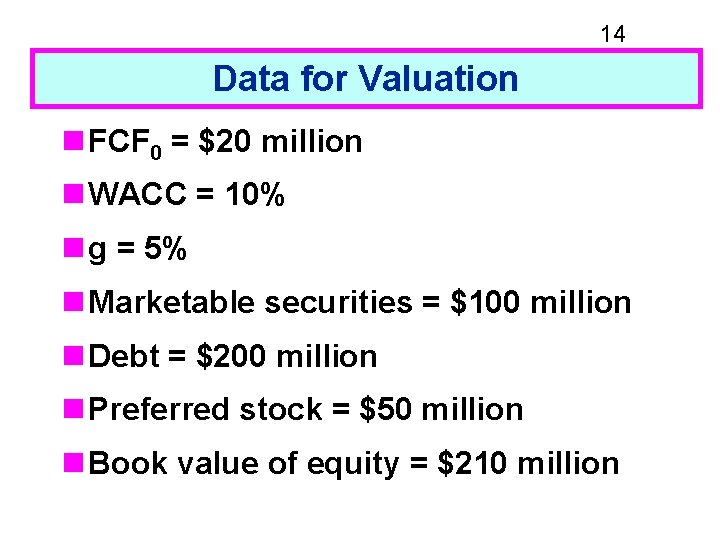
14 Data for Valuation n FCF 0 = $20 million n WACC = 10% n g = 5% n Marketable securities = $100 million n Debt = $200 million n Preferred stock = $50 million n Book value of equity = $210 million
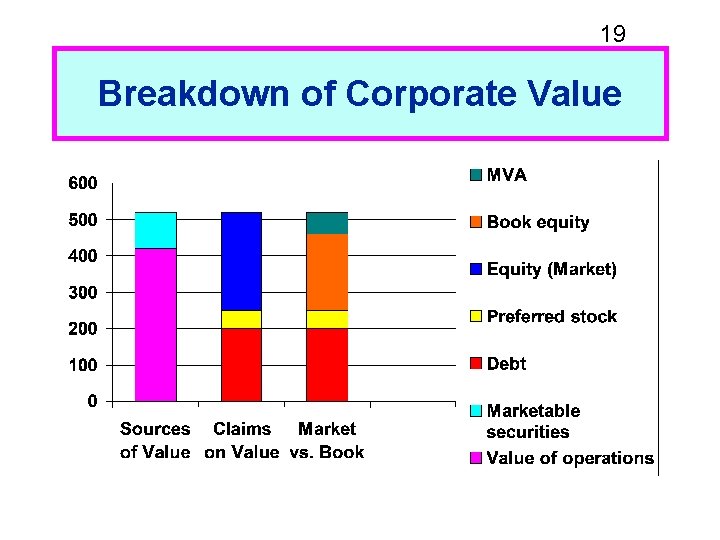
15 Find Value of Operations
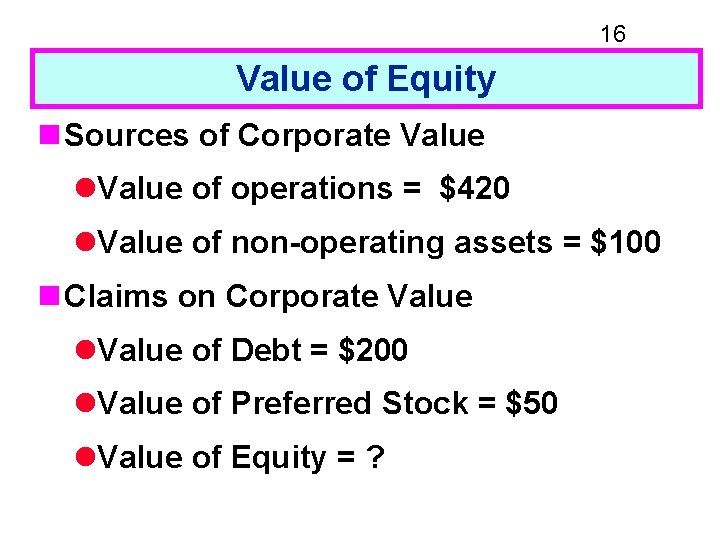
16 Value of Equity n Sources of Corporate Value l. Value of operations = $420 l. Value of non-operating assets = $100 n Claims on Corporate Value l. Value of Debt = $200 l. Value of Preferred Stock = $50 l. Value of Equity = ?
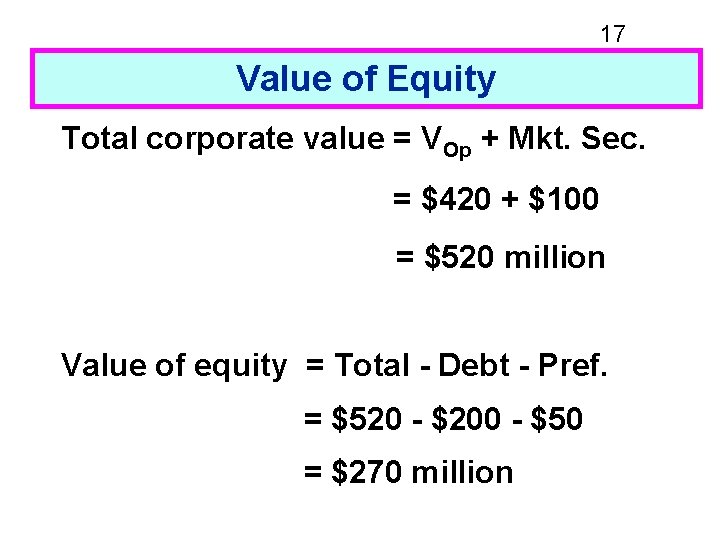
17 Value of Equity Total corporate value = VOp + Mkt. Sec. = $420 + $100 = $520 million Value of equity = Total - Debt - Pref. = $520 - $200 - $50 = $270 million
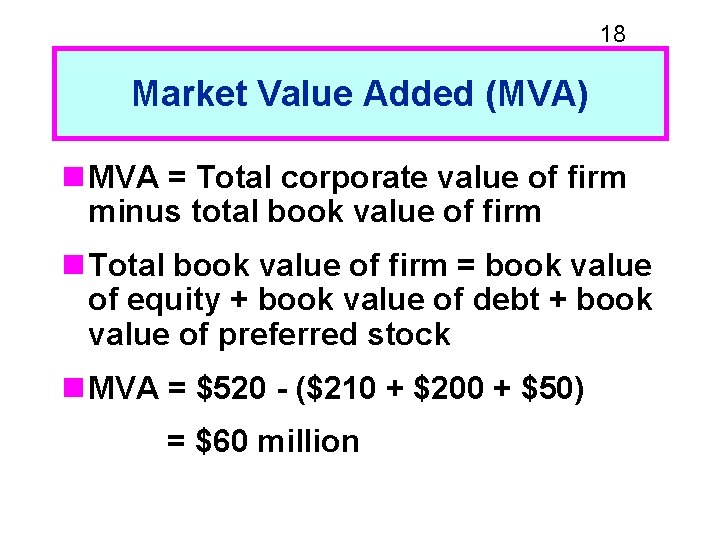
18 Market Value Added (MVA) n MVA = Total corporate value of firm minus total book value of firm n Total book value of firm = book value of equity + book value of debt + book value of preferred stock n MVA = $520 - ($210 + $200 + $50) = $60 million
19 Breakdown of Corporate Value
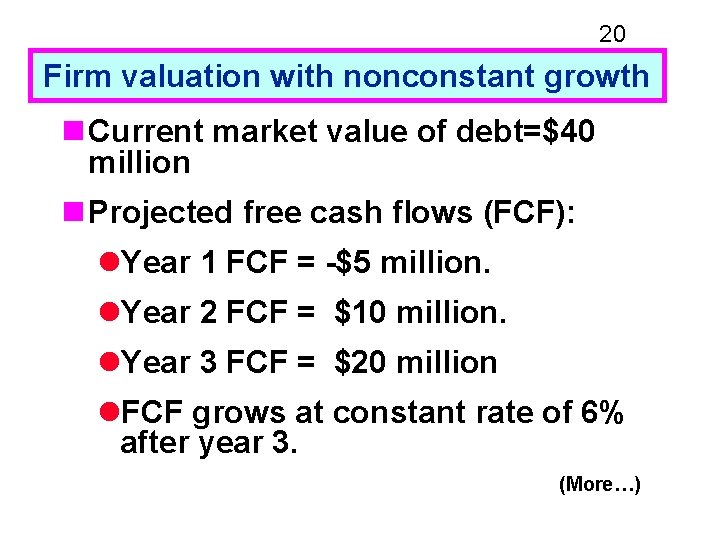
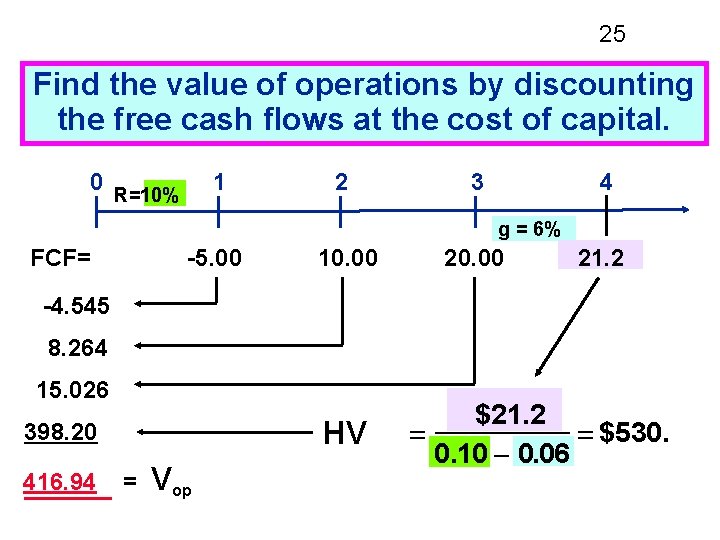
20 Firm valuation with nonconstant growth n Current market value of debt=$40 million n Projected free cash flows (FCF): l. Year 1 FCF = -$5 million. l. Year 2 FCF = $10 million. l. Year 3 FCF = $20 million l. FCF grows at constant rate of 6% after year 3. (More…)
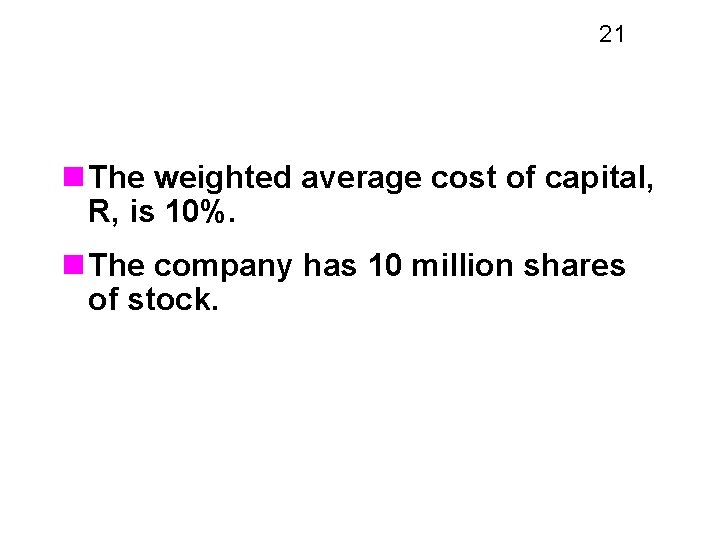
21 n The weighted average cost of capital, R, is 10%. n The company has 10 million shares of stock.
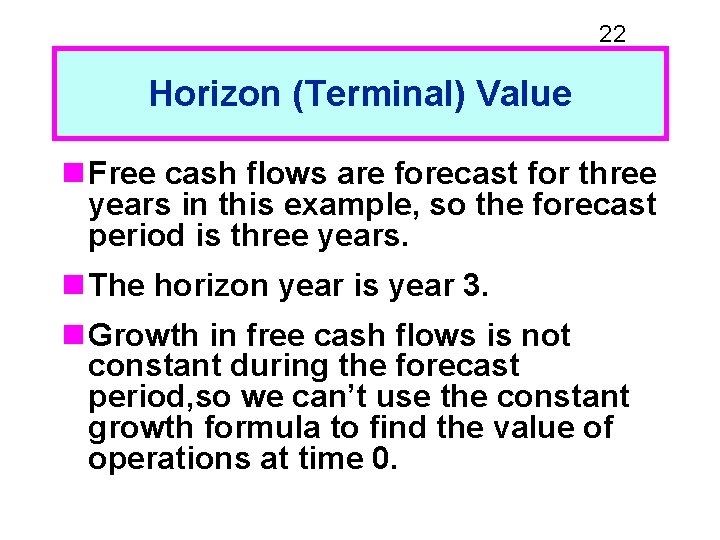
22 Horizon (Terminal) Value n Free cash flows are forecast for three years in this example, so the forecast period is three years. n The horizon year is year 3. n Growth in free cash flows is not constant during the forecast period, so we can’t use the constant growth formula to find the value of operations at time 0.
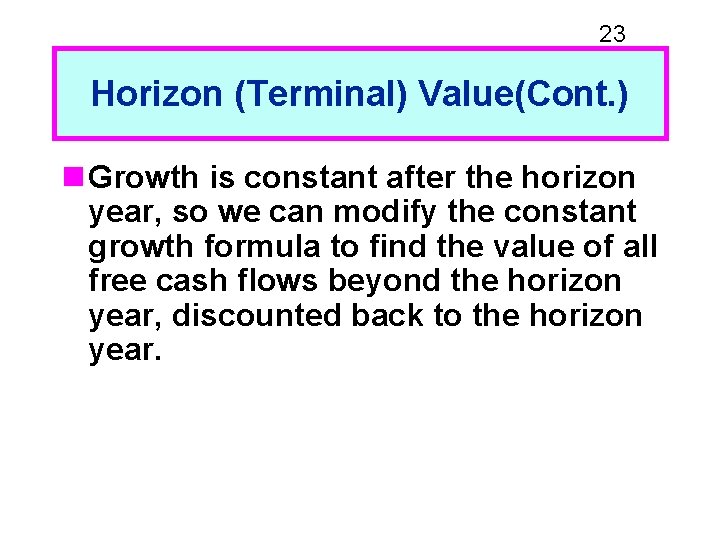
23 Horizon (Terminal) Value(Cont. ) n Growth is constant after the horizon year, so we can modify the constant growth formula to find the value of all free cash flows beyond the horizon year, discounted back to the horizon year.
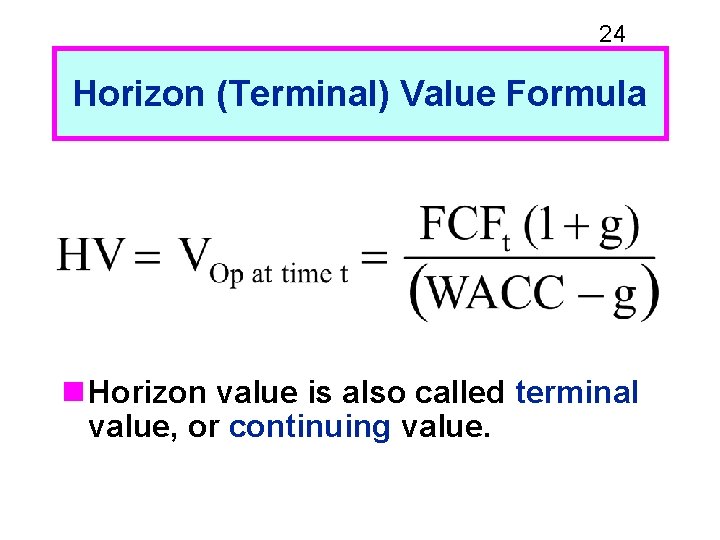
24 Horizon (Terminal) Value Formula n Horizon value is also called terminal value, or continuing value.
25 Find the value of operations by discounting the free cash flows at the cost of capital. 0 R=10% 1 2 3 4 g = 6% FCF= -5. 00 10. 00 21. 2 -4. 545 8. 264 15. 026 HV 398. 20 416. 94 = Vop $21. 2 $530. 0. 10 0. 06
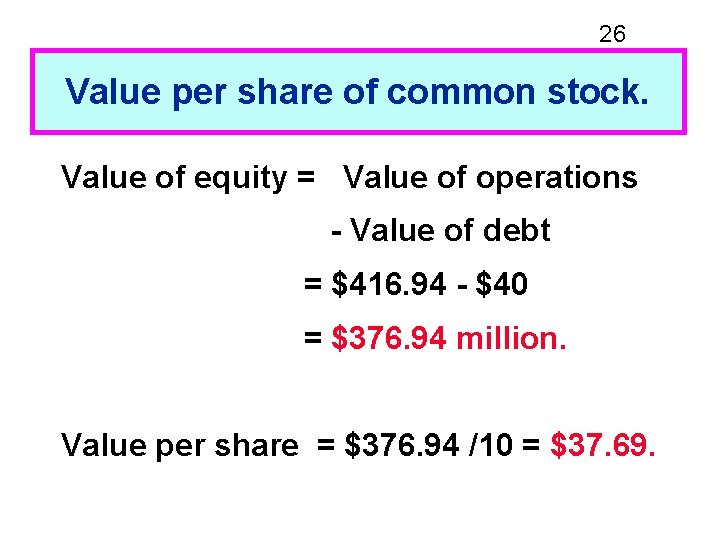
26 Value per share of common stock. Value of equity = Value of operations - Value of debt = $416. 94 - $40 = $376. 94 million. Value per share = $376. 94 /10 = $37. 69.