
1 Connect the Battery Which is the correct
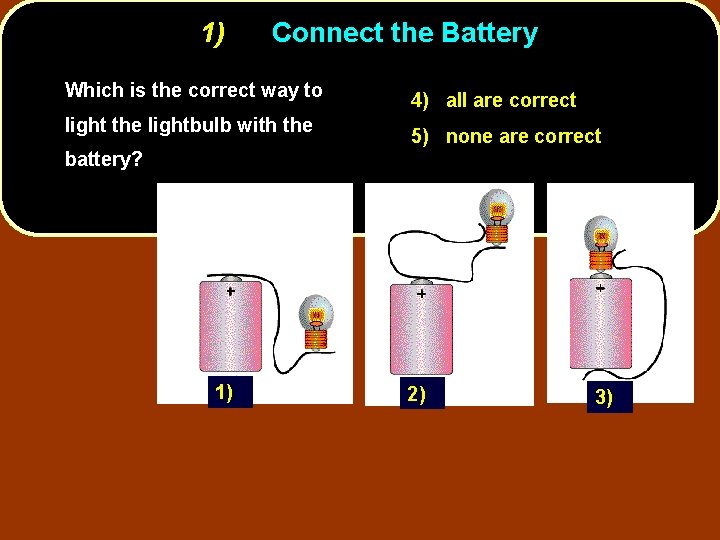
1) Connect the Battery Which is the correct way to light the lightbulb with the battery? 1) 4) all are correct 5) none are correct 2) 3)
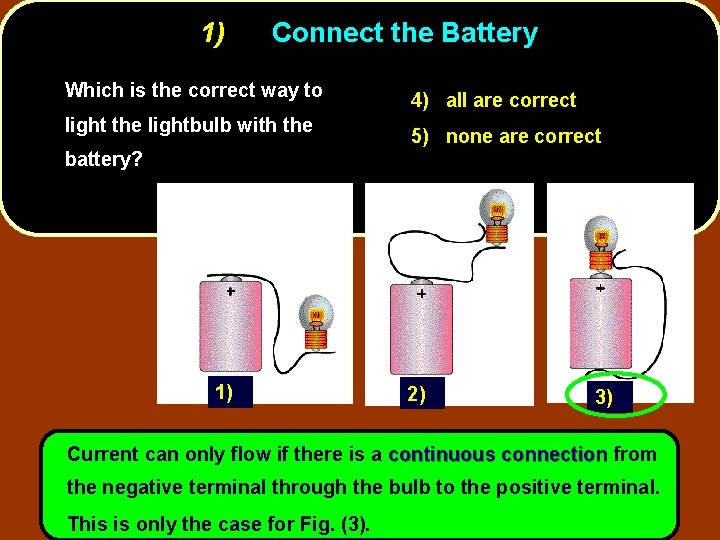
1) Connect the Battery Which is the correct way to light the lightbulb with the battery? 1) 4) all are correct 5) none are correct 2) 3) Current can only flow if there is a continuous connection from the negative terminal through the bulb to the positive terminal. This is only the case for Fig. (3).
2) Dimmer 1) the power When you rotate the knob of a 2) the current light dimmer, what is being 3) the voltage changed in the electric circuit? 4) both (1) and (2) 5) both (2) and (3)
2) Dimmer 1) the power When you rotate the knob of a 2) the current light dimmer, what is being 3) the voltage changed in the electric circuit? 4) both (1) and (2) 5) both (2) and (3) The voltage is provided at 120 V from the outside. The light dimmer increases the resistance and therefore decreases the current that flows through the lightbulb. Follow-up: Why does the voltage not change?
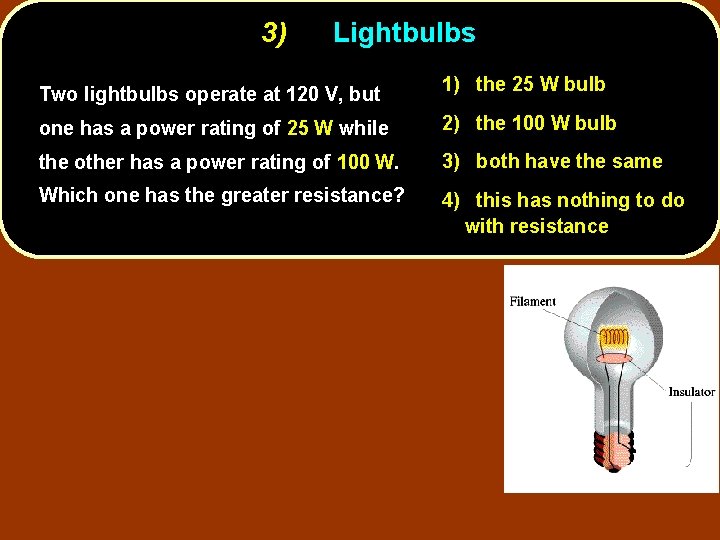
3) Lightbulbs Two lightbulbs operate at 120 V, but 1) the 25 W bulb one has a power rating of 25 W while 2) the 100 W bulb the other has a power rating of 100 W. 3) both have the same Which one has the greater resistance? 4) this has nothing to do with resistance
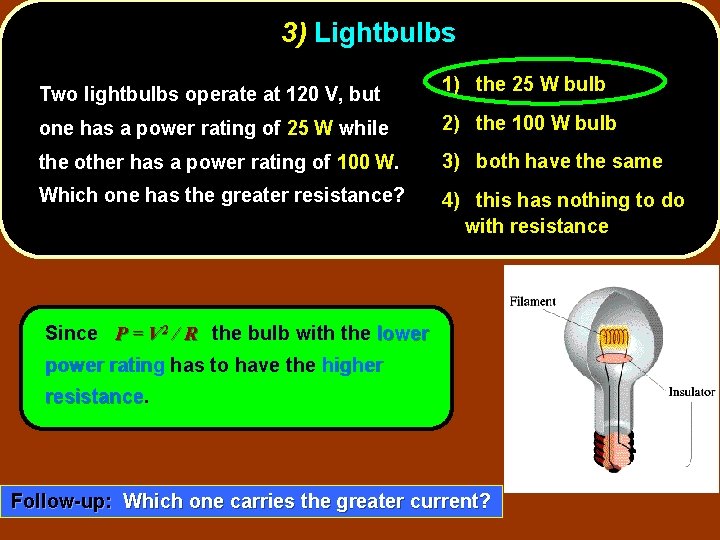
3) Lightbulbs Two lightbulbs operate at 120 V, but 1) the 25 W bulb one has a power rating of 25 W while 2) the 100 W bulb the other has a power rating of 100 W. 3) both have the same Which one has the greater resistance? 4) this has nothing to do with resistance Since P = V 2 / R the bulb with the lower power rating has to have the higher resistance Follow-up: Which one carries the greater current?
4) Space Heaters I Two space heaters in your living room are operated at 120 V. 1) heater 1 Heater 1 has twice the resistance 2) heater 2 of heater 2. Which one will give 3) both equally off more heat?
4) Space Heaters I Two space heaters in your living room are operated at 120 V. 1) heater 1 Heater 1 has twice the resistance 2) heater 2 of heater 2. Which one will give 3) both equally off more heat? Using P = V 2 / R, the heater with the smaller resistance will have the larger power output. Thus, heater 2 will give off more heat. Follow-up: Which one carries the greater current?
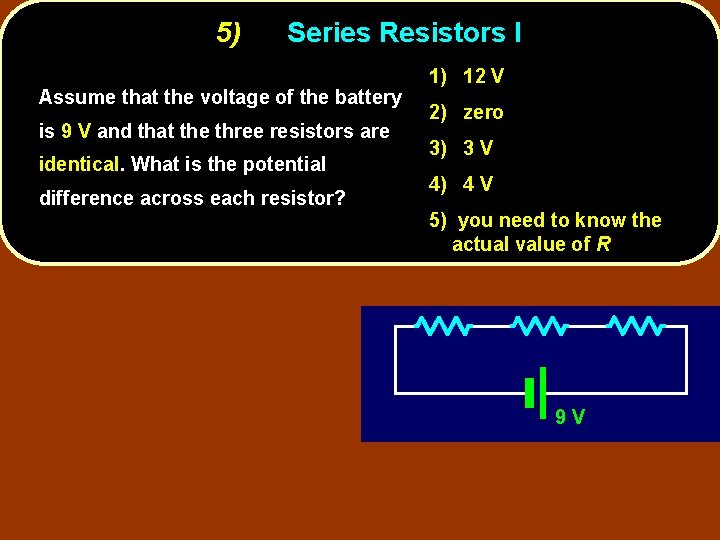
5) Series Resistors I Assume that the voltage of the battery is 9 V and that the three resistors are identical. What is the potential difference across each resistor? 1) 12 V 2) zero 3) 3 V 4) 4 V 5) you need to know the actual value of R 9 V
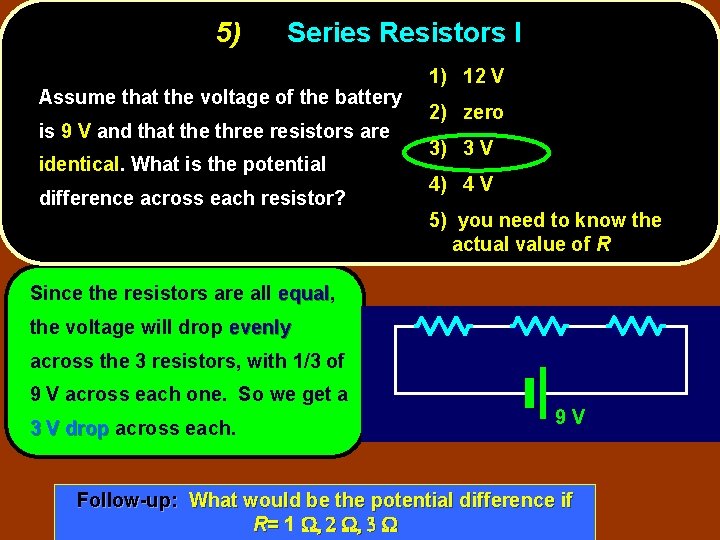
5) Series Resistors I Assume that the voltage of the battery is 9 V and that the three resistors are identical. What is the potential difference across each resistor? 1) 12 V 2) zero 3) 3 V 4) 4 V 5) you need to know the actual value of R Since the resistors are all equal, equal the voltage will drop evenly across the 3 resistors, with 1/3 of 9 V across each one. So we get a 3 V drop across each. 9 V Follow-up: What would be the potential difference if R= 1 W, 2 W, 3 W
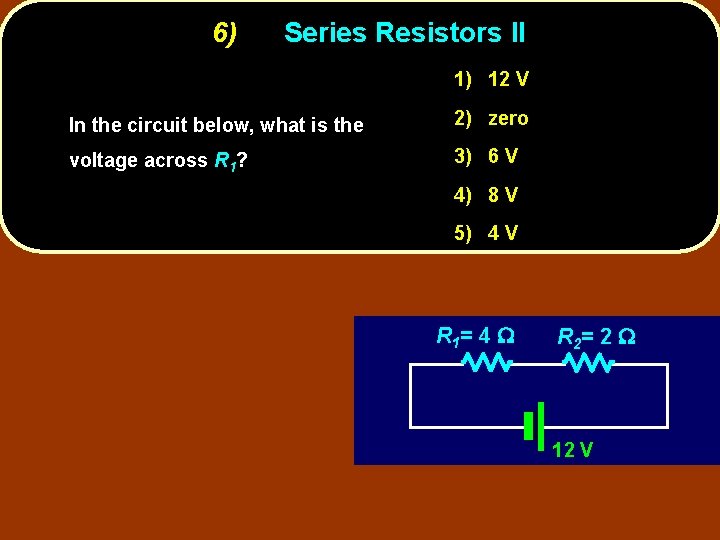
6) Series Resistors II 1) 12 V In the circuit below, what is the 2) zero voltage across R 1? 3) 6 V 4) 8 V 5) 4 V R 1= 4 W R 2= 2 W 12 V
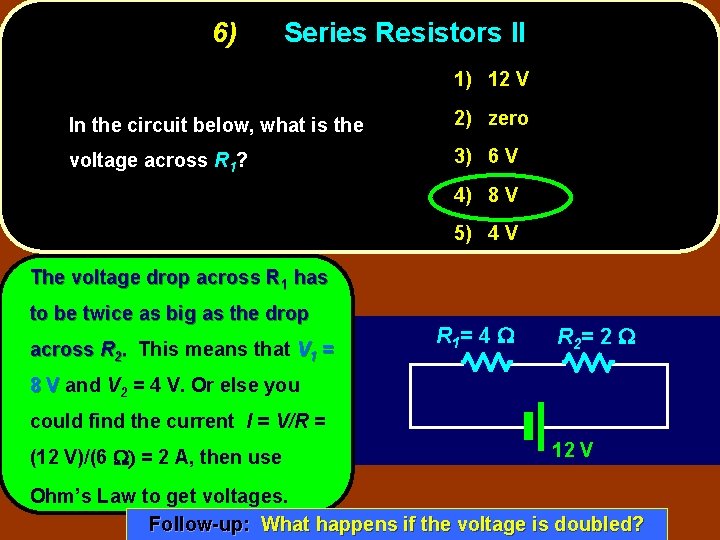
6) Series Resistors II 1) 12 V In the circuit below, what is the 2) zero voltage across R 1? 3) 6 V 4) 8 V 5) 4 V The voltage drop across R 1 has to be twice as big as the drop across R 2. This means that V 1 = R 1= 4 W R 2= 2 W 8 V and V 2 = 4 V. Or else you could find the current I = V/R = (12 V)/(6 W) = 2 A, then use 12 V Ohm’s Law to get voltages. Follow-up: What happens if the voltage is doubled?
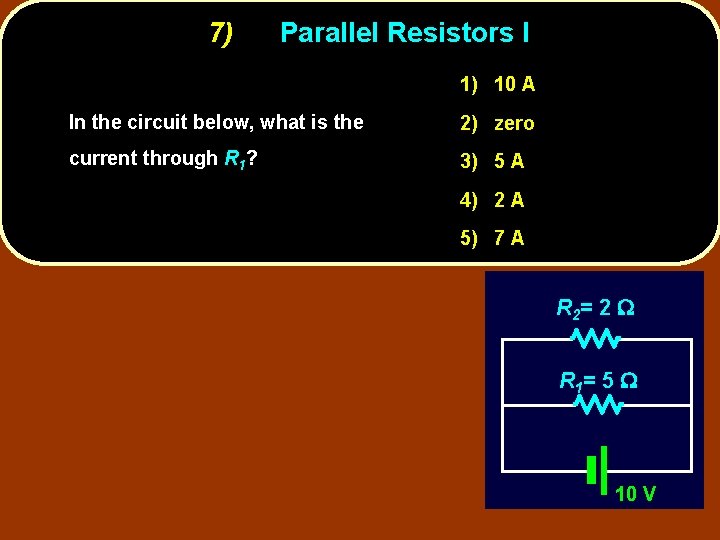
7) Parallel Resistors I 1) 10 A In the circuit below, what is the 2) zero current through R 1? 3) 5 A 4) 2 A 5) 7 A R 2= 2 W R 1= 5 W 10 V
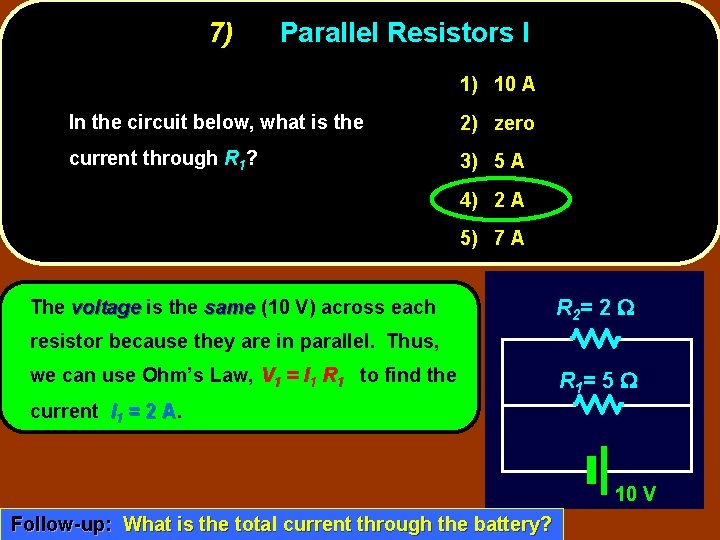
7) Parallel Resistors I 1) 10 A In the circuit below, what is the 2) zero current through R 1? 3) 5 A 4) 2 A 5) 7 A The voltage is the same (10 V) across each R 2= 2 W resistor because they are in parallel. Thus, we can use Ohm’s Law, V 1 = I 1 R 1 to find the R 1= 5 W current I 1 = 2 A. A 10 V Follow-up: What is the total current through the battery?
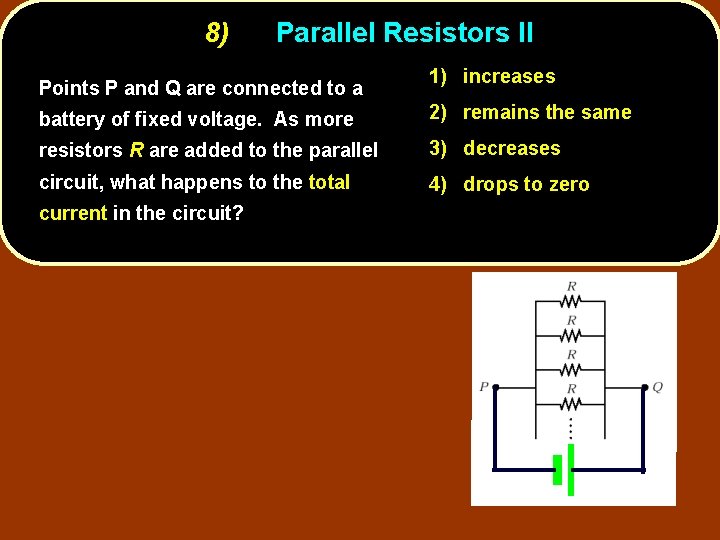
8) Parallel Resistors II Points P and Q are connected to a 1) increases battery of fixed voltage. As more 2) remains the same resistors R are added to the parallel 3) decreases circuit, what happens to the total 4) drops to zero current in the circuit?
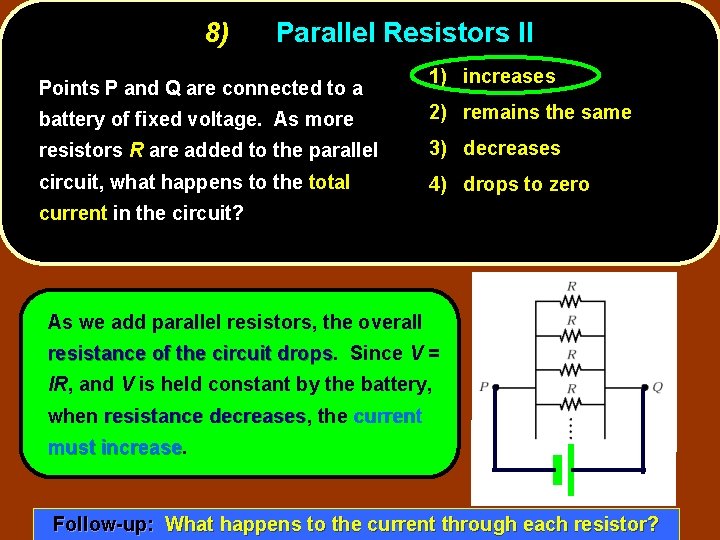
8) Parallel Resistors II Points P and Q are connected to a 1) increases battery of fixed voltage. As more 2) remains the same resistors R are added to the parallel 3) decreases circuit, what happens to the total 4) drops to zero current in the circuit? As we add parallel resistors, the overall resistance of the circuit drops Since V = IR, and V is held constant by the battery, when resistance decreases, decreases the current must increase Follow-up: What happens to the current through each resistor?
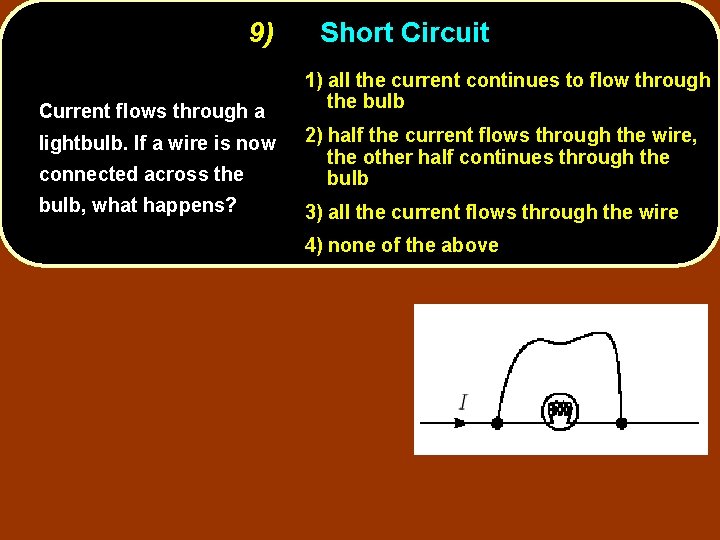
9) Current flows through a Short Circuit 1) all the current continues to flow through the bulb connected across the 2) half the current flows through the wire, the other half continues through the bulb, what happens? 3) all the current flows through the wire lightbulb. If a wire is now 4) none of the above
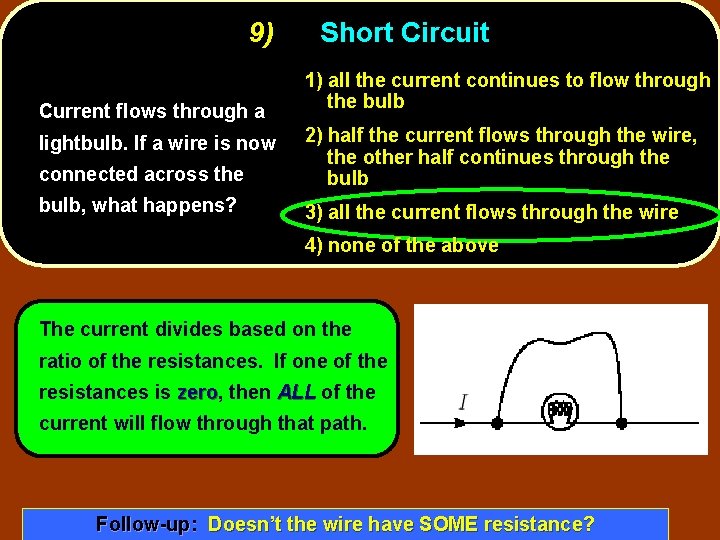
9) Current flows through a Short Circuit 1) all the current continues to flow through the bulb connected across the 2) half the current flows through the wire, the other half continues through the bulb, what happens? 3) all the current flows through the wire lightbulb. If a wire is now 4) none of the above The current divides based on the ratio of the resistances. If one of the resistances is zero, zero then ALL of the current will flow through that path. Follow-up: Doesn’t the wire have SOME resistance?
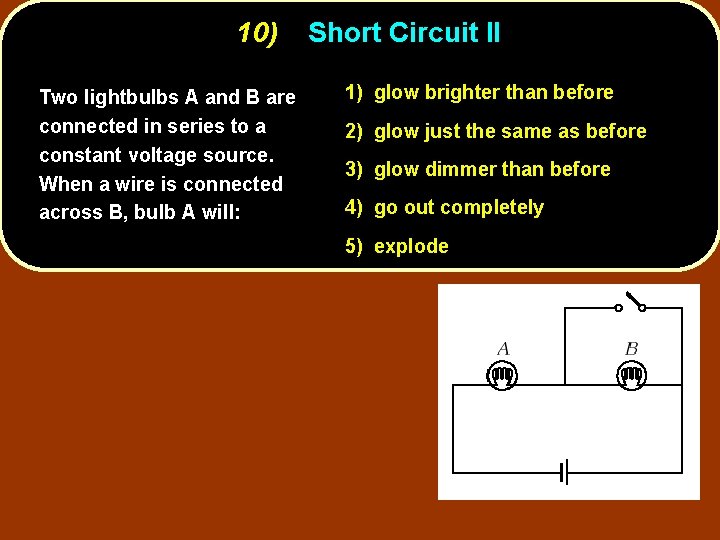
10) Two lightbulbs A and B are connected in series to a constant voltage source. When a wire is connected across B, bulb A will: Short Circuit II 1) glow brighter than before 2) glow just the same as before 3) glow dimmer than before 4) go out completely 5) explode
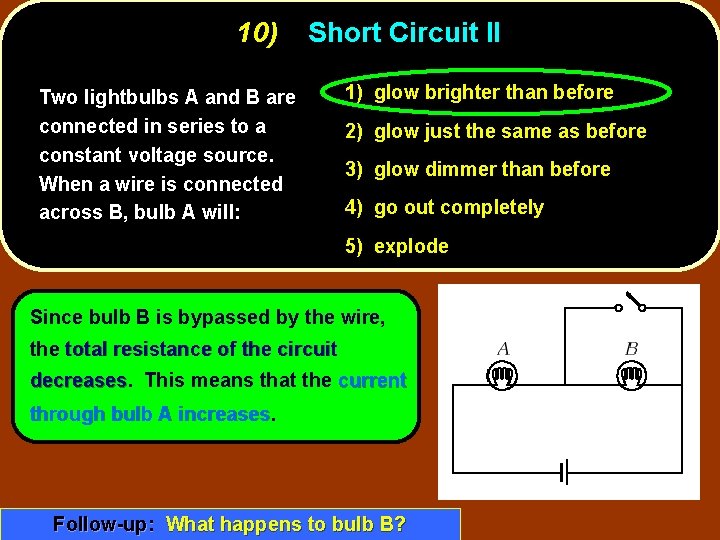
10) Short Circuit II Two lightbulbs A and B are connected in series to a constant voltage source. When a wire is connected across B, bulb A will: 1) glow brighter than before 2) glow just the same as before 3) glow dimmer than before 4) go out completely 5) explode Since bulb B is bypassed by the wire, the total resistance of the circuit decreases This means that the current through bulb A increases Follow-up: What happens to bulb B?
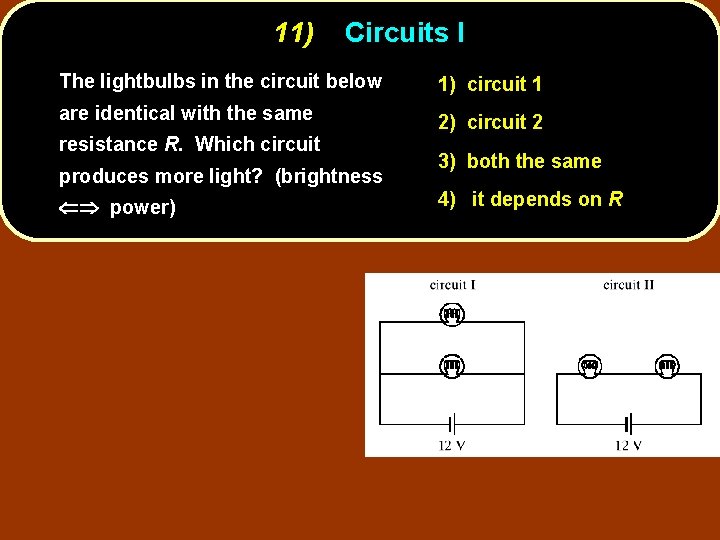
11) Circuits I The lightbulbs in the circuit below 1) circuit 1 are identical with the same 2) circuit 2 resistance R. Which circuit produces more light? (brightness power) 3) both the same 4) it depends on R
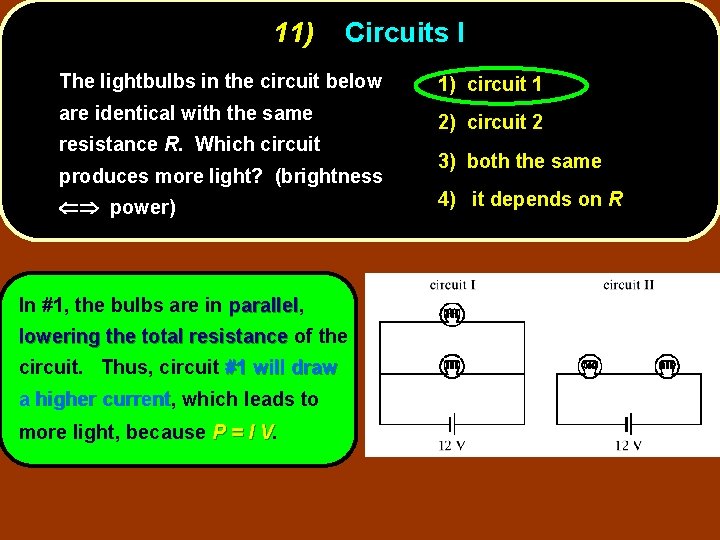
11) Circuits I The lightbulbs in the circuit below 1) circuit 1 are identical with the same 2) circuit 2 resistance R. Which circuit produces more light? (brightness power) In #1, the bulbs are in parallel, parallel lowering the total resistance of the circuit. Thus, circuit #1 will draw a higher current, current which leads to more light, because P = I V. V 3) both the same 4) it depends on R
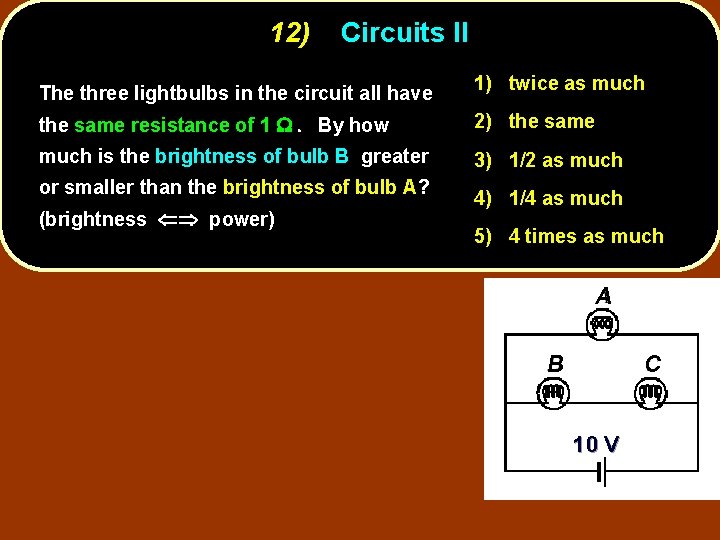
12) Circuits II The three lightbulbs in the circuit all have 1) twice as much the same resistance of 1 W. By how 2) the same much is the brightness of bulb B greater 3) 1/2 as much or smaller than the brightness of bulb A? (brightness power) 4) 1/4 as much 5) 4 times as much A C B 10 V
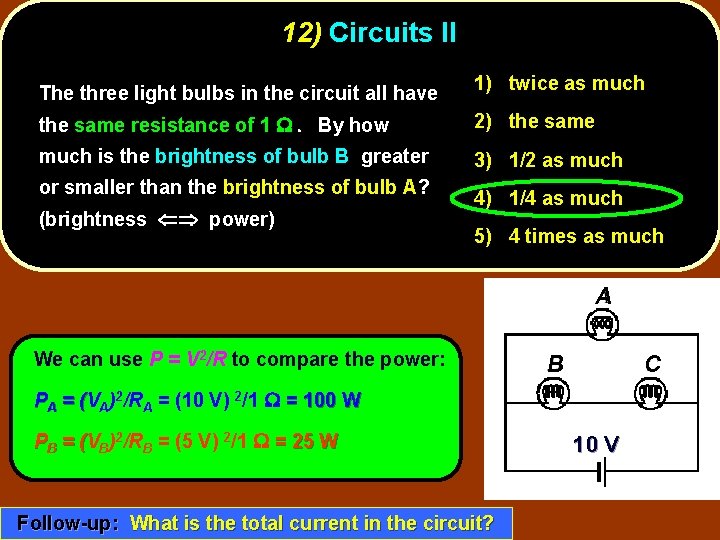
12) Circuits II The three light bulbs in the circuit all have 1) twice as much the same resistance of 1 W. By how 2) the same much is the brightness of bulb B greater 3) 1/2 as much or smaller than the brightness of bulb A? (brightness power) 4) 1/4 as much 5) 4 times as much A We can use P = V 2/R to compare the power: C B PA = (V ( A)2/RA = (10 V) 2/1 W = 100 W PB = (V ( B)2/RB = (5 V) 2/1 W = 25 W Follow-up: What is the total current in the circuit? 10 V
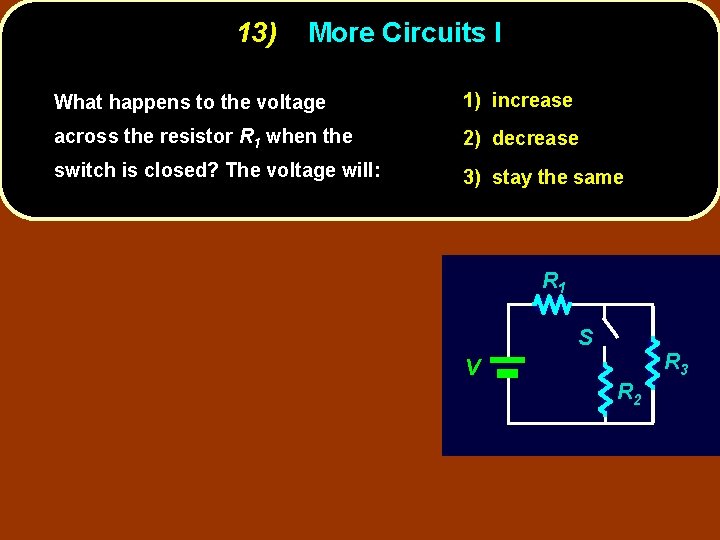
13) More Circuits I What happens to the voltage 1) increase across the resistor R 1 when the 2) decrease switch is closed? The voltage will: 3) stay the same R 1 S V R 3 R 2
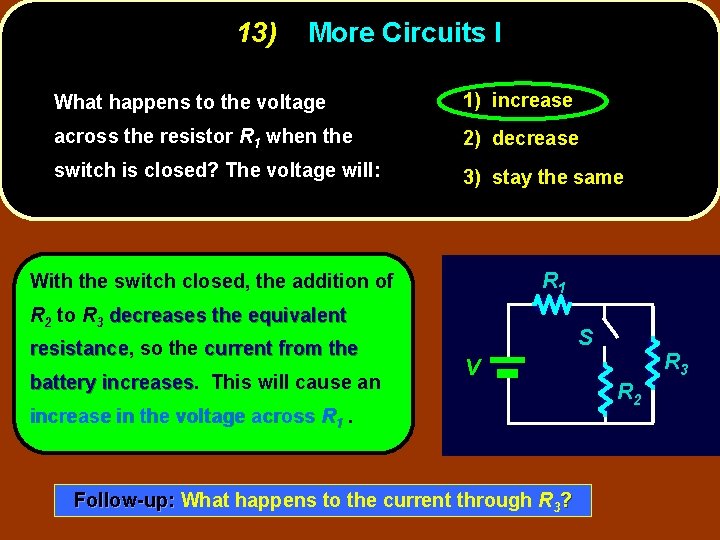
13) More Circuits I What happens to the voltage 1) increase across the resistor R 1 when the 2) decrease switch is closed? The voltage will: 3) stay the same R 1 With the switch closed, the addition of R 2 to R 3 decreases the equivalent resistance, resistance so the current from the battery increases This will cause an S V increase in the voltage across R 1. Follow-up: What happens to the current through R 3? R 3 R 2
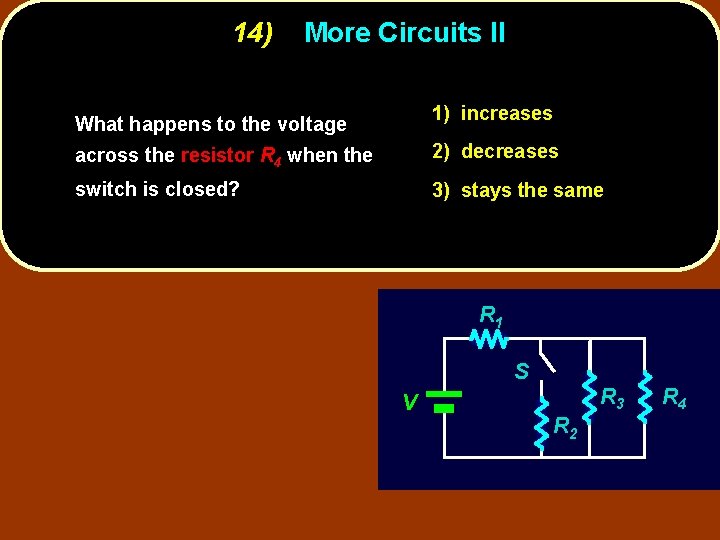
14) More Circuits II 1) increases What happens to the voltage across the resistor R 4 when the 2) decreases switch is closed? 3) stays the same R 1 S V R 3 R 2 R 4
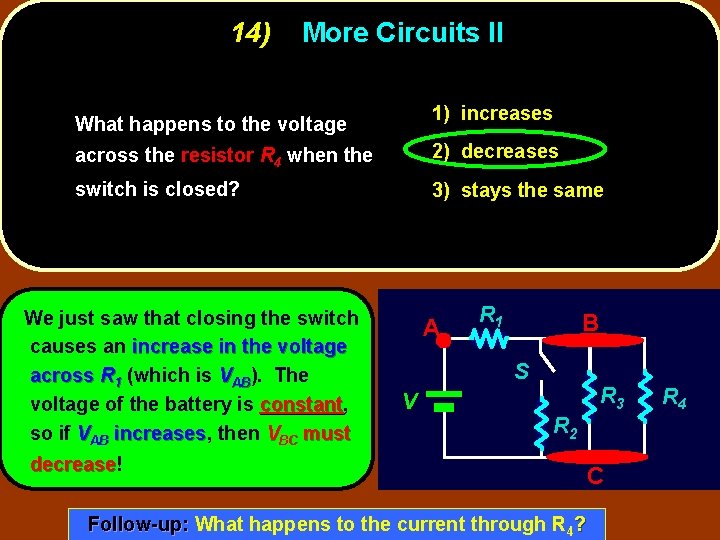
14) More Circuits II 1) increases What happens to the voltage across the resistor R 4 when the 2) decreases switch is closed? 3) stays the same We just saw that closing the switch causes an increase in the voltage across R 1 (which is VAB). The voltage of the battery is constant, constant so if VAB increases, increases then VBC must decrease! decrease A R 1 B S V R 3 R 2 C Follow-up: What happens to the current through R 4? R 4
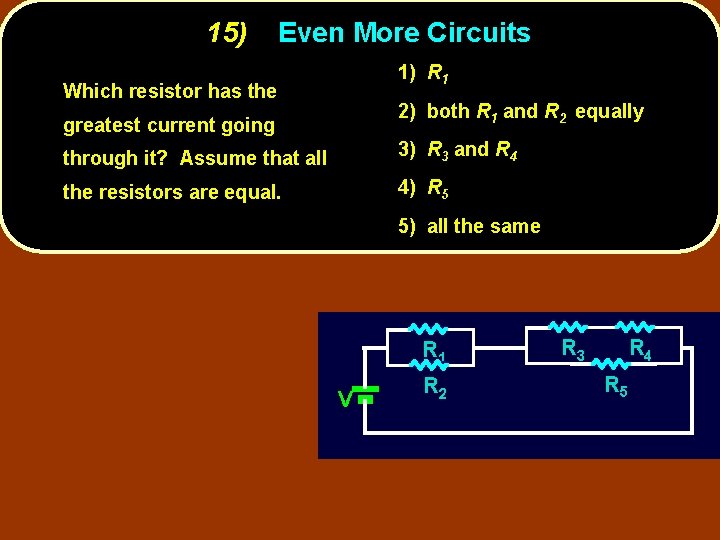
15) Even More Circuits 1) R 1 Which resistor has the 2) both R 1 and R 2 equally greatest current going through it? Assume that all 3) R 3 and R 4 the resistors are equal. 4) R 5 5) all the same R 1 V R 2 R 4 R 3 R 5
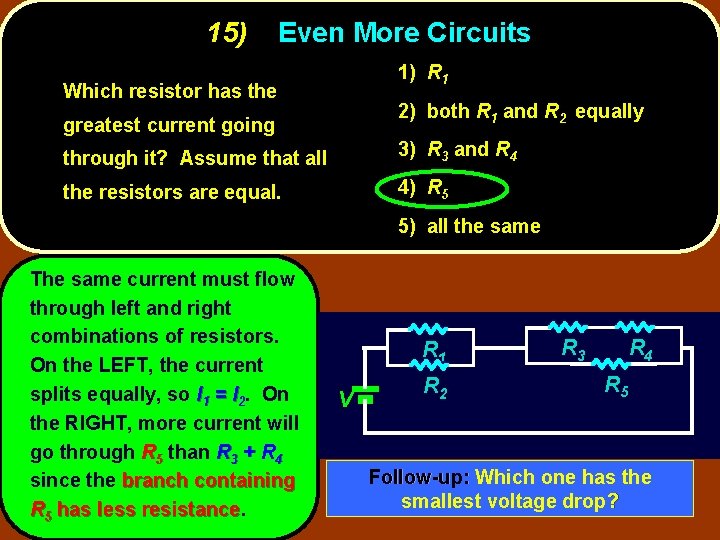
15) Even More Circuits 1) R 1 Which resistor has the 2) both R 1 and R 2 equally greatest current going through it? Assume that all 3) R 3 and R 4 the resistors are equal. 4) R 5 5) all the same The same current must flow through left and right combinations of resistors. On the LEFT, the current splits equally, so I 1 = I 2. On the RIGHT, more current will go through R 5 than R 3 + R 4 since the branch containing R 5 has less resistance R 1 V R 2 R 4 R 3 R 5 Follow-up: Which one has the smallest voltage drop?
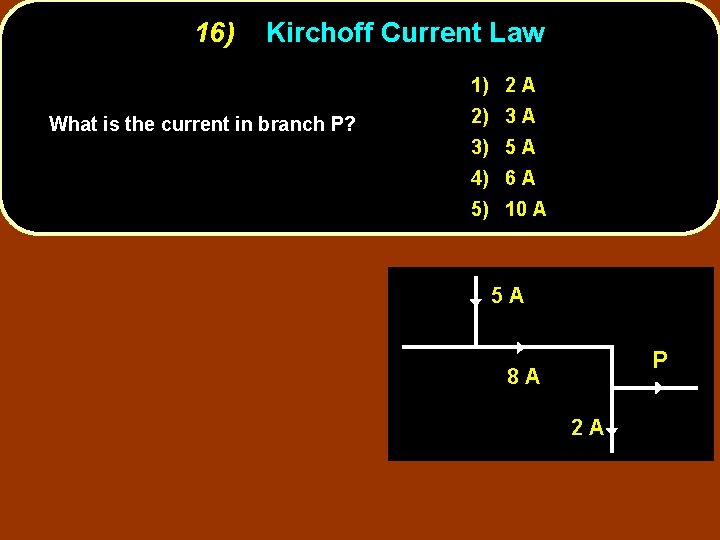
16) Kirchoff Current Law 1) 2 A What is the current in branch P? 2) 3 A 3) 5 A 4) 6 A 5) 10 A 5 A P 8 A 2 A
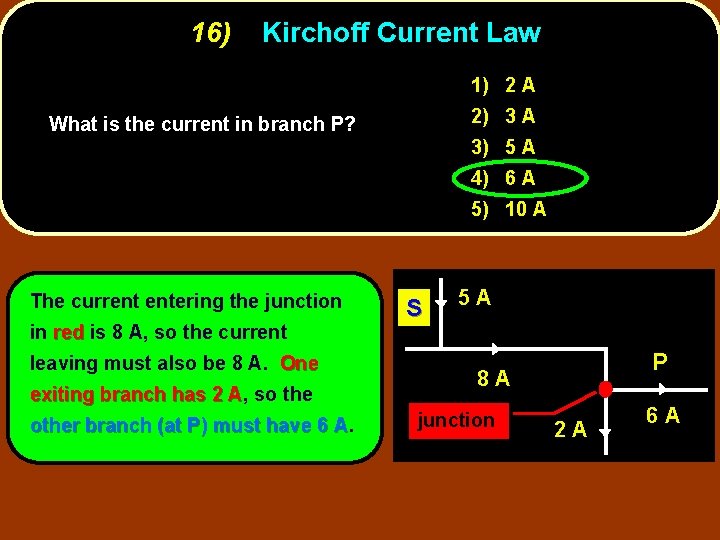
16) Kirchoff Current Law 1) 2 A 2) 3 A What is the current in branch P? 3) 5 A 4) 6 A 5) 10 A The current entering the junction in red is 8 A, so the current leaving must also be 8 A. One exiting branch has 2 A, A so the other branch (at P) must have 6 A. A S 5 A P 8 A junction 2 A 6 A
- Slides: 32