
1 Computer Programming and Basic Software Engineering 6
1 Computer Programming and Basic Software Engineering 6. Pointers and Arrays 6. 2 Arrays and Strings
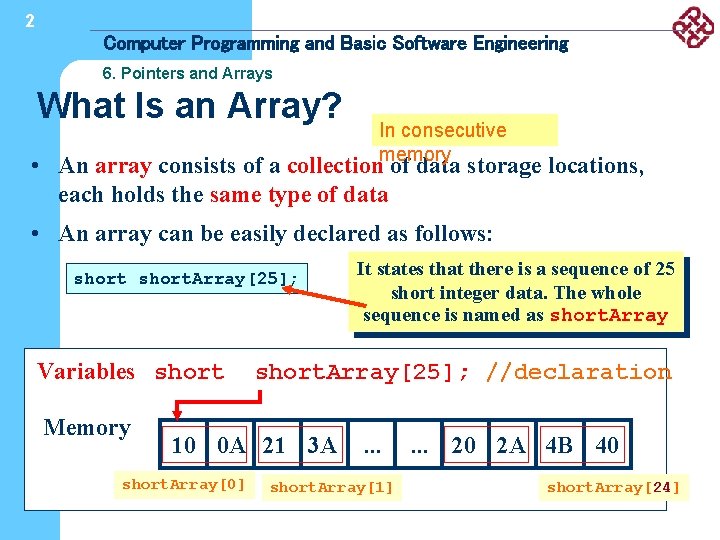
2 Computer Programming and Basic Software Engineering 6. Pointers and Arrays What Is an Array? In consecutive memory • An array consists of a collection of data storage locations, each holds the same type of data • An array can be easily declared as follows: short. Array[25]; Variables short Memory short. Array[25]; //declaration 10 0 A 21 3 A short. Array[0] It states that there is a sequence of 25 short integer data. The whole sequence is named as short. Array . . . 20 2 A 4 B 40 000 B 000 C. . . 0037 0038 0039 003 A short. Array[1] short. Array[24]
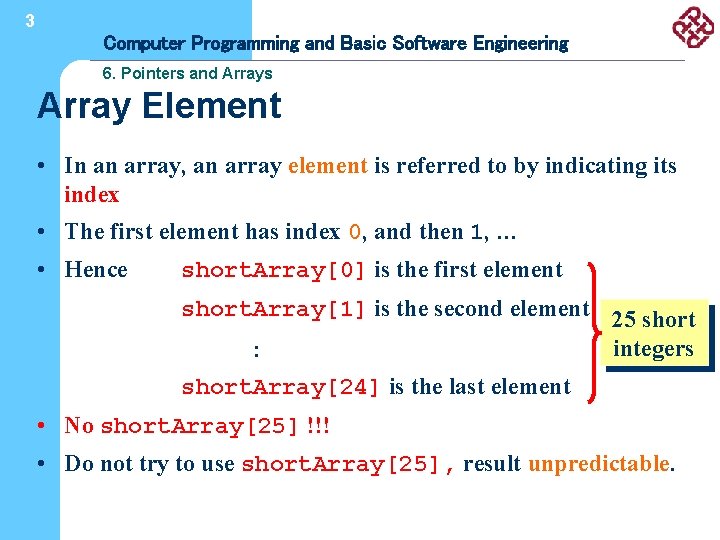
3 Computer Programming and Basic Software Engineering 6. Pointers and Arrays Array Element • In an array, an array element is referred to by indicating its index • The first element has index 0, and then 1, … • Hence short. Array[0] is the first element short. Array[1] is the second element 25 short integers : short. Array[24] is the last element • No short. Array[25] !!! • Do not try to use short. Array[25], result unpredictable.
![4 Computer Programming and Basic Software Engineering 6. Pointers and Arrays short. Array[25]; Variables](http://slidetodoc.com/presentation_image/cb6147a5ba1561978953f8a9ab7aeeff/image-4.jpg "4 Computer Programming and Basic Software Engineering 6. Pointers and Arrays short. Array[25]; Variables")
4 Computer Programming and Basic Software Engineering 6. Pointers and Arrays short. Array[25]; Variables short Memory Declaration short. Array[25]; 10 0 A 21 3 A . . . 20 2 A 4 B 40 Address 0009 000 A 000 B 000 C. . . 0037 0038 0039 003 A (Hex) • So short. Array[0] = 0 x 100 A; // 4106 in deciaml short. Array[1] = 0 x 213 A; // 8506 in decimal : short. Array[23] = 0 x 202 A; short. Array[24] = 0 x 4 B 40; Assignment statements
![5 Computer Programming and Basic Software Engineering 6. Pointers and Arrays No my. Array[5]](http://slidetodoc.com/presentation_image/cb6147a5ba1561978953f8a9ab7aeeff/image-5.jpg "5 Computer Programming and Basic Software Engineering 6. Pointers and Arrays No my. Array[5]")
5 Computer Programming and Basic Software Engineering 6. Pointers and Arrays No my. Array[5] !!! Do not try to use my. Array[5], result unpredictable #include <iostream> using namespace std; int main() { int my. Array[5], i; for (i=0; i<=5; i++) The kind of mistake my. Array[i] = 20; people often make for (i=0; i<5; i++) cout << my. Array[i] << endl; return 0; }
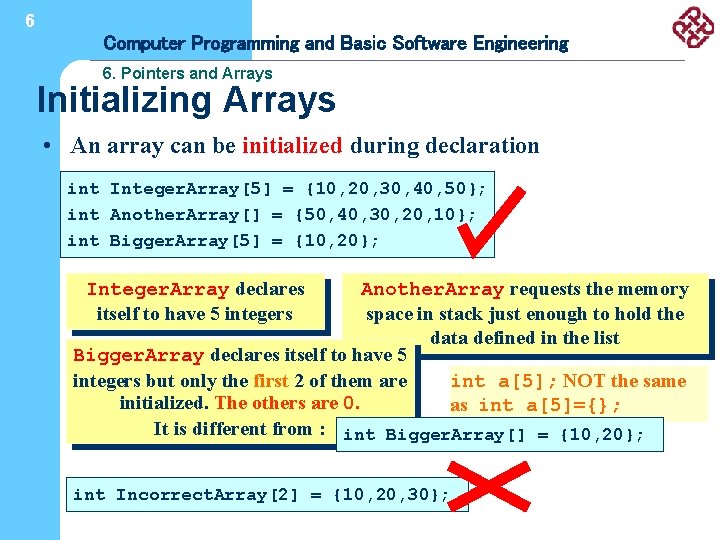
6 Computer Programming and Basic Software Engineering 6. Pointers and Arrays Initializing Arrays • An array can be initialized during declaration int Integer. Array[5] = {10, 20, 30, 40, 50}; int Another. Array[] = {50, 40, 30, 20, 10}; int Bigger. Array[5] = {10, 20}; Integer. Array declares itself to have 5 integers Another. Array requests the memory space in stack just enough to hold the data defined in the list Bigger. Array declares itself to have 5 integers but only the first 2 of them are int a[5]; NOT the same initialized. The others are 0. as int a[5]={}; It is different from : int Bigger. Array[] = {10, 20}; int Incorrect. Array[2] = {10, 20, 30};

7 Computer Programming and Basic Software Engineering 6. Pointers and Arrays Array of Objects • Any object can be stored in an array • Accessing member data in an array of objects is a two-step process • Identify the member of array by [] • Access the member by. CAT Litter[5]; //Litter[0] - Litter[4] are 5 objects int i; for (i=0; i<5; i++) cout << Litter[i]. Get. Age() << endl; To find out which CAT Call Get. Age() of that CAT
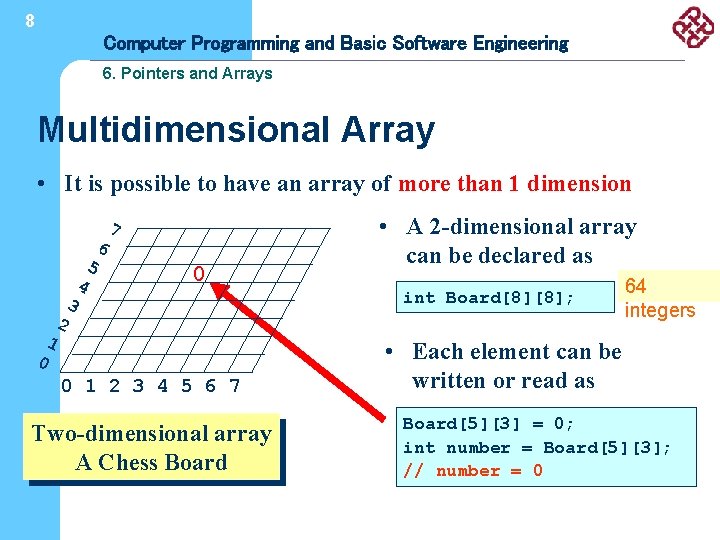
8 Computer Programming and Basic Software Engineering 6. Pointers and Arrays Multidimensional Array • It is possible to have an array of more than 1 dimension 0 1 2 3 4 5 6 7 0 0 1 2 3 4 5 6 7 Two-dimensional array A Chess Board • A 2 -dimensional array can be declared as int Board[8][8]; 64 integers • Each element can be written or read as Board[5][3] = 0; int number = Board[5][3]; // number = 0
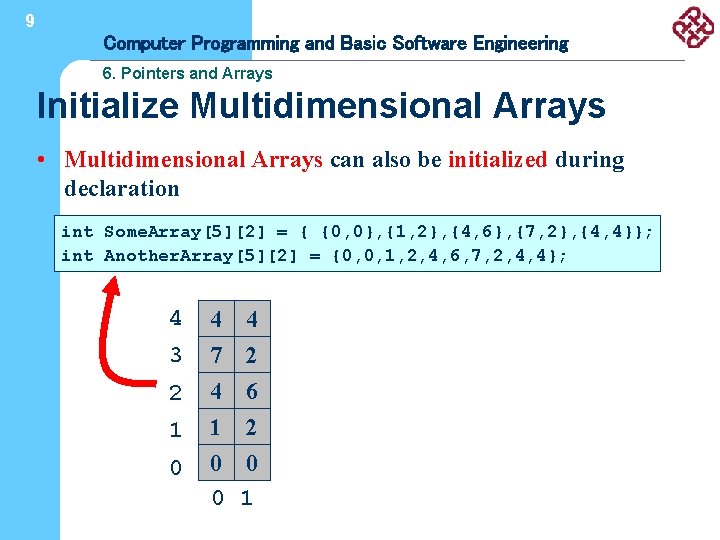
9 Computer Programming and Basic Software Engineering 6. Pointers and Arrays Initialize Multidimensional Arrays • Multidimensional Arrays can also be initialized during declaration int Some. Array[5][2] = { {0, 0}, {1, 2}, {4, 6}, {7, 2}, {4, 4}}; int Another. Array[5][2] = {0, 0, 1, 2, 4, 6, 7, 2, 4, 4}; 4 3 2 1 0 4 7 4 1 0 0 4 2 6 2 0 1
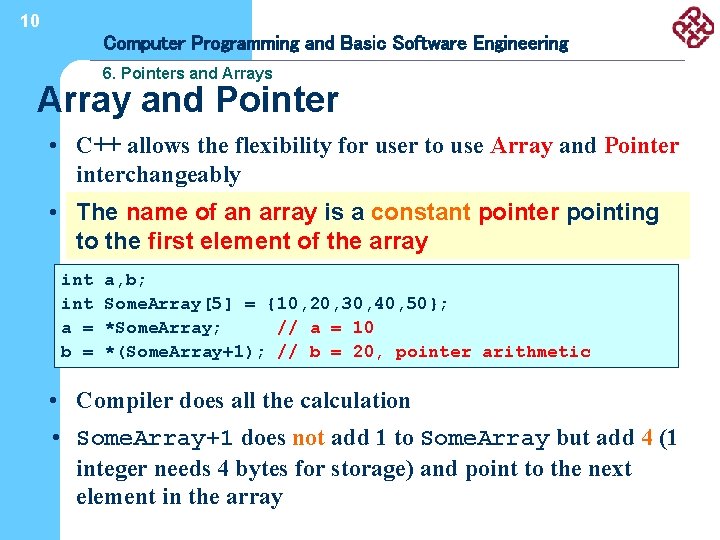
10 Computer Programming and Basic Software Engineering 6. Pointers and Arrays Array and Pointer • C++ allows the flexibility for user to use Array and Pointerchangeably • The name of an array is a constant pointer pointing to the first element of the array int a = b = a, b; Some. Array[5] = {10, 20, 30, 40, 50}; *Some. Array; // a = 10 *(Some. Array+1); // b = 20, pointer arithmetic • Compiler does all the calculation • Some. Array+1 does not add 1 to Some. Array but add 4 (1 integer needs 4 bytes for storage) and point to the next element in the array
![11 Computer Programming and Basic Software Engineering 6. Pointers and Arrays Some. Array[5] The](http://slidetodoc.com/presentation_image/cb6147a5ba1561978953f8a9ab7aeeff/image-11.jpg "11 Computer Programming and Basic Software Engineering 6. Pointers and Arrays Some. Array[5] The")
11 Computer Programming and Basic Software Engineering 6. Pointers and Arrays Some. Array[5] The Stack Address 10 20 30 40 50 0104 0108 010 c 0110 0114 0118 011 c 0120 0124 • There is NOT a memory location to store the pointer Some. Array. Everything is done by an internal conversion x = *Some. Array; will be internally converted to x = Some. Array[0]; // x = 10 px = Some. Array; will be internally converted to px = &(Some. Array[0]); // px = 0104
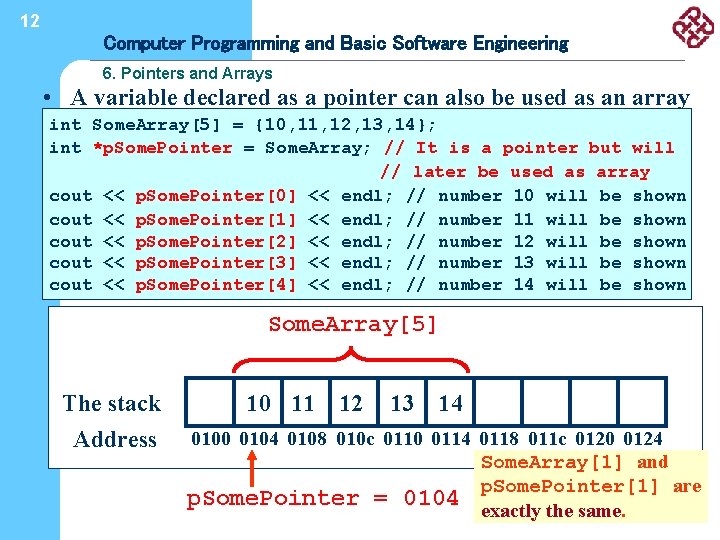
12 Computer Programming and Basic Software Engineering 6. Pointers and Arrays • A variable declared as a pointer can also be used as an array int Some. Array[5] = {10, 11, 12, 13, 14}; int *p. Some. Pointer = Some. Array; // It is a pointer but will // later be used as array cout << p. Some. Pointer[0] << endl; // number 10 will be shown cout << p. Some. Pointer[1] << endl; // number 11 will be shown cout << p. Some. Pointer[2] << endl; // number 12 will be shown cout << p. Some. Pointer[3] << endl; // number 13 will be shown cout << p. Some. Pointer[4] << endl; // number 14 will be shown Some. Array[5] The stack Address 10 11 12 13 14 0100 0104 0108 010 c 0110 0114 0118 011 c 0120 0124 Some. Array[1] and p. Some. Pointer[1] are p. Some. Pointer = 0104 exactly the same.
13 Computer Programming and Basic Software Engineering 6. Pointers and Arrays Array of Pointers • So far the arrays are declared to store data in stack • Usually the memory space of stack is very small • If a large array is required, it is better to store the elements of arrays in Free Store • In this case, for every element in an array, a pointer is assigned to indicate its location in Free Store • This becomes an array of pointers. The array itself is still in the stack.
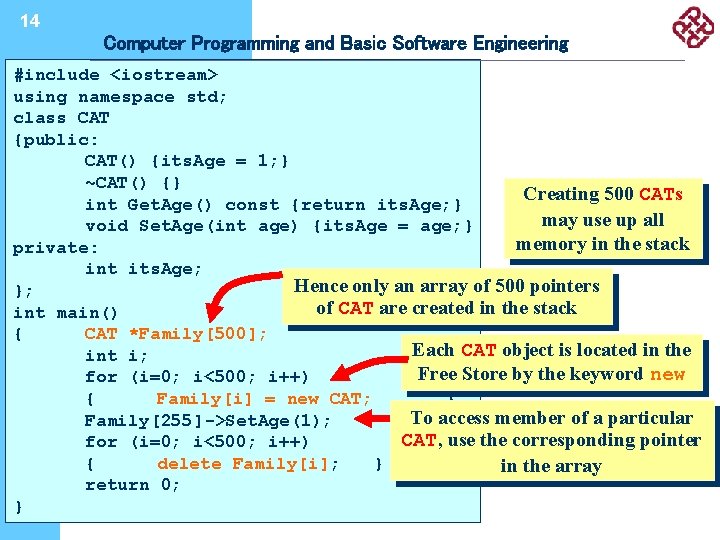
14 Computer Programming and Basic Software Engineering Pointers and Arrays #include 6. <iostream> using namespace std; class CAT {public: CAT() {its. Age = 1; } ~CAT() {} Creating 500 CATs int Get. Age() const {return its. Age; } may use up all void Set. Age(int age) {its. Age = age; } memory in the stack private: int its. Age; Hence only an array of 500 pointers }; of CAT are created in the stack int main() { CAT *Family[500]; Each CAT object is located in the int i; Free Store by the keyword new for (i=0; i<500; i++) { Family[i] = new CAT; } To access member of a particular Family[255]->Set. Age(1); CAT, use the corresponding pointer for (i=0; i<500; i++) { delete Family[i]; } in the array return 0; }
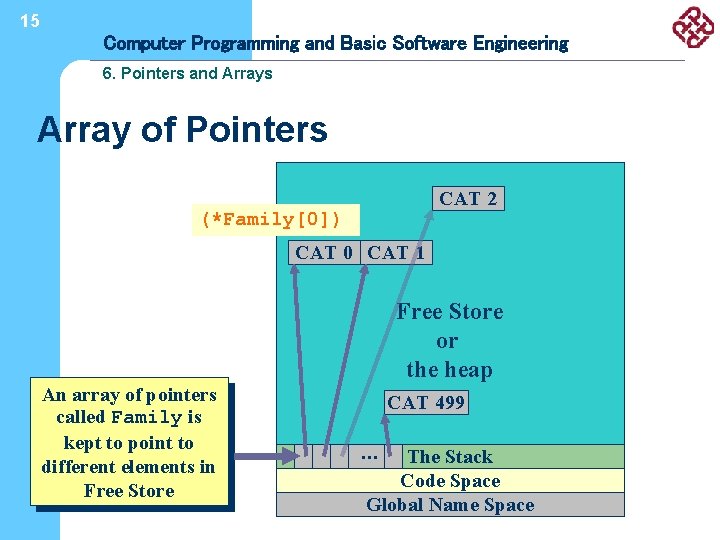
15 Computer Programming and Basic Software Engineering 6. Pointers and Arrays Array of Pointers CAT 2 (*Family[0]) CAT 0 CAT 1 Free Store or the heap An array of pointers called Family is kept to point to different elements in Free Store CAT 499 . . . The Stack Code Space Global Name Space
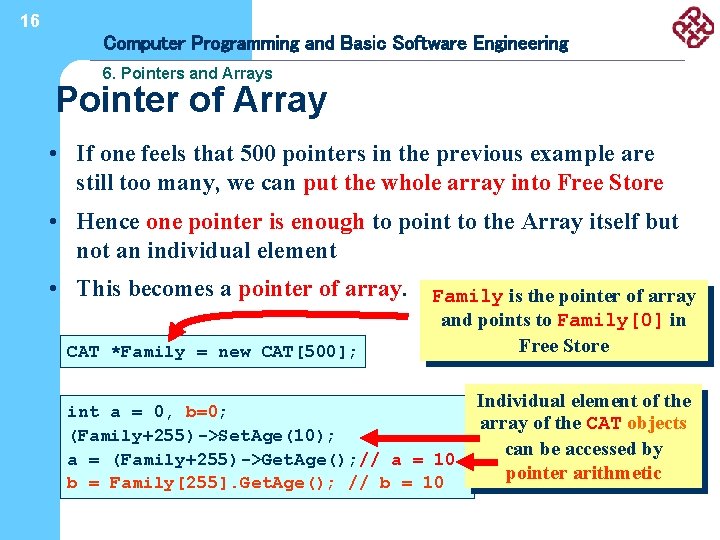
16 Computer Programming and Basic Software Engineering 6. Pointers and Arrays Pointer of Array • If one feels that 500 pointers in the previous example are still too many, we can put the whole array into Free Store • Hence one pointer is enough to point to the Array itself but not an individual element • This becomes a pointer of array. Family is the pointer of array CAT *Family = new CAT[500]; and points to Family[0] in Free Store int a = 0, b=0; (Family+255)->Set. Age(10); a = (Family+255)->Get. Age(); // a = 10 b = Family[255]. Get. Age(); // b = 10 Individual element of the array of the CAT objects can be accessed by pointer arithmetic
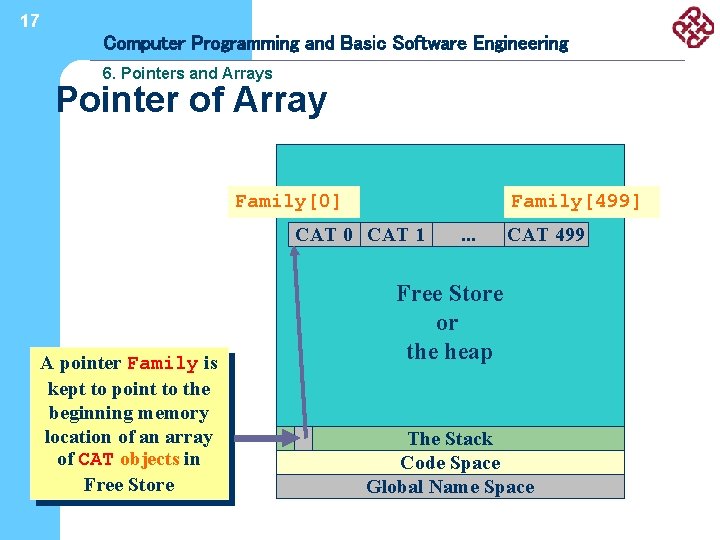
17 Computer Programming and Basic Software Engineering 6. Pointers and Arrays Pointer of Array Family[0] Family[499] CAT 0 CAT 1 A pointer Family is kept to point to the beginning memory location of an array of CAT objects in Free Store . . . CAT 499 Free Store or the heap The Stack Code Space Global Name Space
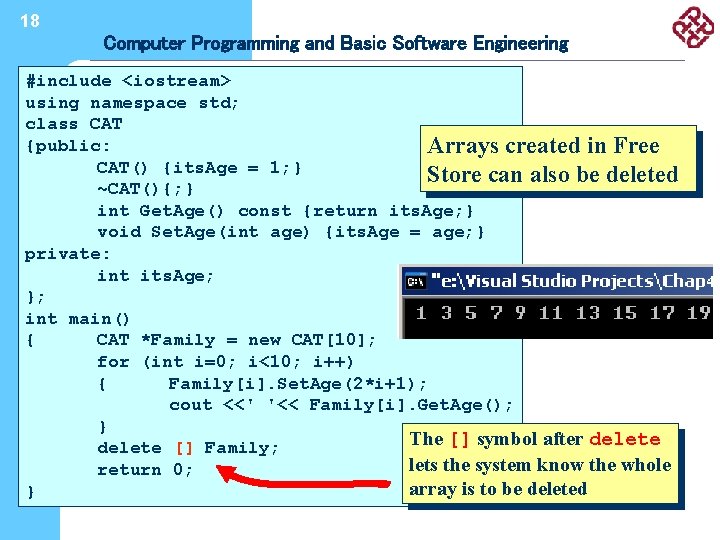
18 Computer Programming and Basic Software Engineering and Arrays #include 6. Pointers <iostream> using namespace std; class CAT {public: Arrays created in Free CAT() {its. Age = 1; } Store can also be deleted ~CAT(){; } int Get. Age() const {return its. Age; } void Set. Age(int age) {its. Age = age; } private: int its. Age; }; int main() { CAT *Family = new CAT[10]; for (int i=0; i<10; i++) { Family[i]. Set. Age(2*i+1); cout <<' '<< Family[i]. Get. Age(); } The [] symbol after delete [] Family; lets the system know the whole return 0; array is to be deleted }
19 Computer Programming and Basic Software Engineering 6. Pointers and Arrays Exercise 6. 2 • Based on the program in the last page, add a destructor to CAT such that when it is called, the age of the cat will be shown on the screen. • How many times the destructor will be called when the “delete [] Family; ” statement is executed? Why? • What will happen if we use the statement “delete Family” instead? Can it be executed in Visual C++?
20 Computer Programming and Basic Software Engineering 6. Pointers and Arrays Exercise 6. 2 b • Modify the program in Ex. 6. 2 such that the “Array of Pointers” approach is used to define the 10 objects of CAT in the heap. Make sure your program will not introduce memory leaks.
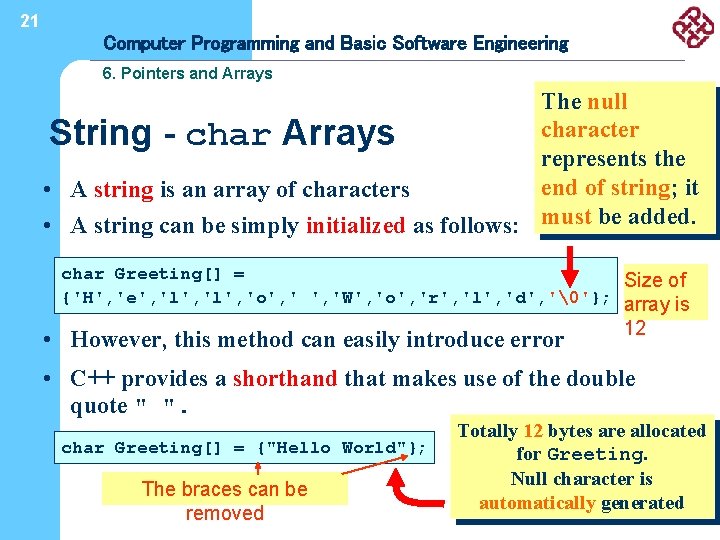
21 Computer Programming and Basic Software Engineering 6. Pointers and Arrays The null character String - char Arrays represents the end of string; it • A string is an array of characters • A string can be simply initialized as follows: must be added. char Greeting[] = Size of {'H', 'e', 'l', 'o', 'W', 'o', 'r', 'l', 'd', ''}; array is • However, this method can easily introduce error 12 • C++ provides a shorthand that makes use of the double quote " ". char Greeting[] = {"Hello World"}; The braces can be removed Totally 12 bytes are allocated for Greeting. Null character is automatically generated
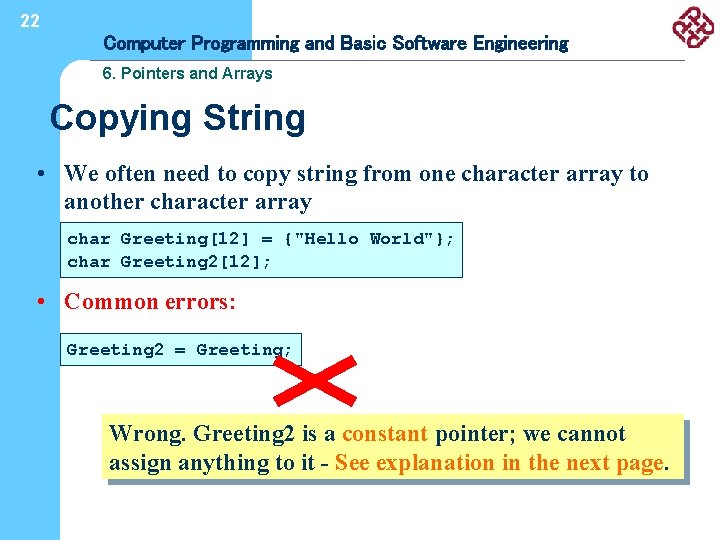
22 Computer Programming and Basic Software Engineering 6. Pointers and Arrays Copying String • We often need to copy string from one character array to another character array char Greeting[12] = {"Hello World"}; char Greeting 2[12]; • Common errors: Greeting 2 = Greeting; Wrong. Greeting 2 is a constant pointer; we cannot assign anything to it - See explanation in the next page.
![23 Computer Programming and Basic Software Engineering 6. Pointers and Arrays Greeting[12] The Stack](http://slidetodoc.com/presentation_image/cb6147a5ba1561978953f8a9ab7aeeff/image-23.jpg "23 Computer Programming and Basic Software Engineering 6. Pointers and Arrays Greeting[12] The Stack")
23 Computer Programming and Basic Software Engineering 6. Pointers and Arrays Greeting[12] The Stack Address 'H' 'e' 'l' … 0100 0101 0102 0103 'l' 'd' '' 010 a 010 b 010 c 010 d Greeting 2[12] The Stack Address ? ? ? 0200 0201 0202 0203 Greeting 2 = Greeting; … ? ? ? 020 a 020 b 020 c 010 d Wrong. We try to make Greeting 2 = 0101. However, Greeting 2 must = 0201 as it is assigned by the OS, and is constant
![24 Computer Programming and Basic Software Engineering 6. Pointers and Arrays Greeting 2[12] =](http://slidetodoc.com/presentation_image/cb6147a5ba1561978953f8a9ab7aeeff/image-24.jpg "24 Computer Programming and Basic Software Engineering 6. Pointers and Arrays Greeting 2[12] =")
24 Computer Programming and Basic Software Engineering 6. Pointers and Arrays Greeting 2[12] = Greeting[12]; Very wrong. Greeting 2[12] means only the 13 th element of Greeting 2, not the whole string. Besides, there is no 13 th element in Greeting or Greeting 2 Note: Greeting 2[11] = Greeting[11]; is legal, which means assigning the 12 th element of Greeting 2 with the value of the 12 th element of Greeting.
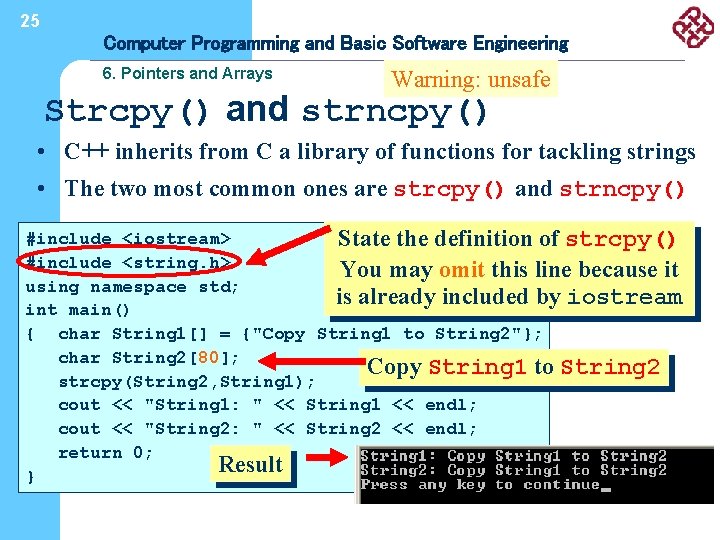
25 Computer Programming and Basic Software Engineering 6. Pointers and Arrays Warning: unsafe Strcpy() and strncpy() • C++ inherits from C a library of functions for tackling strings • The two most common ones are strcpy() and strncpy() #include <iostream> State the definition of strcpy() #include <string. h> You may omit this line because it using namespace std; is already included by iostream int main() { char String 1[] = {"Copy String 1 to String 2"}; char String 2[80]; Copy String 1 to String 2 strcpy(String 2, String 1); cout << "String 1: " << String 1 << endl; cout << "String 2: " << String 2 << endl; return 0; Result }
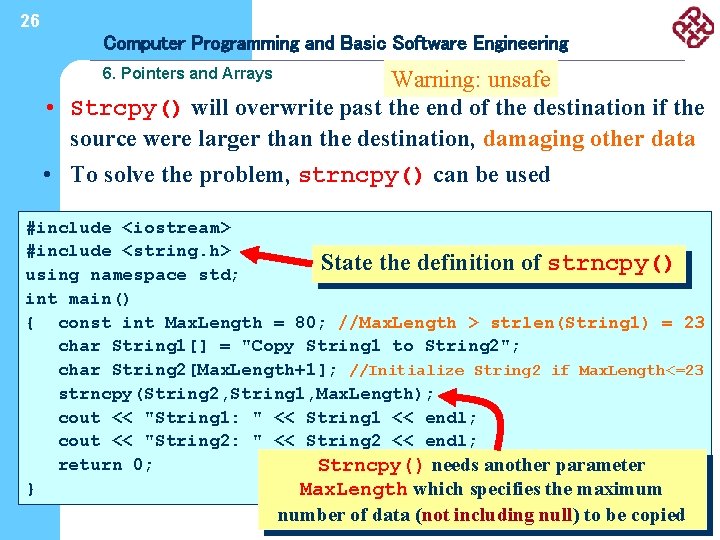
26 Computer Programming and Basic Software Engineering 6. Pointers and Arrays Warning: unsafe • Strcpy() will overwrite past the end of the destination if the source were larger than the destination, damaging other data • To solve the problem, strncpy() can be used #include <iostream> #include <string. h> State the definition of strncpy() using namespace std; int main() { const int Max. Length = 80; //Max. Length > strlen(String 1) = 23 char String 1[] = "Copy String 1 to String 2"; char String 2[Max. Length+1]; //Initialize String 2 if Max. Length<=23 strncpy(String 2, String 1, Max. Length); cout << "String 1: " << String 1 << endl; cout << "String 2: " << String 2 << endl; return 0; Strncpy() needs another parameter } Max. Length which specifies the maximum number of data (not including null) to be copied
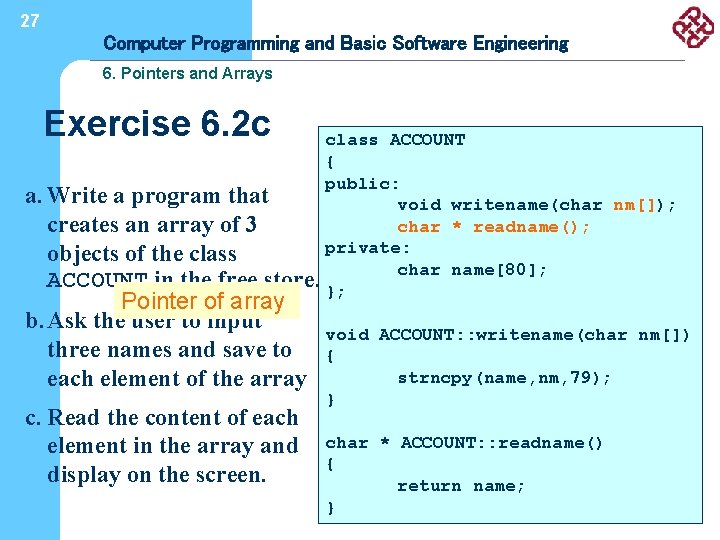
27 Computer Programming and Basic Software Engineering 6. Pointers and Arrays Exercise 6. 2 c class ACCOUNT { public: a. Write a program that void writename(char nm[]); creates an array of 3 char * readname(); private: objects of the class char name[80]; ACCOUNT in the free store. }; Pointer of array b. Ask the user to input three names and save to each element of the array c. Read the content of each element in the array and display on the screen. void ACCOUNT: : writename(char nm[]) { strncpy(name, nm, 79); } char * ACCOUNT: : readname() { return name; }
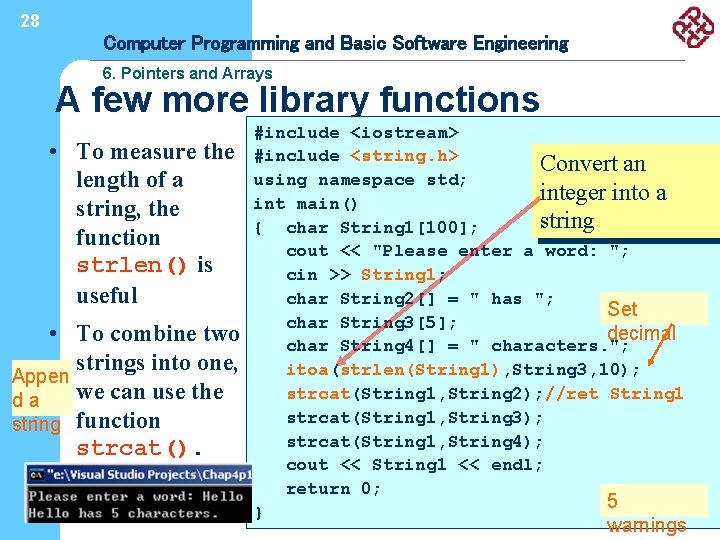
28 Computer Programming and Basic Software Engineering 6. Pointers and Arrays A few more library functions • To measure the length of a string, the function strlen() is useful • To combine two strings into one, Appen we can use the da string function strcat(). #include <iostream> #include <string. h> Convert an using namespace std; integer into a int main() string { char String 1[100]; cout << "Please enter a word: "; cin >> String 1; char String 2[] = " has "; Set char String 3[5]; decimal char String 4[] = " characters. "; itoa(strlen(String 1), String 3, 10); strcat(String 1, String 2); //ret String 1 strcat(String 1, String 3); strcat(String 1, String 4); cout << String 1 << endl; return 0; 5 } warnings
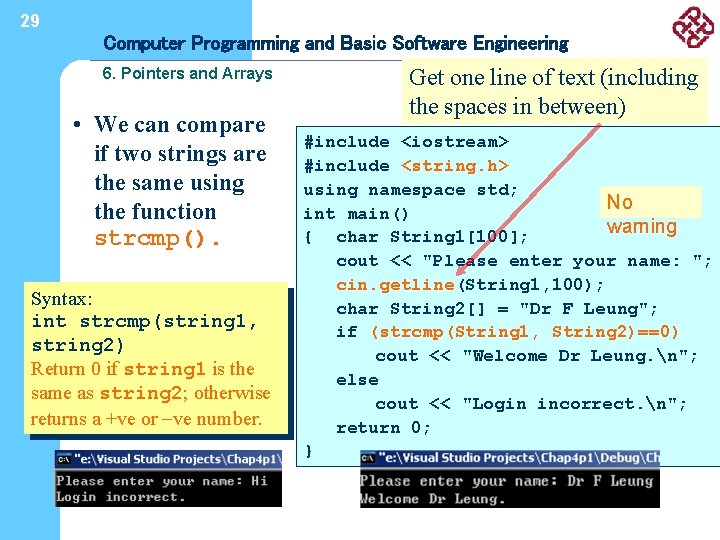
29 Computer Programming and Basic Software Engineering 6. Pointers and Arrays • We can compare if two strings are the same using the function strcmp(). Syntax: int strcmp(string 1, string 2) Return 0 if string 1 is the same as string 2; otherwise returns a +ve or ve number. Get one line of text (including the spaces in between) #include <iostream> #include <string. h> using namespace std; No int main() warning { char String 1[100]; cout << "Please enter your name: "; cin. getline(String 1, 100); char String 2[] = "Dr F Leung"; if (strcmp(String 1, String 2)==0) cout << "Welcome Dr Leung. n"; else cout << "Login incorrect. n"; return 0; }
- Slides: 29